
2026-10-12 · By WeightFAQ Staff
What the 2025–2030 Dietary Guidelines Change—and Don’t Change—for Weight Loss
The 2025–2030 Dietary Guidelines for Americans are useful for one part of weight management: they describe a healthier food pattern to build from. They are not a new diet plan, a calorie prescription, or proof that one food group will make weight loss happen. That distinction matters. A reader trying to lose weight still needs an eating pattern they can repeat, enough energy and protein to support their life, and—when health conditions, medications, or eating concerns are involved—individual clinical guidance.
The information gain in this update is practical rather than dramatic: it helps separate the federal guidance on everyday food quality from the separate evidence on intentional weight loss. The guideline can steer the plate; it cannot choose a deficit, diagnose a medical cause of weight change, or promise an outcome.
What the guideline changes for everyday planning
The current guideline continues to emphasize nutrient-dense foods and beverages across the lifespan: vegetables, fruits, whole grains, beans and other legumes, nuts, seafood, lean protein foods, and unsweetened or lower-sugar choices. It also puts clear limits around added sugars, saturated fat, sodium, and alcohol. For someone managing weight, that is most useful as a shopping and meal-building filter—not as a list of “good” and “bad” foods.
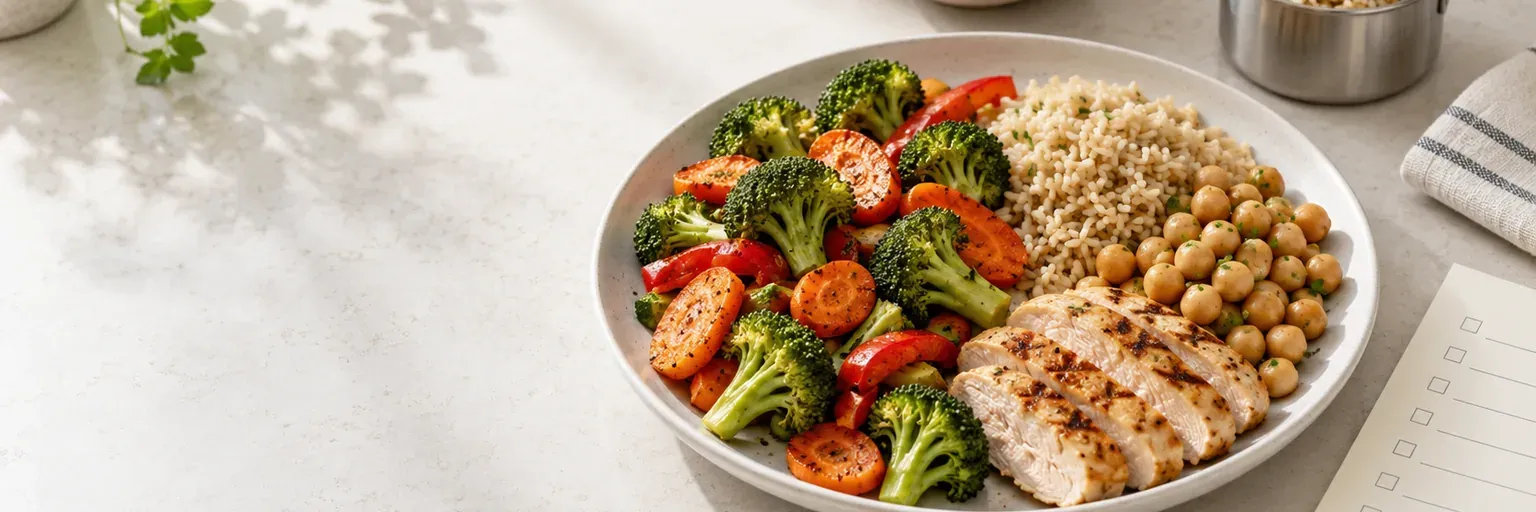
In practice, a guideline-shaped meal can be pleasantly ordinary: beans and vegetables added to a grain bowl, yogurt or eggs at breakfast, fruit where a sweet drink used to be, or a protein-and-produce snack before a long afternoon. These choices tend to make fiber and protein easier to reach and can make meals more filling for the calories they contain. They do not need to be perfect to be useful.
That focus is compatible with long-term weight evidence. In a large prospective analysis, dietary patterns higher in several whole foods and lower in heavily processed, refined choices were associated with less long-term weight gain; the study did not establish that one ingredient alone caused the difference. In a tightly controlled randomized trial, participants offered an ultra-processed diet ate more calories and gained more weight over two weeks than when offered an unprocessed diet matched for several nutrients. Neither finding means all packaged food is harmful or that home cooking is the only valid route. They support paying attention to the overall pattern and how easily it leads you to keep eating past comfortable fullness.
What it does not change
The guideline does not say that carbohydrates, fat, or any named diet must be eliminated for weight loss. A major randomized trial comparing diets with different fat, protein, and carbohydrate targets found that reduced-calorie diets produced similar average weight loss over two years when paired with behavioral support. The workable pattern is usually the one that is nutritionally adequate, affordable, culturally familiar enough to maintain, and not so restrictive that it rebounds.
It also does not supply a universal calorie target. Body size, activity, age, health conditions, pregnancy status, medications, and weight history all matter. A calorie target copied from a friend, an app, or a guideline graphic may be too low, too high, or simply unsuitable. People with diabetes, kidney disease, a history of an eating disorder, or a medication that changes appetite should get individualized advice before making major changes.
Finally, the guideline is not evidence that rapid loss is safer or better. The research it draws on informs population-level nutrition advice; it does not replace a medical evaluation for unexpected weight change, severe food restriction, binge eating, or symptoms such as dizziness and fainting.
A useful way to use the update this week
Try one change that improves the default rather than rebuilding every meal at once:
- Add before subtracting. Add a vegetable, fruit, bean, or protein food to a meal you already eat.
- Make drinks visible. Check how often sweetened beverages, alcohol, or specialty coffees are quietly adding calories; choose water, unsweetened tea, or another lower-sugar option more often.
- Keep convenience, upgrade the pattern. Frozen vegetables, canned beans with a quick rinse, bagged salad, plain yogurt, and rotisserie chicken can all fit. The goal is a repeatable meal, not a photogenic one.
- Watch the result, not the label. If a change leaves you overly hungry, preoccupied with food, or unable to sustain it, adjust the meal structure rather than doubling down.
For a fuller discussion of eating-pattern options, see our guide to choosing a diet for weight loss. If fullness or muscle preservation is the sticking point, protein intake for weight loss is a more specific next step.
Bottom line
The 2025–2030 Dietary Guidelines can help make a weight-management pattern more nourishing and easier to navigate: build meals around minimally processed, nutrient-dense foods more often, and treat added sugar, saturated fat, sodium, and alcohol as things to notice rather than moral failures. What they do not offer is a one-size-fits-all weight-loss plan. Use the guideline as a compass for food quality, then tailor the route to your health needs, budget, preferences, and the support you can actually sustain.
Sources
- U.S. Department of Health and Human Services and U.S. Department of Agriculture. Dietary Guidelines for Americans, 2025–2030.
- Mozaffarian D, Hao T, Rimm EB, Willett WC, Hu FB. Changes in Diet and Lifestyle and Long-Term Weight Gain in Women and Men. New England Journal of Medicine (2011).
- Hall KD, Ayuketah A, Brychta R, et al. Ultra-Processed Diets Cause Excess Calorie Intake and Weight Gain: An Inpatient Randomized Controlled Trial of Ad Libitum Food Intake. Cell Metabolism (2019).
- Sacks FM, Bray GA, Carey VJ, et al. Comparison of Weight-Loss Diets with Different Compositions of Fat, Protein, and Carbohydrates. New England Journal of Medicine (2009).