
2026-07-09 · body composition, DEXA, BIA, Bod Pod, waist circumference, body fat percentage
Updated 2026-10-02
Written by WeightFAQ Staff
Evidence-informed guidance from the WeightFAQ editorial team.
19 min read
Last editorial review Jul 31, 2026
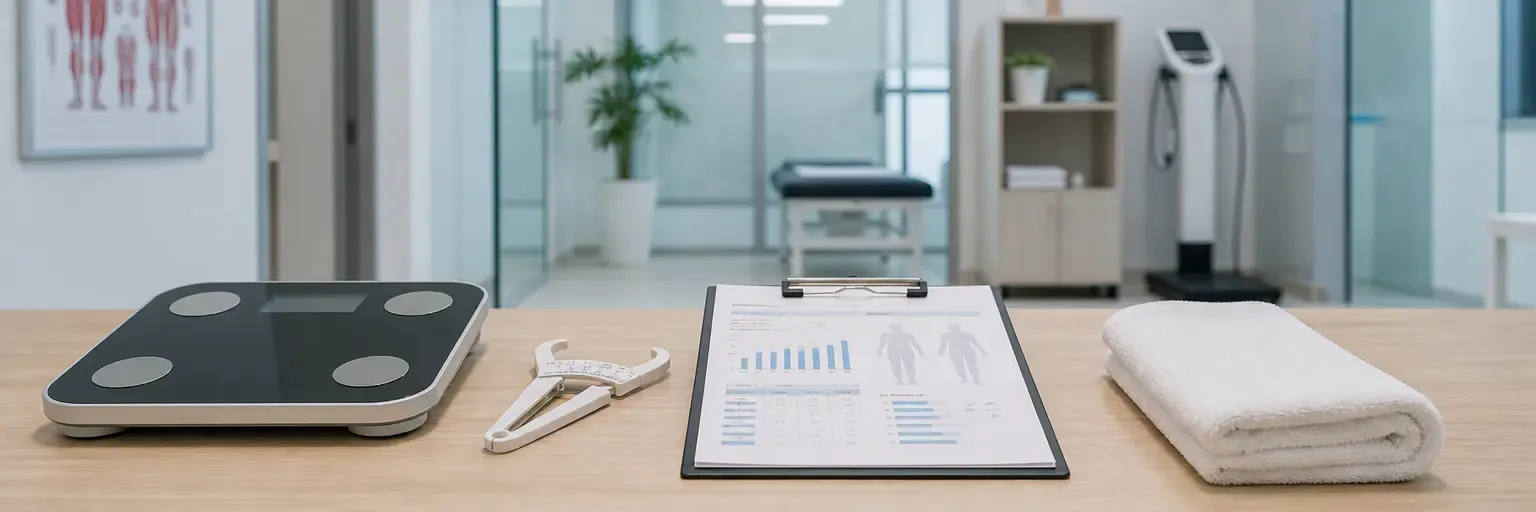
Body Composition Testing: DEXA, BIA, Bod Pod, Skinfolds, and Waist Circumference — What Each One Measures, Costs, and Gets Wrong
Quick answer: No consumer body-composition method reliably measures absolute body-fat percentage within 2 %BF except DEXA and Bod Pod performed under standardised conditions. BIA — the home smart scale, the InBody, the handheld — drifts 5–10 %BF with hydration and geometry. Skinfolds with a trained tester land in the middle. Waist circumference does not measure %BF at all, but predicts cardiovascular mortality better than any %BF number (Ross 2020, Nature Reviews Endocrinology; Cerhan 2014, Mayo Clinic Proceedings). The honest home-tracking stack for most people is a scale, a tape measure, and one consistent %BF method used only as a trend indicator — not as a truth number.
For the broader body-composition frame, see body fat percentage, visceral fat, and water weight and scale fluctuations.
Who this is for — and who it is not for
Best fit. Adults who want to know which body-composition test is worth paying for, which home devices are worth trusting, how to interpret a DEXA report, how to reconcile conflicting numbers from a BIA scale and a gym InBody, and how to build a home-tracking routine that captures real change. Also for people on a GLP-1, in a bariatric-surgery pathway, in a resistance-training block, or in a menopause transition where body composition — not scale weight — is the metric that matters.
Not a fit. People looking for a clinical diagnosis of a body-composition disorder — sarcopenia diagnosis, cachexia workup, or bariatric medical evaluation belong with a clinician, not an article. Elite bodybuilders in contest-prep timing windows have context-specific rehydration and Bod-Pod-versus-DEXA-timing questions that go beyond this guide.
Talk to a clinician first. Older adults being screened for sarcopenia should have DEXA interpreted alongside grip-strength and gait-speed testing. Amputees, ostomy patients, and people with metal implants need a technician who can apply DEXA correction protocols. Pregnancy: DEXA is not recommended (imaging safety principle, not measured harm); BIA is unreliable and should be interpreted only with clinician guidance if used at all.
Primer table — six body-composition methods
| Method | What it measures | Assumes | Where you get it | Real-world use |
|---|---|---|---|---|
| DEXA (dual-energy X-ray absorptiometry) | Differential X-ray attenuation across bone, fat, and lean; regional breakdown | Standard hydration, standard positioning | Scan clinics, hospital radiology, some universities | Reference-adjacent consumer method; also reports bone-mineral density |
| BIA (bioelectrical impedance) — home scale, handheld, InBody, DSM-BIA | Electrical impedance of a small current across body tissue | Standard hydration state, standard body geometry | Home smart scales; gyms; nutrition clinics | Direction-of-change tool; not a truth number |
| Air-displacement plethysmography (Bod Pod) | Body volume from air displaced in a sealed chamber, converted to density and then to fat/lean via a two-compartment model | Standard lung volume; measured or estimated tidal breathing | University labs, sports-medicine clinics, some large gyms | Reference-adjacent; no radiation; less widely available than DEXA |
| Underwater weighing (hydrostatic / hydrodensitometry) | Body density via Archimedes principle in a submerged tank, corrected for residual lung volume | Full exhalation, accurate residual-lung-volume correction | Research settings, a few sports-medicine labs | Historical reference; mostly superseded by DEXA and Bod Pod |
| Skinfold calipers (Jackson-Pollock 3-site or 7-site) | Subcutaneous fat thickness at anatomically defined pinch sites | Trained tester; anatomical landmarks correctly identified; standard equations | Personal trainers, university PE labs, gym floors | Cheap and portable; interior visceral fat is invisible to this method |
| Simple anthropometrics — waist-to-hip ratio, waist-to-height, waist circumference | Central-adiposity dimensions correlated empirically with visceral fat and cardiovascular risk | Standardised tape position at the iliac crest, normal exhale | A cloth tape and a mirror at home | Free; single most useful home-tracking number for cardiovascular risk |
Healthy body-fat percentage ranges (ACE 2009)
| Category | Women | Men |
|---|---|---|
| Essential fat | 10–13% | 2–5% |
| Athletes | 14–20% | 6–13% |
| Fitness | 21–24% | 14–17% |
| Average | 25–31% | 18–24% |
| Obese | ≥ 32% | ≥ 25% |
These ranges come from the American Council on Exercise (ACE) 2009 Body Composition Health Assessment Categories and are widely cited but are category labels, not clinical cutoffs. The World Health Organization and NIH use BMI (not body-fat percentage) for population-level obesity cutoffs. For cardiometabolic risk at the individual level, waist circumference and waist-to-height ratio predict heart-disease outcomes better than body-fat percentage per the Ross 2020 Nature Reviews Endocrinology expert consensus and Cerhan 2014 Mayo Clinic Proceedings. Pair any read of the ACE table with a realistic weight-loss goal and a deliberate muscle-preservation plan — chasing a lower category without protecting lean mass tends to backfire. See the FAQ below for how to interpret a specific body-fat percentage reading.
How each method actually works
DEXA passes two low-dose X-ray beams through the body. Bone, fat, and lean tissue absorb (attenuate) the two energies at different ratios, and software separates the three compartments pixel-by-pixel. It reports total percentage body fat, regional breakdown (arms, legs, trunk, android, gynoid), visceral-adipose-tissue volume in the trunk region, and — as a bonus — bone-mineral density. DEXA assumes standard hydration and standard positioning; a repeat scan on the same machine, same protocol, and same time of day produces the tightest number. Radiation dose is roughly 1–10 μSv per scan — less than a day of natural background exposure and about 1 percent of a chest X-ray (Kelly 2009, Journal of Clinical Densitometry).
BIA sends a very small alternating current between skin electrodes and measures the impedance across the current path. Because lean tissue is far more electrically conductive than fat (it contains more water and electrolytes), impedance is inversely related to fat-free mass. Population-derived equations (Sun 2003, American Journal of Clinical Nutrition, from NHANES data) convert impedance to a body-fat estimate. The critical assumption is standard hydration. In the real world, hydration shifts 3–5 %BF within a single day and 5–10 %BF between a well-hydrated morning-fasted state and a dehydrated post-exercise evening state (Kyle 2004, Clinical Nutrition, ESPEN guideline; Buchholz 2004, Nutrition in Clinical Practice). Home scales measure only leg-to-leg; handheld devices measure only arm-to-arm; multi-frequency segmental BIA (InBody, DSM-BIA) reads all four limbs and is somewhat more robust — but is still BIA.
Bod Pod measures the volume of air a person displaces when they sit inside a sealed chamber. Air-displacement gives body density; a two-compartment model then converts density to fat versus lean using assumed densities. The main assumption is standard lung volume — the machine either measures or estimates the air trapped in the lungs and subtracts it. Bod Pod has no radiation and is roughly as accurate as DEXA in general populations (Ballard 2004, Obesity Research; Toombs 2012, Obesity).
Underwater weighing applies Archimedes’ principle: a person fully exhales and is weighed submerged in a tank. Body density is calculated from the difference between dry weight and submerged weight, corrected for residual lung volume. This was the historical gold standard for decades and is still used in research. It is inconvenient, requires a full underwater exhale, and is largely superseded by DEXA and Bod Pod (Wells 2006, Proceedings of the Nutrition Society).
Skinfold calipers pinch a fold of skin and subcutaneous fat at three (Jackson-Pollock 3-site) or seven (Jackson-Pollock 7-site) anatomically defined sites — commonly chest, abdomen, and thigh for men; triceps, suprailiac, and thigh for women. Sums are plugged into sex-specific regression equations (Jackson 1978, British Journal of Nutrition; Jackson 1980, Medicine and Science in Sports and Exercise) that back-calculate body density. Interior visceral fat is invisible to this method — it only reads what is between skin and muscle. Tester training matters enormously.
Waist circumference is not a body-composition method in the technical sense — it does not report a %BF number. It is measured with a cloth tape at the iliac crest, parallel to the floor, at the end of a normal exhale. The NHLBI cut-offs are 40 in (102 cm) for men and 35 in (88 cm) for women, with lower cut-offs of roughly 90 cm and 80 cm for people of South or East Asian ancestry (Ross 2020). It correlates empirically with visceral adipose tissue and, importantly, independently predicts cardiovascular outcomes even after adjusting for BMI and %BF (Cerhan 2014).
How accurate each method actually is
Accuracy is best expressed as the standard error of estimate (SEE) against the four-compartment reference model — the whole-body multi-method combination that is the closest thing to ground truth outside a cadaver study (Wells 2006). SEE is roughly “expect any single reading to be off by this much.”
| Method | SEE vs 4-compartment model | Same-scanner precision (day-to-day) | Systematic bias |
|---|---|---|---|
| DEXA | ~2–3 %BF; ICC > 0.95 (Kelly 2009; Toombs 2012) | ~1 %BF (same scanner, same protocol) | Slight machine-model differences; hydration shifts small |
| Bod Pod | ~2–3 %BF; ICC ~0.95 (Ballard 2004; Toombs 2012) | ~1–2 %BF | Lung-volume estimation matters at extremes |
| Underwater weighing | ~2 %BF (historical reference method; Wells 2006) | ~1–2 %BF | Residual-lung-volume correction dominant error source |
| BIA — home scale, single-frequency | ~4–8 %BF (Achamrah 2018 meta-analysis, Clinical Nutrition) | Highly variable — 3–5 %BF within a day (Kyle 2004) | Systematic bias by hydration state and body geometry; overestimates %BF in athletes, underestimates in dehydrated states |
| BIA — multi-frequency segmental (InBody, DSM-BIA) | ~3–5 %BF (Buchholz 2004; Achamrah 2018) | ~2–3 %BF under standardised conditions | Better than home scales; still hydration-sensitive |
| Skinfolds — trained tester | ~3–4 %BF (Jackson 1978; Norgan 2005) | ~1–2 %BF with the same tester | Population-equation drift; interior fat invisible |
| Skinfolds — untrained self-tester | ~5–7 %BF | Poor | Pinch-site placement and depth vary trial-to-trial |
| Waist circumference | Not a %BF measurement | ~0.5 cm same-tester precision | Correlates with VAT and CV risk directly; no compartment model needed |
How to read this table. DEXA and Bod Pod are the two consumer-accessible methods where a single reading is within a couple of %BF of ground truth. BIA is where most home tracking happens, and BIA is 4–8 %BF noise on a single number — comparable to the entire body-composition change most people achieve over six months. That is not a knock on BIA; it is a case for using BIA as a trend tool with tight day-to-day controls and never as a truth number.
Cost and access
| Method | Typical out-of-pocket US cost | Where to book |
|---|---|---|
| DEXA (body-composition scan) | ~$50–150 per scan | Standalone scan clinics (DexaFit, BodySpec vans), hospital radiology, some sports-medicine practices |
| Bod Pod | ~$40–100 per scan | Some sports-medicine clinics, university labs, larger gyms in metro areas |
| BIA — home smart scale | ~$25–100 one-time (Withings, Renpho, Garmin, Wyze) | Amazon, big-box retail |
| BIA — InBody at a gym or clinic | ~$25 per scan; often bundled with gym membership | Gyms, functional-medicine clinics, some primary-care offices |
| Skinfold calipers with a trainer | ~$20 per session; free if you own a $10–25 pair of calipers | Any trainer or gym floor |
| Waist circumference | Free — a $5 cloth tape measure | Home |
The cheapest useful stack — a $5 tape measure plus a $50 smart scale — captures 80 percent of the tracking signal most weight-loss plans need. Adding a DEXA at baseline and a repeat at 6 months captures the remaining 20 percent (an accurate compartment breakdown) at a total cost under $250.
What each number actually tells you
| Number | What it can tell you | What it cannot tell you |
|---|---|---|
| Absolute %BF from a reference method (DEXA, Bod Pod) | Where you sit relative to healthy ranges (see body fat percentage) | Which compartment (visceral vs subcutaneous) drives your risk without a regional read |
| Absolute %BF from BIA | An approximate ballpark ±5 %BF; treat as noise if compared across methods | A truth number — do not act on a single BIA reading |
| Change over time on the same device | The most reliable body-comp signal a consumer method produces; useful for tracking whether a deficit is stripping fat versus muscle | Anything about the absolute starting point |
| Regional distribution — android/gynoid ratio, VAT | Where fat is accumulating (only DEXA gives this cleanly; MRI is the reference method) | Nothing useful from home BIA visceral-fat readouts (not validated — see myth list below) |
| Bone-mineral density (a DEXA bonus) | Osteoporosis screening in older adults; especially useful for post-menopausal women and adults with rapid weight loss | Nothing about fat compartments — that is the composition scan, not the bone scan |
| Waist circumference | Cardiovascular and diabetes risk directly (Cerhan 2014; Ross 2020) | Nothing about %BF; nothing about muscle mass |
The 5-step “how to actually use body-comp testing” protocol
- Pick one method and stick with it. Do not compare a DEXA reading to a BIA reading and conclude one is “wrong.” Different methods, different assumptions, different equations — the comparison is not meaningful. Choose the method you can sustain (a home BIA scale for weekly tracking, a DEXA every 3 months, a Bod Pod every 6 months) and read only within-method changes.
- Standardise the conditions. Morning, fasted, empty bladder, similar hydration state, similar clothing, same scanner or same scale. For BIA specifically, avoid the reading within 12 hours of alcohol, within 4 hours of exercise, or within 2 hours of a large meal.
- Retest every 8–12 weeks during active weight loss; every 6 months during maintenance. Shorter intervals mostly capture measurement noise. DEXA precision is ~1 %BF on the same scanner; retesting more often than the noise threshold produces mostly noise.
- Add waist circumference at every retest. A cloth tape at the iliac crest, morning, post-void, standardised. Waist circumference tracks the cardiometabolic-risk compartment directly and independently — see visceral fat for the underlying physiology — and it costs nothing.
- Do not panic on ±2 %BF between scans. That is within the noise of any single method. The signal is a 4–6 %BF trend across 3–6 months, not a single-scan jump. If two consecutive DEXAs disagree by 3–4 %BF, suspect a scanner or protocol change before assuming a real body-composition swing.
Six-row treatment comparison
| Option | Compartment resolution | Accuracy (SEE) | Cost per scan | Best use case | Honest read |
|---|---|---|---|---|---|
| DEXA (body composition) | Regional (arms, legs, trunk, android/gynoid, VAT); bone density as a bonus | ~2–3 %BF; ~1 %BF within-scanner | ~$50–150 | Baseline + 8–12-week retests during active weight loss; sarcopenia screening | Reference-adjacent; the single best consumer number; radiation dose is trivial |
| InBody / DSM-BIA (multi-frequency segmental) | Segmental (arms, legs, trunk) | ~3–5 %BF | ~$25 per scan or bundled with a gym | Monthly progress tracking if you use the same device under standardised conditions | Better than a home scale; still not DEXA-equivalent; the “visceral-fat score” is not validated |
| Home smart-scale BIA (Withings, Renpho, Garmin) | Whole-body only | ~4–8 %BF | ~$25–100 one-time | Trend-tracking on morning-fasted-post-void weigh-ins; 7-day rolling average | Do not compare to any other method; do not read single days as signal |
| Bod Pod | Whole-body only | ~2–3 %BF | ~$40–100 | Athletes and reference-quality tracking without radiation | Comparable to DEXA for a %BF number; no regional breakdown; access is limited |
| Skinfolds (trained tester) | Subcutaneous only | ~3–4 %BF | ~$20 with a trainer | Portable, cheap, useful for consistent tester over time | Interior visceral fat invisible; tester consistency dominates result |
| ”Just a scale and a tape measure” | Weight + waist | 0.5 cm same-tester precision on waist | Under $100 total | The vast majority of home weight-loss tracking | Waist circumference independently predicts CV risk; scale + waist tape is a better signal for most people than a poorly used BIA scale |
| U.S. Navy tape method (Hodgdon 1984) | Whole-body %BF via circumferences + height | ~3–4 %BF vs hydrostatic | Free (tape) | Home %BF estimate without a clinic visit; DoD body-composition standard | More accurate than most consumer BIA smart scales; run it with the free body-fat percentage calculator |
Special situations
On a GLP-1 or during rapid weight loss
GLP-1 medications and other rapid-weight-loss protocols produce large intracellular- and extracellular-water shifts as glycogen depletes, sodium turnover changes, and lean-tissue hydration re-equilibrates. BIA reads those water shifts as “lean-mass loss,” which inflates the apparent muscle-mass drop. DEXA and Bod Pod are far more robust to same-week hydration shifts. If you are on semaglutide, tirzepatide, or a similarly rapid protocol and you want a real read on muscle preservation, use DEXA every 8–12 weeks — not weekly BIA. See preserve muscle during weight loss for the training and protein context.
Older adults (sarcopenia screening)
DEXA is the consumer-accessible gold standard for sarcopenia and sarcopenic-obesity screening — the low appendicular-lean-mass thresholds used in the EWGSOP2 and AWGS diagnostic criteria are DEXA-defined. It is what a geriatrician or nutrition clinic will order. The bone-mineral-density read that comes bundled is directly useful for the same population. See sarcopenia and weight loss and sarcopenic obesity.
Athletes and bodybuilders
Chronic dehydration on measurement day — often by design in contest-prep timing — biases every method. BIA reads it as a large fat spike (dehydration → higher impedance → higher inferred %BF). DEXA reads a small lean-mass drop and a small %BF rise. Bod Pod is somewhat more robust but not immune. Reliable comparisons across a training cycle require identical hydration conditions across measurement days, not identical calendar dates.
Pregnancy and lactation
DEXA is not recommended in pregnancy — the measured radiation dose is trivial but the imaging-safety principle is to avoid non-essential fetal exposure. BIA is unreliable in pregnancy and lactation because plasma volume, extracellular fluid, and breast-tissue composition all shift. Waist circumference is not a meaningful measurement during pregnancy; standard prenatal weight-tracking replaces body-composition testing entirely.
Bariatric-surgery patients
DEXA and Bod Pod are preferred in the rapid-loss phase for the same reason as for GLP-1 patients: BIA misreads the intracellular- and extracellular-water shifts as compartment change. A pre-surgery DEXA plus retests at 3, 6, and 12 months captures both the fat-mass trajectory and the muscle-mass trajectory. Waist circumference is useful throughout. See bariatric surgery overview for the surgical-pathway frame.
Amputees, ostomies, and metal implants
DEXA can accommodate these situations but requires a technician who knows the correction protocols — flag it when booking. BIA is fundamentally unreliable for people with limb amputation because the current-path assumption in the equations is violated. Metal implants introduce localised DEXA artefacts that the technician can mask; they render single-frequency BIA readings uninterpretable.
Six myths this article is here to refute
- “My InBody said 24 %BF today, DEXA said 19 %BF last month, so DEXA was wrong.” No — BIA drifts 5–10 %BF with hydration, and different methods use different assumptions and different equations. A 5 %BF gap between BIA and DEXA is what the literature predicts, not evidence that one is broken. Pick one and stick with it.
- “The scale at the gym says my visceral fat is 8.” Consumer BIA visceral-fat scores are not validated against MRI or CT — the reference methods for visceral-fat quantification. The number is an algorithmic guess dressed up as a compartment reading. DEXA VAT is validated; consumer-BIA VAT is not. Use waist circumference instead (see visceral fat).
- “I should get a DEXA every week.” Same-scanner DEXA precision is ~1 %BF, and weekly change is usually within noise. Every 8–12 weeks during active weight loss is enough. Weekly DEXA is expensive, adds trivial-but-real cumulative radiation, and produces mostly measurement noise.
- “Waist circumference is outdated — I should just use %BF.” No. Waist circumference has independent cardiovascular-outcome evidence after adjustment for BMI and %BF (Cerhan 2014; Ross 2020). The 2020 Nature Reviews Endocrinology expert consensus explicitly reinstates waist circumference as a vital sign that should be measured at every clinical visit alongside blood pressure. A tape measure is not “old” — it is what independently predicts heart-disease outcomes.
- “InBody is as accurate as DEXA.” It is not. The Achamrah 2018 meta-analysis in Clinical Nutrition pooled data across multiple BIA-vs-DEXA studies and reported systematic bias by hydration state, body-mass-index category, and body geometry. InBody is better than a home scale; it is not equivalent to DEXA.
- “Water weight throws all these tests off equally.” No. BIA is by far the most affected — a 3–5 %BF shift within a single day just from normal hydration change. DEXA and Bod Pod are much more robust — hydration-driven shifts are typically well under 1 %BF within the same day. If you want to worry about hydration confounding a body-comp reading, worry about it on the BIA scale, not on the DEXA report — see water weight and scale fluctuations for the broader physiology.
The honest bottom line
- No consumer method reliably measures absolute %BF within 2 %BF except DEXA and Bod Pod done under standard conditions.
- BIA home scales — Withings, Renpho, Garmin, Wyze — are useful for tracking direction of change on morning-fasted-post-void weigh-ins read as a 7-day rolling average. They are not useful for an absolute number and should not be compared against any other method.
- Waist circumference is boring, cheap, and independently predicts cardiovascular outcomes — arguably the single most useful number a home consumer can track.
- DEXA every scan is overkill and expensive; every 8–12 weeks during active weight loss is enough. Weekly DEXA is measurement noise.
- Most people do not need a %BF at all. The bathroom scale, a $5 cloth tape measure at the iliac crest, and a mirror are enough to know if a plan is working. Adding a body-composition method only pays off if the number will actually change a decision — pairing more protein with resistance training if lean mass is dropping, adding aerobic work if visceral fat is not moving, or confirming a GLP-1 is preserving muscle rather than stripping it. See preserve muscle during weight loss and creatine and weight loss for the muscle-preservation levers.
Body-composition testing is a tool. It is not the plan. Pick the method that fits your budget and access, standardise the conditions, read the trend and not the single reading, and let the rest of the tracking — scale, waist tape, mirror, training log, protein intake — do the work.
Sources
- Kelly TL, Wilson KE, Heymsfield SB. Dual energy X-ray absorptiometry body composition reference values from NHANES. Journal of Clinical Densitometry / PLOS ONE (Kelly 2009).
- Toombs RJ, Ducher G, Shepherd JA, De Souza MJ. The impact of recent technological advances on the trueness and precision of DXA to assess body composition. Obesity (Toombs 2012).
- Ballard TP, Fafara L, Vukovich MD. Comparison of Bod Pod and DXA to hydrostatic weighing for body composition. Obesity Research / Medicine and Science in Sports and Exercise (Ballard 2004).
- Achamrah N, Colange G, Delay J, et al. Comparison of body composition assessment by DXA and BIA — meta-analysis. Clinical Nutrition / PLOS ONE (Achamrah 2018).
- Sun SS, Chumlea WC, Heymsfield SB, et al. Development of bioelectrical impedance analysis prediction equations for body composition — NHANES. American Journal of Clinical Nutrition (Sun 2003).
- Kyle UG, Bosaeus I, De Lorenzo AD, et al. Bioelectrical impedance analysis — ESPEN guideline. Clinical Nutrition (Kyle 2004).
- Jackson AS, Pollock ML. Generalized equations for predicting body density of men. British Journal of Nutrition (Jackson 1978).
- Jackson AS, Pollock ML, Ward A. Generalized equations for predicting body density of women. Medicine and Science in Sports and Exercise (Jackson 1980).
- Ross R, Neeland IJ, Yamashita S, et al. Waist circumference as a vital sign in clinical practice — a consensus statement. Nature Reviews Endocrinology (Ross 2020).
- Ashwell M, Gunn P, Gibson S. Waist-to-height ratio as a screening tool for cardiometabolic risk — systematic review and meta-analysis. Obesity Reviews (Ashwell 2012).
- Cerhan JR, Moore SC, Jacobs EJ, et al. A pooled analysis of waist circumference and mortality in 650,000 adults. Mayo Clinic Proceedings (Cerhan 2014).
- Buchholz AC, Bartok C, Schoeller DA. The validity of bioelectrical impedance models in clinical populations. Nutrition in Clinical Practice (Buchholz 2004).
- Norgan NG. Laboratory and field measurements of body composition. European Journal of Clinical Nutrition (Norgan 2005).
- Wells JCK, Fewtrell MS. Measuring body composition — the four-compartment reference model. Proceedings of the Nutrition Society / Archives of Disease in Childhood (Wells 2006).
- Bosy-Westphal A, Later W, Hitze B, et al. Accuracy of bioelectrical impedance consumer devices vs whole-body MRI and DXA. Obesity Facts (Bosy-Westphal 2008).