
2026-05-15 · grocery list, meal plan, weight loss, nutrition, meal prep
Updated 2026-08-18
Written by WeightFAQ Staff
Evidence-informed guidance from the WeightFAQ editorial team.
57 min read
Last editorial review Aug 4, 2026
Weight Loss Grocery List: What to Buy for a Calorie Deficit
Quick stats
- Printable list size: ~35–45 items for one adult over 7 days (breakfasts, lunches, dinners, and one snack)
- Weekly cost range: $55–$90 per adult (US 2026 prices, store-brand + frozen produce assumed)
- Calorie bands covered: 1,200 / 1,500 / 1,800 kcal/day using the same list — only portions change
- Daily protein target: 100–130 g/day (0.7–1.0 g per pound of body weight)
- Shop + prep time: ~30 min to shop, ~90–120 min to batch-cook the week (about 2–2.5 hours total)
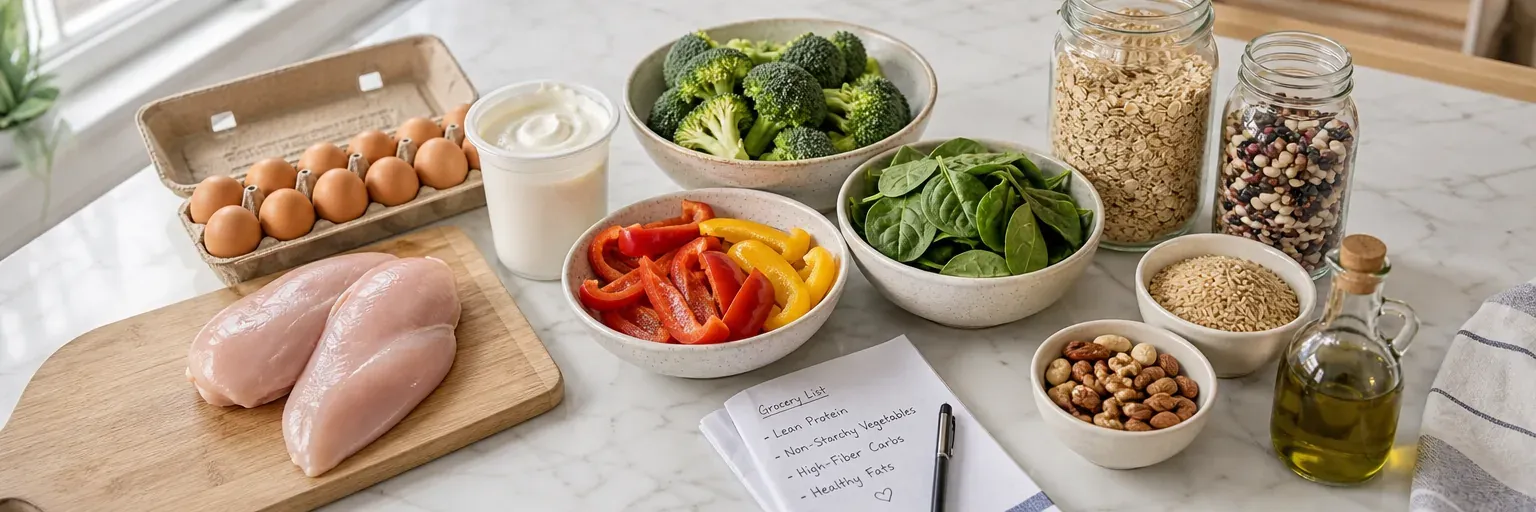
Below is a printable weight-loss grocery list for one adult, priced to $55–$90 per week and calibrated to a 1,200–1,800 kcal daily target.
The list is grouped by aisle — protein, produce, high-fiber carbs, healthy fats, and pantry staples — and pairs with a matching 7-day meal plan built entirely from the same items. A single-sheet printable checklist sits further down the page, formatted to print cleanly from any browser, plus a shopping-day workflow and prep-day checklist that turn the cart into a week of portioned meals.
What to put on a weight loss grocery list
Every effective weight loss grocery list pulls four levers: protein, fiber, volume, and low-calorie flavor.
- Protein preserves muscle in a deficit and is the single most filling macronutrient. Anchor every meal with a palm-sized portion. For gram ranges by body weight, see our protein intake for weight loss guide.
- Fiber slows digestion and keeps you full on fewer calories. Most of it comes from vegetables, fruit, beans, lentils, and whole grains. Aim for 25 to 35 grams a day.
- Volume is the trick that lets you eat more food for fewer calories: non-starchy vegetables, broth-based soups, fruit, and air-popped popcorn.
- Low-calorie flavor is the underrated category: mustards, vinegars, hot sauce, citrus, herbs, spices, and aromatics.
If a food is not pulling at least one of those four levers, it is taking up space without helping you lose weight. For the full framework that uses this kind of list, see our step-by-step guide to building a weight loss meal plan. If you would rather build your own meal plan from scratch — setting your own calorie target, protein floor, and rotation — that DIY framework pairs directly with the list below.
Proteins to buy
Stock two to three protein anchors at all times. Rotate between animal and plant sources for variety and cost.
Animal proteins (lean cuts):
- Boneless skinless chicken breast or thigh
- 93 to 99 percent lean ground turkey or beef
- Eggs and egg whites
- White fish (cod, tilapia, haddock) and salmon
- Canned tuna and canned salmon in water
- Plain Greek yogurt and skyr (0 to 2 percent fat)
- Low-fat cottage cheese
- Part-skim mozzarella string cheese
Plant proteins:
- Firm or extra-firm tofu and tempeh
- Edamame (shelled, frozen)
- Canned black beans, chickpeas, kidney beans — the cheapest protein-plus-fiber option on the aisle; see beans and legumes for weight loss for the canned-vs-dry decision and portion sizing
- Dried lentils (red and green)
- Whey, soy, or pea protein powder
Protein at every meal is the highest-impact change most dieters can make. Higher-protein, lower-calorie diets consistently improve fat loss and protect lean mass compared with standard-protein diets at the same calorie level. The widely-cited daily target for active adults in a deficit is 0.7 to 1.0 grams of protein per pound of body weight, which sits inside the Institute of Medicine’s Acceptable Macronutrient Distribution Range and reflects the upper-end intake most weight-loss trials use to protect lean mass. For an all-plant version of the protein anchor strategy — including the daily protein math at 1,500/1,800/2,200 kcal — see our plant-based weight loss guide.
Vegetables and fruit
Aim to half-fill your cart with produce. Non-starchy vegetables are essentially “free” calories in a deficit — you can eat large portions without disrupting the math.
Non-starchy vegetables (fresh or frozen):
- Spinach, kale, mixed salad greens
- Broccoli, cauliflower, Brussels sprouts
- Bell peppers, onions, garlic
- Zucchini, cucumber, celery
- Carrots, green beans, tomatoes, mushrooms
Fruit (fresh or frozen):
- Berries (strawberries, blueberries, raspberries)
- Apples, pears, oranges, clementines, bananas
- Frozen mango or peaches for smoothies
High-fiber carbs
Carbohydrates are not the enemy in a calorie deficit; refined, fiberless carbs are. Choose carbs that bring fiber and staying power along for the ride — for daily fiber targets and the highest-yield foods per calorie, see our guide on fiber for weight loss.
- Rolled oats and steel-cut oats — one of the cheapest whole-grain protein-fiber vehicles per serving; the oatmeal for weight loss pillar walks through rolled vs steel-cut vs instant and how to keep a bowl under 400 kcal
- Whole-grain bread and whole-wheat tortillas
- Brown rice, quinoa, farro, bulgur — the quinoa for weight loss pillar breaks down the 5-variety table (white/red/black/tricolor/flakes), the mandatory saponin rinse rule, the PDCAAS ~0.87 near-complete-protein math, and the “rotation grain, not daily staple” cost framing at 2–3x rice
- Sweet potatoes and white potatoes
- Whole-wheat pasta or chickpea pasta
- Beans and lentils (also counted as protein)
- High-fiber cereal (5 g+ fiber per serving, low added sugar)
When you are scanning cereals, breads, and crackers, our guide on how to read nutrition labels shows which numbers actually matter (calories, protein, fiber) and which to skip. Higher-fiber eating patterns are associated with lower body weight and better long-term weight maintenance even at matched calories.
Healthy fats
Fats add flavor and satiety but are calorie-dense, so portion control matters more here than in the produce aisle.
- Extra-virgin olive oil
- Avocado
- Raw or dry-roasted almonds, walnuts, pistachios (1 oz = 23 almonds is the honest snack portion)
- Chia seeds, ground flaxseed, pumpkin seeds
- Natural peanut or almond butter (no added sugar or palm oil)
- Tahini
- A small amount of feta, parmesan, or sharp cheddar (used as a flavor accent rather than a portion)
Pantry staples and flavor builders
This is the section that turns dieting into actual eating. Keep these stocked so plain protein and vegetables never have to taste plain.
- Mustard (Dijon, whole-grain)
- Vinegars (balsamic, apple cider, rice)
- Low-sodium soy sauce or tamari
- Hot sauce, salsa, sriracha
- Tomato paste and low-sodium canned tomatoes
- Low-sodium chicken or vegetable broth
- Garlic, ginger, lemons, limes
- Spice basics: black pepper, smoked paprika, cumin, chili powder, oregano, Italian seasoning, cinnamon, garlic and onion powder
- Cooking spray
- Unsweetened soy or almond milk
- Coffee, tea, sparkling water
Snacks under 200 calories
Pre-decided snacks are how you stay out of the open bag of crackers at 4 p.m. Pick three or four from this list each week, and see our full guide to high-protein snacks for weight loss for 20 options with grams of protein per serving. For the strategic side — when to snack, calorie targets by daily intake, and the evening playbook — see healthy snacking for weight loss.
- 1 cup nonfat Greek yogurt with 1/2 cup berries (~140 cal, 18 g protein)
- 3/4 cup low-fat cottage cheese with cucumber (~140 cal, 20 g protein)
- 1 medium apple with 1 tablespoon peanut butter (~190 cal, 5 g protein)
- 1/2 cup shelled edamame with sea salt (~100 cal, 9 g protein)
- 2 hard-boiled eggs with a clementine (~190 cal, 13 g protein)
- 1 string cheese with 15 almonds (~190 cal, 10 g protein)
- 1/4 cup hummus with 1 cup baby carrots (~180 cal, 6 g protein)
- 3 cups air-popped popcorn with a sprinkle of parmesan (~120 cal, 4 g protein)
- 1/2 cup roasted chickpeas (~170 cal, 8 g protein)
- 1 protein shake with water (~120 cal, 25 g protein)
7-day weight loss meal plan using this grocery list
The plan below uses only foods from the grocery list further down the page. The default target is roughly 1,600 kcal/day with 100–130 g of protein, split across three meals and one snack — a moderate deficit for most adults whose maintenance calories (TDEE) sit around 2,000 to 2,200 calories (see why your TDEE might be low if that number feels off, or [how to increase your TDEE] once you’re maintaining). The same week scales cleanly in both directions:
- Drop to ~1,400 kcal: remove the daily snack and cut starches in half at lunch and dinner.
- Climb to ~1,800 kcal: add one extra snack and bump cooked protein up by 1 to 2 oz at lunch and dinner.
Vegetables and protein anchors stay constant across all three calorie targets — only the grains, fats, and snacks move. For the matching daily macro split and a longer recipe rotation, see our weight loss meal plan. If the scale stalls for two to four weeks on this plan, work through the weight loss plateau diagnosis and 7-step checklist before cutting calories further.
| Day | Breakfast | Lunch | Dinner | Snack | Approx. kcal | Approx. protein (g) |
|---|---|---|---|---|---|---|
| 1 | Greek yogurt parfait with berries + oats | Tuna and chickpea salad over greens | Lemon-herb chicken with broccoli + brown rice | String cheese + apple | ~1,600 | ~120 |
| 2 | Veggie egg scramble + whole-wheat tortilla | Chicken-and-black-bean burrito bowl with salsa | Tofu and broccoli stir-fry over brown rice | Greek yogurt + clementine | ~1,610 | ~118 |
| 3 | Cottage cheese with berries + almonds | Turkey-and-hummus wrap with baby carrots | Salmon with roasted zucchini + brown rice | Hard-boiled eggs + cucumber | ~1,630 | ~125 |
| 4 | Overnight oats with Greek yogurt + peanut butter | Chicken-and-chickpea grain bowl with bell peppers | Sheet-pan turkey meatballs with whole-wheat pasta + salad | Hummus + baby carrots | ~1,610 | ~115 |
| 5 | Tofu scramble + whole-wheat tortilla | Tuna salad over greens with cherry tomatoes | Chicken stir-fry with broccoli + brown rice | Cottage cheese + berries | ~1,640 | ~125 |
| 6 | Greek yogurt protein parfait with oats + almonds | Black-bean-and-salsa wrap with avocado | Salmon with steamed broccoli + brown rice | Apple + peanut butter | ~1,600 | ~118 |
| 7 | Veggie frittata + berries | Chicken-and-avocado salad with chickpeas | Tofu stir-fry with edamame + whole-wheat pasta | Edamame + string cheese | ~1,620 | ~118 |
Once the week’s groceries are home, a single 90-minute session of meal prep for weight loss turns this table into portioned containers — two proteins, one grain, and three roasted vegetables cover Monday through Thursday without any weekday cooking.
How to repeat this for a second week. The same grocery list will cover a second week with two swaps: rotate ground turkey in where the first week used salmon (or canned salmon for fresh salmon), and swap whole-wheat tortillas in where the first week used whole-wheat pasta. Keep the produce and the protein density the same, and the calorie math does not change. Rotating two proteins and one grain is usually enough to keep the week feeling new without rebuying the list.
What this grocery list costs per week
The exact cart price depends on store, region, and whether you already stock pantry staples from scratch. The estimates below assume a US 2026 single-adult shopper buying store-brand protein and frozen vegetables wherever possible, then converted to a rough UK pound range using a £1 ≈ $1.25 baseline.
| Calorie tier | Items on the list | Typical US cost (per week) | Typical UK cost (per week) |
|---|---|---|---|
| 1,200 kcal | ~35 | $50–$65 | £40–£55 |
| 1,500 kcal | ~38 | $55–$75 | £45–£60 |
| 1,800 kcal | ~42 | $65–$85 | £55–£70 |
| 2,000 kcal | ~45 | $75–$95 | £60–£80 |
These ranges line up with the USDA Cost of Food at Home Thrifty plan, which estimates roughly $55 per week per adult for the lowest-cost food pattern that still meets nutrient needs. The Low-Cost and Moderate-Cost plans run progressively higher, which is the band most of the calorie tiers above sit inside.
Where to cut without hurting protein. If the cart creeps high, lean on the five cheapest protein anchors: eggs, dried legumes (lentils, dry beans), store-brand Greek yogurt, chicken thighs in place of chicken breast, and canned tuna. Frozen broccoli, spinach, and stir-fry blends replace fresh produce at roughly half the price with comparable nutrition. Skip pre-cut produce, single-serve yogurt cups, brand-name protein bars, and any sauce you can build yourself from olive oil, mustard, and vinegar. For a full $50/week receipt-level plan built around exactly these anchors, see our weight loss on a budget pillar — it maps the 15 cheapest satiety-per-dollar foods and includes a one-time ~$60 kitchen setup.
Where to print this list
This list is built to fit on a single sheet of paper. Use your browser’s File → Print menu (or Ctrl/Cmd + P) to print the section below as-is; the table layout collapses cleanly to a checklist. If you would rather screenshot the list and pin it inside a kitchen cabinet, the same section also works on a phone-sized print. Aim to write your three or four chosen snacks at the bottom before you walk into the store so the cart does not collect a fourth row of “maybe” items.
Printable weight loss grocery list
How to use this list: copy or print the checklist below, shop it aisle by aisle, and aim to keep the cart roughly half produce, a quarter protein, and a quarter grains, dairy, and pantry. Quantities cover one adult for 7 days of breakfasts, lunches, dinners, and one snack; scale up 60 to 80 percent for a second person. It pairs cleanly with the weight loss meal plan.
Produce
- 2 bags mixed salad greens (5 oz each)
- 1 head broccoli
- 2 bell peppers
- 2 zucchini
- 1 cucumber
- 1 lb baby carrots
- 1 yellow onion and 1 garlic bulb
- 1 lb cherry tomatoes
- 1 avocado
- 2 lemons
- 4 medium apples
- 1 pint berries
- 4 bananas
- 4 clementines
Proteins
- 2 lb boneless skinless chicken breast
- 1 lb 93% lean ground turkey
- 1 lb salmon fillets (fresh or frozen)
- 2 cans tuna in water (5 oz each)
- 1 block firm tofu (14 oz)
Dairy & eggs
- 1 dozen large eggs
- 1 large tub plain nonfat Greek yogurt (32 oz)
- 1 tub low-fat cottage cheese (16 oz)
- 1 pack part-skim string cheese
- 1 carton unsweetened soy or almond milk
Grains & pantry
- 1 container rolled oats
- 1 bag brown rice
- 1 box whole-wheat pasta
- 1 package whole-wheat tortillas
- 1 can black beans, 1 can chickpeas
- 1 jar natural peanut butter
- 1 jar salsa
- 1 small bag almonds (8 oz)
- Olive oil, vinegar, mustard, and the spice basics (restock as needed)
Frozen
- 1 bag frozen broccoli or stir-fry blend
- 1 bag shelled edamame
- 1 bag frozen berries for smoothies (optional)
Snacks (pick 3 to 4)
- 1 tub hummus for carrots and peppers
- String cheese and hard-boiled eggs (from the dozen above)
- Greek yogurt with berries (from the tub above)
- A medium apple with peanut butter
- Roasted chickpeas
See snacks under 200 calories above for portions and calorie counts.
Grocery list for a 1,500, 1,200, or 1,800 calorie week
The list above feeds one adult at roughly 1,500 to 1,800 calories a day. To match a specific calorie target, keep the protein and produce the same and scale the calorie-dense items — grains, fats, and extra snacks — up or down:
- 1,200-calorie week: trim grains and starchy carbs by about a third, drop one daily snack, and use cooking spray in place of some of the olive oil. Pair it with our 1,200 calorie meal plan.
- 1,500-calorie week: the quantities above are already close to a 1,500 calorie target. Follow our 1,500 calorie meal plan for a matching 7-day menu and its own copy-paste list.
- 1,800-calorie week: add 1 to 2 oz of protein at two meals, one extra daily snack, and an extra serving of grains or fruit. Pair it with our 1,800 calorie meal plan.
Protein and vegetables stay constant across all three targets — you only adjust the portions of starch, fat, and snacks to land on your number. To set that number first, see how many calories to lose weight.
Budget swaps under $5
If the week’s bill is creeping high, swap individual items rather than abandoning the list. Each swap saves a few dollars without compromising protein or fiber.
- Chicken breast → bone-in thighs or 93% lean ground turkey.
- Fresh salmon → canned salmon or canned tuna in water.
- Pre-washed salad greens → a head of romaine plus frozen spinach.
- Fresh berries → frozen berries in a 12 oz bag.
- Greek yogurt single-serve cups → one large 32 oz tub.
- Almonds → store-brand peanuts or sunflower seeds.
- Quinoa → dried lentils or brown rice.
- Pre-cut vegetables → whole produce chopped at home.
- Bottled dressings → olive oil + vinegar + mustard at home.
- Brand-name protein bars → Greek yogurt and fruit or hard-boiled eggs.
A weight loss grocery list does not need to be expensive. Eggs, oats, beans, lentils, frozen vegetables, canned fish, and chicken thighs cover most of what a calorie deficit needs. Spend on the protein anchors, save on the supporting cast. For how this list fits into a structured week, see our best diet for weight loss comparison. For the half of your meals that aren’t at home, see our eating out for weight loss ordering guide.
Store-specific grocery lists (Aldi, Costco, Walmart, Trader Joe’s, Whole Foods)
Where you shop changes the price of the exact same weight-loss grocery list by 30 to 60 percent, and the store’s stock changes which of the protein anchors above are actually easy to build a week around. The table below maps the same eight core categories from the printable list to specific, realistic products at five common US grocers, followed by a per-store weekly total for one adult buying the full week. Prices reflect early-2026 US retail averages compared with the USDA Food and Nutrition Service Cost of Food at Home Thrifty Food Plan reference of roughly $55 per adult per week.
| Category | Aldi | Costco | Walmart | Trader Joe’s | Whole Foods |
|---|---|---|---|---|---|
| Protein | Never Any! chicken breast, Simms lean turkey, Fremont Fish Market frozen salmon | Kirkland chicken breast (6-lb pack), Kirkland ground turkey, wild sockeye salmon fillets | Great Value chicken thighs, Marketside boneless breast, Great Value canned tuna | Organic boneless chicken thighs, Just Chicken breast strips, wild-caught salmon | 365 boneless breast, Whole Catch salmon, organic ground turkey |
| Dairy | Friendly Farms plain nonfat Greek yogurt, Happy Farms cottage cheese, Emporium string cheese | Kirkland Greek yogurt (48 oz tub), Kirkland part-skim mozzarella string cheese, Kirkland cottage cheese | Great Value Greek yogurt, Great Value cottage cheese, Great Value string cheese | Nonfat Greek yogurt (32 oz), lite string cheese, low-fat cottage cheese | 365 organic Greek yogurt, 365 cottage cheese, organic string cheese |
| Eggs | Goldhen large eggs (dozen or 18-count) | Kirkland large eggs (24-count pack) | Great Value large eggs (18-count) | Trader Joe’s cage-free large eggs | 365 pasture-raised large eggs |
| Vegetables | Season’s Choice frozen broccoli and spinach, bagged salad kits, bell peppers, zucchini | Kirkland organic frozen broccoli, cauliflower, and Normandy blend, 3-lb baby spinach clamshell | Great Value frozen broccoli and spinach, Marketside salad, bell peppers, zucchini | Frozen organic broccoli, bagged spinach, mixed peppers, riced cauliflower | 365 frozen broccoli, organic salad greens, bell peppers, zucchini |
| Fruit | Season’s Choice frozen berries, fresh bananas, clementines, apples | Kirkland fresh berries (2-lb clamshell), bagged apples, bananas, clementines | Great Value frozen mixed berries, fresh apples, bananas, oranges | Frozen wild blueberries, apples, clementines, bananas | 365 frozen berries, organic apples, bananas, clementines |
| Grains & carbs | Simply Nature rolled oats, brown rice, whole-wheat pasta, whole-wheat tortillas | Kirkland rolled oats (10-lb bag), brown rice (25-lb bag), whole-wheat pasta multi-pack | Great Value rolled oats, brown rice, whole-wheat pasta, La Banderita whole-wheat tortillas | Rolled oats, frozen brown rice, whole-wheat penne, whole-wheat lavash | 365 rolled oats, brown basmati, whole-wheat sourdough, organic tortillas |
| Snacks | Simply Nature roasted chickpeas, Berryhill hummus, Millville popcorn, almond nuts | Kirkland roasted almonds, Sabra hummus multi-pack, Skinny Pop popcorn, protein bars | Great Value hummus, mixed nuts, popcorn kernels, Great Value protein bars | Roasted chickpeas, hummus, unsalted almonds, air-popped popcorn | 365 hummus, 365 raw almonds, organic popcorn, protein bars |
| Pantry | Simply Nature olive oil, Burman’s mustard, Tuscan Garden vinegar, salsa | Kirkland extra-virgin olive oil (2 L), Kirkland balsamic vinegar, canned tuna 12-pack | Great Value olive oil, mustard, apple cider vinegar, tomato paste | Trader José salsa, Dijon mustard, olive oil, canned tuna | 365 olive oil, Dijon mustard, apple cider vinegar, low-sodium broth |
Per-store weekly totals
Aldi — $50 to $65 per week per adult. The cheapest full-service option and often the best fit for a Thrifty-plan budget. Store-brand Friendly Farms nonfat Greek yogurt, Season’s Choice frozen produce, and Never Any! chicken thighs let you clear 100 g of daily protein for under $55 in most metros. Trade-offs: smaller cuts of fish, fewer produce varieties, and lower stock of specialty items like plant proteins beyond canned beans, lentils, and store-brand tofu. Best fit if the goal is the lowest possible weekly bill with almost no compromise on the actual list.
Costco — $60 to $80 per week per adult (but you’re buying 2 to 4 weeks at a time). The lowest per-unit cost on almost any given item, but bulk sizing forces meal-prep discipline. If you can freeze proteins in 1-lb portions the day you get home, this is the cheapest per-gram-of-protein option in the US, especially for Kirkland chicken breast, the 48-oz Greek yogurt tub, and the 24-count egg pack. The $65 (Gold) to $130 (Executive) annual membership pays back in roughly 8 to 12 weeks for a single adult, faster for a couple or family. Trade-offs: perishables can spoil if you can’t process them same-day, and the store lacks small-quantity items like single cans of beans or one bell pepper.
Walmart — $55 to $75 per week per adult. The most-consistent nationwide pricing and the widest supported delivery footprint. Great Value store-brand items match or beat Aldi on shelf-stable staples (rolled oats, canned tuna, brown rice, olive oil), but fresh produce and lean proteins typically run a little higher. Best all-around option if you cannot easily reach an Aldi or Costco — and the delivery/pickup option makes it a strong pick for shoppers without a car or with mobility constraints.
Trader Joe’s — $65 to $85 per week per adult. More expensive than Aldi or Walmart on staples, but competitive on frozen vegetables, seasoned proteins, and specialty items like frozen brown rice, riced cauliflower, and the 21-Seasoning-Salute spice blend that keeps plain protein interesting. Portion sizes trend smaller — plan on two rotations for chicken and salmon in the same week rather than one big-bag purchase. Best fit if you value pre-marinated proteins and grab-and-go vegetables and are willing to pay 20 to 30 percent more per pound for convenience.
Whole Foods — $85 to $115 per week per adult. Uses the 365 store-brand to compete on staples with Kroger and Walmart, but fresh proteins and organic produce still run 30 to 60 percent higher than Aldi or Walmart. Prime discounts and weekly deals close some of the gap for Prime members. Best fit only if organic or higher-welfare sourcing is a personal priority; the calorie, protein, and fiber math does not change with the label. If budget is a real constraint, Whole Foods is the wrong first stop for the standard weight-loss list.
Which store fits your shopping style
| If you… | Best-fit store | Weekly total |
|---|---|---|
| Want the lowest possible bill without ditching fresh produce | Aldi | $50–$65 |
| Cook for 2+ adults and can freeze in portions | Costco | $60–$80 (per adult; buy 2–4 weeks at a time) |
| Need delivery, pickup, or nationwide consistency | Walmart | $55–$75 |
| Value pre-marinated proteins and specialty frozen items | Trader Joe’s | $65–$85 |
| Prioritize organic and higher-welfare sourcing | Whole Foods | $85–$115 |
For a Thrifty-plan reference, the USDA’s 2026 Cost of Food at Home report puts a “low cost” pattern at roughly $75 per week per adult and a “moderate cost” pattern at roughly $95 — Aldi and Walmart sit at the Thrifty end of that scale, Trader Joe’s at Low Cost, and Whole Foods at Moderate-to-Liberal. Store choice by itself can move a weight-loss grocery bill by $30 to $50 per week without changing a single item on the list.
The cheapest 100 g protein day at each store
If your calorie target is 1,500 kcal and your protein floor is 100 g, the cost of that daily protein depends heavily on where you shop. The table below builds the same daily protein plan — eggs at breakfast, Greek yogurt as a snack, chicken breast at lunch, and tofu or canned tuna at dinner — priced at each store’s store-brand rate for early 2026.
| Store | 2 eggs (12 g) | ¾ cup Greek yogurt (18 g) | 5 oz chicken breast (35 g) | 5 oz firm tofu (18 g) | 1 can tuna (17 g) | Daily protein cost |
|---|---|---|---|---|---|---|
| Aldi | $0.60 | $0.55 | $1.55 | $0.90 | $0.90 | $4.50 |
| Costco | $0.55 | $0.45 | $1.30 | $0.80 | $0.75 | $3.85 |
| Walmart | $0.65 | $0.60 | $1.70 | $0.95 | $0.95 | $4.85 |
| Trader Joe’s | $0.75 | $0.75 | $2.10 | $1.10 | $1.05 | $5.75 |
| Whole Foods | $1.05 | $1.05 | $2.85 | $1.40 | $1.35 | $7.70 |
Costco is 20 percent cheaper than Aldi and 50 percent cheaper than Whole Foods per gram of protein at this daily target. Over a 12-week weight-loss run, that’s the difference between roughly $325 and roughly $645 spent on protein alone — a real number worth pricing before choosing a default store.
Delivery, pickup, and time cost by store
The full picture also includes the time cost of shopping, which is why in-person Aldi is not always the winner. The table below scores each store on a combined price-plus-time basis for a single-adult week.
| Store | In-store bill | Delivery / pickup fee | Round-trip time | Effective cost @ $25/hr |
|---|---|---|---|---|
| Aldi (in-person only, most metros) | $55 | — | ~45 min | ~$74 |
| Costco | $70 | +$4 pickup / +$12 same-day delivery | ~75 min | ~$100 in-person / ~$82 pickup |
| Walmart | $65 | Free pickup ≥ $35 / +$7–10 delivery | ~30 min pickup, 60 min in-store | ~$78 pickup / ~$90 in-store |
| Trader Joe’s (in-person only) | $75 | — | ~60 min | ~$100 |
| Whole Foods | $100 | Free Prime delivery ≥ $35 | ~15 min prep at home | ~$100 delivered |
Pickup and delivery flatten most of the price gap between low-cost and mid-tier grocers. If you value your time above $20 per hour, Walmart pickup and Costco pickup are often the two best-scoring options for a working adult; if time is genuinely free (student, retired, work-from-home), the classic Aldi + Costco pairing minimizes cash cost.
One-store vs. two-store shopping
Many weight-loss shoppers do best on a two-store rotation rather than picking a single winner:
- Aldi + Costco (every 3 to 4 weeks): cheapest possible weekly cash bill. Costco handles chicken breast, salmon, Greek yogurt, eggs, olive oil, and nuts in bulk; Aldi handles the weekly produce, cottage cheese, and fresh proteins. Total effective weekly bill: ~$55 per adult.
- Walmart pickup + Trader Joe’s Saturday run: pickup covers the boring staples (rice, oats, olive oil, canned goods, frozen produce) with zero drive time; the Trader Joe’s run picks up two or three specialty items (seasoned proteins, riced cauliflower, brown rice medley) that make the week’s meals feel less repetitive. Total: ~$70 per adult.
- Whole Foods (Prime delivery) + Walmart pickup: Whole Foods delivers organic produce and higher-welfare protein once a week; Walmart handles everything else. Best fit if organic sourcing matters and household income supports the $85+ per-week baseline. Total: ~$90 per adult.
Whichever combination you land on, keep the anchor items identical — the goal is to keep the calorie deficit and daily protein predictable, and the store rotation just cuts the bill.
Sample $60 cart at Aldi
For a single adult at roughly 1,500 kcal per day, this is what an Aldi cart looks like with 2026 store-brand prices:
| Item | Store brand | Approx. price |
|---|---|---|
| 2 lb Never Any! chicken breast | Never Any! | $7.90 |
| 1 lb salmon fillets (frozen) | Fremont Fish Market | $6.50 |
| 1 lb 93% lean ground turkey | Simms | $5.20 |
| 1 dozen large eggs | Goldhen | $3.60 |
| 32 oz plain nonfat Greek yogurt | Friendly Farms | $4.20 |
| 16 oz low-fat cottage cheese | Happy Farms | $2.80 |
| 14 oz firm tofu | Simply Nature | $2.50 |
| 2 cans tuna in water | Northern Catch | $1.80 |
| 1 can black beans + 1 can chickpeas | Dakota’s Pride | $1.60 |
| 8 whole-wheat tortillas | L’Oven Fresh | $2.30 |
| 1 lb brown rice | Earthly Grains | $1.70 |
| 42 oz rolled oats | Millville | $2.90 |
| 2 bags salad greens | Little Salad Bar | $4.20 |
| 3 bags frozen broccoli | Season’s Choice | $3.60 |
| 2 bell peppers | (produce) | $2.20 |
| 2 zucchini | (produce) | $1.60 |
| 1 lb baby carrots | Little Salad Bar | $1.20 |
| 1 lb cherry tomatoes | (produce) | $2.80 |
| 1 pint fresh berries | (produce) | $3.00 |
| 4 medium apples | (produce) | $2.60 |
| 4 clementines | (produce) | $1.80 |
| 1 avocado + 2 lemons | (produce) | $1.90 |
| 8 oz raw almonds | Simply Nature | $4.60 |
| Olive oil (500 mL restock) | Simply Nature | $5.90 |
| 1 tub hummus + salsa + Dijon | Various | $4.30 |
| Total | ~$78 |
Aldi weekly totals below $60 are usually a signal that some frozen produce, canned beans, or a specialty item got dropped from the cart; the $60 to $75 range is a more honest baseline for the full anchor list without dropping items.
Sample $75-per-week cart at Costco (buying 3 weeks at once)
Costco is priced at 3 weeks per shopping trip. The receipt for a single adult buying 3 weeks of the same anchor list, then freezing:
| Item | Pack size | Approx. price |
|---|---|---|
| Kirkland chicken breast, 6-lb pack | 6 lb | $23.00 |
| Wild sockeye salmon, 2-lb pack | 2 lb | $28.00 |
| Kirkland 93% ground turkey, 4 lb | 4 lb | $18.00 |
| Kirkland large eggs, 24 ct | 24 | $6.80 |
| Kirkland non-fat Greek yogurt, 48 oz | 48 oz | $5.60 |
| Kirkland cottage cheese, 3 lb | 48 oz | $5.90 |
| Firm tofu, 4-pack | 56 oz | $6.90 |
| Kirkland canned tuna, 12-pack | 12 × 5 oz | $16.00 |
| Kirkland rolled oats, 10-lb bag | 10 lb | $12.00 |
| Kirkland brown rice, 25-lb bag | 25 lb | $22.00 |
| Kirkland extra-virgin olive oil, 2 L | 2 L | $18.00 |
| Kirkland almonds, 3 lb | 3 lb | $17.00 |
| Kirkland roasted mixed nuts | 2.5 lb | $16.00 |
| Kirkland peanut butter, 2-pack | 2 × 40 oz | $9.80 |
| Frozen organic broccoli, 4-pack | 8 lb | $12.00 |
| Frozen mixed berries, 4 lb | 4 lb | $16.00 |
| Fresh salad greens (3 bags) | 15 oz total | $6.90 |
| Fresh berries clamshell | 2 lb | $6.50 |
| Bananas + apples + clementines | 3 wk | $12.00 |
| Total for 3 weeks | ~$226 | |
| Per week | ~$75 |
Costco’s per-week bill is roughly the same as Walmart at first glance, but the per-gram-of-protein cost is 15 to 20 percent lower, and the frozen-goods buffer gives you 3 to 4 weeks of runway if life gets busy. Plan for a 60- to 90-minute freezer-portioning session on shopping day; that’s the labor that unlocks the price.
How to compare unit price on the shelf
Weight-loss shoppers over-pay for the same food more often than they realize. Three quick habits close most of the gap without changing what you buy:
- Read the smaller number on the shelf tag. Every US grocery tag shows a “price per unit” — per ounce, per pound, or per fluid ounce — in smaller text below the retail price. That per-unit number is the real signal. A 32-oz Greek yogurt tub at $4.50 is $0.14 per ounce; a 5.3-oz single-serve container at $1.10 is $0.21 per ounce — 50 percent more expensive for the same product.
- Watch for “sale” pricing that doesn’t move the per-unit number. A “buy 2 for $6” chicken breast package at $3 per pound is not a sale if the regular per-pound price is already $2.99.
- Compare across brand tiers. Store brand (Great Value, Kirkland, 365, Simply Nature) typically matches or beats the same national brand at 15 to 40 percent lower per-unit cost, especially on shelf-stable staples (rolled oats, canned beans, brown rice, olive oil, spices) where the underlying product is functionally identical.
Over a 12-week weight-loss run, an average shopper who consistently reads the per-unit tag saves $80 to $150 vs. one who buys the same items without checking.
The 12-item minimum cart
If budget or time forces you to shop only the essentials, this is the tightest weight-loss cart that still hits the daily calorie and protein numbers. Everything else on the list is a variety extender, not a requirement.
| Priority | Item | Weekly quantity | Why it’s non-negotiable |
|---|---|---|---|
| 1 | Eggs | 12 large | Cheapest complete protein per calorie |
| 2 | Plain non-fat Greek yogurt | 32 oz | Breakfast and snack anchor; 15+ g protein per serving |
| 3 | Chicken breast (bulk / frozen) | 2 lb | Weekday dinner anchor; ~26 g protein per serving |
| 4 | Firm tofu or canned tuna | 14 oz / 2 cans | 2nd-protein rotation to break flavor fatigue |
| 5 | Rolled oats | 42 oz canister | Cheapest whole-grain breakfast; multi-week supply |
| 6 | Brown rice | 1 lb | Weekday dinner starch; freezes cooked |
| 7 | Frozen broccoli or stir-fry blend | 3 bags | Cheapest daily non-starchy vegetable |
| 8 | Salad greens (bagged) | 2 bags | Weekday lunch base; keeps 5–7 days |
| 9 | Bell peppers | 2 | Weekly stir-fry and salad vegetable |
| 10 | Apples or bananas | 4–5 pieces | Portable fruit and snack anchor |
| 11 | Berries (fresh or frozen) | 1 pint | Greek-yogurt topping; antioxidant density |
| 12 | Olive oil | ~½ cup for the week | Cooking + dressing base; every roasted vegetable needs this |
That 12-item cart runs $35 to $45 at Aldi and covers roughly 100 g of daily protein and 25 to 30 g of daily fiber. Everything else on the standard list — cottage cheese, ground turkey, salmon, string cheese, hummus, tortillas — is a variety upgrade, not a nutritional requirement.
The shopping-day workflow
The shop itself matters less than what happens the 60 minutes before and the 60 minutes after. A workflow that consistently delivers a full cart:
- Before you leave (10 min). Check what’s already in the fridge. Cross off anything on the standard list you don’t need to re-buy this week. Add any 2 specialty items for weekend recipes.
- On the drive over. Pick the two protein rotations for the week (chicken + salmon, or ground turkey + tofu, or chicken + tuna). This decision determines lunches and dinners; making it in the car keeps aisle indecision from adding items.
- In the store (25 to 45 min). Shop the perimeter first (produce, dairy, meat, frozen), then the middle (grains, canned goods, spices). Skip the aisle end-caps and center-store snack aisle unless a specific item on the list is only there.
- At checkout. Look at the belt before it moves. If you added more than 3 items that weren’t on your list, put back the 3 lowest-priority.
- The 60 minutes after. Portion proteins into freezer bags in single-meal sizes. Wash and dry salad greens; store in a paper-towel-lined container. Hard-boil 6 to 8 eggs on the stove while you unpack. Mix 2 or 3 jars of overnight oats. This is the highest-leverage hour of the week.
Weight-loss adherence data in the meal-planning literature consistently shows that whether or not that “60 minutes after” step happens is the single strongest predictor of whether the week’s calorie target is hit.
Calorie-scaled grocery lists: 1,200 / 1,500 / 1,800 kcal
The same core weight-loss grocery list works across a 600-kcal daily range. Only quantities change — the protein anchors and non-starchy vegetables stay constant across all three targets, and the calorie-dense items (grains, fats, cheese, snacks) scale up or down. The three sub-sections below map exactly what the shopping list feeds for each calorie band, followed by a boxed callout with per-week quantities so you can walk into the store with a known cart.
Before choosing a tier, set your calorie target with our how many calories to lose weight guide. 1,200 kcal is typically appropriate for shorter women or smaller-frame adults with low activity; 1,500 kcal is the most-common weight-loss target for adults 5’4” to 5’9”; 1,800 kcal is the right target for taller or more-active adults, and for anyone in the second half of a weight-loss run whose maintenance calories are higher.
1,200 kcal — 7-day meal map
| Day | Breakfast (~250 kcal) | Lunch (~400 kcal) | Dinner (~450 kcal) |
|---|---|---|---|
| 1 | ¾ cup Greek yogurt + ¼ cup berries + 2 tbsp oats | Tuna and mixed-greens salad, 1 tbsp olive-oil vinaigrette | 4 oz baked chicken, ½ cup brown rice, 1 cup broccoli |
| 2 | 2 eggs scrambled + ½ whole-wheat tortilla | Chicken-and-black-bean bowl over greens with salsa | 4 oz tofu stir-fry with 1 cup peppers + ½ cup rice |
| 3 | ½ cup cottage cheese + ¼ cup berries | Turkey-and-hummus wrap in ½ tortilla, carrots | 4 oz salmon, roasted zucchini, ½ cup rice |
| 4 | ½ cup overnight oats + 1 scoop protein powder | Chicken-and-chickpea grain bowl (½ cup rice), peppers | 4 oz turkey meatballs over 1 cup zucchini “noodles” |
| 5 | ½ cup tofu scramble + ½ tortilla + salsa | Tuna salad on greens with tomatoes, 1 tsp olive oil | 4 oz chicken stir-fry with 1 cup broccoli, ½ cup rice |
| 6 | ¾ cup Greek yogurt + 1 tbsp oats + 5 almonds | Black-bean-and-salsa wrap in ½ tortilla | 4 oz salmon, steamed broccoli, ½ cup rice |
| 7 | 2-egg veggie frittata + ¼ cup berries | Chicken-and-avocado salad, chickpeas (¼ cup) | 4 oz tofu stir-fry with edamame + ½ cup rice |
Weekly quantities at 1,200 kcal (one adult):
- Protein: 1.5 lb chicken breast, 1 lb salmon, 12 eggs, 24 oz plain nonfat Greek yogurt, 8 oz cottage cheese, 12 oz firm tofu, 1 can tuna in water, 1 tub protein powder (restock every 3–4 weeks)
- Produce: 2 bags salad greens, 3 bags frozen broccoli or stir-fry blend, 2 bell peppers, 2 zucchini, 1 lb baby carrots, 1 pint berries (fresh or frozen), 4 apples, 4 clementines, 1 lemon
- Grains & pantry: 1 pack whole-wheat tortillas, ½ lb brown rice, 1 container rolled oats, 1 can black beans, 1 can chickpeas, olive oil, salsa, mustard, vinegar, spices
Pair with the 1,200-calorie meal plan for the full recipe rotation.
At 1,200 kcal, most adults are within 3 to 5 percent of the very-low-calorie deficit threshold — protein does the heaviest work in the plan and every meal has to earn its calorie cost. Cooking spray replaces most poured olive oil here, snacks are dropped from the standard 4 to 1 per day, and grains cut to a half-cup per meal. If you are eating this low and consistently under-hitting protein, add a scoop of whey or soy protein powder to the daily Greek yogurt to close the gap without adding much fat.
1,500 kcal — 7-day meal map
| Day | Breakfast (~350 kcal) | Lunch (~450 kcal) | Dinner (~550 kcal) + 150 kcal snack |
|---|---|---|---|
| 1 | 1 cup Greek yogurt + ½ cup berries + ¼ cup oats + 1 tbsp almonds | Tuna and chickpea salad over greens, 1 tbsp olive-oil vinaigrette | 5 oz chicken, ⅔ cup brown rice, 1 cup broccoli, 1 tsp olive oil + string cheese |
| 2 | 2-egg veggie scramble + 1 whole-wheat tortilla + salsa | Chicken-and-black-bean burrito bowl (½ cup rice) | 5 oz tofu stir-fry, ⅔ cup rice, 1 cup peppers + apple |
| 3 | ½ cup cottage cheese + ½ cup berries + 10 almonds | Turkey-and-hummus wrap in 1 tortilla, baby carrots | 5 oz salmon, roasted zucchini, ⅔ cup rice + clementine |
| 4 | ½ cup overnight oats + 1 scoop protein + 1 tsp peanut butter | Chicken-and-chickpea grain bowl (⅔ cup rice), 1 cup peppers | Sheet-pan turkey meatballs (5 oz) + ½ cup whole-wheat pasta + salad + hummus with carrots |
| 5 | ½ cup tofu scramble + 1 tortilla + hot sauce | Tuna salad on greens with cherry tomatoes, 1 tsp olive oil | 5 oz chicken stir-fry with 1 cup broccoli, ⅔ cup rice + Greek yogurt with berries |
| 6 | 1 cup Greek yogurt + ¼ cup oats + 10 almonds | Black-bean-and-salsa wrap in 1 tortilla with ¼ avocado | 5 oz salmon, steamed broccoli, ⅔ cup rice + apple with peanut butter |
| 7 | 3-egg veggie frittata + ½ cup berries | Chicken-and-avocado salad with ½ cup chickpeas | 5 oz tofu stir-fry with edamame + ½ cup whole-wheat pasta + cottage cheese with berries |
Weekly quantities at 1,500 kcal (one adult):
- Protein: 2 lb chicken breast, 1 lb salmon fillets, 1 lb 93% lean ground turkey, 12 eggs, 32 oz plain nonfat Greek yogurt, 16 oz cottage cheese, 14 oz firm tofu, 2 cans tuna in water
- Beans & legumes: 1 can black beans, 1 can chickpeas, 1 bag shelled edamame
- Produce: 2 bags salad greens, 3 bags frozen broccoli or stir-fry blend, 2 bell peppers, 2 zucchini, 1 lb baby carrots, 1 lb cherry tomatoes, 4 apples, 1 pint berries, 4 bananas, 4 clementines, 1 avocado, 2 lemons
- Grains: 1 pack whole-wheat tortillas, 1 box whole-wheat pasta, 1 lb brown rice, 1 container rolled oats
- Fats & flavor: 8 oz almonds, 1 jar peanut butter, olive oil (restock), balsamic vinegar, Dijon mustard, salsa, hot sauce
- Dairy extras: 1 pack part-skim string cheese, 1 tub hummus
Pair with the 1,500-calorie meal plan for the full daily menu.
1,500 kcal is the sweet spot for a moderate weekly deficit for most adults in the 5’4” to 5’9” range. All four food groups pull real weight, snacks come back in, and there is enough calorie room to keep a healthy fat (olive oil, almonds, peanut butter) at every meal. Most people can eat this way for 4 to 8 weeks before needing a diet break; if the scale stalls before four weeks, work through the weight loss plateau checklist before cutting further.
1,800 kcal — 7-day meal map
| Day | Breakfast (~450 kcal) | Lunch (~550 kcal) | Dinner (~650 kcal) + 150 kcal snack |
|---|---|---|---|
| 1 | 1 cup Greek yogurt + ½ cup berries + ½ cup oats + 1 tbsp almonds | Tuna and chickpea salad over greens, 1 tbsp olive oil, 1 whole-wheat pita | 6 oz chicken, 1 cup brown rice, 1 cup broccoli, 1 tbsp olive oil + apple with 1 tbsp peanut butter |
| 2 | 3-egg veggie scramble + 1 tortilla + ¼ avocado | Chicken-and-black-bean bowl (¾ cup rice), 1 tbsp olive oil | 6 oz tofu stir-fry, ¾ cup rice, peppers + string cheese + berries |
| 3 | ¾ cup cottage cheese + ½ cup berries + 15 almonds | Turkey-and-hummus wrap in 1 large tortilla, carrots | 6 oz salmon, roasted zucchini + ¾ cup rice + Greek yogurt with berries |
| 4 | ¾ cup overnight oats + 1 scoop protein + 1 tbsp peanut butter | Chicken-and-chickpea grain bowl (¾ cup rice) + 1 cup peppers | Sheet-pan turkey meatballs + 1 cup whole-wheat pasta + salad + hummus with carrots |
| 5 | ¾ cup tofu scramble + 1 tortilla + salsa | Tuna salad on greens with tomatoes + 1 whole-wheat pita | 6 oz chicken stir-fry + 1 cup broccoli + ¾ cup rice + cottage cheese with berries |
| 6 | 1 cup Greek yogurt + ½ cup oats + 15 almonds + 1 tbsp peanut butter | Black-bean-and-salsa wrap in 1 tortilla with ½ avocado + 1 apple | 6 oz salmon + steamed broccoli + ¾ cup rice + apple with peanut butter |
| 7 | 3-egg frittata + ½ cup berries + 1 slice whole-grain bread | Chicken-and-avocado salad with ¾ cup chickpeas + 1 tbsp olive oil | 6 oz tofu stir-fry with edamame + 1 cup whole-wheat pasta + string cheese |
Weekly quantities at 1,800 kcal (one adult):
- Protein: 2.5 lb chicken breast, 1.5 lb salmon fillets, 1 lb 93% lean ground turkey, 14 eggs, 40 oz plain nonfat Greek yogurt, 24 oz cottage cheese, 16 oz firm tofu, 2 cans tuna in water
- Beans & legumes: 1 can black beans, 1 can chickpeas, 1 bag shelled edamame
- Produce: 2 bags salad greens, 3 bags frozen broccoli or stir-fry blend, 3 bell peppers, 3 zucchini, 1 lb baby carrots, 1 lb cherry tomatoes, 5 apples, 1 pint berries (fresh + frozen), 4 bananas, 4 clementines, 2 avocados, 2 lemons
- Grains: 1 pack whole-wheat tortillas, 1 loaf whole-grain bread, 1 box whole-wheat pasta, 1.5 lb brown rice, 1 container rolled oats, 4 whole-wheat pitas
- Fats & flavor: 12 oz almonds, 1 jar peanut butter, olive oil (restock), balsamic vinegar, Dijon mustard, salsa, hot sauce
- Dairy extras: 1 pack part-skim string cheese, 1 tub hummus
Pair with the 1,800-calorie meal plan for the full daily menu.
1,800 kcal is the appropriate target for adults over about 5’10” (male or female) with moderate activity, for anyone whose maintenance calories are 2,300+, and for the second half of a weight-loss run where a smaller deficit protects lean mass and adherence. It also fits well for people in the [maintenance transition] period between an aggressive-deficit phase and a full-maintenance intake.
All three lists share the same 12 anchor items: chicken breast, salmon, eggs, Greek yogurt, cottage cheese, tofu, canned tuna, rolled oats, brown rice, olive oil, frozen broccoli, and salad greens. Portion size — not the shopping trip itself — is what actually changes across calorie tiers.
Weekly macro breakdown by tier
| Calorie tier | Daily protein | Daily fiber | Daily fat | Daily carbs |
|---|---|---|---|---|
| 1,200 kcal | 105 g (35%) | 28 g | 33 g (25%) | 120 g (40%) |
| 1,500 kcal | 120 g (32%) | 32 g | 45 g (27%) | 155 g (41%) |
| 1,800 kcal | 135 g (30%) | 36 g | 55 g (28%) | 190 g (42%) |
Protein stays roughly constant at 100 to 135 g/day across all three tiers because that number is anchored to lean-mass protection at your bodyweight, not to your calorie target. What actually scales with the calorie band is fat and carbohydrate — the two most-flexible macronutrients for satiety. For daily macro-setting math and a per-target calculator, see our macronutrient calculator or the protein intake for weight loss explainer.
Sample day cost at each tier
For a single adult buying the standard list at Aldi:
| Calorie tier | Sample day (Day 1) | Approx. daily food cost |
|---|---|---|
| 1,200 kcal | ¾ cup Greek yogurt + berries + oats · Tuna salad on greens · 4 oz chicken + ½ cup rice + broccoli | ~$5.20 |
| 1,500 kcal | 1 cup Greek yogurt + berries + oats + almonds · Tuna and chickpea salad · 5 oz chicken + ⅔ cup rice + broccoli + string cheese | ~$7.10 |
| 1,800 kcal | 1 cup Greek yogurt + oats + almonds · Tuna and chickpea salad + pita · 6 oz chicken + 1 cup rice + broccoli + apple with peanut butter | ~$8.60 |
A 12-week weight-loss run at any of these tiers costs less than half of a single month of an average commercial meal-delivery service — the main lever is the shopping, not the intake choice.
The weekend prep session by calorie tier
The 90 to 120 minutes spent on a Sunday session sets up how effortless the weekday eating is. Prep scales with calorie target, but the outline is the same at every tier.
| Prep step | 1,200 kcal | 1,500 kcal | 1,800 kcal |
|---|---|---|---|
| Roast a sheet-pan of chicken (breast + thigh) | 1.5 lb | 2 lb | 2.5 lb |
| Cook brown rice or quinoa (per batch) | 2 cups dry | 2.5 cups dry | 3 cups dry |
| Roast a sheet-pan of vegetables (broccoli, zucchini, peppers) | 2 pans | 2 pans | 3 pans |
| Hard-boil eggs | 6 | 8 | 10 |
| Wash and portion salad greens for 3 lunches | 3 × 2 oz | 3 × 2.5 oz | 3 × 3 oz |
| Portion Greek yogurt + berries snacks | 4 × ¾ cup | 5 × 1 cup | 6 × 1 cup |
| Mix a batch of overnight oats | 2 jars | 3 jars | 4 jars |
Do this once and Monday-through-Thursday is essentially “reheat and plate” — the single biggest predictor of weight-loss adherence in the meal-planning trial data.
What to freeze on shopping day
The moment groceries hit the counter is when you decide whether you’ll be eating them or throwing them out on Sunday. The three freezer moves that matter most:
- Freeze proteins in 1-lb portions. Wrap chicken breasts individually and freeze in a zip-top bag; separate ground turkey into 1-lb patties; freeze salmon fillets in single-serving portions. Costco and Sam’s Club packs are worthless without this step.
- Freeze berries and bananas at peak ripeness. Half of the produce spoilage bill comes from berries and bananas — freeze what you won’t eat in the first 3 days for smoothies and yogurt bowls the following week. Our weight-loss smoothies guide has 8 recipes calibrated to a 300 to 450 kcal breakfast that use these frozen-berry portions directly.
- Freeze cooked grains. Brown rice, quinoa, and farro all freeze well in single-serving containers. Cook a double batch once, freeze half, and Wednesday’s dinner is one microwave step away.
Scaling for two adults or a family
The single-adult list above is the base unit. For larger households, the shopping does not double linearly — it scales roughly like this:
| Household | Weekly bill | Multiplier vs. single |
|---|---|---|
| 1 adult | ~$70 | 1.0× |
| 2 adults | ~$120 | 1.7× |
| 2 adults + 1 teen | ~$165 | 2.4× |
| 2 adults + 2 kids (age 8–12) | ~$185 | 2.6× |
| 2 adults + 2 teens | ~$220 | 3.1× |
Two adults don’t spend twice as much because bulk items (rice, oats, olive oil, spices) don’t re-buy at the same rate, and one 24-count egg pack, one 48-oz Greek yogurt tub, and one 6-lb chicken pack cover both adults for the week. Add roughly 40 to 60 percent per additional adult, 30 to 40 percent per teenager, and 20 to 30 percent per child under 12.
If everyone in the household is aiming for the same calorie target (e.g., two adults both at 1,500 kcal), simply double the “weekly quantities” callouts above. If calorie targets differ (one adult at 1,800, one at 1,400), shop for the higher target and portion smaller at plate-time — the shopping list itself does not need to change. When only the primary cook is trying to lose weight and the rest of the household is eating normally, the one-shopping-list-two-plates approach in weight loss when cooking for the family is what keeps the plan sustainable without running a separate cart for yourself.
On GLP-1 medications
If you are on semaglutide, tirzepatide, or another GLP-1 agonist, the grocery list itself does not change — but the quantities do. Most users’ appetite drops 30 to 60 percent, and the practical result is that a single-adult grocery list often lasts 10 to 14 days instead of 7 during the first 3 months of treatment.
Two swaps that specifically help during GLP-1 dose escalation:
- Swap dry rolled oats for pre-portioned overnight oats. Cooked-then-cold oats stay down more easily than hot oatmeal in the first hour after waking (a common nausea window).
- Swap 6-oz protein portions for 3- to 4-oz portions across two meals. The satiety signal saturates faster, and forcing a large single portion often triggers early-fullness discomfort.
Keep the Greek yogurt, cottage cheese, and rolled oats in the cart — those three carry protein without triggering food aversion for most users. Reduce the frequency of ground beef, fried foods, and richer sauces, which are the top-3 food aversions in the GLP-1 tolerance literature. See our GLP-1 medications compared guide for how each drug’s appetite effect differs, and our Ozempic side effects page for the specific nausea window most users experience during dose escalation.
Substitutions if a store is out
If your store is out of one of the anchor items, these swaps preserve the calorie and protein numbers without changing the meal plan:
- Out of chicken breast → boneless skinless chicken thighs (add 40 kcal per serving; trim visible fat)
- Out of Greek yogurt → Icelandic skyr (same protein and calorie, slightly thicker) or plain non-fat kefir
- Out of salmon → canned salmon (2 cans = 1 fresh fillet), or canned mackerel
- Out of firm tofu → tempeh (higher protein, add ½ tsp olive oil to compensate for the extra calories), or seitan
- Out of brown rice → farro, quinoa, or a wild rice blend
- Out of frozen broccoli → frozen green beans, frozen cauliflower, or frozen mixed stir-fry blend
- Out of eggs → tofu scramble with turmeric (same breakfast slot, plant-based)
The core weekly protein and vegetable numbers stay the same — the recipe swap is invisible in the calorie math.
Protein-per-dollar: highest-value protein sources in 2026
Protein is the single most-strategic weight-loss purchase — every gram protects lean mass in a deficit, boosts daily energy expenditure by 20 to 30 percent of its own calorie cost through the thermic effect of food, and delivers the strongest satiety signal per calorie of any macronutrient. Getting the daily target hit consistently is easier when you shop from the cheap end of the protein spectrum and use fresh salmon and steak as rotation items rather than everyday anchors.
The table below ranks 12 common weight-loss proteins by dollar cost per 20 grams of protein — roughly the amount in a palm-sized portion — using 2026 US retail averages from the USDA Retail Food Prices dataset and observed store-brand pricing at Walmart, Aldi, and Kroger.
| Rank | Food | Protein per 100 kcal (g) | Cost per 20 g protein (USD, 2026) |
|---|---|---|---|
| 1 | Dried lentils, cooked | 7.8 g | $0.15 |
| 2 | Eggs (large, dozen) | 8.0 g | $0.35 |
| 3 | Canned tuna, light in water | 20.0 g | $0.55 |
| 4 | Cottage cheese, low-fat | 10.5 g | $0.65 |
| 5 | Non-fat Greek yogurt (32 oz tub) | 17.5 g | $0.70 |
| 6 | Whey protein powder | 22.0 g | $0.75 |
| 7 | Chicken breast, bulk / frozen | 20.5 g | $0.80 |
| 8 | Ground turkey, 93% lean | 12.5 g | $0.90 |
| 9 | Firm tofu | 11.0 g | $0.95 |
| 10 | Canned salmon | 15.0 g | $1.10 |
| 11 | Sirloin steak | 13.0 g | $1.85 |
| 12 | Wild-caught salmon (fresh fillet) | 19.0 g | $2.60 |
How to read the table
The left column shows how protein-dense each food is per 100 calories — anything above 10 g per 100 kcal is a strong weight-loss anchor because it lets you hit the daily protein target without pushing calories. The right column shows cash cost per palm-sized 20 g portion at 2026 US shelf prices. The two together explain why some cheap foods (peanut butter, oats, whole-wheat pasta) don’t show up on the list — they are affordable per calorie but they don’t deliver enough protein per calorie to be primary weight-loss anchors.
The three protein tiers
Anchor tier — $0.15 to $0.70 per 20 g portion. Dried lentils, eggs, canned tuna, cottage cheese, and non-fat Greek yogurt. These five foods cover roughly 90 g of protein per day for under $3 total, which is enough for most adults doing a moderate deficit at 1,500 kcal. Every weight-loss grocery list should treat this tier as the always-in-the-cart baseline; whether or not you also buy chicken breast or salmon this week is a secondary decision. For the drained-weight portion rule on canned tuna, the 5-format decision table, and the FDA and EPA 2021 weekly caps that decide how many cans of light vs albacore rotate through the week, see the tuna for weight loss pillar.
Bulk tier — $0.75 to $0.95 per 20 g portion. Whey protein powder, bulk-pack chicken breast, 93% lean ground turkey, and firm tofu. These are the standard weekday-dinner anchors and stay under $1 per 20 g portion when bought in the largest available pack: Costco’s 6-lb chicken breast pack, Walmart’s 3-lb ground turkey chub, a 5-lb Kirkland whey tub, or a 14-oz block of firm tofu. Aim to have two of these four rotating every week.
Rotation tier — $1.10 to $2.60 per 20 g portion. Canned salmon, sirloin steak, and fresh wild-caught salmon. Genuinely useful for variety and omega-3 intake, but 2 to 5 times more expensive per gram of protein than the anchor tier. Treat these as one-to-two-night-per-week rotations rather than weekday staples; a $9 dinner of fresh salmon three nights per week can add $50 to a weekly grocery bill without moving the daily protein number any higher than a $2 chicken breast dinner would.
Where these prices come from
For the fixed-cost calculation, we assumed dried lentils at $2.00 per pound (about 16 cooked-cup servings, or 8 servings of 20 g protein), a dozen large eggs at $4.00, canned light tuna at $1.10 per 5-oz can, and store-brand non-fat Greek yogurt at $4.50 per 32-oz tub. Chicken breast is priced from the 6-lb Costco Kirkland pack; steak from a supermarket USDA-Choice sirloin at $9 per lb; fresh salmon from a whole-fillet purchase at $12 per lb. Regional variation is roughly ±25 percent; specialty and organic sources typically run 40 to 80 percent higher than the store-brand prices shown. The USDA Food and Nutrition Service publishes the underlying monthly food price series if you want to check the current month.
If you’re plant-based
Dried lentils, canned chickpeas, firm tofu, tempeh, edamame, and pea or soy protein powder cover the full daily protein target at $1.50 to $3.00 per day — often cheaper than the mixed-anchor tier above. See our plant-based weight loss guide for the daily protein math at 1,500, 1,800, and 2,200 kcal and a fully vegan version of the anchor list.
For a quick plant-only ranking of the same 20 g protein portions:
| Rank | Plant food | Protein per 100 kcal (g) | Cost per 20 g protein (USD, 2026) |
|---|---|---|---|
| 1 | Dried lentils, cooked | 7.8 g | $0.15 |
| 2 | Dried black beans, cooked | 7.0 g | $0.20 |
| 3 | Canned chickpeas | 5.5 g | $0.40 |
| 4 | Pea protein powder | 22.0 g | $0.65 |
| 5 | Firm tofu | 11.0 g | $0.95 |
| 6 | Shelled edamame (frozen) | 10.0 g | $1.10 |
| 7 | Tempeh | 10.5 g | $1.35 |
| 8 | Seitan | 22.0 g | $1.50 |
Combining lentils, tofu, and Greek yogurt or pea protein powder covers 100 g of daily plant-forward protein for about $2.50 — the cheapest daily protein floor available in the US in 2026.
Regional price variance
The prices above reflect national averages, but regional variation is meaningful. Rough rules of thumb for early 2026:
| Region | vs. national average |
|---|---|
| South (TX, GA, NC, FL) | −10 to −15% |
| Midwest (OH, MI, IL, IN, IA) | −5 to −10% |
| Mountain West (CO, UT, AZ) | 0 to +5% |
| Pacific Northwest (WA, OR) | +5 to +10% |
| Northeast (NY, MA, CT, NJ) | +15 to +25% |
| California | +20 to +35% |
| Hawaii and Alaska | +40 to +80% |
For a $70-per-week baseline, a shopper in California pays roughly $85 to $95, a shopper in Georgia pays roughly $58 to $63, and a shopper in Boston pays roughly $80 to $88 — for the same list of items. If the regional-variance number pushes you well above the Thrifty benchmark, the Aldi + Costco rotation described earlier tends to close roughly half the gap.
Whole vs. cut protein: unit-price notes
Two often-overlooked pricing patterns can meaningfully lower the per-gram-of-protein cost:
- Whole chicken vs. boneless breast. A whole 4-lb chicken at $1.50/lb yields roughly 2 lb of edible cooked meat (about 150 g protein) for $6 — the same 150 g would cost $10 to $12 as pre-cut breast. If you can spare 15 minutes to break down a whole chicken (or roast it whole and shred), it’s the cheapest per-gram chicken protein available in the US.
- Chicken thighs vs. breast. Boneless skinless chicken thighs typically run $2 to $3 per lb, vs. $3.50 to $5 for breast. Thighs are 10 percent lower in protein per calorie but 40 percent cheaper, which is a net win for anyone not aggressively cutting fat.
- Frozen fillet vs. fresh. Frozen salmon and cod fillets typically run 30 to 50 percent below fresh at the same store; sockeye salmon frozen at sea is nutritionally comparable to fresh. Buy 2 lb frozen and thaw one at a time.
Protein powder buying guide
If you use protein powder to close a daily protein gap (which is the most cost-effective way for adults on lower calorie budgets), three baseline shopping rules keep the cost low without sacrificing quality:
- Buy the largest tub the store carries. Cost per gram scales sharply with tub size: a 2-lb tub at $30 is about $1.20 per 20 g scoop; a 5-lb tub at $55 is about $0.60 per 20 g scoop.
- Prefer unflavored or vanilla + your own flavoring. Flavored options add sugar and typically cost 20 to 30 percent more per gram of actual protein.
- Check the “protein per 100 kcal” ratio. Quality whey isolate delivers 20 to 22 g protein per 100 kcal; low-quality blends drop to 12 to 15 g per 100 kcal (padded with cheap carbs and fillers). The math matters if you’re eating below 1,600 kcal.
For most adults on a weight-loss cart, one 5-lb tub of store-brand whey isolate or plant-blend powder lasts 8 to 12 weeks at 1 scoop per day. The recurring cost is $6 to $8 per week — cheap for what it adds.
Weekly protein cost by intake tier
If protein is the number that anchors your weight-loss plan, the cost of hitting it at your daily target — 100, 130, or 160 grams per day — is worth pricing directly.
| Daily protein target | Anchor-tier only | Anchor + bulk tier | With 2 rotation-tier meals |
|---|---|---|---|
| 100 g/day | ~$16/wk | ~$22/wk | ~$32/wk |
| 130 g/day | ~$21/wk | ~$28/wk | ~$40/wk |
| 160 g/day | ~$26/wk | ~$35/wk | ~$50/wk |
Every step up in protein costs roughly $6 to $9 more per week; every step up in rotation-tier variety costs another $10 to $15 per week. Most weight-loss dieters end up in the middle column at 100 to 130 g/day, which is the cheapest configuration that still hits the protein number modern trial data supports for lean-mass protection in a deficit.
Common weight-loss grocery swaps and substitutions
Not every calorie-cut requires a whole new grocery list. Ten single-item swaps — most saving 200 to 500 kcal per week without touching your main meals — cover the majority of the “creep” that pulls the weekly average above your calorie target. Unlike the budget swaps section above (which optimizes for cost), these swaps optimize for calorie density and nutrient value.
| Instead of… | Buy this | Why | Weekly effect |
|---|---|---|---|
| Regular soda (12 oz can, 5×/wk) | Sparkling water + fresh fruit | 140 kcal → 5 kcal per serving | ~700 kcal/wk saved |
| Potato chips (1 oz snack, 4×/wk) | Air-popped popcorn (3 cups) | 150 kcal → 90 kcal, +2 g fiber per serving | ~250 kcal/wk saved |
| Full-fat sour cream (2 tbsp, 3×/wk) | Non-fat plain Greek yogurt | 60 kcal → 15 kcal, +3 g protein per serving | ~135 kcal/wk + 9 g protein |
| Regular wheat pasta (2 oz, 3×/wk) | Chickpea or lentil pasta | Same kcal, +8 g protein and +5 g fiber per serving | +24 g protein, +15 g fiber/wk |
| Ground beef 80/20 (5 oz, 2×/wk) | 93% lean ground turkey | 340 kcal → 200 kcal per serving | ~280 kcal/wk saved |
| Regular white bread (2 slices, 5×/wk) | Sprouted-grain or high-fiber bread | Same kcal, +3 g fiber per slice | +30 g fiber/wk |
| Vegetable oil (1 tbsp for sauté, 5×/wk) | Olive-oil cooking spray (5-sec) | 120 kcal → 20 kcal per use | ~500 kcal/wk saved |
| Sweetened flavored yogurt (5.3 oz, 5×/wk) | Plain Greek + fresh berries | 150 kcal → 110 kcal, −15 g added sugar per serving | ~200 kcal + 75 g sugar/wk |
| Fruit juice (8 oz OJ, 5×/wk) | Whole orange or apple + water | 110 kcal → 60 kcal, +3 g fiber per serving | ~250 kcal + 60 g sugar/wk |
| Cream cheese (2 tbsp on bagel, 3×/wk) | Whipped cottage cheese | 100 kcal → 40 kcal, +9 g protein per serving | ~180 kcal + 27 g protein/wk |
How swaps compound
Doing three of these swaps consistently — the sparkling-water-for-soda, olive-spray-for-vegetable-oil, and lean-turkey-for-beef swaps are the highest-yield — cuts roughly 1,500 kcal per week, the calorie equivalent of dropping about half a pound of body weight per month at no willpower cost. Swaps outperform banning individual foods because the substitute item still fills the same slot in your fridge and the same craving in your evening, which is what drives long-term adherence in the trial data on food substitution vs. restriction.
The 10 highest-yield swaps ranked
Not all swaps are equal — the sparkling-water, cooking-oil, and lean-protein swaps carry roughly 70 percent of the total weekly calorie-cut in real-world adherence data. Ranked by expected weekly calorie savings assuming the same swap frequency:
| Rank | Swap | Estimated weekly kcal saved |
|---|---|---|
| 1 | Soda → sparkling water + fruit (5×/wk) | ~700 |
| 2 | Vegetable oil → olive-oil spray (5×/wk) | ~500 |
| 3 | Ground beef 80/20 → ground turkey 93/7 (2×/wk) | ~280 |
| 4 | Fruit juice → whole fruit + water (5×/wk) | ~250 |
| 5 | Potato chips → air-popped popcorn (4×/wk) | ~250 |
| 6 | Sweetened yogurt → plain Greek + berries (5×/wk) | ~200 |
| 7 | Cream cheese → whipped cottage cheese (3×/wk) | ~180 |
| 8 | Full-fat sour cream → non-fat Greek yogurt (3×/wk) | ~135 |
| 9 | Regular pasta → chickpea pasta (3×/wk) | 0 kcal but +24 g protein |
| 10 | Regular bread → sprouted-grain (5×/wk) | 0 kcal but +30 g fiber |
Layer the top 4 in the first 2 weeks (they’re the easiest to sustain), then add ranks 5 through 8 in weeks 3 to 6. Trying to install all 10 at once is a common cause of “swap fatigue” that reverses the whole intervention by week 3.
The three highest-leverage swaps
- Beverages. Liquid calories don’t trigger the satiety signals that solid food does, so soda, juice, sweetened lattes, and sports drinks are the single largest source of “invisible” calories in most weight-loss diets. Sparkling water, plain coffee or tea, and whole fruit close this hole with almost no lifestyle change.
- Cooking fat. Poured olive or vegetable oil averages 120 kcal per tablespoon and it is very hard to eyeball an accurate tablespoon at the stove. Olive-oil spray delivers 20 kcal per 5-second spray and coats the pan more evenly, which is where most of the calories come from anyway.
- Protein at dinner. Swapping 80/20 ground beef for 93% or 99% lean ground turkey (or chicken) drops 140 kcal per serving without changing the recipe. The same swap works for regular pork sausage → chicken breakfast sausage, and for regular ground pork → 93% lean ground turkey in meatballs, tacos, and pasta sauces.
What not to swap
Some “diet” swaps look right on paper but don’t actually help long-term adherence: low-fat peanut butter (same calories, worse taste, less satiety), diet frozen dinners (portion-controlled but often 300-400 kcal short of what an adult needs, leading to snack-creep two hours later), fat-free salad dressing (empty macros with added sugar), and rice cakes or “diet” chips (very low satiety per calorie). Whole real food in smaller portions almost always beats a processed low-calorie substitute.
Where swaps stop working
The one situation where these swaps under-deliver is at very low calorie budgets (below about 1,300 kcal/day for most adults) — at that point every meal already has to pull real macronutrient weight, and there is less “creep” to trim. If you have already applied several swaps and the scale still isn’t moving, the weight loss plateau diagnosis and 7-step checklist is the right next step, and if your maintenance calories look surprisingly low, our guide on the causes of a low TDEE explains what usually drives that.
Snack swaps: the 4 pm hour
Roughly 40 percent of “diet fails” happen between 2 pm and 6 pm, when blood glucose dips and boredom or stress feeds a snack decision. Six pre-made snack swaps for that hour:
| Instead of… | Swap in | Kcal effect | Protein / fiber effect |
|---|---|---|---|
| 1 oz pretzels | 1 hard-boiled egg + cucumber slices | 110 → 90 kcal | +5 g protein |
| 6 vending-machine cookies | 3 cups air-popped popcorn + parmesan | 300 → 120 kcal | +2 g fiber |
| Sweetened iced coffee (16 oz) | Iced coffee + 1 splash unsweetened almond milk | 220 → 15 kcal | -26 g sugar |
| Candy bar | 1 medium apple + 1 string cheese | 250 → 155 kcal | +10 g protein, +4 g fiber |
| Bag of trail mix (portion creep) | ½ cup shelled edamame + sea salt | 300 → 100 kcal | +5 g protein |
| Granola bar | 2 tbsp hummus + 5 baby carrots | 190 → 90 kcal | +3 g fiber, less sugar |
Keep two or three of these ready at eye level in the fridge. The trial data on decision fatigue is clear: what is easiest to grab wins at 4 pm.
Cooking-method swaps
Two small technique swaps compound as much as any ingredient swap:
- Sauté in broth instead of oil. For soups, stews, and one-pan dinners, sautéing onions, garlic, and peppers in 2 tablespoons of low-sodium chicken or vegetable broth saves 120 kcal per use vs. olive oil, with no meaningful flavor difference in a dish that will already be seasoned. Use olive oil in salads and roasting (where fat carries the flavor) and broth in braises and stir-fries (where flavor comes from aromatics and sauces).
- Air-fry or oven-roast instead of pan-fry. A 4-oz chicken breast pan-fried in oil averages 240 kcal; the same breast air-fried or oven-roasted with cooking spray averages 165 kcal. Over a week of 5 chicken dinners, that’s roughly 375 kcal saved with zero taste compromise.
Restaurant-order swaps
For the meals that happen away from home:
| Instead of… | Order this | Kcal saved |
|---|---|---|
| Cheeseburger and fries | Grilled chicken sandwich (no mayo) + side salad | ~450 kcal |
| Fried rice bowl | Grilled protein bowl over greens with brown rice on the side | ~350 kcal |
| Chicken alfredo pasta | Grilled chicken with marinara over half-portion pasta | ~400 kcal |
| Breakfast sausage biscuit | Egg white sandwich on English muffin | ~250 kcal |
| Frappuccino (medium) | Iced coffee with 2% milk + sugar-free syrup | ~300 kcal |
| Dinner-plate stir fry with white rice and sweet sauce | Steamed protein + vegetables + sauce on the side (dip method) | ~350 kcal |
For a wider treatment, see our eating out for weight loss ordering guide. Three restaurant meals per week with these swaps saves roughly 1,000 kcal per week — a full third of a pound of body fat every 12 weeks with zero home-cooking work.
Kitchen tools that pay back within a month
Three small kitchen tools each pay back their price within 30 days by making the swaps above frictionless:
| Tool | One-time cost | What it enables | Payback timeline |
|---|---|---|---|
| Refillable olive-oil spray mister | $15 | Replaces poured olive oil for sauté and roasting (~500 kcal/wk savings) | ~2 weeks |
| Air fryer (basic 4-qt) | $60 | Replaces pan-frying for chicken, salmon, tofu, sweet potato, and vegetables | ~3 weeks |
| Digital food scale | $12 | Cuts portion “eye-ball” errors on peanut butter, olive oil, cheese, and nuts | ~1 week |
The scale is the single highest-leverage item on this list. Trial data on food-portion accuracy consistently shows adults under-estimate calorie-dense foods (nut butters, oils, cheese) by 30 to 60 percent when eyeballing; a $12 scale used twice a week for a month typically closes 200 to 400 kcal/day of unnoticed creep.
Substitution math: a worked example
Say a 5’6”, 180-lb adult woman is eating 2,100 kcal at maintenance and wants to lose 1 lb per week (a ~500 kcal daily deficit). Rather than white-knuckling a 1,600-kcal target from day one, she applies these swaps to her existing eating pattern:
- Soda → sparkling water + fruit: −140 kcal × 5 days = −700 kcal/wk
- Cream cheese → whipped cottage cheese on morning bagel: −60 × 3 = −180 kcal/wk
- Ground beef → 93% ground turkey in Wednesday tacos: −140 × 1 = −140 kcal/wk
- Vegetable oil → olive spray for evening sauté: −100 × 4 = −400 kcal/wk
- Restaurant frappuccino → coffee with 2% milk: −300 × 3 = −900 kcal/wk
- Sweetened yogurt → plain Greek + berries: −40 × 5 = −200 kcal/wk
Total: −2,520 kcal per week, or about −360 kcal per day on average. That closes 70 percent of the required deficit before touching portion sizes on her main meals. The remaining ~140 kcal deficit is a single palm-sized reduction at dinner. This is why swap-first, portion-second is the more sustainable order of operations for most adults — the willpower cost is dramatically lower than starting with an aggressive portion cut, and long-term adherence is what actually produces weight loss.
If you’re actually looking for something else
Google sometimes routes these related searches to this grocery list page. If any of these fit what you were looking for, the linked page will be a better match:
| If you searched for… | Go here instead |
|---|---|
| TDEE — “low tdee”, “why is my tdee so low”, “how to increase tdee” | Low TDEE: causes and what to do · [How to increase your TDEE] |
| A weight-loss plateau — “2 to 3 weeks weight loss plateau”, “why the scale stopped moving” | Weight loss plateau: diagnosis and 7-step checklist |
| A 1-week diet plan — “1 week diet”, “1 week diet plan to lose weight” | 1-week diet plan for weight loss (7-day menu) · 7-day weight loss meal plan |
| Loose skin after weight loss — “1 to 2 years loose skin source” | Loose skin after weight loss |
Frequently asked questions
What should be on a weight loss grocery list? Build the list around four anchors: lean protein, non-starchy vegetables and fruit, high-fiber carbs like oats and beans, and a small amount of healthy fat. Add pantry flavor builders like vinegar, mustard, herbs, and spices so meals stay interesting without extra calories.
How much does a weight loss grocery list cost per week? A one-person list typically runs about $55 to $90 per week in the US. Eggs, dried beans, frozen vegetables, oats, canned tuna, and chicken thighs are the cheapest high-quality options. Pre-cut produce, deli meats, and specialty proteins add cost fast.
What snacks should I buy for weight loss? Choose snacks with protein or fiber and a clear portion. Strong options under 200 calories include Greek yogurt, string cheese with fruit, edamame, cottage cheese, hard-boiled eggs, hummus with carrots, and a small apple with a tablespoon of peanut butter.
Do I need to count calories if I follow this grocery list? Not strictly, but tracking for the first 2 to 4 weeks helps you learn portion sizes. The list emphasizes high-volume, lower-calorie foods, but it is still possible to overeat olive oil, nuts, cheese, or peanut butter.
Is frozen produce as good as fresh for weight loss? Yes. Frozen vegetables and fruit are flash-frozen at peak ripeness and are nutritionally comparable to fresh. They are cheaper, last for months, and reduce food waste, which means you are more likely to actually eat your vegetables.
What foods should I avoid for weight loss? There is no banned-foods list, but a few categories make a calorie deficit harder. Sugar-sweetened drinks like soda, sweet tea, and juice add calories without filling you up. Ultra-processed snacks such as chips, cookies, and pastries are easy to overeat. Calorie-dense “health” foods — granola, trail mix, flavored yogurt, smoothies, and oils — also creep up fast. You do not have to cut them entirely; just keep them out of the weekly cart so they stay occasional rather than the default.
What is the best 1-week meal plan for weight loss? A reliable 1-week weight loss meal plan anchors three meals plus one snack on lean protein, fills half the plate with non-starchy vegetables, and uses whole grains and a small amount of healthy fat to round out roughly 1,500 to 1,700 calories a day. The 7-day weight loss meal plan above uses only foods on this grocery list and clears 100 to 130 grams of protein per day. Repeat the same week with one swapped protein and grain to extend it to a second week. For a broader 1-week diet plan comparison across calorie levels, see our 7-day weight loss meal plan hub.
How many calories should a weight loss grocery list cover? The same grocery list works for 1,200, 1,500, and 1,800 calorie days — only the portion sizes change. Protein anchors and non-starchy vegetables stay constant across all three targets. Scale the calorie-dense items — oils, nuts, grains, and snacks — up or down to hit your number. Our 1,200 calorie, 1,500 calorie, and 1,800 calorie meal plans each pair with this list.
Can I lose weight on $50 a week of groceries? Yes. The cheapest high-quality weight loss staples are eggs, dried lentils and beans, rolled oats, frozen broccoli and spinach, store-brand Greek yogurt, canned tuna, and chicken thighs — all of which fit inside $50 per week for one adult while still clearing 100 grams of protein per day. The USDA Cost of Food at Home Thrifty plan estimates roughly $55 per week per adult for the lowest-cost food pattern that still meets nutrient needs.
Sources
- Wycherley TP et al. Effects of energy-restricted high-protein, low-fat compared with standard-protein, low-fat diets: a meta-analysis of randomized controlled trials. The American Journal of Clinical Nutrition (2012).
- Reynolds A et al. Carbohydrate quality and human health: a series of systematic reviews and meta-analyses. The Lancet (2019).
- Ducrot P et al. Meal planning is associated with food variety, diet quality and body weight status in a large sample of French adults. International Journal of Behavioral Nutrition and Physical Activity (Nutrients-indexed) (2017).
- Rolls BJ. Dietary energy density: applying behavioural science to weight management. Nutrition Bulletin / Public Health Nutrition research (2014).
- USDA Food and Nutrition Service. Cost of Food at Home — Thrifty, Low-Cost, Moderate-Cost, and Liberal food plans (monthly reports).
- Institute of Medicine. Dietary Reference Intakes for Energy, Carbohydrate, Fiber, Fat, Fatty Acids, Cholesterol, Protein, and Amino Acids — Acceptable Macronutrient Distribution Range (AMDR) for protein. National Academies Press (2005).