
2026-05-27 · bariatric, surgical, comparison, weight-loss-surgery
Updated 2026-06-02
Written by WeightFAQ Staff
Evidence-informed guidance from the WeightFAQ editorial team.
11 min read
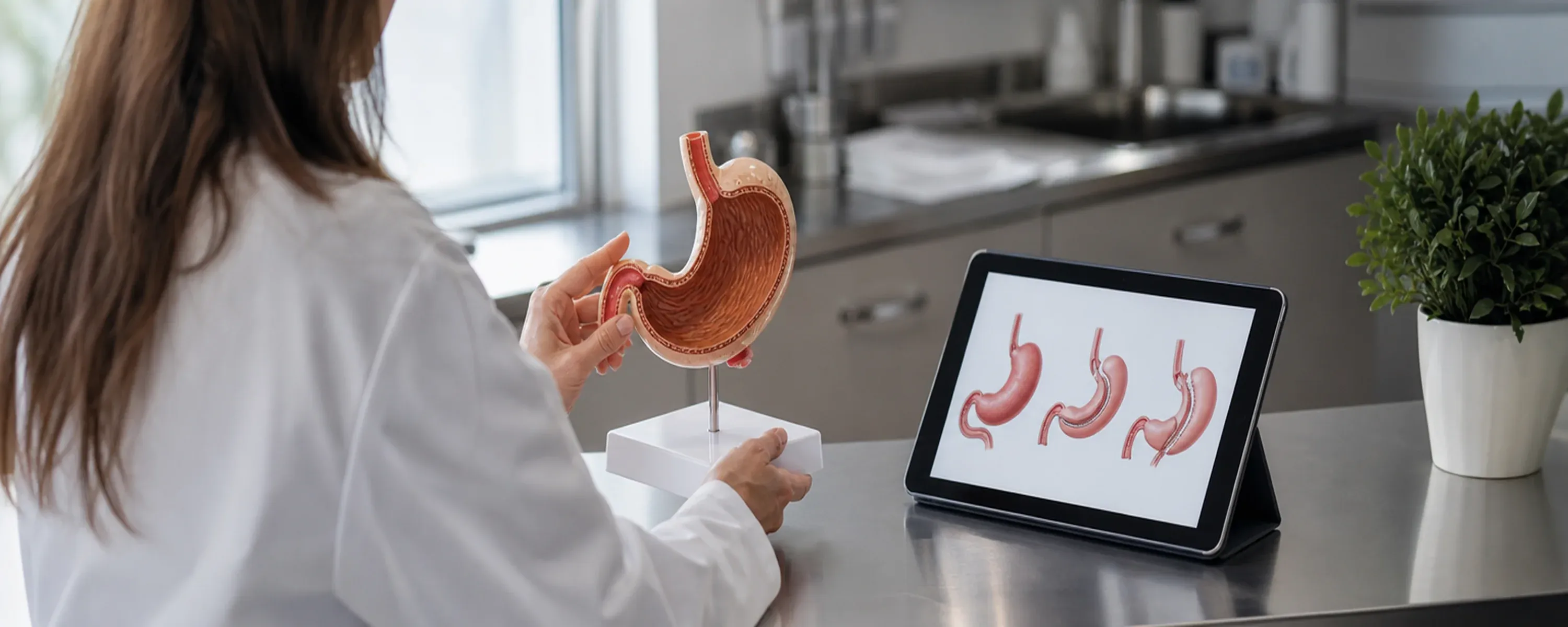
Bariatric Surgery Types Compared (2026): Gastric Bypass vs Sleeve vs Band vs ESG
Quick answer
The “best” bariatric procedure depends on your BMI (use the BMI calculator if you are not sure of your current number), comorbidities (especially type 2 diabetes and reflux), tolerance for permanent anatomy changes, and willingness to commit to lifelong follow-up. Roux-en-Y gastric bypass and sleeve gastrectomy produce the largest, most durable weight loss and are by far the two most commonly performed operations. Adjustable gastric banding, endoscopic sleeve gastroplasty (ESG), and the gastric balloon are less invasive options with smaller average weight loss. Revision surgery is a separate category for people whose first procedure has not held up. Use the table below as a starting point, then read the procedure summaries before talking with a bariatric team.
Quick stats
- Sleeve gastrectomy is the most-performed bariatric procedure in the U.S. — roughly 58% of all bariatric operations in 2022 (ASMBS).
- Typical 1-year weight loss across all options ranges from about 10% of total body weight (gastric balloon) to 30% (gastric bypass and sleeve).
- Recovery to normal activity ranges from a few days for endoscopic procedures (balloon, ESG) to about 4 weeks for sleeve and bypass.
Looking at less invasive options? See our non-surgical weight loss procedures compared hub for an ESG vs gastric balloon vs adjustable gastric band side-by-side aimed at the BMI 30–40 decision. For what each procedure actually costs out of pocket and what insurance covers, see bariatric surgery cost and insurance coverage.
Side-by-side comparison
Costs vary widely by procedure, region, and insurance status — see bariatric surgery cost and insurance coverage for typical out-of-pocket prices and the BMI/comorbidity criteria most U.S. insurers require.
| Procedure | Typical excess weight loss (EWL) at 1–2 yrs | Reversible? | Anatomy change | Recovery | Best fit |
|---|---|---|---|---|---|
| Roux-en-Y gastric bypass | ~60–70% | Technically yes, rarely done | Small stomach pouch + intestinal rerouting | 2–4 weeks to normal activity | Higher BMI, type 2 diabetes, severe GERD |
| Sleeve gastrectomy | ~55–65% | No (permanent) | ~75% of stomach removed | 2–4 weeks to normal activity | Most patients seeking durable loss without rerouting |
| Adjustable gastric banding | ~40–50% | Yes | Silicone band around upper stomach | 1–2 weeks to normal activity | Lower-risk preference, willing to attend frequent adjustments |
| Endoscopic sleeve gastroplasty (ESG) | ~15–20% TBWL | Not routinely | Stomach folded with sutures (no tissue removed) | A few days | Lower BMI, want a non-surgical option |
| Gastric balloon | ~10–15% TBWL | Yes (removed at 6 months) | Saline-filled balloon in stomach (temporary) | 1–3 days | Lower BMI, short-term jump-start |
| Bariatric surgery revision | Varies (often 10–25% added TBWL) | Depends on revision type | Modifies prior procedure | 2–6 weeks | Inadequate weight loss, regain, or complications from a prior surgery |
EWL = excess weight loss (the percentage of weight above ideal that is lost). TBWL = total body weight loss. Ranges are drawn from the cited literature; individual results vary.
Procedure summaries
Roux-en-Y gastric bypass
Gastric bypass creates a small upper stomach pouch and reroutes the small intestine so food bypasses most of the stomach and the upper small intestine. The result is reduced food intake plus hormonal changes that lower hunger and improve blood sugar regulation almost immediately.
In the STAMPEDE trial, bypass produced higher rates of type 2 diabetes remission than medical therapy or sleeve at 5 years. Long-term follow-up from the Swedish Obese Subjects (SOS) study showed durable mortality reduction. Trade-offs include a small risk of internal hernia, marginal ulcer, dumping syndrome, and lifelong vitamin and mineral supplementation.
Bypass is often the first choice when type 2 diabetes, severe GERD, or higher BMI is in the picture.
Sleeve gastrectomy
Sleeve gastrectomy removes roughly 70–80% of the stomach along the greater curvature, leaving a narrow tube. Hunger drops in part because the section of stomach that produces most of the body’s ghrelin is removed. Sleeve does not reroute the intestines, so absorption is more normal than after bypass.
In STAMPEDE, sleeve produced similar total weight loss to bypass at 5 years, with slightly less diabetes remission but a simpler operation and shorter operative time. Reflux can worsen after sleeve, which is the main reason patients with significant baseline GERD are often steered toward bypass instead.
Sleeve has become the most commonly performed bariatric operation in the U.S. and worldwide.
Adjustable gastric banding
Adjustable gastric banding places a silicone band around the upper stomach, creating a small pouch above the band. A port under the skin lets the surgeon tighten or loosen the band over time by adding or removing saline.
It is fully reversible and the lowest-risk operation in terms of immediate complications. Long-term outcomes have been less impressive than sleeve or bypass — lower average weight loss and a meaningful rate of reoperation for slippage, erosion, or port problems. As a result, banding is far less common than it once was, but it remains an option for patients who specifically want a reversible device and accept frequent follow-up.
Endoscopic sleeve gastroplasty (ESG)
Endoscopic sleeve gastroplasty reshapes the stomach using an endoscope and sutures passed through the mouth. No incisions, no tissue removed. The stomach is folded and stitched into a narrow tube similar in shape to a surgical sleeve.
The MERIT randomized trial showed ESG produces around 13–15% total body weight loss at 12 months — meaningful but smaller than surgical sleeve. Recovery is short, often a few days. ESG is most often offered to patients with lower BMI (around 30–40) who want an option short of surgery, or who do not qualify for or want a permanent anatomy change.
Gastric balloon
Gastric balloon procedures place a saline- or gas-filled balloon in the stomach to take up space and slow gastric emptying. The balloon is placed endoscopically and removed at 6 months. It is the least invasive option in this group.
Average weight loss is 10–15% of total body weight at 6 months, with some regain after removal unless habit changes are in place. The balloon is best thought of as a 6-month jump-start that buys time to build sustainable eating and activity routines, not as a stand-alone solution.
Bariatric surgery revision
Bariatric surgery revision is a second operation that modifies a prior procedure — for example, converting a sleeve to a bypass for refractory reflux or inadequate weight loss, removing a band, or revising a bypass that has stretched over time. Revisions are technically more demanding than primary surgery and carry higher complication rates, so they are reserved for clear clinical reasons rather than disappointment with results.
If you are considering revision, working through the original procedure, weight-loss history, and current symptoms with a bariatric team is the right first step. See our bariatric surgery overview for the broader context on long-term follow-up.
How to choose the right bariatric procedure
A few quick decision rules cover most patients before they sit down with a bariatric team:
- If type 2 diabetes is your dominant comorbidity → gastric bypass tends to edge out sleeve gastrectomy in trial data (STAMPEDE, SLEEVEPASS) for diabetes remission rates.
- If significant GERD or reflux is present → gastric bypass over sleeve, because sleeve can worsen reflux and is the most common reason for sleeve-to-bypass revision.
- If BMI is 30–40 and you want to avoid permanent anatomy change → endoscopic sleeve gastroplasty or a gastric balloon is the usual starting point.
- If you’ve had a prior procedure with regain or complications → start with a bariatric surgery revision evaluation rather than choosing a primary procedure from scratch.
Beyond those rules, the full decision is built from several inputs:
- BMI and eligibility. Most U.S. insurers cover surgery at BMI ≥40 or ≥35 with an obesity-related condition. ASMBS guidance updated in 2022 supports surgery at BMI ≥35 (regardless of comorbidity) and ≥30 with metabolic disease, but insurance criteria often trail clinical guidance. ESG and the gastric balloon are sometimes offered at lower BMIs.
- Reversibility preference. If a reversible option matters to you, the gastric band and balloon are the clear choices. ESG sits in the middle (no tissue removed, but sutures are not routinely undone). Sleeve is permanent, and bypass is functionally permanent.
- Comorbidity priorities. Type 2 diabetes and severe GERD push toward bypass. Lower BMI with no metabolic disease often pushes toward ESG or balloon. A clean baseline without reflux pushes toward sleeve.
- Insurance and access. Coverage requirements vary by plan. Many require a documented supervised weight loss attempt (often 3–6 months), psychological evaluation, and an in-network bariatric center of excellence before approval.
- Willingness to commit to follow-up. All bariatric procedures require lifelong follow-up. Bypass and sleeve require lifelong vitamin and mineral supplementation — see the bariatric post-op vitamin and nutrition protocol for the ASMBS-standard supplement stack by procedure and the 3 / 6 / 12-month lab cadence. Banding requires periodic in-office adjustments. ESG and balloon need habit-change support to hold the loss.
If you are early in the decision, the bariatric surgery overview is the best place to read about eligibility, the pre-op workup, and what long-term follow-up looks like. If you are weighing surgery against GLP-1 medication therapy, our bariatric surgery vs GLP-1 medications comparison covers expected loss, durability, and long-term cost on both paths.
Risks and trade-offs
Every option here has trade-offs. General bariatric risks include bleeding, infection, leak (for sleeve and bypass), blood clots, nutritional deficiencies (especially iron, B12, vitamin D, and calcium after bypass), and the possibility of weight regain over time. Device-based options (band, balloon) add device-specific complications such as slippage, erosion, deflation, or intolerance. Endoscopic options carry the lowest immediate risk but produce less weight loss.
Weight regain is common across all procedures over 5–10 years and is the most frequent reason people consider bariatric surgery revision. Long-term success in every category depends on consistent nutrition, activity, and follow-up rather than the operation alone.
Frequently asked questions
Which weight loss surgery is most effective? Roux-en-Y gastric bypass and sleeve gastrectomy produce the largest, most durable weight loss in randomized trials, with average excess weight loss around 60–70% at 1–2 years. Bypass tends to edge out sleeve for diabetes remission, while sleeve has a slightly shorter operative time and no intestinal rerouting. Adjustable gastric banding, ESG, and the gastric balloon produce less weight loss but are less invasive.
Gastric bypass vs gastric sleeve — which is better? Both produce similar weight loss at 5 years in the STAMPEDE trial — roughly 25–30% total body weight loss — but bypass produces faster and more durable type 2 diabetes remission and better GERD control. Sleeve has a shorter operation, no intestinal rerouting, and a lower long-term risk of internal hernias and ulcers, but reflux can worsen after sleeve. The best choice depends on diabetes status, baseline reflux, and patient preference.
Is the lap band still used? Adjustable gastric banding is still offered at some U.S. centers but is far less common than it was in the 2000s. Long-term follow-up showed lower weight loss than sleeve or bypass and a high rate of reoperation for band-related problems. Many surgeons now use it only for select patients who want a reversible, lower-risk option, or remove existing bands during revision surgery.
Which bariatric procedure has the fewest side effects? The gastric balloon and ESG carry the lowest risk profile because they do not cut or remove tissue. They also produce less weight loss — typically 10–20% total body weight loss at 1 year — and the balloon must be removed at 6 months. Among surgical options, sleeve gastrectomy has a slightly lower complication rate than gastric bypass in most large registries.
Which weight loss surgery is reversible? Adjustable gastric banding is fully reversible. The gastric balloon is temporary by design and is removed at 6 months. ESG is technically reversible because no tissue is removed, but the sutures are not routinely undone. Sleeve gastrectomy is permanent. Gastric bypass can be reversed in rare cases but the operation is complex and not routine.
What BMI do I need to qualify for bariatric surgery? Most U.S. insurers cover bariatric surgery at BMI ≥40, or BMI ≥35 with an obesity-related condition such as type 2 diabetes, sleep apnea, or severe hypertension. ASMBS and IFSO updated guidance in 2022 lowering the threshold to BMI ≥35 (regardless of comorbidity) and ≥30 with metabolic disease, but insurance criteria often lag clinical guidance. ESG and the gastric balloon are sometimes offered at lower BMIs.
What is the safest bariatric surgery? Endoscopic procedures — gastric balloon and endoscopic sleeve gastroplasty (ESG) — have the lowest serious-complication rates in large registries because no tissue is cut or removed. Among true surgical operations, sleeve gastrectomy carries a slightly lower 30-day complication rate than gastric bypass in MBSAQIP data (roughly 5–6% vs 7–8% for any complication). “Safest” also depends on the patient — bypass may be safer for someone with severe reflux that would worsen after sleeve, and sleeve may be safer for someone who cannot reliably take lifelong supplements.
How long is recovery after gastric bypass vs sleeve? Recovery times are similar for the two operations. Most patients are discharged within 1–2 days, return to desk work in about 2 weeks, and reach normal activity (including light exercise) by 3–4 weeks. The full post-op diet progression — liquids, then purees, then soft foods, then regular textures — typically takes about 8 weeks for both procedures. Lifting restrictions (no more than 10–15 lbs) usually last 4–6 weeks. Sleeve has a slightly shorter operative time, but recovery experience and downtime are nearly identical for most patients.
Does insurance cover bariatric surgery? Most major U.S. insurers cover bariatric surgery when criteria are met: typically BMI ≥40, or BMI ≥35 with an obesity-related comorbidity (type 2 diabetes, sleep apnea, severe hypertension). Coverage usually requires prior authorization, a documented supervised weight-loss attempt (often 3–6 months), a psychological evaluation, and surgery at an in-network bariatric center of excellence. The gastric balloon and ESG are still treated as investigational by many plans and are often self-pay. For a full breakdown of out-of-pocket cost, BMI gates, and approval timelines, see bariatric surgery cost and insurance coverage.
Sources
- Schauer PR, Bhatt DL, Kirwan JP, et al. Bariatric surgery versus intensive medical therapy for diabetes — 5-year outcomes (STAMPEDE). New England Journal of Medicine (2017).
- Sjöström L, Narbro K, Sjöström CD, et al. Effects of bariatric surgery on mortality in Swedish obese subjects (SOS). New England Journal of Medicine (2007).
- Abu Dayyeh BK, Bazerbachi F, Vargas EJ, et al. Endoscopic sleeve gastroplasty for treatment of class 1 and 2 obesity (MERIT): a prospective, multicentre, randomised trial. The Lancet (2022).
- Eisenberg D, Shikora SA, Aarts E, et al. 2022 ASMBS and IFSO indications for metabolic and bariatric surgery. Surgery for Obesity and Related Diseases (2022).