
2026-05-29 · bariatric, GLP-1, comparison, weight-loss-surgery, Wegovy, Ozempic, Zepbound
Updated 2026-07-12
Written by WeightFAQ Staff
Evidence-informed guidance from the WeightFAQ editorial team.
17 min read
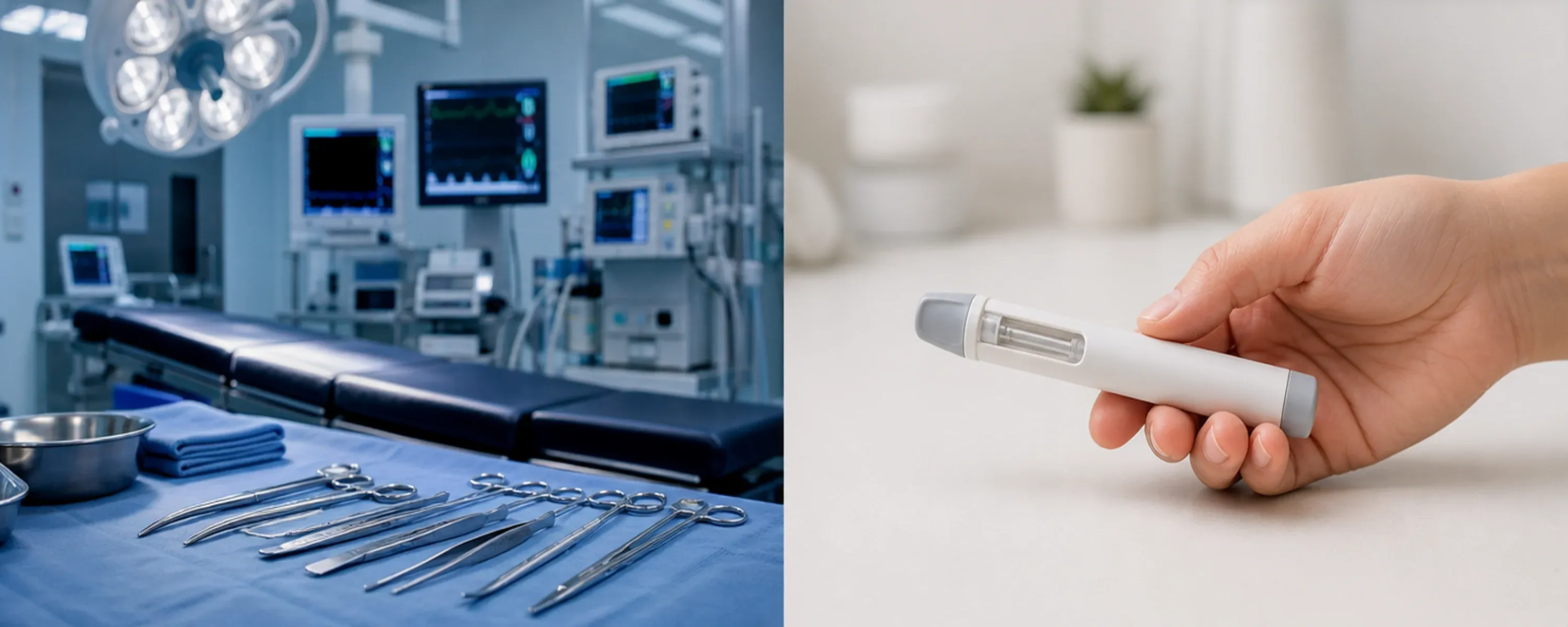
Bariatric Surgery vs GLP-1 Medications: Which Is Right For You?
Quick answer
Bariatric surgery typically produces the largest and most durable weight loss — roughly 25–30% of body weight maintained at 5+ years — but it is irreversible and carries surgical risk. GLP-1 medications like Wegovy and Zepbound produce 15–22% average loss in trials, are easier to start, and are reversible — but most of the loss returns when the drug is stopped, and the monthly cost is substantial. The right answer depends mostly on your BMI, comorbidities, tolerance for ongoing medication, and what insurance covers. For many patients, the question is no longer “surgery or drug” but “in what order, and for how long.”
This article compares the two treatment paths fairly. If you are still mapping out the landscape, the bariatric surgery overview and GLP-1 weight loss overview are good starting points before reading this comparison.
At a glance
| Decision axis | GLP-1 medications | Bariatric surgery | Winner |
|---|---|---|---|
| 12-month weight-loss ceiling | 10–22% TBWL (semaglutide → tirzepatide, dose-dependent) | 25–35% TBWL (sleeve or gastric bypass) | Bariatric |
| First-year all-in cost, US cash-pay | $7,000–$16,000 (list-price monthly × 12) | $15,000–$30,000 (procedure bundle) | GLP-1 |
| Insurance-coverage prevalence | Commercial: rising, prior-auth gated; Medicare Part D: CVD-only under SELECT; Medicaid: minority of states | Commercial: broad when NIH criteria met; Medicare: covered; Medicaid: most states | Bariatric |
| Reversibility | Fully reversible — effects fade after discontinuation | Sleeve and bypass effectively permanent; band is reversible | GLP-1 |
| Sustained loss at 5 years without continued treatment | Most of loss regained within 12 months of stopping (STEP 4, SURMOUNT-4) | ~20–28% TBWL held (STAMPEDE, SOS) | Bariatric |
| Time-to-return-to-work / activity | None — weekly injection, no downtime | ~1–3 weeks after laparoscopic sleeve or bypass | GLP-1 |
This matrix is a starting frame, not a verdict. The trial evidence, cost mechanics, and clinical decision points behind each row are walked through in the rest of the article.
Head-to-head comparison
| Dimension | Bariatric surgery (typical) | GLP-1 medication (typical) |
|---|---|---|
| Average %TBWL at 12 months | ~25–30% (sleeve / bypass) | ~15% (semaglutide 2.4 mg); ~20–22% (tirzepatide 15 mg) |
| Durability at 5 years | ~20–28% TBWL maintained (STAMPEDE, SOS) | Maintained only while drug is taken; STEP 4 / SURMOUNT-4 showed substantial regain after stopping |
| Reversibility | Sleeve and bypass are effectively permanent; band is reversible | Fully reversible — effects fade after discontinuation |
| Onset of effect | Weight loss begins within days post-op; peaks at 12–18 months | Gradual; meaningful loss visible by 3–6 months as dose escalates |
| Cost | $15,000–$30,000 one-time self-pay; often covered by insurance with prior auth | ~$900–$1,350/month list price; insurance coverage varies. See bariatric surgery cost and insurance coverage for surgery side |
| Side-effect profile | Surgical risk (bleeding, leak, VTE); lifelong vitamin/mineral supplementation (see the bariatric post-op vitamin and nutrition protocol for the ASMBS-standard stack); possible reflux, dumping, hernia | GI symptoms (nausea, vomiting, constipation); rare pancreatitis; boxed warning for medullary thyroid carcinoma history |
| Eligibility / BMI threshold | Typically BMI ≥40, or ≥35 with comorbidity; 2022 ASMBS guidance lowered this | Wegovy/Zepbound: BMI ≥30, or ≥27 with weight-related condition |
| Lifestyle requirements | Permanent dietary changes; lifelong follow-up and labs; protein-first eating | Slow titration; tolerate GI side effects; ongoing adherence to weekly injections |
| Effect on type 2 diabetes remission | Strong — bypass produces durable remission in a high share of patients (STAMPEDE) | Excellent glycemic control while on drug; remission less common, returns on discontinuation |
Ranges are drawn from the cited trials. Individual results vary widely based on dose, adherence, baseline BMI, diabetes status, and biology. For a closer look at the bariatric options themselves, see bariatric surgery types compared; for the medications, see GLP-1 medications compared.
What the evidence shows
GLP-1 trial data
In the STEP 1 trial, adults with overweight or obesity (without type 2 diabetes) randomized to weekly semaglutide 2.4 mg lost about 14.9% of body weight at 68 weeks, compared with 2.4% on placebo. About one in three reached at least 20% loss. STEP 4 then asked what happens with continued treatment versus withdrawal: people who continued semaglutide kept losing slowly, while those switched to placebo regained roughly two-thirds of their initial loss within a year.
In SURMOUNT-1, adults with obesity and without diabetes randomized to weekly tirzepatide lost about 15% (5 mg), 19.5% (10 mg), and 20.9% (15 mg) of body weight at 72 weeks, compared with about 3% on placebo. At the 15 mg dose, more than one in three reached at least 25% loss. SURMOUNT-4 again showed substantial regain after discontinuation. The 2025 head-to-head SURMOUNT-5 trial reported greater weight loss with tirzepatide than semaglutide in adults with obesity without diabetes.
The takeaway: GLP-1 medications can produce loss approaching what bariatric surgery delivers, but the loss is contingent on staying on the drug.
Bariatric durability data
In the STAMPEDE trial, adults with type 2 diabetes randomized to gastric bypass or sleeve gastrectomy on top of medical therapy lost about 21–25% of body weight at 5 years, compared with roughly 5% in the medical-therapy group. Diabetes remission and reduced medication use were substantial and durable, especially after bypass.
The Swedish Obese Subjects (SOS) study followed adults with obesity for 10–20 years after bariatric surgery (mostly vertical banded gastroplasty and gastric banding, with some bypass) compared with matched non-surgical controls. Surgical patients maintained roughly 16–25% weight loss at 10 years and showed reductions in overall mortality, cardiovascular events, and incident type 2 diabetes. The SOS dataset remains the longest-running prospective evidence on bariatric surgery.
Together, STAMPEDE and SOS make the durability case for bariatric procedures: average loss is largely held many years after the operation, even when motivation or habits drift. If you have Type 2 diabetes, the surgical-vs-medication trade-off differs — sleeve gastrectomy and gastric bypass produce remission in roughly 70–80% of recent-onset cases at 1–2 years versus excellent glycemic control on GLP-1 therapy that returns to baseline if the drug is stopped. On 5-year remission durability, STAMPEDE reports ~29% after gastric bypass and ~23% after sleeve vs ~5% on intensive medical therapy — a gap that widens over time. The type 2 diabetes remission via weight loss guide lays out the DiRECT / DIADEM-I / STAMPEDE remission-durability comparison side by side, and the diabetes and weight loss guide covers the remission thresholds and how the decision shifts when diabetes is in the picture.
When each is the better choice
This is the decision frame most patients actually need. None of these are rigid rules — they are starting points to discuss with a bariatric or obesity-medicine clinician.
GLP-1 is likely the better choice when:
- BMI is 27–35 with a weight-related condition (high blood pressure, prediabetes, sleep apnea, fatty liver). For MASLD specifically, the 2024 ESSENCE and SYNERGY-NASH trials showed GLP-1s significantly resolve MASH; bariatric surgery delivers ~80% NASH resolution at 5 years when severe obesity coexists. For OSA, the December 2024 FDA approval of tirzepatide on the SURMOUNT-OSA trial gave GLP-1s their first dedicated clinical-condition label in this class.
- Established cardiovascular disease qualifies for semaglutide 2.4 mg under the SELECT indication and, since 2024, opens Medicare Part D coverage — see the cardiovascular disease and weight loss guide for the SELECT population and event-reduction detail.
- You prefer a reversible, non-surgical approach and accept the trade-off of needing ongoing therapy.
- You can sustain the monthly cost — through insurance, manufacturer programs, or out-of-pocket — for the long term.
Bariatric surgery is likely the better choice when:
- BMI is ≥40, or ≥35 with severe comorbidities such as poorly controlled type 2 diabetes.
- Type 2 diabetes duration is under about 6 years — the STAMPEDE remission data are strongest at shorter T2D duration and preserved C-peptide.
- You have already tried a GLP-1 medication for more than 12 months without a meaningful response, or you have lost GLP-1 access via an insurance change.
- Your goal exceeds about 20% total body weight loss, and you are willing to accept irreversible anatomy changes and commit to lifelong follow-up, supplementation, and dietary changes in exchange for the strongest evidence-based path to type 2 diabetes remission.
A combined GLP-1 + bariatric protocol is used when:
- Pre-operatively as bridge therapy — a 3–6 month GLP-1 course to lower BMI and hepatic fat before surgery, especially at BMI ≥50.
- Post-operatively for inadequate response or weight regain — small studies (Mok 2023 Obes Surg) suggest meaningful additional loss when a GLP-1 is layered onto a stable post-op plan, and the 2020 AACE obesity guideline acknowledges this pathway.
- Long-term combined therapy remains an open research question; insurance rarely covers both simultaneously, but practice is moving faster than coverage.
Neither is the right first step when:
- Pregnancy, planned pregnancy, or breastfeeding (GLP-1s contraindicated; bariatric typically deferred).
- Personal or family history of medullary thyroid carcinoma or MEN2 syndrome (GLP-1 contraindicated per boxed warning).
- Inability or unwillingness to commit to lifelong vitamin and mineral supplementation and annual labs (bariatric contraindicated on adherence grounds).
Defer the decision when:
- Active eating disorder or recent history of one — treatment stabilization comes first, since both paths can worsen restrictive or binge patterns without support.
- Unmanaged severe depression, active substance-use disorder, or current alcohol use disorder — all raise post-op complication risk and reduce medication adherence.
For patients trying to choose between specific procedures or specific drugs, the bariatric surgery types compared and GLP-1 medications compared hubs are the next step. If you are weighing less invasive procedures, see the non-surgical weight loss procedures compared guide.
What happens when you stop
A fair comparison has to address what happens after the active phase ends, because both paths have a durability story.
Stopping GLP-1 medications
The honest answer is that most weight comes back. In STEP 4, participants who had reached steady weight loss on semaglutide 2.4 mg and then switched to placebo regained roughly two-thirds of their lost weight within a year, and cardiometabolic improvements largely reversed. SURMOUNT-4 reported a similar pattern after stopping tirzepatide. This is consistent with the underlying biology — GLP-1 medications work by lowering the body’s defended weight setpoint while taken, not by permanently resetting it. Both bariatric surgery and GLP-1 medications appear to lower the defended set point, but only surgery does so durably; for the full mechanism see set point theory and weight loss.
This is not a moral failure; it is how the drug class works. Obesity behaves like a chronic condition, and pharmacologic treatment is increasingly framed the way blood-pressure and lipid drugs are: indefinite use, with off-ramps only when paired with structural changes (such as surgery) or sustained behavioral change.
Weight regain after bariatric surgery
Bariatric surgery is more durable than medication, but it is not “set and forget.” Long-term follow-up from the SOS study and from large U.S. registries shows that most patients regain some weight 5–10 years after surgery — typically 10–25% of the maximum loss is added back. Sleeve gastrectomy and gastric bypass patients tend to bottom out at 12–18 months and then drift up modestly over the following years. A subset experiences more substantial regain and may be candidates for bariatric surgery revision or for adding a GLP-1 medication.
The fair conclusion: surgery is more durable on average, but neither path is permanent without ongoing attention.
Cost tiers
Real US pricing splits into six tiers. Ranges reflect list prices and typical out-of-pocket data through 2026:
- GLP-1 cash-pay (year 1): roughly $7,000–$16,000 for Wegovy, Zepbound, Mounjaro, or off-label Ozempic at typical monthly list prices of $900–$1,350 across 12 months, before manufacturer savings cards.
- GLP-1 with commercial coverage (BMI-qualified): roughly $600–$3,000 out-of-pocket per year after prior authorization, depending on formulary tier and coinsurance. See the GLP-1 cost and insurance guide for a plan-by-plan breakdown.
- Compounded semaglutide or tirzepatide via telehealth: roughly $1,800–$4,200 per year at typical cash-pay pricing. This tier is legally and clinically distinct — read the compounded semaglutide and tirzepatide safety guide before assuming equivalence with FDA-approved brand product.
- Bariatric surgery cash-pay: roughly $15,000–$30,000 for a single laparoscopic sleeve or gastric bypass at a US center of excellence. See the bariatric surgery cost and insurance coverage guide for regional and bundle-vs-a-la-carte pricing.
- Bariatric with commercial coverage: roughly $3,000–$8,000 out-of-pocket after deductible and coinsurance, when the plan covers the procedure and NIH criteria are met.
- Bariatric with Medicare: roughly $0–$2,000 out-of-pocket depending on Medigap and Part B specifics, once NIH criteria and center-of-excellence requirements are satisfied.
HSA and FSA dollars are eligible for both categories when there is a qualifying obesity diagnosis and a provider letter of medical necessity.
5-year cost projection — the honest comparison. Most side-by-side articles quote year-1 numbers, which flatters GLP-1s. Year 5 looks different: continued GLP-1 use at cash-pay list price lands near $35,000–$80,000 over five years, assuming ongoing therapy plus the real-world regain risk on discontinuation shown in the STEP 1 extension (Wilding 2022). Bariatric surgery at 5 years is closer to $3,500–$7,000 in additional cost beyond the procedure itself — mostly annual labs, vitamins, and follow-up (see the bariatric post-op vitamin and nutrition protocol for the standard ASMBS-aligned stack). Bariatric wins on total cost from year 5 onward; GLP-1 wins on reversibility and lower front-loaded risk. Neither wins on both.
How insurance decides
Commercial plans typically approve GLP-1 coverage when the member has a BMI of 30, or BMI 27 with a documented weight-related comorbidity such as hypertension, dyslipidemia, prediabetes, or obstructive sleep apnea. Approval is via prior authorization; many plans also require a documented supervised weight-loss attempt or step therapy with an older medication. Bariatric coverage is broader on paper — most commercial plans cover it when the member meets the 1991 NIH criteria (BMI ≥40, or ≥35 with a serious comorbidity) — but they usually gate it behind a 3–6 month medically supervised weight-loss program, a psychological evaluation, and a nutrition consult. The GLP-1 cost and insurance guide tracks current major-carrier formularies and prior-authorization criteria.
Medicare treats the two paths very differently. Bariatric surgery is covered by Medicare when the NIH criteria are met and the procedure is done at a Medicare-approved center. GLP-1 medications for obesity alone are not covered — but since the CMS 2024 Part D memo, semaglutide 2.4 mg (Wegovy) is covered under Part D when the member has established cardiovascular disease, on the basis of the SELECT trial. This is currently the only Medicare pathway to a GLP-1 for weight, and it is narrow by design.
Medicaid varies dramatically by state. Most state Medicaid programs cover bariatric surgery when NIH criteria are met, although prior-authorization requirements are often heavier than commercial coverage. A minority of states cover GLP-1 medications for obesity; more cover them for type 2 diabetes. HSA and FSA dollars remain eligible for both categories when there is a qualifying obesity diagnosis and provider documentation.
Cost over 5 and 10 years
A rough back-of-envelope comparison helps set expectations. Real numbers will depend heavily on insurance, manufacturer programs, and local pricing — see the bariatric surgery cost and insurance coverage guide for a more detailed breakdown on the surgery side.
| Horizon | Surgery (self-pay scenario) | GLP-1 (self-pay scenario at $1,100/mo) |
|---|---|---|
| Year 1 | ~$15,000–$30,000 (one-time) | ~$13,200 |
| 5 years | ~$15,000–$30,000 + ~$1,000–$3,000 vitamins/follow-up | ~$66,000 |
| 10 years | ~$15,000–$30,000 + ~$2,500–$6,000 vitamins/follow-up | ~$132,000 |
Insurance changes the picture substantially. When a commercial plan covers bariatric surgery, out-of-pocket cost is often limited to a deductible plus coinsurance. When a plan covers Wegovy or Zepbound for obesity, monthly out-of-pocket can drop to under $100 — and that is where most U.S. patients actually live. Medicare Part D does not currently cover GLP-1s for obesity alone, which is a major affordability issue for older adults.
The general pattern: if insurance covers surgery and you have higher BMI, surgery tends to win on lifetime cost. If insurance covers a GLP-1, the monthly cost is manageable; if it does not, long-term self-pay is unsustainable for most households.
Can you do both?
Yes — and clinicians are increasingly treating bariatric surgery and GLP-1 medications as complementary rather than mutually exclusive. Three patterns are emerging:
- GLP-1 as bridge therapy before surgery. Pre-operative weight loss reduces hepatic volume, lowers perioperative risk, and may improve long-term outcomes. A 3–6 month course of a GLP-1 before surgery is now common at many bariatric centers, especially for patients with BMI ≥50.
- GLP-1 for post-surgical weight regain. Patients who plateau or regain after sleeve or bypass increasingly turn to a GLP-1 as an “add on” rather than considering revision surgery. Small studies suggest meaningful additional loss when GLP-1s are layered onto a stable post-op plan. A parallel trend: some patients whose adjustable gastric band is failing choose band removal plus a GLP-1 rather than converting to sleeve or bypass, trading indefinite medication cost for a non-surgical path.
- Long-term combined therapy. Whether continuous GLP-1 use after surgery improves durability of weight loss and metabolic outcomes is an open research question. Early observational data is encouraging; large randomized trials are still pending.
For broader context on medical pathways that sit alongside surgery, the medical weight loss programs and prescription weight loss medications overviews are useful.
Frequently asked questions
Is bariatric surgery still worth it if GLP-1s exist? For higher-BMI patients and for diabetes remission, yes. Surgery still produces the largest and most durable loss in randomized and long-term observational data. GLP-1s have made the choice harder for BMI 30–40 patients, but they have not displaced surgery for severe obesity.
How much more weight do you lose with surgery vs Wegovy? On average, sleeve or bypass produces ~25–30% TBWL at 1–2 years; Wegovy averaged ~15% in STEP 1; Zepbound averaged ~20–22% in SURMOUNT-1. Surgery leads, but tirzepatide narrows the gap.
Is a GLP-1 medication a substitute for gastric sleeve? Sometimes, especially at lower BMIs. At BMI ≥40 or with severe diabetes, surgery still tends to outperform. The choice depends on BMI, comorbidities, ability to sustain ongoing therapy, and personal preference.
What happens if I stop a GLP-1 after weight loss? Most people regain a large share. STEP 4 and SURMOUNT-4 both showed substantial regain after discontinuation. GLP-1s are best understood as chronic therapy.
Can I take a GLP-1 medication after bariatric surgery? Yes, and it is increasingly common for inadequate loss or weight regain. Coverage is inconsistent, but clinical use is rising.
Which is cheaper long term — surgery or GLP-1s? With insurance coverage, surgery is usually cheaper over 5–10 years. Without coverage on either side, GLP-1s cost roughly $50,000–$130,000 over a decade, well above the typical self-pay surgical bundle.
Which is cheaper long-term: GLP-1 or bariatric surgery? Over five years, bariatric surgery is almost always cheaper unless GLP-1 coverage stays stable the whole time. Cash-pay GLP-1 use lands near $35,000–$80,000 over five years; bariatric adds roughly $3,500–$7,000 in labs, vitamins, and follow-up beyond the procedure itself. With commercial coverage on both sides, bariatric still wins at year 5+.
Can you take GLP-1 medications after bariatric surgery? Yes. Layering a GLP-1 onto a stable post-op plan is now a common approach for inadequate weight loss or weight regain 12+ months after surgery. The 2020 AACE obesity guideline acknowledges the combined pathway; insurance coverage is inconsistent and often requires separate prior authorization for the medication.
Which is safer — GLP-1 or bariatric surgery? Short-term, GLP-1s have a lower serious-adverse-event rate — most side effects are dose-related and gastrointestinal. Bariatric surgery carries a peri-operative mortality of ~0.1–0.3% at accredited US centers plus lifelong nutrient-deficiency risk without adherent supplementation. Long-term, the durable weight-loss benefits of surgery in SOS can reverse the short-term safety gap for patients with severe obesity and diabetes.
Does Medicare cover both GLP-1 and bariatric surgery? Partially. Bariatric is covered when 1991 NIH criteria are met and the procedure is done at a Medicare-approved center. Since the CMS 2024 Part D memo, semaglutide 2.4 mg is covered under Part D only for members with established cardiovascular disease. Tirzepatide is not yet covered by Medicare for weight.
How this compares to other options
- Compared with prescription weight loss medications outside the GLP-1 class — such as phentermine — GLP-1s produce substantially more weight loss but cost more and require injections.
- Compared with non-surgical weight loss procedures like ESG or gastric balloon, surgery produces more loss; GLP-1s often produce similar loss to ESG with no procedure at all.
- For a closer look at semaglutide-based brands, see Ozempic vs Wegovy and Ozempic for weight loss.
- For the underlying surgical operations themselves, see gastric bypass surgery and sleeve gastrectomy.
Practical next steps
This week
- Confirm your BMI and list your weight-related conditions. These two facts determine which paths your insurance is likely to cover.
- Check your plan’s formulary for Wegovy and Zepbound, and search for an in-network bariatric center of excellence.
- Write down your goal in concrete terms (e.g., “lose 25% of body weight and reduce diabetes medication”) so the trade-offs become easier to weigh.
What to track
- Weight trend (weekly), waist circumference (monthly), and key labs (A1c, lipids, liver enzymes) every 3–6 months.
- Side effects and adherence on any GLP-1 trial.
- Honest sense of whether the chosen path feels sustainable.
How to know it’s working
- For GLP-1s: ≥5% loss by 3–4 months at a tolerated maintenance dose suggests the drug is doing its job.
- For surgery: steady loss through 12–18 months, then maintenance, with stable labs and no untreated nutrient deficiencies.
Sources
- Once-weekly semaglutide in adults with overweight or obesity (STEP 1). New England Journal of Medicine (2021).
- Tirzepatide once weekly for the treatment of obesity (SURMOUNT-1). New England Journal of Medicine (2022).
- Bariatric surgery versus intensive medical therapy for diabetes — 5-year outcomes (STAMPEDE). New England Journal of Medicine (2017).
- Effects of bariatric surgery on mortality in Swedish obese subjects (SOS). New England Journal of Medicine (2007).
- Effect of continued weekly subcutaneous semaglutide vs placebo on weight loss maintenance (STEP 4). JAMA (2021).