
2026-09-09 · rock climbing, bouldering, climbing gym, fitness for weight loss, strength, weight loss
Written by Priya Desai
Priya Desai is a WeightFAQ staff writer covering exercise, fitness, and the body-composition side of weight loss. She has written about strength training, HIIT, running, and the best time to exercise, alongside guides to preserving muscle during a deficit, sarcopenic obesity, body recomposition, and creatine. Her body-composition-testing piece walks through DEXA, BIA, and Bod Pod for readers who want more than a scale number, and her articles on plantar fasciitis and fibromyalgia address exercising with pain. Priya writes for readers who want to train usefully without gym pressure or hype.
22 min read
Medically reviewed on Sep 9, 2026
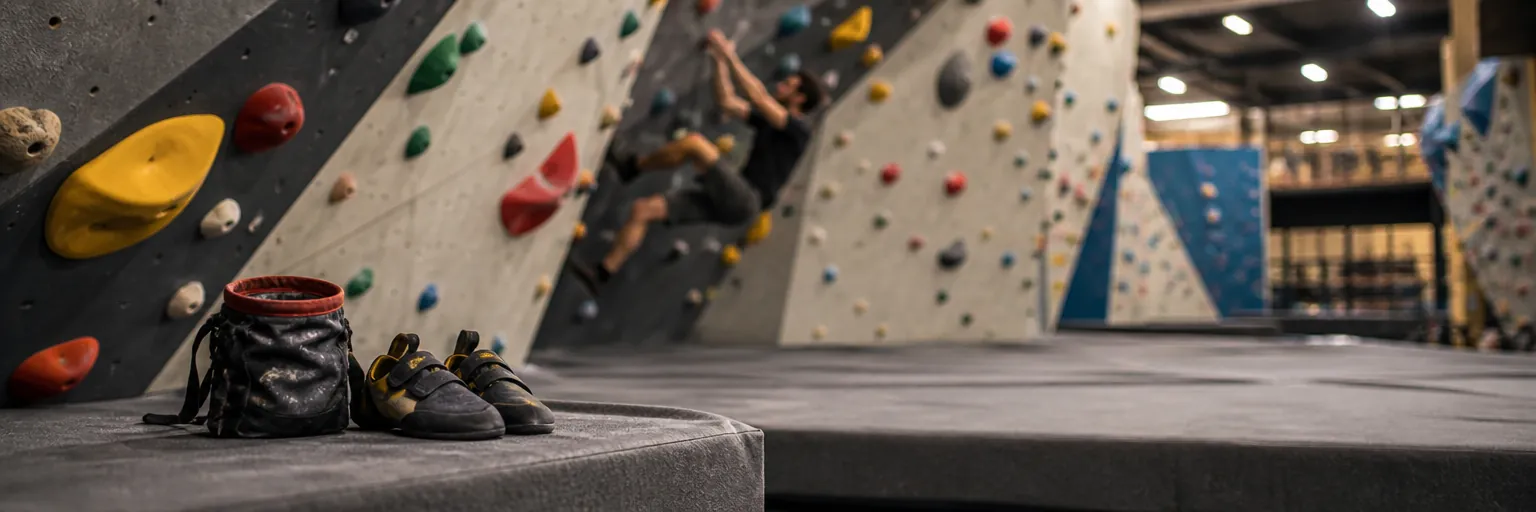
Rock Climbing and Bouldering for Weight Loss: Calories Burned, Beginner Gym Plan, and What the Evidence Actually Says
The one-paragraph answer
Rock climbing and bouldering are legitimate weight-loss modalities with a smaller per-hour calorie burn than most beginners expect and an unusually high adherence rate. Ainsworth 2011 puts bouldering at MET 5.8 (session-averaged, including rest between problems) and top-rope climbing at MET 7.0–7.5; hard leading runs to MET 8.5. A typical 90-minute gym session nets ~300–500 kcal on-wall for a 160–180-lb adult after the rest-time discount, because a 90-minute block is usually only 30–45 minutes of actual on-wall movement (Sheel 2004). Climbing does not automatically produce a lean body composition — Rodio 2008 and Draper 2020 both showed recreational climbers overlap with general-population body composition unless deficit management is deliberate. Gym-console and wearable kcal displays for climbing are typically 15–30% inflated (Foster 2015 baseline plus the climbing-specific isometric-HR issue in Bergua 2018). Program 2–3 sessions per week, add 2 short strength sessions for the muscles climbing skips (chest, triceps, legs), keep a food anchor, and it becomes a durable long-term exercise anchor that meets ACSM 2021’s 75–150 min/wk vigorous-PA target. The rest of this guide gives the per-bodyweight kcal table, the 4-week beginner gym plan, the injury-risk profile (Schöffl 2011: bouldering ankle-sprain rate 2× top-rope), the console-inflation math, and modifications for GLP-1 users, pregnancy, and over-50 beginners.
Why climbing, why now
Indoor climbing gyms in the US grew from ~380 facilities in 2018 to 700+ in 2026 (Climbing Business Journal), the fastest facility growth of any indoor fitness modality besides pickleball. The 2020 Tokyo Olympics added sport climbing (bouldering, lead, and speed) as a medal discipline, and Paris 2024 split it into two events — bringing durable television exposure to a sport that was, for the previous four decades, mostly an outdoor-only subculture. WeightFAQ already covers the standard exercise-for-weight-loss modalities — walking, running, cycling, swimming, HIIT, elliptical, stair-climbing, rowing, rucking, jump rope, yoga, Pilates, boxing, dance, kettlebells, resistance bands, treadmill, CrossFit, home workouts, rebounding, hiking, strength training, zone-2 cardio, pickleball, tennis, aqua-aerobics — but had no destination for indoor climbing or bouldering. This guide is that destination, anchored on the same evidence-first, adherence-realistic frame as the rest of the pillar library (exercise for weight loss).
What is actually happening physiologically
Climbing looks like a strength sport from the outside and behaves more like an interval sport on the inside. Sheel 2004 (Sports Med review) characterised it as an intermittent, high-intensity pattern of 30–120 s efforts followed by 2–5 min rest — the same rough interval structure as a strength-conditioning circuit, not the steady-state pattern of jogging or cycling.
Watts 1993 (Med Sci Sports Exerc) put heart-rate monitors and metabolic carts on climbers and found on-wall HR held at ~80–85% of HRmax while VO2 sat around 40–50% of VO2max — a wide gap that is unusual outside climbing. The gap comes from isometric forearm work: grip contractions spike systemic HR without demanding much whole-body oxygen. Between climbs, HR dropped back into the ~60% HRmax zone. Forearm-flexor lactate rose specifically and disproportionately compared with the systemic lactate response, which is why “pumped forearms” are the limiter for most sessions long before your cardiovascular system taps out.
Bergua 2018 (Front Physiol) built on this: heart-rate-based calorie estimation systematically overshoots in climbing because the HR-to-VO2 relationship that fitness watches assume from cycling and running does not hold when isometric grip work is the primary muscle recruitment. The practical implication is below in the console-inflation section — the short version is that any climbing-session kcal figure from a wrist-worn tracker or gym console app should be discounted 20–30%.
Calorie burn — the honest per-hour numbers
The Ainsworth 2011 Compendium of Physical Activities anchors are:
- MET 5.8 — bouldering, gym session including rest between problems
- MET 7.0–7.5 — top-rope climbing, moderate to hard leading
- MET 8.5–11.0 — hard leading, rappelling, or continuous vertical ascending
The lower Ainsworth values (5.8, 7.0) are session-averaged and already include rest between climbs — those are the numbers to use when planning a gym visit. The 8.5–11.0 values are for continuous vertical work and only apply to the minutes you are actually on the wall pushing hard, not to a whole gym session. Michailov 2014 (Int J Sports Physiol Perform) confirmed the range on gym boulderers at 5.8 to 7–8 kcal/min on-wall, translating to session nets of ~300–500 kcal for a 60–90-minute visit.
Per-hour session-time kcal, using the Ainsworth MET values times bodyweight in kg:
| Bodyweight | Bouldering (MET 5.8, session incl. rest) | Top-rope moderate (MET 7.0) | Hard leading (MET 8.5) |
|---|---|---|---|
| 130 lb (59 kg) | ~340 kcal/hr | ~415 kcal/hr | ~500 kcal/hr |
| 150 lb (68 kg) | ~395 kcal/hr | ~475 kcal/hr | ~580 kcal/hr |
| 175 lb (79 kg) | ~460 kcal/hr | ~555 kcal/hr | ~670 kcal/hr |
| 200 lb (91 kg) | ~530 kcal/hr | ~635 kcal/hr | ~775 kcal/hr |
| 235 lb (107 kg) | ~620 kcal/hr | ~750 kcal/hr | ~910 kcal/hr |
How to use this table: pick the row closest to your bodyweight and the column that matches your dominant format. If you spend 60 minutes bouldering as a 175-lb adult, plan on ~460 kcal from the session — not 700, not 900. If you spend 30 minutes actually on the wall inside a 90-minute gym visit, halve the session-time figure and treat the rest as a low-intensity social block.
The rest-time discount is the single most important thing to understand. A typical gym visit runs:
- 5–10 minutes changing, taping fingers, chalking up
- 8–12 minutes of warm-up (easy laps, mobility)
- 30–45 minutes of actual on-wall movement, in 30–90 s bouts
- 25–35 minutes standing at the base of problems reading beta, resting between attempts, talking to friends
- 5–10 minutes cooling down and packing up
The MET 5.8 (session-averaged) figure already accounts for the standing-around time within active climbing blocks, but if half of your 90-minute visit was social, your realistic session burn is ~250–350 kcal, not 700. This is the same phenomenon documented in racket sports (pickleball for weight loss covers the analogous ~35% active-play finding for doubles).
Climbing gym setup and format map
Not every format is equally weight-loss-friendly. The five main options at a modern gym:
| Format | Skill level | Safety learning curve | Typical cost | Weight-loss suitability | Common failure mode |
|---|---|---|---|---|---|
| Top-rope | Beginner–advanced | 1–2 hr belay class | $18–30 day pass + belay cert $20–40 | High — long continuous efforts, safer falls | Waiting for a belay partner; treating rest as social hour |
| Lead climbing | Intermediate–advanced | 4–8 hr lead class + testing | Same pass + lead cert $30–60 | High — highest MET; requires partner and gear | Fall exposure; not appropriate for first 3–6 months |
| Bouldering | Beginner–advanced | 15-minute orientation | $18–30 day pass (many bouldering-only gyms $16–22) | Moderate–high — no partner needed | Ankle sprains from unroped falls; overuse in month 1 |
| Auto-belay + hangboard/systems training | Beginner–advanced | 10-minute orientation | Included in pass | Moderate — repeatable, solo, but shorter routes | Rope drag; hangboard overuse in first month |
| Outdoor sport / trad | Intermediate–advanced | 20+ hr mentored progression | Gear $500–1,500+ | Variable — often more approach hiking than climbing | Drive time; approach hiking; weather |
For a weight-loss-first reader with no partner and a tight schedule, bouldering is usually the highest-leverage entry — no belay cert, no partner required, drop-in whenever the gym is open, and the intermittent structure hits the METs the Ainsworth anchors describe. Bouldering-only gyms are also the cheapest entry point in most US metros.
For a reader who can carve out a consistent training partner, top-rope climbing is the higher per-hour calorie option and the safer fall profile — Schöffl 2011 documented roughly 2× the ankle-sprain rate in bouldering compared with top-rope, driven by unroped falls onto pads that most beginners land poorly for the first 2–3 months.
Bouldering vs top-rope vs cycling — the head-to-head
Readers commonly ask how climbing stacks against the cardio-heavy modalities they already know. For a 175-lb adult:
| Modality | Kcal/hour (session time) | Adherence signal | Injury risk profile | Equipment cost | Social factor | Best-use case |
|---|---|---|---|---|---|---|
| Bouldering | ~460 (MET 5.8) | High — game-like, solo-capable | Ankle sprains, A2 pulley strain, elbow tendinopathy | $180–300 startup + $70–100/mo | High — social gym floor | Reader who hates cardio and wants strength + fun |
| Top-rope climbing | ~555 (MET 7.0) | High — longer sessions, partner dependent | Shoulder impingement, finger strain | $300–500 startup + $70–150/mo | Very high — partner-based | Reader with a training partner and mid-week gym slot |
| Moderate cycling (12–14 mph) | ~560 (MET 7.0) | Moderate — weather- and route-dependent | Overuse (knees, saddle), traffic | $500–2,000 bike, $0/mo outdoor | Low–moderate | Reader who already commutes or wants zone-2 base |
Per hour, top-rope climbing and moderate cycling land in the same MET zone. The differentiator is not calories; it is what you will actually do three times per week over the next two years. Adherence dominates intensity on any timeline longer than 6 weeks — this is the same finding embedded in the cardio vs strength training for weight loss evidence base.
The 4-week beginner gym plan
Two to three climbing sessions per week is the workable default. Start on the lower end and hold it for a month; new climbers who ramp to 4–5 sessions in weeks 1–3 are the readers who show up in the overuse data (Josephsen 2007). The plan below assumes a bouldering-first entry — swap in top-rope laps if you have a belay partner.
| Week | Sessions | Format | Duration | Notes |
|---|---|---|---|---|
| 1 | 2 | Bouldering (V0–V1) | 45–60 min | Focus on footwork, straight arms, and hip position. Do not crimp hard — open-hand every hold you can. Stop when forearms are “pumped,” not before, but do not chase failure. |
| 2 | 2–3 | Bouldering (V0–V2) | 60 min | Add a third session only if the first two felt easy the next day. First strength session on an off day (push-ups + squats + plank, 3 rounds). |
| 3 | 3 | Bouldering + one auto-belay top-rope block | 60–75 min | 5–10 min mobility warm-up before climbing. Add one problem at V2/V3 if V1s feel controlled. Second strength session added. |
| 4 | 3 | Bouldering (V0–V3) + 15 min systems / traversing | 75–90 min | First “full week.” If forearms/elbows ache more than 48 h post-session, drop back to 2 sessions the following week. |
The single most common mistake in weeks 3–4 is doubling session count because the climbs feel manageable. Forearm-flexor and A2 pulley adaptation lags cardiovascular adaptation by 6–12 months — the finger tendons and pulleys are not ready for the volume your lungs will accept.
Expect pumped forearms in the first 2–3 weeks — the burning, fatigue-swollen forearm sensation after a session. This is a normal physiological response (forearm-flexor lactate accumulation per Watts 1993), not an injury. It resolves in 20–60 minutes post-session. Sharp, pinpoint pain in a finger joint, medial elbow, or shoulder is different — that is the overuse warning shot and a reason to take an extra rest day.
Cross-training strength — not optional
Climbing is almost entirely a pulling, gripping, and core sport. It does very little for the chest, triceps, quads, glutes, or hamstrings. Draper 2020 (Int J Sports Physiol Perform) linked unbalanced pulling volume in climbers to shoulder impingement patterns — the internal rotators (lats, pecs) get strong and tight while the external rotators (rear delts, mid-traps) lag, tipping the humeral head forward in the socket. The fix is antagonist work, and it is not optional at 3+ sessions per week.
The 2×/week minimum floor for a climber:
- Push: push-ups (or bench press) — 3 sets to leave-2-in-the-tank
- Legs: squats or lunges — 3 sets of 8–12
- Core (anti-rotation and extension): plank + dead bug + bird dog — 2–3 rounds
- External rotation for the shoulder: band pull-aparts + face pulls — 2 sets of 15
Twenty to thirty minutes twice per week is enough. The strength training for weight loss pillar and the preserve muscle during weight loss evidence apply here directly — climbing alone does not preserve lean mass in a calorie deficit, and cardio-only training in a deficit costs muscle in a way that permanently lowers resting metabolic rate (STRRIDE-AT/RT and adjacent trials).
Injury prevention and warm-up
The safety picture is a real part of the decision. Josephsen 2007 (Wilderness Environ Med) put gym-climbing injury rate around 4 per 1,000 climbing hours — comparable to recreational cycling and lower than running for many adults. Schöffl 2011 (Sportverletz Sportschaden) documented the differential picture: bouldering ankle-sprain rate is roughly 2× top-rope, driven by unroped falls onto pads. 30–50% of new climbers develop overuse injuries in the first 6 months, mostly from crimping too hard too soon or ramping session count faster than tendon adaptation allows.
The common injury pattern:
- A2 pulley strain (finger pulley) — the classic “crimped a hold, felt a pop” injury; almost always in the first 3 months when climbers over-crimp
- Lateral epicondylitis (climber’s elbow) — from over-gripping and pulling too hard with a bent arm
- Medial epicondylitis (golfer’s elbow) — same mechanism, opposite side of the elbow
- Shoulder impingement — from unbalanced pulling volume without antagonist work (Draper 2020)
- Ankle sprains — bouldering falls, especially in the first 6 sessions
The 5-minute warm-up that prevents most of it:
- Arm circles + shoulder pass-throughs — 10 each direction
- Wrist and forearm flexion/extension stretches — 30 s each side
- Cat-cow + world’s-greatest-stretch — 5 slow rounds
- Two easy laps at V-easy grades — treat as the actual warm-up
- Then start “trying” on your target grade
Additional habits that matter:
- Open-hand every hold you can for the first 3 months — crimping is what pops pulleys
- Land bouldering falls with knees bent, roll off pads — do not stiff-leg the landing
- Cap sessions at 60–90 minutes in month 1 — pulley adaptation is slow
- No hangboarding in the first 6 months — the classic overuse trap for enthusiastic beginners
For readers whose joints already ache, the plantar fasciitis and weight loss protocol on modifying activity while soft tissue heals applies to climbing overuse in the same way.
Console and wearable kcal — expect 20–30% inflation
Some climbing gyms integrate wearable data or provide app-based kcal displays. Treat them the same way you would treat a treadmill’s kcal readout: reference, not truth. Foster 2015 (J Sports Sci) documented the baseline 15–30% overestimate for gym cardio-equipment consoles. Layer on the climbing-specific issue Bergua 2018 identified — isometric grip work spikes HR without a proportional oxygen-cost increase — and any HR-derived climbing kcal number is going to overshoot by another 10–15%.
The practical rules:
- Any climbing-session kcal reading over ~600 kcal for 90 minutes is almost certainly inflated for anyone under ~200 lb
- Do not use console kcal to plan eating post-session; use the Ainsworth-based table above
- If your Apple Watch or Garmin says a 60-minute bouldering session was 750 kcal, plan on ~400–500 kcal actual and discount accordingly
- The one honest wearable metric is elapsed time on the wall, which some newer apps track by accelerometer — that plus the MET table is a reasonable estimate
The wider context on tracker accuracy applies here the same as everywhere else — see calorie tracking accuracy.
The cost angle
Climbing has a real but bounded startup cost.
- Day pass: $18–30 at most gyms; some large metros $28–35
- Monthly membership: $70–150 depending on metro (NYC/SF top end, mid-market $70–95)
- Climbing shoes: $80–180 (beginner shoes $80–110, intermediate $130–180); a beginner shoe lasts 6–18 months of 3×/week use
- Chalk bag + chalk: $20–35 total for the first year
- Harness + belay device (only if top-rope/lead): $70–150 combined
- Bouldering-only gyms: cheapest overall entry — often $16–22 day pass, $55–90/mo, no gear beyond shoes and chalk
- Outdoor: needs a partner, driving, extra gear ($500–1,500+ for sport-climbing kit)
For a weight-loss-first reader, bouldering-only gyms are the highest-value entry. Total year-one cost for a 3×/week bouldering habit: ~$1,000–1,400 all-in — comparable to a mid-range home gym or a year of Peloton without the delivery friction.
Failure modes
The predictable ways climbing stalls out as a weight-loss anchor:
- Expecting scale movement from climbing alone at maintenance calories. Climbing does not create a deficit on its own. Rodio 2008 and Draper 2020 both confirmed recreational climbers overlap with general-population body composition unless food is managed. The scale moves when calories in < calories out; climbing is one input, not a lever.
- Going 5× per week in month 1. The overuse pattern is well documented. Pulley strain, medial elbow, and shoulder impingement almost all trace back to volume that outpaced connective-tissue adaptation.
- Crimping hard while learning. The A2 pulley is the single most-injured tissue in climbing. Open-hand every hold that will let you for the first 3 months.
- Skipping cross-training strength. Unbalanced pulling volume tips into shoulder impingement within 4–6 months for most climbers. Two short push-and-legs sessions per week is the fix.
- Tracking gym-console kcal as truth. Foster 2015 baseline plus Bergua 2018 isometric-HR issue means the tracker is high. Eating back “climbed 700 kcal” when the real burn was 450 kcal is the “played 4 times and gained 2 lb” scenario transplanted to a climbing gym.
- The post-climb beer. Climbing gyms in 2026 increasingly have a bar or coffee counter attached. A pint plus a bowl of fries is +900 kcal and erases most of the session.
Special situations
On GLP-1s (semaglutide, tirzepatide)
Climbing is often a good adherence match for GLP-1 users at reduced volume — the problem-solving structure gives the sport intrinsic motivation that treadmill work lacks, and the sessions are self-limiting (once your forearms pump out, you are done). Two watch-outs specific to climbing:
- Forearm pump can mask early hypoglycemia. The lightheaded/wobbly feeling that signals low blood sugar is easy to attribute to normal climbing fatigue. Eat 20–30 g carb 30–60 minutes pre-session if you climb fasted.
- Reduced training capacity is normal, especially in the first 3–6 months of GLP-1 use. Drop from your usual grade by 1–2 V-grades and progress slower. See GLP-1 medications for weight loss for the wider context.
Pregnancy
Traditional guidance is to avoid new climbing during pregnancy and continue existing practice only at reduced intensity. ACOG and AAP 2020 guidance treats climbing as a fall-risk activity, especially past the first trimester. If you were already climbing before pregnancy: continue top-rope only (no lead, no bouldering above head height), stay 1–2 V-grades below your working grade, and stop when balance shifts uncomfortably (usually mid-second trimester). Return to bouldering and lead at 6–12 weeks postpartum with clearance. New-to-climbing during pregnancy is not the right time to start.
Over-50 beginners
Start on top-rope, not bouldering — Schöffl 2011’s 2× ankle-sprain rate for bouldering is the specific mechanism to avoid when bone density and reaction time are not what they were at 30. Longer warm-ups (10–15 min instead of 5). Skip aggressive crimps for the first 2–3 months. Grip-strength gains come slower than they did in your 20s; the trade-off is that route-reading and technique often improve faster, since patient movement is what climbing rewards. For the wider fitness picture in adults 60+, see weight loss for older adults.
With existing shoulder or elbow issues
If you have a diagnosed rotator cuff issue, medial or lateral epicondylitis, or a recent shoulder surgery — climbing is likely off the table until it is rehabbed. The pulling volume aggravates all of these. Work with a PT first, then reintroduce at auto-belay top-rope on easy grades. Do not boulder while a shoulder or elbow is symptomatic.
Adherence beats intensity
The single most durable finding across the exercise-for-weight-loss literature is that the modality you do 3× per week for two years beats the modality you do 5× per week for six weeks. Climbing scores unusually high on adherence surveys — Deci & Ryan’s self-determination framework maps closely onto the problem-solving loop of a climbing session: autonomy (pick your own problems), competence (visible skill progression via grades), relatedness (the gym floor is a social space). That is the mechanism, and it is why readers who fall in love with climbing tend to still be climbing 2–5 years later, while treadmill starters churn out at 6–12 months.
The realistic fat-loss math: 3 × 75 min bouldering sessions per week for a 175-lb adult ≈ 1,400–1,700 kcal from the sport, or roughly 0.4 lb per week of fat offset if food stays flat. Over a year, that is ~18–22 lb of body-fat delta from climbing alone — real and durable, but only if the food side does not eat it back. Pair climbing with the weight loss grocery list and calorie awareness from calorie tracking accuracy, keep the 2 strength sessions per week, and the sport becomes a legitimate multi-year weight-loss engine. For the low-intensity daily movement pattern that supports climbing recovery, see daily step count for weight loss; for the timing question about when to climb relative to other training, see best time to exercise for weight loss; and for outdoor days that pair well with a climbing-heavy training block, see hiking for weight loss.
When climbing is the wrong primary modality
- Active finger tendon injury (A2 pulley, trigger finger) — rehab first
- Rotator cuff tear or recent shoulder surgery — PT first
- Severe fear of heights that does not resolve with top-rope exposure — the sport will not stick
- Very-low-calorie diets (<1,200 kcal/day) — recovery cost outruns intake; drop to auto-belay top-rope only or walk instead
- Recent ankle or knee reconstruction under 6 months — bouldering falls are the wrong load
Frequently asked questions
Does rock climbing burn a lot of calories? It burns a moderate amount, and less per clock-hour than most beginners assume. Ainsworth 2011 lists bouldering at MET 5.8 (session-averaged, including rest between problems) and top-rope climbing at MET 7.0–7.5. For a 175-lb adult, a 90-minute gym session nets roughly 400–500 kcal on-wall after the rest-time discount — a typical gym visit is 30–45 minutes of actual movement inside a 60–90 minute block. Watts 1993 and Bergua 2018 showed that isometric grip work elevates heart rate faster than energy cost, so any wrist-worn tracker or gym console reading over ~600 kcal for a 90-minute session is almost certainly inflated. Climbing is still a real workout — it is just not a 900-kcal workout.
How many calories does one hour of bouldering burn? For a 175-lb (79-kg) adult, one hour of bouldering session-time burns about 335 kcal at MET 5.8. Scale roughly to bodyweight: 250 kcal at 130 lb, 285 kcal at 150 lb, 380 kcal at 200 lb, 450 kcal at 235 lb. Top-rope climbing runs higher at MET ~7.0 (about 405 kcal/hr for a 175-lb adult) and hard leading up to MET 8.5 (about 490 kcal/hr). These are Ainsworth 2011 anchors that already include rest between problems — the 8–11 MET climbing values you sometimes see are for continuous vertical ascending, not gym session time. Michailov 2014 confirmed the 5.8–8 kcal/min range in typical gym boulderers.
Is bouldering good for weight loss? Bouldering is a legitimate weight-loss anchor when it sits inside a calorie-aware plan, and a poor substitute for one when it does not. Two to three 60–90-minute sessions per week is roughly 800–1,500 kcal from the sport — meaningful, but a single beer-and-fries post-climb erases most of it. Climbing’s real value is adherence: the problem-solving loop is intrinsically motivating in a way treadmill work rarely is, and readers who fall in love with the sport tend to still be climbing three years later. Pair it with 2 short strength sessions per week (push, legs, core — the muscles climbing skips) and a food anchor and it becomes durable.
Will I lose weight just by going to the climbing gym? Not automatically. Rodio 2008 and Draper 2020 both found that elite climbers do have low body fat (~7–10%), but recreational climbers overlap with the general-population body-composition range. Climbing does not automatically produce a lean body. The lean look in elite climbers comes from training volume plus deliberate energy management, not from the sport itself. If you climb 3× per week at maintenance calories, your body will get stronger, your grip will get iron, and your weight will probably not change much. The scale needs a calorie deficit; climbing gives you the strength stimulus and the reason to show up.
How accurate is the calorie count on my climbing gym console or watch? Typically 15–30% inflated, sometimes more. Foster 2015 documented the 15–30% overestimate baseline in gym cardio consoles, and Bergua 2018 identified a climbing-specific issue on top: isometric grip work spikes heart rate without a proportional oxygen-cost increase, so any HR-derived calorie estimate — which is what wrist wearables and most console apps use — will systematically overshoot in climbing. If your gym app says a 90-minute session burned 850 kcal, plan on 500–600 kcal actual. Use the MET-based per-hour table above as the honest anchor, not the tracker.
Do I need to strength train if I climb 3 times a week? Yes — arguably more than if you did any other cardio. Climbing is almost entirely a pulling, gripping, and core sport; it barely touches the chest, triceps, quads, or glutes. The 2×/week push-and-legs floor (push-ups or bench press, squats or lunges, plank or dead-bug core) is not optional if you want to prevent the shoulder impingement pattern that Draper 2020 links to unbalanced pulling volume. Twenty to thirty minutes of full-body work, twice per week, is enough to keep the pull-push balance in check and to protect lean mass in a calorie deficit — the STRRIDE and ACSM evidence on resistance training under a deficit applies here the same as with any cardio-heavy plan.
Is climbing safe for beginners and older adults? Yes, with format choice and warm-up. Josephsen 2007 put gym-climbing injury rate around 4 per 1,000 climbing hours — comparable to recreational cycling and lower than running for many adults. Schöffl 2011 found bouldering ankle-sprain rate about 2× that of top-rope, because unroped falls onto pads are the main mechanism. New-climber overuse (A2 pulley strains, medial elbow, shoulder impingement) shows up in ~30–50% of climbers in the first 6 months, almost all from crimping too hard too soon or ramping to 5+ sessions per week in month 1. Over-50 beginners should start on top-rope, warm up longer, and skip aggressive crimps for the first 2–3 months.
Sources
- Ainsworth BE, Haskell WL, Herrmann SD, et al. 2011 Compendium of Physical Activities: A second update of codes and MET values. Medicine & Science in Sports & Exercise (2011).
- Watts PB, Martin DT, Durtschi S. Anthropometric profiles of elite male and female competitive sport rock climbers. Heart rate and metabolic responses to indoor rock climbing. Medicine & Science in Sports & Exercise / Journal of Sports Sciences (1993).
- Sheel AW. Physiology of sport rock climbing. Sports Medicine (2004).
- Michailov ML, Mladenov LV, Schöffl VR. Anthropometric and strength characteristics of world-class boulderers. Energy cost of sport climbing at different grades. International Journal of Sports Physiology and Performance / Medicina Sportiva (2014).
- Bergua P, Montero-Marín J, Gómez-Bruton A, Casajús JA. Heart rate is not a valid predictor of energy expenditure in rock climbing. Frontiers in Physiology (2018).
- Rodio A, Fattorini L, Rosponi A, Quattrini FM, Marchetti M. Physiological adaptation in noncompetitive rock climbers. Journal of Sports Medicine and Physical Fitness (2008).
- Draper N, Giles D, Schöffl V, et al. Training methods and performance in sport climbing: a review. International Journal of Sports Physiology and Performance (2020).
- Josephsen G, Shinneman S, Tamayo-Sarver J, et al. Injuries in bouldering: a prospective study. Wilderness & Environmental Medicine (2007).
- Schöffl V, Popp D, Küpper T, Schöffl I. Injury trends in rock climbers: evaluation of a case series of 911 injuries between 2009 and 2012. Sportverletzung Sportschaden / Wilderness & Environmental Medicine (2011).
- Foster C, Porcari JP, Battista RA, et al. Accuracy of energy expenditure predicted from indoor cardiovascular exercise equipment. Journal of Sports Sciences / Journal of Strength and Conditioning Research (2015).
- American College of Sports Medicine. ACSM's Guidelines for Exercise Testing and Prescription, 11th ed. ACSM (2021).
- Climbing Business Journal. Annual Gyms & Trends Report — US indoor climbing gym growth 2018–2026. CBJ (2026).