
2026-04-16 · exercise, strength-training, resistance training, weight lifting, fat-loss, muscle, body recomposition, muscle preservation, progressive overload, hypertrophy, beginners
Updated 2026-07-29
Written by WeightFAQ Staff
Evidence-informed guidance from the WeightFAQ editorial team.
18 min read
Last editorial review Jul 29, 2026
Strength Training for Weight Loss
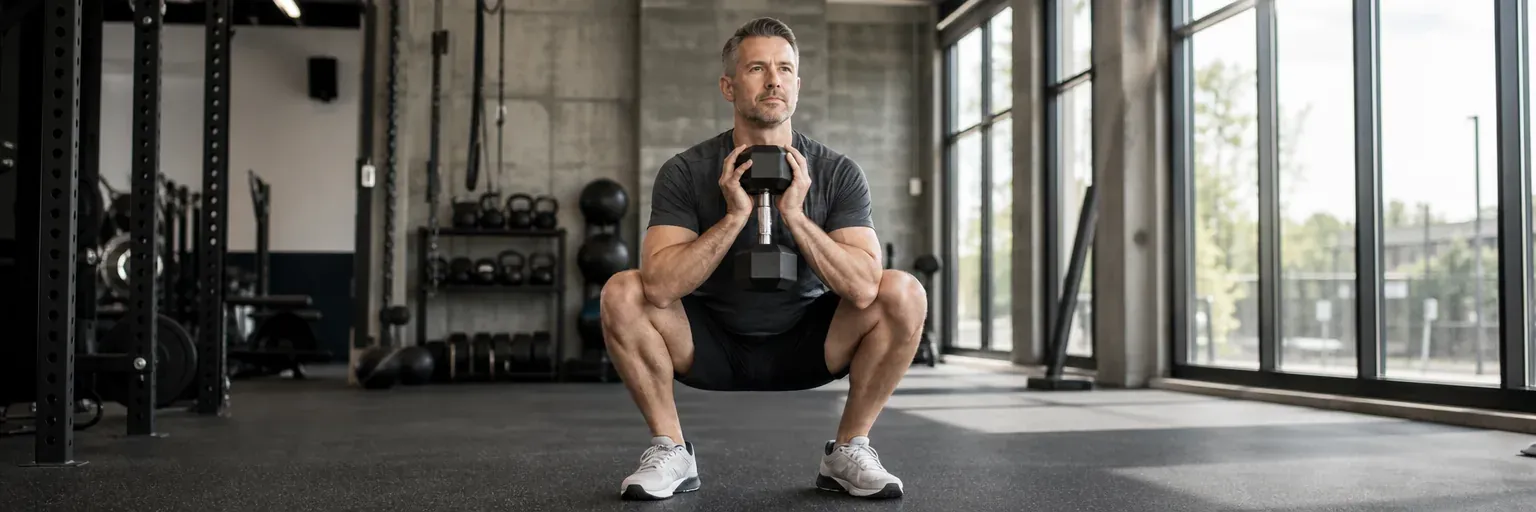
Yes, you should lift weights when you are trying to lose weight — it is the single strongest signal you can send your body to burn fat instead of muscle. Two to four sessions a week in a moderate calorie deficit typically keeps roughly 90 percent of the weight you lose coming from fat rather than lean mass, versus the 60 to 75 percent split most people get from diet alone. Cardio and step count still matter, but they do not send that preservation signal. The rest of this guide is about how much lifting is enough, how to program it, and how to know it is working — starting with the numbers.
Quick stats
- Sessions per week: 2 to 4 for most people; 2 full-body sessions is the minimum effective dose for muscle retention in a deficit.
- Sets per muscle group per week: 10 to 20 hard sets is the evidence-based range (Schoenfeld 2019 volume review). Beginners start at the low end.
- Reps per set: 5 to 12 for strength focus, 8 to 15 for hypertrophy focus. Both drive muscle when sets are taken close to failure (Schoenfeld 2021 loading recommendations).
- Rest between sets: 60 to 180 seconds — longer for heavy compounds, shorter for accessory work.
- Lean-mass retention advantage vs cardio-only in a deficit: roughly +1 to +2 kg additional lean tissue kept, per Miller 2018 Sports Medicine meta of 66 trials.
- Expected strength progression during a moderate cut: flat to +1 or +2 percent on the main compounds for intermediate lifters. That is a win, not a plateau.
Who this is for
This guide is for beginners and intermediate lifters who are eating in a calorie deficit and want to lose fat while keeping as much muscle as possible. It is also relevant if you are:
- Taking a GLP-1 medication and concerned about muscle loss during rapid weight loss.
- Recovering from bariatric surgery and cleared by your care team to start resistance training.
- Over 50 and looking to maintain bone density and functional strength while losing weight.
- A breast-cancer survivor with stable arm lymphedema — the 2009 PAL trial (Schmitz, NEJM) showed slowly progressive resistance training reduces lymphedema exacerbations and symptom severity, overturning the old “don’t lift” advice.
- New to the gym or returning after a long break and unsure where to start.
Strength training is especially important for preserving bone density and muscle mass after 40. See our guide to weight loss for women over 40 for age-specific strategies, or our weight loss for men guide for how lifting fits into a male-specific calorie and protein plan. For men whose primary concern is low testosterone, resistance training preserves lean mass during weight loss and supports the testosterone gains that come from reducing visceral adiposity — see low testosterone and weight loss. If reducing abdominal fat is the specific goal, see how to lose belly fat for the visceral-vs-subcutaneous distinction; if upper-arm fat is what feels stubborn, how to lose arm fat walks through the 12-week beginner arm-and-shoulder plan that builds definition while a full-body deficit does the actual fat-loss work; the lower-body counterpart — a 3-day plan built around goblet squats, hip thrusts, Romanian deadlifts, and Bulgarian split squats that develops the quadriceps, hamstrings, glutes, and adductors underneath the gluteofemoral fat layer — is in how to lose thigh fat. For women in perimenopause and beyond, strength training is non-negotiable — the sarcopenia and bone-density picture compounds with falling estrogen; see menopause and weight loss for the hormonal context and osteoporosis and weight loss for the LIFTMOR resistance-training BMD data and the full bone-protection protocol.
If you have an uncontrolled cardiovascular condition, recent joint surgery, or other medical concerns, get clearance from a clinician before beginning a lifting program. For adults with knee osteoarthritis, lower-body strength training is one of the highest-yield interventions — quad, glute, and calf work measurably reduces pain and improves function alongside weight loss.
Why strength training matters in a calorie deficit
When you eat fewer calories than you burn, your body pulls energy from both fat and lean tissue. Without a signal telling your muscles to stay, a meaningful share of the weight you lose will come from lean mass rather than fat alone. Three mechanisms explain why resistance training is the single most reliable way to shift that ratio.
Lean mass preservation. Resistance training tells the body that the muscle you have is doing work and should be spared. The Willoughby 2019 Nutrients meta of 12 randomized trials found that combining resistance training with a higher-protein intake during a deficit consistently produced net lean-mass retention — and in beginners, small lean-mass gains — while cardio-only plus standard-protein arms lost lean tissue. The Miller 2018 Sports Medicine meta of 66 trials across 3,494 adults showed diet-plus-lifting groups kept an average of 1.4 kg more lean tissue than diet-only groups at equal fat loss. For the unified protocol — protein × training × deficit size — see our guide to preserving muscle during weight loss.
Resting metabolism protection. Lean tissue drives a portion of your resting energy expenditure. Losing 3 to 5 kg of muscle across a diet is a permanent 60 to 120 kcal per day drop in resting metabolism — a hidden headwind on every attempt at maintenance later. Keeping muscle keeps that number stable, which is why the [how-to-increase-TDEE guide] treats lifting and NEAT as the two most reliable long-term levers.
Insulin sensitivity and glycogen sink. Trained muscle acts as a low-friction storage tank for carbohydrate. That improves blood-glucose control during a deficit, reduces the muscle-glycogen fluctuation that makes the scale bounce, and gives you room to eat carbs around workouts without derailing fat loss. In people with insulin resistance or a family history of type 2 diabetes, this second-order benefit alone is often reason enough to lift.
For people on GLP-1 medications, where weight loss can happen quickly, resistance training is one of the strongest tools available for protecting lean mass during treatment.
Evidence at a glance
The trials below are the most-cited resistance-training-and-deficit studies of the last decade. They converge on the same finding: at matched calories, adding resistance training to a diet reliably preserves more lean mass and often produces more fat loss than diet alone.
| Study | Design | Intervention | Deficit | Outcome |
|---|---|---|---|---|
| Longland 2016, AJCN | 4-wk RCT, 40 young men | 2.4 g/kg protein + 6×/wk resistance + HIIT | −40% TDEE | High-P: +1.2 kg lean, −4.8 kg fat. Low-P: −0.1 kg lean, −3.5 kg fat. |
| Miller 2018 meta, Sports Med | 66 studies, 3,494 adults | Diet + resistance training vs diet only | Various | Diet+RT: +1.4 kg lean. Diet only: −1.0 kg lean. Equal fat loss. |
| Willoughby 2019 meta, Nutrients | 12 RCTs, 383 adults | Higher-protein + resistance training vs standard | Various | Consistent lean-mass retention and small gains during deficit. |
| Villareal 2017, NEJM | 6-mo RCT, 141 older adults with obesity | Diet + resistance vs diet + aerobic vs combined | −500 to −750 kcal/d | Combined arm produced the best fat-loss + muscle-quality result. |
| Bellicha 2021 meta, Obesity Reviews | 149 RCTs | Resistance vs endurance vs combined training | Various | Combined training produced the best overall body-composition outcome. |
Two through-lines matter. First, cardio alone is not enough during a deficit — every meta above shows worse lean-mass outcomes in cardio-only or diet-only arms compared with anything that includes resistance training. Second, the effect does not require heroic training volume. Two to four full-body sessions a week is enough to capture almost all of the muscle-preservation benefit shown in the trials above; more volume mostly buys diminishing returns during a cut.
How to program lifting in a deficit
Two templates cover almost every reader. The 3-day full-body plan is the default for beginners and busy schedules. The 4-day upper-lower plan is the natural next step when you can lift more often and want a little more volume per muscle group.
3-day full-body (Mon / Wed / Fri)
Each session hits every major movement pattern — squat, hinge, push, pull, and carry — and lands 6 to 8 hard sets on each major muscle group across the week.
| Slot | Movement | Sets × Reps | RPE target |
|---|---|---|---|
| A1 | Goblet or back squat | 3 × 5 to 8 | 7 to 8 |
| A2 | Dumbbell row or lat pulldown | 3 × 8 to 12 | 7 to 8 |
| B1 | Romanian deadlift or hip hinge | 3 × 6 to 10 | 7 to 8 |
| B2 | Dumbbell bench or push-up | 3 × 8 to 12 | 7 to 9 |
| C1 | Split squat or step-up | 2 × 8 to 12 per leg | 7 to 9 |
| C2 | Overhead press or landmine press | 2 × 8 to 12 | 7 to 8 |
| Finisher | Farmer carry or plank | 2 × 30 to 45 sec | 8 to 9 |
Alternate the two A-block variations (squat one week, back squat the next) if you have both available. Total session time: 40 to 55 minutes.
4-day upper-lower
Best for readers with more time who want slightly more volume per muscle group without pushing session length beyond an hour. Split: Monday upper, Tuesday lower, Thursday upper, Friday lower.
- Upper day A: 3 × 6 to 10 bench, 3 × 8 to 12 row, 2 × 8 to 12 overhead press, 2 × 10 to 15 face pull, 2 × 8 to 12 biceps + triceps superset.
- Lower day A: 3 × 5 to 8 back or front squat, 3 × 6 to 10 Romanian deadlift, 2 × 8 to 12 walking lunge, 2 × 12 to 20 calf raise, 2 × 30 to 45 sec loaded carry.
- Upper day B: 3 × 8 to 12 incline dumbbell press, 3 × 8 to 12 lat pulldown, 2 × 8 to 12 dumbbell shoulder press, 2 × 12 to 15 rear-delt fly, 2 × 8 to 12 curl + triceps extension superset.
- Lower day B: 3 × 5 to 8 deadlift or trap-bar deadlift, 3 × 8 to 12 leg press or hack squat, 2 × 8 to 12 Bulgarian split squat, 2 × 8 to 15 hip thrust, 2 × 12 to 20 hamstring curl.
When to switch templates. Start on the 3-day plan if you are new, restarting after a break, or dieting hard. Move to the 4-day plan once the 3-day plan has felt sustainable for at least 6 to 8 weeks and you have time on Tuesday and Friday to add another 45-minute session. Do not chase 5- or 6-day splits during a deficit — recovery will not keep up and you will bleed strength.
How much cardio to add
Cardio is a complement, not a competitor. The right dose during a cut is enough to widen the deficit and support cardiovascular health without draining the recovery you need for lifting. Readers weighing how to split their week between the two — or wondering whether to drop cardio entirely — should read the head-to-head breakdown in cardio vs strength training for weight loss, which walks through the STRRIDE-AT/RT trial data and lays out a four-row decision framework by time budget and joint status. For readers whose cardio slot is a racket sport, see tennis for weight loss — the 8.0-MET singles / 6.0-MET doubles per-hour math (Ainsworth 2011), the mandatory 2 strength days for calf, glute, and posterior-shoulder health, and the leg-priority strength template that directly reduces the tennis elbow, Achilles, and rotator-cuff injury patterns catalogued in Pluim 2006. For readers whose cardio slot is a climbing-gym session, see rock climbing and bouldering for weight loss — the Ainsworth MET 5.8 (bouldering, session-averaged) / MET 7.0–7.5 (top-rope) per-hour math, and specifically why the 2 push-and-legs strength days are mandatory to balance the pulling volume climbing loads onto the shoulders (Draper 2020).
- Zone-2 sessions: 2 to 3 per week, 30 to 45 minutes at a conversational pace. Walking, cycling, rowing, elliptical, or easy jogging all work. This is the highest-yield cardio dose for weight loss because it eats calories without meaningfully impairing next-day lifting. See Zone 2 cardio for weight loss for the heart-rate math, three methods for finding your zone, and a 12-week starter progression.
- Daily steps: 7,000 to 10,000 per day is the practical target for most adults. Every 1,000-step bump above baseline is measurable extra energy expenditure with essentially zero recovery cost.
- High-intensity intervals: 1 or 2 short sessions per week, 15 to 25 minutes total, if you enjoy them. See HIIT for weight loss for the specific protocols with the best evidence, or boxing and kickboxing for weight loss for a skill-based HIIT pairing that also loads the shoulders and trunk in a pattern lifting rarely reaches.
- Plyometric / power work: 1 or 2 short sessions per week, 15 to 25 minutes each, on non-heavy-legs days. See plyometrics for weight loss for the intensity ladder (Level 0 pogo hops through Level 2 box jumps under 24 in), the 4-week beginner protocol, and the Ramírez-Campillo 2018 evidence on why plyo specifically protects the fast-twitch (Type II) fibers that atrophy first in a calorie deficit — the muscle-preservation lever cardio alone cannot reach.
- Grip and pillar-strength finisher: the finisher slot in the 3-day plan above pairs cleanly with loaded carries for weight loss — a 2×/week farmer + suitcase carry rotation trains grip, posterior chain, and gait-under-load in one movement, with Leong 2015 Lancet PURE documenting grip strength as an all-cause-mortality predictor.
When cardio starts eating muscle. Beyond roughly 4 to 5 hours of moderate-to-hard cardio per week during a deficit, lifts start to fall and recovery worsens — the classic “concurrent training interference” pattern. If you are training for a race or event that requires higher cardio volume, accept that lifting progress will be maintenance-only until the event is done, and prioritize the two lifting sessions per week that keep muscle intact.
How to keep making progress on a cut
The progression curve during weight loss looks different from the surplus curve most beginner programs describe. Set the right expectation and you will not mistake normal for broken.
- Beginners: expect real strength gains for the first 3 to 6 months even in a deficit, because your nervous system has more room to improve than your muscle has to grow. Add reps or weight almost every session.
- Intermediates: expect flat lifts on the main compounds during a cut. Holding a 100 kg squat and a 60 kg bench across a 3-month deficit while dropping 5 kg of body fat is a win, not a plateau — you are 5 kg lighter doing the same work.
- Advanced lifters: expect small decrements on the heaviest lifts as the deficit deepens. Use RPE targets (top set at RPE 7 to 8, not 9 to 10) so effort stays high while absolute load can float down slightly without wrecking motivation.
Rep quality and RPE. During a cut, rep quality is the truer signal of adaptation than absolute weight. If a set that felt like RPE 7 last week feels like RPE 9 this week at the same weight, you are still training hard even though the number on the bar has not moved. That is enough stimulus to preserve muscle.
Deload weeks. Every 6 to 8 weeks — or when performance falls for two sessions running — take a deload week. Cut sets roughly in half at the same weight, keep the movements, and let recovery catch up. A well-timed deload almost always produces a strength bump the following week.
Bodyweight and band alternatives
You do not need a barbell to strength-train productively. A set of resistance bands and body weight can drive gains for the first 6 to 12 months if you make sets progressively harder over time. The trick is that bodyweight movements have to actually get hard — that means near-failure sets, tempo, or unilateral variations, not endless easy reps.
- Squat pattern: bodyweight squat → tempo squat (3-second lowering) → pause squat → Bulgarian split squat → single-leg pistol progression.
- Hinge pattern: hip bridge → single-leg hip bridge → band Romanian deadlift → banded hip thrust.
- Push pattern: knee push-up → full push-up → tempo push-up → decline push-up → deficit push-up.
- Pull pattern: band pulldown → inverted row (feet on floor) → inverted row (feet elevated) → chin-up progression.
- Carry / core: plank → side plank → suitcase carry with any weighted object → farmer carry.
For the equipment-free progressive path built around leverage, tempo, range, and volume — with a 6-level progression ladder from wall push-up through one-arm push-up and pistol squat — see calisthenics for weight loss, which covers the Kotarsky 2018 push-up-vs-bench RCT, the MET / kcal table, and the honest read on the bodyweight load ceiling for advanced hypertrophy.
For a full 8-week bodyweight progression built around these patterns, see our home workouts for weight loss plan. For the band-first version — a 12-week, 3×30-minute program built around a $25–50 tube-band set with door anchor — see resistance band training for weight loss, which walks through band-tier progression as the “add 5 lb per session” analog. For the small-group barbell-and-gymnastic version — where the lifting is programmed by a coach, the schedule is fixed, and the community-and-scheduled-class effect drives adherence — see CrossFit for weight loss, which walks through the 5-modality cost comparison, the injury-rate data, and the scaling rule that keeps beginners safe.
One important non-substitute: barre — the ballet-inspired studio class format — is a muscular-endurance and postural workout, not a loaded resistance program. Barre’s 1-to-3-lb weights and long isometric holds do not produce the mechanical tension needed for muscle protein synthesis at a hypertrophy dose (Kadowaki 2011 EMG data), so barre supports posture, hip-endurance, and adherence but does not replace 1 to 2 sessions per week of the loaded compound work described above. Readers using barre as their primary class format should still program the squat, hinge, push, pull, carry work here on 1 to 2 additional days per week.
If the block on running this program is not the equipment or the programming but the walk into the gym itself — the parking-lot-and-drive-home pattern, the free-weight-rack “everyone is watching me” freeze, the year-long unused membership — the parallel-work pillar covers a 4-driver audit (SPAS, skill-and-equipment FNE, stigma exposure, environmental hostility), a 6-visit graded-exposure protocol, and a full alternative-paths library for a home-strength setup that produces the same lean-mass-preservation benefit outside the gym: weight loss and gym anxiety.
Common mistakes
Five patterns account for most of the “I’m lifting but not seeing the muscle-preservation benefit I expected” cases we see in reader questions.
- Skipping compound lifts for machines. Squats, deadlifts, presses, rows, and carries recruit far more total muscle per rep than isolation machines. A program built on compounds first plus a small amount of isolation work covers almost everyone; a machine-only program leaves lean-mass benefit on the table.
- Chasing “toning” with high-rep-only work. Training exclusively at 20+ reps and light weight rarely produces the mechanical tension that drives muscle retention. Mixed rep ranges — some heavy work in the 5 to 8 range, most in the 8 to 12 range, a little in the 12 to 15 range — is the evidence-based default. And “toning a specific area” is a different mistake: high-rep local sets do not remove the fat above the muscle, only build the muscle underneath, as the spot-reduction myth pillar covers with six null trials.
- Cutting rest days. Muscle grows and repairs during recovery, not during the session. In a calorie deficit recovery capacity is already reduced, so at minimum 2 full rest days per week (or active-recovery walking days) should be non-negotiable. Post-lift ice baths are another quiet way to blunt hypertrophy signalling; separate cold exposure from lifting by at least 4 hours — see the cold exposure for weight loss guide for the Roberts 2015 hypertrophy-blunting evidence.
- Under-eating protein. All of the trials in the evidence table above required 1.6 g/kg or higher protein for the muscle-preservation result. Cutting calories without protecting protein is the fastest way to lose lean mass. See Protein Intake for Weight Loss for the target and per-meal distribution.
- Doing only cardio. Cardio burns calories but does not send a strong muscle-preservation signal. Without resistance training, a larger share of weight loss comes from lean mass. For a balanced approach, see exercise for weight loss.
When to talk to a clinician
Most healthy adults can start a 2- to 3-day full-body lifting program without a medical review. A few situations warrant an individualized conversation first:
- Recent joint or spine surgery. Wait for surgical clearance and start with a physical therapist rather than a general program.
- Uncontrolled cardiovascular disease. Uncontrolled hypertension, unstable angina, or recent cardiac events should be cleared and dose-managed by a cardiologist before heavy lifting.
- Ongoing acute pain. Sharp, worsening pain during a lift is a signal, not something to push through. Get a diagnosis before continuing.
- Late-term pregnancy. Second- and third-trimester lifting can be safe with modifications, but the specifics should be set with your obstetric team.
- Unstable balance or recent falls. Older adults with fall history should start supervised or with hand support to protect against a fall-related fracture.
For older adults, the wider function-first framework — frailty screening, slower deficits, polypharmacy review — is in weight loss for older adults.
Practical next steps
This week
- Choose 2 to 3 days for lifting and block them on your calendar.
- Pick the 3-day full-body template above and do your first session. Use a weight that feels challenging but allows good form for all reps.
- Set a protein target of 1.6 g/kg/day and track intake for a few days to see where you stand.
4-week starter plan
- Weeks 1 to 2: learn the movements. Use light to moderate weight. Focus on form and full range of motion. 2 sessions per week.
- Weeks 3 to 4: add weight or reps each session. Move to 3 sessions per week if recovery allows.
What to track
- Weight used and reps completed for each exercise (a simple notebook or phone app works).
- Body weight as a 7-day rolling average.
- Waist measurement every 2 weeks.
- How you feel: energy, soreness, sleep quality.
If your lifts are progressing, your waist is shrinking, and you are recovering well, the program is working. If you hit a plateau, revisit your calorie intake, sleep, and training volume before making big changes.
How this article was researched
This article draws on peer-reviewed randomized trials, systematic reviews, and position stands examining the effects of resistance training on body fat, lean mass, and resting energy expenditure during calorie restriction. Every numeric claim (session counts, rep ranges, trial deltas, mortality data) is tied to a named study in the Sources block below.
Sources at a glance
- Longland TM et al. Higher compared with lower dietary protein during an energy deficit combined with intense exercise promotes greater lean mass gain and fat mass loss: a randomized trial. American Journal of Clinical Nutrition (2016).
- Miller T et al. Resistance training combined with diet decreases body fat while preserving lean mass: a systematic review and meta-analysis. Sports Medicine (2018).
- Willoughby DS et al. Body composition changes in resistance-trained adults during a calorie deficit with higher versus standard protein: a meta-analysis. Nutrients (2019).
- Villareal DT et al. Aerobic or resistance exercise, or both, in dieting obese older adults. New England Journal of Medicine (2017).
- Bellicha A et al. Effect of exercise training on weight loss, body composition changes, and weight maintenance in adults with overweight or obesity: an overview of 12 systematic reviews and 149 randomized controlled trials. Obesity Reviews (2021).
- Schoenfeld BJ, Grgic J, Van Every DW, Plotkin DL. Loading recommendations for muscle strength, hypertrophy, and local endurance: a re-examination of the repetition continuum. Sports (2021).
- Wewege MA et al. The effect of resistance training in healthy adults on body fat percentage, fat mass and visceral fat: a systematic review and meta-analysis. Sports Medicine (2022).
- Hunter GR et al. Resistance training conserves fat-free mass and resting energy expenditure following weight loss. Obesity (2008).