
2026-06-07 · HIIT, high-intensity interval training, cardio, exercise, weight loss, fat loss
Updated 2026-08-01
Written by Priya Desai
Priya Desai is a WeightFAQ staff writer covering exercise, fitness, and the body-composition side of weight loss. She has written about strength training, HIIT, running, and the best time to exercise, alongside guides to preserving muscle during a deficit, sarcopenic obesity, body recomposition, and creatine. Her body-composition-testing piece walks through DEXA, BIA, and Bod Pod for readers who want more than a scale number, and her articles on plantar fasciitis and fibromyalgia address exercising with pain. Priya writes for readers who want to train usefully without gym pressure or hype.
14 min read
Medically reviewed on Aug 1, 2026
HIIT for Weight Loss: Does High-Intensity Interval Training Actually Burn More Fat?
Quick answer
HIIT burns about the same total fat as moderate-intensity steady-state cardio when sessions are matched for perceived effort — but it does so in 30 to 50 percent less time. The “afterburn” (EPOC) is real, but it typically adds only 25 to 80 extra calories per session, not the 300 to 500 that supplement ads and clickbait often promise. The best use case is for time-constrained adults who already have a baseline of aerobic fitness. HIIT is not the right starting point for true beginners, the chronically stressed and under-recovered, or anyone already accumulating five-plus hours of running or cycling per week.
What HIIT actually is (and isn’t)
HIIT — high-intensity interval training — alternates short bouts of near-maximal effort with periods of rest or low-intensity recovery. The defining feature is intensity, not duration: each “work” bout takes you above your lactate threshold. If you can hold a normal conversation during the work intervals, it isn’t HIIT — it’s vigorous steady-state cardio.
Work bouts can range from 20 seconds to about 4 minutes. The total session is typically 15 to 35 minutes including warm-up and cool-down, with 6 to 30 minutes of actual interval work.
A few related terms get used interchangeably but mean different things:
- MICT (moderate-intensity continuous training). A steady jog, swim, or bike ride at 65 to 75 percent of max heart rate. Conversational pace. The reference standard for cardio.
- LISS (low-intensity steady-state). Walking, easy cycling, slow swimming at 50 to 65 percent of max heart rate. Highly sustainable, low recovery cost. The foundation of most weight-loss plans.
- Tabata. A specific HIIT protocol — 20 seconds work, 10 seconds rest, repeated 8 times for 4 minutes of total work. From a 1996 study by Izumi Tabata using all-out cycling.
- SIT (sprint interval training). Even harder than typical HIIT — supramaximal sprints of 10 to 30 seconds with full recovery between. Very high adaptation per minute, but recovery cost is steep.
For most people, “HIIT” in practice means the middle of that range: 30-second to 4-minute work bouts on a bike, rower, or running interval, alternated with easy or rest periods.
The afterburn (EPOC) — honest math
EPOC stands for “excess post-exercise oxygen consumption.” After a hard session, your metabolism stays elevated for several hours as your body restores oxygen stores, clears lactate, and repairs tissue. That elevation burns extra calories — the “afterburn.” It is real, and it is routinely exaggerated.
A 2006 review by LaForgia and colleagues and a 2015 paper by Greer and colleagues put EPOC at roughly 6 to 15 percent of the session’s calorie cost for true HIIT:
- A 30-minute HIIT session that burns 250 calories during the workout adds roughly 25 to 80 extra calories in EPOC.
- A 20-minute bodyweight Tabata session burning 180 calories adds maybe 15 to 50 extra.
- Three weekly HIIT sessions: about 75 to 240 extra calories total. A half-cookie to a small candy bar.
Useful, not transformative. Reject the framing that a 20-minute HIIT workout “burns calories all day.” The bulk of the calorie cost is still the work itself.
HIIT vs steady-state cardio — what the trials show
For weight loss specifically, the question is not “which feels harder” but “what do controlled trials actually show?” Three pieces of evidence frame it cleanly:
- Wewege and colleagues (2017 meta-analysis): HIIT and MICT produced equivalent fat loss when total exercise work was matched. Neither was meaningfully superior for body composition, including visceral fat — a useful data point for anyone using HIIT to work on how to lose belly fat, where the visceral depot is the target that actually matters. And the visceral-fat response to HIIT is a systemic drainage effect, not spot reduction of the abdomen — no burpee or mountain-climber preferentially strips fat from the muscle it works.
- Keating and colleagues (2017 meta-analysis): HIIT slightly outperformed MICT for VO2max gains and time efficiency. Equivalent for body composition outcomes.
- Türk and colleagues (2017 systematic review): HIIT produced about 28 percent less fat loss per minute of exercise, but in roughly 40 percent less total time. The net effect on fat loss per hour of life spent training was a wash.
The practical takeaway is unglamorous: the best cardio for weight loss is the one you will do consistently for months. HIIT’s real advantage is time efficiency — you finish a hard session in 20 minutes instead of 50. Its disadvantages are recovery cost, joint and tendon stress, and the higher barrier to consistency that comes with high-intensity work. Steady-state cardio is easier to repeat day after day for years.
For readers who want the power-output and bone-density side of the same high-intensity family — box jumps, jump squats, and depth work programmed with full recovery between reps rather than the short-rest interval structure HIIT uses — see plyometrics for weight loss for the intensity ladder, 4-week beginner protocol, and the honest per-hour calorie math (comparable to a brisk-jog interval; the differentiator is fast-twitch preservation and EPOC, not raw kcal).
If you have 25 minutes and need cardio that fits a busy schedule, HIIT is excellent. If you have an hour to walk or jog and find that more sustainable, walking and jogging work fine too.
Who HIIT works well for
HIIT is a strong fit if you are:
- Time-constrained — 20 to 30 minutes per session is realistic; an hour is not.
- Aerobically conditioned at a baseline level — 6 to 8 weeks of consistent moderate cardio (walking briskly, easy jogging, cycling) before adding HIIT.
- A strength trainee who wants to add cardio without compromising lifting recovery — short HIIT sessions add cardiovascular stimulus without the recovery cost of long steady-state runs.
- Bored by steady-state cardio — adherence beats theoretical optimality every time. If intervals are the only cardio you’ll actually do, intervals are the right cardio. If bike or rower intervals feel repetitive, boxing and kickboxing for weight loss is the most engaging skill-based alternative to intervals — a 60-minute cardio-boxing class delivers the same HIIT physiology at ~8 METs with combos and footwork that keep boredom out. For a lower-skill-floor group-fitness alternative that trades some peak intensity for much better long-term adherence, dance fitness for weight loss covers Zumba, hip-hop cardio, and aerobic dance at 5–7 METs with 3–4× the stick-with-it rate of solo intervals. For the small-group version that layers Metcon-style intervals onto barbell and gymnastic work in a coached box, see CrossFit for weight loss — the 300–500 kcal per 60-min class runs at 6–8 METs and adds the community-and-scheduled-class effect that drives the 89% adherence figure in the Meyer 2017 intervention.
- Looking to improve VO2max and metabolic health markers, not just lose weight — HIIT has a small but consistent edge here.
Who HIIT does NOT work well for
HIIT is over-prescribed online to people who would do better elsewhere:
- True beginners — deconditioned adults with no recent cardio history. The cardiovascular and joint demand is high and adherence drops. Start with walking for weight loss and build a 6-to-8-week base first. If HIIT is too intense but flat walking is not enough, the 12-3-30 workout for weight loss is the low-impact steady-state incline protocol that lands most adults in Zone 2 / Zone 3 without the joint load of running or the recovery cost of interval work.
- Chronically stressed or under-recovered adults. High-intensity work compounds sympathetic load. If sleep is poor and stress is high, lower-intensity movement is higher leverage.
- Runners or cyclists already training 5-plus hours per week. Adding HIIT cuts into recovery without much marginal benefit.
- Pregnant or recently postpartum people without clearance from their care team. See weight loss after pregnancy for return-to-exercise pacing.
- Anyone with cardiovascular disease, uncontrolled high blood pressure, recent joint injury, or chest pain on exertion — get medical clearance before starting.
- Adults with active knee osteoarthritis — the jumping and high-impact intervals load the joint at 5 to 8 times body weight and often flare symptoms; switch to low-impact bike or rower HIIT, or defer HIIT until weight loss and strength have controlled pain.
Sample HIIT workouts (no equipment to bike to rower to step mill)
These protocols cover the practical range across modalities. All include a 3-to-5-minute warm-up and 2-to-3-minute cool-down. Note also that the stair climber for weight loss supports the Allison 2017 sprint-interval protocol (3 × 20-second all-out efforts, 2 minutes easy between, 3 times per week) — one of the shortest evidence-based HIIT protocols and a good fit for readers who dislike running sprints but tolerate step-mill work.
Beginner — Bodyweight Tabata
20 seconds work / 10 seconds rest, 8 rounds (4 minutes of work). Repeat with three movements: squats, push-ups (knee push-ups if needed), reverse lunges. Total session: 20 to 25 minutes. The gentlest real HIIT — no equipment, scalable, doable at home. Readers who want a full 4-day-per-week bodyweight strength program to run alongside HIIT can plug this in as the conditioning finisher — see home workouts for weight loss for the 8-week no-gym plan. For the highest calorie-per-minute HIIT modality — roughly 12 METs at moderate pace, higher per minute than running — see jump rope for weight loss; its inherently interval-structured technique breaks map cleanly onto a 30/30 or Tabata protocol without needing an app.
Bike sprint protocol (most studied)
30 seconds all-out / 90 seconds easy spin, 6 to 8 rounds. Full session: 18 to 22 minutes. This format matches many of the foundational HIIT studies. A stationary bike lets you apply maximum effort without joint impact. For the full spin-class, Peloton, and stationary-bike HIIT context — including the honest console-kcal read — see indoor cycling for weight loss.
Rower 1-minute intervals
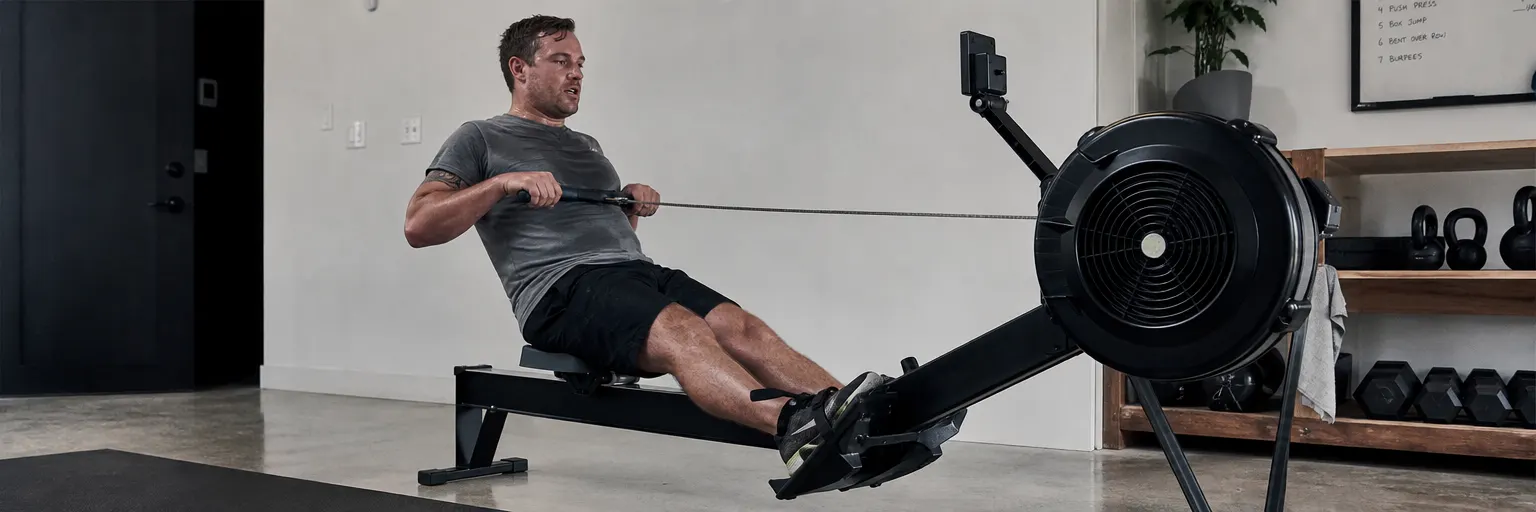
1 minute hard / 1 minute easy, 10 rounds. Full session: 25 minutes. Hard means 80 to 90 percent effort — strong strokes, breathing hard. The rower spreads load across legs, back, and arms, making it less injury-prone than running intervals.
Running 4×4 (Norwegian protocol)
4 minutes at 85 to 95 percent of max heart rate / 3 minutes easy jog, 4 rounds. Full session: 35 minutes. The highest VO2max stimulus of the four. Use only if you’ve been jogging consistently for several months with no joint or cardiovascular contraindications.
How often per week?
- Beginners (cleared for HIIT): 2 sessions per week, 48 hours between sessions.
- Intermediate (3-plus months of consistent training): 2 to 3 sessions per week.
- Cap at 3 sessions per week for almost everyone. Beyond that, returns diminish and injury risk climbs.
HIIT works best paired with other modalities, not as a standalone program. A productive HIIT-focused week: 2 HIIT sessions, 2 strength training sessions to preserve lean mass, daily walking of 7,000-plus steps, and one full rest day. Add adequate protein, sleep, and a moderate calorie deficit if fat loss is the goal. If you plunge for recovery, the same 4-hour buffer applies as with lifting — see the cold exposure for weight loss guide for the recovery-vs-adaptation trade-off.
Heart-rate zones — how hard is “high intensity”?
A heart-rate monitor (chest strap more accurate than wrist) gives an objective target for “hard enough”:
| Zone | % HRmax | Talk test | HIIT? |
|---|---|---|---|
| Zone 2 (LISS) | 60–70% | Easy conversation | No |
| Zone 3 (MICT) | 70–80% | Short sentences | No |
| Zone 4 | 80–90% | One word at a time | Yes — interval ceiling |
| Zone 5 (SIT) | 90–100% | Cannot speak | Yes — sprint protocols |
Estimate maximum heart rate as roughly 220 minus your age — good enough as a starting point, though individual variation is significant. For the low-intensity companion to a HIIT program — the steady 45- to 60-minute sessions that build the mitochondrial and fat-oxidation base HIIT layers on top of — see Zone 2 cardio for weight loss.
The most common mistake in self-directed HIIT is undercooking the work bouts. People stall in upper Zone 3 because Zone 4 feels uncomfortably hard. The point of HIIT is that it is uncomfortably hard. If you can speak full sentences during a work bout, you are not doing HIIT.
The 4-week beginner HIIT plan
Prerequisites: you can walk briskly for 30 minutes, have no cardiovascular contraindications, and have been moving regularly for 6 to 8 weeks.
- Week 1: 1 session of bodyweight Tabata — 20s work, 10s rest, 6 rounds (3 minutes of work). Squats only. Plus daily walking.
- Week 2: 2 sessions, 6 rounds each. Squats one day, push-ups the other. 48 hours between.
- Week 3: 2 sessions of full Tabata (8 rounds, 4 minutes of work). Add one short sprint walk-back session on day 5 — 30-second sprint, walk back, × 4.
- Week 4: 2 sessions of full Tabata plus 1 bike or rower session at 30s/90s × 6 rounds.
Track rate of perceived exertion (RPE 1–10), not just time. By week 4, work bouts should feel 8 or 9 — gasping, glad when the bout ends. If anything feels wrong — chest tightness, lightheadedness, sharp joint pain — stop and reassess.
HIIT mistakes that kill results
- Turning every workout into HIIT. No recovery, rising cortisol, sleep disruption. Cap at 3 sessions per week.
- Doing HIIT fasted with no protein anchor. A small amount of protein and carbohydrate before or after supports recovery. See protein intake for weight loss for daily targets. Intervals are the specific case where fasted work is worst — the Aird 2018 meta shows meaningful performance drop-off above Zone 2 in a fasted state; the fasted cardio for weight loss evidence walk-through explains why fasted intervals are the wrong pairing.
- Skipping strength training in favor of more HIIT. Cardio doesn’t preserve muscle the way resistance training does. In a deficit, strength training matters more than extra HIIT sessions — the head-to-head evidence and a decision framework for splitting weekly time between the two are in cardio vs strength training for weight loss. A loaded-conditioning option that hybridizes both — see kettlebell training for weight loss — makes every rep of a HIIT-style interval both a cardio and a strength stimulus.
- Using HIIT to “earn” extra calories at meals. A 20-minute session burns 200 to 300 calories — easily exceeded by a celebratory post-workout dessert.
- Going hard but not actually hitting Zone 4. Intermediate intensity gets you neither the time-efficiency benefit of HIIT nor the recoverability of steady-state. Don’t split the difference.
- Adding HIIT on top of high training volume. If you’re already running 5-plus hours per week or lifting hard 4-plus days, more HIIT costs more in recovery than it adds in benefit.
Frequently asked questions
Is HIIT better than running for weight loss? Not for total fat lost — matched-work meta-analyses show HIIT and steady-state running produce equivalent fat loss. HIIT wins on time efficiency; running wins on recoverability and sustainability. See running for weight loss for the steady-state side.
How many calories does a 20-minute HIIT workout burn? Roughly 180 to 300 calories during the workout depending on body weight and intensity, plus another 25 to 80 in EPOC over the next several hours.
How many HIIT workouts per week is best for fat loss? Two to three sessions, with at least 48 hours between sessions. More than three shows diminishing returns and rising injury risk.
Can I do HIIT every day? No. By definition, HIIT takes you above lactate threshold, which requires recovery between sessions. Alternate with walking, easy cardio, mobility, or strength training.
Does HIIT really burn fat for hours after? Yes, but the effect is modest. Meta-analyses put EPOC at 6 to 15 percent of session calorie cost — about 25 to 80 extra calories — not the 300-plus sometimes advertised.
Is HIIT safe for beginners? For deconditioned adults, no — start with walking and 6 to 8 weeks of progression first. For people with a baseline of regular movement and no cardiovascular contraindications, a gentle bodyweight Tabata is reasonable.
What’s the difference between HIIT and Tabata? Tabata is a specific HIIT protocol: 20 seconds work, 10 seconds rest, 8 rounds (4 minutes of work). HIIT is the broader category of any interval format where work bouts push above lactate threshold.
How this article was researched
This article draws on peer-reviewed meta-analyses and systematic reviews comparing HIIT to moderate-intensity continuous training for body composition, fat loss, and cardiometabolic outcomes. EPOC estimates are based on the LaForgia and Greer reviews of post-exercise oxygen consumption across exercise intensities and modalities.
Sources
- Wewege M, van den Berg R, Ward RE, Keech A. The effects of high-intensity interval training vs. moderate-intensity continuous training on body composition in overweight and obese adults: a systematic review and meta-analysis. Obesity Reviews (2017).
- Keating SE, Johnson NA, Mielke GI, Coombes JS. A systematic review and meta-analysis of interval training versus moderate-intensity continuous training on body adiposity. Obesity Reviews (2017).
- LaForgia J, Withers RT, Gore CJ. Effects of exercise intensity and duration on the excess post-exercise oxygen consumption. Journal of Sports Sciences (2006).
- Greer BK, Sirithienthad P, Moffatt RJ, Marcello RT, Panton LB. EPOC comparison between isocaloric bouts of steady-state aerobic, intermittent aerobic, and resistance training. Research Quarterly for Exercise and Sport (2015).