
2026-07-05 · compounded semaglutide, compounded tirzepatide, GLP-1, FDA, 503A, 503B, pharmacy compounding, drug safety
Written by WeightFAQ Staff
Evidence-informed guidance from the WeightFAQ editorial team.
19 min read
Last editorial review Jul 5, 2026
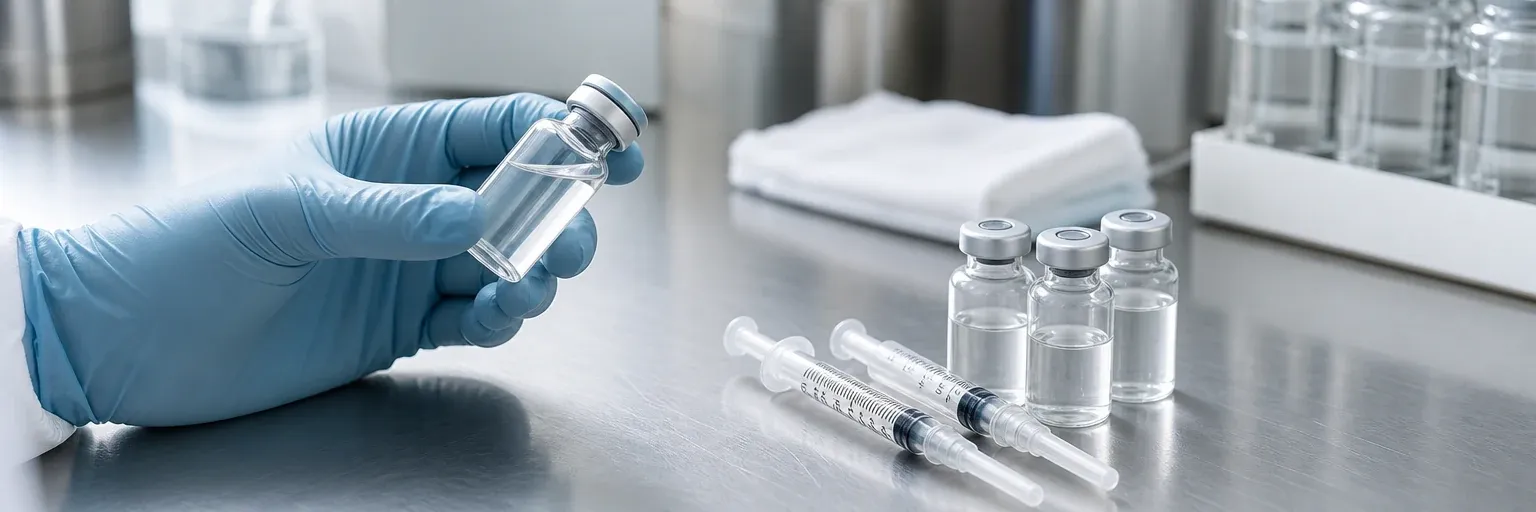
Compounded Semaglutide and Tirzepatide in 2026: Safety, Legality, and Quality After the Shortage Ended
Compounded semaglutide and tirzepatide exploded during the 2022–2024 GLP-1 shortage, filled a real access gap for millions of US adults, and then became largely illegal on 2 October 2024 (FDA 2024 Semaglutide Shortage Resolution Notice) and 19 December 2024 (FDA 2024 Tirzepatide Shortage Resolution Notice) when the FDA declared both drugs no longer in shortage. The 2026 landscape is genuinely different from the compounding-was-normal era of 2023: Section 503A of the Federal Food, Drug and Cosmetic Act prohibits compounders from producing a copy that is essentially the same as the FDA-approved product once that product is no longer in shortage, and FDA 2025 guidance narrowed the clinical-need exceptions to documented allergy to an excipient, a dose not commercially available, or a medically necessary combination product.
The honest framing: compounded semaglutide and tirzepatide were a legitimate shortage-era response for a real access problem. They were also uneven in quality. Some compounders used the FDA-warned-against sodium salt form (FDA 2023 Warning Letters on Semaglutide Salt Forms), dosing was often expressed in unfamiliar units of IU/mL rather than mg per dose, and the FDA has documented multiple hospitalisations and at least one death attributed to compounded-product unit-conversion errors (FDA 2024 Adverse Event Communication on Compounded Semaglutide). The safest 2026 path is FDA-approved product from Ozempic, Wegovy, Rybelsus, Mounjaro, or Zepbound. If compounding is being used, patient-specific 503A prescriptions from state-licensed pharmacies with clear mg-per-dose labelling — not online telehealth clinics selling generic-looking product — are the legitimate option.
The same regulatory picture — with even less legal cover — applies to gray-market vials sold as “retatrutide,” Eli Lilly’s investigational triple-agonist that is not FDA-approved, has never been on the FDA drug-shortage list, and cannot legally be compounded under Section 503A. Any product labeled “retatrutide” on a telehealth clinic or research-peptide vendor site is not the Lilly molecule from the Jastreboff 2023 NEJM Phase 2 trial. Read the retatrutide page for the full picture on why waiting for the FDA-approved product is the only safe route.
Quick stats
- 2 October 2024 — FDA declared semaglutide no longer in shortage; 503A “essentially a copy” prohibition triggered for Ozempic and Wegovy compounded copies (FDA 2024 Semaglutide Shortage Resolution Notice).
- 19 December 2024 — FDA declared tirzepatide no longer in shortage; same trigger for Mounjaro and Zepbound compounded copies (FDA 2024 Tirzepatide Shortage Resolution Notice).
- June 2023 — FDA warning letters to compounders on semaglutide sodium and acetate salt forms — not the same active ingredient as FDA-approved semaglutide base (FDA 2023 Warning Letters).
- 3,000+ poison-control calls related to semaglutide from 2019 through 2023, a substantial fraction linked to compounded-product dosing errors (CDC 2024 Poison Control Reports on Compounded GLP-1s).
- 503A is state-regulated patient-specific compounding; 503B is FDA-regulated outsourcing-facility compounding — two different regulatory universes.
- 911 red flag — accidental 10× overdose or IU/mL versus mg dose-conversion confusion, severe pancreatitis, or acute allergic reaction.
- 1-800-222-1222 — US Poison Control for immediate guidance on a suspected compounded-product overdose or unit-conversion error.
The regulatory background you need to understand
Three product categories, three different rulebooks. Getting these straight is the difference between a legitimate 2026 prescription and a legally grey purchase.
| Category | What it is | Regulator | 2026 legality |
|---|---|---|---|
| FDA-approved product | Ozempic and Wegovy (semaglutide base), Rybelsus (oral semaglutide), Mounjaro and Zepbound (tirzepatide); pharmaceutical-grade API; efficacy and safety proven in STEP and SURMOUNT trials; labelled in mg per pen click | FDA — full new drug application and cGMP manufacturing | Legal; the default 2026 choice |
| Section 503A patient-specific compounding | Traditional pharmacy compounding under a valid individual prescription for a specific named patient | State board of pharmacy; state-regulated with wide quality variability | Legal in limited clinical-need scenarios (documented allergy, unavailable dose, medically necessary combination) per FDA 2025 guidance |
| Section 503B outsourcing-facility compounding | FDA-registered outsourcing facilities; may compound in advance of prescriptions for hospitals and clinics; a much smaller universe | FDA — cGMP inspections and outsourcing-facility registration | Legal in the same narrow clinical-need scenarios; Outsourcing Facilities Association v. FDA 2025 created a limited injunction on 503B tirzepatide during the appeal window |
How the shortage-and-resolution timeline unfolded
The dates matter — they determine what was legal when, and they explain why some compounders wound down programs in early 2025 while others continued under litigation.
| Date | Event |
|---|---|
| March 2022 | Ozempic and Wegovy formally added to FDA drug-shortage list; 503A and 503B compounding of semaglutide became permissible under shortage-era rules |
| December 2022 | Mounjaro formally added to FDA drug-shortage list; Zepbound approved November 2023 and added to shortage-list coverage |
| June 2023 | FDA warning letters to compounders using semaglutide sodium and acetate salt forms; the sodium salt is not the same active ingredient as FDA-approved semaglutide base (FDA 2023) |
| 2 October 2024 | Semaglutide shortage declared resolved (FDA 2024 Semaglutide Shortage Resolution Notice); Section 503A “essentially a copy” prohibition triggered for Ozempic and Wegovy compounded copies |
| 19 December 2024 | Tirzepatide shortage declared resolved (FDA 2024 Tirzepatide Shortage Resolution Notice); same trigger for Mounjaro and Zepbound compounded copies |
| 2025 | Federal-court injunctions in Outsourcing Facilities Association v. FDA narrowly permitted 503B tirzepatide during the appeal; state boards of pharmacy escalated enforcement; FDA 2025 Section 503A Guidance clarified narrow clinical-need exceptions |
What “compounded” actually means
Four points that most 2023-era readers never had to think about, and that matter more now.
Not a generic
FDA-approved semaglutide and tirzepatide are still under active US patent. There is no legal generic version of either drug in 2026. A pharmacy selling “generic semaglutide” is not offering a generic in the FDA-approved sense of the word — it is offering a compounded product, which is a regulatory category with a different rulebook and different quality-control standards. Salt forms (semaglutide sodium, semaglutide acetate) are not the same as the base form and are not covered by the FDA’s approval of Ozempic or Wegovy (FDA 2023 Warning Letters).
API sourcing variability
Compounded product is only as good as its active pharmaceutical ingredient (API). Some 503A pharmacies source semaglutide base from FDA-inspected foreign manufacturers with legitimate certificates of analysis; others source from research-chemical suppliers with limited or unverifiable quality controls. The variability is not visible to the patient at the point of sale. This is the single biggest quality question in the compounded-GLP-1 market, and it does not have a consumer-facing solution — the state board of pharmacy and the FDA are the enforcement mechanisms.
Dosing unit confusion
FDA-approved Ozempic and Wegovy dose in mg per pen click — the pen delivers a fixed volume at a fixed concentration, and the user does not have to do any conversion math. Compounded product is typically supplied as a vial with a concentration in mg/mL or IU/mL and a syringe. A patient who reads 250 IU on a syringe scale as 2.5 mg when the concentration actually makes it 0.25 mg has caused a 10× overdose. The FDA’s 2024 Adverse Event Communication documented multiple hospitalisations and at least one death from this exact conversion error.
Not the same as pharmaceutical-grade in a shortage-appropriate context
Even during the 2022–2024 shortage window when compounded product was broadly legal, adverse-event reporting was uneven, product labelling was inconsistent, and quality varied widely between pharmacies. The shortage-era permission to compound was a regulatory accommodation, not a statement that compounded product was equivalent to FDA-approved product on efficacy, safety, or quality. Any 2026 conversation about compounded GLP-1 should start from that baseline.
Clinical-need exceptions that remain legal in 2026
FDA 2025 Section 503A Guidance enumerated the narrow scenarios in which a 503A patient-specific compounded semaglutide or tirzepatide product remains legal after the shortage ended. These are the honest options for a patient with a genuine clinical reason to prefer compounded over FDA-approved product.
| Exception | What it means in practice |
|---|---|
| Documented allergy | The patient has a documented allergy or intolerance to a specific excipient in the FDA-approved product — for example, a preservative or buffer — and a compounded formulation without that excipient is medically necessary |
| Pediatric or renal dose | A dose strength not commercially available in the FDA-approved product line is medically necessary — for example, a pediatric or renal-adjusted dose that Ozempic and Wegovy do not offer |
| Medically necessary combination product | A combination with pyridoxine, cyanocobalamin, or another compatible ingredient is medically necessary and not commercially available as a fixed-dose FDA-approved product |
| Documented individual supply gap | The FDA-approved product is unavailable at the patient’s local and mail-order pharmacies despite documented attempts — a much narrower route than the historical shortage-list broad permission |
| Off-label use — grey area | Prescribing FDA-approved product off-label (for example, microdosing) remains legal, but compounding “essentially a copy” of that product for the off-label purpose is now prohibited under Section 503A; the legal route is a prescription for an approved starter dose used off-label under supervision |
How to evaluate a compounding pharmacy
If a clinical-need exception applies and compounded product is being used, five checks separate a legitimate 503A pharmacy from a telehealth-storefront reseller.
1. State board of pharmacy licensure
Every US state has a board of pharmacy with a public license lookup. Verify current licensure in the state where the pharmacy operates and in the state where you receive shipments. Cross-state licensure is required; a pharmacy operating from Florida and shipping to Massachusetts must hold a non-resident Massachusetts pharmacy licence in addition to its Florida licence. Interstate-compounding enforcement actions were a major theme of 2024 and 2025 state board activity (NABP 2024 State Board of Pharmacy Enforcement Actions Summary).
2. Individual prescription from your prescribing clinician
Section 503A compounding is patient-specific by statute. A legitimate 503A prescription comes from a clinician who has actually seen and evaluated the patient — not from an online questionnaire scored by an algorithm and countersigned by a physician who never met the patient. The mass-market telehealth-clinic model in which one physician nominally supervises tens of thousands of prescriptions per month is not consistent with the traditional 503A framework (APhA 2024 Compounding Position Statement).
3. Ingredient identity — semaglutide (base), not sodium
Read the pharmacy’s product label. It should state semaglutide or semaglutide base with a strength in mg per dose or mg/mL. It should not state semaglutide sodium or semaglutide acetate — those are salt forms the FDA has explicitly warned against (FDA 2023 Warning Letters), with unknown efficacy and safety in humans. For tirzepatide, the label should state tirzepatide with a mg-per-dose strength. If the label is unclear, ask the pharmacy for a certificate of analysis and the API supplier’s identity.
4. Clear mg-per-dose labelling
The single biggest source of hospitalisation from compounded GLP-1 has been unit-conversion error. A legitimate compounding pharmacy labels a vial with both the concentration (mg/mL) and a clear weekly dose instruction in mg — for example, “draw 0.5 mg (0.2 mL of 2.5 mg/mL) once weekly.” An IU/mL-only label with no mg equivalent is not adequate; ask for a mg-per-dose reconstitution card or refuse the product (FDA 2024 Adverse Event Communication).
5. Adverse-event reporting pathway
A legitimate 503A pharmacy supports FDA MedWatch reporting for any adverse event and can name the reporting pathway. It also has a real address, a licensed pharmacist accessible by phone, and a state-board complaint process. A pharmacy that will not name its MedWatch pathway or its supervising pharmacist is not a pharmacy you should be using.
How the treatment landscape compares in 2026
Six categories, six different risk and access profiles. The table is the honest 2026 map.
| Category | Evidence & quality | 2026 legality | Approx. US monthly cost |
|---|---|---|---|
| FDA-approved Ozempic / Wegovy | STEP-1: 12–15% body weight loss at 68 wk (Wilding 2021); cGMP; FDA-inspected | Legal; default 2026 choice | ~$500 via Novo Nordisk direct-cash Wegovy; ~$1,300 list |
| FDA-approved Mounjaro / Zepbound | SURMOUNT-1: 20–22% body weight loss at 72 wk (Jastreboff 2022); cGMP; FDA-inspected | Legal; default 2026 choice | ~$350–$550 via Lilly Direct single-dose vials; ~$1,000 list |
| 503A patient-specific compounded | Extrapolated from FDA-approved efficacy; state-regulated; wide quality variability | Legal only under narrow clinical-need exceptions (FDA 2025) | ~$150–$350 typical 2024 pricing |
| 503B outsourcing-facility compounded | Extrapolated efficacy; FDA-registered cGMP facilities; limited independent data | Legal only under narrow clinical-need exceptions; OFA v. FDA 2025 injunction for tirzepatide during appeal | ~$200–$400 |
| Online telehealth-clinic “compounded” | No independent efficacy data; documented dose-conversion errors and salt-form product (FDA 2024; NABP 2024) | Grey to illegal for essentially-a-copy semaglutide or tirzepatide | ~$150–$300 |
| Research-chemical resellers | None; not intended for human use; unregulated | Illegal to sell for human use | Variable |
Special-situation sections
The microdosing regulatory grey area
Microdosing — 0.125 to 0.5 mg semaglutide equivalents weekly, or the tirzepatide equivalent, off-label for weight or metabolic goals — was one of the largest growth areas for compounded product in 2023 and 2024. The 2026 legal picture is: prescribing FDA-approved product off-label is legal, so a clinician can prescribe a 0.25 mg Ozempic or Wegovy starter pen for a patient who never titrates past that dose. Compounding an essentially-a-copy sub-therapeutic dose from bulk API is a different question, and FDA 2025 guidance treats it as prohibited under Section 503A unless a clinical-need exception applies. The safer 2026 microdosing route is a starter-dose FDA-approved pen used off-label under prescriber supervision. See the GLP-1 microdosing guide for the fuller framing.
The sodium salt form issue
FDA 2023 Warning Letters to compounding pharmacies were explicit: semaglutide sodium and semaglutide acetate are not the same active ingredient as the FDA-approved semaglutide base in Ozempic, Wegovy, and Rybelsus. The salt forms were not evaluated in the STEP trials, and no bioequivalence data exist. Detection is a label check: the label should read semaglutide or semaglutide base with a mg-per-dose strength. A label that reads semaglutide sodium or semaglutide acetate is a product the FDA has explicitly warned against and should not be used. The state board of pharmacy is the appropriate complaint channel for a pharmacy dispensing salt-form product without disclosure.
Do not compound novel combinations from separate peptides
A 2026 trend to flag: “DIY” stacks that combine compounded semaglutide with a separately-sourced research-chemical peptide — most commonly cagrilintide (marketed to consumers as home-mix “CagriSema”), or research-chemical retatrutide. These are not compounded products under any legitimate 503A or 503B pathway; they are unregulated peptide combinations of unknown identity, sterility, and potency. Cagrilintide has never been FDA-approved, has never been on the shortage list, and has no compounding pathway. Reports of hospitalization from home-mixed peptide stacks have emerged in 2026 poison-control data. Waiting for the FDA-approved fixed-dose combination — see CagriSema for weight loss for the current REDEFINE evidence and realistic 2027 timeline — is the only safe route.
Reporting an adverse event
Three channels, used in parallel where warranted. FDA MedWatch (1-800-FDA-1088 or the online reporting portal) is the federal adverse-event surveillance system and the FDA has explicitly asked patients and clinicians to report compounded-GLP-1 events. Poison Control (1-800-222-1222) provides immediate 24-hour guidance for a suspected overdose, unit-conversion error, or accidental pediatric ingestion. The state board of pharmacy in the state where the pharmacy operates is the licensure-and-enforcement channel for mislabelling, salt-form product, or unlicensed physician oversight (NABP 2024). For life-threatening events — severe pancreatitis, severe hypoglycaemia with unresponsiveness, or acute allergic reaction — 911 comes first, then the reports.
Cost math in 2026
The economics changed sharply. In 2023, list-price Wegovy at roughly 1,300 US dollars per month made compounded semaglutide at 150 to 250 US dollars a large cost gap. In 2024 Novo Nordisk launched a direct-cash pathway pricing Wegovy at roughly 500 US dollars per month for cash-pay patients, and Eli Lilly’s Lilly Direct offered single-dose Zepbound vials at 350 to 550 US dollars. For patients who were on compounded product primarily for cost reasons, the direct-cash FDA-approved pathway often now costs less than the compounded alternative — without the sodium-salt-form, mislabelling, or dose-conversion risks. See the GLP-1 cost and insurance guide for the fuller pricing table.
Cash-pay versus insurance
Cash-pay and insurance-covered are two different economics. Insurance-covered Wegovy or Zepbound requires prior authorisation, documented BMI, prior weight-loss attempts, and often a related-condition diagnosis; the copay is typically 25 to 100 US dollars per month once approved. Direct-cash Novo Nordisk Wegovy or Lilly Direct Zepbound cannot be combined with insurance and runs 350 to 550 US dollars per month, but requires no prior authorisation. For patients whose insurance covers weight-loss medication, insurance is almost always cheaper. For patients whose insurance excludes weight-loss medication — still common in employer plans as of 2026 — the direct-cash pathway has replaced most of the legitimate cost case for compounded product.
When your telehealth clinic switches from compounded to brand-name mid-treatment
This became common through 2025. The dose-conversion step is where transitions fail. Compounded product is typically labelled in mg/mL with a syringe; FDA-approved product is labelled in mg per pen click. A patient stable at 1.7 mg weekly compounded semaglutide should be switched to the 1.7 mg Wegovy weekly pen, not the 2.4 mg maintenance dose. The transition week should not skip a dose. Expect a brief GI-tolerability adjustment because the excipients and delivery mechanism differ; if side effects change materially, tell the prescriber and consider a step-down for one week. Prior-authorisation delays for insurance-covered Wegovy or Zepbound are common — ask the prescriber to submit the paperwork before the last compounded pen expires.
The state-board complaint pathway
If a compounder is dispensing salt-form product, mislabelling doses, operating without individual prescriptions, or shipping across state lines without non-resident licensure, the state board of pharmacy is the correct enforcement channel. Every state board has a public complaint portal. NABP’s 2024 enforcement-actions summary listed dozens of cases in California, Florida, Texas, Massachusetts, and New York against unlicensed telehealth-compounding operations. Filing a complaint does not require a lawyer, does not require the patient to prove injury, and can be filed anonymously in some states. For an adverse event and a suspected compounding violation, file the FDA MedWatch report and the state board complaint in parallel.
Red flags — when to see a doctor
Some findings are not routine and warrant immediate action.
- Accidental 10× overdose or IU-versus-mg unit-conversion confusion — call 911 and Poison Control 1-800-222-1222; the FDA has documented hospitalisations and at least one death from this exact error (FDA 2024 Adverse Event Communication).
- Persistent vomiting with severe upper-abdominal pain radiating to the back — pancreatitis workup; call 911 or go to the ER; class-labelled risk for all GLP-1 receptor agonists.
- Severe hypoglycaemia with confusion, seizure, or unresponsiveness — rare on GLP-1 alone, common when GLP-1 is combined with sulfonylurea or insulin — call 911; oral or IM glucagon if available.
- Acute allergic reaction — hives, tongue or throat swelling, difficulty breathing — call 911; anaphylaxis to compounded product excipients has been reported.
- New or worsening suicidal ideation — call 988 (US Suicide and Crisis Lifeline); mood signals across the GLP-1 class remain under postmarketing surveillance.
- Product label that does not clearly state semaglutide (base) or tirzepatide with a mg-per-dose strength — do not use the product; consult prescriber and file a state board of pharmacy complaint (FDA 2023 Warning Letters).
Bottom line
Compounded semaglutide and tirzepatide filled a real access gap during the 2022–2024 FDA-declared shortage, and the 503A and 503B compounding pathways are legitimate parts of the US pharmacy system. The 2026 picture is different from the 2023 picture in ways that matter: the shortages are over, the “essentially a copy” prohibition is in force under Section 503A, direct-cash Wegovy and Lilly Direct Zepbound have narrowed the cost gap, and the FDA has documented adverse events and salt-form-product problems in the compounded market. For most patients in 2026, FDA-approved product from Ozempic, Wegovy, Rybelsus, Mounjaro, or Zepbound is the safest and often cheapest option. Where a clinical-need exception applies, a patient-specific 503A prescription from a state-licensed pharmacy with clear mg-per-dose labelling is the legitimate route. Online telehealth-clinic generic-looking product and research-chemical resellers are neither.
How this connects to the rest of the site
For the FDA-approved brand overviews and dosing detail, see Wegovy for weight loss, Ozempic for weight loss, Zepbound for weight loss, Mounjaro for weight loss, and Saxenda for weight loss. For the molecule-level context, see semaglutide for weight loss, tirzepatide for weight loss, and semaglutide versus tirzepatide. For head-to-head comparisons, see Ozempic versus Wegovy and GLP-1 medications compared. For cost, coverage, and the direct-cash pathways, see GLP-1 cost and insurance. For microdosing and off-label practice, see GLP-1 microdosing and GLP-1 weight loss overview. For the discontinuation and regain framework, see rebound weight gain after stopping GLP-1. For class-wide safety framing, see weight loss drug safety.
Compounded semaglutide and tirzepatide FAQ
Is compounded semaglutide still legal in 2026? Only under narrow clinical-need exceptions per FDA 2025 Section 503A Guidance — documented allergy, unavailable dose, or medically necessary combination.
What is the sodium salt form issue? FDA 2023 Warning Letters — semaglutide sodium and acetate are not the same active ingredient as FDA-approved semaglutide base; do not use.
503A versus 503B? 503A is state-regulated patient-specific compounding; 503B is FDA-regulated outsourcing-facility compounding.
How do I evaluate a compounding pharmacy? State board of pharmacy licence, patient-specific prescription, semaglutide (base) not sodium, mg-per-dose labelling, MedWatch pathway.
Can I still microdose? Off-label prescribing of FDA-approved product remains legal; compounding an essentially-a-copy microdose is now regulatory grey area — see the microdosing guide.
What if my telehealth clinic switches me to brand-name? Match the mg dose precisely; do not skip the transition week; expect brief GI-tolerability adjustment; ask about prior authorisation.
What are the cash-pay pathways? Novo Nordisk direct-cash Wegovy near 500 US dollars per month; Lilly Direct Zepbound single-dose vials at roughly 350 to 550 US dollars per month.
How do I report an adverse event? FDA MedWatch 1-800-FDA-1088; Poison Control 1-800-222-1222; state board of pharmacy for licensure violations; 911 for life-threatening events.
Sources
- US Food and Drug Administration. Medications containing semaglutide marketed for type 2 diabetes or weight loss. FDA Drug Safety and Availability (2024).
- US Food and Drug Administration. Drug shortages: semaglutide injection resolution and tirzepatide injection resolution. FDA Drug Shortage Program (2024).
- US Food and Drug Administration. Compounded drug products that are essentially copies of a commercially available drug product under Section 503A. FDA Guidance for Industry (2025).
- Wilding JPH et al. Once-weekly semaglutide in adults with overweight or obesity (STEP 1). New England Journal of Medicine (2021).
- Jastreboff AM et al. Tirzepatide once weekly for the treatment of obesity (SURMOUNT-1). New England Journal of Medicine (2022).
- Rubino D et al. Effect of continued weekly subcutaneous semaglutide vs placebo on weight loss maintenance (STEP 4). JAMA (2021).
- National Association of Boards of Pharmacy. State board of pharmacy enforcement actions summary. NABP (2024).
- American Pharmacists Association. Position statement on compounding of GLP-1 receptor agonists. APhA (2024).
- Alliance for Pharmacy Compounding. Position statement on FDA enforcement and 503A compounding. APC (2025).
- American Diabetes Association. Pharmacologic approaches to glycemic treatment: Standards of Care in Diabetes — 2024, Section 8. Diabetes Care (2024).
- JAMA Editorial. The compounded GLP-1 landscape after the shortage. JAMA (2024).
- Outsourcing Facilities Association v. US Food and Drug Administration. Federal court injunction on 503B tirzepatide. US District Court (2025).
- US Food and Drug Administration. Warning letters on semaglutide sodium and semaglutide acetate salt forms. FDA (2023).
- Centers for Disease Control and Prevention. Poison control reports on semaglutide and compounded GLP-1 products. CDC MMWR (2024).