
2026-07-06 · continuous glucose monitor, CGM, Stelo, Lingo, Dexcom, FreeStyle Libre, metabolic health, glucose response
Updated 2026-11-27
Written by WeightFAQ Staff
Evidence-informed guidance from the WeightFAQ editorial team.
18 min read
Last editorial review Jul 6, 2026
Continuous Glucose Monitors for Weight Loss: What Stelo, Lingo, Dexcom, and FreeStyle Libre Actually Tell You
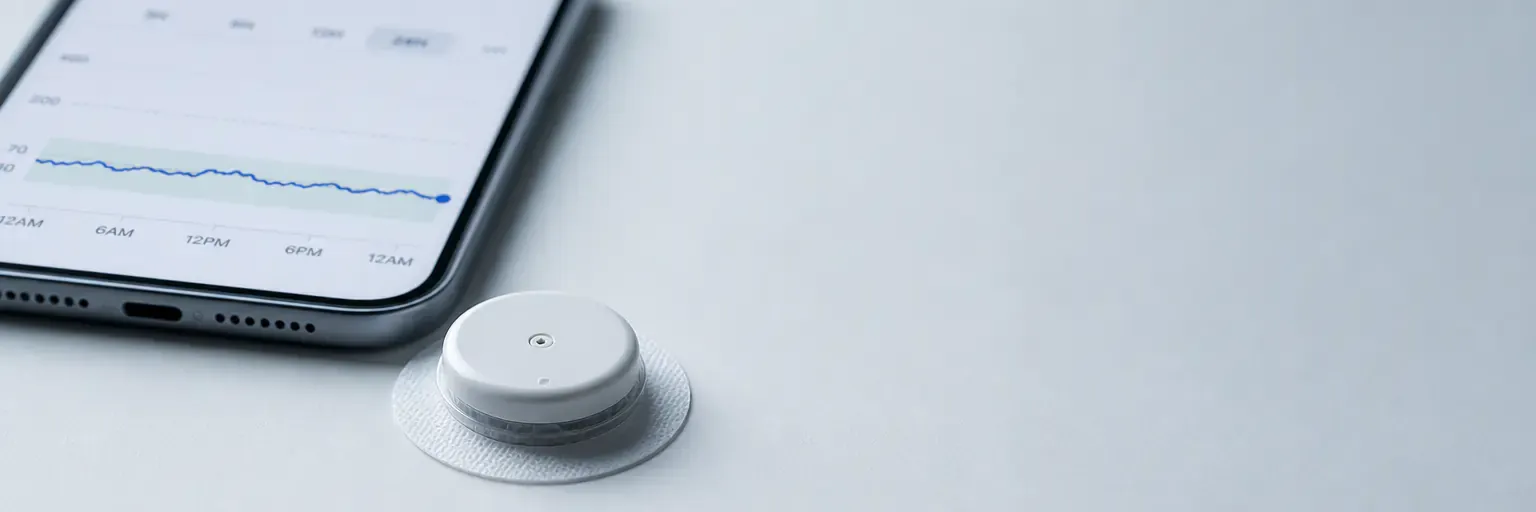
A continuous glucose monitor — CGM — is a small sensor worn on the upper arm or abdomen that measures interstitial glucose every 1 to 5 minutes for 10 to 15 days per sensor. In type 1 diabetes and insulin-treated type 2 diabetes, CGM is standard of care and clearly improves outcomes (Beck 2017 DIAMOND, JAMA; Martens 2021 MOBILE, JAMA; Aleppo 2017 REPLACE-BG). For adults without diabetes, do not assume that improved glucose readings mean additional weight loss. The Richardson 2024 systematic review found no statistically significant pooled weight or BMI benefit from CGM-based feedback; most included trials involved diabetes.
The 2024 launch of over-the-counter CGMs — Stelo (Dexcom, FDA-cleared 2024-03) and Lingo (Abbott, US launch 2024-09) — moved CGMs from a diabetes tool into a mainstream wellness and weight-loss category. This guide covers what a CGM actually measures, what the RCT evidence supports, when a CGM is genuinely helpful (T2D on insulin, T1D, reactive-hypoglycaemia workup, post-bariatric dumping-syndrome characterisation), when it is mostly noise (chasing every spike in a non-diabetic adult), and how to decide whether Stelo, Lingo, Dexcom G7, or FreeStyle Libre 3 is the right choice.
Quick stats
- What a CGM measures: interstitial glucose, every 1 to 5 minutes, with a 5 to 15 minute lag vs blood.
- Sensor life: 10 days (Dexcom G7, Stelo), 14 days (FreeStyle Libre 3), 14 days (Lingo).
- OTC status: Stelo cleared 2024-03 (Dexcom); Lingo launched 2024-09 (Abbott). Dexcom G7 and FreeStyle Libre 3 are prescription CGMs.
- Weight-loss evidence: Richardson 2024 pooled 25 trials, mostly in diabetes, and found no statistically significant weight or BMI effect. This does not establish a kilogram benefit for adults without diabetes.
- Non-diabetic post-meal glucose: routine excursions to 140 to 180 mg/dL and back to baseline within 90 to 180 minutes are normal (Zeevi 2015, Cell).
- Time-in-range target in diabetes: >70 percent of readings between 70 and 180 mg/dL (Battelino 2019 consensus, Diabetes Care).
- CGM accuracy (MARD): roughly 8 to 10 percent for modern sensors versus a lab reference (Kovatchev 2019).
- CGM adherence signal: about 60 percent of non-diabetic wearers stop within 6 months (Klonoff 2023 International Consensus).
- 911 red flags: persistent CGM readings below 54 mg/dL in a non-diabetic adult (workup for reactive hypoglycaemia, dumping, or insulinoma); fainting; sensor allergic reaction with airway or breathing symptoms.
CGM device primer
The category has separated into two tracks in 2026: the prescription CGMs originally developed for diabetes, and the OTC wellness CGMs launched in 2024 for non-diabetic adults. All four leading devices use the same underlying interstitial-glucose sensor chemistry; the differentiators are sensor life, prescription status, cost, and app / coaching layer.
| Device | Sensor life | Rx status | Cost per month (US, 2026) | Target user |
|---|---|---|---|---|
| Dexcom G7 | 10 days | Prescription | ~$150 with insurance, $300+ cash | T1D, insulin-treated T2D, non-insulin T2D per Medicare rules |
| Stelo (Dexcom OTC) | 15 days | OTC (cleared 2024-03) | ~$89 per month, ~$99 single-month | Non-diabetic adults, prediabetes, wellness |
| FreeStyle Libre 3 | 14 days | Prescription | ~$75 with insurance, ~$140 cash | T1D, T2D on insulin, T2D per Medicare rules |
| Lingo (Abbott OTC) | 14 days | OTC (US launch 2024-09) | ~$89 per month | Non-diabetic adults, behaviour-change wellness |
| Nutrisense-style analytics | Dexcom / Libre sensor + software | Requires Rx or OTC sensor | $200–$400 per month bundled | Data-driven learners who want dietitian coaching layer |
What a CGM actually tells you
A CGM does not measure one thing well — it measures four things, each with a different clinical weight and each easy to misinterpret without the diabetes context that framed how the readings are interpreted.
1. Time-in-range (TIR): 70 to 180 mg/dL
The Battelino 2019 International Consensus on Time in Range (Diabetes Care) codified TIR as the primary CGM metric in diabetes: the percentage of readings between 70 and 180 mg/dL over a 14-day window. The consensus targets are >70 percent time-in-range for most non-pregnant adults with diabetes and <4 percent time-below-range. TIR translates roughly to A1c — 70 percent TIR corresponds to an A1c near 7.0 percent — but it captures glycaemic variability and hypoglycaemia that A1c hides. In a non-diabetic wearer, TIR is nearly always 95 percent or higher; the metric is not a meaningful weight-loss lever in that population.
2. Glycaemic variability
Variability — how much glucose bounces around a mean — is measured by the coefficient of variation (CV) across all readings. In diabetes, CV <36 percent is the consensus target for stability (Battelino 2019). Elevated CV is a signal for pre-diabetes progression risk and, in symptomatic adults, for reactive hypoglycaemia. This is the CGM metric with the most non-diabetic informational value: a spiky, wide-variability trace can flag the meals or timing patterns that most disrupt glucose control, even in the absence of a diabetes diagnosis.
3. Post-prandial excursions
The number most non-diabetic wearers focus on — how high glucose peaks after a meal — is also the most easily misinterpreted. Zeevi 2015 (Cell) showed that the same food produces dramatically different post-prandial responses across individuals; there is no universal “bad” glucose response. In a healthy adult, post-prandial excursions to 140 to 180 mg/dL returning to baseline within 90 to 180 minutes are normal. Sustained excursions above 200 mg/dL, delayed returns to baseline, or a rising 2-hour post-prandial glucose above 140 mg/dL across multiple days warrant a prescriber conversation and a formal OGTT or HbA1c — not a smaller portion of oatmeal.
4. Interstitial lag and calibration
CGMs measure glucose in interstitial fluid — the fluid between cells beneath the skin — not in blood. Interstitial glucose lags blood glucose by 5 to 15 minutes, and the two can disagree by 15 to 20 percent, especially during rapid glucose changes. This is not device failure. Kovatchev 2019 and the FDA accuracy standard framework quantify the discrepancy as MARD (mean absolute relative difference) versus a lab reference; modern CGMs achieve MARD near 8 to 10 percent. On the first day of a new sensor and immediately after insertion, MARD is worst; by day 2 or 3 the reading stabilises. Understanding this artifact prevents the very common “the CGM is broken” moment when the number does not match a finger-stick.
Time course — what to expect over the first year
For a non-diabetic wearer using CGM as a behaviour-change tool, the arc is predictable: the first days are calibration and orientation, weeks 1 to 4 are where behaviour change happens, and month 6 is where most adults stop wearing.
| Timepoint | What is happening | What to focus on |
|---|---|---|
| Days 0 to 3 | Sensor calibration, first-day artifact, unfamiliar readings | Do not draw conclusions; expect the reading to disagree with a finger-stick by 15 to 20% |
| Weeks 1 to 2 | First behavioural changes — meal-by-meal A/B testing, walk-after-meal experiments | Identify the two or three meals that produce the largest excursions and the effect of a 10 to 20 minute post-meal walk |
| Weeks 3 to 4 | Habit consolidation — the mealtime changes stick or they do not | Log what changed; document the successful swaps so they persist after you stop wearing |
| Month 3 | Do not use an expected kilogram loss as the test of CGM benefit | Review whether the readings serve a defined clinical or educational purpose with your healthcare professional |
| Month 6 | Typical CGM-quit rate ~60 percent in non-diabetic wearers (Klonoff 2023) | Most learners have extracted the useful information by now — a scheduled break is reasonable |
| Month 12 | Do not infer a weight-maintenance benefit from continued sensor wear | Revisit the purpose and cost of monitoring with your healthcare professional |
The RCT evidence — what CGM does and does not do for weight
Glucose-management outcomes and weight-loss outcomes are different. Evidence from insulin-treated diabetes should not be presented as proof that a sensor causes weight loss in adults without diabetes.
Beck 2017 DIAMOND (JAMA) enrolled 158 adults with T2D on multiple daily insulin injections and reported a 0.3 percent additional A1c reduction at 24 weeks in the CGM arm versus finger-stick monitoring, with a mean CGM-arm weight change of approximately 0.5 kg. Martens 2021 MOBILE (JAMA) enrolled 175 adults with T2D on basal insulin only and reported a 0.4 percent additional A1c reduction at 8 months in the CGM arm. Aleppo 2017 REPLACE-BG confirmed that CGM can replace routine finger-stick monitoring in adults with T1D — a category shift, not a modest tweak. These are the trials that made CGM standard of care in insulin-treated diabetes.
Richardson and colleagues (2024) reviewed 25 randomised trials involving 2,996 adults. Most trials involved type 2 diabetes. CGM-based feedback improved HbA1c and time in range, but the pooled effects on weight (eight trials, 691 participants) and BMI (nine trials, 761 participants) were not statistically significant. Only four trials assessed dietary changes and five assessed physical activity. These findings do not support promising adults without diabetes an extra 1–2 kg of weight loss or attributing such a benefit to a proven behavioural mechanism.
Ehrhardt and Al Zaghal (2019) is a literature review, not a prediabetes weight-loss RCT. It describes limited behavioural evidence and calls for further evaluation of CGM for weight reduction; it does not establish an extra kilogram benefit for adults without diabetes. Zeevi 2015 (Cell) is the personalised-nutrition anchor: identical meals produce very different post-prandial glucose responses across individuals, and there is no universal “healthy glucose response” curve. Klonoff 2023 International Consensus on Use of CGM codified the current framework: CGM is standard of care in insulin-treated diabetes, useful in non-insulin T2D on multi-drug therapy per Medicare 2023 rules, useful diagnostically in reactive hypoglycaemia and dumping syndrome, and a modest behaviour-change tool for non-diabetic wellness. The ADA 2024 Standards of Care Section 7 recommend CGM for T1D, T2D on multiple daily insulin injections or continuous subcutaneous insulin infusion, and increasingly for T2D on basal insulin — but not as a stand-alone weight-loss intervention in adults without diabetes.
CGM vs other measurement tools for weight loss
| Tool | What it measures | Approximate cost | Evidence for weight loss | Actionability |
|---|---|---|---|---|
| CGM (Dexcom G7, Libre 3, Stelo, Lingo) | Interstitial glucose every 1–5 minutes | $75–$300 per month | No established kilogram benefit for adults without diabetes in the reviewed evidence; diabetes glucose management is a different outcome | High for T1D, T2D on insulin; moderate for behaviour-change wellness |
| Finger-stick blood glucose meter | Capillary blood glucose at one moment | $10–$40 device + $0.20–$1 per strip | Weak stand-alone; used with insulin dose | Situational — a single number |
| Food journal (paper or app) | What and how much you ate | Free–$20 per year | Moderate — the strongest lifestyle intervention (Hollis 2008) | High — direct behaviour change lever |
| Macro-tracking app (MyFitnessPal, Cronometer) | Calories, protein, carbs, fats | Free–$100 per year | Moderate — depends on adherence | High for portion and protein targeting |
| Personalised nutrition analysis (Zeevi-style) | Individual glucose response to specific foods | $200–$500 for a testing window | Emerging — small trials only | Moderate — informs meal choices |
| OGTT (oral glucose tolerance test) | Blood glucose 2 hours after 75 g glucose | $30–$100 for the lab | Diagnostic, not treatment | Diagnostic — used to identify prediabetes / T2D |
| HbA1c | 3-month average blood glucose | $20–$50 for the lab | Diagnostic and monitoring | Diagnostic — used to identify prediabetes / T2D |
5-step “should I actually get a CGM?” protocol
The right answer is not the same for every reader. The five-question flow below reflects how endocrinologists and diabetes educators triage CGM decisions in 2026.
Step 1 — Type 1 or insulin-treated type 2 diabetes
Yes — a prescription CGM is standard of care. Dexcom G7 and FreeStyle Libre 3 both have clear insulin-dosing accuracy and both are covered by Medicare and most commercial insurance for this indication. See our companion coverage of insulin therapy and weight in type 2 diabetes and type 1 diabetes and weight loss for how CGM integrates with the dosing algorithm.
Step 2 — Non-insulin type 2 diabetes or prediabetes
Discuss with the prescriber. The DIAMOND, MOBILE, and Ehrhardt 2019 data support CGM value in adults on metformin and GLP-1 or SGLT2 layered therapy, and Medicare 2023 expanded CGM coverage to include non-insulin T2D adults with problematic hypoglycaemia. Isaacs 2020 made the broader case for CGM in T2D not on insulin. See prediabetes and weight loss, metformin and weight, and insulin resistance and weight loss for the surrounding treatment picture.
Step 3 — Reactive hypoglycaemia workup or post-bariatric dumping syndrome
Yes for two weeks — diagnostic, not chronic use. CGM is the modern way to characterise both patterns (Craig 2021 documented CGM use in post-bariatric dumping). The two-week window captures the trigger meals and the pattern of the drop; beyond that, the CGM is not additive to a food-and-symptom diary. See hypoglycemia and weight loss and dumping syndrome after bariatric surgery for the workup framework.
Step 4 — Non-diabetic weight loss
Do not buy a CGM on a promise of extra weight loss. The Richardson review did not establish a statistically significant pooled weight benefit. If you are considering CGM for learning about glucose patterns, agree on a specific purpose and interpretation plan with your healthcare professional rather than treating a flatter trace as evidence of fat loss.
Step 5 — How to actually use it
Take a before snapshot of your typical week — the meals, the walks, the timing. Wear the sensor for two to four weeks. Pair Stelo or Lingo with the built-in app coaching layer (this is where the behaviour-change value sits). Test specific hypotheses: does a 10-minute walk after breakfast flatten the excursion? Does eating protein first flatten the excursion? Do not chase every spike to zero — the goal is not a flat line, it is a mental model of how your body responds to your typical meals so the learning persists after you stop wearing.
Special situations
T2D on insulin
CGM is standard of care and the strongest evidence base in the CGM literature (Beck 2017 DIAMOND; Martens 2021 MOBILE; Aleppo 2017 REPLACE-BG; ADA 2024 Standards of Care Section 7). Use CGM to titrate basal insulin to fasting glucose targets, to detect nocturnal hypoglycaemia, and to identify the post-prandial meals that most disrupt time-in-range. See insulin therapy and weight in type 2 diabetes for the layering strategy.
T2D on metformin ± GLP-1
CGM catches nocturnal drops and post-prandial excursions that fasting glucose alone misses. In an adult on metformin plus a GLP-1 receptor agonist (semaglutide, tirzepatide, liraglutide, dulaglutide), a two-week CGM window can identify whether A1c drift is driven by fasting glucose (dose-adjust the metformin or add basal) or post-prandial spikes (the GLP-1 will typically flatten these; if it does not, portion size is usually the issue). See metformin and weight and GLP-1 weight loss overview.
Reactive hypoglycaemia and post-prandial dizziness
CGM is diagnostic. A two-week trace that shows repeated drops below 70 mg/dL 2 to 4 hours after high-carbohydrate meals — coupled with symptoms in the food-and-symptom diary — is characteristic of reactive hypoglycaemia. See hypoglycemia and weight loss.
Dumping syndrome after bariatric surgery
CGM has become the standard modern way to characterise both early dumping (rapid post-meal excursion) and late dumping (reactive hypoglycaemia 1 to 3 hours after a high-carbohydrate meal), replacing older provocative-testing protocols in most centres (Craig 2021). See dumping syndrome after bariatric surgery.
Non-diabetic weight loss
The Richardson 2024 review found no statistically significant pooled effect on weight or BMI from CGM-based feedback. Most included trials involved diabetes, so the results cannot establish an expected weight-loss benefit in adults without diabetes. Glucose patterns and changes in body weight are different outcomes.
PCOS and insulin resistance
CGM can visualise the insulin-resistance response pattern — a flatter but longer excursion, a delayed return to baseline, and higher fasting glucose. This is often more motivating than a single fasting glucose number in adults building the case for metformin, a GLP-1, or dedicated weight-loss lifestyle work. See PCOS and weight loss and insulin resistance and weight loss.
Endurance athletes and low-carb dieters
Expect flat glucose lines and low averages. This is not a problem or a “broken metabolism.” Ultra-endurance athletes and adults on ketogenic or low-carb regimens routinely show 24-hour CGM averages in the 80s and post-meal peaks that barely reach 130 mg/dL. Interpreting these traces against a diabetes-population framework is a common source of unnecessary alarm.
Pregnancy and gestational diabetes
CGM use in gestational diabetes and pre-existing T2D during pregnancy is increasing but not yet uniformly covered. The ADA 2024 framework recognises CGM as useful for adults with gestational diabetes requiring insulin. Stelo and Lingo are not indicated for pregnancy management — pregnancy CGM use should be under a prescriber’s care with a prescription device. See gestational diabetes and weight loss.
Myths and red flags
- “Every glucose spike is fat storage” — no. In non-diabetic adults, post-meal excursions to 140 to 180 mg/dL and back to baseline are normal physiology. There is no evidence that flattening these excursions accelerates weight loss.
- “A CGM can replace an A1c” — no. CGM captures time-in-range and variability; A1c captures the 3-month glycaemic average. They measure related but distinct things, and both are used together in the diabetes clinic.
- “Higher-carb meals are always the problem” — no. Zeevi 2015 (Cell) showed the same meal produces very different responses across individuals; there is no universal problematic food.
- “CGM readings are as accurate as a lab draw” — no. MARD is roughly 8 to 10 percent for modern CGMs, and interstitial-lag differences of 15 to 20 percent versus a finger-stick are normal during rapid glucose changes (Kovatchev 2019).
- Fainting, sensor allergic reaction with airway or breathing symptoms — call 911.
- Persistent CGM readings below 54 mg/dL in a non-diabetic adult — see a physician. The differential includes reactive hypoglycaemia, post-bariatric dumping syndrome, and rarely insulinoma; a targeted endocrinology workup is appropriate.
Bottom line
A continuous glucose monitor measures interstitial glucose every 1 to 5 minutes. In type 1 diabetes and insulin-treated type 2 diabetes, CGM is standard of care and clearly improves outcomes. In non-insulin T2D on multi-drug therapy and in prediabetes with behavioural coaching, CGM adds modest value. For reactive-hypoglycaemia workup and post-bariatric dumping-syndrome characterisation, a two-week CGM is diagnostic. For adults without diabetes considering CGM for weight loss, do not assume a kilogram benefit: the Richardson review found no statistically significant pooled effect on weight or BMI, and most trials involved diabetes. Discuss the clinical or educational purpose and cost of a sensor with a healthcare professional rather than treating glucose readings as a measure of fat loss.
How this connects to the rest of the site
For the diabetes context, see diabetes and weight loss, prediabetes and weight loss, type 1 diabetes and weight loss, gestational diabetes and weight loss, and insulin therapy and weight in type 2 diabetes. For the glucose-drop workup, see hypoglycemia and weight loss and dumping syndrome after bariatric surgery. For the underlying physiology and the surrounding drug classes, see insulin resistance and weight loss, metformin and weight, SGLT2 inhibitors and weight, and PCOS and weight loss.
Sources
- Beck RW, Riddlesworth TD, Ruedy K, et al. Continuous glucose monitoring versus usual care in patients with type 2 diabetes receiving multiple daily insulin injections (DIAMOND). JAMA (2017).
- Martens T, Beck RW, Bailey R, et al. Effect of continuous glucose monitoring on glycemic control in patients with type 2 diabetes treated with basal insulin (MOBILE). JAMA (2021).
- Aleppo G, Ruedy KJ, Riddlesworth TD, et al. REPLACE-BG: A randomized trial comparing continuous glucose monitoring with and without routine blood glucose monitoring in adults with well-controlled type 1 diabetes. Diabetes Care (2017).
- Richardson KM, Jospe MR, Bohlen LC, et al. The efficacy of using continuous glucose monitoring as a behaviour change tool in populations with and without diabetes: a systematic review and meta-analysis of randomised controlled trials. International Journal of Behavioral Nutrition and Physical Activity (2024).
- Ehrhardt N, Al Zaghal E. Behavior Modification in Prediabetes and Diabetes: Potential Use of Real-Time Continuous Glucose Monitoring. Journal of Diabetes Science and Technology (2019).
- Zeevi D, Korem T, Zmora N, et al. Personalized nutrition by prediction of glycemic responses. Cell (2015).
- Battelino T, Danne T, Bergenstal RM, et al. Clinical targets for continuous glucose monitoring data interpretation: recommendations from the International Consensus on Time in Range. Diabetes Care (2019).
- Bergenstal RM, Klonoff DC, Garg SK, et al. Threshold-based insulin-pump interruption for reduction of hypoglycemia (ASPIRE In-Home). New England Journal of Medicine / Diabetes Care (2013).
- The Diabetes Control and Complications Trial Research Group. The effect of intensive treatment of diabetes on the development and progression of long-term complications in insulin-dependent diabetes mellitus (DCCT). New England Journal of Medicine (1993).
- American Diabetes Association. Diabetes technology: Standards of Care in Diabetes — 2024 (Section 7). Diabetes Care (2024).
- Klonoff DC, Wang J, Rodbard D, et al. A glycemia risk index (GRI) of hypoglycemia and hyperglycemia for continuous glucose monitoring validated by clinician ratings. Journal of Diabetes Science and Technology / International Consensus on CGM (2023).
- Craig CM, Liu L-F, Deacon CF, Holst JJ, McLaughlin TL. Continuous glucose monitoring characterises post-bariatric hypoglycaemia and dumping syndrome. Obesity Surgery (2021).
- US Food and Drug Administration. Dexcom Stelo Glucose Biosensor System — De Novo classification (DEN230081). FDA (2024).
- US Food and Drug Administration. FDA clears first over-the-counter continuous glucose monitor. FDA press announcement (2024).
- Kovatchev BP. Metrics for glycaemic control — from HbA1c to continuous glucose monitoring. Nature Reviews Endocrinology / Journal of Diabetes Science and Technology (2019).
- Rodbard D. Continuous glucose monitoring: a review of successes, challenges, and opportunities. Diabetes Technology and Therapeutics (2016).
- Isaacs D, Cox C, Schwab K, et al. Continuous glucose monitoring in type 2 diabetes not treated with insulin: a review of the evidence. Journal of Diabetes Science and Technology (2020).
- Hollis JF, Gullion CM, Stevens VJ, et al. Weight loss during the intensive intervention phase of the weight-loss maintenance trial. American Journal of Preventive Medicine (2008).