
2026-08-08 · green tea, EGCG, catechins, matcha, supplements, thermogenesis, fat oxidation, hepatotoxicity, weight loss, safety
Written by Nora Kim
Nora Kim is a WeightFAQ staff writer who translates clinical, surgical, and pharmacological weight-loss research into plain-English guidance. She covers the GLP-1 landscape — semaglutide, tirzepatide, and next-generation drugs — alongside bariatric surgery types, post-op nutrition protocols, and revision options. Her articles also address type 2 diabetes remission, cardiovascular risk, PCOS, fatty liver, night eating syndrome, sarcopenic obesity, and how common medications like antipsychotics, statins, and antidepressants affect weight. Nora writes for readers weighing serious clinical decisions and wanting a clear read on evidence, safety, cost, and realistic outcomes.
14 min read
Medically reviewed on Aug 8, 2026
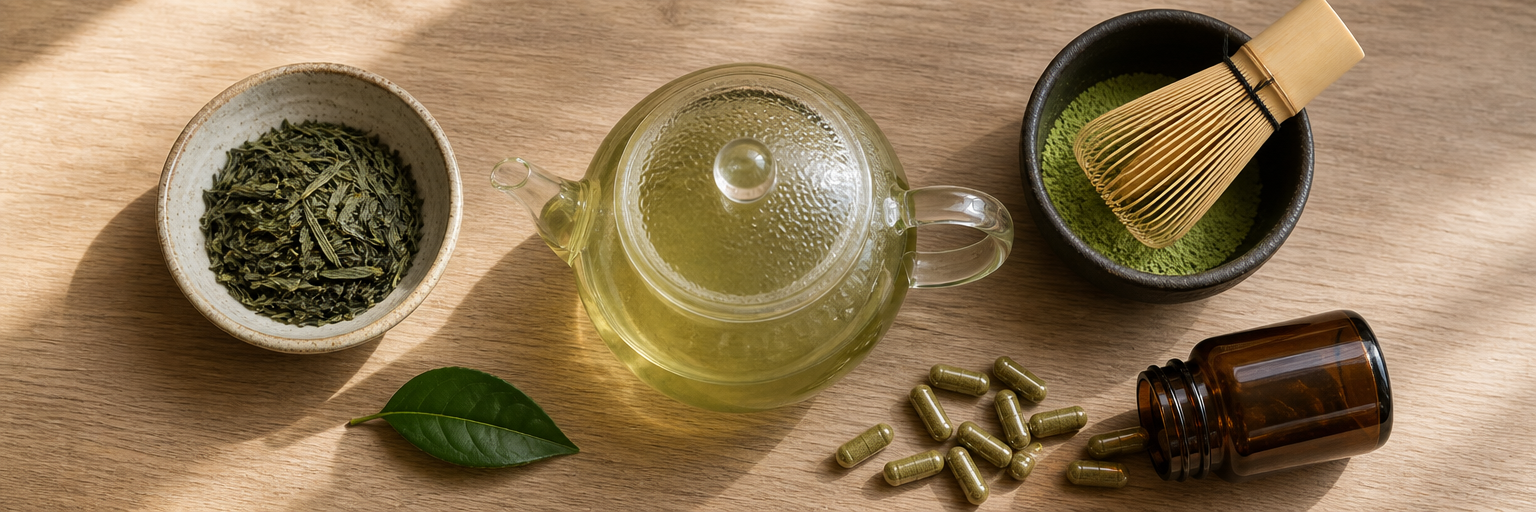
Green Tea and EGCG for Weight Loss: What the Evidence Actually Shows
Green tea is one of the most-searched natural weight-loss supplements in the world, and the marketing around it is one of the most credulous. Some pages promise dramatic body-composition changes from a few cups a day; others sell 800 mg EGCG “fat-burner” capsules stacked with caffeine and yohimbine as if the safety picture were settled. Neither read matches the trial base. Green tea catechins do produce a small, replicable weight-loss signal — the Hursel 2009 meta-analysis pooled 11 randomized trials and found roughly 1 kg over placebo, and the 2012 Cochrane review confirmed the effect while calling it “not likely to be clinically important.” At the same time, the safety window at concentrated-extract doses is narrower than the marketing suggests. This guide walks through the mechanism, the numbers, the dose that works, and the dose where the hepatotoxicity signal starts to matter.
What green tea and EGCG actually are
Green tea is the unfermented leaf of Camellia sinensis, the same plant that produces black and oolong tea. The active polyphenols are a family of catechins: epigallocatechin gallate (EGCG), epigallocatechin (EGC), epicatechin gallate (ECG), and epicatechin (EC). EGCG is the most abundant and the most studied — it accounts for roughly half of the total catechin content in a standard brewed cup and drives most of the pharmacology discussed below.
Catechin content varies dramatically by form. Khokhar and Magnusdottir (2002, Journal of Agricultural and Food Chemistry) reported ranges of roughly 30 to 130 mg of EGCG per 200 mL brewed cup depending on leaf quality, water temperature, and steep time. Matcha, made from stone-ground whole leaves whisked into water, delivers about 60 to 70 mg of EGCG per teaspoon of powder — meaningfully more concentrated per volume than bagged tea. Loose-leaf sencha and gyokuro sit between the two. Concentrated green tea extract capsules deliver anywhere from 200 to 800-plus mg of EGCG in a single dose, and this concentration is the pivot point for the entire safety story.
Caffeine content differs from coffee. A standard 8 oz brewed green tea contains roughly 30 to 50 mg of caffeine (versus 80 to 120 mg for drip coffee), which is enough to contribute to the thermogenic effect discussed below without producing the same cardiovascular load. For a wider look at caffeine’s own weight-loss profile, see the coffee and caffeine for weight loss guide.
The AMPK and fat-oxidation mechanism
Green tea catechins act through two mechanisms that are more plausible than the effect size suggests. EGCG modulates AMP-activated protein kinase (AMPK) signaling and lipolysis in cell and animal models (Wolfram 2006, Journal of the American College of Nutrition; Nagao 2005, American Journal of Clinical Nutrition), the same cellular energy sensor that berberine and metformin activate. That drives increased fatty-acid oxidation and reduced hepatic lipogenesis in preclinical work.
The second lever is COMT inhibition. Catechol-O-methyltransferase is the enzyme that breaks down norepinephrine; EGCG partially inhibits it, prolonging norepinephrine signaling at fat cells (Dulloo 1999, American Journal of Clinical Nutrition). The practical effect is a modest extension of the thermogenic and lipolytic effect of caffeine — which is why nearly every positive trial in the literature combined green tea catechins with caffeine rather than testing catechins alone.
Venables (2008, American Journal of Clinical Nutrition) tested this directly in trained men during moderate exercise and reported a 17 percent higher fat-oxidation rate after a single 890 mg green tea extract dose versus placebo. That is a real acute physiological signal — but “17 percent higher fat oxidation during one 30-minute exercise bout” is a very different claim than “17 percent more body weight lost over a year,” and the trial base has never delivered anything close to the latter. Mechanistic plausibility is stronger than clinical magnitude — a pattern that shows up across the fat-burner supplements landscape.
Five-row evidence panel for weight loss
The randomized trial and meta-analytic base is now large enough to give a clean read on the average effect. The numbers below anchor on the highest-quality reviews and the two individual RCTs most often cited for a positive effect.
| Study | n | Duration | Dose | Weight-loss finding |
|---|---|---|---|---|
| Hursel 2009 Int J Obes — meta-analysis | 11 RCTs (pooled) | 12 wks median | 270–1,200 mg catechins + caffeine | ~1.31 kg extra loss over placebo |
| Jurgens 2012 Cochrane Database Syst Rev — updated review | 14 RCTs (pooled) | 12–13 wks median | Wide range | Small, statistically significant, “not likely to be clinically important” |
| Nagao 2005 Am J Clin Nutr — Japanese men | 35 | 12 weeks | 690 mg catechins/day | –1.3 kg body weight; –4.5 percent body-fat mass |
| Maki 2009 J Nutr — exercise trial | 132 | 12 weeks | 625 mg catechins/day + walking | Greater abdominal-fat loss vs control at same activity level |
| Wang 2010 Obesity — high-dose catechin | 182 | 90 days | 458–886 mg catechins/day | ~1.2 kg extra loss at high dose; dose-response signal |
The pooled numbers converge on roughly 1 to 1.3 kg over 12 weeks versus placebo, on top of whatever calorie deficit the trial was running. The individual “greater loss” trials (Nagao 2005, Maki 2009, Wang 2010) mostly ran in Asian populations at lower baseline body-mass indices, which some reviewers argue produces a slightly larger relative effect than in North American obese-adult populations.
The honest verdict: how much weight does green tea actually lose
The numeric ceiling is important. Green tea catechins produce roughly 1 kg (about 2.2 lb) of extra weight loss over 12 weeks on top of a calorie-controlled diet. The 2012 Cochrane review — the most authoritative synthesis of the evidence base — was blunt: the effect is statistically significant but “not likely to be clinically important.” That framing matters because commercial pages routinely present the Hursel meta-analysis as if it validated green tea as a serious weight-loss lever.
For scale, compare the pooled green-tea magnitude to the four most common alternatives a reader might be weighing:
- GLP-1 medications (semaglutide, tirzepatide) — roughly 15 to 21 percent of body weight over a year in STEP-1 and SURMOUNT-1; a different order of magnitude.
- Phentermine — 5 to 10 percent of body weight over 6 months in most randomized trials.
- Berberine — roughly 1.5 to 2 kg over 12 to 16 weeks with meaningful metabolic-marker improvements, but a more complex drug-interaction and hepatotoxicity picture.
- Lifestyle-only intervention — 5 to 10 percent of body weight at 1 year in the Diabetes Prevention Program.
Green tea sits below all of the above in absolute magnitude. It is a legitimate low-cost adjunct with an unusually wide safety margin at brewed doses; it is not a substitute for a calorie deficit and not comparable to a prescription medication. The honest positioning is that a cup or two of green tea a day is a reasonable habit-level lever, and a 300 to 500 mg EGCG capsule stacked with a real dietary change might add a modest kilogram over three months.
Dose, timing, and formulation
The dose-response relationship is measurable but shallow. The table below covers the five most common exposure levels and the trade-offs between them.
| Form and dose | EGCG delivered | Effect size | Safety notes |
|---|---|---|---|
| Brewed green tea, 2–3 cups/day | ~200–300 mg catechins | Small; the safest exposure form | Widest safety margin; below EFSA threshold |
| Matcha, 1 tsp/day | ~60–70 mg EGCG plus caffeine | Small; whole-leaf format | Safe at typical intakes |
| Low-dose extract, 250 mg EGCG/day | 250 mg | Small; below trial range | Safe at label doses |
| Mid-dose extract, 300–500 mg EGCG/day | 300–500 mg | Trial-anchored (Hursel 2009) | Take with food; avoid drug interactions |
| High-dose extract, 800+ mg EGCG/day | 800+ mg | Marginal added benefit | Crosses EFSA hepatic-safety threshold — do not exceed |
Two timing details are worth flagging. Sang and colleagues (2011, AAPS Journal) reported that fasted dosing of green tea extract produces higher plasma catechin peaks than dosing with a meal — which sounds like a bioavailability advantage but is exactly the pharmacokinetic pattern linked to hepatic stress in the case-report literature. Take extract with food. And catechins act as a caffeine synergist for thermogenesis and fat oxidation (Dulloo 1999; Venables 2008), which is why nearly every positive trial paired the two — so timing extract before exercise, or with a morning coffee, is closer to the trial protocol than dosing it alone in the afternoon.
Safety: hepatotoxicity is real above 800 mg EGCG/day
This is the section supplement marketing tends to skip. Concentrated green tea extract has a genuine hepatotoxicity signal, and the case-report literature converges on the same dose range.
- EFSA 2018 — The European Food Safety Authority’s scientific opinion set 800 mg/day of EGCG from supplements as the threshold above which the risk of drug-induced liver injury becomes measurable. Below that, the record is good; above, adverse hepatic events start to appear.
- Mazzanti 2015 Archives of Toxicology — case series describing acute hepatitis linked to green tea extract supplements, most cases involving daily EGCG intake in the 700 to 1,000 mg range or higher.
- Bunchorntavakul and Reddy 2013 Alimentary Pharmacology & Therapeutics — herbal-and-dietary hepatotoxicity review identifying green tea extract as one of the leading recurrent offenders in the case-report and US Drug-Induced Liver Injury Network databases.
- Sarma 2008 US Pharmacopeia — earlier safety review that first formalized the concentrated-extract hepatotoxicity concern in the peer-reviewed literature.
The five-row product-category safety table clarifies where the line sits.
| Product category | Typical EGCG per day | Hepatotoxicity risk |
|---|---|---|
| Brewed green tea (2–3 cups) | 200–300 mg catechins | Very low; widest safety margin |
| Matcha (1 tsp) | 60–70 mg | Very low |
| Low-dose extract capsule | 250 mg | Low; safe at label dose |
| Mid-dose extract capsule | 300–500 mg | Low if taken with food; avoid drug stacking |
| High-dose “fat-burner” blend | 800+ mg | Real hepatic-injury signal — do not exceed |
Real-world safety practice: do not exceed 500 mg/day of EGCG from concentrated extract, always take with food to lower peak hepatic exposure, avoid stacking with other hepatically metabolized supplements or heavy alcohol, and stop immediately if you notice right-upper-quadrant pain, unexplained fatigue, dark urine, or jaundice.
Drug interactions
Concentrated green tea extract interacts with several common medication classes through the same hepatic-clearance pathways that drive the safety concern.
| Medication class | Nature of the interaction | Practical impact |
|---|---|---|
| Statins (atorvastatin, simvastatin) | Competitive hepatic clearance (Werba 2018) | Elevated statin levels; higher myopathy and hepatic risk |
| Warfarin | Vitamin K content in high volumes of brewed green tea | INR instability at very high tea intakes |
| Methotrexate | Hepatotoxicity potentiation | Additive hepatic-injury risk — avoid high-dose extract |
| Beta-blockers | Caffeine content interference | Blunted or amplified cardiovascular effect depending on dose |
| Any hepatically cleared drug | Shared clearance pathway plus hepatic load at high EGCG | Avoid high-dose extract without pharmacist review |
Cross-reference the weight-loss drug safety guide for a broader look at supplement-plus-prescription interactions across the weight-loss category. The general rule: brewed tea at 2 to 3 cups a day is a low-interaction exposure; concentrated extract at 500 mg EGCG or higher is a real interaction risk and should be routed through a pharmacist if you are on any chronic prescription.
Green tea vs berberine vs caffeine — the honest supplement comparison
The most useful frame is a head-to-head against the two most common evidence-based alternatives in the weight-loss supplement category.
| Comparator | Evidence tier | Kg loss vs placebo | Cost (US retail) | Safety concerns |
|---|---|---|---|---|
| Green tea catechins 300–500 mg EGCG/day | A/B — pooled RCTs, Cochrane confirmed | ~1 kg over 12 weeks | $10–30/month | Hepatotoxicity above 800 mg/day EGCG |
| Berberine 1,500 mg/day | B — 18-RCT meta-analysis | ~1.5–2 kg over 12–16 weeks | $15–40/month | GI, CYP3A4 interactions, contraindicated in pregnancy |
| Caffeine 200–400 mg/day | A — replicated | ~1 kg short-term; tolerance builds | $0–10/month | Insomnia, elevated HR/BP |
| Green tea + caffeine stack | A/B — most positive trials used the stack | ~1–1.3 kg over 12 weeks | $10–30/month | Same as above, additive |
The honest read: green tea and berberine produce comparable weight-loss magnitudes, but berberine has stronger metabolic-marker and insulin-sensitivity data — meaningful if the reader has PCOS, prediabetes, or fatty liver. Green tea has a wider safety margin at brewed doses and a longer everyday-food track record. Neither approaches the effect size of a prescription weight-loss medication, and both should sit on top of a calorie deficit rather than substitute for one. For the broader category framework, see weight-loss supplements overview and appetite-suppressant supplements for the satiety-based comparators. Because catechins produce a modest LDL and inflammatory-marker signal, they also show up in the cholesterol and weight loss landscape as a low-tier adjunct, and the low-inflammation signal is why the anti-inflammatory diet for weight loss guide includes green tea in its whole-food list.
Who green tea is right for and who should skip it
Not every reader is a good fit. The two lists below cover the main scenarios.
Green tea is a reasonable adjunct for:
- Adults with modest weight-loss goals who already have a calorie deficit in place.
- Existing green-tea drinkers who want to formalize the habit into 2 to 3 cups a day.
- Anyone looking for a lower-caffeine, higher-antioxidant tea alternative to coffee.
- Readers seeking a cheap, evidence-based adjunct with a wide safety margin at brewed doses.
- People with modestly elevated LDL who want a low-risk dietary lever (see cholesterol and weight loss).
Skip concentrated extract if you:
- Are pregnant or breastfeeding — catechin extract has not been safety-tested at the doses sold in supplements.
- Have existing liver disease, elevated liver enzymes, or heavy alcohol use.
- Take a hepatically cleared medication your clinician has flagged (statins, methotrexate, cyclosporine, tacrolimus, most chemotherapy agents).
- Have anxiety or insomnia that worsens at typical caffeine doses.
- Have iron-deficiency anemia — catechins reduce non-heme iron absorption when consumed with meals. Separate tea from iron-rich meals by an hour, or drink between meals.
- Are running a large-magnitude weight-loss plan and expect green tea to move the needle — the effect is not the right size for that job. See GLP-1 weight loss overview for the prescription landscape and adaptive thermogenesis and metabolic adaptation for what actually drives the metabolic side of the picture.
When to see a clinician
Any of the following should prompt an immediate stop and a visit:
- Right-upper-quadrant abdominal pain that develops after starting green tea extract.
- New-onset unexplained fatigue, especially in the first 4 to 12 weeks of an extract.
- Dark urine, pale stools, or yellowing of the eyes or skin (jaundice).
- Nausea and loss of appetite that persist for more than a few days.
Any of these can suggest a hepatic reaction and warrant discontinuation plus liver-function testing. In practice, the risk is concentrated in the high-dose extract population — brewed tea and matcha at typical intakes almost never produce this pattern.
Route the decision through primary care before starting high-dose extract if you have pre-existing liver disease, are on any chronic medication with a hepatic warning, or are stacking multiple supplements. None of these are emergencies; all are reasons to make the decision with a clinician rather than from a marketing page.
Sources at a glance
Sources
- Hursel R, Viechtbauer W, Westerterp-Plantenga MS. The effects of green tea on weight loss and weight maintenance: a meta-analysis. International Journal of Obesity (2009).
- Jurgens TM, Whelan AM, Killian L, Doucette S, Kirk S, Foy E. Green tea for weight loss and weight maintenance in overweight or obese adults. Cochrane Database of Systematic Reviews (2012).
- Nagao T, Komine Y, Soga S, et al. Ingestion of a tea rich in catechins leads to a reduction in body fat and malondialdehyde-modified LDL in men. American Journal of Clinical Nutrition (2005).
- Maki KC, Reeves MS, Farmer M, et al. Green tea catechin consumption enhances exercise-induced abdominal fat loss in overweight and obese adults. Journal of Nutrition (2009).
- Wang H, Wen Y, Du Y, et al. Effects of catechin enriched green tea on body composition. Obesity (2010).
- Dulloo AG, Duret C, Rohrer D, et al. Efficacy of a green tea extract rich in catechin polyphenols and caffeine in increasing 24-h energy expenditure and fat oxidation in humans. American Journal of Clinical Nutrition (1999).
- Venables MC, Hulston CJ, Cox HR, Jeukendrup AE. Green tea extract ingestion, fat oxidation, and glucose tolerance in healthy humans. American Journal of Clinical Nutrition (2008).
- European Food Safety Authority Panel on Food Additives and Nutrient Sources. Scientific opinion on the safety of green tea catechins. EFSA Journal (2018).
- Mazzanti G, Di Sotto A, Vitalone A. Hepatotoxicity of green tea: an update. Archives of Toxicology (2015).
- Bunchorntavakul C, Reddy KR. Review article: herbal and dietary supplement hepatotoxicity. Alimentary Pharmacology & Therapeutics (2013).
- Sang S, Lambert JD, Ho CT, Yang CS. The chemistry and biotransformation of tea constituents. Pharmacological Research / AAPS Journal (2011).
- Khokhar S, Magnusdottir SG. Total phenol, catechin, and caffeine contents of teas commonly consumed in the United Kingdom. Journal of Agricultural and Food Chemistry (2002).