
2026-05-14 · nutrition, protein, protein intake, high protein diet, muscle-preservation, calorie-deficit, leucine, ISSN
Updated 2026-10-02
Written by WeightFAQ Staff
Evidence-informed guidance from the WeightFAQ editorial team.
19 min read
Last editorial review Jul 29, 2026
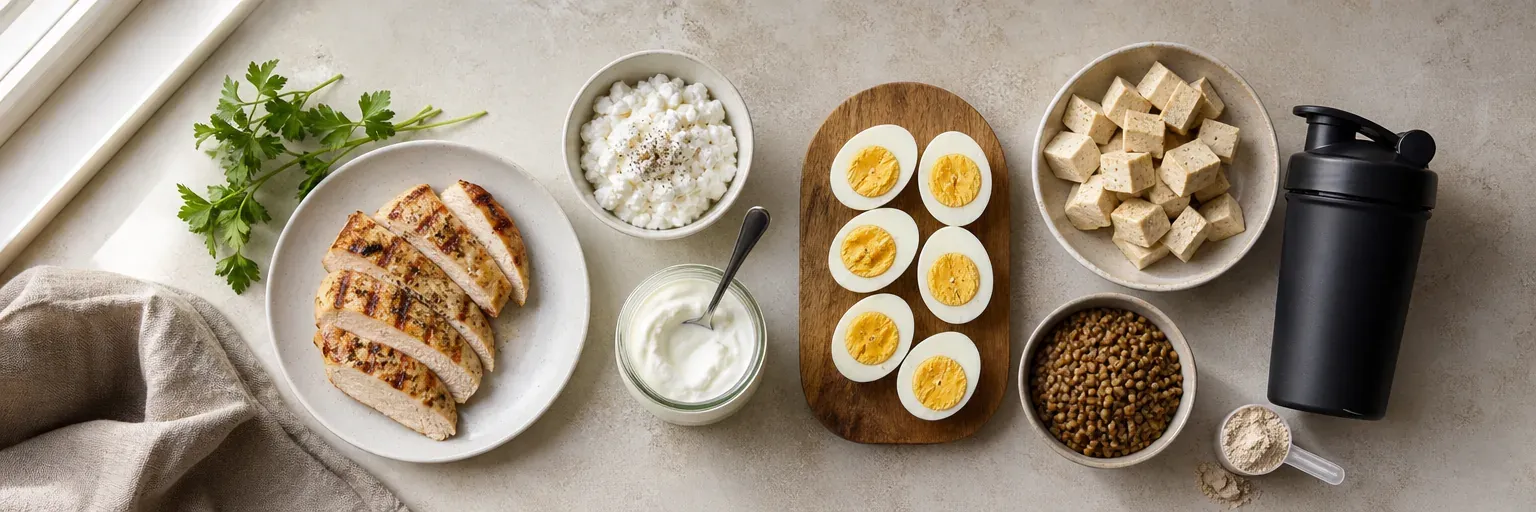
Protein Intake for Weight Loss
Most adults lose weight better when they eat roughly 1.6 g of protein per kilogram of body weight per day. That target, drawn from the International Society of Sports Nutrition 2017 position stand and confirmed in dozens of randomized trials, is the single most reliable nutritional lever for keeping muscle, blunting hunger, and slightly raising daily energy burn while you are in a calorie deficit. Everything else in this guide — per-meal timing, whole-food vs powder choices, common tracking mistakes — is downstream of hitting that number.
For an 82 kg (180 lb) adult, 1.6 g/kg lands at about 130 g of protein per day. That is a lunch salad with 40 g of chicken, a breakfast with 30 g of Greek yogurt and eggs, and a dinner with 45 g of salmon or tofu, plus a small snack. Most people can get there from whole foods without adding a single powder scoop. What follows is how to set your own target, why it matters more in a deficit than at maintenance, and what the trial evidence actually says.
Quick stats
- General fat loss (light training): 1.2 to 1.6 g of protein per kg body weight per day.
- Resistance training in a deficit: 1.6 to 2.2 g/kg per day.
- Aggressive deficit or lean athletes: up to 2.2 to 2.4 g/kg (ISSN 2017 upper).
- Thermic effect of food (TEF): roughly 20 to 30% of protein calories are burned during digestion — vs 5 to 10% for carbs and 0 to 3% for fat.
- Per-meal ceiling before diminishing returns: ~0.4 g/kg or about 40 g of protein per sitting for most adults.
- Satiety advantage: high-protein meals extend time-to-hunger by roughly 30 to 60 minutes vs equal-calorie carb-dominant meals (Halton & Anderson 2004).
Who this is for / not for
Good fit if:
- You are in a calorie deficit and want to keep lean muscle while losing fat.
- You struggle with hunger between meals and want a practical way to improve satiety.
- You do resistance training, walk regularly, or are rebuilding activity after time off.
Not a fit if:
- You have chronic kidney disease or a medical condition that requires limiting protein. Work with your clinician on a target that fits your labs — see the “when to talk to a clinician” checklist below and set a personal cap that is safe for your kidney function.
- You have a history of disordered eating and find food tracking triggering. A registered dietitian can help you build structure without strict counting.
- You are pregnant, breastfeeding, or medically managed on a specialized diet. Your needs are individualized and should be set with your care team.
Why protein matters in a calorie deficit
When you cut calories, your body can lose both fat and lean tissue. Protein is the nutrient that most reliably tips that ratio in favor of fat loss. Three mechanisms stand out.
Satiety. Protein increases fullness signals such as peptide YY and GLP-1 and reduces the hunger hormone ghrelin more than carbohydrate or fat at equal calories. Higher-protein meals tend to keep people full longer, which can make a deficit easier to hold across the week. The Halton & Anderson 2004 satiety review — a synthesis of controlled feeding studies — found that isocaloric high-protein meals produced meaningfully greater short-term satiety scores and reduced subsequent energy intake by roughly 10 to 25% at the next meal compared with high-carb or high-fat equivalents. That effect compounds across a day and helps explain why high-protein dieters typically undershoot their calorie target by more than low-protein dieters at the same nominal intake.
Lean mass preservation. In a deficit, muscle protein breakdown can outpace synthesis. Eating enough protein, ideally alongside resistance training, helps protect muscle so more of the weight you lose comes from fat. For the unified protocol — the protein target plus the resistance training and deficit-size rules that combine with it — see our guide to preserving muscle during weight loss. Beyond muscle, what too little protein does is also visible in the mirror: sustained intake below about 0.8 g/kg is one of the four nutritional drivers of telogen effluvium, the diffuse hair shedding that often shows up 2 to 4 months into an aggressive cut.
Thermic effect of food. Roughly 20 to 30 percent of the calories in protein are burned during digestion and processing, compared with about 5 to 10 percent for carbs and 0 to 3 percent for fat. The effect is modest but real. At a 150 g/day protein intake, the extra TEF burn is roughly 60 to 100 kcal per day above a low-protein diet at the same total calories — about the calorie cost of a short walk. The full math on how TEF stacks against the NEAT lever is in our guide to [how to increase TDEE]. Once protein is set, the split between carbs and healthy fats for weight loss is mostly personal preference — head-to-head trials show similar fat loss at matched calories whether the remaining calories tilt higher-carb or lower-carb. And protein is one half of the story; the other half is the vitamins and minerals that come with whole foods — vitamin D, magnesium, iron, B12, and zinc do the cofactor work that lets the protein actually build and maintain muscle.
This matters because a sustainable deficit is easier to hold when you are less hungry, keep more muscle, and feel steadier day to day. Protein is one of the few variables that helps on all three.
How much protein to eat per day
Research supports a range, not a single magic number. Use your current body weight to set a target.
- General weight loss (minimal training): about 1.2 to 1.6 grams of protein per kilogram of body weight per day. For a 180 lb (82 kg) adult, that is roughly 98 to 131 grams per day.
- Weight loss with regular resistance training or a larger deficit: about 1.6 to 2.2 grams per kilogram per day. For the same 82 kg adult, that is roughly 131 to 180 grams per day.
- Aggressive deficit, lean individuals, or athletes trying to preserve muscle: up to about 2.2 to 2.4 grams per kilogram per day, consistent with the International Society of Sports Nutrition position stand.
These ranges reflect systematic reviews and the ISSN position stand on protein and exercise. They are starting points, not prescriptions. For the primary-source citations (Helms 2014, Longland 2016, ISSN 2017) side-by-side with the other numbers this property leans on, see the weight-loss guidelines and numbers reference. If you have kidney disease, diabetes with kidney involvement, or another medical condition, ask your clinician what upper limit is safe for you.
Quick shortcut for pounds
If you would rather work in pounds than kilograms, the table below converts the same ranges into everyday body-weight bands. Round to the nearest 5 g when you meal-plan.
| Body weight (lb) | Body weight (kg) | 1.2 g/kg (g/day) | 1.6 g/kg (g/day) | 2.2 g/kg (g/day) |
|---|---|---|---|---|
| 130 lb | 59 kg | 71 g | 94 g | 130 g |
| 150 lb | 68 kg | 82 g | 109 g | 150 g |
| 170 lb | 77 kg | 93 g | 124 g | 170 g |
| 190 lb | 86 kg | 104 g | 138 g | 190 g |
| 210 lb | 95 kg | 114 g | 153 g | 210 g |
| 230 lb | 104 kg | 125 g | 167 g | 230 g |
A working shortcut many dietitians use during active fat loss: ~0.7 to 1.0 g of protein per pound of goal body weight. It lands in the same evidence-based range for most adults and side-steps the metric-conversion step at the grocery store.
For a full walkthrough of how to estimate your TDEE and set a safe deficit, see our TDEE and calorie deficit guide. For more on building the deficit itself, see our guide to calorie restricted diets. If you need help estimating your daily calorie target, see how many calories to eat for weight loss.
Common daily-protein targets translated to grams
Readers often arrive at the article with a round-number target already in mind — 150 g, 200 g, 230 g — and want to know whether that number is high, low, or right for their body weight. The table below translates the three evidence-based grams-per-kilogram anchors into absolute daily grams across four common body weights.
| Body weight | 1.6 g/kg (lean-mass minimum) | 2.0 g/kg (strong default) | 2.2 g/kg (upper evidence) |
|---|---|---|---|
| 60 kg (132 lb) | 96 g | 120 g | 132 g |
| 75 kg (165 lb) | 120 g | 150 g | 165 g |
| 90 kg (198 lb) | 144 g | 180 g | 198 g |
| 105 kg (231 lb) | 168 g | 210 g | 231 g |
The 1.6 g/kg lower bound is the Morton 2018 British Journal of Sports Medicine meta-analysis threshold at which more protein stops producing additional lean-mass retention in resistance-trained adults in a deficit. The 2.0 to 2.2 g/kg band is the Helms 2014 and Phillips 2016 cut-phase default for preserving muscle while losing fat. Above 2.2 g/kg, Antonio 2015 (a one-year RCT at 3.4 g/kg) and Antonio 2016 (a crossover at 3.3 g/kg) found no renal, hepatic, lipid, or body-composition adverse effects in healthy resistance-trained adults — but also no additional lean-mass or fat-loss benefit. If someone is targeting 200 g+/day because they weigh 200 lb and prefer round numbers, the plan is fine; if they are targeting 200 g+/day on a 130-lb frame, the number is above where the evidence shows further benefit.
Evidence at a glance
The trials below are the most-cited protein-and-deficit studies of the last decade. They converge on the same story: at matched calories, higher protein consistently preserves more lean mass and often produces more fat loss.
| Study | Design | Protein arm | Deficit | Body-comp outcome |
|---|---|---|---|---|
| Longland 2016, AJCN | 4-wk RCT, 40 young men, resistance + HIIT training | 2.4 vs 1.2 g/kg | −40% TDEE | High-P: +1.2 kg lean, −4.8 kg fat. Low-P: −0.1 kg lean, −3.5 kg fat. |
| Pasiakos 2013, FASEB J | 21-day RCT, 39 healthy adults | 3× RDA vs 1× RDA | −30 to −40% TDEE | 3× RDA arm: ~60% of weight loss = fat. 1× RDA arm: ~25% of loss = fat. |
| Cava 2017 review, Adv Nutr | Systematic review, 24 studies | ≥1.6 g/kg vs standard | Various deficits | Higher-P groups consistently retained more lean mass; no significant difference in fat loss magnitude. |
| Wycherley 2012 meta, AJCN | 24 RCTs, ~1,400 adults | Higher-P (~1.2 g/kg) vs standard-P (~0.8) | Various | Higher-P arms lost an additional 0.9 kg fat and retained an additional 0.7 kg lean mass vs standard-P at equal calories. |
| Antonio 2014/2016 series, JISSN | Trained-adult overfeeding trials | 3.4 g/kg vs habitual (~1.8 g/kg) | Calorie surplus | No fat gain from added protein alone; no measurable change in kidney or liver markers over 8 to 16 weeks. |
Two through-lines matter. First, the protein floor for a deficit is meaningfully higher than the RDA (0.8 g/kg) — the 0.8 number is a minimum to prevent deficiency in a sedentary adult at maintenance, not an optimum for someone in a deficit trying to keep muscle. Second, the ceiling is much higher than most people worry about — Antonio’s overfeeding series shows that even 3.4 g/kg produces no fat gain and no measurable organ stress in healthy adults, so worrying about “too much” is misplaced for anyone without kidney disease.
Per-meal distribution
Total daily protein is the primary lever, but how you spread it across the day makes a measurable second-order difference. Most research suggests distributing protein across the day in roughly 25 to 45 gram servings, about three to five times per day, supports muscle protein synthesis better than stacking most of it into one meal.
The Aragon & Schoenfeld 2013 review of the “anabolic window” makes the timing story simpler than the pre-workout supplement industry does: what matters is hitting a protein-rich meal within a few hours before or after training. The narrow 30-minute post-workout window turns out to be largely a myth for anyone eating protein-containing meals across the day. What actually matters is:
- A per-meal dose that clears the leucine threshold. Muscle protein synthesis flatlines above roughly 0.3 to 0.4 g/kg per meal — about 25 to 45 g for most adults, or 30 to 50 g for adults over 65 who need more to overcome anabolic resistance.
- Three to five spaced feedings. Three big meals plus a snack works. Four moderate meals works. Five smaller meals works. Two very large meals plus a snack works less well than any of the above.
- Consistency across the week. Total-week protein averaged across 7 days matters more than any individual day’s precision.
A practical distribution for a 140 gram daily target:
- Breakfast: 30 to 35 g (Greek yogurt with berries, or eggs with a side of cottage cheese)
- Lunch: 35 to 40 g (chicken salad bowl, lentil and tofu soup, or a protein wrap)
- Snack: 15 to 25 g (string cheese plus jerky, a scoop of whey, or a half-cup of cottage cheese with fruit)
- Dinner: 35 to 45 g (salmon, tofu stir fry, or lean beef chili with beans)
Older adults and people in a larger deficit may do slightly better aiming for the upper end of the per-meal range, since the muscle building response to protein can be blunted with age and under-eating. If you struggle to hit your numbers from meals alone, a couple of high-protein snacks for weight loss at 10 to 20 grams each are an easy way to top up the day’s total. For breakfast specifically, our high-protein breakfast ideas guide covers easy ways to anchor the first meal at 25 to 40 grams so you are not chasing protein by 8 p.m.
Whole-food vs powder
You can hit any protein target from whole foods. Powders are a convenience tool, not a special ingredient with metabolic magic.
Animal sources (high biological value):
- Chicken breast (4 oz cooked delivers ~35 g protein at ~187 kcal — the cheapest way on the market to hit a per-meal target), plus turkey breast for weight loss (~125 kcal and 26 g protein per 3 oz cooked, essentially tied with chicken on the macros with a meaningful edge on selenium and zinc — the 1-for-1 poultry rotation partner, with the honest read on brine-injected sodium and the IARC-Group-1 deli-slice carveout), and lean ground turkey (93% or 99% lean)
- White fish including cod for weight loss (19.4 g protein per 89 kcal per 3 oz cooked at 0.22 g protein per kcal, tied with canned light tuna at the top of the ratio table), salmon (4-6 oz cooked delivers 30-40 g protein plus the AHA-target omega-3 dose), tuna (canned light in water at ~90 kcal and ~20 g protein per drained 3 oz serving is one of the cheapest complete-protein foods on the shelf), shrimp for weight loss (20 g protein per 84 kcal per 3 oz cooked — the highest protein-per-calorie whole food on the shelf)
- Eggs and egg whites
- Greek yogurt, cottage cheese, skyr, low-fat milk
- Lean beef, pork tenderloin, lean ground beef
Plant sources:
- Tofu, tempeh, edamame, soy milk — plus the whole-grain-format complete-adjacent option, quinoa for weight loss (8 g protein and 5 g fiber per cooked cup at PDCAAS ~0.87, well above any common cereal grain and useful when a plant plate is under-protein at the grain slot)
- Lentils, chickpeas, black beans, kidney beans — the pulse category delivers 15 to 18 g of protein and 12 to 16 g of fiber per cooked cup at 200 to 270 kcal; for portion sizing, canned-vs-dry trade-offs, and cost-per-serving math, see beans and legumes for weight loss
- Seitan (wheat protein), where tolerated
- High-protein pasta, quinoa, and fortified plant milks
Protein powders:
- Whey, casein, and blends for omnivores
- Soy, pea, rice, or blended plant powders for plant-based eaters
- A compliant meal-replacement shake — ≥15 g protein, <5 g added sugar, ≥3 g fiber — is a legitimate protein-floor tool on busy mornings or on GLP-1s; see our weight-loss shakes pillar for the per-product buy-vs-skip filter.
If you keep dairy and eggs in the rotation, our vegetarian weight loss meal plan — a 7-day lacto-ovo template built around Greek yogurt, cottage cheese, eggs, tofu, tempeh, and legumes — clears 80 to 95 grams of protein a day at 1,500 to 1,600 calories, denser than most omnivorous templates at the same calorie level.
The practical hierarchy: whole food first, powder as a top-up. Whole food comes with fiber, chewing time, micronutrients (iron, zinc, B12, calcium, magnesium), and a fullness signal that a shake cannot match. A scoop of whey has 25 g of protein and roughly 120 calories with no fiber; a cup of Greek yogurt has 25 g of protein, 150 calories, and probiotics plus calcium. Two large eggs for weight loss sit in the same protein-per-calorie bracket at 12 g of complete protein for 144 kcal, with the fat-soluble vitamins and choline concentrated in the yolk. Powders are ideal for busy commutes, post-training top-ups, small appetites on GLP-1s, or catching up when the day got away from you. They are less ideal as a default meal substitute for someone who could reasonably eat food.
Plant vs animal protein. Animal proteins tend to be more leucine rich and have a higher digestibility score, which is why older adults and people training hard may benefit from slightly higher totals on plant-heavy diets. The per-meal threshold matters more after 65 because of anabolic resistance — the wider geriatric framework is covered in weight loss for older adults. Well-planned plant-based diets still support fat loss and muscle retention when overall protein is adequate and varied across soy, legumes, grains, and protein powders. Soy is the standout single ingredient here: tofu for weight loss breaks down the ~10 kcal per gram of protein math that puts extra-firm tofu on par with chicken breast, a PDCAAS around 1.0 (functionally complete), and the class-level Kim 2016 meta-analysis showing modest weight and body-composition benefits when soy protein is substituted for other protein at matched calories, and tempeh for weight loss covers the fermented-whole-soybean counterpart at ~17 g protein plus ~8 g fiber per 3 oz — the single main-course food that carries both a full protein anchor and a meaningful fiber block in one 3 oz slab. Our high-protein vegetarian meal plan shows how to anchor every meal on these sources; for the strict-vegan version with worked daily protein math at 1,500/1,800/2,200 kcal, see our plant-based weight loss guide.
For targeted product picks and safety notes, see our primer on fiber and protein supplements. If you are weighing fullness aids, our review of appetite suppressant supplements covers what fiber, protein, and stimulant-based options actually deliver.
Common mistakes
Five patterns account for most of the “I’m hitting my protein target but not losing muscle at the rate I expected” cases we see in reader questions.
- Under-counting portions. A “6 oz” chicken breast cooked-down from 8 oz raw, an “80 g” scoop of Greek yogurt that turns out to be 55 g on a scale, and nut butter measured with a soup spoon rather than a tablespoon are the three biggest silent-drift sources. Weigh dense protein-and-calorie foods for the first two weeks of a new plan to calibrate your eye.
- Loading all the protein at dinner. Many people get 5 to 10 g at breakfast, 15 to 20 g at lunch, and 60+ g at dinner. That fails the per-meal-ceiling test and leaves muscle protein synthesis under-stimulated for most of the day. Spread protein into three to five 25 to 45 g meals instead.
- Quitting when the scale sticks. A 1 to 2 week stall on the scale is usually water, glycogen, sodium, or digestion — not protein failure. Cutting protein because “the plan isn’t working” is exactly the wrong response; you lose muscle first. Keep protein steady and see our weight loss plateau guide for the actual troubleshooting checklist.
- Skipping resistance training. Protein works best for muscle retention when paired with resistance work two to four times per week. Without a training stimulus, extra protein still helps satiety and TEF but does much less for lean-mass preservation. See our exercise for weight loss guide for beginner-friendly routines, and our strength training for weight loss pillar for how much lifting is enough. Protein targets are even more important when pursuing body recomposition — losing fat and gaining muscle at the same time — because hitting the upper end of the range is what allows muscle gain in a small deficit.
- Drinking calories that displace protein. A 400 kcal fancy coffee plus a 300 kcal glass of wine plus a 200 kcal juice is 900 kcal that could have been three 30 g protein anchors instead. Liquid calories rarely satisfy hunger the way solid protein does. Our alcohol and weight loss guide covers the specific mechanism.
Two runners-up worth naming: under-eating protein on GLP-1 medications (appetite suppression from drugs like semaglutide can drive intake far below target, accelerating muscle loss — our semaglutide for weight loss guide covers the nutrition strategy) and going to extremes (doubling the top of the range rarely adds benefit for most people and can crowd out fiber, fruit, and vegetables).
When to talk to a clinician
Most healthy adults can safely follow the ranges above without a medical review. A few situations warrant an individualized conversation:
- Chronic kidney disease. People with CKD, especially at stage 3 or later, often need to stay closer to 0.8 g/kg. A nephrologist or renal dietitian sets the personal cap based on eGFR and proteinuria.
- Dialysis. Dialysis patients typically need more protein (1.0 to 1.2 g/kg or higher) than the general population to offset losses through dialysate. The exact target is set by the treating team, not by general weight-loss guidance.
- Gout flares on high-protein shifts. Purine-rich animal proteins (organ meats, sardines, anchovies) can trigger gout flares. If you have a history, plant proteins, dairy, and lower-purine animal choices are better anchors.
- Pregnancy and breastfeeding. Protein needs rise (roughly 1.1 g/kg in pregnancy, up to 1.3 g/kg while breastfeeding), and ACOG supports only a gradual 500 kcal/day deficit above the 1,800 kcal lactation floor for nursing adults, not a conventional deficit. Work with an obstetric team.
- Disordered-eating history. Strict protein targets can escalate rigid tracking behavior. A registered dietitian trained in intuitive-eating or eating-disorder care can build a plate-based structure without gram-counting.
Practical next steps
This week
- Estimate your protein target using a 1.6 g per kg starting point.
- Add a protein anchor to breakfast so you start the day above 25 grams.
- Pick two or three go-to high-protein meals you can repeat without thinking.
What to track
- Grams of protein per day for two weeks to calibrate your estimates.
- Hunger and energy on higher-protein days versus lower-protein days.
- Strength and body weight trends week over week.
How to know it is working
- You feel full longer between meals without grazing.
- Scale weight trends down about 0.5 to 1 percent of body weight per week.
- Strength holds steady or improves in the gym.
How this article was researched
We reviewed peer-reviewed randomized trials, systematic reviews, and position stands on protein, fat loss, and muscle preservation, with a focus on adults in an energy deficit. Protein range recommendations are drawn directly from cited sources rather than general rules of thumb, and every figure in this article reflects a range reported in the underlying literature.
Sources at a glance
- Jäger R et al. International Society of Sports Nutrition position stand: protein and exercise. Journal of the International Society of Sports Nutrition (2017).
- Longland TM et al. Higher compared with lower dietary protein during an energy deficit combined with intense exercise promotes greater lean mass gain and fat mass loss. American Journal of Clinical Nutrition (2016).
- Pasiakos SM et al. Effects of high-protein diets on fat-free mass and muscle protein synthesis following weight loss. FASEB Journal (2013).
- Cava E, Yeat NC, Mittendorfer B. Preserving healthy muscle during weight loss. Advances in Nutrition (2017).
- Wycherley TP et al. Effects of energy-restricted high-protein, low-fat compared with standard-protein, low-fat diets: a meta-analysis of randomized controlled trials. American Journal of Clinical Nutrition (2012).
- Halton TL, Hu FB. The effects of high protein diets on thermogenesis, satiety and weight loss: a critical review. Journal of the American College of Nutrition (2004).
- Aragon AA, Schoenfeld BJ. Nutrient timing revisited: is there a post-exercise anabolic window? Journal of the International Society of Sports Nutrition (2013).
- Antonio J et al. The effects of consuming a high protein diet (4.4 g/kg/d) on body composition in resistance-trained individuals. Journal of the International Society of Sports Nutrition (2014).