
2026-06-10 · anti-inflammatory diet, nutrition, weight loss, mediterranean diet, gut health, inflammation
Updated 2026-07-31
Written by Maya Patel
Maya Patel is a WeightFAQ staff writer covering sustainable weight loss through mindful eating, flexible routines, and evidence-based nutrition. She translates research on protein, fiber, portion control, and calorie awareness into practical meal-planning guidance readers can actually follow at home. Her articles favor honest expectations over fad promises — small changes that compound, calorie bands scaled to real households, and grocery lists built around whole foods with room for real life. Maya writes for people juggling family meals, busy weeks, and long-term goals, not gym-optimized single adults with unlimited prep time.
13 min read
Medically reviewed on Jul 31, 2026
Anti-Inflammatory Diet for Weight Loss: What It Is, What It Does, and How to Run It
Quick answer
An anti-inflammatory diet is an eating pattern designed to lower chronic low-grade inflammation — high in vegetables, fruit, fish, olive oil, nuts, legumes, whole grains, and spices, and low in refined sugar, ultra-processed food, processed meat, excessive alcohol, and refined grains. It overlaps roughly 80 percent with the Mediterranean diet and substantially with DASH. The direct weight-loss effect is modest — about 2 to 5 lb at 6 to 12 months without specific calorie control, and 4 to 8 percent of body weight when a moderate deficit is layered on top. The bigger payoff is metabolic and symptomatic: lower CRP and IL-6, better insulin sensitivity, less joint pain, and a meaningful benefit in metabolic-syndrome, PCOS, and post-menopause readers.
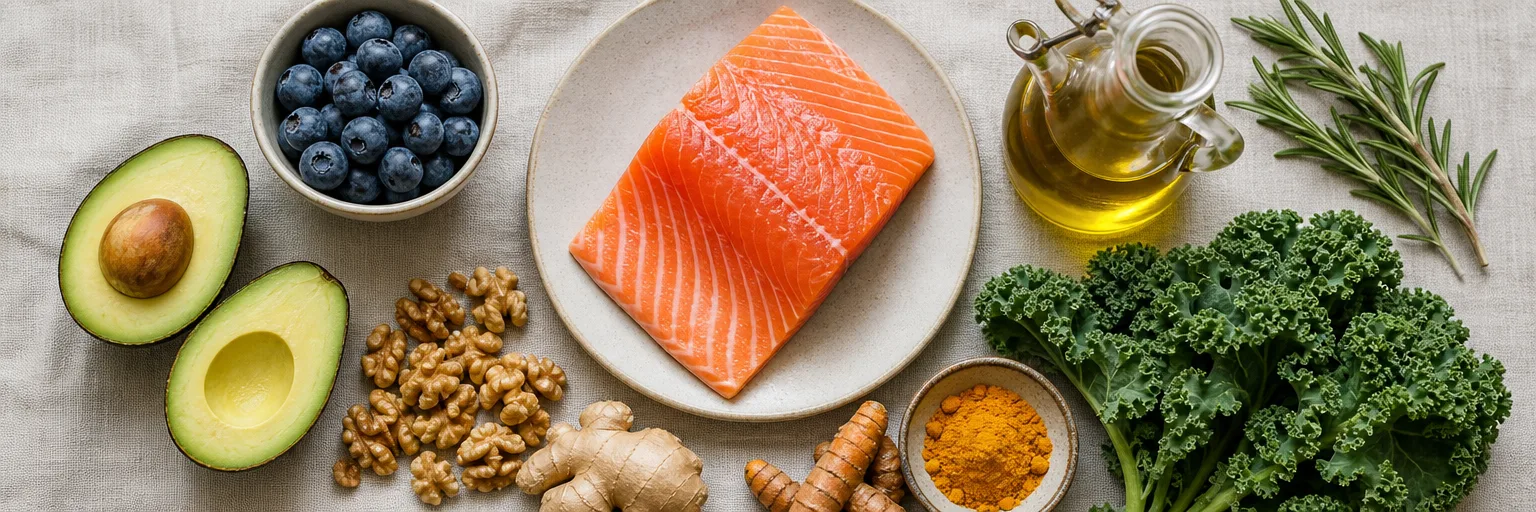
Top 5 foods to add: leafy greens (spinach, kale, arugula), fatty fish (salmon, sardines, mackerel), berries (blueberries, raspberries, strawberries), extra-virgin olive oil, and walnuts or almonds.
Top 5 foods to limit: sugar-sweetened beverages and added sugar, ultra-processed foods (most packaged snacks, sweets, breakfast cereals), processed meats (bacon, sausage, deli meat), refined grains (white bread, white rice, pastries), and excessive alcohol.
Who this is for / not for
Good fit if you:
- Have rheumatoid arthritis, inflammatory bowel disease (IBD) — see IBD and weight loss for the Mediterranean / IBD-AID framework after the Chicco 2021 MED-CD trial — multiple sclerosis — see multiple sclerosis and weight loss for the Wahls-vs-Swank trial and the Katz Sand 2023 review — or another inflammatory condition where reducing dietary inflammatory load is part of standard nutrition guidance. (If your gut symptoms are functional rather than inflammatory — bloating, altered bowel habits, abdominal pain without bleeding or weight loss — see IBS and weight loss for the FODMAP-aware version of the protocol; if gluten is the suspected trigger, rule out celiac disease and weight loss before going gluten-free.)
- Have PCOS or insulin resistance — the pattern improves both directly, with overlap to the PCOS and weight loss and insulin resistance and weight loss playbooks. The same Mediterranean / anti-inflammatory pattern is the highest-evidence dietary recommendation in endometriosis and weight loss (Parazzini 2013; ESHRE 2022).
- Are post-menopausal and dealing with cardiometabolic drift — visceral fat, blood pressure, lipids — alongside weight goals.
- Have chronic joint pain without a confirmed inflammatory diagnosis but want a sensible baseline pattern to layer onto activity and weight management.
- Want a flexible, sustainable framework rather than a strict elimination protocol.
Not a fit if you:
- Have severe oxalate sensitivity (a small kidney-stone-forming subgroup) — the pattern’s high spinach, almond, and beet load needs modification.
- Have clinically significant nightshade sensitivity with reproducible reactions — most anti-inflammatory plans lean heavily on tomatoes, peppers, and eggplant.
- Are in active eating-disorder treatment — adding another rule layer to food while you are working with a clinician on flexibility is usually counterproductive.
- Need very rapid short-term loss (the pattern is paced for sustainability, not a 30-day sprint).
- Want a clear ban list and macro target — a structured plan like the DASH diet at a defined calorie level may suit you better.
What inflammation is (and isn’t)
Inflammation is the immune system’s response to damage or infection. Acute inflammation — a sprained ankle, a cold, a cut healing — is short-lived, visible, and protective. That is not what an anti-inflammatory diet targets.
The target is chronic low-grade inflammation: a long-running, small elevation in inflammatory signaling that does not produce overt swelling or pain but raises the risk of cardiovascular disease, type 2 diabetes, cognitive decline and dementia, and several cancers. It is measured in the blood with markers like C-reactive protein (CRP), interleukin-6 (IL-6), and TNF-alpha. An hs-CRP under 1 mg/L is low risk; 1 to 3 mg/L is moderate; over 3 mg/L is high.
The eating pattern that consistently lowers these markers in trials is the same one that lowers cardiovascular risk and supports gradual weight loss — there is not a separate “inflammation diet” hidden behind the wellness branding. Most of what gets sold as one is a Mediterranean diet with extra polyphenol emphasis and a shorter ban list.
The food list — 20 to add, 10 to limit
The pattern reduces to a short list of repeat-purchase foods. The “active component” column is the working hypothesis from the trial literature, not a guarantee that any one molecule does the work.
| Food | Active component | Evidence note |
|---|---|---|
| Spinach, kale, arugula | Folate, polyphenols, nitrates | Inverse association with CRP across cohorts |
| Broccoli, cauliflower, Brussels sprouts | Sulforaphane | Lowers oxidative stress markers in RCTs |
| Berries (blueberries, raspberries, strawberries) | Anthocyanins | Reliable CRP reduction in trials at 1 to 2 cups/day |
| Tomatoes (cooked) | Lycopene | Lowers CRP and improves endothelial function |
| Bell peppers | Vitamin C, carotenoids | High polyphenol per calorie |
| Carrots, sweet potato | Beta-carotene | Standard high-fiber vegetable load |
| Garlic and onion | Allicin, quercetin | Modest CRP signal; strong cardiometabolic data |
| Olive oil (extra-virgin) | Oleocanthal, MUFA | Central fat in PREDIMED; CRP drop at 30 to 50 g/day |
| Fatty fish (salmon, sardines, mackerel) | Omega-3 EPA/DHA | Strongest single-food evidence; 2+ servings/week |
| Walnuts | Omega-3 ALA, polyphenols | PREDIMED nut arm produced cardiometabolic benefit |
| Almonds and pistachios | MUFA, vitamin E | Lower CRP at 1 to 2 oz/day |
| Legumes (lentils, chickpeas, black beans) | Fiber, plant protein | Lower CRP and improved glycemia |
| Whole grains (oats, quinoa, barley) | Beta-glucan, fiber | Replace refined grains for satiety and CRP drop |
| Avocado | MUFA, fiber | Lowers inflammatory markers vs refined-carb meals |
| Plain yogurt and kefir | Probiotics, protein | Lower CRP in fermented-dairy trials |
| Green tea | Catechins (EGCG) | Modest but consistent CRP signal |
| Turmeric (with black pepper) | Curcumin | Lowers CRP in meta-analyses; bioavailability low |
| Ginger | Gingerols | Lowers CRP and joint pain markers |
| Cinnamon | Polyphenols | Small glycemic benefit; flavor-displacer for added sugar |
| Dark chocolate (70%+, modest portions) | Flavanols | Lowers CRP at 1 oz/day; calorie-aware |
| Food to limit | Why |
|---|---|
| Sugar-sweetened beverages | Largest single dietary contributor to inflammatory load |
| Added sugar (candy, pastries, sweetened cereals) | Raises CRP and insulin; primary calorie creep source |
| Refined grains (white bread, white rice, refined pasta) | Lower satiety, higher glycemic load |
| Processed meat (bacon, sausage, deli meat) | Consistent CRP signal; WHO Group 1 carcinogen |
| Ultra-processed foods broadly | Independent association with CRP beyond their nutrient profile |
| Excessive alcohol (above 1 drink/day women, 2 men) | Raises CRP, IL-6, and liver inflammation markers |
| Industrial seed oils in fried/restaurant food | Excess omega-6 in ultra-processed context; whole-food use is fine |
| Trans fats (still present in some baked goods) | Strongest single dietary inflammation signal |
| Charred/burnt meat (very high heat) | AGEs and HCAs raise oxidative load |
| Sugary “healthy” snack bars | Sneak in 15 to 30 g added sugar per serving |
For the broader sugar piece, the sugar and weight loss guide covers the limits, swaps, and what counts as “added” — and the fiber for weight loss guide handles the ramp on the add side.
What the evidence says about weight loss specifically
The honest read on the trial literature is that the direct weight effect of the pattern is modest — and the indirect effect through food displacement is larger.
- Dietary Inflammatory Index (DII, Shivappa et al., 2014). The DII is the most-validated tool for scoring the inflammatory potential of a dietary pattern. Across cohort studies, adults in the most anti-inflammatory DII quartile have lower BMI, smaller waist circumference, and 20 to 30 percent lower odds of metabolic syndrome compared to those in the most pro-inflammatory quartile. Causality is weaker than for the intervention trials, but the gradient is consistent.
- PREDIMED (Estruch et al., NEJM 2018, primary publication 2013). The Mediterranean diet plus extra-virgin olive oil or mixed nuts produced about a 30 percent reduction in major cardiovascular events at 5 years. Weight change in the trial was modest (1 to 2 kg less than control), and CRP fell measurably in both Mediterranean arms. The pattern is the closest large-trial proxy for an anti-inflammatory diet.
- MIND trial (Morris et al., 2015, originally proposed framework; full RCT published 2023). The MIND diet — a Mediterranean-DASH hybrid emphasizing leafy greens and berries — produced modest weight loss (about 5 kg at 3 years in the trial intervention arm) but did not outperform a calorie-matched Mediterranean control on cognitive outcomes. The anti-inflammatory food emphasis is the same.
- AHA/ACC 2019 dietary guidance on cardiovascular prevention describes the eating pattern most likely to lower inflammation and cardiometabolic risk: vegetables, fruit, legumes, nuts, whole grains, fish, low-fat or fermented dairy, and minimally processed lean protein, with limited refined grains, added sugar, processed meat, and sodium. This is the anti-inflammatory pattern under a different name.
The pragmatic takeaway: the pattern is best understood as a cardiometabolic intervention that produces moderate weight loss when calories are controlled, in the same neighborhood as Mediterranean and DASH. For the broader comparison across named diets, the best diet for weight loss hub maps each pattern to the situations it suits.
Anti-inflammatory vs Mediterranean vs DASH vs Whole30
These four patterns sit close to each other on the food side but diverge on rules, evidence, and sustainability.
| Feature | Anti-inflammatory | Mediterranean | DASH | Whole30 |
|---|---|---|---|---|
| Typical calorie reduction (uncontrolled) | 200 to 400 kcal/day via displacement | 100 to 300 kcal/day | 100 to 300 kcal/day | 300 to 700 kcal/day (very restrictive) |
| Weight-loss evidence strength | Moderate (2 to 5 lb uncontrolled; 4 to 8% with deficit) | Moderate to strong (4 to 10% at 6 to 12 mo) | Moderate (4 to 10 lb at 6 mo) | Short-term only; no long-term RCTs |
| CRP-reduction evidence | Strong | Strong | Strong | Limited |
| Sustainability | Good | Excellent | Good | Poor (30-day reset framing) |
| Banned food groups | Few — limits added sugar, UPF, processed meat | None — discourages but allows | None — sets sodium target | Many — grains, dairy, legumes, sugar, alcohol |
| Best suited for | Inflammatory conditions, PCOS, post-menopause, metabolic syndrome | Cardiovascular prevention, sustainable everyday eating | Hypertension, prediabetes | Short reset, identifying food triggers |
| Downsides | Vague rules can drift toward “intuitive Mediterranean” | Portion creep on nuts and olive oil | Sodium target hard outside home cooking | Restrictive, social cost, no long-term evidence |
If you are framing your eating around inflammation, the Mediterranean diet plus a harder line on added sugar, alcohol, and ultra-processed food is essentially the anti-inflammatory diet. Whole30 sits apart — it is a short elimination protocol, not a long-term pattern.
A 1-day ~1,600-calorie anti-inflammatory plate plan
A practical day that hits the pattern and lands around 1,600 kcal.
| Meal | What | Notes |
|---|---|---|
| Breakfast (~380 kcal) | 1 cup plain Greek yogurt + 1 cup mixed berries + 2 tbsp walnuts + 1 tsp ground flax + dash of cinnamon | High polyphenol load before noon; protein anchor at ~25 g |
| Lunch (~500 kcal) | Big salad: 3 cups spinach and arugula, 4 oz grilled salmon, 1/2 cup chickpeas, 1/2 avocado, cherry tomatoes, cucumber, 1 tbsp extra-virgin olive oil + lemon vinaigrette | Two omega-3 sources (salmon + flax at breakfast); 30+ g protein |
| Snack (~220 kcal) | 1 oz almonds + 1 medium apple + green tea | Fiber + MUFA bridge to dinner |
| Dinner (~500 kcal) | 4 oz baked chicken thigh (skin off) + 3/4 cup quinoa + 1.5 cups roasted broccoli + Brussels sprouts with garlic, olive oil, and turmeric + side of sauerkraut | Sulforaphane plus fermented food; 30+ g protein |
| Total | ~1,600 kcal | ~110 g protein, 35 to 40 g fiber, 2 omega-3 sources |
For a tighter calorie target swap one egg for the salmon-portion lunch and drop the snack almonds to 1/2 oz; for a higher target add a second tbsp of olive oil at dinner and a slice of whole-grain sourdough at lunch. The pattern handles 1,400 to 2,200 kcal without much restructuring. For other ready-made days see the 1,500-calorie meal plan and the weight-loss meal plan guide.
Special situations: PCOS, Hashimoto’s, joint pain, post-menopause
PCOS. The anti-inflammatory pattern overlaps directly with the dietary recommendations for PCOS — vegetables, lean protein, fish, legumes, whole grains, olive oil, with minimal added sugar and ultra-processed food. Trials of low-DII patterns in PCOS show improvements in fasting insulin, HOMA-IR, and androgen markers at 8 to 12 weeks, often alongside 3 to 6 percent body weight loss. The mechanism — lower insulin response, less visceral fat, lower oxidative stress — maps neatly onto the central PCOS problem. Build the pattern on top of the playbook in PCOS and weight loss.
Hashimoto’s. Anti-inflammatory eating is reasonable for general health and may modestly help energy, joint pain, and brain fog — but it does not reverse the autoimmunity, normalize TSH, or replace levothyroxine. The honest read from trials in Hashimoto’s patients is that diet does not move thyroid function meaningfully once replacement therapy has TSH in range. Pair the pattern with the realistic framing in thyroid and weight loss, and the deep-dive on TSH targets, selenium evidence, the gluten controversy, and T4/T3 combinations sits in Hashimoto’s thyroiditis and weight loss.
Joint pain. For knee osteoarthritis and chronic non-inflammatory joint pain, weight loss is the largest dietary lever (every 1 lb off the scale takes about 4 lb off the knees during walking). The anti-inflammatory pattern layers on top: omega-3 from fish, polyphenols from berries and leafy greens, and turmeric/ginger have small but consistent effects on joint-pain scores in randomized trials. For inflammatory arthritis (rheumatoid arthritis, psoriatic arthritis), discuss the pattern with a rheumatologist — it is complementary, not a replacement for disease-modifying medication. The full evidence on biologic-response and weight in RA, plus the 5-step protocol, is in rheumatoid arthritis and weight loss; the seronegative dactylitis-and-enthesitis pattern (including the Klingberg 2019 weight-loss-as-DMARD signal) is in psoriatic arthritis and weight loss. The Th17/IL-23 axis that drives plaque psoriasis and psoriatic arthritis is fed directly by adipose-derived cytokines, which is why the same Mediterranean-anchored eating pattern produces measurable PASI improvement in psoriasis and weight loss.
Post-menopause. The pattern addresses the three things that drift in the transition — visceral fat, blood pressure, and lipids — with the strongest evidence in the same demographic that runs the largest PREDIMED-style trials. Combine it with the strength-training and protein-target framework in menopause and weight loss; the food side is essentially the same.
Obese-asthma. Adipose-driven IL-6 and TNF-α directly worsen the late-onset, Th2-low obese-asthma phenotype, and Mediterranean adherence is associated with better asthma control in observational data (Garcia-Larsen 2018, European Respiratory Journal). Layer the pattern on the weight-loss and inhaler protocol in the asthma guide.
Frequently asked questions
Will an anti-inflammatory diet help me lose weight? Modestly and mostly indirectly. Direct trial evidence shows 2 to 5 lb of loss at 6 to 12 months without specific calorie control; layering a moderate deficit produces 4 to 8 percent of body weight loss in the same neighborhood as Mediterranean and DASH.
Is the anti-inflammatory diet the same as the Mediterranean diet? About 80 percent overlap. The differences: more explicit emphasis on berries, leafy greens, and spices; a harder line on added sugar, alcohol, and ultra-processed food; less central role for wine. A well-run Mediterranean diet is already an anti-inflammatory diet.
What foods are most inflammatory? Refined sugar and sugar-sweetened beverages, refined grains, ultra-processed foods, processed meats, excessive alcohol, and trans fats — in roughly that order of evidence strength.
Are nightshades inflammatory? No, at the population level. Tomato-rich diets are neutral-to-anti-inflammatory in trials. Individual reactors exist; an elimination-and-reintroduction test is reasonable if you suspect you are one.
How fast do I see results? CRP and IL-6 typically drop within 2 to 6 weeks; weight follows the calorie deficit at the usual 0.5 to 1 lb per week. If nothing has moved at 6 weeks, the pattern is not being followed tightly enough — usually because of residual sugar, alcohol, or restaurant meals.
Can it help PCOS, Hashimoto’s, or insulin resistance? Yes for PCOS and insulin resistance — improvements in fasting insulin, HOMA-IR, and androgen markers within 8 to 12 weeks. More modestly for Hashimoto’s, where the pattern is a sensible baseline but not a substitute for levothyroxine.
Sources
- Shivappa N, Steck SE, Hurley TG, Hussey JR, Hébert JR. Designing and developing a literature-derived, population-based dietary inflammatory index. Public Health Nutrition (2014).
- Estruch R, Ros E, Salas-Salvadó J, et al. Primary prevention of cardiovascular disease with a Mediterranean diet supplemented with extra-virgin olive oil or nuts (PREDIMED). New England Journal of Medicine (2018).
- Morris MC, Tangney CC, Wang Y, Sacks FM, Bennett DA, Aggarwal NT. MIND diet associated with reduced incidence of Alzheimer's disease. Alzheimer's & Dementia (2015).
- Arnett DK, Blumenthal RS, Albert MA, et al. 2019 ACC/AHA Guideline on the Primary Prevention of Cardiovascular Disease. Journal of the American College of Cardiology (2019).
- Hess JM, Stephensen CB, Kratz M, Bolling BW. Exploring the links between diet and inflammation: dairy foods as case studies. Advances in Nutrition (2018).