
2026-07-12 · home workout, bodyweight, no gym, weight loss, exercise, strength training
Written by WeightFAQ Staff
Evidence-informed guidance from the WeightFAQ editorial team.
20 min read
Last editorial review Jul 12, 2026
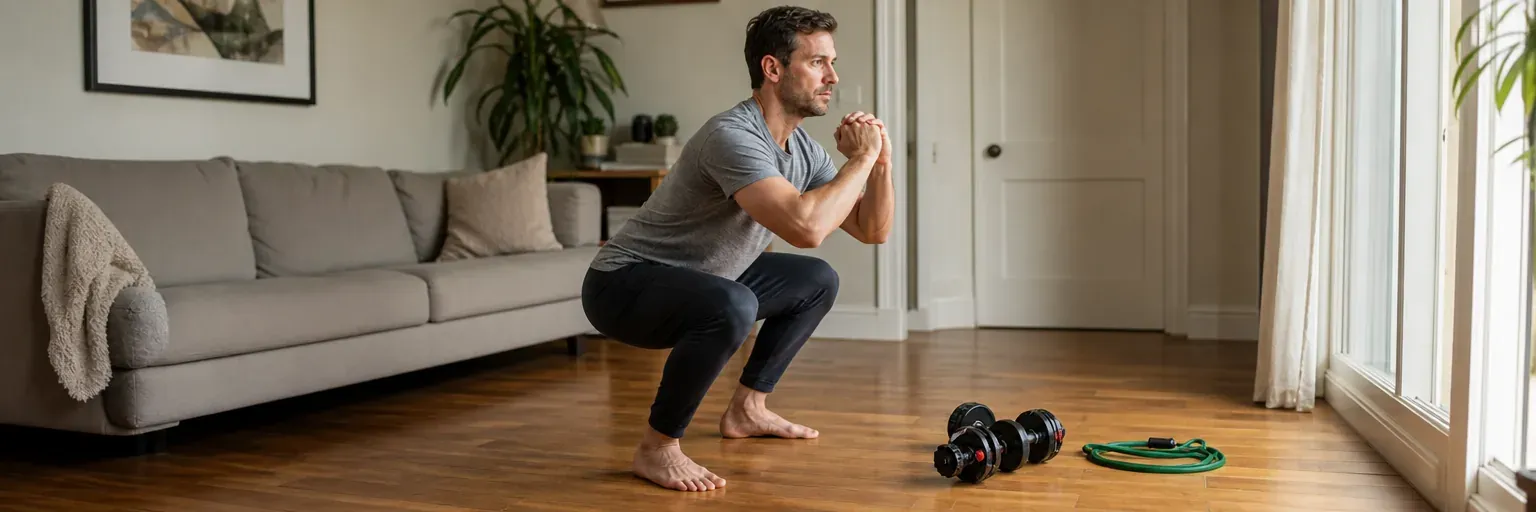
Home Workouts for Weight Loss: 8-Week No-Gym Plan (Bodyweight Only)
Quick answer: You can lose weight with bodyweight-only home workouts. The plan is 4 sessions per week, roughly 30–40 minutes each, built around six movement patterns (push, squat, hinge, pull, core, conditioning) that progress over 8 weeks through five levers — reps, sets, tempo, pause, and unilateral variation — instead of added load. Realistic loss is 0.5–1 lb per week when paired with a 400–500 kcal daily food deficit, or 20–40 lb over a year. Roughly 90% of the deficit still comes from food; exercise’s job is to protect lean mass, raise NEAT, and improve adherence (Hall 2011 Lancet; Donnelly 2009 ACSM position stand). Skip the “$500 home gym” step until you have proven 8 weeks of consistency with zero equipment.
Who this is for — and not for
Good fit if: you want to lose weight without a gym membership, you live in a small apartment or rural area, you work variable hours, you are cost-sensitive (pairs well with our weight loss on a budget $50/week food plan), you are new to resistance training and want to build the movement base at home, you are returning after a long break and want a low-pressure ramp, you are on a GLP-1 medication and need a lean-mass-protection protocol you can do anywhere, you have small kids and cannot leave the house for a training window, or you have tried a gym and the anxiety keeps winning — Chu 2019 documents ~68% of first-time gym users report meaningful anxiety at first visit, and Hausenblas 2004 documents a real home-advantage for high-SPAS individuals with equivalent weight-loss outcomes; the audit and the alternative-paths library live at weight loss and gym anxiety.
Not a fit if: you have an acute injury, uncontrolled cardiovascular disease, or a joint condition without medical clearance; you are more than 6 weeks postpartum but have not been cleared for exercise; you are within the deferred window post-bariatric surgery (usually 6 weeks minimum, physician-cleared — see our bariatric surgery overview); you are in active mood-disorder crisis; or you are already an intermediate lifter chasing a strength ceiling that bodyweight alone will not unlock — you can still train at home, but the plan below is a starting-and-restarting program, not a long-run intermediate powerbuilding template.
If you are new to exercise entirely, start with a 2-week walking base (see walking for weight loss) before layering these sessions on top. If you know you will not train — see weight loss without exercise for the food-only path, which is a legitimate route with a modest ceiling.
What “home workout” actually means for weight loss
The temptation is to treat home workouts as a workaround for people who cannot afford a gym. That framing sells the modality short. The physiology of weight loss through bodyweight training rests on three mechanisms:
First, food does most of the work. Hall 2011 in The Lancet modeled the human energy-balance system in a way that put the arithmetic beyond argument: a ~500 kcal daily deficit produces roughly 1 lb of fat loss per week, and 80–90% of that deficit for most weight losers comes from food, not exercise. A hard bodyweight session burns 150–350 kcal — meaningful, but not the primary lever. Do not overpromise the calorie side of home workouts to yourself; you will feel cheated when the scale does not move as fast as the effort suggests.
Second, exercise preserves lean mass in a deficit. Villareal 2011 in the New England Journal of Medicine — the FLESS trial in older adults with obesity — showed that adding resistance training to a calorie deficit shifted the composition of weight lost toward more fat and less muscle. Villareal 2017 in NEJM extended the picture, and Willis 2012 in the Journal of Applied Physiology — the STRRIDE-AT/RT trial — showed the combined resistance-plus-aerobic group produced the best body composition outcomes. Translation: without resistance training, a bigger fraction of the weight you lose is lean tissue, which lowers your resting metabolism and makes maintenance harder. This is the single strongest reason to keep bodyweight sessions in the plan even when the scale-move-per-hour math looks better for pure walking. For the gym-based analog of this plan and the deeper sets-and-reps rationale, see strength training for weight loss.
Third, NEAT compounds. Levine 1999 in Science — the NEAT paper — established that non-exercise activity thermogenesis can vary by up to 2,000 kcal/day across individuals, and that people who train regularly tend to move more between sessions rather than compensating downward. That is why 7,000–10,000 daily steps stacked on top of 4 bodyweight sessions per week beats either alone. For a deeper dive on adherence and the practical exercise-and-weight-loss picture, see our exercise for weight loss parent guide, and for a time-efficient interval alternative, HIIT for weight loss. Time-of-day matters less than most people think — see best time to exercise for weight loss for the chrono side.
Missing from the mechanism list on purpose: EPOC (the “afterburn effect”) and “muscle burns calories at rest.” Both are real; both are marketed at 5–10× their actual size. EPOC adds roughly 25–80 kcal to a hard bodyweight session, not 500. A pound of new muscle burns roughly 6 kcal/day at rest, not 50. Do not build the plan on either.
The 8-week bodyweight program
Four sessions per week: two upper-body focus, two lower-body/full-body focus. Aim for at least 48 hours between sessions that hit the same movement pattern; one full rest day and one active-recovery walking day per week are non-negotiable.
A workable weekly template:
- Monday — Session 1 (upper-body focus)
- Tuesday — walk (20–40 min) or full rest
- Wednesday — Session 2 (lower-body focus)
- Thursday — walk (20–40 min) or full rest
- Friday — Session 3 (full-body/pull-emphasis)
- Saturday — Session 4 (lower-body/conditioning-emphasis)
- Sunday — full rest (this is where the adaptation actually happens — sleep is not optional)
Every session runs the same six movement patterns in this order: push, squat, hinge, pull, core, conditioning finisher. Only the specific exercise variation and the set/rep prescription change week to week.
Week-by-week progression
| Weeks | Focus | Sets × reps | Tempo / rest | Notes |
|---|---|---|---|---|
| 1–2 | Technique + volume base | 2 × 8–12 | Normal tempo, 60–90 s rest | Prioritize form. Expect soreness. Do not add rounds early. |
| 3–4 | Base build | 3 × 10–15 | Normal tempo, 45–60 s rest | Progress the exercise variation only when the top rep count feels like RPE 7 or lower. |
| 5–6 | Intensity + tempo | 3 × 12–15 | 3-second lowering phase, 30–45 s rest | Slower tempo replaces external load. Sessions feel meaningfully harder without more time. |
| 7–8 | Challenge + unilateral | 3–4 × 15+ or advanced regression | 2-second bottom-position pause, 30–45 s rest | Push toward unilateral variations (split squat, one-arm progression, single-leg glute bridge). |
If a movement variation feels like RPE 9–10 (grinding, form breaking) at the prescribed reps, drop back one regression level for that exercise for the current week and re-attempt next week. If it feels like RPE 5–6 (easy, could do 5+ more), advance one progression level. RPE stands for rate of perceived exertion on a 1–10 scale — RPE 7 means you could do roughly 3 more reps; RPE 9 means you had 1 rep left in reserve.
The six core movement patterns (progression ladder)
Push variation (chest, shoulders, triceps) — wall push-up → incline push-up (hands on a counter, then a chair) → knee push-up → full push-up → decline push-up (feet elevated on a chair) → one-arm push-up progression. Advance when you hit the top of the rep range with 2+ reps in reserve for two sessions in a row.
Squat variation (quads, glutes) — assisted bodyweight squat (hands on a doorframe or chair back for balance) → full bodyweight squat → sumo squat → Bulgarian split squat (rear foot elevated on a chair) → jump squat (skip the jump if joint issues; add a 2-second pause instead). Full range of motion — thighs at least parallel — matters more than depth beyond parallel for hypertrophy. If the jump-squat progression appeals to you as a standalone stimulus rather than a squat variation, see plyometrics for weight loss for the intensity ladder, the 4-week beginner protocol (2 sessions per week, Level 0 pogo hops through Level 1 broad jumps), the landing-mechanics rules (soft-knee, quiet, land-where-you-took-off), and the 5-scenario decision matrix that names the readers who should skip plyo entirely.
Hinge variation (hamstrings, glutes, lower back) — glute bridge → single-leg glute bridge → hip thrust (shoulders on a couch, feet flat on floor) → single-leg hip thrust → good morning progression. This pattern is the most under-trained in home programs and the most important for lower-back health and posture.
Pull surrogate (upper back, biceps, rear deltoid) — this is where zero-equipment programs struggle. Options in order of ease: inverted row using a sturdy dining table (lie underneath, grip the edge, pull chest to table) → doorway inverted row using a towel looped through a securely-locked door → renegade row (in a plank position, alternate pulling knees toward chest — this is a core-plus-pull surrogate but does not replace a true pulling movement) → assisted chin-up with a doorway pull-up bar ($15, worth buying if you can). If none of these work in your space, a $20 resistance band anchored under a closed door replaces this pattern well — see resistance band training for weight loss for the 12-week band-first plan and door-anchor safety rules.
Core — dead bug (lying face-up, alternate opposite arm and leg extensions) → plank → side plank → bird dog → hollow body hold. Rotate through variations rather than adding endless reps of one — anti-rotation (Pallof-style) and anti-extension (plank) trains the core better than sit-ups.
Conditioning finisher — 30 seconds work / 30 seconds rest × 4 rounds of: mountain climbers → jumping jacks → high knees → burpees (or step-back burpees if joints or downstairs neighbors are an issue). Total finisher time: 4 minutes. This drives the metabolic-conditioning side and pulls average session heart rate up.
Sample Session 1 (upper-body focus, weeks 3–4)
| Order | Exercise | Sets × reps | Notes |
|---|---|---|---|
| 1 | Dynamic warm-up | 5 min | Arm circles, cat-cow, 10 bodyweight squats, 5 knee push-ups |
| 2 | Push-up (knee or full) | 3 × 10–15 | Chest to fist-height off floor |
| 3 | Bulgarian split squat | 3 × 10 per side | Rear foot on chair |
| 4 | Single-leg glute bridge | 3 × 12 per side | Pause 1 sec at top |
| 5 | Inverted row (table) or renegade row | 3 × 8–12 | Slow lowering phase |
| 6 | Dead bug | 3 × 10 per side | Low back stays flat |
| 7 | Conditioning finisher | 4 × 30/30 | Mountain climbers |
Total time: ~35 minutes. Rest 45–60 seconds between sets in weeks 3–4.
NEAT and cardio layer
Bodyweight sessions handle the strength-and-lean-mass side. Daily walking handles the calorie-burn-and-adherence side. Target 20–40 minutes of walking per day at a conversational pace, or roughly 7,000–10,000 daily steps if you prefer to track it that way. This is not the same as the workout — it is on top of it. See the walking for weight loss guide for the pace, incline, and cadence details. For an outdoor complement that raises calorie burn per hour without changing your walking pace, rucking for weight loss — walking with a 10–20% body-weight pack — adds 30–50% more burn than the same-pace unloaded walk and pairs cleanly with a bodyweight strength plan. If you have or are considering a home treadmill or walking pad, the treadmill workout for weight loss guide covers per-session calorie math and how a walking pad at 2 mph adds 4,000–8,000 accumulated steps per work day without a dedicated workout block; for the specific 30-minute incline protocol that most home-treadmill readers actually run, see the 12-3-30 workout for weight loss pillar.
Optional add-ons for weeks 3+ if joints and energy allow: 1–2 low-impact conditioning days of 20–30 minutes each — dance fitness (streaming Zumba, hip-hop cardio, or aerobic dance from FitOn / Peloton / YouTube pairs cleanly with a bodyweight strength plan, needs only cross-trainers and a 6×6 ft floor patch, and beats most solo cardio on stick-with-it rate), barre (streaming Barre3, Alo Moves, or Obé for $10–30/mo — uses a sturdy chair back as the barre substitute, needs only 1–3 lb dumbbells and a resistance loop, and delivers a hip-endurance and postural stimulus that pairs well with bodyweight strength), jump rope (advanced only — the most space-efficient home cardio modality, needing only a 6×6-foot floor and a 9-foot ceiling, but 4–5× body-weight forefoot impact makes it a poor fit for higher-BMI or joint-sensitive readers), climbing apartment or stadium stairs (the free, Jenkins-2019-style version of the stair climber for weight loss — 3 flights × 3 times per day is enough to improve VO2peak without a gym), or a light bike ride. Do not add these in the first two weeks; soreness from the strength sessions will dominate.
Caloric-deficit reminder — you cannot out-train poor food
A 4-session-per-week bodyweight plan burns roughly 800–1,400 kcal from formal exercise plus 200–400 kcal per day from added NEAT. That is meaningful — call it 400–500 kcal/day averaged across the week. But a single 800 kcal takeout dinner erases that entire day’s burn plus the workout, and it takes 5 seconds to eat versus 40 minutes to earn. The rank order of levers has not changed: food is #1, sleep is #2, exercise is #3. See best diet for weight loss for the diet-selection framework and how many calories to lose weight for the arithmetic, and layer this plan on top. Protein intake matters even more when you are training — aim for 0.7–1.0 g/lb bodyweight (protein intake for weight loss has the full ranges).
Realistic time course
| Time point | What to expect |
|---|---|
| Week 1 | Soreness. Push-up form still developing. Small water-weight bump (~1–2 lb) from muscle glycogen storage — do not misread as fat gain. |
| Week 4 | Measurable strength gain (push-up reps often doubled from baseline; can hold a plank 30–60 seconds longer). First waist measurement drop of ~0.5–1 in typical. Scale change ~2–4 lb with a food deficit. |
| Week 8 | Visible composition change — clothes fit differently. Push-ups moved from knee to full for most beginners, or full to decline for intermediates. Scale ~4–8 lb down. Waist ~1–2 in down. Continue the same template but keep progressing variations. |
| Month 3 | Split squats and single-leg glute bridges become standard. Conditioning finisher no longer redlines the session. Resting heart rate down ~4–8 bpm. |
| Month 6 | Pants sizes down for most. Strength progression tapers unless external load is introduced — a $50 pair of adjustable dumbbells or a full band set is worth it here. |
| Maintenance (12+ months) | Move to 3 sessions per week if maintenance, 4 if still losing. Rotate through progressions on a 6–8 week cycle. Injury risk increases if novelty is chased at the cost of consistency. |
Individual response varies. Track weekly weight (same day, same time, once per week), monthly waist measurements, and one photograph every four weeks. Skip the scale for a week if it is driving disordered thoughts — the how to track weight loss progress guide has a full tracking cadence.
Special situations
Small apartment or low ceiling
Skip burpees and jump squats. Substitute knee drives (marching in place with a high knee), lateral shuffles (short-range side steps), and step-ups on a sturdy chair. The strength side of the program is unchanged — the conditioning finisher is where the jumping usually lives, and it swaps cleanly for a jumping-jack-alternative like squat pulses or fast alternating lunges (without the jump).
Dorm room or shared space
The full bodyweight plan works in a dorm without any equipment or floor space beyond a yoga-mat footprint. Skip jumping if you have a roommate downstairs or bunk beds overhead; the low-ceiling and small-apartment substitutions above apply directly. For campus context — how to combine this dorm routine with rec-center strength days, dining-hall protein targeting, and the 7-hour sleep floor — see weight loss for college students.
Bad knees or osteoarthritis
Use chair-supported squats (light hand touch on chair back for balance), wall push-ups or elevated push-ups (hands on counter), and skip all jumping. Add a longer warm-up (10 minutes of easy walking and mobility). For a zero-equipment low-impact companion practice that trains core, hip stabilizers, and posture without loading the knee joint, see wall pilates for weight loss. See osteoarthritis and weight loss for the wider pain-and-load management picture; the resistance-training-plus-weight-loss combo is one of the highest-yield interventions for OA symptoms.
Postpartum (weeks 6–12)
Start only after your 6-week clearance. Screen for diastasis recti before adding plank or crunch variations — if the midline gaps more than 2 fingers, sub dead bug and heel slides for plank in the core slot, and skip the conditioning finisher for the first four weeks. See breastfeeding and postpartum weight loss for the calorie-floor and lactation-safety layer. Keep sessions to 20–25 minutes for the first two weeks and rebuild volume gradually.
Older adults (65+)
Emphasize sit-to-stand (from a chair, no hands) as the squat variation, single-leg balance work as a warm-up (30 seconds each side), and skip all jumping. The conditioning finisher becomes a 4-minute continuous march-in-place at moderate intensity. Add a longer warm-up. Falls prevention is the priority — every unilateral progression is a balance-training exposure. See weight loss for older adults for the wider frailty and sarcopenia context.
On a GLP-1 medication
Semaglutide or tirzepatide accelerates weight loss but pulls lean mass with it if resistance training is absent. Aim for 1.2–1.6 g/kg bodyweight of protein — this is a higher floor than the standard weight-loss recommendation — and prioritize the resistance side of the plan (2 sessions per week minimum) even if appetite makes eating feel like a chore. See sarcopenic obesity for the muscle-preservation science on GLP-1 protocols.
Shift worker
Anchor the sessions to your activity start, not the calendar clock. A pre-shift bodyweight session 60–90 minutes before clock-in works well; a post-shift session within 90 minutes of target sleep does not. See shift work and weight loss for the full circadian-training template. Skip a session on days you slept under 5 hours — trained-hard-on-no-sleep is where injury clusters.
Post-bariatric surgery
Wait for the 6-week (or longer) physician clearance. Reintroduce bodyweight movements at the wall-push-up / assisted-squat regression level for the first month post-clearance regardless of pre-op fitness. See bariatric surgery overview for the wider post-op activity ramp.
Home bodyweight vs. other exercise choices
| Modality | Setup cost | Weekly time | Lean-mass preservation | Adherence signal | Calorie burn / session | Best for |
|---|---|---|---|---|---|---|
| Home bodyweight (this plan) | $0–$35 | 2.5–3 h + walking | Strong (with progression) | Very high (no travel, no schedule) | 150–350 kcal | Cost-sensitive, time-constrained, small-space, restart programs |
| calisthenics for weight loss | $0–$100 | 2–3 h + walking | Strong (leverage / tempo / range / volume) | Very high (no equipment required at entry) | 200–400 kcal | Readers who want a structured 6-level progression path from wall push-up to one-arm push-up and pistol squat |
| Walking only | $0 | 3.5–7 h | Weak | Highest of all modalities | 200–400 kcal | Complete beginners, joint-limited readers, older adults, everyone as a base |
| Gym full-body 3×/wk | $30–$70/mo | 3–4 h + travel | Strongest (progressive external load) | Moderate (travel friction) | 250–450 kcal | Serious strength progression past month 6, community accountability |
| CrossFit box | $150–$250/mo | 3–4 h | Strong (barbell + gymnastic progression) | High if the schedule fits your life | 300–500 kcal | Readers who want scheduled small-group coaching and can afford the premium — see CrossFit for weight loss for the community-effect adherence data, scaling rule, and 5-modality comparison |
| HIIT (bodyweight or bike) | $0–$200 | 1–1.5 h | Moderate | Moderate (high recovery cost) | 200–350 kcal | Time-crunched readers who tolerate hard intensity |
| Peloton / cardio equipment | $500–$2,500 | 2–4 h | Weak | High if the machine is used | 300–600 kcal | Cardio-focused readers with budget and floor space — see indoor cycling for weight loss for the 4-format buying guide and the Peloton console-kcal correction |
| Home heavy bag + gloves | $150–$350 | 2–3 h | Weak–moderate (upper-body endurance) | High (skill-based) | 250–450 kcal | Readers who bounce off treadmills — see boxing and kickboxing for weight loss for the equipment tier and 4-week plan |
| Mini-trampoline rebounder | $80–$400 | 2–2.5 h | Weak (cardio, not strength) | High (indoor, low-impact, low friction) | 260–580 kcal | Apartment dwellers, joint-sensitive readers, and older adults — see rebounding on a mini-trampoline for weight loss for buying guide and 4-week plan |
| Battle ropes + floor anchor | $70–$120 | 40 min working | Weak (upper-body isometric endurance only) | Moderate (grip fatigue caps sessions) | 250–450 kcal | Small-space home gyms (4 × 8 ft), lower-body-impact-limited readers, and readers who want a genuine HIIT effect without running — see battle ropes for weight loss for the 10.3 MET math, work-rest table, 4-week ramp, and buying guide |
| loaded carries for weight loss | $0–$400 | 60–90 min | Moderate (grip + core + posterior chain) | High (low technique barrier) | 200–500 kcal | Minimal-equipment readers who want gait-under-load strength — farmer, suitcase, front-rack, and overhead walks that scale from a gallon of water per hand up to half body weight per hand and train grip strength, an all-cause-mortality predictor per Leong 2015 Lancet PURE |
| No exercise (food-only) | $0 | 0 | Weakest (measurable lean loss) | Highest (nothing to skip) | 0 | Readers who genuinely will not train — better than no plan |
| Climbing gym (bouldering) | $16–$95/mo + $80–180 shoes | 2.5–4.5 h | Moderate (pulling and core, skips legs and chest) | Very high (game-like adherence) | 300–500 kcal | Readers who hate treadmills and want a strength-plus-cardio hybrid — see rock climbing and bouldering for weight loss for the Ainsworth MET 5.8 (bouldering, session-averaged) / MET 7.0–7.5 (top-rope) per-hour math, the 4-week beginner plan, and why 2 short push-and-legs home strength sessions per week remain non-negotiable alongside climbing |
Adherence beats optimization. The best plan is the one you will actually do 4 times a week for 8 weeks, then keep doing.
Myths and red flags
- Myth: bodyweight cannot build strength. No — progression through tempo, pause, unilateral variations, and leverage produces real strength gain, especially in the first 6–12 months. Beyond that, external load becomes a bigger lever.
- Myth: a home workout burns 500+ calories per session. No — 150–350 kcal is the honest range for a 30–40 minute bodyweight session at moderate-to-hard intensity. The 500+ number usually comes from fitness-app estimates or the marketing for interval videos, both of which routinely overestimate.
- Myth: you need a gym for weight loss. No — adherence beats gym access. The Villareal, Willis, and Donnelly literature does not care where the resistance work happens, only that it happens with progression and sufficient volume.
- Myth: HIIT is required to burn fat. No — total training volume drives the majority of body composition change. HIIT is one legitimate tool for time efficiency; it is not a metabolic special case. See HIIT for weight loss for the honest EPOC math.
- Red flag: chest pain, sudden shortness of breath, one-sided weakness, or fainting during or immediately after a session. Stop. Call 911. This is not a training question.
- Red flag: sharp joint pain that lasts more than 48 hours after a session (not muscle soreness — sharp, localized, or with visible swelling). Substitute the offending movement, drop intensity for a week, and if it persists get a physical therapy evaluation before continuing.
Bottom line
A structured 4-session-per-week bodyweight plan can produce 0.5–1 lb of weight loss per week for most beginners when combined with a 400–500 kcal daily food deficit and 7,000–10,000 daily steps. That is 20–40 lb over a year, matched to any gym-based program at equivalent adherence. Progress the six movement patterns through five levers — reps, sets, tempo, pause, unilateral — over an 8-week mesocycle, then repeat with new variations. Food does most of the work; the training’s job is to keep the loss weighted toward fat rather than muscle. Skip a session when sick or under-slept, do not chase novelty at the cost of consistency, and add a $15 pull-up bar and a $20 band before you buy anything more expensive.
Sources
- Donnelly JE, Blair SN, Jakicic JM, Manore MM, Rankin JW, Smith BK. ACSM position stand: appropriate physical activity intervention strategies for weight loss and prevention of weight regain for adults. Medicine and Science in Sports and Exercise (2009).
- Hall KD, Sacks G, Chandramohan D, Chow CC, Wang YC, Gortmaker SL, Swinburn BA. Quantification of the effect of energy imbalance on bodyweight. The Lancet (2011).
- Villareal DT, Chode S, Parimi N, Sinacore DR, Hilton T, Armamento-Villareal R, et al. Weight loss, exercise, or both and physical function in obese older adults. New England Journal of Medicine (2011).
- Villareal DT, Aguirre L, Gurney AB, Waters DL, Sinacore DR, Colombo E, Armamento-Villareal R, Qualls C. Aerobic or resistance exercise, or both, in dieting obese older adults. New England Journal of Medicine (2017).
- Ross R, Janssen I, Dawson J, Kungl AM, Kuk JL, Wong SL, et al. Exercise-induced reduction in obesity and insulin resistance in women: a randomized controlled trial. Annals of Internal Medicine / Obesity Research (2004).
- Wewege M, van den Berg R, Ward RE, Keech A. The effects of high-intensity interval training vs. moderate-intensity continuous training on body composition in overweight and obese adults: a systematic review and meta-analysis. Obesity Reviews (2017).
- Levine JA, Eberhardt NL, Jensen MD. Role of nonexercise activity thermogenesis in resistance to fat gain in humans. Science (1999).
- U.S. Department of Health and Human Services / ACSM. Physical Activity Guidelines for Americans, 2nd edition. HHS (2018).
- Chilibeck PD, Kaviani M, Candow DG, Zello GA. Effect of creatine supplementation during resistance training on lean tissue mass and muscular strength in older adults: a meta-analysis. Open Access Journal of Sports Medicine (2017).
- Willis LH, Slentz CA, Bateman LA, Shields AT, Piner LW, Bales CW, Houmard JA, Kraus WE. Effects of aerobic and/or resistance training on body mass and fat mass in overweight or obese adults. Journal of Applied Physiology (2012).