
2026-04-16 · exercise, walking, steps per day, cardio, NEAT, low-impact exercise, 10000 steps, beginner, weight loss cardio
Updated 2026-07-29
Written by WeightFAQ Staff
Evidence-informed guidance from the WeightFAQ editorial team.
16 min read
Last editorial review Jul 29, 2026
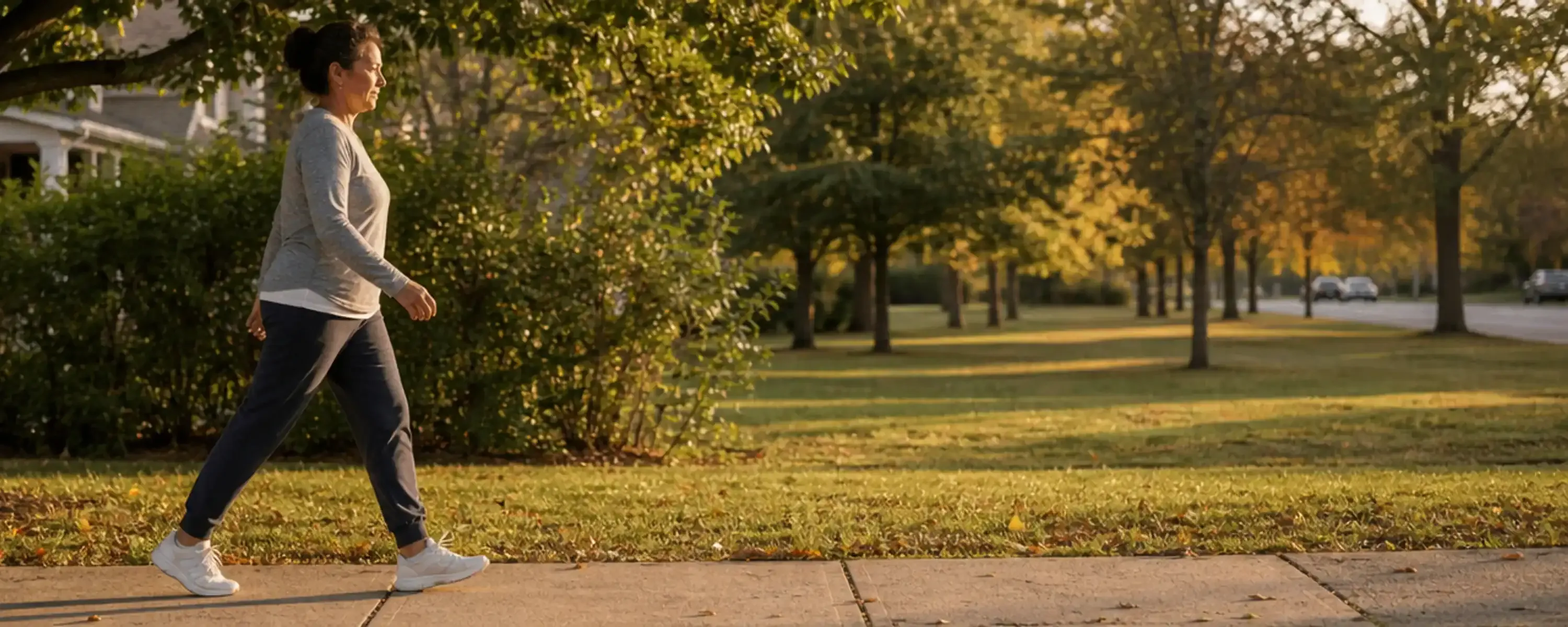
Walking for Weight Loss
For most adults, adding 2,000 to 4,000 steps above your current daily baseline is the highest-yield, lowest-friction way to widen a calorie deficit and pick up meaningful health gains at the same time. A typical 180-lb adult burns about 250 to 350 kcal per hour at a 3-mph brisk walk, and all-cause mortality reductions in the Paluch 2022 Lancet Public Health meta-analysis level off near 7,000 steps per day — not the marketing-driven 10,000. Everything else in this guide — pace, progression, injury-friendly modifications, common mistakes — is downstream of hitting the right step-count bump above where you already are.
Quick stats
- Typical kcal burn: ~250 to 350 kcal/hour at 3-mph brisk walking for a 180-lb adult; lighter adults burn less, heavier adults burn more.
- Mortality curve inflection: ~7,000 steps/day for older adults, ~8,000 to 10,000 for adults under 60 (Paluch 2022 Lancet Public Health; Saint-Maurice 2020 JAMA).
- Practical starting bump for weight loss: +2,000 steps above your current baseline — enough to feel doable, small enough to sustain.
- 4-week progression target: 15 minutes/day in week 1 → 40 to 50 minutes/day most days by week 4.
- Fitness-tracker calorie error: consumer trackers overestimate walking burn by roughly 20 to 40 percent — do not eat back the reported number.
- Post-meal glucose damping: short post-meal walks improve 24-hour glycemic control more than a single equivalent-duration continuous walk (DiPietro 2013 Diabetes Care).
Who this is for / not for
Good fit if you are:
- A complete beginner who has not exercised regularly, or returning after a long break or injury.
- An older adult looking for a joint-friendly option, or someone with knee, hip, or back pain who finds high-impact exercise uncomfortable. For chronic low back pain specifically, walking is one of the best-validated non-drug treatments — protocol in back pain and weight loss. For readers 65+ where fall-risk and balance dominate the mobility picture, pair a daily walking base with 2 sessions per week of tai chi for weight loss — the Wolf 1996 Atlanta FICSIT RCT and Li 2018 JAMA Internal Medicine trial documented 47.5% fall-risk reduction and 58% fall-injury reduction respectively, and CDC STEADI 2023 names tai chi a Level 1 fall-prevention recommendation. Walking protects the cardio and step-count base; tai chi protects the balance system that keeps the walking going.
- Living with knee osteoarthritis — White 2014 in Arthritis Care & Research found ≥6,000 steps per day was associated with substantially reduced incidence of functional limitation, so walking is genuinely disease-modifying, not just tolerable.
- Managing plantar fasciitis — walking still works with cushioned shoes and shorter intervals; the stretching-and-BMI protocol on that guide pairs cleanly with a walking base.
- Living with peripheral arterial disease (PAD). Interval walk-rest — walk until near-maximal claudication pain, rest until it resolves, repeat for 30 to 45 minutes, 3 times a week — is a first-line treatment shown in Gardner 2011 J Vasc Surg to substantially increase pain-free walking distance.
- Managing lymphedema or post-cancer survivorship swelling — daily walking in compression is one of the gentlest, highest-adherence aerobic anchors.
- A GLP-1 medication user maintaining activity during dose escalation, or a desk-based worker looking to add movement without a gym membership — sedentary office workers should also see weight loss and desk jobs for the 20-8-2 break rule and the 7,000–8,500-step workday build.
- Postpartum and rebuilding — start with 10-minute bouts, keep sessions below the level that triggers pelvic-floor heaviness, and progress slowly.
Not a fit as your only intervention if you have:
- Uncontrolled cardiovascular disease, unstable angina, or a recent cardiac event — get clearance and dose management from a cardiologist first.
- Significant balance concerns, active foot ulcers in diabetes, or a recent joint replacement without post-op clearance.
- Chest pain, dizziness, or unusual shortness of breath with exertion — see a clinician before progressing.
Why walking works for weight loss
Three mechanisms explain why walking punches above its weight in the fat-loss literature — even though it burns fewer calories per minute than running or HIIT.
The NEAT lever. Structured walks add to your exercise activity, but everyday movement — parking farther away, taking the stairs, pacing during phone calls — adds to non-exercise activity thermogenesis, or NEAT, the 200- to 800-kcal-per-day lever Levine 2005 identified in Science as the main reason two similar people at the same intake can differ by 15 kg. Walking is the highest-adherence way to move that lever, and stacking structured walks with daily-life step count is the most reliable way to [increase TDEE] without redesigning your day. For desk-bound readers, the highest-leverage at-work NEAT tool is an under-desk treadmill and walking pad for weight loss — 2 to 3 hours per day at 1.5 to 2.0 mph during meetings and email adds ~200 to 500 kcal per day without displacing structured exercise.
Low-impact adherence advantage. Any exercise only works if you actually do it for months. Long-term physical-activity trials consistently show that walking has the strongest adherence curve of any modality — higher than running, cycling, or gym training — because it fits into commutes, errands, and family time without requiring a gym, special skill, or recovery day. The biggest health and fat-loss gains come from moving more than you did before, not from hitting a single magic-intensity target.
Appetite-neutral, glucose-damping. Blundell 2015 in Obesity Reviews and related work show that low-to-moderate-intensity exercise like brisk walking does not drive strong compensatory hunger — post-exercise energy intake tends to stay flat or drop slightly. On top of that, splitting daily walking into short bouts after meals blunts the post-meal glucose spike (DiPietro 2013 Diabetes Care), which reduces the late-afternoon crashes that drive snacking. Both effects widen the practical calorie deficit without demanding more willpower.
Evidence at a glance
The trials below are the most-cited studies linking step count and walking dose to health, mortality, and body-composition outcomes. They converge on the same finding: consistent daily walking produces measurable, durable benefits well before the 10,000-step mark.
| Study | Design | Intervention | Outcome |
|---|---|---|---|
| Saint-Maurice 2020, JAMA | 4,840 US adults, 10-yr F/U | Accelerometer step counts | All-cause mortality drop plateaus at ~8k–10k steps/day; intensity added little independent benefit. |
| Paluch 2022, Lancet Public Health | Meta of 15 cohorts, ~47k adults | Step counts vs mortality | Mortality inflection ~6–8k steps/day for adults ≥60; ~8–10k for adults <60. |
| Bassett 2004, Med Sci Sports Exerc | Old Order Amish community cohort | ~18k self-reported steps/day | Very-high-step communities showed very low obesity prevalence largely independent of diet. |
| White 2014, Arthritis Care Res | 1,788 adults with or at risk of knee OA, 2-yr F/U | Accelerometer step counts | ≥6,000 steps/day associated with substantially reduced incidence of functional limitation. |
| DiPietro 2013, Diabetes Care | Adults at risk of impaired glucose tolerance, crossover trial | 15-min walk after each meal vs one continuous walk | Post-meal split bouts markedly improved 24-h glycemic control vs single continuous walk. |
Two through-lines matter. First, the mortality benefit plateaus well before 10,000 steps — 7,000 to 8,000 is the physiologically meaningful threshold, and the round-number 10,000 is a habit, not a cliff. Second, walking has disease-specific evidence in populations where high-impact exercise is off the table — knee OA, PAD, older adults — which makes it the correct default modality for a huge share of the readers most other exercise guides implicitly exclude.
How many steps do you need?
The honest answer is: it depends on your starting point, and the delta matters more than the absolute number. Three benchmarks are worth knowing.
- The mortality-benefit threshold is ~7,000 steps/day for older adults and 8,000 to 10,000 for younger adults. Below that range, adding steps buys measurable health gains fast. Above it, gains flatten.
- For weight loss specifically, +2,000 to +4,000 steps above your current baseline is the practical target — enough to add roughly 100 to 200 kcal/day of energy expenditure at typical body weights, small enough to actually sustain.
- The 10,000-step target is a round-number habit, not a physiological requirement. It originated with the Japanese “manpo-kei” pedometer marketing campaign in the 1960s. There is nothing wrong with aiming for 10,000 if you enjoy the challenge — but treat it as a stretch goal, not a medical minimum.
A good first step is to track your current average for a full week — including a weekend — then add 2,000 and build from there. Walking above your baseline is what matters for the deficit. Chasing a single number in isolation is what leaves people frustrated when the scale does not move. For the full dose-response, calorie-per-step math, and a step-target-by-goal table, see daily step count for weight loss.
A simple 4-week walking progression
This plan assumes you are currently sedentary or lightly active. If you are already walking regularly, start at week 2 or 3.
Week 1: Build the habit. Add 15 minutes of walking after one meal daily — lunch or dinner, whichever fits your schedule. Comfortable pace, 5 days this week. Focus on consistency, not speed. If 15 minutes feels demanding, split it into two 8-minute bouts.
Week 2: Extend the bout. Extend to 25 minutes, 5 days this week. Add 3 brisk segments of 2 to 3 minutes each within the walk — enough that you feel your breathing pick up but can still hold a conversation. Keep the pace comfortable in between.
Week 3: Stack a second bout. Walk 30 to 40 minutes on weekdays. Either extend into a single longer walk or add a second 15-minute bout after a different meal. Maintain the brisk segments. Add one longer weekend walk of 45 to 60 minutes if you enjoy it.
Week 4: Consolidate and vary. Walk 40 to 50 minutes most days, 5 to 6 days this week. Optional additions: hill segments, stairs, or intervals where you walk faster for 2 minutes then recover for 1 minute. Once hill segments feel comfortable, hiking for weight loss is the natural next step — more elevation, meaningfully higher calorie burn, and generally better adherence than treadmill inclines. If your gym has one, the stair climber for weight loss is the indoor version of that same “add elevation” progression — around 9 METs and 300 to 450 kcal per 30-minute session, gentler on the knees than running. A second progression that keeps the walking motion but adds substantial calorie burn without adding pace or impact is rucking for weight loss — walking with a 10–20% body-weight pack burns roughly 30–50% more calories per hour than the same-pace unloaded walk. A gear-lighter alternative in the same “same pace, higher burn” family is nordic walking for weight loss — a pair of nordic-specific poles with an open-hand power strap and a plant-behind-the-hip technique adds ~20–25% energy expenditure at matched pace, with a $30–70 one-time gear cost and no added axial load on the spine. A very different long-duration walking-with-load progression that most readers never think of as exercise is golf for weight loss — a walking-and-carrying 18-hole round covers 4–7 miles across 4–5 hours at ~4.3 MET, burns 800–1500 kcal per round, and produced the ~5-year longevity signal Farahmand 2009 documented in a 300,818-golfer Swedish cohort; the walk-vs-cart decision is the single biggest lever inside the sport. After week 4, hold whatever level you can sustain — consistency across months beats pushing hard for a few weeks and stopping.
Progression does not have to stop here, and it does not have to keep climbing. The biggest gains come from the version of this plan you can actually hold for a year, not from the version that looks best on paper.
Walking vs running vs strength training
Walking, running, and lifting all belong in a well-rounded weight-loss plan — they just do different jobs. The quick comparison below covers the main trade-offs.
| Modality | kcal/min (typical 70 kg adult) | Injury risk | Muscle preservation | Adherence |
|---|---|---|---|---|
| Brisk walking (3.5 mph) | ~4 kcal/min | Very low | Modest | Highest |
| Running (6 mph) | ~10 kcal/min | Moderate to high | Modest | Moderate |
| Strength training | ~5 to 8 kcal/min (session-average) | Low if programmed well | High (best of the three) | Moderate |
For most beginners, walking is the correct starting point — you can always add running later if your joints, fitness, and interest support it. See our guide to running for weight loss when you are ready. Adding 2 to 3 strength training sessions per week is the highest-yield addition to a walking base, because walking alone does not send a strong muscle-preservation signal during a calorie deficit — the head-to-head data on how cardio and resistance training compare for scale loss, muscle preservation, and body composition is laid out in cardio vs strength training for weight loss. For a broader look at how walking fits alongside cardio and NEAT, see our parent guide to exercise for weight loss, and for time-efficient interval work on top of a walking base see HIIT for weight loss or the 8-week bodyweight plan in home workouts for weight loss. If you want a group-fitness cardio option with more energy and social pull than solo walks, dance fitness for weight loss covers Zumba, hip-hop cardio, and low-impact aerobic dance at 5–7 METs and pairs cleanly with a daily walking base. And if walking is not an option because of weather, no safe outdoor route, or knees that flare on hard surfaces, rebounding on a mini-trampoline is the closest low-impact indoor substitute — comparable calorie burn to brisk walking with roughly half the joint load. Short winter days are the single biggest walking-adherence hazard for most readers — Tudor-Locke 2004 and Chan 2006 both documented 15–25 percent step-count drops between summer and winter — and the indoor-substitute-plus-morning-light plan in seasonal weight gain and winter weight loss is designed to defend the walking base through December, January, and February. In snow-country climates, the walking gait itself ports directly to snow with a $100–180 pair of recreational snowshoes — snowshoeing for weight loss covers the 7–10 MET snow-load math (Ainsworth code 19180, Connolly 2002, Jubeau 2011), the joint-friendly soft-surface profile that helps readers with knee osteoarthritis (Bilodeau 1996), and the 4-week ramp that keeps a walking base outdoors through the darkest weeks of the year instead of ceding them to the couch.
Walking with a specific problem
Walking is one of the few exercises broadly usable across pain and mobility limitations. Four situations come up often enough to deserve their own protocols.
- Plantar fasciitis: cushioned shoes, shorter intervals (10 to 15 minutes) with rest between, avoid barefoot walking on hard surfaces, and add the calf/plantar stretching protocol in plantar fasciitis and weight loss. Do not push through worsening morning heel pain — that is a sign to reduce duration for a week.
- Knee osteoarthritis: the Master 2022 protocol — building toward 6,000+ steps per day — is disease-modifying. Prioritize consistent daily volume over pace. Poles or a light hiking stick reduce knee-joint load meaningfully on longer walks. Cross-train with pool walking on flare days.
- Peripheral arterial disease (PAD): use interval walk-rest — walk until claudication pain is near-maximal, rest until it resolves, repeat for 30 to 45 minutes, 3 times a week (Gardner 2011 J Vasc Surg). Total pain-free walking distance typically improves substantially over 12 weeks. Discuss with vascular medicine before starting.
- Postpartum recovery: start with 10-minute bouts, monitor for pelvic-floor heaviness or leaking, and progress by adding 5 minutes per week rather than increasing pace. Loaded walks — carrying a baby in a front carrier — count, but add them gradually.
If you have another condition — cardiovascular disease, asthma, diabetes with foot involvement — see the “when to talk to a clinician” checklist below and pair walking with medical guidance for the specifics.
Common mistakes
Five patterns account for most of the “I’m walking every day but not losing weight” cases we see in reader questions.
- Only counting “exercise walks.” The structured walk is a fraction of your daily step total. If you sit still the other 15 hours a day, your NEAT — the bigger lever — is unchanged. Stack the exercise walk on top of a higher baseline: park farther, take stairs, pace on calls.
- Buying calories back at the water fountain. A 200-kcal walk erased by a 400-kcal snack you would not otherwise have eaten is worse than no walk at all, because now you have both the fatigue and the surplus. Fitness trackers overestimate walking burn — do not eat back the reported number.
- Treadmill at 0% incline forever. Flat-belt treadmill walking underestimates the effort of overground walking by 5 to 10 percent because there is no wind resistance and the belt assists foot clearance. Set the incline to 1 to 2 percent to match overground energy cost, or vary between 1 and 4 percent to add stimulus without changing pace. For a structured incline protocol, see the 12-3-30 workout for weight loss; the wider machine-level guide is treadmill workout for weight loss.
- Steps as a license to skip strength training. Walking preserves cardiovascular fitness and burns calories, but it does not send a strong muscle-preservation signal during a deficit. Without 2 to 3 strength sessions per week, a meaningful share of your weight loss comes from lean mass.
- Chasing 10,000 with no calorie awareness. Precisely tracking steps while loosely estimating portion sizes is one of the most common tracking asymmetries. Both sides of the energy equation matter. Set a rough calorie deficit and adequate protein alongside the step target.
When to talk to a clinician
Most healthy adults can start a walking program without a medical review. A few situations warrant an individualized conversation first.
- Chest pain, unusual shortness of breath, or dizziness with exertion. Get evaluated before progressing beyond your current baseline.
- PAD symptoms — leg or calf pain with walking that resolves with rest. The walk-rest interval protocol above is first-line, but should be set up with vascular medicine, especially if pain is progressive.
- Uncontrolled cardiovascular disease — unstable angina, poorly controlled hypertension, or recent cardiac events need cardiology clearance and dose management.
- Foot ulcers or advanced neuropathy in diabetes. Foot inspection before and after every walk is non-negotiable; consider offloading footwear from a podiatrist.
- Recent joint replacement or spinal surgery. Wait for surgical clearance and start with a physical therapist rather than a general program.
For adults over 50 with a long inactivity gap or cardiovascular risk factors, a brief pre-participation screen with your primary-care clinician is a reasonable step before ramping past 30 minutes per day. If you live with asthma, walking is one of the lowest-trigger entry exercises and pairs well with a warm-up and SABA-pretreatment protocol.
Practical next steps
This week
- Track your current daily step count for 3 to 5 days to find your baseline.
- Add one 15-minute walk per day at a comfortable pace, after your largest meal.
- Pick a consistent time (morning, lunch, or after dinner) you can protect. If you are not sure which slot will stick, our guide to the best time of day to exercise walks through the morning-vs-evening trade-offs.
What to track
- Daily steps or walking minutes.
- A rolling 7-day weight average (weigh daily, average weekly) to smooth normal fluctuations.
- How your clothes fit, which often changes before the scale moves.
When to add strength training Once walking feels routine (usually by week 3 or 4), add 2 resistance training sessions per week. This protects muscle, supports metabolism, and improves body composition beyond what walking alone can do. Pair with adequate protein — 1.6 g/kg per day is the evidence-based target during a deficit.
If your weight trend goes flat for several weeks despite consistent effort, our weight loss plateau guide covers the most common causes and fixes.
How this article was researched
This article draws on peer-reviewed research on step count and mortality outcomes, physical activity guidelines from the U.S. Department of Health and Human Services, and body-composition and glycemic trials examining the role of walking in energy balance. Every numeric claim (step counts, kcal/hr, mortality-inflection points, glucose delta) is tied to a named study in the Sources block below.
Sources at a glance
- Saint-Maurice PF et al. Association of daily step count and step intensity with mortality among US adults. JAMA (2020).
- Paluch AE et al. Daily steps and all-cause mortality: a meta-analysis of 15 international cohorts. The Lancet Public Health (2022).
- Bassett DR, Schneider PL, Huntington GE. Physical activity in an Old Order Amish community. Medicine & Science in Sports & Exercise (2004).
- White DK et al. Daily walking and the risk of incident functional limitation in knee osteoarthritis: an observational study. Arthritis Care & Research (2014).
- DiPietro L, Gribok A, Stevens MS, Hamm LF, Rumpler W. Three 15-min bouts of moderate postmeal walking significantly improves 24-h glycemic control in older people at risk for impaired glucose tolerance. Diabetes Care (2013).
- Levine JA et al. Interindividual variation in posture allocation: possible role in human obesity. Science (2005).
- Blundell JE et al. Appetite control and energy balance: impact of exercise. Obesity Reviews (2015).
- Gardner AW et al. Efficacy of quantified home-based exercise and supervised exercise in patients with intermittent claudication: a randomized controlled trial. Circulation (2011).
- U.S. Department of Health and Human Services. Physical Activity Guidelines for Americans, 2nd Edition. HHS (2018).