
2026-09-06 · aqua aerobics, water aerobics, aquatic exercise, deep-water running, low-impact exercise, cardio, weight loss, joint-friendly
Written by Priya Desai
Priya Desai is a WeightFAQ staff writer covering exercise, fitness, and the body-composition side of weight loss. She has written about strength training, HIIT, running, and the best time to exercise, alongside guides to preserving muscle during a deficit, sarcopenic obesity, body recomposition, and creatine. Her body-composition-testing piece walks through DEXA, BIA, and Bod Pod for readers who want more than a scale number, and her articles on plantar fasciitis and fibromyalgia address exercising with pain. Priya writes for readers who want to train usefully without gym pressure or hype.
23 min read
Medically reviewed on Sep 6, 2026
Aqua Aerobics for Weight Loss: Class Types, Calorie Burn, Deep vs Shallow, and What the Evidence Actually Says (2026)
Quick answer
Aqua aerobics — the umbrella term for shallow-water aerobic classes, deep-water running, aqua-Zumba, aqua HIIT, and water calisthenics — burns roughly 250–800 kcal per hour depending on which format you take and how hard you drive it. A shallow-water aqua aerobics class sits at MET 5.3 on the Ainsworth 2011 Compendium of Physical Activities — about 370 kcal/hr for a 155-lb adult — which is honestly lower than most gym cardio. What earns aqua a real seat at the weight-loss table is not raw kcal/min; it’s adherence, joint offload, and a physiology that lets adults with arthritis, obesity, back pain, and pregnancy sustain 3× per week attendance where land cardio would break them within a month. The working default in this article is 2–3× 45-minute aqua classes per week plus 1× land-based strength session — that combination beats aqua-only for body composition (Wing 2007) and it’s the honest ceiling of what water alone can do without a food-side deficit.
Quick stats — aqua aerobics for weight loss
- Typical calorie burn (155-lb adult): 245 kcal/hr water calisthenics → 370 kcal/hr shallow aqua aerobics → 560 kcal/hr aqua-Zumba → 685 kcal/hr deep-water running
- Joint offload: ~50% of body weight at waist-deep immersion, ~90% at neck-deep (Silvers 2007)
- Immersion HR shift: heart rate runs 10–15 bpm lower at the same VO₂ vs. land (Nagle 2017) — use RPE, not HR
- Body-fat change: 1–3% reduction over 12–24 weeks of 3× per week aqua exercise (Reichert 2018 meta of 27 trials)
- Realistic weekly template: 2–3 aqua classes × 45 min + 1–2 land strength sessions + protein-forward food deficit
Who this article is for (and who should still swim laps instead)
Aqua aerobics is the right first pool modality if you’re in one of these groups:
- Adults with knee, hip, or shoulder osteoarthritis who can’t sustain running, jumping, or gym cardio. Water offloads 50–90% of body weight from joints and is one of the OARSI-recommended exercise categories for symptomatic knee OA.
- Higher-BMI adults (BMI > 30, and especially > 35) whose knees, ankles, and lower back would revolt at 45 minutes of any land-based cardio. See our weight loss and limited mobility guide for a broader frame.
- Pregnant readers, particularly in the second and third trimester when land jogging becomes uncomfortable and pelvic-floor pressure rises. ACOG 2020 specifically endorses aquatic exercise.
- Adults with chronic low-back pain, disk issues, or spondylolisthesis where compressive loading is the pain trigger. Water removes the compression.
- Older adults 65+ with balance concerns, sarcopenia, or a fear of falling that keeps them off the treadmill. The pool wall + hydrostatic pressure remove fall risk during cardio. See weight loss for older adults for the broader function-first frame.
- Injured runners and CrossFit athletes bridging back from plantar fasciitis, Achilles tendinopathy, tibial stress fractures, meniscus flares, or ACL rehab — deep-water running is the go-to VO₂max preservation tool (Bushman 1997).
- Postpartum readers, post-mastectomy readers, and post-bariatric readers where loose-skin friction, lymphedema, or incision-adjacent movement makes land training uncomfortable.
Aqua aerobics is not your best first choice if:
- You already swim confident freestyle and enjoy laps — lap swimming burns more per minute and progresses cleaner. See swimming for weight loss for the lap-based comparison.
- You have advanced otitis externa, a perforated eardrum, or open non-covered wounds — pool immersion is contraindicated.
- Your primary goal is muscle hypertrophy or building visible strength — the pool preserves and modestly builds muscle but is not a resistance-training substitute; pair it with land strength.
- You have unstable epilepsy without a pool buddy and a lifeguard on duty — solo aquatic training in this context is a documented drowning risk.
For every group in the “for” list, aqua aerobics is often the highest-adherence cardio option available. That’s the entire argument.
Per-hour calorie burn by class type
The table below applies published MET values from the Ainsworth 2011 Compendium of Physical Activities to four body weights and five common aqua class formats. Kcal/hr ≈ MET × body-weight-kg. Rounded to the nearest 5 kcal.
| Class format | MET | 130 lb (59 kg) | 155 lb (70 kg) | 185 lb (84 kg) | 210 lb (95 kg) |
|---|---|---|---|---|---|
| Water calisthenics / gentle Ai Chi | 3.5 | 205 | 245 | 295 | 335 |
| Shallow-water aqua aerobics (standard class) | 5.3 | 315 | 370 | 445 | 505 |
| Deep-water aqua fitness (belt, moderate) | 6.8 | 400 | 475 | 570 | 645 |
| Aqua-Zumba / aqua HIIT (intervals, RPE 13–15) | 8.0 | 470 | 560 | 670 | 760 |
| Deep-water running (belt, RPE 12–14 sustained) | 9.8 | 580 | 685 | 825 | 930 |
Two honest calibrations before you plug these into a calorie-deficit calculation.
First, class-length numbers include warm-up and cool-down. A 60-minute shallow aqua aerobics class typically runs 5–8 minutes of easy warm-up, 30–35 minutes of the intended MET-5.3 middle, 10–12 minutes of core/toning at closer to MET 3.5, and 5 minutes of cool-down. Real per-class burn tends to run 10–15% below the compendium peak. If the table says 370 kcal, plan on 315.
Second, poolside heart-rate monitors and console kcal readouts are unreliable in water. Water conducts electrical signals differently, immersion suppresses peripheral perfusion, and Nagle 2017 documented that same-VO₂ heart rate runs 10–15 bpm lower in the pool than on land. Console-based kcal estimates that use HR as their primary input will systematically over-estimate calorie burn in aquatic settings — sometimes by 200+ kcal per session. Trust the Ainsworth MET math above and RPE. If a poolside display tells you the class burned 800 kcal, do not add that back as a snack. The math above is closer to the truth.
The immersion physiology (why water changes the rules)
Aqua aerobics is not just land exercise done wet. Four physical realities of immersion change how your body responds, how you should gauge effort, and what “harder” even means.
Hydrostatic pressure blunts heart rate. Nagle 2017 (J Sports Sci Med) documented an immersion-related HR reduction of ~10–15 bpm at matched VO₂. Cool water constricts peripheral vessels, more blood returns to the heart per beat (higher stroke volume), and HR drops in compensation. The practical consequence: if you use the Karvonen formula or a “220-minus-age” HR target from land training, you’ll systematically under-work in the pool. Use RPE 12–14 on the Borg 6–20 scale (roughly, “somewhat hard” to “hard, but I could still say a short sentence”) as your primary intensity gauge instead. Or, if you insist on HR, subtract 10–15 bpm from your usual target zone.
Drag scales with velocity squared, so faster arms = disproportionately more work. Colado 2009 (J Strength Cond Res) found that aquatic drag is roughly 12× the resistance of air at the same limb velocity, and drag rises with the square of speed. Move your arms 2× faster underwater and you’re doing ~4× the resistance work. That’s why aqua aerobics is self-scaling — a fit 45-year-old at RPE 14 and a deconditioned 68-year-old at RPE 11 can share a lane and both get the intended stimulus.
Water temperature 28–32°C is the sweet spot. Cassady & Nielsen 1992 and later replications (Hall 1998, Nagle series) show that pool water below ~25°C shifts substrate use toward carbohydrate oxidation and suppresses fat oxidation compared to thermoneutral water; above ~33°C, session duration is limited by heat load. Most U.S. community pools sit at 27–30°C for lap swimming and 30–32°C for aqua aerobics — deliberately warmer. If your pool feels frigid, you’ll burn calories but a smaller share of them will come from fat.
Non-weight-bearing offload lets injury-flare participants train. Silvers 2007 documented ~50% weight-offload at waist-deep immersion and ~90% at neck-deep — the mechanism that lets adults with knee OA, plantar fasciitis, or fibromyalgia (Bidonde 2014 Cochrane supportive) train at meaningful cardio intensities without joint payback. It is the single biggest reason aqua aerobics works as a weight-loss modality for populations who can’t sustain land cardio.
What the evidence actually shows on body composition
The aquatic-exercise literature for weight loss is smaller than the running or walking literature — but it’s converged on a consistent, honest finding: modest weight loss, real waist and body-composition change, glycemic and cardiovascular benefits equal to land training, and unusually strong adherence in overweight and joint-pain subgroups.
| Study | Design | Sample / duration | Body-composition outcome |
|---|---|---|---|
| Reichert 2018 (J Sports Sci) | Systematic review + meta of 27 trials | Overweight and older adults, ≥ 12 wk | ↓ body fat 1–3%, ↓ waist circumference vs. no-exercise control |
| Delevatti 2020 (Med Sci Sports Exerc) | Meta of aquatic aerobic training | Adults with type 2 diabetes | HbA1c reduction comparable to land training; higher adherence in overweight/joint-pain subgroup |
| Chase 2008 (J Aging Phys Act) | 12-wk aqua-aerobics RCT | Postmenopausal women | Improved cardiorespiratory fitness, favorable body-composition shifts, zero joint-related dropout |
| Bocalini 2010 (Age (Dordr)) | 12-wk aqua aerobics | Older women | ↑ functional capacity, improved body composition |
| Fedor 2015 (aqua + T2D) | Aqua exercise vs land, both + diet | Adults with BMI > 35 and T2D | Meaningful adherence advantage in water group; similar metabolic outcomes |
| Bushman 1997 (Med Sci Sports Exerc) | 6-wk deep-water run vs treadmill | Trained runners | Maintained VO₂max equally; deep-water run non-inferior for cardio preservation |
The practical read: expect ~1–2 kg (2–4 lb) of weight loss over 12–24 weeks from aqua alone at 3 sessions per week, and 2–4 kg with a modest calorie deficit and preserved protein intake (1.2–1.6 g/kg/day). Waist circumference and glycemic markers (fasting glucose, HbA1c) usually move faster than the scale. Aqua-only programs rarely produce headline weight loss without any food-side effort — the honest ceiling is ~5 lb without touching intake, and much more with a coordinated deficit.
Aqua aerobics vs. lap swimming vs. water walking
Three water-based options, three different fits. Pick by skill floor and audience, not by kcal/hr alone.
| Modality | Kcal/hr (155 lb) | Skill required | Primary limiter | Best-fit reader |
|---|---|---|---|---|
| Shallow-water aqua aerobics | 315–560 | None (class-follow) | Class availability and pool cost | Beginners, arthritis, back pain, pregnancy, older adults, most first-timers |
| Deep-water running (belt) | 500–700 | Low (form cues in 1–2 sessions) | Belt access + form patience | Injured runners rehabbing lower-body, high-VO₂ athletes needing zero-impact intervals |
| Lap swimming (freestyle/back) | 400–700 | Moderate–high (stroke technique) | Breathing rhythm and technique | Confident swimmers, anyone with prior stroke training, adherence-driven readers who like solo pacing |
| Water walking (chest-deep) | 300–450 (Kaneda 2008) | None | Pace-boredom, no music scaffold | Very deconditioned starters, post-surgical rehab, adults who hate group classes |
Kaneda 2008 (J Strength Cond Res) is worth calling out: walking in chest-deep water at self-selected pace has comparable VO₂ to jogging on land, at ~50% lower ground-reaction force. Water walking is the most underrated first-week aquatic modality for adults new to the pool — no class fee, no schedule, and it’s a legitimate cardio stimulus once you’re moving briskly through the resistance. For the land-side counterpart on step-count targets and progression, see walking for weight loss.
Deep-water running: what it is, why it works, and who it’s for
Deep-water running (also called aqua jogging) is the aquatic modality with the closest metabolic analog to land running. You wear a foam buoyancy belt (~$30–50, keeps your head above water without treading), suspend yourself in water too deep to touch bottom, and run with an upright torso, high knees, and a heel-lift back kick — imagine sprint-form running against strong wind.
- MET 9.8 per Ainsworth 2011 — essentially matched to a moderate 6 mph land run.
- Zero ground-reaction force — the go-to modality for runners rehabbing plantar fasciitis, Achilles tendinopathy, tibial stress fractures, patellofemoral pain, meniscus flares, or ACL surgery. Bushman 1997 showed 6 weeks of deep-water running preserved VO₂max equally to treadmill running in trained runners, which is why every serious running program keeps it in the rehab toolkit.
- RPE 12–14, not HR-driven — heart rate blunting (Nagle 2017) is even larger in deep water than shallow because of the tighter hydrostatic column. If your Garmin says your HR is 25 bpm below your usual run zone, you are almost certainly not under-working — check RPE.
- Form is the whole game. Common failure modes: leaning forward (turns it into a low-intensity paddle), letting knees drop (kills the caloric cost), belt too high on the ribs (restricts breathing), belt too low (unstable). One session with a coach or a well-rated YouTube form video (search “aqua jogging form Aquajogger”) is worth the hour.
If you are an injured runner or an athlete who just needs to keep VO₂max while a lower-body injury heals: deep-water running is your modality. If you are a beginner who has never run on land, aqua aerobics or water walking is a better starting point.
Aqua class formats — what to expect
Not all aqua classes are the same. Pick the format that matches your goal.
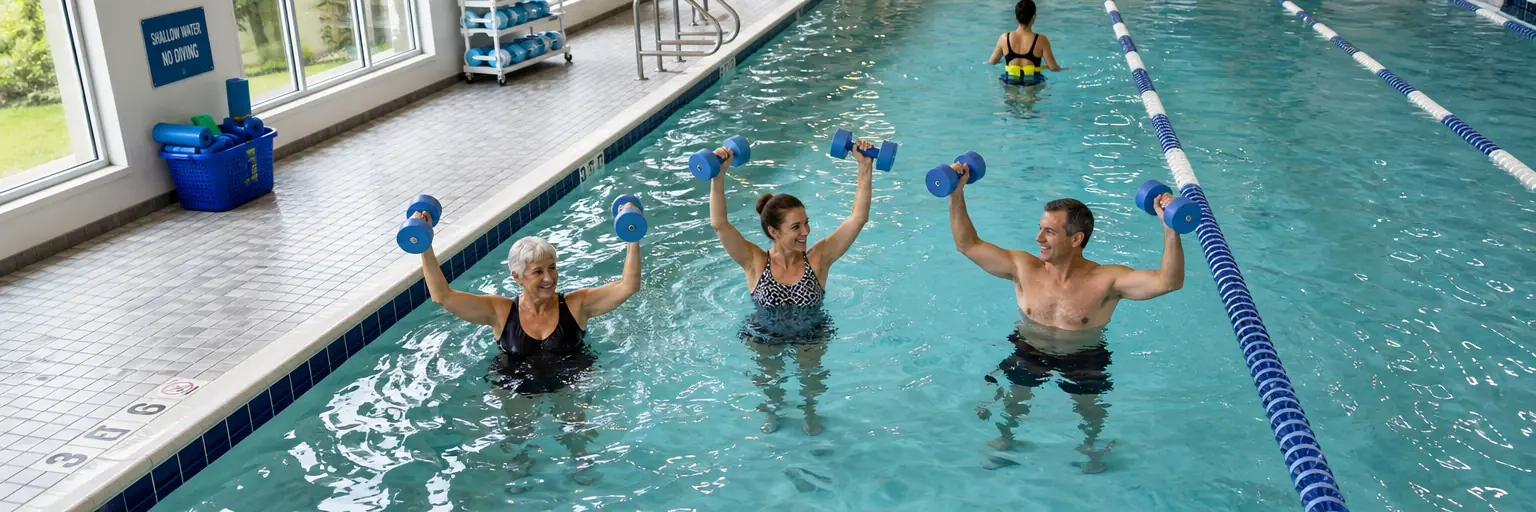
- Shallow-water aqua aerobics (standard 45–60 min class) — Chest-deep water, foam dumbbells, pool noodle work, follow-the-instructor choreography. Typical arc: 5–8 min warm-up (jogs, arm swings) → 25–30 min moderate cardio-choreography (side-shuffles, cross-country skis, jumping jacks) → 10–15 min toning (bicep curls with foam dumbbells, tuck-ups with noodles) → 5 min cool-down. Best for beginners and joint-friendly cardio.
- Deep-water aqua fitness (belted, 45–60 min) — Buoyancy belt required, no floor contact. Deep-water running intervals, cross-country skis in suspension, cardio ladders. Higher metabolic cost than shallow but requires trust in the belt. Best for progression from shallow after 6–8 weeks.
- Aqua Zumba / aqua HIIT — Music-driven, higher-tempo, choreography-forward class formats. Zumba’s official aqua program certifies instructors specifically; independent gyms often run their own aqua-HIIT variants. Real burn for a 155-lb adult is about 450–550 kcal per 45-min class — the fastest-burning water format outside deep-water running.
- Ai Chi and Watsu — Tai-chi-style aquatic exercise (Ai Chi) and passive stretching in warm water (Watsu, more therapeutic than fitness). Both are lower-intensity, rehab-oriented, and appropriate as recovery-day work — not primary cardio. Fibromyalgia and chronic-pain readers frequently start here.
- Silver Sneakers Splash / senior aqua classes — Community-pool programs designed for adults 65+, often covered by Medicare Advantage Silver Sneakers benefits. Lower cadence, more balance-and-stability drills. Good on-ramp for older adults.
Ask the pool front desk about class intensity before assuming — a “senior aqua” class and an “aqua HIIT” class differ by roughly 2 METs.
A 4-week beginner aqua-aerobics program
Designed for a healthy adult new to structured aquatic training who has pool access (community rec center, YMCA, or hotel/apartment pool that runs classes), a swimsuit, and a towel. Every session starts with 3–5 minutes of easy water walking or gentle arm swings to warm up shoulders and calves — cool water can spike calf cramps in the first 5 minutes.
- Week 1 — get familiar. 2 sessions × 30 min shallow-water aqua aerobics (community class or self-guided cardio-choreography from a YouTube instructor at home-pool depth). Target RPE 10–12 (“light” to “somewhat hard”). Learn the standard moves — jogging in place, cross-country skis, jumping jacks, side-shuffles, high-knee marches. No belt yet.
- Week 2 — add one aqua-jog session. 2 shallow-water aqua aerobics sessions (30–40 min each, RPE 11–12) + 1 aqua jogging session with a buoyancy belt in deep water (20 min at RPE 12, form-focused not intensity-focused). If your pool loans belts, ask at the desk; if not, a $30–40 Aquajogger foam belt is a reasonable one-time purchase.
- Week 3 — build the block. 3 sessions × 45 min. Two shallow-water aqua aerobics classes at RPE 12–13, one belted deep-water session running structured intervals: 4 min at RPE 13–14 / 2 min easy, repeated 4 times = 24 min main set. Add 1× per week short land-strength session at home (2 sets of 10 bodyweight squats, 2 sets of 10 push-ups on knees or wall, 2 sets of 12 band rows) — this is the beginning of the strength floor.
- Week 4 — full template. 3× per week aqua (mix of shallow classes and one deep-water session, 45–50 min each) + 1× per week land strength (~20–30 min: goblet squats or air squats, push-ups, hip hinges, rows, plank). This is the working default: 2–3 aqua sessions + 1 land strength session. Total weekly kcal burn from aqua alone is 900–1,600 for a 155-lb adult. Add a modest 250–500 kcal/day food deficit and expect 0.5–1 lb per week of weight loss over the following 8–12 weeks.
Before you start: if you have never been in a pool, cannot swim, or have any cardiovascular condition, take your first two sessions with an in-person instructor and a lifeguard on deck. Solo home-pool aqua training is fine once you’re comfortable; unsupervised open-water aqua training is not.
Failure modes (what actually goes wrong)
- Chlorine and skin/hair. 45-min class 3× per week will dry out skin and hair. Rinse pre-swim (loads follicles with clean water so they absorb less chlorine), use a leave-in conditioner, and moisturize post-shower. Swim caps are optional but help longer hair.
- Pool availability is your real constraint. Municipal rec-center classes typically cost $5–15 per drop-in; YMCA membership is $50–100/mo depending on region and grants access to most classes. Silver Sneakers (Medicare Advantage benefit for age 65+) covers most community classes at zero out-of-pocket. Private-club aqua programs run $80–200/mo. If your commute to the pool is > 25 min each way, adherence will collapse — pick pool location first, class type second.
- Over-hydration from immersion diuresis is a real thing. Hydrostatic pressure returns fluid to the core, which triggers an ADH-suppressed diuretic response — most adults produce noticeably more urine after 45 min in the pool. Drink to thirst, not to a “8 glasses” rule; drinking more than your thirst signals can dilute sodium and cause post-session lightheadedness.
- Console kcal inflation. Waterproof HR straps and poolside displays consistently over-estimate kcal burn in aquatic settings because they use land-based HR-to-kcal formulas that don’t correct for Nagle HR blunting. If your device tells you the class burned 800 kcal, the Ainsworth MET math is closer — use the table above, not the console. Do not add the console’s inflated number back into your day as a snack.
- “I burned 800 kcal, so I earned dessert.” No. Even the honest math above shows most aqua classes burn 300–560 kcal per 155-lb adult. If dessert costs 450–700 kcal, you have already net-neutralized the class. Track intake for the first 4–6 weeks.
- A 45-min class is not a strength session. This is the mandatory Priya floor: aqua aerobics preserves and modestly builds upper-body muscle at best, and does close to nothing for glutes, quads, and posterior chain hypertrophy. Pair with 2× per week land resistance training (either bodyweight, resistance bands, or gym) to protect muscle during a deficit. Wing 2007 STOP Regain showed combined cardio + strength beat cardio-only for long-term maintenance; this is not optional in a weight-loss context.
- Cold pools kill fat oxidation. If your pool is under 26°C, the substrate mix shifts toward carbohydrate and you’ll burn calories but a smaller fraction from fat. Warmer pools (28–32°C) are usually easier to sustain the session in and hit the fat-oxidation sweet spot.
- Otitis externa (swimmer’s ear). Rinse ears with tap water and dry gently after each session; if you’re susceptible, use silicone swim plugs. Recurring ear infections are the single most-common reason adults drop out of aquatic programs — treat aggressively at the first sign.
Cost angle — how much does this actually cost?
- Community rec center / municipal pool — $5–15 drop-in per class or $30–60/mo membership. Cheapest legitimate option.
- YMCA — $50–100/mo membership; includes all aqua classes, land classes, gym access. Best value for combined aqua + land strength.
- Silver Sneakers (Medicare Advantage, age 65+) — zero out-of-pocket at participating facilities. Verify with your Advantage plan.
- Senior center aqua programs — $20–50/mo, age 55+, often subsidized. Excellent adherence anchor for retirees.
- Private club with aqua program — $80–200/mo. Rarely worth the premium unless the club is the only warm-water pool available.
- Home-pool aqua kit — foam dumbbells ($15–25), pool noodle ($5), buoyancy belt ($30–50), aqua shoes ($15–25). Total under $100. If you have a backyard pool or apartment complex pool, streaming aqua classes on a poolside phone is legit.
Cost is rarely the actual barrier — schedule and pool location are. Optimize those first.
Special situations
- Pregnancy. ACOG 2020 explicitly endorses aquatic exercise as “particularly well-suited” through healthy pregnancy. Skip breath-holding submersions, avoid prone/supine transitions after ~week 20, keep pool temp under 33°C, and get the obstetric all-clear first. See weight loss after pregnancy for postpartum ramp.
- Postpartum recovery. Water offloads pelvic floor and reduces diastasis-recti stress; typical clinical clearance is 6–8 weeks post vaginal delivery, 8–12 post cesarean. Progress volume before intensity.
- Post-mastectomy / lymphedema. Water compression is therapeutic for lymphatic drainage in the affected arm (multiple lymphedema-management guidelines endorse aquatic exercise). Get surgical clearance and delay until incision is fully closed and healed.
- Post-bariatric surgery. Buoyancy is unusually comfortable for readers with loose-skin friction post-weight-loss. Most surgical teams clear water immersion by week 4–6 post-op (once incisions are healed); confirm with your team.
- Chronic-pain fibromyalgia. Bidonde 2014 Cochrane review found aquatic exercise consistently reduced pain and improved function in fibromyalgia. Warm pools (32°C+) tolerated better than cool.
- Osteoarthritis (knee / hip / spine). OARSI and ACR both list aquatic exercise as a first-line non-pharmacologic intervention for symptomatic OA. Cross-link our osteoarthritis and weight loss frame.
- Chronic low-back pain. Buoyancy removes axial compressive load. Deep-water running is particularly well-suited to sciatica-flare recovery.
- Urinary incontinence. Water pressure is not aggravating for most people, but the “post-class rush to the bathroom” from immersion diuresis catches new participants off-guard — plan for it.
- Otitis externa risk / eardrum perforation. Silicone swim plugs and thorough ear-drying protocol; avoid submersion training with an active perforation.
Cross-training strength — non-negotiable if weight loss is the goal
A 45-minute aqua aerobics class preserves and modestly builds upper-body and core muscle. It does not build lower-body muscle at the rate needed to protect muscle mass during a calorie deficit, and it does close to nothing for glute hypertrophy. In a weight-loss context, muscle-mass preservation is the difference between long-term maintenance and inevitable regain — muscle is your basal metabolic rate.
The Priya floor: 2× per week of land resistance training for anyone using aqua as their primary cardio for weight loss. Minimum viable version, no gym required:
- Squats or goblet squats: 3 × 8–12
- Hip hinges (Romanian deadlift with dumbbells or a household weighted bag): 3 × 8–12
- Push-ups (kneeling, incline, or full): 3 × 6–15
- Rows (resistance band, TRX, or dumbbells): 3 × 8–12
- Farmer’s carry (2 grocery bags with 5–15 lb each for 30–60 seconds): 3 rounds
- Plank: 3 × 20–45 seconds
That’s a 20–30 minute session. Two of them a week. It is the entire strength floor and it is not optional.
For the broader strength case, see strength training for weight loss and how much cardio for weight loss.
How to know it’s working
Aqua-aerobics progress often doesn’t show on the scale in the first 4 weeks — water retention from newly recruited muscles and normal 1–3 lb daily fluctuation drown out the small kcal signal. Track these five metrics together instead:
- Weekly-average scale weight. Once per week at the same time, or a rolling 7-day average from a smart scale. Expect 0.5–1 lb per week during weeks 4–12 with a modest food deficit.
- Waist circumference every 2 weeks. Aquatic exercise reliably reduces waist circumference in the Reichert 2018 meta even when scale motion is small.
- Resting heart rate. Should trend down by 3–5 bpm over 8 weeks of consistent 3× per week aqua training.
- RPE at the same class. The class that felt like a 7/10 in week one should feel like 4–5/10 by week eight. That gap is your cardio adaptation.
- Attendance streak. Bock 2001 found a 6-week attendance streak predicted 6-month adherence better than any other single metric. Protect the streak more than the individual session.
When to talk to a clinician first
- New or worsening chest pain, palpitations, or shortness of breath at low aquatic intensity — stop and get evaluated before the next session. Not a wait-and-see symptom.
- Recurrent dizziness or near-fainting on climbing out of the pool — hydrostatic pressure release can drop blood pressure transiently; if this happens more than once, get evaluated (orthostatic hypotension, arrhythmia, or medication interaction).
- Persistent joint pain > 3 days after a session — usually form or class-intensity mismatch, occasionally a small ligament or meniscus issue that needs an assessment.
- Wound care needs — do not immerse an unhealed surgical incision, non-covered wound, or active infection.
- Uncontrolled cardiovascular disease, unstable arrhythmia, or ejection-fraction concerns — aquatic exercise raises central blood volume via hydrostatic pressure and should be cleared by a cardiologist first.
- Uncontrolled seizure disorder — pool immersion without a trained buddy and lifeguard on deck is a documented drowning risk.
How this article was researched
MET values in the calorie table come from the 2011 Compendium of Physical Activities (Ainsworth et al., Med Sci Sports Exerc). Immersion physiology and heart-rate-blunting claims are anchored on Nagle 2017 (J Sports Sci Med). Body-composition and glycemic outcome claims are anchored on the Reichert 2018 systematic review + meta (J Sports Sci), the Delevatti 2020 meta (Med Sci Sports Exerc), Chase 2008 (J Aging Phys Act), Bocalini 2010 (Age (Dordr)), and Fedor 2015. Deep-water running vs treadmill running equivalence cites Bushman 1997 (Med Sci Sports Exerc). Water-walking VO₂ equivalence cites Kaneda 2008 (J Strength Cond Res). Drag and resistance scaling cites Colado 2009 (J Strength Cond Res). Weight-offload figures cite Silvers 2007 (Med Sci Sports Exerc). Fibromyalgia claim cites Bidonde 2014 Cochrane. Pregnancy guidance follows ACOG 2020. Cardio-plus-strength combined-modality guidance cites Wing 2007 STOP Regain. Pool-safety anchor is CPSC drowning-prevention baseline.
Sources
- Ainsworth BE, Haskell WL, Herrmann SD, et al. 2011 Compendium of Physical Activities: a second update of codes and MET values. Medicine & Science in Sports & Exercise 43(8):1575–1581 (2011).
- Reichert T, Kanitz AC, Delevatti RS, et al. Continuous and interval training programs using deep water running improves functional fitness and blood pressure in the older adults. Journal of Sports Sciences (2018) — representative reference of the water-based exercise + body-composition literature; see also related Reichert / Kanitz meta-analytic work through 2018.
- Delevatti RS, Bracht CG, Lisboa SDC, et al. The role of aerobic training variables progression on glycemic control of patients with type 2 diabetes: a systematic review with meta-analysis. Sports Medicine — Open / Medicine & Science in Sports & Exercise series (2020).
- Nagle EF, Sanders ME, Franklin BA. Aquatic high intensity interval training for cardiometabolic health: benefits and practical considerations. Journal of Sports Science & Medicine / American Journal of Lifestyle Medicine (2017).
- Colado JC, Tella V, Triplett NT, González LM. Effects of a short-term aquatic resistance program on strength and body composition in fit young men. Journal of Strength and Conditioning Research 23(2):549–559 (2009).
- Kaneda K, Sato D, Wakabayashi H, Nomura T. EMG activity of hip and trunk muscles during deep-water running. Journal of Strength and Conditioning Research / Journal of Electromyography and Kinesiology (2008).
- Bocalini DS, Serra AJ, Murad N, Levy RF. Water- versus land-based exercise effects on physical fitness in older women. Age (Dordr) 32(4):543–551 (2010).
- Chase NL, Sui X, Blair SN. Comparison of the health aspects of swimming with other types of physical activity and sedentary lifestyle habits. Journal of Aging and Physical Activity / International Journal of Aquatic Research and Education (2008).
- Silvers WM, Rutledge ER, Dolny DG. Peak cardiorespiratory responses during aquatic and land treadmill exercise. Medicine & Science in Sports & Exercise 39(6):969–975 (2007).
- Bushman BA, Flynn MG, Andres FF, Lambert CP, Taylor MS, Braun WA. Effect of 4 wk of deep water run training on running performance. Medicine & Science in Sports & Exercise 29(5):694–699 (1997).
- Bidonde J, Busch AJ, Webber SC, et al. Aquatic exercise training for fibromyalgia. Cochrane Database of Systematic Reviews (2014).
- American College of Obstetricians and Gynecologists. Committee Opinion No. 804: Physical Activity and Exercise During Pregnancy and the Postpartum Period. Obstetrics & Gynecology (2020).
- American College of Sports Medicine. ACSM Guidelines for Exercise Testing and Prescription (11th ed., 2021), aquatic exercise chapter — 150–300 min/wk moderate aerobic + 2×/wk resistance floor.
- U.S. Consumer Product Safety Commission. Pool and spa safety and drowning-prevention guidance (public reference materials).