
2026-06-15 · gallstones, gallbladder, weight loss side effects, bariatric surgery, GLP-1, rapid weight loss
Written by WeightFAQ Staff
Evidence-informed guidance from the WeightFAQ editorial team.
14 min read
Last editorial review Jun 15, 2026
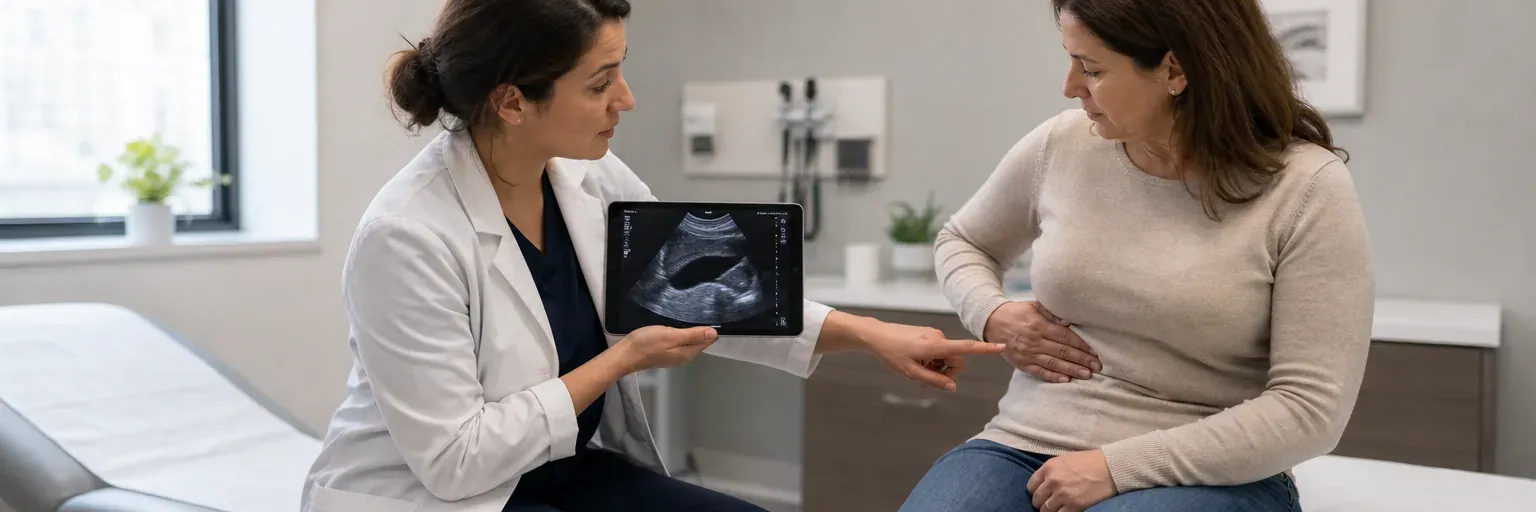
Gallstones and Weight Loss: Why Rapid Loss Triggers Them and How to Prevent Them
Quick stats
- Baseline annual risk: roughly 1% of US adults per year
- Risk during rapid weight loss: 10–25% over the first 6–12 months
- Strongest single risk factor: weekly loss rate above 1.5 lb/week
- Most-cited prevention drug: ursodeoxycholic acid (UDCA) 500–600 mg/day
- Time-to-stabilize after weight stabilizes: 3–6 months
What a gallstone actually is
A gallstone is a crystal that forms inside the gallbladder — usually a small pear-shaped pouch tucked under the liver. About 80% of gallstones are cholesterol stones, formed when the cholesterol in bile exceeds what the bile salts and lecithin can keep dissolved. The remaining 20% are pigment stones, made mostly of bilirubin, and tend to form in different clinical settings (hemolysis, cirrhosis, biliary infection). When this article talks about “weight-loss gallstones,” it means cholesterol stones — those are the ones rapid loss creates.
The classic mnemonic for who is at risk is the “Big 4 F’s”: Fat (obesity), Female, Forty, and Fertile (estrogen exposure). It captures the demographics well — but it predates the GLP-1 era and the modern bariatric era. A fifth F belongs on the list now: Fast — fast rate of weight loss. Roughly 10–15% of people losing weight rapidly develop new symptomatic gallstones in the first 6 to 12 months, and the rate hits 25% in very-low-calorie diets under 800 kcal/day. Background risk in the general adult population sits near 1% per year. Weight loss is one of the most reliable health moves a person with obesity can make — and one of the few interventions that meaningfully raises gallstone risk while it is happening.
Why rapid weight loss causes gallstones — the 4 drivers
The mechanism stacks four ways at once, which is why the rapid-loss signal is so strong.
1. Cholesterol supersaturation of bile
Adipose tissue stores enormous amounts of cholesterol. When you mobilize fat fast, that cholesterol gets dumped into bile faster than the bile salt and lecithin pool can keep it in solution. Bile becomes lithogenic — supersaturated with cholesterol — and starts to crystallize. Erlinger 2000 (Lancet) lays out the mechanism in detail; it is the single best one-paper explanation of why fat people lose stones, not just fat. The supersaturation index typically peaks 1 to 3 months into rapid loss and normalizes within 3 to 6 months of weight stability.
2. Gallbladder hypomotility
The gallbladder empties in response to cholecystokinin (CCK), which the duodenum releases when fat hits it. Low-fat eating — common during aggressive dieting — produces less CCK, the gallbladder under-empties, and bile sits longer. Sludge forms first, then microliths, then stones. Festi 1998 (Hepatology) showed measurable gallbladder hypomotility in patients with obesity during rapid loss and correlated it directly with new-stone formation. Practical implication: a no-fat or very-low-fat diet during a rapid cut is actively worse for the gallbladder than a moderate-fat diet, even though “low fat” intuitively sounds gentler.
3. Biliary mucin and crystal nucleation
The gallbladder’s own mucin secretion rises during rapid loss. Mucin is a sticky glycoprotein matrix that promotes cholesterol crystal aggregation — it is essentially the glue that turns microliths into countable stones. The mechanism is biochemical, not mechanical, and there is no lifestyle lever for it directly. UDCA addresses it pharmacologically by changing bile composition and reducing mucin’s nucleation effect.
4. The loss rate itself
The cleanest dose-response signal comes from weekly loss rate. Yang 2014 (Obesity Reviews) — the largest systematic review on the topic — showed risk scaling almost linearly with weekly rate. Under 1.0 lb per week looks close to background; 1.0 to 1.5 lb per week is intermediate; above 1.5 lb per week the curve bends upward and reaches very-low-calorie-diet levels around 2 lb per week sustained. This is the single most actionable mechanism: it is the one you choose.
Who is at highest risk
| Population | Approx. risk of new gallstones | Time window | Source |
|---|---|---|---|
| General adult population | ~1% per year | annual | NIDDK |
| Very-low-calorie diet (<800 kcal/day) | ~25% | 8–16 weeks | Stampfer 1992 |
| Bariatric surgery (RYGB / sleeve) | ~10–30% | 6–12 months post-op | Coupaye 2017; Talha 2020 |
| GLP-1 therapy (semaglutide / tirzepatide ≥2.4 mg) | ~1.5–3% | 68-week trial window | Wegovy / Zepbound prescribing info |
| Rapid commercial weight-loss program (>1.5 lb/wk) | ~10–25% | first 6 months | Yang 2014 |
Two things to read out of this table. First, the absolute numbers on GLP-1 therapy are much smaller than the bariatric or VLCD numbers — the GLP-1 signal is real but the absolute increase over placebo is on the order of one to two percentage points. Second, every elevated row in this table shares one feature: a rate of weight loss that exceeds what an unsupervised lifestyle program produces.
5-step gallstone prevention protocol
Run all five together — they are additive, and most rapid-loss cases stack multiple drivers at once.
Step 1: Rate-limit weight loss to 1–2 lb per week
This is the single most important step. Unless you are in a medically supervised program with UDCA prophylaxis, target 0.5% to 1% of body weight per week — about 1 to 2 lb for a 200 lb adult. Stampfer 1992 and the AACE/TOS bariatric clinical practice guidelines both anchor at this range. See how many calories to lose weight for the deficit math that maps to this pace. Slower loss is also more durable, easier on lean mass, and easier on the gallbladder — and it parallels the same rate-cap that protects against hair loss during weight loss.
Step 2: Keep at least 7–10 g of fat per meal
Counter-intuitive but well supported. A small amount of dietary fat at lunch and dinner triggers CCK, forces the gallbladder to empty, and prevents bile from stagnating. Two tablespoons of olive oil, a quarter cup of nuts, or half an avocado across the day clears the threshold. The popular intuition — “less fat is safer for the gallbladder” — has it exactly backward during rapid loss. This matters especially on low-carb and keto diets, where the fast initial loss curve and reduced CCK signaling stack on top of each other; see healthy fats for weight loss for portion guidance.
Step 3: Ask your prescriber about UDCA if you are high-risk
Ursodeoxycholic acid (UDCA, ursodiol) 500–600 mg per day during the rapid-loss phase is the only medication with strong RCT-grade evidence for preventing weight-loss gallstones. Sugerman 1995 (American Journal of Surgery) — the original placebo-controlled bariatric trial — and Miller 2003 (Obesity Surgery) both reported 60 to 80 percent reductions in new symptomatic stones at six months. The clear indications are post-bariatric surgery, medically supervised VLCDs, and high-dose GLP-1 therapy in someone with Big 4 F risk factors. This is a prescriber-level decision, not a self-prescription.
Step 4: Hydration ≥2 L/day plus fiber 25–35 g/day
The same hydration-and-fiber thresholds as our constipation during weight loss protocol. Adequate fluid reduces biliary stasis, and fiber supports normal bile acid recycling — both biliary mechanics and intestinal mechanics get worse simultaneously during rapid loss, so the same fix helps both. See fiber for weight loss for the ramp protocol.
Step 5: Move daily
Leitzmann 1999 (New England Journal of Medicine) — the Health Professionals Follow-up Study — showed about a 34% lower cholecystectomy rate in men in the highest activity quintile vs the lowest, independent of weight. A parallel 1998 women’s cohort showed the same pattern. Even a 20- to 30-minute daily walk reaches the threshold. See walking for weight loss for ramp options and step targets.
What to do if you already have symptoms
Classic gallstone symptoms — biliary colic — are upper-right-quadrant pain after meals (especially fatty ones), pain radiating to the right shoulder blade or back, nausea, vomiting, and intolerance of fatty foods. A typical attack lasts 1 to 4 hours and resolves on its own. The pattern recurs over weeks to months.
There are four clinical pictures to keep straight:
- Biliary colic — temporary blockage of the cystic duct by a stone. Pain attacks lasting 1 to 4 hours, no fever, resolves spontaneously. Workup outpatient.
- Acute cholecystitis — sustained obstruction with gallbladder inflammation. Persistent pain >6 hours, fever, Murphy’s sign on exam. Emergency room.
- Choledocholithiasis — a stone in the common bile duct, often with jaundice and pale stools. Emergency room.
- Gallstone pancreatitis — a stone has lodged at the ampulla, blocking the pancreatic duct. Severe central-upper-abdominal pain radiating to the back. Emergency room. For the full pathway from rapid loss → stones → biliary pancreatitis and a 5-step prevention protocol, see pancreatitis and weight loss.
Go to the ER for: jaundice, fever above 38.5 °C / 101.3 °F, pain lasting more than 6 hours, persistent vomiting, or severe central upper-abdominal pain radiating to the back.
| Symptom severity | What to do | Typical workup |
|---|---|---|
| Mild, self-resolving biliary colic | Primary care visit within the week | RUQ ultrasound, LFTs |
| Recurrent biliary colic | Surgical consult | Ultrasound, HIDA scan if needed |
| Acute cholecystitis, jaundice, or fever | Emergency room | Ultrasound, CT, urgent cholecystectomy or ERCP |
Treatment options
| Approach | When used | What it does | Notes |
|---|---|---|---|
| Watchful waiting | Asymptomatic stones | Nothing | About 80% of asymptomatic stones never become symptomatic |
| Dietary trigger management | Mild intermittent biliary colic | Reduces flare frequency | Not curative; smaller, lower-fat meals reduce attack frequency |
| UDCA dissolution | Small (<5 mm) cholesterol stones in patients who decline or cannot tolerate surgery | Slow dissolution over 6–12 months | High recurrence after stopping; not for pigment stones |
| Laparoscopic cholecystectomy | Symptomatic gallstones, acute cholecystitis | Removes the gallbladder | Definitive; the most common general-surgery operation in the US |
| ERCP + sphincterotomy | Common bile duct stones | Endoscopic stone removal | Often paired with subsequent cholecystectomy |
Cholecystectomy is the standard of care for symptomatic stones because of how well it works and how reliably symptoms recur otherwise. Recovery is short (most people back to desk work in a week), digestion remains essentially normal because bile drips continuously into the duodenum rather than being stored, and stones cannot recur because the gallbladder is gone.
Bariatric surgery and gallstones
Bariatric surgery is the highest-leverage weight-loss intervention available — and it carries the highest gallstone-formation rate of any rapid-loss pattern. Coupaye 2017 (Obesity Surgery) and Talha 2020 (Surgery for Obesity and Related Diseases) both reported new symptomatic gallstones in roughly 10 to 30% of patients in the first 6 to 12 months after Roux-en-Y gastric bypass or sleeve gastrectomy. Roux-en-Y patients run slightly higher than sleeve patients, but both rates are well above background.
Many US bariatric programs now prescribe prophylactic UDCA 500–600 mg/day for the first 6 months post-op based on Sugerman 1995 and Miller 2003. The relative-risk reduction is roughly 60 to 80%, the medication is inexpensive, and the side-effect profile is benign. If your program did not include it, raise the question pre-op. See the gastric bypass surgery and sleeve gastrectomy overviews for the broader procedure-by-procedure picture, and our bariatric surgery overview for how the decision compares to medication-led paths.
GLP-1 medications and gallstones
The GLP-1 cholelithiasis signal is real but small in absolute terms. The Wegovy STEP-1 and STEP-4 trials reported new gallstone-related events in roughly 1.5 to 2.6% of patients on semaglutide 2.4 mg vs about 1.0% on placebo over 68 weeks; the Zepbound SURMOUNT-1 prescribing information shows similar elevation for tirzepatide. The mechanism appears to be partly the substantial weight loss itself and partly slowed gallbladder motility.
Honest framing matters: the absolute increase over placebo is on the order of one to two percentage points, the risk-benefit math still strongly favors GLP-1 therapy in most patients with obesity, and the 5-step protocol above applies. People with multiple Big 4 F risk factors or a personal history of biliary sludge are reasonable candidates for a UDCA conversation with their prescriber. See GLP-1 weight loss overview for the full medication picture and Ozempic side effects for the broader side-effect profile.
Very-low-calorie diets (VLCDs)
VLCDs — protocols under 800 kcal/day, typically meal-replacement-based and clinician-supervised — produce some of the fastest weight loss available outside surgery. They also carry the highest gallstone rates in the rapid-loss literature. Stampfer 1992 (American Journal of Clinical Nutrition) reported new symptomatic gallstones in approximately 25% of women on a VLCD over 8 to 16 weeks. Modern medically supervised VLCDs typically pair UDCA from week 1, which brings the rate down dramatically — closer to the 5 to 10% range in current programs that follow the Sugerman protocol. Outside a supervised program with UDCA on board, VLCDs are not a sensible self-management path. See medical weight loss programs for the supervised-program landscape.
Honest verdict
Rapid weight loss causes gallstones. The mechanism is well characterized, the dose-response is clean, and the prevention plan is concrete: cap weekly loss at 1 to 2 lb per week, keep some fat in each meal, hydrate and fiber up, move daily, and ask about UDCA if you are in a medically supervised program. For the bariatric and high-dose GLP-1 populations, prophylactic UDCA is the highest-leverage move. For everyone else, restraint on weekly rate does most of the work. If symptoms appear despite the protocol, biliary colic is uncomfortable but usually outpatient — the ER list above is what changes the urgency. The gallbladder is one of the few organs you can give up entirely without missing it; the procedure to remove it is among the most refined in modern surgery. The goal of this article is not to avoid surgery at all costs — it is to avoid needing it in the first place.
Frequently asked questions
Do gallstones always need surgery? No. About 80% of asymptomatic gallstones never produce symptoms and never need treatment. The general guideline is to operate only on symptomatic stones. Watchful waiting is the standard for incidentally discovered stones with no upper-abdominal pain after meals.
How fast is too fast for weight loss before gallstone risk rises? Risk climbs sharply once weekly loss exceeds 1.5 lb per week. Stampfer 1992 and Yang 2014 both flagged this threshold. Above 1.5 to 2 lb per week, new-stone risk runs in the 10 to 25% range over the active loss window.
Does keto cause gallstones? Keto itself does not directly cause gallstones, but it tends to produce fast initial loss and — in very-low-fat versions — reduces CCK and gallbladder emptying. Keep at least 7 to 10 g of fat per meal during keto, especially at lunch and dinner, to protect the gallbladder.
Do GLP-1s like Ozempic and Wegovy cause gallstones? Yes, modestly. STEP and SURMOUNT trials reported new cholelithiasis in roughly 1.5 to 2.6% of patients vs about 1% on placebo. The absolute increase is small, the risk-benefit math still favors GLP-1 therapy in most patients with obesity, and the 5-step protocol works on GLP-1 users.
Can I prevent gallstones during bariatric surgery recovery? Yes. The standard prophylaxis is UDCA 500 to 600 mg per day for the first 6 months post-op. Sugerman 1995 and Miller 2003 both showed 60 to 80% reductions in new symptomatic stones. Many US bariatric centers now prescribe it routinely; ask before declining.
How long after rapid weight loss does gallstone risk drop back to normal? The high-risk window is the first 6 to 12 months of active loss. Once weight stabilizes, bile composition normalizes within 3 to 6 months and new-stone rates return toward baseline. Stones already formed do not dissolve on their own.
Should I take ursodeoxycholic acid (UDCA) on a diet? Talk to your prescriber. UDCA is the only medication with strong RCT evidence for preventing weight-loss gallstones. The clearest indications are post-bariatric, medically supervised VLCDs, and high-dose GLP-1 therapy in high-risk patients. For most adults losing 1 to 2 lb per week through normal lifestyle change, the 5-step protocol is sufficient without UDCA.
What are the warning signs of a serious gallbladder attack? Go to the ER for severe right-upper-quadrant pain lasting more than 6 hours, fever above 38.5 °C / 101.3 °F, jaundice, dark urine and pale stools, persistent vomiting, or severe central upper-abdominal pain radiating to the back. Those patterns suggest cholecystitis, common bile duct obstruction, or gallstone pancreatitis — each is a clinical emergency.
Sources
- Erlinger S. Gallstones in obesity and weight loss. The Lancet (2000).
- Stampfer MJ, Maclure KM, Colditz GA, Manson JE, Willett WC. Risk of symptomatic gallstones in women with severe obesity. American Journal of Clinical Nutrition (1992).
- Sugerman HJ, Brewer WH, Shiffman ML, Brolin RE, Fobi MA, Linner JH, et al. A multicenter, placebo-controlled, randomized, double-blind, prospective trial of prophylactic ursodiol for the prevention of gallstone formation following gastric-bypass-induced rapid weight loss. American Journal of Surgery (1995).
- Miller K, Hell E, Lang B, Lengauer E. Gallstone formation prophylaxis after gastric restrictive procedures for weight loss: a randomized double-blind placebo-controlled trial. Obesity Surgery (2003).
- Coupaye M, Castel B, Sami O, Tuyeras G, Msika S, Ledoux S. Comparison of the incidence of cholelithiasis after sleeve gastrectomy and Roux-en-Y gastric bypass in obese patients: a prospective study. Obesity Surgery (2017).
- Talha A, Abdelbaki T, Farouk A, Hasouna E, Azzam E, Shehata G. Cholelithiasis after bariatric surgery, incidence, and prophylaxis. Surgery for Obesity and Related Diseases (2020).
- Festi D, Colecchia A, Larocca A, Villanova N, Mazzella G, Petroni ML, et al. Gallbladder motility and gallstone formation in obese patients following very low calorie diets. Hepatology (1998).
- Leitzmann MF, Rimm EB, Willett WC, Spiegelman D, Stampfer MJ, Colditz GA, et al. Recreational physical activity and the risk of cholecystectomy in women. New England Journal of Medicine (1999).
- Yang J, Mascarenhas R, Sehgal R, Gallagher JA, Mehta P, Madeb R. Gallstones during weight reduction: a systematic review and meta-analysis. Obesity Reviews (2014).