
2026-06-10 · carbohydrates, macronutrients, nutrition, weight loss, glycemic index, fiber
Updated 2026-08-04
Written by Maya Patel
Maya Patel is a WeightFAQ staff writer covering sustainable weight loss through mindful eating, flexible routines, and evidence-based nutrition. She translates research on protein, fiber, portion control, and calorie awareness into practical meal-planning guidance readers can actually follow at home. Her articles favor honest expectations over fad promises — small changes that compound, calorie bands scaled to real households, and grocery lists built around whole foods with room for real life. Maya writes for people juggling family meals, busy weeks, and long-term goals, not gym-optimized single adults with unlimited prep time.
14 min read
Medically reviewed on Aug 4, 2026
Carbohydrates and Weight Loss: How Many Carbs You Really Need
Quick answer
Most adults in a deficit do well at 100 to 225 grams of carbs per day — roughly 35 to 55 percent of a 1,500 to 1,800 kcal plan. Active people land at the upper end, sedentary dieters at the lower end, and only those choosing a deliberate low-carb plan need to go under 100 grams. Sub-50 grams is keto — a specific tool, not the default. The trials that matter (A to Z, DIRECT, DIETFITS) show low-carb and balanced-macro plans produce similar fat loss when calories and protein match. The bigger lever for almost everyone is swapping refined carbs for whole-food carbs, not cutting carbs as a category.
Who this is for / not for
Good fit if you:
- Are losing weight on a balanced eating pattern and want to know where carbs should land
- Eat mostly refined grains and sugar today and want a sane upgrade path
- Train regularly and need carbs to fuel sessions
- Tried keto, did not enjoy it, and want a sustainable middle ground
- Have type 2 diabetes or prediabetes and want a non-keto carb strategy (coordinate with your care team)
Not a fit if you:
- Have type 1 diabetes — carb targets are tied to insulin dosing and require clinical guidance, not a general article
- Have advanced chronic kidney disease — your protein and carb mix is set by your nephrologist
- Have a history of an eating disorder — macro tracking can be triggering; work with a registered dietitian
- Are pregnant or breastfeeding — energy and carb needs are higher than weight-loss ranges
How carbs actually affect weight
Carbs are not a uniquely fattening macronutrient. They affect weight through four real, overlapping mechanisms — and understanding each one prevents the most common mistakes.
1. Insulin and fat storage. Carbs raise blood glucose, which raises insulin. Insulin shuts down fat release from adipose tissue while it is elevated. This is the kernel of truth behind the “carbs make you fat” framing — but it is not the whole story. Protein also raises insulin (about half as much as carbs gram-for-gram), and people lose weight on high-carb diets all the time when calories are controlled. The DIETFITS trial randomized 609 adults to healthy low-fat or healthy low-carb diets for 12 months and found nearly identical weight loss (5.3 kg vs 5.9 kg) regardless of baseline insulin sensitivity. Insulin matters, but the calorie balance matters more.
2. Glycogen and water weight. Your body stores carbs as glycogen in muscle and liver — roughly 400 to 500 grams total in a typical adult. Every gram of glycogen binds about 3 grams of water. When you cut carbs from 200 grams a day down to 50, you burn through stored glycogen in the first 2 to 4 days and lose 3 to 8 pounds of associated water. This is the dramatic early “weight loss” on low-carb plans. It is real on the scale, but it is not fat. When you eat carbs again, the glycogen and water come back the same week.
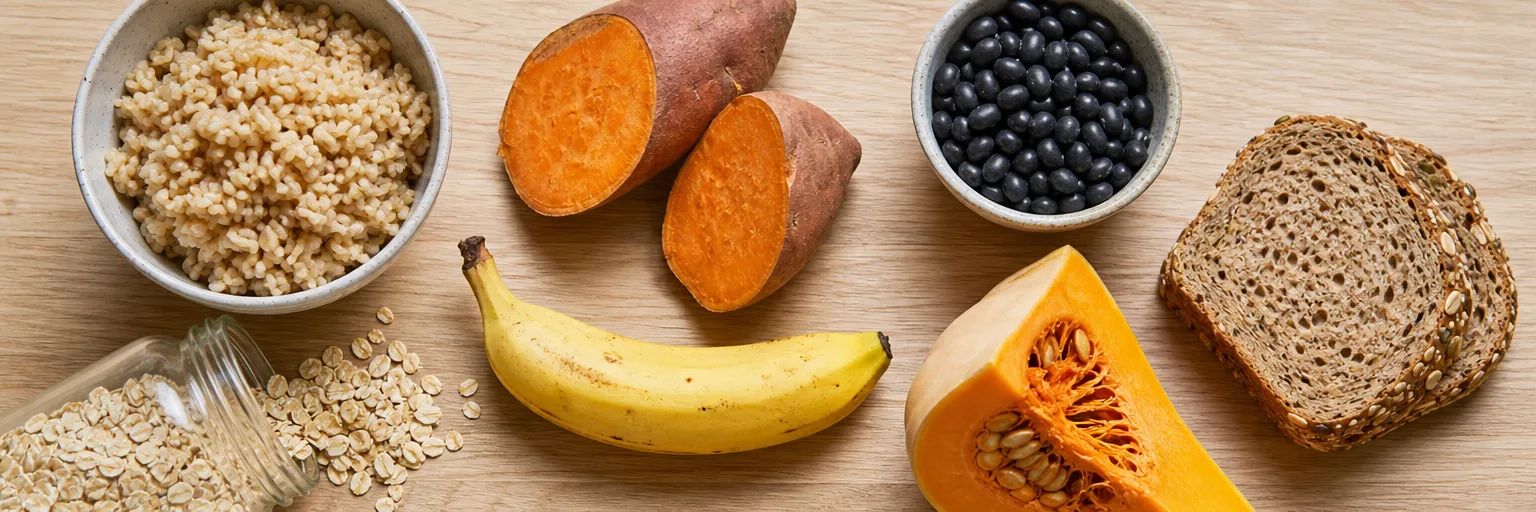
3. Satiety per calorie. Whole-food carbs and refined carbs are not the same. A cup of black beans (227 kcal, 15 g fiber, 15 g protein) and a 20-ounce soda (240 kcal, 0 g fiber, 0 g protein) deliver similar calories but completely different satiety and blood-sugar curves. High-fiber whole-food carbs (beans, oats, fruit, intact whole grains, potatoes) are among the most filling foods per calorie in the diet. Refined carbs and liquid sugar are among the least filling per calorie. This is why “cut carbs” advice usually works in practice — it usually means cutting the refined ones, which are the ones driving overeating.
4. Palatability and reward. Many of the most calorie-dense, hyperpalatable foods in the modern diet — cookies, ice cream, chips, pastries, sweetened cereal — combine refined carbs with fat and sugar. These foods bypass normal satiety signaling and are easy to overeat without noticing. Cutting them produces real weight loss not because of an insulin trick but because the calories go down. A moderate-carb plan that keeps whole-food carbs in and cuts the ultra-processed ones captures most of the benefit without the restrictiveness of keto.
How many grams per day
The 2002 Institute of Medicine carbohydrate AMDR (Acceptable Macronutrient Distribution Range) sets the healthy range at 45 to 65 percent of total calories for the general population, with an RDA of 130 g/day to meet brain glucose needs. For weight loss specifically, the practical target depends on activity level, body weight, and how strongly you want to use carb restriction as an appetite tool.
| Activity / approach | Grams of carb per kg body weight | % of calories | Typical g/day at 1,600 kcal |
|---|---|---|---|
| Active (3+ resistance or endurance sessions/week) | 3 to 5 g/kg | 45 to 55% | 180 to 220 g |
| Moderately active (some training, walking daily) | 2 to 4 g/kg | 40 to 50% | 160 to 200 g |
| Sedentary in deficit | 1 to 3 g/kg | 35 to 45% | 140 to 180 g |
| Moderate-carb / “lower carb” | 1 to 2 g/kg | 25 to 35% | 100 to 140 g |
| Low-carb (non-keto) | < 1 g/kg | 15 to 25% | 60 to 100 g |
| Keto | n/a (cap) | 5 to 10% | 20 to 50 g |
Body-weight math gets you closer to the right number than a flat gram target. A 180 lb (82 kg) adult doing two strength sessions and daily walks lands at roughly 165 to 245 g/day on a balanced plan, or 80 to 165 g/day on a deliberate moderate-carb plan. A 140 lb (64 kg) sedentary adult lands at 64 to 192 g/day on a balanced plan.
If you want a worked daily calorie target before splitting macros, see our guide to how many calories to eat for weight loss. For the protein side of the equation — which should be set first and is the most important macro in a deficit — see protein intake for weight loss. For the parallel fat guide — how many grams of fat per day, which kinds, and why they matter — see healthy fats for weight loss.
Good carbs vs. carbs to limit
Energy density and fiber are the two best predictors of whether a carb source helps or hurts a weight-loss plan. The table below ranks 18 common foods you will actually buy.
| Choose freely | Why | Limit or minimize | Why |
|---|---|---|---|
| Black beans, kidney beans, chickpeas, lentils | 12 to 16 g fiber per cup, slow digestion, high satiety | Sugary drinks (soda, sweet tea, juice drinks, energy drinks) | Liquid calories with near-zero satiety; strongest cohort evidence for weight gain |
| Rolled or steel-cut oats | High soluble fiber (beta-glucan), keeps you full | White bread, white rolls, bagels | Low fiber, fast digestion, easy to overeat |
| Quinoa, brown rice, barley, farro | Intact whole grains, fiber, micronutrients | Pastries, doughnuts, croissants | Refined flour + fat + sugar combo bypasses satiety |
| Whole-wheat bread (≥3 g fiber per slice) | Cheap, satiating, sandwich-friendly | Sweetened breakfast cereals | Refined grain + added sugar; rarely filling |
| Potatoes (with skin), sweet potatoes, squash | Surprisingly high satiety per calorie (potato tops the satiety index) | White rice in large portions (>1.5 cups) | Calorie-dense; easy to overeat if not portioned |
| Berries, apples, pears, citrus, melon | Whole fruit, fiber, water content | Fruit juice (even 100%) | Strips fiber, leaves the sugar |
| Bananas, mangoes, grapes (whole) | Higher-sugar fruit is still fine in a deficit | Candy, cookies, ice cream, granola bars | Engineered for overconsumption |
| Greek yogurt, kefir, low-fat milk | Carb + protein + calcium; high satiety | Flavored yogurts with added sugar | Often as much sugar as a dessert |
| Non-starchy vegetables (broccoli, peppers, spinach) | Volume for almost no calories | Ultra-processed snack foods (chips, crackers, pretzels) | Engineered low-satiety carb + fat + salt |
The rule that captures most of this: if the carb came packaged with fiber, it is probably fine. If the fiber was removed and sugar was added, treat it as a sometimes food. For a fuller picture of why fiber is the lever inside the carb category, see our guide to fiber for weight loss. The same principle drives our low-calorie high-volume foods and sugar and weight loss guides.
High-carb vs. moderate-carb vs. low-carb vs. keto
The table below compares the four common carb strategies head-to-head on what the trials actually show.
| Approach | Typical g/day | % of calories | Evidence for weight loss | Who it suits | Downsides |
|---|---|---|---|---|---|
| Balanced / higher-carb (Mediterranean, DASH) | 180 to 250 | 45 to 55% | DIRECT, PREDIMED — durable 5 to 10% loss over 6 to 12 months when calories controlled; strongest CV outcomes | Most adults; trainees; people who like flexibility | Slower initial scale movement than low-carb |
| Moderate-carb | 100 to 150 | 25 to 35% | DIRECT 2-yr; modest appetite benefit over higher-carb; good lipid profile | People who want carb-aware without restriction; insulin resistance | Less “fast” early loss than keto; small social friction |
| Low-carb (non-keto) | 50 to 100 | 10 to 25% | A to Z Trial (Gardner 2007), DIRECT — equal to balanced at 6 to 12 mo; faster early loss | Strong appetite-control responders; insulin resistance; T2D (with clinician) | LDL-C may rise; restrictive at meals out |
| Keto | < 50 (often 20 to 30) | 5 to 10% | Largest early loss (water); converges with low-fat by 12 mo (DIETFITS shows ~5 to 6 kg either way) | Specific cases: drug-resistant epilepsy, some T2D, strong hunger responders | High dropout; “keto flu”; lipid changes; rigid; not for endurance training |
The takeaway from the trial literature is consistent: at matched calories and protein, the long-term scale outcome is similar across the four approaches, and individual adherence is the biggest variable. Faster does not mean better — the A to Z and DIETFITS trials specifically settle the “is low-carb superior” debate at no, it’s a tie, pick the one you can stick with.
For the keto-specific deep dive, see our guide to low-carb and keto diets. For the balanced-macro patterns, see Mediterranean diet for weight loss and DASH diet for weight loss. To put any of these inside a calorie-counted framework, see our overview of the best diet for weight loss.
A fifth pattern — carb cycling — layers on top of any of the four: it alternates high-carb training days with low-carb rest days while holding weekly calories at a deficit. There is no RCT-level evidence it beats a matched-calorie continuous deficit for weight loss, but it is a defensible protocol for trained athletes and plateaued late-cut dieters. See carb cycling for weight loss for the seven-day worked protocol and who it actually helps.
Glycemic index and load — does it matter for weight loss?
Glycemic index (GI) ranks foods 0 to 100 by how fast they raise blood glucose. Glycemic load (GL) adjusts that for the portion you actually eat. Both are sensible concepts — but the evidence for using them as your main weight-loss lever is weaker than the marketing suggests.
A 2013 meta-analysis by Schwingshackl and Hoffmann pooled 14 controlled trials and found that low-GI diets produced about 1 to 3 pounds more weight loss over 6 months than high-GI diets at matched calories — a small effect. A 2007 Cochrane review (Thomas) found a similar modest effect (~2 lb advantage). The OmniCarb trial (Sacks 2014) tested low-GI vs high-GI inside a DASH framework and found no meaningful weight or insulin-sensitivity advantage from GI alone.
Where GI matters more is insulin resistance, prediabetes, and type 2 diabetes, where slower glucose curves improve glycemic control independent of weight. If that is your situation, see insulin resistance and weight loss and diabetes and weight loss for the targeted guidance.
The practical shortcut: foods low in GI are almost always also high in fiber and minimally processed. If you choose carbs from the “choose freely” column above, your average GI drops automatically without tracking a single number.
How to lower carbs without going keto
If you want the appetite-control benefit of fewer carbs without the rigidity, social cost, or LDL-C concerns of strict keto, here are five swaps that get you from a typical 250 g/day to 100 to 150 g/day in a week — without losing any meal categories.
- Replace sugary drinks with sparkling water, unsweetened tea, or coffee. This alone can cut 30 to 80 g of carbs per day for soda drinkers and is the single best-evidenced food-pattern change for weight loss.
- Swap one daily refined grain for a legume or non-starchy vegetable. Swap the bread under your sandwich for a lettuce wrap once a day, or the side of pasta for a side of beans. Drops 20 to 40 g of carbs per swap and raises fiber.
- Anchor every meal with 25 to 40 g of protein. Higher protein automatically displaces lower-quality carbs and improves satiety. See high-protein breakfast ideas for the meal where most people leak the most carbs.
- Eat fruit instead of fruit juice or fruit-flavored snacks. A whole apple is 25 g of carbs with 4.4 g of fiber. A cup of apple juice is 28 g of carbs with 0 g of fiber.
- Save refined carbs for one planned context. A piece of birthday cake, a slice of pizza on Friday night, a Sunday pancake breakfast — keeping refined carbs as planned occasions rather than the default is what separates a sustainable plan from a restrictive one.
You do not need to track grams to do any of this. If you do want a worked split for your specific calorie target, the macronutrient calculator will turn calories into protein, carb, and fat grams in seconds.
Frequently asked questions
How many carbs should I eat per day to lose weight? Most adults in a deficit do well between 100 and 225 grams of carbohydrate per day, which works out to roughly 35 to 55 percent of calories on a 1,500 to 1,800 kcal plan. Active people with regular resistance or endurance training tend to land at the upper end (3 to 5 g/kg of body weight), moderately active people at 2 to 4 g/kg, and sedentary dieters at 1 to 3 g/kg. Going below 100 grams per day for an extended period is a low-carb plan; below 50 grams is ketogenic. The 2002 Institute of Medicine AMDR puts the healthy range at 45 to 65 percent of total calories for the general population, and weight-loss outcomes from the DIETFITS trial (Gardner 2018) and the A to Z Trial show low-fat and low-carb approaches produce similar fat loss when protein and total calories match.
Are carbs the reason I can’t lose weight? Almost never the carbs themselves — usually the calorie surplus delivered through refined carbs. Sugary drinks, white-flour snacks, pastries, and refined breakfast cereals are calorie-dense and weakly satiating, which makes overeating easy. Whole-food carbs like beans, oats, fruit, potatoes, and intact whole grains are not associated with weight gain in observational studies and often help weight loss by adding fiber and volume. The honest fix is usually to cut refined carbs and added sugar, not to cut all carbs.
Will cutting carbs help me lose weight faster than a balanced diet? In the first 2 to 4 weeks, yes — cutting carbs from 200 to 50 grams typically drops 3 to 8 pounds of water weight, because each gram of stored glycogen binds about 3 grams of water. After that, weight loss is driven by the calorie deficit. Head-to-head trials at 6 and 12 months — the A to Z Trial (2007), DIETFITS (2018), and the DIRECT trial (2008) — show low-carb plans produce similar long-term fat loss to balanced or Mediterranean plans, with adherence as the biggest predictor of which approach works for which person.
Does the glycemic index matter for weight loss? Modestly, and mostly for people with insulin resistance, prediabetes, or type 2 diabetes. A 2013 meta-analysis (Schwingshackl) found low-GI diets produced only a small additional weight loss compared with high-GI diets when calories were matched — roughly 1 to 3 pounds over 6 months. The bigger picture is that low-GI foods tend to be high in fiber and minimally processed, so choosing them improves diet quality without needing to track GI numbers.
What are the best carb sources for weight loss? Beans and lentils, intact whole grains (oats, quinoa, brown rice, barley, whole-wheat bread), starchy vegetables (potatoes, sweet potatoes, squash), whole fruit (berries, apples, citrus), and dairy (Greek yogurt, milk). These are high-fiber, high-volume, and slowly digested, which means they fill you up for fewer calories and keep blood sugar steadier. Limit refined grains, sugary drinks, sweets, and most ultra-processed snack foods — they are the carb sources most consistently linked to weight gain in cohort studies.
Can I lower carbs without going full keto? Yes — and for most people this is the more sustainable path. A moderate-carb approach targets 100 to 150 grams of carbs per day (about 25 to 35 percent of calories), drops most of its carbs from added sugar and refined grains, and keeps fruit, beans, and intact whole grains in the plan. This captures most of the appetite-control benefit of low-carb without the social friction, lipid concerns, and dropout rate of strict keto, and it is well tolerated by people who train regularly.
Sources
- Institute of Medicine. Dietary Reference Intakes for Energy, Carbohydrate, Fiber, Fat, Fatty Acids, Cholesterol, Protein, and Amino Acids. National Academies Press (2002/2005).
- Gardner CD, Trepanowski JF, Del Gobbo LC, et al. Effect of Low-Fat vs Low-Carbohydrate Diet on 12-Month Weight Loss (DIETFITS). JAMA (2018).
- Gardner CD, Kiazand A, Alhassan S, et al. Comparison of the Atkins, Zone, Ornish, and LEARN Diets for Change in Weight (A TO Z Weight Loss Study). JAMA (2007).
- Shai I, Schwarzfuchs D, Henkin Y, et al. Weight loss with a low-carbohydrate, Mediterranean, or low-fat diet (DIRECT). New England Journal of Medicine (2008).
- Schwingshackl L, Hoffmann G. Long-term effects of low glycemic index/load vs. high glycemic index/load diets on parameters of obesity and obesity-associated risks: a systematic review and meta-analysis. Nutrition, Metabolism & Cardiovascular Diseases (2013).