
2026-06-08 · fiber, nutrition, satiety, weight loss, soluble fiber, insoluble fiber
Updated 2026-07-31
Written by Maya Patel
Maya Patel is a WeightFAQ staff writer covering sustainable weight loss through mindful eating, flexible routines, and evidence-based nutrition. She translates research on protein, fiber, portion control, and calorie awareness into practical meal-planning guidance readers can actually follow at home. Her articles favor honest expectations over fad promises — small changes that compound, calorie bands scaled to real households, and grocery lists built around whole foods with room for real life. Maya writes for people juggling family meals, busy weeks, and long-term goals, not gym-optimized single adults with unlimited prep time.
14 min read
Medically reviewed on Jul 31, 2026
Fiber for Weight Loss: How Much, Which Type, and Why It Works
Quick answer
Fiber lowers calorie intake by slowing digestion, stretching the stomach, and triggering satiety hormones — and almost every US adult is underdosing it. The daily target is 25 g for women and 38 g for men, but average intake sits around 15 to 17 g. Closing that gap, ramped up by no more than 5 g per week with extra water, typically cuts daily intake by 100 to 300 calories without conscious restriction and produces modest but durable weight loss in controlled trials.
Who this is for / not for
Good fit if you:
- Want a low-effort food-first lever that doesn’t require calorie tracking
- Currently eat fewer than 20 g of fiber per day (most US adults do)
- Are looking for steadier appetite and fewer between-meal cravings
- Want to improve cholesterol, blood sugar, and gut health alongside weight loss
Not a fit if you:
- Have active IBS flare, Crohn’s disease, ulcerative colitis flare, or diverticulitis without clinician guidance (see our guide on IBD and weight loss for the fiber-by-phenotype framework in stricturing Crohn’s vs UC in remission)
- Are within the first 6 weeks after bariatric surgery
- Have a known stricture, severe gastroparesis, or any obstruction risk
- Cannot reliably increase water intake to match the added fiber
How fiber actually helps weight loss
Fiber is not magic — it is mechanical and hormonal. Four overlapping effects explain why people who eat more fiber tend to lose more weight even without trying to.
1. Satiety hormone release. When fermentable fibers reach the colon, gut bacteria break them down into short-chain fatty acids (SCFAs) — mainly acetate, propionate, and butyrate. SCFAs trigger L-cells in the gut wall to release GLP-1 and PYY, the same satiety hormones that prescription medications like semaglutide amplify. Higher GLP-1 and PYY slow gastric emptying and signal fullness to the brain, lowering the size of the next meal.
2. Slower gastric emptying. Soluble fiber absorbs water and forms a viscous gel in the stomach. That gel keeps food in the stomach 20 to 50 percent longer than a low-fiber meal of the same calories, which prolongs the feeling of fullness and blunts the post-meal blood-sugar spike that often drives a 4 pm crash and cravings.
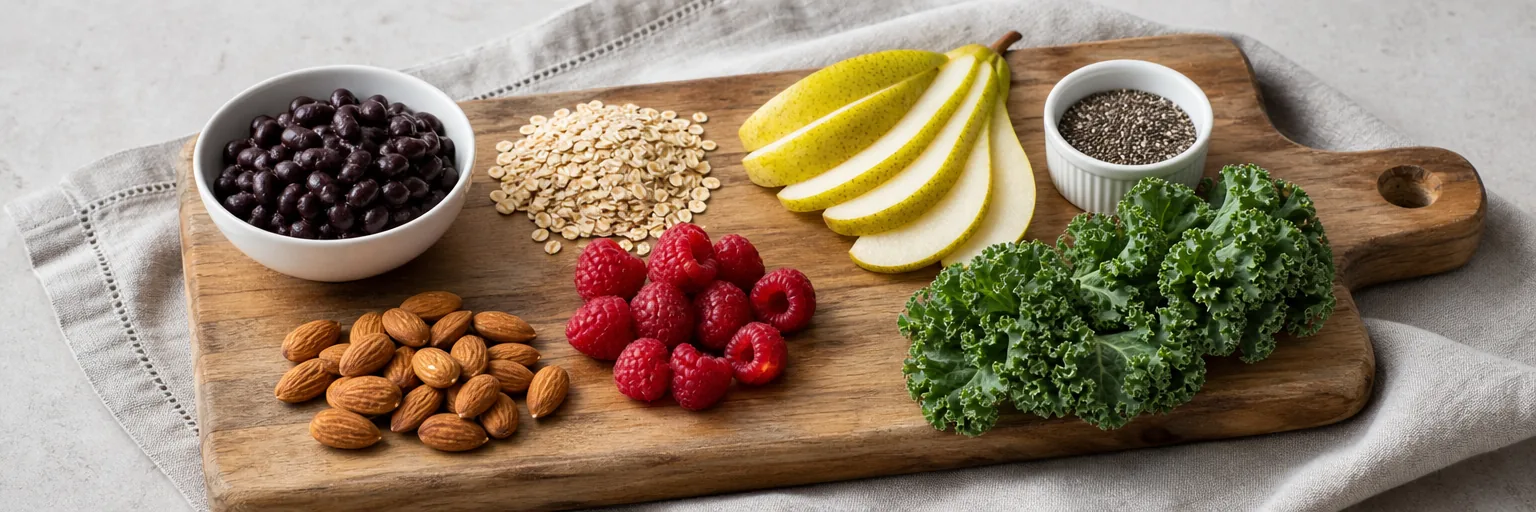
3. Calorie displacement. High-fiber foods are mostly low energy density — they bring a lot of food weight for few calories. A cup of black beans, a bowl of oatmeal, or a plate of raspberries — see berries for weight loss for the fiber-per-calorie breakdown across the four common berries — crowds out higher-calorie options on the plate without any conscious effort. They also take longer to chew, which pairs naturally with mindful eating for weight loss — a 20-minute fiber-rich meal gives satiety hormones time to register before the plate is empty. For the full picture on the volume lever, see our guide to low-calorie high-volume foods.
4. Gut microbiome and SCFAs. Beyond appetite, the SCFAs produced from fermentable fiber improve insulin sensitivity, reduce systemic inflammation, and may directly act on adipose tissue to limit fat storage. Higher-fiber diets consistently correlate with lower visceral fat in observational cohorts, even after controlling for total calorie intake.
Soluble vs insoluble fiber
Most whole-food fiber sources contain a blend, but the two types behave differently in the gut.
| Feature | Soluble fiber | Insoluble fiber |
|---|---|---|
| Dissolves in water | Yes (forms gel) | No |
| Main food sources | Oats, beans, lentils, chia, flax, apples, citrus, psyllium | Whole grains, vegetable skins, nuts, seeds, leafy greens |
| Gut effect | Slows digestion; feeds microbiome | Adds bulk; speeds transit |
| Satiety effect | Strong (delays gastric emptying, triggers GLP-1/PYY) | Moderate (volume-based) |
| Blood-sugar effect | Lowers post-meal glucose spike | Minimal |
| Cholesterol effect | Lowers LDL | Minimal |
| Best for | Appetite control, glucose, cholesterol, visceral fat | Regularity, gut motility |
For weight loss specifically, the satiety and visceral-fat evidence skews toward soluble fiber. But you do not need to chase the ratio — eating a variety of beans, oats, berries, vegetables, whole grains, nuts, and seeds will reliably give you both.
Daily fiber target: how much you actually need
The Institute of Medicine (IOM) recommendations are based on a target of 14 g per 1,000 calories consumed.
| Group | Daily fiber target |
|---|---|
| Women, 19–50 years | 25 g |
| Men, 19–50 years | 38 g |
| Women, 51+ years | 21 g |
| Men, 51+ years | 30 g |
| Pregnant adults | 28 g |
| Lactating adults | 29 g |
The average US adult consumes only 15 to 17 g per day — roughly half of the target. Closing that gap is the single largest nutrition lever most people have available. For weight loss specifically, controlled trials show benefit starting around 25 to 30 g per day; pushing toward 35 to 40 g produces slightly larger reductions in body weight and waist circumference, with diminishing returns above 50 g and rising GI discomfort.
20 high-fiber foods ranked by grams per 100 calories
Energy-density-adjusted fiber is the best single metric for weight loss because it tells you which foods give you the most fiber for the fewest calories.
| Food | Serving | Fiber (g) | Calories | Fiber per 100 kcal |
|---|---|---|---|---|
| Chia seeds | 1 oz (28 g) | 10 | 138 | 7.2 |
| Raspberries | 1 cup (123 g) | 8 | 64 | 12.5 |
| Blackberries | 1 cup (144 g) | 8 | 62 | 12.9 |
| Artichoke (boiled) | 1 medium | 7 | 64 | 10.9 |
| Lentils (cooked) | 1 cup (198 g) | 16 | 230 | 7.0 |
| Black beans (cooked) | 1 cup (172 g) | 15 | 227 | 6.6 |
| Kidney beans (cooked) | 1 cup (177 g) | 13 | 225 | 5.8 |
| Chickpeas (cooked) | 1 cup (164 g) | 12 | 269 | 4.5 |
| Split peas (cooked) | 1 cup (196 g) | 16 | 231 | 6.9 |
| Edamame (shelled) | 1 cup (155 g) | 8 | 188 | 4.3 |
| Broccoli (cooked) | 1 cup (156 g) | 5 | 55 | 9.1 |
| Brussels sprouts | 1 cup (156 g) | 4 | 56 | 7.1 |
| Avocado | 1/2 medium (100 g) | 7 | 160 | 4.4 |
| Pear (with skin) | 1 medium (178 g) | 6 | 101 | 5.9 |
| Apple (with skin) | 1 medium (182 g) | 4.4 | 95 | 4.6 |
| Oats (rolled, dry) | 1/2 cup (40 g) | 4 | 150 | 2.7 |
| Flaxseed (ground) | 2 tbsp (14 g) | 4 | 75 | 5.3 |
| Almonds | 1 oz (28 g) | 3.5 | 164 | 2.1 |
| Whole-wheat pasta (cooked) | 1 cup (140 g) | 6 | 174 | 3.4 |
| Quinoa (cooked) | 1 cup (185 g) | 5 | 222 | 2.3 |
Berries, artichoke, and chia top the chart — but legumes are the realistic workhorses because you can eat them as a main dish, not just a topping. A single cup of lentils gets you to 16 g, more than half a day’s target for women, in one bowl. For portion sizing, canned-vs-dry trade-offs, cost per serving, and the gas-tolerance ramp on the pulse category, see beans and legumes for weight loss.
For a category-by-category shopping breakdown including high-fiber carbs and produce, see our weight loss grocery list. For how the broader carbohydrate target fits into a weight-loss plan — including how many grams of carbs per day at different activity levels — see our guide to carbs for weight loss. Several of the highest-ranking foods on this list (chia, flax, almonds, avocado) also carry significant healthy fats — see our healthy fats for weight loss guide for how the omega-3 and monounsaturated content of these foods fits into your daily fat target. The avocado line in the table above — 7 g of fiber for half a medium fruit at ~160 kcal — is a good example of a fiber source that has to be portioned rather than eaten freely; see avocado for weight loss for the half-a-Hass-per-meal rule that keeps the calorie load honest.
How to add fiber without bloating or GI distress
The most common reason people abandon a high-fiber plan is the bloating, gas, and cramping that come from ramping too fast. The fix is mechanical, not magic.
- Ramp up by no more than 5 g per week. If you’re starting at 15 g, plan for week 1 at 20 g, week 2 at 25 g, week 3 at 30 g. Most people reach a comfortable target in 4 to 6 weeks.
- Drink one extra glass of water for every 5 to 10 g added. Fiber pulls water into the gut. Without enough fluid it does the opposite of what you want — constipation instead of regularity.
- Spread fiber across meals. A 35 g hit at dinner is uncomfortable; 10 g at breakfast, 12 g at lunch, 10 g at dinner, and 3 g from snacks is not.
- Cook your vegetables, at least at first. Steamed broccoli is gentler than raw broccoli; lentil soup is gentler than a kale salad.
- Slow down if symptoms get uncomfortable. Stay at the current level for an extra week instead of pushing through.
Most GI complaints resolve within 2 to 4 weeks as the gut microbiome adapts to the new fermentation load.
Fiber supplements: an honest look
Food fiber beats supplements in almost every comparison, but supplements are a reasonable backup when food fiber consistently falls short.
- Psyllium husk (5 to 10 g/day): the most-studied supplemental soluble fiber. Meta-analyses show modest weight loss (1 to 4 pounds over 8 to 12 weeks) and meaningful LDL cholesterol reductions (roughly 5 to 10 mg/dL per 10 g/day of soluble fiber — see cholesterol and weight loss for the dose-response). Generally well tolerated.
- Glucomannan (1 to 3 g/day): soluble fiber from konjac root with the strongest evidence for between-meal hunger reduction. Must be taken with a full glass of water — there are documented choking and esophageal-obstruction cases when capsules are taken dry.
- Inulin and FOS (5 to 10 g/day): fermentable fibers that feed beneficial gut bacteria. Strong prebiotic effect, but produce more gas and bloating than psyllium for many people; not ideal for IBS sufferers — see IBS and weight loss for the FODMAP-aware fiber strategy. Prebiotic fiber is the sibling category to probiotic supplements; the strain-level probiotic evidence and marketing red flags are covered separately in probiotics for weight loss.
- Wheat dextrin and methylcellulose: primarily marketed for regularity rather than weight loss; minimal satiety effect.
If you use a supplement, take it 15 to 30 minutes before a meal, with a full glass of water, and don’t double-dose to make up for missed days. For a deeper look at how supplemental fiber stacks against protein supplements and other satiety tools, see our fiber and protein supplements guide.
A sample high-fiber day (~30 g)
This is one realistic day at roughly 1,600 calories that hits 30 g of fiber from food alone, with no calculator gymnastics.
| Meal | Food | Fiber (g) | Calories |
|---|---|---|---|
| Breakfast | 1/2 cup rolled oats + 1 tbsp chia + 1 cup raspberries | 13 | 360 |
| Snack | 1 medium apple with skin + 1 tbsp almond butter | 6 | 195 |
| Lunch | 1 cup black bean salad + leafy greens + 1/2 avocado | 12 | 420 |
| Snack | 1/4 cup hummus + 1 cup carrot and pepper sticks | 6 | 180 |
| Dinner | 4 oz grilled salmon + 1 cup broccoli + 3/4 cup quinoa | 8 | 480 |
| Total | ~45 | ~1,635 |
Even with conservative serving sizes this day overshoots the 25 g women’s target and lands close to the 38 g men’s target, with room for snacks or a small dessert. The lesson is that hitting fiber is easy once you anchor each meal around a fiber-rich base (oats, beans, vegetables, berries). A half-cup of dry rolled oats alone contributes 2 g of beta-glucan toward the 3-g/day FDA threshold — the oatmeal for weight loss pillar walks through how to stack a second soluble-fiber source to close that gap.
For more breakfast options that pair fiber with the 25 to 40 g protein anchor that maximizes satiety, see our high-protein breakfast ideas and our broader guide on protein intake for weight loss.
Special situations
IBS and low-FODMAP overlap. People with IBS often react to specific fermentable fibers (the FODMAPs — including inulin, fructans in wheat, and the oligosaccharides in beans). A low-FODMAP fiber strategy emphasizes oats, chia, flax, blueberries, strawberries, carrots, spinach, and firm tofu, while limiting or trialing onion, garlic, wheat, lentils, and apples. Work with a registered dietitian familiar with the protocol if symptoms are significant — restricting FODMAPs long-term without reintroduction is not the goal.
Pre- and post-bariatric surgery. In the first 6 weeks after sleeve gastrectomy or gastric bypass, fiber is typically restricted to allow healing and tolerance progression. After that window, fiber is reintroduced gradually with an emphasis on soluble, well-cooked, and well-chewed sources. Many post-bariatric patients struggle to hit even 15 g per day because of restricted intake, and a low-dose psyllium supplement can fill the gap. Always coordinate with your bariatric team.
Fiber and GLP-1 medications. GLP-1s (semaglutide, tirzepatide) slow gastric emptying on their own, which can amplify the bloating and constipation effect of added fiber. Many GLP-1 patients tolerate fiber better when they ramp more slowly (2 to 3 g per week instead of 5), prioritize soluble over insoluble sources, and increase water intake significantly. Soluble fiber is also one of the most effective non-medication strategies for the constipation during a calorie deficit that affects 20 to 40 percent of GLP-1 users — see the full 5-step protocol there.
Insulin resistance and pre-diabetes. Soluble fiber improves insulin sensitivity independently of weight loss, partly via SCFA production and partly by blunting post-meal glucose spikes. Most pre-diabetes and PCOS protocols specifically push for 30 to 40 g of fiber per day, with a heavy emphasis on soluble sources. See our guide to insulin resistance and weight loss for the full picture.
Comparing fiber to added sugar reduction. Adding fiber and cutting added sugar tend to move together — most high-fiber whole foods are low in added sugar, and most low-fiber processed foods are high in it. If you’re already working on the sugar side of the equation, see our guide to sugar and weight loss.
Frequently asked questions
How much fiber should I eat per day to lose weight? The Institute of Medicine sets the daily target at 25 g for adult women and 38 g for adult men, dropping to 21 and 30 g after age 50. Most US adults get only 15 to 17 g per day. For weight loss specifically, controlled trials show benefit starting around 25 to 30 g per day, and pushing toward 35 to 40 g produces slightly larger reductions in body weight and waist circumference. Ramp up by no more than 5 g per week and increase water intake to avoid bloating.
Does fiber really make you feel full? Yes, through several mechanisms working together. Soluble fiber absorbs water and forms a gel in the stomach that slows gastric emptying. Both soluble and insoluble fiber add bulk that triggers stretch receptors in the gut wall. Fermentable fibers also feed gut bacteria, which release short-chain fatty acids that stimulate the release of GLP-1 and PYY. The combined effect typically cuts intake at the next meal by 50 to 200 calories without conscious restriction.
What is the difference between soluble and insoluble fiber for weight loss? Soluble fiber dissolves in water and forms a gel — found in oats, beans, lentils, chia, flax, apples, and citrus. It is the type most strongly linked to satiety, slower digestion, lower LDL cholesterol, and steadier blood sugar. Insoluble fiber does not dissolve and adds bulk to stool — found in whole grains, vegetables, nuts, and seeds. It supports regularity and gut motility. Both matter; most whole-food fiber sources contain a mix of the two.
Is fiber supplementation as effective as food fiber? Food fiber wins in almost every comparison. Whole foods deliver fiber alongside water, protein, vitamins, and phytonutrients that supplements lack, and they take longer to eat. Supplements such as psyllium husk and glucomannan do have evidence for modest weight loss (1 to 4 pounds over 8 to 12 weeks), and they can fill the gap when food fiber falls short. Treat supplements as a backup, not a substitute, and pair them with plenty of water.
Can too much fiber cause weight gain or bloating? Fiber itself does not cause fat gain — it has very few absorbable calories — but ramping up too fast reliably causes bloating, gas, cramping, and temporary water weight that can read as a 1 to 3 pound jump on the scale. Increase fiber by no more than 5 g per week, drink an extra glass of water for every 5 to 10 additional grams, and back off briefly if symptoms get uncomfortable. Most GI complaints resolve within 2 to 4 weeks.
Does fiber help with belly fat specifically? Soluble fiber has the most consistent evidence for reducing visceral (belly) fat. The Multi-Ethnic Study of Atherosclerosis found that every additional 10 g of soluble fiber per day was associated with a 3.7 percent reduction in visceral adipose tissue accumulation over 5 years. The mechanism is partly hormonal — soluble fiber improves insulin sensitivity and lowers fasting insulin. Whole-food sources rich in soluble fiber include oats, beans, lentils, chia, flax, and apples.
Sources
- Slavin JL. Dietary fiber and body weight. Nutrition (2005).
- Howarth NC, Saltzman E, Roberts SB. Dietary fiber and weight regulation. Nutrition Reviews (2001).
- Reynolds A, Mann J, Cummings J, et al. Carbohydrate quality and human health: a series of systematic reviews and meta-analyses. The Lancet (2019).
- Hairston KG, Vitolins MZ, Norris JM, et al. Lifestyle factors and 5-year abdominal fat accumulation in a minority cohort: the IRAS Family Study. Obesity (2012).
- Ma Y, Olendzki BC, Wang J, et al. Single-component versus multicomponent dietary goals for the metabolic syndrome: a randomized trial. Annals of Internal Medicine (2015).