
2026-05-26 · hydration, nutrition, appetite, weight loss
Updated 2026-10-02
Written by WeightFAQ Staff
Evidence-informed guidance from the WeightFAQ editorial team.
11 min read
Last editorial review Jul 28, 2026
Does Drinking Water Help You Lose Weight? What the Research Actually Shows
Quick answer: Water itself does not burn fat. But two specific water habits have real, evidence-based support for weight loss: drinking a glass of water before meals, which modestly reduces how much you eat, and replacing sugar-sweetened drinks with water, which can quietly cut hundreds of calories a day. A small “water-induced thermogenesis” effect may add a tiny calorie bump, but it is not big enough to drive results on its own. Think of water as a supporting habit that makes a calorie deficit easier to maintain — not as a fat-burner.
Drinking more water is one of the most common pieces of weight loss advice on the internet, and it sits somewhere between solid and oversold. The honest version is that hydration is supportive, not transformative: it helps in a few specific, measurable ways, and most of the dramatic claims do not hold up. This guide walks through what the research actually shows about pre-meal water, beverage swaps, and the “metabolism boost” claim, then gives you a practical daily-water plan that does not require carrying a gallon jug around.
What water can and cannot do for weight loss
Water has no calories, so on its own it cannot create the calorie deficit that fat loss requires. What it can do is change behavior around food and drink in ways that lower your overall intake. There are three pathways researchers have actually studied:
- Pre-meal water and appetite. Drinking water shortly before a meal can take the edge off hunger and modestly lower how much you eat.
- Beverage substitution. Replacing sugar-sweetened drinks (soda, juice, sweetened coffee, energy drinks) with water cuts a large source of “invisible” calories that the body does not compensate for very well.
- Water-induced thermogenesis. Drinking water may transiently raise energy expenditure by a small amount. The effect is real in some studies and inconsistent in others, and it is too small to matter on its own.
The first two are where the practical wins live. The third is interesting but largely a sideshow.
Pre-meal water: a small, real appetite assist
The most cited study on pre-meal water is a 12-week randomized trial in middle-aged and older adults on a hypocaloric diet. One group drank about 500 ml (roughly 16 oz) of water 30 minutes before each main meal; the other followed the same diet without the water instruction. The pre-meal water group lost about 2 kilograms more on average, mostly because they ate fewer calories at meals. Subsequent shorter-term experiments have generally backed this up in older adults, while studies in younger adults show smaller and less consistent effects — the pre-meal water trick seems to work better as we age and the thirst-vs-hunger signal gets weaker.
What this means in practice:
- Pre-meal water helps a little, especially for older adults. Expect a modest reduction in meal calories, not appetite suppression on the scale of GLP-1 medications or even a high-protein meal.
- Timing matters. Roughly 20 to 30 minutes before the meal is the window most studies use. Chugging water while eating is fine, but the appetite effect is weaker.
- Volume matters. Around 400 to 500 ml (a typical large glass) is enough; more is not better and can be uncomfortable.
Pre-meal water is cheap, has no real downside for most adults, and pairs well with portion control and the volume-eating principles in our guide to low-calorie, high-volume foods. Just do not expect it to do the heavy lifting on its own.
The biggest practical lever: swap caloric drinks for water
If you only change one thing about hydration to support weight loss, swap sugar-sweetened drinks for water (or another non-caloric drink). This is the strongest, most reliable hydration lever in the literature.
Why it works:
- Liquid calories barely register as food. Trials comparing identical calories from solid food versus sugar-sweetened drinks find that drink calories trigger weaker fullness signals, so people do not eat less later to compensate.
- The numbers are large. A 20-ounce soda is roughly 240 calories; many specialty coffees and “wellness” drinks land at 300 to 500 calories. Replacing one daily soda with water can plausibly cut around 1,500+ calories a week with no change to food intake.
- The substitution itself drives weight change. Beverage-replacement trials, including studies that swap sugar-sweetened drinks for water or diet drinks, consistently show lower calorie intake and modest weight loss over months.
This is also a habit you can implement gradually: replace one drink a day for the first week, then expand. Sparkling water, unsweetened tea or coffee, and diet sodas are all reasonable bridges if plain water feels boring. To see how the calories from drinks fit into your overall target, check our guide on how many calories you need to lose weight.
Water-induced thermogenesis: small effect, oversold story
You will see claims that drinking water boosts your metabolism by 24 to 30 percent. That number traces back to a small 2003 study where participants drank 500 ml of water and energy expenditure rose for about an hour. The absolute calorie bump worked out to roughly 24 extra calories per liter of water — not a huge amount, and well within a margin where small measurement errors matter.
Later research has been mixed. Some studies have found a much smaller effect (around half that, or less), and the question of whether cold water amplifies the effect is unsettled. The most honest summary is:
- The effect, if it exists, is small — on the order of tens of calories, not hundreds.
- It is not a meaningful weight loss mechanism on its own.
- It is not a reason to force-drink water beyond thirst.
Hydration is worth doing for a long list of reasons. Boosting metabolism enough to matter for fat loss is not one of them.
How much water should you actually drink?
There is no single “weight loss water target.” Old guidance often cited 8 glasses (about 2 liters) a day, but actual fluid needs vary a lot with body size, activity, climate, and what you eat — foods like fruit, vegetables, soup, and yogurt contribute meaningful water too.
A reasonable starting framework for most healthy adults:
- Baseline: roughly 2 to 2.5 liters (about 8 to 10 cups) of total fluid per day from all sources combined.
- Add for activity and heat: an extra 400 to 800 ml for moderate exercise, more for long or hot sessions.
- Bigger bodies need more: larger adults generally need more than smaller ones at the same activity level.
- Drink to thirst, then check urine color: pale yellow is a good sign; consistently dark yellow suggests you can add more.
For weight loss specifically, add one practical layer on top:
- A glass of water (around 400 to 500 ml) 20 to 30 minutes before your main meals.
- Water as the default drink between meals, with sugar-sweetened drinks reduced or replaced.
You do not need to time water with a stopwatch or carry a gallon jug. Most people who hit those two habits land in a sensible total without thinking about it.
A brief note on overdoing it
It is uncommon, but possible, to drink too much water. Consuming very large volumes in a short period can dilute blood sodium and cause hyponatremia, with symptoms ranging from headache and nausea to confusion and, in severe cases, seizures. This mostly shows up in endurance athletes, people doing water-loading “challenges,” and certain medical conditions. For everyday adults, drinking to thirst and adding a glass before meals stays well within a safe range. If you have heart, kidney, or liver disease, ask your clinician about a specific fluid target. For people with a history of kidney stones, the prevention target is higher — about 2.5 to 3 liters of fluid per day to produce ≥2.5 L of urine.
Practical tips that actually move the needle
- Anchor water to existing habits. A glass with each meal, on waking, after brushing your teeth, and after every bathroom break covers most people without needing a tracker.
- Pre-meal glass. Make it a default before lunch and dinner; that alone captures most of the appetite benefit.
- Replace, do not just add. Swapping a soda for water beats drinking the same soda plus more water.
- Check hunger vs. thirst. Mild dehydration can feel like a vague snacky urge. If a craving hits between meals, drink a glass of water and wait 10 to 15 minutes before deciding it was real hunger.
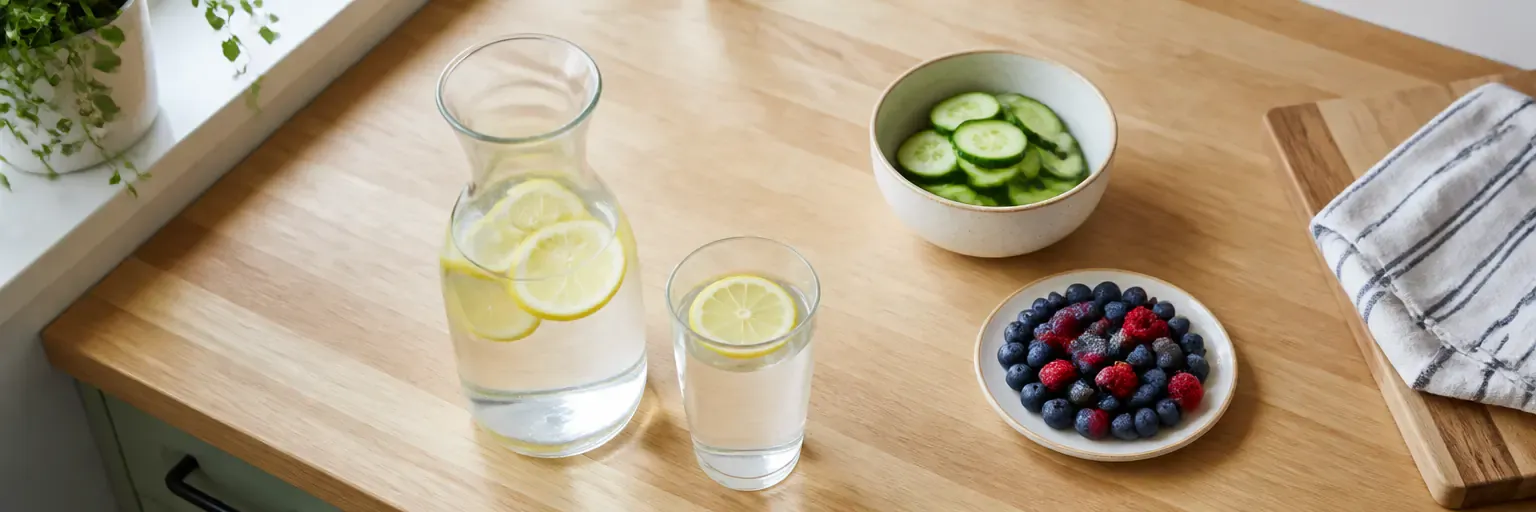
- Use sparkling or flavored water as a bridge. Unsweetened sparkling water, or water with citrus or cucumber, can make the swap from sweetened drinks easier without adding calories.
- Watch the “healthy” caloric drinks. Smoothies, oat-milk lattes, kombucha, and many “wellness” drinks can easily carry 200 to 400 calories. They are not automatically a free pass.
A note for people on GLP-1 medications
People taking GLP-1 medications such as semaglutide or tirzepatide often eat and drink noticeably less, and dehydration is a known driver of side effects, especially during dose changes. Sipping water through the day, prioritizing water with meals, and watching for signs of dehydration (dark urine, lightheadedness, persistent dry mouth) matter more on these drugs than off them. Our Ozempic side effects and GLP-1 weight loss overview pages cover this in more depth. For sodium, potassium, and magnesium replacement during aggressive deficits, low-carb protocols, or GLP-1 use, see hydration and electrolytes for weight loss.
Natural appetite suppressants — what the evidence actually supports
Three mechanisms have RCT-level evidence; several widely-sold supplements do not.
What works: pre-meal water (Dennis 2010 Obesity 12-week RCT; Davy 2008; Jeong 2018), soluble fiber for weight loss at 10–15 g with meals (Howarth 2001 Nutrition Reviews meta-analysis; Rebello 2016; Clark 2013 psyllium RCT), and protein intake for weight loss at ≥25 g per meal (Weigle 2005; Leidy 2015; Paddon-Jones 2008 — satiety-hormone response peaks around 25–30 g protein per meal). The combined effect is a 150–300 kcal/day reduction in intake without conscious restriction.
What does not work, with a safety flag: green tea extract — NCCIH 2023 flagged hepatotoxicity cases per the Yu 2023 American Journal of Gastroenterology review, and the mild acute thermogenesis (~70–100 kcal/day per the Hursel 2011 meta-analysis) does not translate into durable weight loss. Hoodia, Garcinia cambogia, raspberry ketones, bitter orange, and apple cider vinegar — no RCTs show weight-loss effects larger than placebo per the Fogelholm 2020 Nutrients herbal-weight-loss review and the Onakpoya 2011 International Journal of Obesity Garcinia meta-analysis. The FDA 2004 ephedra ban followed documented cardiovascular events. Honest read: supplements marketed as “natural appetite suppressants” are a low-value category; the three evidence-backed mechanisms are water, fiber, and protein — all foods, all costing nothing extra.
The honest bottom line
Drinking water supports weight loss in two specific, well-supported ways: pre-meal water modestly lowers meal calories (especially in older adults), and swapping sugar-sweetened drinks for water cuts a large source of barely-noticed calories. A small thermogenic effect may exist but is too minor to bank on. None of this is a fat-burner, and no one is going to lose weight on hydration alone. But layered onto a moderate calorie deficit, adequate protein, and consistent activity, the right hydration habits make the whole plan easier to stick to — which is usually the difference between a plan that works and one that does not.
Frequently asked questions
Does drinking water help you lose weight? Indirectly, yes. Water itself does not burn fat, but pre-meal water and swapping sugar-sweetened drinks for water both modestly lower calorie intake. Treat it as a supporting habit, not a fat-burner.
How much water should I drink to lose weight? A reasonable starting target is around 2 to 2.5 liters (8 to 10 cups) of total fluid a day from all sources, with more for exercise, heat, or larger bodies. Drink to thirst, aim for pale-yellow urine, and add a glass 20 to 30 minutes before main meals if you are dieting.
Does drinking water before meals reduce appetite? Modestly. A 12-week trial in middle-aged and older adults found that 500 ml of water 30 minutes before each meal led to about 2 kg extra weight loss versus diet alone. Effects are smaller and less consistent in younger adults.
Is it better to drink water instead of soda for weight loss? Yes. Sugar-sweetened drinks add calories that the body does not register as food the way it does solids, so they push your daily total up without reducing later intake. Swapping them for water is one of the highest-impact hydration changes you can make.
Can drinking water boost your metabolism? A little, but not enough to matter on its own. The often-quoted “30% boost” comes from a single small study; later research shows smaller, inconsistent effects, and any extra calorie burn is on the order of tens of calories.
Can you drink too much water? Yes, though it is uncommon. Drinking very large volumes quickly can cause hyponatremia. Drinking to thirst plus a glass before meals stays well within a safe range for most adults.
Sources
- Dennis EA, Dengo AL, Comber DL, Flack KD, Savla J, Davy KP, Davy BM. Water consumption increases weight loss during a hypocaloric diet intervention in middle-aged and older adults. Obesity (2010).
- Davy BM, Dennis EA, Dengo AL, Wilson KL, Davy KP. Water consumption reduces energy intake at a breakfast meal in obese older adults. Journal of the American Dietetic Association (2008).
- Boschmann M, Steiniger J, Hille U, Tank J, Adams F, Sharma AM, Klaus S, Luft FC, Jordan J. Water-induced thermogenesis. The Journal of Clinical Endocrinology & Metabolism (2003).
- Tate DF, Turner-McGrievy G, Lyons E, Stevens J, Erickson K, Polzien K, Diamond M, Wang X, Popkin B. Replacing caloric beverages with water or diet beverages for weight loss in adults: main results of the Choose Healthy Options Consciously Everyday (CHOICE) randomized clinical trial. The American Journal of Clinical Nutrition (2012).
- DiMeglio DP, Mattes RD. Liquid versus solid carbohydrate: effects on food intake and body weight. International Journal of Obesity (2000).