
2026-06-11 · dietary fat, macronutrients, nutrition, weight loss, omega-3, saturated fat
Updated 2026-08-02
Written by Maya Patel
Maya Patel is a WeightFAQ staff writer covering sustainable weight loss through mindful eating, flexible routines, and evidence-based nutrition. She translates research on protein, fiber, portion control, and calorie awareness into practical meal-planning guidance readers can actually follow at home. Her articles favor honest expectations over fad promises — small changes that compound, calorie bands scaled to real households, and grocery lists built around whole foods with room for real life. Maya writes for people juggling family meals, busy weeks, and long-term goals, not gym-optimized single adults with unlimited prep time.
18 min read
Medically reviewed on Aug 2, 2026
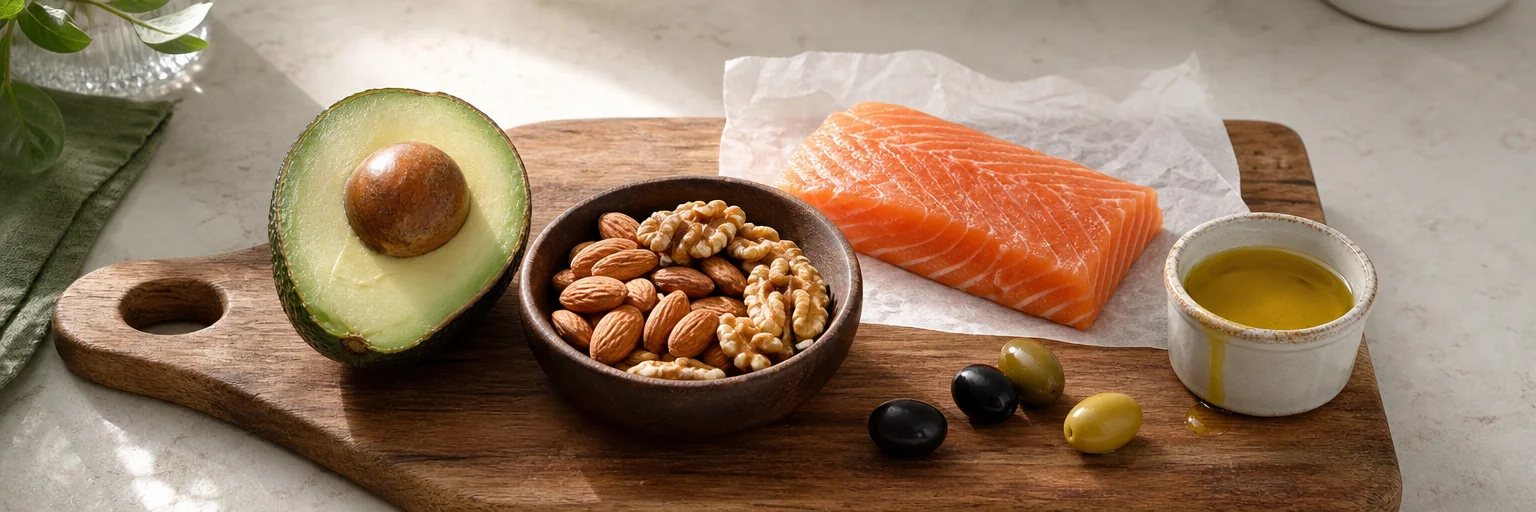
Healthy Fats for Weight Loss: How Much, Which Kinds, and Why They Matter
Quick answer
Most adults losing weight do well at 0.6 to 1.0 grams of fat per kilogram of body weight per day, or 20 to 35 percent of calories — about 40 to 70 grams a day at a 1,500 to 2,000 kcal target. Under 20 percent backfires on satiety, hormone production, and fat-soluble vitamin absorption; over 40 percent (outside a deliberate keto plan) crowds out protein and fiber, both of which matter more for weight loss than the carb-to-fat ratio. Source matters more than total: most of your fat should come from olive oil, avocado, nuts, seeds, and fatty fish; saturated fat is the contested middle; trans fats are the only category to truly avoid. Healthy fats do not cause weight loss — they make a sensible deficit easier to live with.
Who this is for / not for
Good fit if you:
- Want a clear answer on how much fat to eat in a calorie deficit
- Already have protein and carb targets and need to fill in the fat slot
- Are following a Mediterranean or balanced-macro plan and want to dial in the fat sources
- Tried very low-fat eating and found it unsatisfying or unsustainable
- Want an honest read on saturated fat, omega-3, and supplements
Not a fit if you:
- Have a history of pancreatitis — fat restriction is medical, not general
- Had your gallbladder removed and still have fat-malabsorption symptoms — work with your clinician
- Have advanced familial hypercholesterolemia — your fat type and saturated-fat ceiling is set by lipidology, not a general article
- Are on a very-low-fat clinical protocol (Ornish, Esselstyn, or similar) under medical supervision — those programs cap fat under 10 percent of calories for cardiac reasons and should not be modified without your care team
Why fat matters in a weight loss diet
Fat is the most calorie-dense macronutrient — 9 kilocalories per gram versus 4 for protein and carbohydrate. That density is also why fat punches above its weight on satisfaction per bite, and why it can quietly tip a deficit into a surplus when portions drift. Five mechanisms are worth understanding before you set a target.
1. Satiety and meal satisfaction. Fat slows gastric emptying and triggers cholecystokinin (CCK) release from the small intestine, which signals fullness to the brain. Meals with reasonable fat (15 to 25 g per meal) keep people fuller longer than equivalent-calorie low-fat meals. Very-low-fat diets (under 20 percent of calories) consistently rate lower on meal satisfaction and have higher dropout rates in long-term trials.
2. Fat-soluble vitamin absorption. Vitamins A, D, E, and K require dietary fat to be absorbed. A salad of spinach and carrots with no fat delivers a fraction of the carotenoids that the same salad with a tablespoon of olive oil does. Long-running very-low-fat plans without supplementation can run readers into low vitamin D, low vitamin E, and impaired vitamin K absorption — none of which help weight loss.
3. Hormone synthesis. Cholesterol, which comes partly from dietary fat, is the backbone of cortisol, testosterone, estrogen, and progesterone. Chronic very-low-fat eating (below ~0.5 g/kg) can lower testosterone in men and disrupt menstrual cycles in lean women, especially when combined with an aggressive deficit. This is a real failure mode of “I’ll just eat plain chicken and rice forever.”
4. Essential fatty acids. Linoleic acid (omega-6) and alpha-linolenic acid (omega-3, ALA) cannot be synthesized in the body and must come from food. Their downstream products — EPA, DHA, arachidonic acid — drive cell membrane composition and inflammatory signaling. The minimum to avoid deficiency is small (a few grams a day), but the practical target for cardiovascular and inflammatory benefit is higher and comes mostly from fatty fish.
5. The palatability trap. Fat plus refined carbs plus salt or sugar is the formula behind the most overeat-able foods in the modern diet: chips, ice cream, pastries, fried fast food, ultra-processed snacks. The mechanism is not “fat is fattening” — it is that engineered combinations bypass normal satiety signaling. Whole-food fats from olive oil, avocado, nuts, and fish do not trigger the same overconsumption pattern. This is the practical reason “eat healthy fats, limit ultra-processed” is durable advice.
How much fat per day
The 2005 Institute of Medicine fat AMDR (Acceptable Macronutrient Distribution Range) puts the healthy range at 20 to 35 percent of total calories for the general population, with no RDA below that because fat is partly synthesized and partly stored. For weight loss specifically, the practical target depends on body weight, calorie target, and how you have set protein and carbs.
| Approach | Grams of fat per kg body weight | % of calories | Typical g/day at 1,500 kcal | Typical g/day at 1,800 kcal | Typical g/day at 2,000 kcal |
|---|---|---|---|---|---|
| Floor for hormonal health | 0.5 to 0.6 g/kg | ~18 to 22% | 30 to 37 g | 36 to 44 g | 40 to 49 g |
| Balanced (Mediterranean-style) | 0.8 to 1.0 g/kg | 25 to 35% | 42 to 58 g | 50 to 70 g | 55 to 78 g |
| Higher-fat (lower-carb non-keto) | 1.0 to 1.3 g/kg | 35 to 45% | 58 to 75 g | 70 to 90 g | 78 to 100 g |
| Keto | 1.3 to 1.8 g/kg | 60 to 75% | 100 to 125 g | 120 to 150 g | 133 to 167 g |
Body-weight math gets you closer than a flat target. A 70 kg (154 lb) adult on a 1,800 kcal Mediterranean-style plan lands at roughly 56 to 70 g of fat per day. An 85 kg (187 lb) adult on a 2,000 kcal balanced plan lands at 68 to 85 g. Going below ~0.5 g/kg for more than a few weeks is where the hormonal and satiety problems start.
If you have not set a daily calorie target yet, see our guide to how many calories to eat for weight loss. Set protein first using our protein intake for weight loss guide, choose your carb level using our carbs for weight loss guide, and fat will fill the remaining calories.
The four kinds of fat — what to eat more of, what to limit
Dietary fat is not a single substance. The four main types behave very differently in the body, and the practical advice is type-specific.
Monounsaturated fat (MUFA) — eat freely. Found in extra-virgin olive oil, avocado, almonds, hazelnuts, macadamia nuts, and high-oleic seed oils. The 2018 PREDIMED trial randomized over 7,400 adults to a Mediterranean diet supplemented with extra-virgin olive oil, the same diet with mixed nuts, or a low-fat control; both Mediterranean arms cut major cardiovascular events by about 30 percent over five years. MUFA-rich plans are the most consistently weight-loss-friendly fat profile across long-term trials. For the single-food deep dive on portion, format, and the whole-almond-versus-almond-butter math, see almonds for weight loss.
Polyunsaturated fat (PUFA) — split it. PUFA splits into omega-6 (linoleic acid, found in sunflower, soybean, corn, and most processed foods) and omega-3 (ALA, EPA, DHA). The honest picture on omega-6 is that it is not the villain the “seed oil” discourse paints — replacing saturated fat with PUFA lowers cardiovascular events in pooled trials — but most Americans already get plenty of omega-6 and not enough omega-3, so the practical lever is to raise omega-3, not panic about omega-6. For a whole-food linoleic-acid source that also carries protein, fiber, and the highest vitamin-E density of any common seed, see sunflower seeds for weight loss — one ounce delivers ~49 percent of the daily vitamin-E target, which most US adults under-hit.
Saturated fat (SFA) — moderate. Found in butter, fatty cuts of red meat, full-fat dairy, coconut, and chocolate. This is the most contested category. The 2017 AHA presidential advisory (Sacks et al.) reviewed the controlled-feeding evidence and recommended keeping saturated fat under 10 percent of calories — about 17 g a day on a 1,500 kcal plan — because replacing it with PUFA lowered cardiovascular events by 30 percent in pooled trials. The 2017 PURE study and 2020 BMJ meta-analyses muddied the all-cause-mortality picture but did not exonerate the swap from saturated fat to refined carbs. The defensible default: keep SFA moderate (under 10 percent of calories for most adults), and when you do cut it, replace it with MUFA and omega-3, not with refined grains and sugar.
Trans fat — avoid. Industrially produced partially-hydrogenated oils raise LDL, lower HDL, and increase cardiovascular events at any dose studied. The FDA banned them from the US food supply in 2018, but trace amounts (under 0.5 g per serving, which can still be labeled as 0 g) persist in some processed baked goods and fast food. The rule is mechanical: skip anything with “partially hydrogenated” in the ingredient list. For the broader picture on how fat type, soluble fiber, and weight loss combine to move your lipid panel, see cholesterol and weight loss.
Omega-3: how much, from where, and supplements
Omega-3 is the single fat sub-category with the strongest evidence for cardiovascular and inflammatory benefit, and it is the one most American diets are short on. The practical targets:
- General health: 250 to 500 mg of combined EPA + DHA per day. Two servings of fatty fish per week (salmon, sardines, mackerel, trout, herring, anchovies) covers this without a supplement. A 3.5 oz serving of farmed Atlantic salmon delivers about 2,000 mg of EPA + DHA — two servings a week averages out to roughly 570 mg per day. For the single-food deep dive on portion, wild vs farmed, and mercury tier, see salmon for weight loss. Note that canned light tuna is not a high-omega-3 food — it is a cheap lean-protein anchor rather than an EPA + DHA source — so tuna rotates as the protein-anchor lunch and salmon or sardines carry the omega-3 dose; see the tuna for weight loss pillar for the honest tuna-vs-salmon comparison.
- Clinical use: 1 to 2 g per day of EPA + DHA is used for triglyceride reduction and inflammatory conditions. Higher doses should be cleared with a clinician because they can affect bleeding time.
- Vegan sources: Algal oil supplements provide EPA and DHA directly and are the cleanest plant-source option. Ground flax, chia, hemp hearts, and walnuts deliver ALA, which converts to EPA at only about 5 to 10 percent and to DHA at less than 5 percent — a real source, but not a substitute for direct EPA/DHA at clinical doses. Hemp hearts also carry the most favorable LA-to-ALA ratio (~3:1) of the seed-and-nut set, plus a complete plant protein. For the highest magnesium-and-zinc density of the seed rotation — different lever than ALA, but the same “1 to 2 tablespoons a day inside a deficit” playbook — see pumpkin seeds for weight loss.
Omega-3 does not drive meaningful weight loss in head-to-head trials, but it supports the cardiometabolic markers that often co-travel with a successful weight-loss effort. Treat it as health insurance for the deficit, not as a weight-loss tool. If you supplement, look for products with a third-party purity certification (IFOS, USP) and a clearly listed combined EPA + DHA dose on the label.
Foods to add and foods to limit
Energy density and type-of-fat profile are the two best predictors of whether a fat source helps or hurts a weight-loss plan. The table below covers 20 common foods.
| Add freely | Why | Limit or minimize | Why |
|---|---|---|---|
| Extra-virgin olive oil (1 to 2 tbsp/day) | MUFA-rich; the most-studied weight-loss-friendly fat | Margarine with partially-hydrogenated oils | Trans fat; older versions are the worst type |
| Avocado | MUFA + fiber + potassium; high satiety per calorie | Deep-fried fast food | Refined oils + reheated trans fat byproducts |
| Almonds, walnuts, pistachios, cashews (1 oz/day) | MUFA, omega-3 (walnuts), fiber; trial-supported for weight maintenance | Ultra-processed baked goods (pastries, doughnuts) | Refined flour + sugar + fat — the palatability trap |
| Salmon, sardines, mackerel, trout | EPA + DHA, complete protein | Crackers, chips, ultra-processed snack foods | Engineered low-satiety fat + salt + refined carbs |
| Chia and flaxseed (1 to 2 tbsp/day) | ALA + soluble fiber | Cured meats high in saturated fat (salami, pepperoni) | High SFA + sodium + processing |
| Eggs (whole, 1 to 3/day) | Choline, B12, high satiety; lipid effect is modest for most | Processed cheese spreads | Refined fat + sodium + additives |
| Olives | MUFA + polyphenols | Coconut oil in large amounts | Very high SFA; modest if used sparingly |
| Greek yogurt (2% or full-fat in moderation) | Fat + protein; high satiety | Butter and ghee in large amounts | High SFA; modest amounts are fine |
| Dark chocolate (≥70%, 1 oz/day) | MUFA, polyphenols, satisfaction | Sugary “fat-free” desserts | The fat got removed; the sugar replaced it |
| Tahini and natural nut butters (1 to 2 tbsp/day; see peanut butter for weight loss for the per-tablespoon math) | MUFA, fiber | Hydrogenated peanut spreads | Trans fat residue |
The rule that captures most of this: if the fat came packaged with fiber, protein, or polyphenols, it probably helps; if it came packaged with refined carbs and sugar, it probably hurts. The same principle drives our low-calorie high-volume foods and Mediterranean diet for weight loss guides.
How to hit your fat target without blowing calories
Fat is forgiving on satisfaction and unforgiving on math. At 9 calories per gram, a casual extra tablespoon of olive oil is 120 calories — half of a 250-calorie snack, in one pour. Six tactics that work:
- Measure oil with a spoon, not a glug. A free-hand pour from a bottle is typically 2 to 3 tablespoons (270 to 400 calories). The tablespoon is the highest-leverage piece of kitchen equipment for fat targets.
- Swap mayo for mashed avocado on sandwiches. Same creamy texture, roughly half the calories per serving, plus fiber and potassium. For the full portion-and-tracking playbook on avocado in a deficit — half a Hass per meal, one whole per day maximum — see avocado for weight loss.
- Choose loin or round cuts of meat at the base, then add fat at the plate. A 4 oz piece of pork tenderloin is 130 kcal; the same weight of pork belly is 580. Build the base from lean protein, then add measured olive oil, avocado, or nuts at serving so you control the fat number.
- Use nuts as a snack, not a topping. A measured 1 oz handful (160 to 200 kcal) eaten alone is satisfying. A “sprinkle” on a salad plus another in a stir-fry plus a few in oatmeal can quietly add 400 calories a day — and 2 tablespoons of nut butter on top of a plain oat bowl is nearly 200 kcal on its own, which is the trap the oatmeal for weight loss pillar walks through in detail.
- Pre-portion high-fat snacks. Pour out 1 oz of almonds into a small dish; do not eat from the bag. Slice half an avocado for breakfast and save the other half in lemon water.
- Pick one calorie-dense fat per meal, not three. If the protein is fatty fish, skip the avocado and use a vinegar-based dressing. If the salad has avocado, skip the olive oil and use a citrus dressing.
For a worked split that turns calories into protein, carb, and fat grams, the macronutrient calculator does the math in seconds — and the fat column is exactly the gram target this article is helping you set.
Low-fat vs. moderate vs. higher-fat vs. keto
The table below compares the four common fat strategies head-to-head on what the trials actually show, at a 1,800 kcal target.
| Approach | Typical g/day at 1,800 kcal | % of calories | Evidence for weight loss | Who it suits | Downsides |
|---|---|---|---|---|---|
| Low-fat (<20%) | < 40 g | < 20% | Ornish-style very-low-fat plans show weight loss at matched calories but high dropout; DIETFITS low-fat arm lost 5.3 kg at 12 months | People with familial hypercholesterolemia or under cardiac protocol; some prefer the food rules | Lower satiety, lower hormone synthesis, harder fat-soluble vitamin absorption, monotony |
| Moderate (25 to 35%) | 50 to 70 g | 25 to 35% | PREDIMED, DIRECT, DIETFITS — strongest long-term and CV-outcome evidence; the IOM AMDR sits here | Most adults losing weight; people who eat socially and cook for a household | Slower scale movement than keto in week 1 |
| Higher-fat (35 to 45%) | 70 to 90 g | 35 to 45% | DIRECT low-carb arm, DIETFITS low-carb arm — equal to low-fat at 12 months, modest appetite advantage | Strong appetite responders to lower carbs; insulin resistance; people who hate counting carbs | LDL may rise; portion creep is easy at 9 kcal/g |
| Keto (60 to 75%) | 120 to 150 g | 60 to 75% | Largest early loss (water from glycogen); converges with low-fat by 12 months (DIETFITS ~5 to 6 kg either way) | Drug-resistant epilepsy, some T2D, specific appetite responders; not endurance training | High dropout, “keto flu,” lipid changes, rigid socially |
The pattern from the trial literature is consistent: at matched calories and protein, long-term weight loss converges across the four approaches, and individual adherence is the biggest variable. The choice between moderate and higher-fat is mostly preference. For the keto-specific deep dive, see our guide to low-carb and keto diets — and remember that keto is a dietary pattern, while this article is the macro-level “how much fat” guide. For the plant-free extreme-elimination extension of the higher-fat pattern, see the carnivore diet for weight loss — a template that concentrates saturated fat and heme iron intake well above any keto plate that includes vegetables. For the bigger picture across diet types, see the best diet for weight loss, and for the inflammation-focused approach that emphasizes omega-3 and olive oil, see the anti-inflammatory diet for weight loss and DASH diet for weight loss.
For the carbohydrate side of the same calorie pie, see carbs for weight loss, and for the third macro that often gets overlooked, see fiber for weight loss.
Frequently asked questions
How much fat should I eat per day to lose weight? Most adults in a calorie deficit do well at 0.6 to 1.0 grams of fat per kilogram of body weight, which works out to roughly 20 to 35 percent of total calories on a 1,500 to 2,000 kcal plan. For a 70 kg (154 lb) adult, that is about 42 to 70 grams of fat per day. The 2005 Institute of Medicine fat AMDR puts the healthy range at 20 to 35 percent of calories for the general population. Going under 20 percent for an extended period tends to backfire on satiety, hormone production, and absorption of fat-soluble vitamins; going over 40 percent (outside of a deliberate keto plan) usually crowds out protein and fiber, both of which matter more for weight loss than the carb-to-fat ratio.
Are healthy fats good for weight loss? Yes, in the right amount and from the right sources. Whole-food fats from olive oil, avocado, nuts, seeds, and fatty fish are tied to better long-term weight outcomes in trials like PREDIMED and DIETFITS, partly because they improve meal satisfaction and partly because they replace lower-quality calories. But fat is the most calorie-dense macronutrient at 9 calories per gram, so even healthy fats can stall weight loss if portions drift. The honest framing is that healthy fats do not cause weight loss on their own — they make a sensible deficit easier to live with.
Is a low-fat or low-carb diet better for losing weight? Neither wins at matched calories and protein. The Stanford DIETFITS trial randomized 609 adults to healthy low-fat or healthy low-carb plans for 12 months and found nearly identical weight loss (5.3 kg vs 5.9 kg). The DIRECT trial and the A to Z Trial reached the same conclusion. Adherence is the strongest predictor of which approach works for which person. Below 20 percent of calories from fat tends to be harder to sustain because meals feel flatter and hunger rises sooner; above 40 percent often crowds out protein. A moderate 25 to 35 percent range is where most people land.
How much omega-3 do I need per day for weight loss? For general health, aim for 250 to 500 mg of combined EPA plus DHA per day from two servings of fatty fish per week (salmon, sardines, mackerel, trout, herring). Higher doses of 1 to 2 grams per day are used clinically for triglyceride reduction and inflammatory conditions and should be discussed with a clinician. Omega-3 itself does not drive meaningful weight loss in head-to-head trials, but it supports cardiovascular and inflammatory markers that often co-travel with weight loss. Vegans can use algal-oil supplements; plant ALA from flax, chia, and walnuts converts to EPA at only about 5 to 10 percent efficiency, so direct EPA/DHA is the more reliable source.
Will eating more saturated fat make me gain weight? Calories drive weight, not the saturated-fat percentage of those calories. People lose weight on higher-saturated-fat plans (keto, carnivore) and on lower-saturated-fat plans (Mediterranean, DASH) when calories are matched. The bigger question is what saturated fat does to your cardiovascular profile, and the picture there is contested. The 2017 American Heart Association advisory still recommends keeping saturated fat under 10 percent of calories; the 2017 PURE study and several 2020 meta-analyses found no clear all-cause mortality signal but also did not exonerate replacing saturated fat with refined carbs. The defensible default is to keep saturated fat moderate (under 10 percent for cardiovascular risk, higher if your lipids and clinician allow) and to make most of your fat unsaturated.
Can I lose weight on a high-fat diet? Yes, if total calories are in a deficit. Ketogenic plans (60 to 75 percent of calories from fat, under 50 grams of carbs per day) produce strong early weight loss, much of it water from glycogen depletion, and convert to similar long-term loss as lower-fat plans by 12 months. Moderate higher-fat plans (35 to 45 percent of calories) work the same way. The trade-off is that high-fat plans tend to crowd out fiber and high-volume carbs, which can make hunger harder to manage and shift the lipid profile in some people. If you do go higher-fat, prioritize monounsaturated and omega-3 sources and watch your LDL on labs.
Sources
- Institute of Medicine. Dietary Reference Intakes for Energy, Carbohydrate, Fiber, Fat, Fatty Acids, Cholesterol, Protein, and Amino Acids (Acceptable Macronutrient Distribution Range for fat: 20 to 35 percent of calories). National Academies Press (2005).
- Gardner CD, Trepanowski JF, Del Gobbo LC, et al. Effect of Low-Fat vs Low-Carbohydrate Diet on 12-Month Weight Loss in Overweight Adults and the Association With Genotype Pattern or Insulin Secretion (DIETFITS). JAMA (2018).
- Estruch R, Ros E, Salas-Salvadó J, et al. Primary Prevention of Cardiovascular Disease with a Mediterranean Diet Supplemented with Extra-Virgin Olive Oil or Nuts (PREDIMED). New England Journal of Medicine (2018).
- Sacks FM, Lichtenstein AH, Wu JHY, et al. Dietary Fats and Cardiovascular Disease: A Presidential Advisory From the American Heart Association. Circulation (2017).
- Shai I, Schwarzfuchs D, Henkin Y, et al. Weight loss with a low-carbohydrate, Mediterranean, or low-fat diet (DIRECT). New England Journal of Medicine (2008).