
2026-06-05 · eating out, restaurant tips, fast food, travel weight loss, calorie deficit
Updated 2026-08-04
Written by Tessa Morgan
Tessa Morgan is a WeightFAQ staff writer focused on the long-game side of weight loss: habits, motivation, tracking, and what happens after the first pound comes off. She has written about weight-loss maintenance, plateaus, why the scale sometimes stops moving, water-weight fluctuations, and adaptive thermogenesis, as well as practical guides to weight-loss apps, non-scale victories, emotional eating, and cheat meals and refeed days. Tessa covers realistic timelines — how long weight loss actually takes — and travel-friendly strategies. She writes for readers building routines they can hold for years, not weeks.
16 min read
Medically reviewed on Aug 4, 2026
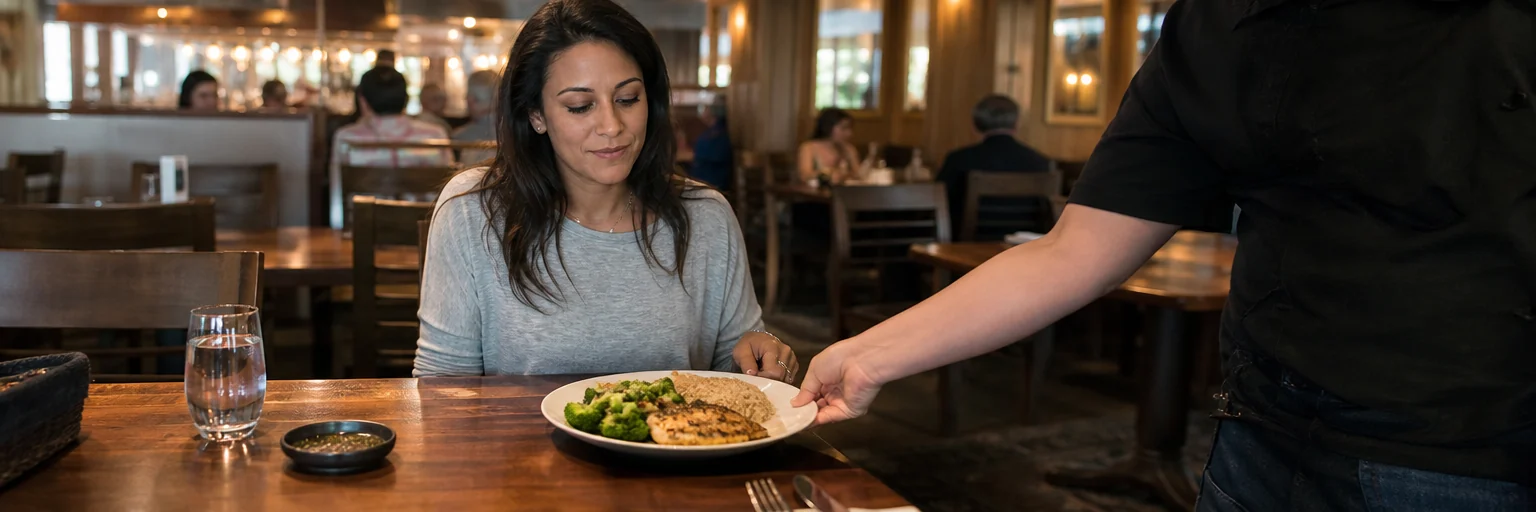
Eating Out for Weight Loss: Restaurant, Fast Food, and Travel Tips That Actually Work
Quick answer
Restaurant meals average over 1,200 calories and you cannot reliably count what someone else cooked — so the win is structural, not arithmetic. Three rules cover about 80 percent of it: pick the protein first, ask for sauces and dressings on the side, and skip liquid calories. Add a 200-calorie protein snack an hour before you go and pre-decide what to do with the starch and dessert, and most people can eat out two to three times a week without stalling progress. This guide gives you the universal playbook, a fast-food cheat sheet by chain, ordering rules for nine common cuisines, and a travel and social-event protocol.
Why eating out wrecks calorie deficits
Restaurant portions have been climbing for decades. Roberts and colleagues measured the calorie content of nearly 4,000 frequently purchased restaurant meals across five countries (BMJ, 2018) and found typical full-service entrées averaged just over 1,300 kcal — about two-thirds of an entire daily target for many people losing weight. Young and Nestle’s earlier portion-size analysis (American Journal of Public Health, 2002) showed US restaurant servings run two to eight times the federal reference standard. Cohort reviews of eating-out frequency (Nutrition Reviews, 2012; Obesity Reviews, 2012) consistently link more meals away from home with higher energy intake.
Cooking fats, sugars, and salt are invisible in the finished plate, and “healthy” menu items — large salads, grain bowls, wraps — routinely clear 800 to 1,000 calories once dressing, cheese, croutons, and tortillas are added. Restaurant portions are 2 to 4 times what the portion control playbook treats as a normal serving. You cannot reasonably out-count this. You out-order it.
The universal 5-rule ordering playbook
These five rules apply at almost any restaurant in any cuisine. Memorize them and you no longer need to “be good” each time — you just run the protocol.
Protein first, then everything else
Anchor the meal in 30 to 40 grams of protein: grilled chicken, fish, steak, shrimp, tofu, eggs, or beans. Protein is the most filling macronutrient and the biggest lever against the late-night second wave of hunger that follows under-protein meals. Order the protein first, then build the rest of the plate around it. For target grams by body weight, see protein intake for weight loss.
Sauces, dressings, cheese on the side
The single highest-leverage swap. A 2 oz ladle of ranch is ~290 calories; a server’s olive oil drizzle is 200 to 300; aioli on a sandwich is 150 to 250. Ask for sauces, dressings, cheese, and sour cream on the side and dip the fork, not the food. Typical reduction is 200 to 400 calories per meal without losing the flavor that made you order it.
Skip liquid calories
Soda, sweet tea, lemonade, juice, frozen cocktails, and specialty coffee drinks reliably add 200 to 600 calories per visit — none of which you would have eaten as food. Default to water, sparkling water with lime, unsweetened iced tea, or black coffee. For the full numbers, see alcohol and weight loss and sugar and weight loss.
Halve or share the starch and dessert
Restaurant pasta, rice, fries, bread, and desserts are sized for sharing — even when nobody said so. Pre-decide one of three plays: share the starch with a tablemate, box half before eating, or swap it for a second vegetable. Same with dessert: split one, take two bites, or skip. The decision is easier before the food arrives than after.
Eat a 200-kcal protein snack 60 minutes before
A Greek yogurt, hard-boiled egg, string cheese plus an apple, or a small protein shake about an hour before your reservation kills the “I’ll just order anything” reflex that drives most overordering. See high-protein snacks for portable options.
Slow the meal itself
Restaurant overeating is mostly a pace problem. Portions are bigger and the meal is longer, but the bites usually keep coming until the plate is empty rather than until the body is full. See mindful eating for weight loss for the 20-minute meal floor, the halfway fullness check-in, and the “first five bites” attention trick that work in any restaurant without changing the order.
Fast food ordering — the under-600-kcal picks by chain
The fast-food meals below are widely-reported approximations using current menu nutrition pages; rounded conservatively. Confirm grams on the chain’s website if you are within 50 calories of your daily target.
| Chain | Order | Approx kcal | Approx protein | Notes |
|---|---|---|---|---|
| McDonald’s | Grilled Chicken Sandwich (no mayo) + side salad + water | ~430 | 38 g | Hold mayo; use mustard or balsamic on the side. |
| Chick-fil-A | Grilled Nuggets (12 ct) + Kale Crunch Side + water | ~470 | 45 g | Skip the breaded nuggets; ask for half the kale dressing. |
| Chipotle | Salad bowl: double chicken, half brown rice, black beans, salsa, fajita veg, no cheese, no sour cream | ~620 | 60 g | Skip queso and chips; vinaigrette adds ~220 kcal, use half. |
| Subway | Rotisserie chicken 6” on wheat, all veggies, mustard, no cheese, no mayo | ~370 | 30 g | Get it as a salad to drop another 150 kcal. |
| Panera | Modern Greek Salad with Chicken, half size + water | ~410 | 30 g | Dressing on the side; skip the baguette. |
| Starbucks | Egg White & Roasted Red Pepper Bites + Americano | ~170 | 13 g | Add Greek yogurt cup for ~270 kcal total. |
| Taco Bell | Power Menu Bowl (chicken, no rice) | ~390 | 26 g | Add salsa and lettuce; skip nacho cheese and chips. |
| Wendy’s | Grilled Chicken Sandwich + small chili + water | ~530 | 47 g | Chili is high protein, low fat; the order’s anchor. |
| In-N-Out | Protein-Style Cheeseburger (bun replaced with lettuce) | ~330 | 22 g | Add a second patty for ~440 kcal and 35 g protein. |
| Domino’s | 2 slices thin-crust cheese + side salad with vinaigrette | ~480 | 22 g | Cap at 2 slices; the box does not care if you close it. |
| Five Guys | Little hamburger (no fries) + water | ~480 | 24 g | Smallest meaningful order; skip the cup of fries. |
| Shake Shack | SmokeShack single + side salad (no dressing/cheese) | ~520 | 26 g | Single patty only; bourbon-BBQ swap saves ~80 kcal vs. cheese. |
The pattern repeats: grilled or roasted protein, mayo and cheese held, sauces or dressings on the side, water in the glass, and one starch instead of two. None of this requires a special menu or a “diet” version of the meal.
Sit-down restaurants by cuisine
American (burgers, grill, bar food)
Best: grilled chicken or fish entrée with a double vegetable side; lean steak (sirloin, flank, filet) with salad and a small baked potato. Worst: loaded burger with fries; chicken Caesar (often 1,200 kcal). Tip: swap fries for salad or steamed vegetable — most kitchens do it without charging.
Italian
Best: grilled chicken or fish over vegetables, side of red sauce; small pasta with marinara plus a salad. Worst: chicken parmesan (1,400+ kcal); fettuccine Alfredo or carbonara (1,200+ kcal). Tip: order pasta as an appetizer size and ask the bread basket to skip the table.
Mexican
Best: fajitas with chicken, shrimp, or steak (skip rice, halve tortillas); grilled fish tacos with salsa, no sour cream. Worst: smothered burritos; chimichangas. Tip: salsa and pico de gallo are free flavor — use them instead of cheese, sour cream, and queso, which routinely add 400+ kcal.
Chinese / Asian
Best: steamed protein with vegetables, brown rice on the side; Vietnamese pho or banh mi with grilled protein. Worst: General Tso’s, sweet and sour, orange chicken (deep-fried then sauced); fried rice as the main. Tip: sauce on the side, steamed instead of fried, half the rice.
Indian
Best: tandoori chicken, shrimp, or paneer with raita and a small portion of rice; chana or dal with one piece of naan and salad. Worst: butter chicken, korma, tikka masala (700+ kcal each); biryani plus naan plus appetizers. Tip: less ghee, share the naan, pick one cream-based dish or one rice dish, not both.
Japanese / sushi
Best: sashimi or nigiri (8 to 10 pieces) with edamame and miso; chicken or salmon teriyaki bowl, half the rice. Worst: large specialty rolls with tempura and cream cheese; ramen with pork belly. Tip: soy sauce is fine; spicy mayo, eel sauce, and tempura coatings are the calorie traps.
Mediterranean
Best: grilled chicken, lamb, or fish kebab plate with salad, tabbouleh, and a small portion of rice or one piece of pita; Greek salad with grilled chicken, dressing on the side. Worst: gyro with fries; oversized hummus and pita board as a meal. Tip: double the salad, halve the rice, use olive oil sparingly.
Steakhouse
Best: 6 to 8 oz filet, sirloin, or flank with a vegetable side and small salad; grilled fish or chicken with vegetables and half a baked potato. Worst: ribeye plus creamed spinach plus loaded potato; fried appetizers. Tip: one side, not three; sauces and butter on the side; skip the bread basket.
Breakfast / diner
Best: veggie omelet with fruit instead of hash browns or toast; Greek yogurt parfait plus two scrambled eggs. Worst: pancakes or French toast with bacon and sausage; loaded breakfast burritos. Tip: swap hash browns and toast for fruit or tomato slices — most diners will do it.
Drinks: the silent calorie sink
The drink decision often matters more than the food decision. A 20 oz soda is 250 kcal. Sweet tea runs 200 to 300. Frozen margaritas, daiquiris, and piña coladas land between 350 and 600. Specialty coffee drinks — frappuccinos, mochas, salted-caramel anything — regularly clear 400 to 600 kcal. Smoothies marketed as healthy at major chains often top 500 kcal, sometimes 800. None of these compete with food for satiety. Default to water, sparkling water with lime, unsweetened iced tea, or black coffee. For how much alcohol stalls weight loss at a per-drink and per-week level, and the rest of the liquid-calorie picture, see also coffee and caffeine for weight loss.
Travel: airports, hotels, road trips
For the full multi-day playbook — trip-length primers, jet-lag physiology, the post-vacation scale swing, and GLP-1 and post-bariatric travel notes — see our travel and weight loss guide. The rules below cover the meal decisions inside those trips.
Airports
Pre-pack a protein bar, jerky, almonds, and fruit before you leave. Inside the terminal, the best picks are a grilled chicken wrap (mayo and dressing on the side), a Greek yogurt parfait, an egg-and-cheese wrap, a salad with grilled chicken, or a sushi tray. Skip the trail-mix and candy stations sold by weight — they reliably price out at 800 to 1,500 kcal per scoop.
Hotel breakfasts
Hotel buffets favor pancakes, waffles, sausage, and pastries because they hold heat cheaply. Build your plate around eggs, Greek yogurt, fruit, and a single piece of toast or one waffle — not all of them. Coffee with milk or unsweetened tea instead of juice. Pancakes are fine occasionally, but as a replacement for one of your day’s meals, not in addition to lunch and dinner.
Road trips
Gas-station picks: beef jerky, string cheese, hard-boiled eggs, low-fat Greek yogurt, a banana or apple, unsweetened iced tea or sparkling water, a small bag of almonds. Avoid the candy-and-chips loop and the giant fountain drink. Pre-pack a small cooler with sandwiches or wraps for the longest stretch of the drive.
Conferences and catered events
Two rules. Eat a real meal before catered events — never arrive hungry to a buffet you do not control. Pick the protein and a single vegetable, skip the bread basket, and treat the dessert table as a one-piece decision. Soda, sweet tea, and pastries are where the day quietly adds 800 kcal.
For office cafeteria, snack pantry, and catered team lunch patterns specifically — the ones that stack Monday to Friday and account for most of the 2–5 lb / 3-month drift new return-to-office workers see — the weight loss and return to office pillar covers the 5-tier cafeteria decision matrix (salad bar with grilled protein at ~500 kcal vs the everything-plus-dessert plate at 1,200–1,800 kcal), the 4 snack-pantry rules that break the hand-in-jar pattern, and the single-plate rule for catered team lunches.
Social events, weddings, and holidays
Big social occasions need a different plan than a Tuesday night out. The framework: eat at maintenance, not a deficit, on the day, protect your daily activity floor, pick one indulgent plate instead of all-day grazing, and return to baseline within 48 hours. The menu-tactics side above handles the ordering; the interpersonal side — how to handle the host, the “one more” pressure at the family table, the office pizza spread, and the group-meal +30–50 percent intake bump documented in Herman 2003 — sits in social eating and weight loss, which pairs directly with this piece for anyone whose calendar is mostly meals with other people. When the specific friction at a client dinner or a group meal is not the food itself but the felt cost of declining — the “I’m the only one not ordering appetizers” or “the host insisted” pattern — the 15-script library, the 5-second silence rule, and the pre-event coping-planning protocol in weight loss and people-pleasing are the dedicated tools.
Most regret from a wedding or holiday meal is not the meal itself — it is what happens to the surrounding two days. A single 3,000-calorie celebration adds about 0.4 lb of fat at the upper end; three days of grazing on leftovers, snack-tray picking, and afternoon drinking adds 2 to 4 lb of real-feeling weight (mostly water and gut content, some actual fat). To slot these days in deliberately, see cheat meals and refeed days; for the specific six-week Thanksgiving-to-New-Year’s stretch, the holiday weight-loss playbook covers the alcohol audit, meal-anchor template, and recovery-week cadence.
The morning-after recovery (no-shame protocol)
One high-calorie meal does not undo a week of effort, and the most damaging response is overcorrection. Do not skip breakfast, do not “punish-restrict” with a 1,000-calorie day, do not add a brutal extra workout, and do not weigh yourself expecting the number to make sense — sodium and food volume can push the scale 2 to 4 lb up overnight without a single gram of fat gained.
The protocol: a glass of water with breakfast, normal eating at your normal calorie target, 20 to 30 extra walking minutes, and no alcohol for 24 to 48 hours. The scale normalizes within 3 to 5 days. Treat the meal as a single data point, not a verdict on the plan.
Common mistakes
- “I’ll just be healthy” — no plan. Walking into a restaurant without a pre-decided order leads to whatever the server suggests, which is usually whatever the kitchen wants to sell. Pre-decide on the way over.
- Skipping meals to “save” calories. Arriving very hungry adds bread, appetizers, a second drink, and a faster eating speed. A 200-calorie protein snack 60 minutes before usually saves 300 to 500 on the meal.
- Drinking on an empty stomach. Alcohol-on-empty disinhibits ordering by the time the menu lands. Eat the snack, then have the drink.
- Picking “salad” without checking. Large restaurant salads routinely clear 900 to 1,200 calories once dressing, cheese, croutons, candied nuts, and crispy chicken are added. Ask for dressing on the side, swap crispy for grilled, and skip one of the toppings.
- Never asking the server. Every modification in this guide — dressing on the side, swap fries for salad, half portion of pasta, no cheese, grilled instead of fried — is a normal kitchen request. Servers do not judge it. Ask.
The same plate-mine-first, portion-on-your-plate discipline runs at your own dinner table when you are the primary cook feeding a household that is not dieting — see weight loss when cooking for the family for the one-meal-two-plates protocol.
Frequently asked questions
Can you lose weight while eating fast food? Yes, if you order structurally and budget the meal into your day. Most major chains have at least one under-600-calorie meal built around grilled protein, vegetables, and water. The combinations that stall progress are fried protein, full-sugar drinks, fries, and default-order sauces. The habit list: pick grilled or roasted, hold mayo and cheese, swap fries for a side salad or fruit, skip soda or sweet tea. You do not need a perfect order; you need a repeatable one.
How do you order at a restaurant for weight loss? Anchor the meal in 30 to 40 grams of protein, ask for sauces and dressings on the side, and skip liquid calories. Those three rules cover most of the math without counting. Add two more: halve or share the starch and dessert, and eat a 200-calorie protein snack an hour before so you do not arrive hungry. Restaurant portions average 2 to 4 times the CDC reference size — the win is structural, not arithmetic.
What’s the healthiest fast food chain for weight loss? There is no single best chain — there is a best order at most chains. Chick-fil-A, Subway, Panera, Chipotle, Starbucks, and Wendy’s all have under-500-calorie meals with 25+ grams of protein if you ask. The biggest predictor of how a meal lands is not the brand but whether you swap mayo, dressing, cheese, and sugary drinks for grilled protein, vegetables, mustard, and water. Ask “what is my repeatable order at this chain” instead.
How do you stay on a diet while traveling? Plan the protein and the breakfast, then let the rest flex. Pack jerky, protein bars, and nuts so airport and gas-station detours do not force you into the candy aisle. At hotels, build breakfast around eggs and Greek yogurt and skip the pancakes-and-waffles autopilot. Aim for maintenance calories on travel days rather than a deficit; protecting muscle, sleep, and energy keeps the rest of the week intact.
Should I skip meals before going out to eat? No. Skipping meals almost always backfires — arriving very hungry pushes the order toward fried appetizers, bread, fast eating, and a second drink. A 200-calorie protein snack (Greek yogurt, hard-boiled egg, string cheese, small protein shake) about 60 minutes before keeps blood sugar steady and usually saves 300 to 500 calories on the meal itself.
How many times a week can I eat out and still lose weight? The honest pattern: 2 to 3 structured restaurant meals a week fit comfortably into most deficits, 4 to 5 start to crowd out adherence, and 6+ nearly always stalls weight loss. The variable is not the count, it is the ordering pattern. Two structured restaurant meals usually beat five home-cooked meals plus a Friday night that quietly adds 1,500 calories. When most of those restaurant meals fall Friday through Sunday, the ordering pattern above matters even more — the full Friday-through-Sunday framing is in weekend weight loss.
What should I drink at a restaurant during weight loss? Water, sparkling water with lime, unsweetened iced tea, or black coffee cover almost every situation at near-zero calories. If you want one alcoholic drink, dry wine (~120 to 130 kcal per 5 oz), a vodka soda (~100), light beer (~100), or a hard seltzer fit easily. Skip soda, sweet tea, juice, frozen cocktails, and dessert coffees — these regularly add 200 to 500 calories you would not eat as food.
Sources
- Roberts SB, Das SK, Suen VMM, et al. Measurement of energy content of frequently purchased restaurant meals: multi-country cross sectional study. BMJ (2018).
- Young LR, Nestle M. The contribution of expanding portion sizes to the US obesity epidemic. American Journal of Public Health (2002).
- Bezerra IN, Curioni C, Sichieri R. Association between eating out of home and body weight. Nutrition Reviews (2012).
- Lachat C, Nago E, Verstraeten R, et al. Eating out of home and its association with dietary intake: a systematic review of the evidence. Obesity Reviews (2012).
- Nguyen BT, Powell LM. The impact of restaurant consumption among US adults: effects on energy and nutrient intakes. Public Health Nutrition (2014).