
2026-05-31 · alcohol, calories, belly fat, nutrition, weight loss, calorie deficit
Updated 2026-07-31
Written by Maya Patel
Maya Patel is a WeightFAQ staff writer covering sustainable weight loss through mindful eating, flexible routines, and evidence-based nutrition. She translates research on protein, fiber, portion control, and calorie awareness into practical meal-planning guidance readers can actually follow at home. Her articles favor honest expectations over fad promises — small changes that compound, calorie bands scaled to real households, and grocery lists built around whole foods with room for real life. Maya writes for people juggling family meals, busy weeks, and long-term goals, not gym-optimized single adults with unlimited prep time.
17 min read
Medically reviewed on Jul 31, 2026
Alcohol and Weight Loss: Calories, Belly Fat, and How Much Slows Progress
Quick stats
- Calories in alcohol: 7 kcal per gram (almost as dense as fat)
- Standard drink: 14 g alcohol = 98 kcal from alcohol alone (real drinks 100-500 kcal)
- Fat-burning pause: 3 to 12 hours after a drink, while the liver clears the alcohol first
- Next-day calorie bump: +20-30% (well documented across controlled feeding studies)
- “Won’t stall most people” ceiling: 1 to 2 drinks per week
- “Will stall most people” floor: 3+ drinks on most days
Per-drink calorie and deficit cost
The deficit-cost column translates each drink into the share of one week’s progress at a 500 kcal/day target (drink kcal ÷ 3,500).
| Drink | Typical serving | Calories | Deficit cost (% of one week’s 500 kcal/day target) |
|---|---|---|---|
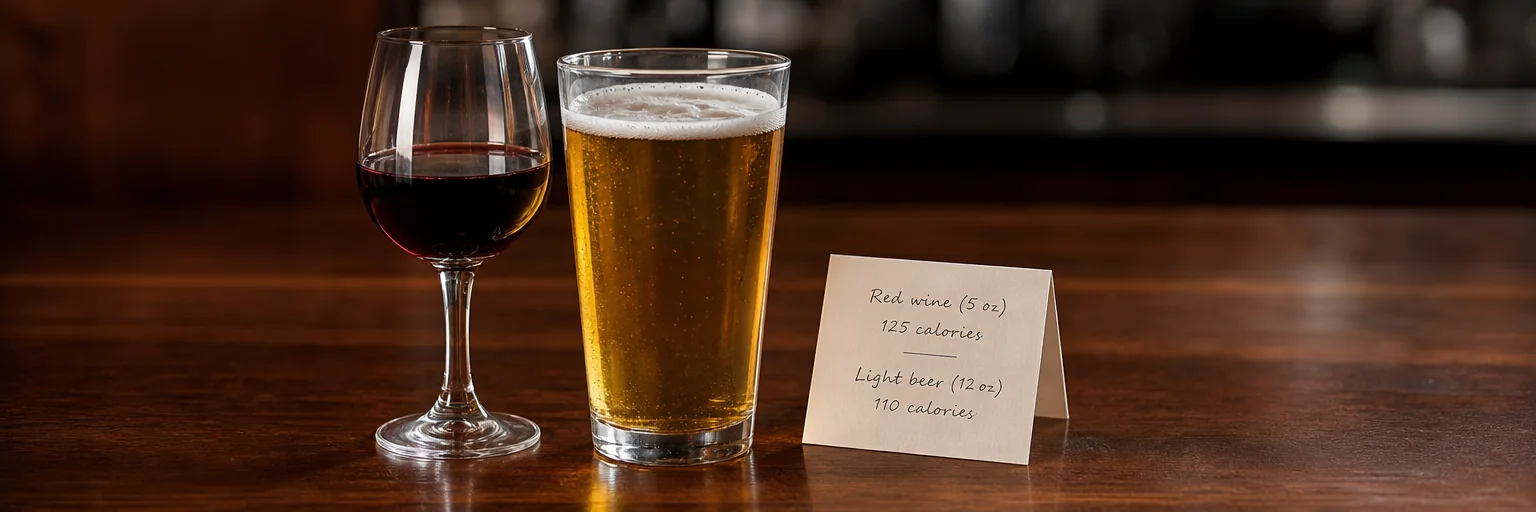
| Light beer | 12 oz | 100 | 2.9% |
| Regular beer | 12 oz | 150 | 4.3% |
| Craft IPA | 12 oz | 220 | 6.3% |
| Red or white wine | 5 oz | 125 | 3.6% |
| Vodka soda | 1.5 oz vodka + soda | 100 | 2.9% |
| Whiskey neat | 1.5 oz | 100 | 2.9% |
| Margarita (standard) | 8 oz | 300 | 8.6% |
| Margarita (frozen) | 12 oz | 450 | 12.9% |
| Piña colada | 8 oz | 450 | 12.9% |
| Long Island iced tea | 12 oz | 400 | 11.4% |
| Espresso martini | 4 oz | 250 | 7.1% |
| Hard seltzer | 12 oz | 100 | 2.9% |
Quick answer
Alcohol slows weight loss in three ways: 7 calories per gram with no satiety, a 3 to 12 hour pause in fat oxidation after a few drinks, and disinhibited eating that typically adds 200 to 500 extra calories of food per drinking evening. About 1 to 2 drinks a couple of times a week fits inside most deficit plans. Three or more drinks on most days will stall most people, mostly through the extra calories rather than anything mysterious about ethanol.
Key takeaways
- Alcohol is 7 calories per gram — almost as dense as fat (9), nearly twice as dense as carbs or protein (4). A standard drink supplies about 98 calories from the alcohol alone, before mixers.
- Fat oxidation drops sharply for 3 to 12 hours after drinking. It does not stop weight loss but shifts the day’s calorie partitioning.
- The biggest hit is the next-meal calorie spike: drinking evenings reliably add a few hundred extra calories of food on top of the drinks.
- The “beer belly” is not a beer-specific phenomenon — it is total weekly surplus plus where your genetics store fat.
- You can lose weight while drinking, but you have to budget the calories in advance — about 100 to 130 per standard drink, treated like any other food in your daily total.
How alcohol affects weight loss (3 mechanisms)
Alcohol slows fat loss through three overlapping mechanisms.
1. Empty calories at 7 kcal per gram. Pure ethanol is 7.1 calories per gram — almost as dense as fat (9), nearly double carbs or protein (4). A 14 g US standard drink supplies about 98 calories before mixers, with no protein, no fibre, and almost no satiety; the body does not turn off hunger to compensate.
2. A pause in fat oxidation. Your liver prioritises clearing alcohol because acetaldehyde is toxic. The classic Suter et al. study (New England Journal of Medicine, 1992) showed whole-body fat oxidation drops by roughly 30 percent for hours after a moderate dose, and stays suppressed for 3 to 12 hours. You do not “stop losing weight” during this window, but the day’s partitioning shifts toward storing fat and burning alcohol.
3. Disinhibited eating. This is the largest real-world mechanism by far. Yeomans (Physiology & Behavior, 2010) reviewed evidence that even moderate doses of alcohol increase subsequent food intake by roughly 10 to 30 percent. A drinking evening typically adds 200 to 500 extra food calories on top of the drinks, often from high-fat, salty, late-night options.
Stacked together, four drinks plus a late pizza can put a 1,200 calorie surplus on top of an otherwise clean week. The drinks alone are not the problem; the drinks plus the food are.
Calories in common drinks
Calorie counts below assume typical real-world pours, not the FDA’s nominal “standard drink.” For the official US standard-drink reference (14 g of pure alcohol), the NIAAA chart is authoritative.
| Drink | Typical serving | Calories | Carbs (g) | Drinks to add 500 kcal |
|---|---|---|---|---|
| Light beer | 12 oz | 95–110 | 6 | ~5 |
| Regular beer | 12 oz | 140–160 | 13 | ~3.5 |
| Craft IPA (6.5% ABV) | 12 oz | 200–250 | 18 | ~2 |
| Red wine (dry) | 5 oz | 120–130 | 4 | ~4 |
| White wine (dry) | 5 oz | 115–125 | 4 | ~4 |
| Prosecco / Champagne | 5 oz | 100–120 | 3 | ~4.5 |
| Vodka soda (with lime) | 1.5 oz vodka + 6 oz soda | 95–110 | 0 | ~5 |
| Gin & tonic (full-sugar) | 1.5 oz gin + 6 oz tonic | 180–200 | 22 | ~2.5 |
| Margarita (on the rocks) | 8 oz | 250–350 | 25–35 | ~1.5 |
| Piña colada | 8 oz | 400–500 | 50–60 | ~1.1 |
| Whiskey neat | 1.5 oz | 95–110 | 0 | ~5 |
| Hard seltzer | 12 oz | 95–110 | 2 | ~5 |
Patterns worth noticing: clear spirits (vodka, gin, tequila, whiskey) all sit around 95 to 110 calories per 1.5 oz pour — the mixer drives the rest. The same 1.5 oz of vodka becomes 95 calories in soda water and 250 in orange juice. Craft beers run 50 to 100 percent higher than regular beers because of higher ABV. Creamy or blended cocktails can cross 500 calories per drink — close to a full meal. Liquid calories from sweetened mixers and beer add up the same way refined sugar does — see sugar and weight loss for the broader added-sugar picture. Our walkthrough on how to count calories covers the database-entry tricks for spirits and mixed drinks.
Is beer worse than wine for belly fat?
Not by calorie. Calorie for calorie, beer, wine, and spirits affect body fat the same way — through total weekly intake. The “beer belly” stereotype comes from patterns that pair with beer more than wine or spirits: larger serving sizes (a 16 oz pint vs a 5 oz wine pour), higher alcohol per pour (a craft IPA at 7% ABV contains the alcohol of two glasses of wine), and the food culture around it (pizza, wings, chips). The simplest rule is to pick the drink you enjoy slowly and budget it by calorie — a 250-calorie pint of craft beer and a 250-calorie 8 oz pour of wine cost the same.
The next-day calorie spike
The biggest weight-loss effect of a drinking evening is usually not the drinks — it is the eating that follows. A typical pattern: 4 drinks at 150 calories each (600), late-night food like a pizza slice and chips (400 to 800), and a higher-calorie breakfast or brunch the next day (300 to 600 above normal). Stacked together, a single drinking evening reliably puts a 1,000 to 2,000 calorie surplus on top of an otherwise clean week — enough to erase most of a 500 kcal/day weekday deficit.
The food pattern is not weakness. Expecting yourself to eat normally after four drinks is not realistic; pre-deciding the next meal is. The framing in our guide to cheat meals and refeed days — how to treat alcohol on a calorie deficit as a planned cost rather than an accident — is the most useful next read. For multi-day drinking scenarios like vacations and cruises where the disinhibited-eating amplifier stacks night after night, the travel and weight loss playbook covers the pre-decided per-night ceiling that keeps the surplus from compounding.
How to budget alcohol on a calorie deficit
The weekly budget depends on how deep your deficit is. Three honest tiers:
Strict deficit (lose 1 lb/week, no slowdown)
- Budget: 0 to 200 kcal alcohol per week (max 2 light beers or 1.5 glasses of wine)
- Logic: you cannot afford the per-day deficit cost above 200 kcal/week without giving back visible progress
Moderate deficit (lose 0.5 lb/week)
- Budget: 200 to 500 kcal alcohol per week (3-4 standard drinks, spread across 2 nights)
- Logic: at a 250 kcal/day deficit you have ~1,750 weekly kcal of headroom; spending 500 on alcohol still leaves room for one moderate restaurant meal
Maintenance or recomp
- Budget: 500 to 1,000 kcal alcohol per week (5-10 standard drinks)
- Logic: weight stable, no deficit cost; the real risks are sleep quality, next-day overeating, and the fat-burning pause described above — not the scale
A few practical rules that hold across all three tiers:
- Pre-decide the number of drinks. Two drinks decided in advance is meaningfully different from “however many I feel like” in both calories and next-meal eating. Pre-decision is the single strongest lever across group-drinking settings — a bar meetup, a wedding, a brunch, a work happy hour all follow the same social-facilitation pattern Herman 2003 documented for food; social eating and weight loss walks through the if-then scripts and one-alcoholic-one-water pairing that make the drink cap actually hold once the group is around you. For the specific workplace happy-hour pattern — the 1–3 events/week that stack in the first 2 months of a return-to-office transition and account for a chunk of the 2–5 lb / 3-month drift — the weight loss and return to office pillar has a per-week ceiling and a 4-script library (“soda water with lime,” “one drink then water,” “I’m doing a health thing this month,” “grab me next time”) that hold up in a real office.
- Swap mixers. A vodka soda is 100 calories; a vodka cranberry is 200; a vodka Red Bull is 230. The spirit is identical — the mixer is the entire difference. Soda water, lime, and diet mixers are essentially zero-calorie.
- Eat protein first, then drink. A meal with 30 to 40 g of protein and fibre before the first drink slows alcohol absorption and shrinks the late-night calorie spike.
- Count the drinks in your daily total. If your target is 1,500 kcal and you plan two drinks at 130 each, your food budget for the day is 1,240. Our 1,500 calorie meal plan walks through how to budget alcohol into your calories without blowing the day.
- Cap pours. A “glass of wine” at home is often 7 to 9 oz, not the nominal 5 — a 50 to 80 calorie difference per glass. A small wine glass and a jigger close that gap for free.
The fat-burning pause: what actually happens
The “alcohol stops fat burning” claim has a kernel of truth but is usually overstated. Ethanol gets first priority in the liver because acetaldehyde is toxic, so whole-body fat oxidation drops by roughly 30 percent for 3 to 12 hours after a few drinks (Suter et al., 1992).
What this does not mean: weight loss is not “paused” — body weight tracks weekly calorie balance, not hourly oxidation. The fat you did not burn is not converted to body fat by any special mechanism; it is energy you did not use, behaving like any other surplus. The “one beer and you stop burning fat for 36 hours” framing is exaggerated.
What it does mean: on drinking days, energy partitioning briefly disadvantages fat oxidation, so calories eaten above maintenance are slightly more likely to be stored than on a sober day. The effect is small compared with the extra food calories that come with the evening — track those, and the metabolic pause becomes second-order.
Belly fat specifically
Alcohol’s link to abdominal and visceral fat is well-documented but indirect. Schröder et al. (European Journal of Clinical Nutrition, 2007) analysed Spanish cohort data and found that more than 30 g per day (roughly 2+ drinks) was associated with greater abdominal obesity even after adjusting for total calorie intake. Similar associations appear in NHANES analyses of US adults.
Proposed mechanisms: cortisol elevation after heavy nights, a steady weekly calorie surplus stored where genetics direct it, and disrupted sleep that independently associates with abdominal fat. There is no evidence that alcohol selectively deposits fat in the abdomen by a unique mechanism — heavy drinkers gain abdominal fat through the same surplus they would from any other source, mildly amplified. See how to lose belly fat for the full set of levers.
What happens to weight when you stop drinking
If you are doing a dry month, the typical pattern is:
- Week 1: 2 to 4 lb drop, mostly water — alcohol is mildly diuretic and glycogen-bound water shifts as carbs stabilise. Real on the scale, not fat loss.
- Weeks 2 to 4: the absence of 800 to 2,000 weekly drink calories deepens the deficit, and 0.5 to 1 lb of weekly fat loss often follows.
- Weeks 4 to 8: sleep improves, late-night eating falls without effort, and energy and mood usually trend up.
If you are going for longer than a dry month — a full cessation rather than an experiment — the arc is different. Roughly 40 to 60 percent of people gain 5 to 15 lb in the first 6 to 12 months of sobriety even though they removed 500 to 1,500 kcal/day of ethanol calories, driven by sugar-craving substitution, reward-system remapping, sleep-appetite rebound, and social-ritual reorganization. That paradox and the 90-day “protect sobriety, not deficit” protocol are covered in weight loss when you quit drinking — read that before running a deficit inside the first three months of cessation.
If your dry-month loss is much larger than 0.5 to 1 lb per week after week 1, the food changes — not the alcohol itself — are doing most of the work. Blood pressure also tracks down quickly — moderating alcohol cuts ~3 to 4 mmHg systolic within 1 to 2 weeks, which is why it sits in the top 5 non-drug levers covered in our high blood pressure and weight loss guide. The single highest-yield use case is paroxysmal atrial fibrillation — the Voskoboinik 2020 NEJM abstinence trial cut AFib recurrence from 73% to 53% at 6 months in regular drinkers, which is why alcohol moderation sits at the top of the atrial fibrillation and weight loss protocol. Skin disease is a smaller but real lever — heavy alcohol use independently worsens plaque severity and amplifies methotrexate hepatotoxicity, so adults pursuing meaningful weight loss with active psoriasis usually see the cleanest skin response when alcohol is cut for the first 8 to 12 weeks; see psoriasis and weight loss for the dose-response.
Frequently asked questions
Does alcohol stop weight loss completely? No. A single drink does not stop weight loss, and people lose weight while drinking moderately all the time. Alcohol layers three small headwinds on a deficit: empty calories at 7 kcal per gram, a 3 to 12 hour pause in fat oxidation while the body clears the alcohol, and a documented next-meal calorie bump. Most people can fit 1 to 2 drinks a couple of times a week into a deficit; three or more drinks on most days will stall most people, mostly through the extra calories.
How many calories are in a standard drink? A US standard drink is 14 grams of pure alcohol, or about 98 calories from the alcohol itself. Real-world drinks are higher because of mixers and serving size: a 12 oz light beer is roughly 100 calories, a regular beer 150, a craft IPA 200 to 250, a 5 oz glass of wine 120 to 130, a vodka soda 100, a margarita 250 to 350, and a piña colada 400 to 500. Pours at home tend to run 25 to 50 percent larger than the nominal standard.
Why does alcohol cause belly fat? Alcohol does not deposit fat in the abdomen by any unique mechanism — fat is stored where your genetics direct it. The link is indirect: alcohol adds calories without satiety, pauses fat oxidation for hours, drives late-night high-fat eating, and raises cortisol after heavy nights. Repeated weekly, that pattern produces a calorie surplus that shows up as visceral fat in people genetically prone to abdominal storage.
Can you drink alcohol and still lose weight? Yes, if the drinks fit inside your weekly calorie budget. Most adults can lose weight at 1 to 4 drinks per week without much disruption, especially with lower-calorie options (light beer, dry wine, vodka soda, hard seltzer) and a plan for the food. The combination that stalls people is not the alcohol itself — it is the extra 300 to 500 calories of pizza, fries, or chips that often follow it.
What is the best alcohol for weight loss? The lowest-calorie practical choices are clear spirits (vodka, gin, tequila, whiskey) with soda water, lime, or diet mixers at 95 to 110 calories per drink, hard seltzers at about 100, light beers at 95 to 110, and dry wines at 120 to 130 per 5 oz pour. Avoid creamy cocktails, sugary mixers, and large craft beers, which run 200 to 600 calories per drink. The “best” option is whichever low-calorie pour you actually enjoy drinking slowly.
How long after drinking does fat burning resume? Whole-body fat oxidation drops within 30 to 60 minutes of drinking and stays suppressed for roughly 3 to 12 hours after a few drinks, depending on dose, body size, and food intake. A single drink with a meal usually pauses fat burning for an hour or two; a 4 to 6 drink evening can keep it suppressed into the next morning. The pause matters less than total weekly intake — weight loss still tracks calorie balance.
Does beer cause more belly fat than wine? Not directly. Calorie for calorie, beer, wine, and spirits affect body fat the same way. The “beer belly” association comes from drinking volume (more beer per session than wine), pairings (pizza, wings, chips), and timing (often layered on top of a full day’s calories). A daily 12 oz craft beer at 230 calories adds 1,600 calories a week — enough to stall most people regardless of what is in the glass.
How many drinks per week is too many for weight loss? Three or more drinks on most days will stall weight loss for most people, primarily through the extra calories (a 3-drink night adds 300 to 750 kcal, more than half a daily deficit). One to two drinks per week is the ceiling most adults can fit into a 500 kcal/day deficit without giving back progress. The number that matters is your weekly total — a Friday-night 4-drink session followed by 6 dry days at 800 net calories of alcohol is harder on a deficit than spreading 4 drinks across the week, mostly because of sleep quality and the next-day overeating bump.
Is wine or beer better for weight loss? Per drink, wine and light beer are tied at roughly 100-130 kcal per standard serving — there is no meaningful weight-loss advantage either way at the volume most people drink. What matters is real-world serving size and what you eat alongside. A 5-oz pour of wine becomes an 8-oz pour at home (about 200 kcal). A 12-oz beer becomes a 16-oz craft pint (about 300 kcal). Wine is more often consumed with dinner (calorie additive); beer is more often consumed alone and triggers more next-meal snacking. The honest answer: choose the one you can stop at one of, and measure the pour.
Does alcohol cause belly fat specifically? No — alcohol does not deposit fat in the abdomen directly. Fat storage location is determined by genetics and hormones, not by what you ate or drank. The “beer belly” association is real but the mechanism is indirect: alcohol layers four small effects (empty calories with no satiety, a 3-12 hour pause in fat oxidation, late-night high-fat eating, and elevated next-day cortisol) that compound into a net weekly surplus, which then shows up as visceral fat in people genetically prone to abdominal storage. Cutting alcohol does often produce visible waist-circumference loss within 2-4 weeks for habitual drinkers, but the mechanism is total-calorie reduction, not a targeted fat-loss effect.
Practical next steps
This week: add drinks to your calorie tracker the same way you add food. Pour at home using a 1.5 oz jigger and a 5 oz wine glass for a week — you will quickly discover whether your usual “glass” is 5 oz or 9. The full method is in our guide to how to count calories.
Next 2 to 4 weeks: pre-decide your weekly drink budget, the drink itself, and the food that will go with it. That structure removes the late-night decisions where most surplus calories enter. When you’re eating out, the drinks decision often matters more than the food — see our eating out for weight loss playbook. Because Yeomans’ next-meal multiplier is what drives most of the weekend damage, a Friday-and-Saturday two-drink cap does more for the week than any single food swap — the fuller Friday-through-Sunday version of the same trade is in weekend weight loss.
Long term: if your weight has stalled for 3+ weeks on honest tracking and you are at 4+ drinks a week, dropping to 0 to 2 is one of the highest-leverage single changes. For the rest of the abdominal-fat picture see how to lose belly fat; for how to slot drinking occasions into a deficit deliberately, see cheat meals and refeed days. If you are on a GLP-1 (Wegovy, Zepbound, Ozempic, Mounjaro, Saxenda), the drug interacts with alcohol on pancreatitis risk, hypoglycemia risk in T2D combos, delayed gastric emptying, and dehydration — see GLP-1s and alcohol for the medication-specific interaction and the emerging craving-reduction signal. If you are 18 to 24 and drinking is happening in a college context (dorm parties, bar nights, drunk-food ordering at 1 a.m.), the life-stage-specific playbook is weight loss for college students — the two-nights-a-week cap and drunk-food pre-plan are covered there in the campus context.
Sources
- Suter PM, Schutz Y, Jequier E. The effect of ethanol on fat storage in healthy subjects. New England Journal of Medicine (1992).
- Yeomans MR. Alcohol, appetite and energy balance: is alcohol intake a risk factor for obesity? Physiology & Behavior (2010).
- Schröder H, Morales-Molina JA, Bermejo S, et al. Relationship of abdominal obesity with alcohol consumption at population scale. European Journal of Clinical Nutrition (2007).
- National Institute on Alcohol Abuse and Alcoholism. What Is A Standard Drink? NIH / NIAAA reference (current).