
2026-06-05 · sugar, added sugar, nutrition, weight loss, cravings, carbs
Updated 2026-08-02
Written by Maya Patel
Maya Patel is a WeightFAQ staff writer covering sustainable weight loss through mindful eating, flexible routines, and evidence-based nutrition. She translates research on protein, fiber, portion control, and calorie awareness into practical meal-planning guidance readers can actually follow at home. Her articles favor honest expectations over fad promises — small changes that compound, calorie bands scaled to real households, and grocery lists built around whole foods with room for real life. Maya writes for people juggling family meals, busy weeks, and long-term goals, not gym-optimized single adults with unlimited prep time.
13 min read
Medically reviewed on Aug 2, 2026
Sugar and Weight Loss: Hidden Calories, Cravings, and Honest Limits
Quick answer
Sugar does not directly cause weight gain — excess calories do — but added sugar is one of the easiest ways to overshoot a calorie target. It is calorically dense, satiety-poor, and hidden in foods you do not think of as sweet. The American Heart Association recommends capping added sugar at about 25 g/day (~6 tsp) for women and 36 g/day (~9 tsp) for men. The average US adult consumes 60 to 80 g/day, which is where most of the surplus quietly comes from. Whole-fruit sugar is a different conversation; it is not the problem.
Added sugar vs natural sugar — the only distinction that matters for weight loss
“Sugar” on a label can mean two different things, and they behave very differently in the diet.
Natural sugar is the fructose in a whole apple, the lactose in milk, and the sucrose in a sweet potato. It arrives packaged with fiber, water, protein, or micronutrients that slow digestion and blunt the blood-sugar response. A medium apple has roughly 19 g of sugar — and 4 g of fiber, 86 percent water, and a satiety profile that makes eating four of them in a sitting genuinely hard. People who eat more whole fruit, on average, weigh less and have lower diabetes risk in cohort studies. Whole fruit is not the problem — see our guide on fiber for weight loss for why the fiber-and-water packaging matters as much as the sugar content.
Added sugar is anything a manufacturer or cook puts in: cane sugar, high-fructose corn syrup, honey, maple syrup, agave, brown rice syrup, fruit-juice concentrate. It is concentrated, calorie-dense, and stripped of the fiber and water that normally signal “enough.” A 20 oz soda has 65 g of sugar with no fiber, no protein, and no chewing time. A flavored yogurt has more added sugar than a slice of cake. That is where the calorie pressure builds.
For weight loss, treat whole fruit as food and added sugar as a budget. The low-calorie high-volume foods guide covers fruit’s role in a deficit in more detail, and berries for weight loss walks through why 15 g of sugar in a cup of blueberries is not the same food as 15 g of added sugar from a soda.
How much added sugar per day? (evidence-based limits)
The two major guidelines — the American Heart Association’s 2016 added-sugar advisory and the WHO’s 2015 free-sugar guideline — agree on the direction and roughly on the numbers.
| Body / goal | Upper limit (added sugar) |
|---|---|
| Adult women | ≤25 g/day (~6 tsp) — AHA |
| Adult men | ≤36 g/day (~9 tsp) — AHA |
| WHO (general) | <10% of total calories; <5% ideal |
| Active weight loss | 10–15 g/day from added sources; reserve ~50–100 kcal/day for it |
| Children (2–18) | ≤25 g/day total — AHA |
| Children under 2 | 0 g — AHA / WHO |
For a 1,500-calorie weight-loss day, the WHO 5 percent ideal is about 19 g of added sugar. For 2,000 calories, it is about 25 g. The practical working number for most people losing weight is 10 to 15 g/day — a square of dark chocolate, a small flavored yogurt, or a tablespoon of barbecue sauce, not all three. None of this means zero. A complete ban tends to backfire.
Where added sugar hides (the top 10 sources)
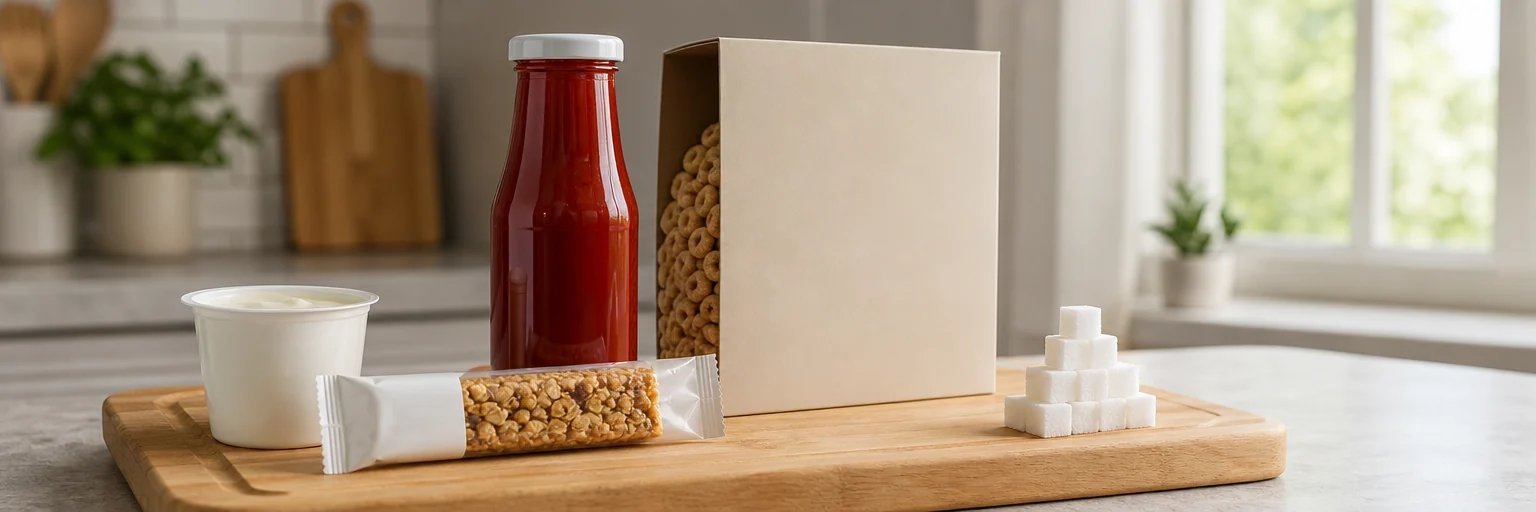
Most added sugar in the average diet is not from desserts; it is from foods marketed as savory, healthy, or “for breakfast.” Typical grams per serving:
- Sweetened beverages — 12 oz soda (39 g), sweet tea (28 g), sports drinks (21 g), bottled flavored coffee drinks (30–45 g). The single largest source for most adults.
- Flavored yogurt — 15–25 g per 5–6 oz cup. Plain Greek yogurt has 4–6 g of natural sugar from lactose.
- Granola and protein bars — 8–18 g per bar. “Energy” bars and granola bars often outpace candy bars on a gram-for-gram basis.
- Pasta sauce — 6–10 g per half-cup. Most jarred marinaras include added sugar even when they do not taste sweet.
- Bread — 2–4 g per slice. Small per slice, large across the week if you eat 4–6 slices a day.
- Ketchup and BBQ sauce — 4–6 g per tablespoon. Sweet BBQ sauces routinely cross 12 g per tablespoon.
- Salad dressings — 3–6 g per tablespoon. Honey mustard, sesame ginger, and French dressings are the worst offenders.
- Breakfast cereals — 10–18 g per serving. Even many “fiber” cereals sit over 10 g.
- Instant oatmeal packets — 10–14 g per packet. Plain rolled oats have 0 g added.
- “Healthy” smoothies — 30–60 g per 16–20 oz cup at most chains, often more than a soda.
The pattern: liquids and condiments are the silent leaders. Whole foods you cook yourself are almost never the source. For a full label-reading walkthrough, see how to read nutrition labels.
How to read a nutrition label for added sugar
Before 2016, US nutrition facts labels showed a single “Sugars” line that lumped natural and added together — a slice of cantaloupe and a candy bar looked metabolically similar. The 2016 FDA rule split that into two lines: Total Sugars and, indented below it, Includes Added Sugars.
The added-sugar line is the one that matters for weight loss budgeting. A few practical rules:
- Read the added-sugar line first, then check the %DV. The FDA’s 5/20 rule of thumb applies: 5% DV or less is “low,” 20% or more is “high.” The %DV for added sugar is anchored to 50 g/day, close to but slightly above the AHA limits.
- Check the serving size. A “single” yogurt cup is often 5.3 oz, but the smoothie next to it might be listed per 8 oz of a 16 oz bottle — two servings. Multiply.
- Skim the ingredient list for sweeteners by alias. Cane juice, evaporated cane juice, corn syrup, high-fructose corn syrup, brown rice syrup, fruit juice concentrate, maltose, dextrose, and “organic cane sugar” are all added sugar.
For the full label-reading method, see how to read nutrition labels for weight loss.
The fructose / liver / belly-fat question
A common claim is that fructose is uniquely fattening — that it bypasses normal satiety, goes straight to the liver, and turns into belly fat in a way glucose does not. The honest read of the evidence is narrower than that.
At matched calories, controlled trials and the Te Morenga and Mann 2013 BMJ meta-analysis show no meaningful difference in body weight between fructose and other carbohydrates. Replace 50 g of sugar with 50 g of starch and weight does not change. Weight only changes when sugar adds calories on top of what you were already eating.
The practical concern is real, but it lives in form, not molecule. Sugar-sweetened beverages — sodas, sweet tea, sweetened coffee drinks, juice — concentrate fructose in liquid form, and liquid calories do not trigger normal fullness signals. Large cohort studies, including Malik and colleagues’ analyses, consistently link sugar-sweetened beverages to weight gain, abdominal fat, and Type 2 diabetes risk, while solid-food fructose intake (mostly from fruit) does not. The mechanism is over-consumption, not metabolic alchemy.
Translation: a glass of orange juice and an orange are not equivalent, even though their sugar grams are similar. The orange has fiber, takes time to eat, and self-limits. The juice does neither.
Sugar cravings — what they are and what to do
Cravings are usually a mix of three things: blood-sugar swings after a refined-carb meal, restriction backlash from cutting “forbidden” foods too aggressively, and a learned habit cue (after dinner, with coffee, on the couch at 9 pm). They are not a sign of willpower failure or sugar “addiction” in any clinical sense. Craving intensity follows a predictable 4-week curve on a new deficit — peak in weeks 1 to 2, roughly 50 percent lower by week 4 — and adherence usually stands or falls on how you handle those first two weeks; sugar cravings and weight loss walks through the full 6-lever craving-management protocol. Four tactics handle most cases.
- Protein at every meal. Anchoring breakfast, lunch, and dinner with 30 to 40 g of protein keeps blood sugar and hunger steadier through the day, which lowers the size of evening cravings. See protein intake for weight loss.
- Build an evening pattern interrupt. Whatever is happening at the moment cravings hit — TV, scrolling, the kitchen — gets paired with sugar over time. Replacing the cue with a walk, a tea, or brushing your teeth breaks the loop.
- Delay-and-distract 15 minutes. Most cravings peak within 10 to 15 minutes and fade. Set a timer, do something else, and re-decide at the end.
- Have a low-cost sweet swap on hand. Two squares of dark 70 percent chocolate (~80 kcal), a small flavored yogurt, or fruit lets the answer be “yes, this,” not “no, white-knuckle it.” The emotional eating guide covers the broader habit work in more depth.
Supplements marketed for carbohydrate cravings — most commonly chromium picolinate and 5-HTP — have small, inconsistent trial data (a single carb-craving subgroup finding in Docherty 2005 for chromium, and no broader replication). Protein at meals and structured sleep produce a larger real-world effect than any craving supplement on the shelf.
Sugar swaps that actually work
Most of the easy weight-loss wins from cutting sugar come from a handful of swaps, not blanket avoidance. Picking three of these and ignoring the rest will outperform any restrictive plan.
| Instead of | Try | Saves |
|---|---|---|
| 12 oz cola (39 g sugar) | 12 oz sparkling water + lime | ~150 kcal |
| Flavored yogurt (22 g sugar) | Plain Greek + berries (~6 g natural sugar) | ~70 kcal |
| Granola bar (16 g sugar) | Apple + 1 Tbsp peanut butter | ~20 kcal, +protein |
| Sweetened latte (18 g) | Cortado or unsweetened oat latte | ~120 kcal |
| Flavored oatmeal packet (12 g) | Plain oats + cinnamon + half-banana | ~30 kcal, +fiber |
| Pasta sauce with added sugar | Sauce labeled “no added sugar” | ~5–8 g/serving |
| Sweet BBQ marinade | Mustard + smoked paprika + vinegar | ~6 g sugar/Tbsp |
| Store smoothie (45 g sugar) | Homemade: 1 fruit + protein + greens + water | ~200 kcal |
| Dessert (300 kcal, 30 g sugar) | 2 squares dark 70% chocolate (~80 kcal) | ~220 kcal |
| Sweetened breakfast cereal | Plain Cheerios or oats + berries | ~10 g sugar/serving |
The principle behind every row: keep the moment, change the cost. The reward of “something sweet after dinner” or “a flavored drink in the afternoon” is preserved; the calorie and added-sugar load is cut.
Artificial sweeteners and sugar alcohols — what the evidence actually says
The honest summary is that the evidence is mixed and the practical answer depends on context. For the sweetener-by-sweetener deep dive — WHO 2023 guidance, the Witkowski 2023 erythritol signal, and the GLP-1 rules — see artificial sweeteners and weight loss.
The 2023 WHO advisory recommended against routine non-sugar sweetener use as a long-term weight-management strategy, citing observational studies that link heavy artificial-sweetener use to higher weight and cardiometabolic risk. Those associations are difficult to interpret because people who reach for diet drinks are often already heavier or already trying to lose weight (reverse causation).
The randomized-trial evidence points the other way for short-term substitution: when sugar-sweetened beverages are replaced with diet versions in controlled studies, body weight falls. If swapping diet soda for full-sugar soda is the change that lets a calorie deficit stick, the practical benefit usually outweighs the unsettled long-term questions.
A quick map of the common options:
- Allulose, monk fruit, stevia — naturally derived, minimal impact on blood glucose, generally well tolerated.
- Sucralose, aspartame, acesulfame potassium — long safety records at typical intake levels; the WHO 2023 IARC review of aspartame placed it in the “possibly carcinogenic” tier but did not change the acceptable daily intake.
- Sugar alcohols (erythritol, xylitol, sorbitol) — low- or zero-calorie sweeteners that can cause GI symptoms (gas, loose stools) above 30 to 50 g/day, especially sorbitol and xylitol. Erythritol is the best-tolerated.
Default to plain water and unsweetened drinks where you can; treat non-sugar sweeteners as an adherence tool, not a daily centerpiece.
Sugar and clinical conditions
Specific conditions shift the picture, but rarely to “zero carbs.”
- Type 2 diabetes. Total carb load and carb quality matter together. Refined sugar and sugar-sweetened beverages drive the largest glucose spikes; whole-food carbs with fiber are well-tolerated for most people. The diabetes and weight loss guide covers the carb-quality-vs-quantity debate and the medication interactions in detail.
- PCOS. Insulin resistance amplifies the metabolic impact of refined carbs and added sugar, and the standard advice is to anchor meals with protein and fiber and limit liquid sugar. See PCOS and weight loss. Added sugar’s main weight-loss risk runs through insulin — the deeper mechanism is in insulin resistance and weight loss.
- Fatty liver disease. The added-fructose link is strongest here; controlled trials show that reducing fructose-sweetened beverages improves liver fat independent of total weight loss. Whole fruit is not implicated at typical intakes. See fatty liver (NAFLD / MASLD) and weight loss for the dose-response between weight loss and liver-fat reversal, the diagnostic path, and the 2024 medication landscape.
Common myths
- “Sugar feeds cancer cells.” Every cell uses glucose for energy, including healthy ones. Cutting dietary sugar does not selectively starve tumors, and major cancer organizations do not recommend it for that reason.
- “Fruit makes you fat.” No. Whole-fruit intake is consistently linked to lower body weight and lower diabetes risk in cohort data. The exception is juice.
- “Fructose is uniquely fattening.” Only when consumed as a liquid in excess. At matched calories, fructose and glucose produce the same weight effects in controlled trials.
- “Natural sweeteners (honey, agave) are healthier than sugar.” They are calorically similar and metabolically similar. Count them in the same added-sugar budget.
FAQ
How much sugar can I eat per day and still lose weight? The AHA caps added sugar at ~25 g/day for women and ~36 g/day for men, and the WHO 2015 guideline suggests under 10 percent of calories — ideally under 5 percent. For active weight loss, 10 to 15 g of added sugar a day from sources you enjoy is a workable budget. Natural sugar from whole fruit, milk, and plain dairy is not counted against that.
Does fruit make you gain weight? No. Whole fruit comes with fiber, water, and micronutrients that slow digestion and blunt blood sugar, and observational studies consistently link higher fruit intake with lower body weight and diabetes risk. The exception is juice, which behaves like a sweetened beverage.
Is fructose worse than glucose for weight loss? Not at matched calories. The Te Morenga and Mann 2013 BMJ meta-analysis found no difference when swapping sugar for other carbs at the same calorie level — only when sugar added calories on top. The practical concern with fructose is liquid form, not the molecule.
Can I drink diet soda while losing weight? Yes, in most cases. The 2023 WHO advisory cautioned against long-term reliance, but randomized trials substituting diet for full-sugar beverages reliably show short-term help with weight loss. If it makes your deficit stick, the practical benefit usually wins.
How do I stop sugar cravings? Protein at every meal, an evening pattern interrupt, delay-and-distract for 15 minutes, and a planned low-cost sweet swap on hand. See the emotional eating guide for the broader habit work.
Does cutting sugar reduce belly fat? Indirectly, by reducing total calories. Sugar-sweetened beverages are reliably linked to greater visceral fat in cohort studies, but the mechanism is calorie surplus, not a unique fat-targeting property of sugar.
Are honey and agave healthier than table sugar? Not meaningfully for weight loss. Honey is about 64 kcal/Tbsp, agave 60, table sugar 48 — all concentrated added sugar with similar effects. Trace minerals in honey are too small to matter at normal intakes.
Sources
- Vos MB, Kaar JL, Welsh JA, et al. Added Sugars and Cardiovascular Disease Risk in Children: A Scientific Statement From the American Heart Association. Circulation (2016).
- Te Morenga L, Mallard S, Mann J. Dietary sugars and body weight: systematic review and meta-analyses of randomised controlled trials and cohort studies. BMJ (2013).
- World Health Organization. Guideline: Sugars Intake for Adults and Children. WHO Guidelines (2015).
- Malik VS, Pan A, Willett WC, Hu FB. Sugar-sweetened beverages and weight gain in children and adults: a systematic review and meta-analysis. American Journal of Clinical Nutrition (2013).
- World Health Organization. Use of non-sugar sweeteners: WHO guideline. WHO Guidelines (2023).