
2026-05-20 · snacks, high protein, weight loss, nutrition, meal plan
Updated 2026-07-31
Written by WeightFAQ Staff
Evidence-informed guidance from the WeightFAQ editorial team.
15 min read
Last editorial review Jul 31, 2026
High-Protein Snacks for Weight Loss: 20 Ideas Under 250 Calories
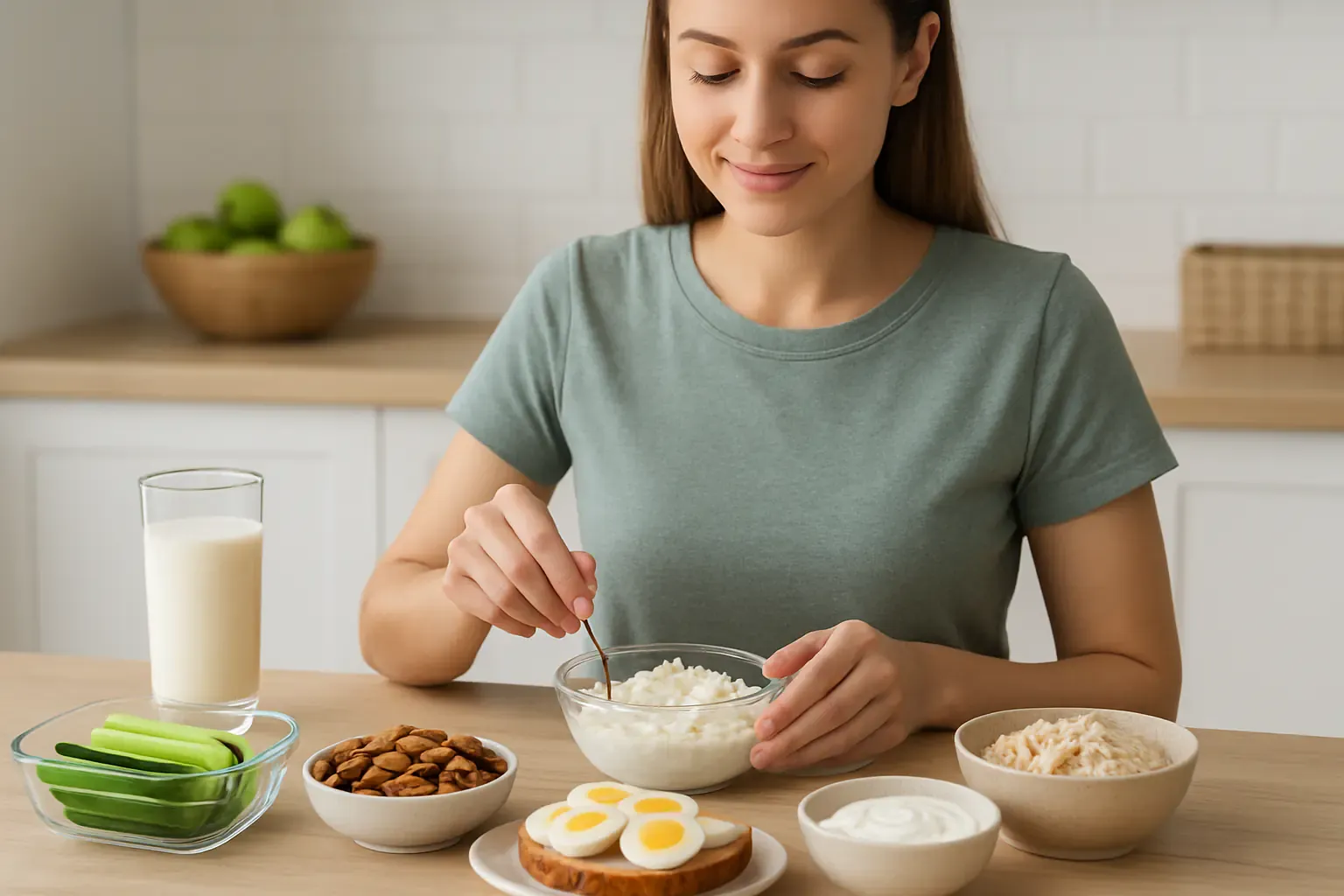
Snacking is where a lot of weight-loss plans quietly fall apart. The afternoon energy dip, the long stretch between lunch and dinner, the late-night grazing in front of a screen, these are the moments when most people reach for refined carbs that spike hunger again an hour later. A protein-anchored snack does the opposite: it bridges the gap between meals, steadies your appetite, and adds to your daily protein total without much of a calorie cost. This guide explains why protein-first snacking works, how much protein to aim for, and gives you 20 specific high-protein snacks under 250 calories, including options for late-night cravings, travel, pre-workout, and dairy-free eaters.
20 high-protein snacks under 250 calories at a glance
Ordered roughly by protein per calorie, so the snacks that give you the most protein for the smallest calorie hit sit at the top. Values are approximate; check labels for your specific brand or portion.
| Snack | Serving size | Calories | Protein (g) |
|---|---|---|---|
| Ready-to-drink protein shake | 1 bottle (~11 oz) | 150 | 25 |
| Chilled shrimp with cocktail sauce | 3-4 oz shrimp + 2 tbsp sauce | 120 | 18 |
| Savory cottage cheese with cherry tomatoes | 1/2 cup low-fat cottage cheese + 1/2 cup tomatoes | 110 | 14 |
| Turkey and cheese roll-ups | 2 slices deli turkey + 1 stick part-skim cheese | 150 | 16 |
| A sensible protein bar | 1 bar | 200 | 20 |
| Smoked salmon on cucumber rounds | 2 oz smoked salmon + 1 cup cucumber | 120 | 12 |
| Single-serve skyr with raspberries | 5.3 oz container + 1/4 cup raspberries | 150 | 14 |
| Baked tofu bites | 1/2 cup cubes | 150 | 14 |
| Ham and light cream cheese pinwheels | 2 slices ham + 1 tbsp light cream cheese | 130 | 12 |
| Edamame with sea salt | 1 cup shelled | 120 | 11 |
| Tuna packet with whole-grain crackers | 2.6 oz tuna pouch + 4-5 crackers | 190 | 17 |
| Hard-boiled eggs with everything seasoning | 2 large eggs | 140 | 12 |
| Greek yogurt with cinnamon and chopped walnuts | 3/4 cup nonfat Greek yogurt + 1 tbsp walnuts | 190 | 16 |
| Frozen Greek yogurt bark | ~3/4 cup yogurt + berries, frozen | 150 | 12 |
| Beef or turkey jerky with grapes | 1 oz jerky + small handful grapes | 170 | 13 |
| Roasted soy nuts | 1/4 cup | 200 | 11 |
| Roasted chickpeas | 1/2 cup | 130 | 7 |
| Roasted pumpkin seeds (pepitas) | 1/4 cup | 170 | 9 |
| White-bean or edamame hummus with vegetables | 1/4 cup hummus + 1 cup raw vegetables | 170 | 9 |
| String cheese with an apple | 1 stick + 1 medium apple | 160 | 8 |
Each option below explains how to put the snack together and why it works in a deficit.
Why protein-anchored snacks work
Protein is the most filling of the three macronutrients, calorie for calorie, and that is exactly what you want from a snack. It increases satiety signals such as peptide YY and GLP-1 while lowering the hunger hormone ghrelin, so a protein-rich snack tends to hold you over until your next meal instead of leaving you hungry again in 30 minutes. A handful of crackers or a granola bar made mostly of refined carbs does the reverse, nudging you toward more snacking later in the day.
There is also a muscle-preservation angle. When you eat in a calorie deficit, your body can lose a mix of fat and lean tissue, and spreading protein across the day, rather than stacking it all at dinner, gives your muscles a steadier supply of amino acids to work with. A protein snack between meals is one of the easiest ways to even out that distribution. For the full daily picture and gram ranges by body weight, see our protein intake for weight loss guide.
Finally, protein has the highest thermic effect of food: roughly 20 to 30 percent of its calories are burned during digestion, compared with 5 to 10 percent for carbs and 0 to 3 percent for fat. The effect is modest, but a protein-forward snack makes a small daily contribution to total energy expenditure on top of its much larger benefit for appetite control.
How much protein per snack
Aim for 10 to 20 grams of protein per snack. That range is enough to meaningfully reduce hunger between meals without turning a snack into a fourth meal. Below about 10 grams, a snack does little for satiety; much above 20 grams and you are usually better off folding those calories into an actual meal.
Two snacks a day at 10 to 20 grams each adds 20 to 40 grams of protein to your total, which fits comfortably inside a 100 to 130 gram daily target for most adults losing weight. If you are training hard or are larger, your daily target may be higher, in which case a third protein snack can help you reach it. To see how snacks fit alongside three protein-anchored meals across a full day, our weight loss meal plan lays out breakfast, lunch, dinner, and a snack at roughly 30 to 40 grams of protein each, and our high-protein breakfast ideas cover the first meal of the day.
Pair the protein with some fiber from fruit or vegetables when you can. The protein does the heavy lifting on satiety, but fiber slows digestion and adds volume for very few calories — and the pre-meal water evidence is a free third lever when hunger shows up before the next snack is due.
20 high-protein snack ideas under 250 calories
Each idea lists approximate calories and protein. Treat the numbers as close estimates, since brands and portions vary.
- Hard-boiled eggs with everything seasoning. ~140 cal, 12 g protein. Two eggs and a sprinkle of everything bagel seasoning; prep a batch so they are grab-and-go — hard-boiled eggs keep 7 days refrigerated in the shell, and the eggs for weight loss pillar covers the per-day dose range and the cholesterol answer for higher-lipid-risk groups.
- Turkey and cheese roll-ups. ~150 cal, 16 g protein. Roll two slices of lean deli turkey around a stick of part-skim cheese, no bread needed. Deli slice is the occasional-not-daily version of this snack — see turkey breast for weight loss for the honest read on the ~750-1,200 mg per 3 oz sodium load and the IARC-Group-1 processed-meat carveout, plus the fix (roast a whole breast on Sunday, slice it cold yourself) that keeps the same roll-up format at ~55 mg sodium per 3 oz.
- Savory cottage cheese with cherry tomatoes. ~110 cal, 14 g protein. Half a cup low-fat cottage cheese topped with halved tomatoes and cracked pepper.
- Roasted chickpeas. ~130 cal, 7 g protein. Crunchy and shelf-stable; the fiber makes up for the moderate protein.
- Edamame with sea salt. ~120 cal, 11 g protein. A cup of steamed shelled edamame with a pinch of salt, ready in minutes from frozen. For the per-half-cup nutrient breakdown (11 g complete protein, 8 g fiber, PDCAAS ~1.0, GI ~15), the low-FODMAP 1/4-cup starting portion for IBS-sensitive readers, and the GLP-1 titration rules, see the edamame for weight loss pillar.
- Tuna packet with whole-grain crackers. ~190 cal, 17 g protein. A single-serve tuna pouch with four or five whole-grain crackers — for the drained-weight portion rule, the 5-format decision table, and the FDA and EPA 2021 weekly mercury caps that decide how often canned light vs canned albacore can rotate in, see the tuna for weight loss pillar. The tinned-fish snack plate variant swaps in a $2 tin of sardines for weight loss at ~180 kcal and ~23 g protein per tin, with 500 to 1000 mg EPA + DHA and ~350 mg of edible-bone calcium in the same portion — cornichons, cucumber slices, and 4 whole-grain crackers turn it into the ~350 kcal, ~28 g protein plate that beats a protein bar on nutrient density.
- Beef or turkey jerky with grapes. ~170 cal, 13 g protein. One ounce of jerky plus a small handful of grapes for sweetness and fiber.
- Ready-to-drink protein shake. ~150 cal, 25 g protein. The fastest 20-plus grams there is; keep one in your bag for emergencies. For a per-product buy-vs-skip filter on the shake category itself, see our weight-loss shakes pillar.
- String cheese with an apple. ~160 cal, 8 g protein. A classic pairing of protein, fat, and fiber that needs zero prep. Swapping the cheese stick for 1 measured tablespoon of peanut butter on the same apple lands around ~150 cal with a bigger satiety hit from the fat matrix, at the cost of 4 g of protein.
- Greek yogurt with cinnamon and chopped walnuts. ~190 cal, 16 g protein. Three-quarter cup plain nonfat Greek yogurt, a dash of cinnamon, and a tablespoon of walnuts. Swapping the walnuts for 1 oz of counted-out almonds lands at ~215 cal with 3.5 g of fiber and a stronger magnesium and vitamin E contribution, for 1 oz of in-shell pistachios at ~215 cal with the shell-paced Pistachio Principle brake on portion drift, or for 1 oz of dry-roasted cashews at ~210 cal with a bigger magnesium and zinc contribution (but noticeably less fiber, so satiety per calorie is slightly weaker) — the portion honesty is still the whole game.
- Smoked salmon on cucumber rounds. ~120 cal, 12 g protein. Drape two ounces of smoked salmon over thick cucumber slices for a no-cook bite.
- A sensible protein bar. ~200 cal, 20 g protein. Choose one with at least 3 grams of fiber and an ingredient list you recognize.
- Roasted pumpkin seeds (pepitas). ~170 cal, 9 g protein. A quarter cup delivers protein, magnesium, and a satisfying crunch. For the portion, roasted-vs-raw, and pepitas-vs-sunflower-vs-chia-vs-hemp comparison, see the pumpkin seeds for weight loss single-food pillar — the “small handful” is almost always ~2 oz, not the ~1 oz mental model implies. For a nut-allergy-safe alternative that works in every peanut-free school and nut-free household, see the sunflower seeds for weight loss pillar — whole kernels or 2 Tbsp of SunButter (~200 kcal, ~7 g protein) is the correct swap for the peanut-butter templates on this list.
- Baked tofu bites. ~150 cal, 14 g protein. Cube firm tofu, toss with soy sauce, and bake until firm; they keep for days.
- White-bean or edamame hummus with vegetables. ~170 cal, 9 g protein. Higher-protein hummus scooped with bell pepper strips and carrots.
- Single-serve skyr with raspberries. ~150 cal, 14 g protein. Skyr is thicker and slightly higher in protein than standard yogurt.
- Ham and light cream cheese pinwheels. ~130 cal, 12 g protein. Spread a thin layer of light cream cheese on lean ham, roll, and slice.
- Roasted soy nuts. ~200 cal, 11 g protein. A shelf-stable, dairy-free crunch that travels well in a small container.
- Chilled shrimp with cocktail sauce. ~120 cal, 18 g protein. Three to four ounces of cooked shrimp; one of the leanest protein hits on this list.
- Frozen Greek yogurt bark. ~150 cal, 12 g protein. Spread sweetened Greek yogurt with berries on a tray, freeze, and break into pieces for a dessert-like snack.
- Rotisserie or batch-cooked chicken breast, pulled cold. ~140 cal, 26 g protein. Three ounces of pulled chicken breast is the highest-protein-per-calorie savory hit on this list — keep a labeled container in the fridge from Sunday meal prep.
Pick a snack by use case
If you only need one quick pick, here is the strongest option for each common situation.
Best for late-night cravings (low-calorie, slow-digesting). Cottage cheese is the best evening pick — the casein in it digests slowly (about a 4 to 6 hour amino-acid release versus 1 to 2 hours for whey), so it holds you over for several hours without a big calorie hit. Savory cottage cheese with cherry tomatoes lands at ~110 cal and 14 g protein, the lowest-calorie strong-protein hit in the list above.
Best post-workout (faster protein, moderate carbs). After training you want fast-digesting protein plus some carbohydrate to start refilling glycogen. A ready-to-drink protein shake delivers 25 g of mostly whey protein in 150 cal, or pair Greek yogurt with cinnamon and chopped walnuts with a piece of fruit for a more food-shaped version.
Best on-the-go (no prep, no fridge needed). Beef or turkey jerky with grapes survives a glovebox or backpack and delivers 13 g of protein for 170 cal. A vetted protein bar or shelf-stable roasted soy nuts are the next two picks if jerky is not your thing.
Best lowest-calorie hit. Savory cottage cheese with cherry tomatoes at ~110 cal is the cheapest calorie spend on the list for double-digit protein, and chilled shrimp with cocktail sauce at 120 cal and 18 g protein is the highest protein-per-calorie option overall. Cottage cheese also wins on the per-gram-of-protein math against protein powder — see our weight loss on a budget breakdown for the receipt-level comparison.
Snacks for specific situations
Late-night cravings
The best late-night snacks are slow-digesting and lower in calories, so they keep you comfortable without a big hit to your daily budget. Cottage cheese, plain Greek yogurt, and a casein shake all fit, since casein digests slowly and supports muscle overnight. Before you reach for anything, check whether you are actually hungry or just bored, tired, or stressed, much of late-night eating is habit rather than true hunger. If evening grazing is a recurring struggle, our emotional eating and weight loss guide covers practical ways to tell physical hunger from the emotional kind and what to do about it.
Pre-workout
Before training, you want a little protein plus some easy carbohydrate for energy, eaten roughly 60 to 90 minutes ahead so it settles. Greek yogurt with fruit, a banana with a scoop of protein blended into milk, or a small protein bar all work. Keep it on the lighter side so you are not training on a full stomach.
Travel and on the go
Shelf-stable protein is the goal when you are away from a fridge. Jerky, tuna or salmon packets, roasted chickpeas, roasted soy nuts, single-serve protein powder you can shake with water, and a vetted protein bar all survive a bag or glovebox. Stashing two or three of these means a hunger spike on the road never has to mean drive-through food. Our travel and weight loss playbook covers where these carry-on snacks fit inside the broader trip protocol — the anchor-breakfast rule, the alcohol ceiling, and the 5- to 7-day post-trip scale swing.
No dairy
You can hit 10 to 20 grams without any dairy. Edamame, roasted chickpeas, baked tofu bites, jerky, tuna or salmon packets, pumpkin seeds, roasted soy nuts, hummus with vegetables, and a plant-based protein shake all clear the bar. Soy-based options like edamame, tofu, and soy nuts tend to be the most protein-dense of the plant choices.
What to keep stocked
Protein snacking only works if the ingredients are already in the house. Keep two or three of these on hand at all times:
- Fridge: eggs (boil a batch on the weekend), cottage cheese, plain Greek yogurt or skyr, string cheese, lean deli turkey or ham, firm tofu, cooked shrimp.
- Pantry: tuna and salmon packets, jerky, roasted chickpeas, roasted soy nuts, pumpkin seeds, whole-grain crackers, vetted protein bars, single-serve protein powder.
- Freezer: shelled edamame, frozen berries, frozen banana for blending, batches of Greek yogurt bark.
With even half of this list stocked, a 10 to 20 gram protein snack is never more than a minute or two away, which is what keeps you from defaulting to chips or cookies.
When snacking hurts weight loss
Snacking is a tool, not a requirement, and it can backfire if you are not paying attention. A few honest cautions:
- Untracked calories add up fast. Even “healthy” snacks have calories, and a few handfuls of nuts or an extra bar can erase a meal-sized deficit without you noticing. If the scale stalls, snacks are one of the first places to look — see how to break a weight loss plateau when progress stops. Our weight loss meal plan shows how to budget snacks into a daily target instead of adding them on top.
- Mindless grazing is the real risk. Eating straight from a bag in front of a screen makes it almost impossible to register how much you have had. Portion snacks into a bowl or single serving before you sit down.
- Sometimes the answer is fewer, bigger meals. If you find yourself snacking constantly, you may simply be under-eating at meals. Building more protein and volume into breakfast, lunch, and dinner can remove the need to snack at all. For some people, consolidating into three satisfying meals is easier to control than four or five smaller eating occasions.
Used deliberately, a protein-anchored snack keeps hunger manageable and supports muscle in a deficit. Used mindlessly, it is just extra calories. The difference is planning. For the strategic side of the question — when, how often, and at what calorie target you should be snacking at all — see our guide to healthy snacking for weight loss, which covers timing, evening playbooks, and the calorie-budget math that this list assumes.
Frequently asked questions
How much protein should a high-protein snack have? Aim for roughly 10 to 20 grams of protein per snack. That is enough to curb hunger between meals and add to your daily total without becoming a full meal. Two snacks a day in that range fits inside a 100 to 130 gram daily target for most adults losing weight.
Are protein bars worth it for weight loss? A protein bar is a convenient snack if you read the label first. Look for about 15 to 20 grams of protein, under 250 calories, and at least 3 grams of fiber, and treat anything that reads like a candy bar as an occasional treat. Whole-food snacks are usually more filling per calorie, so use bars to fill gaps when time is tight.
What are the best high-protein snacks under 200 calories? Two hard-boiled eggs, savory cottage cheese with tomatoes, turkey and cheese roll-ups, edamame, a tuna packet with a few crackers, jerky, and smoked salmon on cucumber rounds all land under 200 calories with 10 to 18 grams of protein.
What are good high-protein snacks without dairy? Edamame, roasted chickpeas, baked tofu bites, jerky, tuna or salmon packets, pumpkin seeds, roasted soy nuts, hummus with vegetables, and a plant-based protein shake are all dairy-free and deliver 10 to 20 grams of protein.
What are the best high-protein snacks for late-night cravings? Choose slow-digesting, lower-calorie protein such as cottage cheese, plain Greek yogurt, or a casein shake. First check whether you are truly hungry or just bored or stressed, since a lot of late-night eating is habit rather than real hunger.
How many high-protein snacks should I eat per day? Most adults losing weight do well with one to two protein-anchored snacks per day. Two snacks at 10 to 20 grams of protein each add 20 to 40 grams to your daily total, which fits cleanly inside a 100 to 130 gram target. A third snack only helps if you are training hard or struggling to hit your protein floor at meals.
Can high-protein snacks replace meals for weight loss? A snack of 10 to 20 grams of protein and 150 to 250 calories is too light to replace a full meal for most adults. Pairing two snacks back to back can work occasionally — for example, Greek yogurt with fruit plus a tuna packet — but a real meal at 30 to 40 grams of protein and 400 to 600 calories will hold you longer and keep your eating pattern from drifting into all-day grazing.
Do high-protein snacks help build muscle? Indirectly, yes. Building muscle requires hitting a daily protein total (around 0.7 to 1.0 grams per pound of goal body weight) plus a resistance training stimulus. Spreading that protein across three to five eating occasions, including one or two snacks, gives your muscles a steadier supply of amino acids than back-loading it all at dinner. The snack itself does not build muscle, but it makes hitting the daily total easier.
Sources
- Paddon-Jones D et al. Protein, weight management, and satiety. The American Journal of Clinical Nutrition (2008).
- Halton TL, Hu FB. The effects of high protein diets on thermogenesis, satiety and weight loss: a critical review. Journal of the American College of Nutrition (2004).
- Njike VY et al. Snack Food, Satiety, and Weight. Advances in Nutrition (2016).