2026-05-24 · portion control, nutrition, weight loss, habits
Updated 2026-08-04
Written by WeightFAQ Staff
Evidence-informed guidance from the WeightFAQ editorial team.
13 min read
Last editorial review Aug 4, 2026
Portion Control for Weight Loss: The Hand and Plate Method
Quick answer: Portion control means managing how much you eat rather than counting every calorie. It works because portion size is one of the strongest, most consistent drivers of how much people eat, and right-sizing your servings lowers daily intake almost automatically. You can use it as a lighter alternative to calorie counting, or as a complement that makes a calorie target easier to hit without weighing food at every meal.
Calorie counting works, but plenty of people find it tedious, hard to sustain, or stressful enough to abandon within a few weeks. Portion control is the practical middle ground: it gives your meals structure and a built-in ceiling on the foods that cause overeating, without spreadsheets or a food scale on the counter. This guide covers two no-tracking systems, the hand-portion method and the plate method, plus the handful of foods that quietly wreck most people’s portions and how to fix them.
Why portion size drives how much we eat
Decades of feeding research point to the same conclusion: give people more food, and they eat more, usually without noticing and without feeling any fuller afterward. This is often called the “portion size effect.” In one well-known controlled study, increasing portion sizes raised daily calorie intake and the effect was sustained for the full 11 days of the trial, with no sign that people compensated by eating less later. A Cochrane systematic review of dozens of studies reached the same verdict: reducing the size of portions, packages, and tableware consistently lowers how much people eat and drink.
The takeaway is simple and encouraging. You do not have to rely on willpower to eat less at every meal. If you change the amount that lands on your plate, your intake tends to follow, quietly and without a constant sense of restriction. Portion control is just a set of habits that put that finding to work.
For a deeper look at how this fits into total daily energy balance, see our TDEE and calorie deficit guide for beginners.
The hand-portion method
The hand-portion method uses your own hand as a built-in, always-available measuring tool. Because hand size scales roughly with body size, larger people get slightly larger portions automatically, which is exactly what you want. There is nothing to weigh and nothing to look up at the table.
The four basic cues:
- Palm = protein. One palm-sized serving (thickness included) of chicken, fish, lean beef, tofu, or tempeh.
- Fist = vegetables. One fist of non-starchy vegetables like broccoli, peppers, greens, or zucchini.
- Cupped hand = carbs. One cupped handful of rice, pasta, oats, potato, or other starchy carbs.
- Thumb = fats. One thumb-sized portion of oil, butter, nut butter, or cheese.
Hand-portion reference table
Use this table to connect each hand cue to a rough amount and calorie range. Treat the calories as ballpark figures, not exact numbers.
| Hand cue | Food group | Typical amount | Rough calories |
|---|---|---|---|
| 1 palm | Protein (chicken, fish, tofu, lean beef) | ~3 oz / 85 g cooked, ~20–25 g protein | ~120–180 cal |
| 1 fist | Non-starchy vegetables | ~1 cup | ~25–50 cal |
| 1 cupped hand | Carbs (rice, pasta, oats, potato) | ~½–1 cup cooked, ~20–30 g carbs | ~120–200 cal |
| 1 thumb | Fats (oil, butter, nut butter, cheese) | ~1 tbsp / ~14 g | ~100–120 cal |
How to build a meal with your hand
A practical default for most adults losing weight:
- Protein: 1 to 2 palms per meal
- Vegetables: 1 to 2 fists per meal
- Carbs: 1 to 2 cupped hands per meal
- Fats: 1 to 2 thumbs per meal
Smaller or less active people anchor toward the lower end; larger or more active people toward the higher end. The protein and vegetable portions are forgiving, so you can be generous there. The carb and especially the fat portions are where calories add up fast, so keep those closer to a single cupped hand and a single thumb until the scale tells you otherwise. For the full picture on protein targets by body weight, see our protein intake for weight loss guide.
The plate method
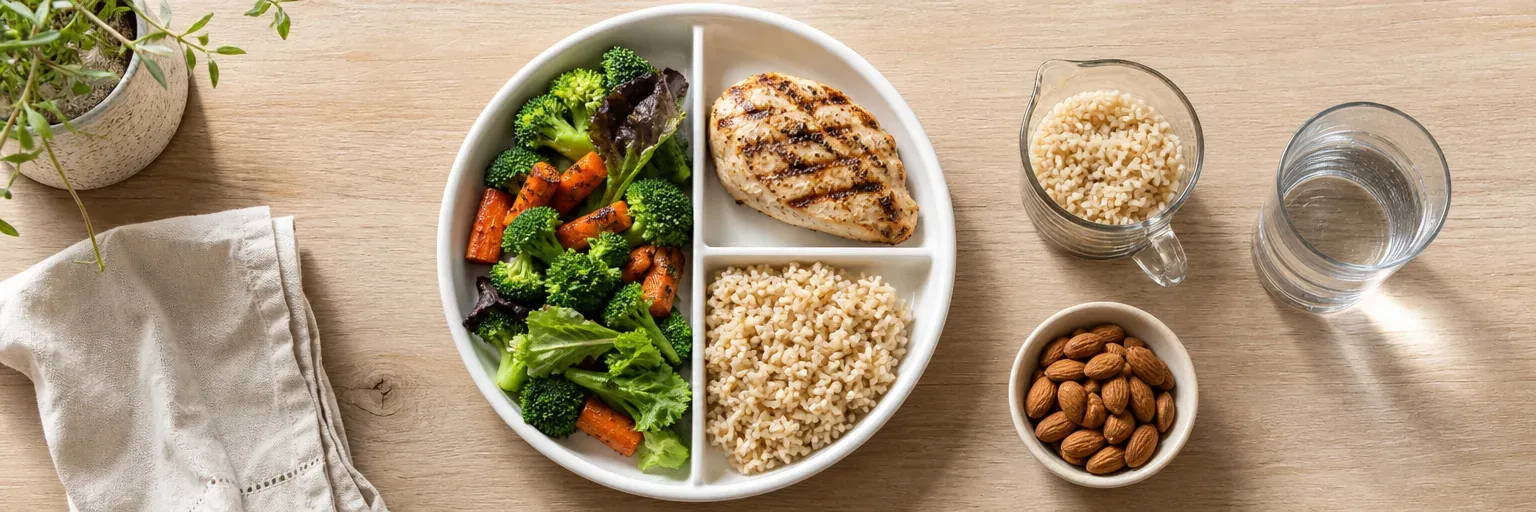
If hand portions feel like too much mental math, the plate method is even simpler because you measure nothing at all. You just divide a standard 9- to 10-inch dinner plate:
- ½ plate: non-starchy vegetables (salad, roasted vegetables, stir-fried greens)
- ¼ plate: protein (a palm or two of chicken, fish, tofu, eggs, or beans)
- ¼ plate: whole grains or starchy carbs (brown rice, quinoa, potato, whole-grain bread)
- Plus a small amount of healthy fat (a thumb of oil, avocado, or dressing) and, if you like, a piece of fruit or a serving of dairy on the side
The plate method does two useful things at once. It caps the two most calorie-dense parts of the meal, protein and starch, at a quarter of the plate each, and it fills the largest section with high-volume, low-calorie vegetables. That combination raises the sheer amount of food on your plate while lowering its calorie total, which helps you feel satisfied on less. This half-plate-vegetables move is the same energy-density swap that the Volumetrics diet builds an entire eating pattern around. It also takes about three seconds to apply, which is why it survives busy weeknights. The veg-and-grain half of the plate is also where most of your daily fiber comes from — see our guide on fiber for weight loss for the satiety mechanism and daily targets.
The plate template is the backbone of most balanced weight-loss menus. Our weight loss meal plan shows a full sample week built on exactly this structure, and our step-by-step guide to building a weight loss meal plan walks through turning the plate template into a repeatable rotation.
Practical tactics that make portions stick
Knowing the right portion is half the job. These tactics make the right portion the default so you do not have to decide at every meal.
Serve from the kitchen, not the table. Plating food in the kitchen and leaving the pots and pans there removes the easy second helping. Family-style serving at the table is one of the most reliable ways to overeat, because seconds are right in front of you.
Pre-portion snacks and bulk foods. Eating chips, nuts, or trail mix straight from the bag almost guarantees you eat more than you planned. Portion snacks into small containers or bags once, after shopping, so a serving is already decided. The same goes for batch-cooked meals: divide them into single portions while you put them away. For the strategic side of snack portions — when to snack, how many calories, and the evening playbook — see our healthy snacking for weight loss guide.
Try smaller plates and bowls, with realistic expectations. Downsizing to a smaller plate or bowl can nudge some people to serve and eat less, partly because a modest portion looks complete instead of sparse. The effect is real but modest and not universal, so use it as one helpful nudge rather than the whole strategy.
Have a plan for eating out. Restaurant portions are often two to three times a reasonable serving. Useful tactics: box half the entrée before you start, split a dish, order an appetizer plus a side salad as your main, or ask for dressings and sauces on the side so you control the pour. You do not need to count anything, just halve the obvious excess.
Watch the “portion distortion” foods. A few calorie-dense foods cause most accidental overeating because they are easy to over-pour and easy to underestimate:
- Cooking oils and dressings: a casual drizzle of olive oil is often 200-plus calories. Measure with a spoon.
- Nut butter: a real tablespoon is level, not a heaping scoop. Two “spoonfuls” can be 300 calories.
- Cheese: a serving is about the size of two thumbs (~1 oz), not the handful most people shred on top.
- Cereal and granola: the labeled serving is usually far smaller than a comfortable bowl, sometimes by two or three times. Our guide on how to read nutrition labels shows how to spot multi-serving packages before they wreck your portions.
- Cooked rice and pasta: these expand when cooked, so a “small” bowl can be two or three cupped-hand servings.
Measure just these few high-density foods with a spoon or measuring cup for a week or two. Once your eye is calibrated, you can go back to estimating and your portions will stay honest.
When portion control is (and isn’t) enough
Portion control works only to the extent that it produces a calorie deficit, the state of eating less than you burn. For many people, right-sizing portions of calorie-dense foods is enough to create that deficit on its own, no tracking required. That is the best-case outcome, and it is common.
But portion control is not magic. It can fall short when:
- The portions are still too large. Even well-structured plates add up if every component is at the top of its range and snacks are frequent.
- High-calorie drinks slip through. Juice, soda, sweetened coffee, and alcohol are easy to leave out of “portion” thinking but add hundreds of calories.
- You are close to your goal. As you get leaner, your calorie needs shrink and the margin for error narrows, so eyeballed portions may need to tighten or be tracked for a stretch.
If the scale has not moved after three to four weeks of consistent portioning, that is your signal. First tighten the most calorie-dense portions, the oils, cheese, nut butter, and grains, then, if needed, track intake for a couple of weeks to find where the extra calories are coming from — our guide to how to count calories walks through the practical weigh-log-label workflow for a short calibration stint. Most people underestimate how much they eat by a meaningful margin, and a short tracking stint usually reveals the gap. To set a realistic target in the first place, see our guide on how many calories to eat for weight loss.
The honest framing: portion control is a powerful, low-friction way to reach a calorie deficit without counting. It complements calorie awareness rather than replacing the underlying math. Use it as your default, and reach for tracking only when the results tell you to. Restaurant portions average 2 to 4 times reference sizes, so portion rules there look different — see the eating out ordering playbook for the structural swaps that work without measuring.
Pair portion control with the slowing-down practice in mindful eating for weight loss. The two work on different levers — portion control caps how much food lands on the plate, mindful eating slows the meal so fullness signals arrive before the plate is empty — and most people who get a durable result from one are already doing some version of the other.
Frequently asked questions
What is portion control and how does it help with weight loss? Portion control is managing how much food you eat at a meal rather than tracking every calorie. It helps with weight loss because portion size is one of the strongest drivers of how much we eat. In controlled studies, larger servings reliably push people to eat more without feeling any fuller, so right-sizing your portions lowers your daily calorie intake almost automatically. It works as a lighter-touch alternative or complement to calorie counting.
How do I use my hand to measure portions? Use your hand as a built-in measuring guide: a palm of protein (about 3 ounces or 20 to 25 grams), a fist of non-starchy vegetables (about one cup), a cupped hand of carbs like rice or pasta (about half to one cup cooked), and a thumb of fats like oil, nut butter, or cheese (about one tablespoon). Your hand scales roughly with your body size, so larger people get slightly larger portions. Build most meals from one to two palms of protein, one to two fists of vegetables, one to two cupped hands of carbs, and one to two thumbs of fat.
What is the plate method for weight loss? The plate method fills half your plate with non-starchy vegetables, one quarter with protein, and one quarter with whole grains or starchy carbs, plus a small amount of healthy fat and a piece of fruit or serving of dairy on the side. It needs no measuring at all, automatically caps calorie-dense foods at a quarter of the plate each, and raises the volume of low-calorie vegetables, which helps you feel full on fewer calories.
Can I lose weight with portion control without counting calories? Yes, many people lose weight on portion control alone because smaller portions of calorie-dense foods cut intake without formal tracking. But portion control only works if it actually produces a calorie deficit. If the scale has not moved after three to four weeks of consistent portioning, you likely need to tighten the most calorie-dense portions (oils, cheese, nut butter, grains) or track for a couple of weeks to find where the extra calories are hiding.
Do smaller plates really help you eat less? Smaller plates and bowls can help some people serve and eat less, mainly by making a modest portion look complete and reducing the urge to clean an oversized plate. The effect is real but modest and varies from person to person, so treat smaller tableware as one helpful nudge among several rather than a guaranteed fix. Pre-portioning food and serving from the kitchen instead of family-style at the table tend to have a more reliable impact.
What foods cause the biggest portion mistakes? The biggest portion mistakes come from calorie-dense foods that are easy to over-pour: cooking oils and dressings, nut butters, cheese, granola and cereal, and cooked rice or pasta. A casual drizzle of olive oil can be 200-plus calories, and a heaping bowl of cereal is often two or three labeled servings. Measure these few high-density foods with a spoon or cup for a week or two until your eye is calibrated, and you fix most accidental overeating.
Sources
- Rolls BJ, Roe LS, Meengs JS. The effect of large portion sizes on energy intake is sustained for 11 days. Obesity (Silver Spring) (2007).
- Hollands GJ, Shemilt I, Marteau TM, et al. Portion, package or tableware size for changing selection and consumption of food, alcohol and tobacco. Cochrane Database of Systematic Reviews (2015).
- Ello-Martin JA, Roe LS, Ledikwe JH, Beach AM, Rolls BJ. Dietary energy density in the treatment of obesity: a year-long trial comparing 2 weight-loss diets. American Journal of Clinical Nutrition (2007).
- Steenhuis IHM, Vermeer WM. Portion size: review and framework for interventions. International Journal of Behavioral Nutrition and Physical Activity (2009).