
2025-03-01 · medications, glp-1, semaglutide, tirzepatide, wegovy, zepbound, prescription, weight-loss
Updated 2026-10-01
Written by WeightFAQ Staff
Evidence-informed guidance from the WeightFAQ editorial team.
23 min read
Last editorial review Aug 1, 2026
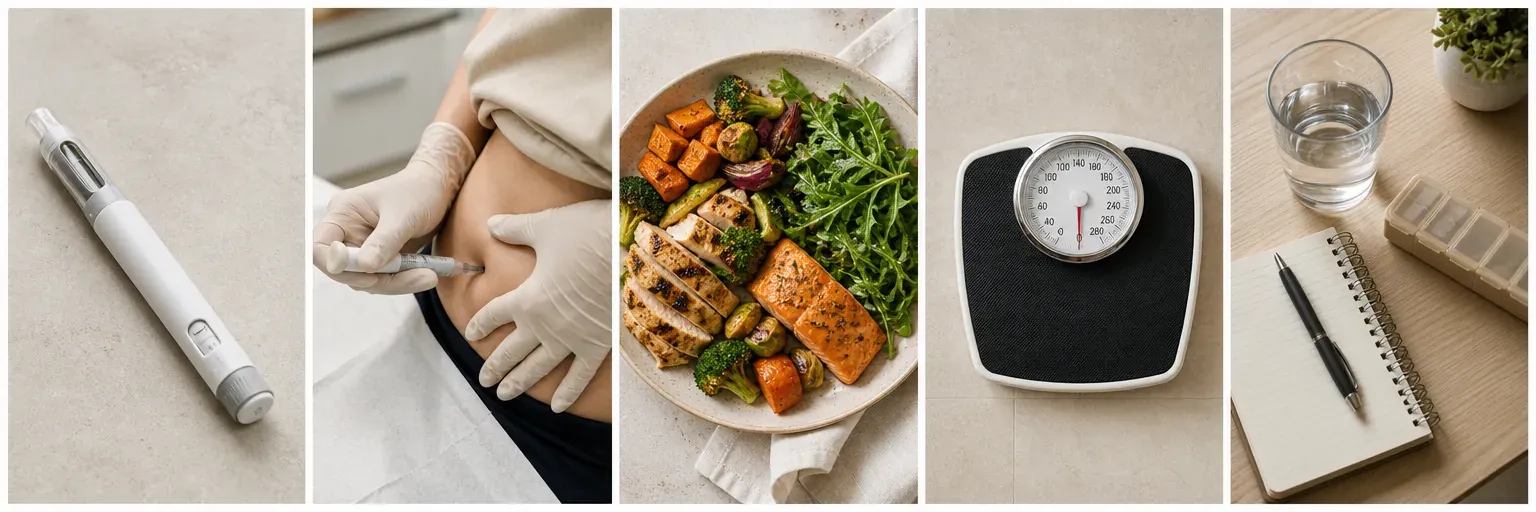
GLP-1 Weight Loss Medications Overview
GLP-1 receptor agonists are the first medication class to deliver bariatric-surgery-adjacent weight loss without surgery. They have reshaped the prescription-weight-loss landscape since 2021, added cardiovascular and kidney indications, and now anchor how endocrinologists and obesity-medicine physicians treat metabolic disease. This guide walks through what they are, who they fit, what the pivotal trials actually show, what to expect week by week, and what happens when you stop.
Quick stats
- Typical weight loss on a full dose: 14.9% at 68 weeks on semaglutide 2.4 mg (STEP-1); 20.9% at 72 weeks on tirzepatide 15 mg (SURMOUNT-1).
- Time to weight-loss plateau: ~60–68 weeks for semaglutide, ~72 weeks for tirzepatide, with the steepest loss between weeks 12 and 40.
- Retail cost range in the U.S.: roughly $900–$1,300 per month for Wegovy or Zepbound before insurance; LillyDirect self-pay tirzepatide vials start closer to $349–$499/month at lower doses.
- Cardiovascular benefit magnitude: 20% relative reduction in major adverse cardiovascular events on semaglutide 2.4 mg in adults with pre-existing CVD (SELECT).
- Common side-effect resolution timeline: most nausea, constipation, and reflux resolve within 8 weeks as the body adapts to each dose step.
What GLP-1 medications actually are
GLP-1 receptor agonists are injectable (or, for a couple of newer options, oral) medications that mimic glucagon-like peptide-1, a gut hormone released after eating. They act on GLP-1 receptors in the brain, pancreas, and gut to reduce appetite, slow gastric emptying, and increase glucose-dependent insulin release. The net effect is smaller portions, longer fullness between meals, and a lower daily energy intake — usually without the willpower cost that unassisted dieting demands. Patients frequently describe a quiet reduction in “food noise,” meaning intrusive thoughts about food fade in the background — see our dedicated food noise and GLP-1s guide for the underlying mechanism and what happens when the drug is stopped.
The three GLP-1-class medications with FDA approval specifically for weight management are:
- Semaglutide 2.4 mg — sold as Wegovy. A once-weekly subcutaneous injection. The same molecule at lower doses is Ozempic for type 2 diabetes.
- Tirzepatide 15 mg — sold as Zepbound. A once-weekly injection that activates both GLP-1 and GIP receptors, which is why it produces larger average losses than pure GLP-1 agonists. The diabetes brand is Mounjaro.
- Liraglutide 3.0 mg — sold as Saxenda. A daily injection, older mechanism, smaller weight losses, and now largely displaced by weekly semaglutide and tirzepatide.
For a four-way brand comparison across Ozempic, Wegovy, Mounjaro, and Zepbound, see GLP-1 medications compared.
2026 dose ladders at a glance
Each GLP-1 has its own titration schedule. The gap between the starting dose and the full maintenance dose is 8–20 weeks depending on the drug, and skipping steps almost always produces intolerable GI symptoms. The six most commonly prescribed injectable and oral GLP-1s — including the two off-label diabetes brands that are still frequently used for weight — are summarized below (source: FDA prescribing information for each brand, 2025 revisions).
| Drug | Starting dose | Titration cadence | Full maintenance dose | Notes |
|---|---|---|---|---|
| Wegovy (semaglutide 2.4 mg) | 0.25 mg weekly | Step every 4 weeks: 0.5 → 1.0 → 1.7 → 2.4 mg | 2.4 mg weekly | FDA-approved for chronic weight management; separate CV indication after SELECT. |
| Zepbound (tirzepatide 15 mg) | 2.5 mg weekly | Step every 4 weeks: 5.0 → 7.5 → 10 → 12.5 → 15 mg | 15 mg weekly (10 and 5 mg are also approved maintenance doses) | Dual GIP/GLP-1 agonist; adds HFpEF indication after SUMMIT. |
| Saxenda (liraglutide 3.0 mg) | 0.6 mg daily | Step weekly: 1.2 → 1.8 → 2.4 → 3.0 mg | 3.0 mg daily | Daily injection, older mechanism, smaller mean loss (~6–8%). |
| Ozempic (semaglutide, off-label for weight) | 0.25 mg weekly | Step every 4 weeks: 0.5 → 1.0 → 2.0 mg | 2.0 mg weekly (T2DM label) | FDA-approved for T2DM only; weight-loss use is off-label and typically caps at 2.0 mg. |
| Mounjaro (tirzepatide, off-label for weight) | 2.5 mg weekly | Same as Zepbound | 15 mg weekly | Same molecule as Zepbound; T2DM label. |
| Rybelsus (oral semaglutide, off-label for weight) | 3 mg daily | Step every 30 days: 7 → 14 mg | 14 mg daily (T2DM label); 25 and 50 mg tested for obesity | T2DM label only; obesity-indicated oral semaglutide is expected to launch under a new brand after OASIS-1 review. |
Every ladder assumes GI tolerance — if nausea, vomiting, or dehydration is severe at any step, holding the current dose an extra 2–4 weeks before stepping up is standard clinical practice and does not compromise long-term efficacy.
Two dose-specific decisions come up in every early visit:
- Do you need the full 2.4 mg / 15 mg dose? In responders, weight loss at maintenance dose (2.4 mg semaglutide or 15 mg tirzepatide) is 3–6 percentage points larger than at the middle dose (1.7 mg semaglutide, 10 mg tirzepatide). Some patients tolerate the maintenance dose comfortably; others plateau adequately at a lower step and stay there.
- When to hold vs step up. A useful clinical rule: if you can eat a normal-portion meal without nausea, keep dinner down for the full evening, and are drinking > 2 L of fluid daily, you are ready to step. Any one of those failing is a reason to hold the current dose 2–4 more weeks.
Head-to-head: how the trials compare
The pivotal trials are the anchor for every reasonable claim about GLP-1 efficacy. The table below summarizes the five that matter most.
| Trial | Drug | Duration | Weight change vs placebo | Reference |
|---|---|---|---|---|
| STEP-1 | Semaglutide 2.4 mg | 68 weeks | −14.9% | Wilding 2021, NEJM |
| STEP-3 | Semaglutide 2.4 mg + intensive behavioral therapy | 68 weeks | −16.0% | Wadden 2021, JAMA |
| SURMOUNT-1 | Tirzepatide 15 mg | 72 weeks | −20.9% | Jastreboff 2022, NEJM |
| SURMOUNT-5 | Tirzepatide 15 mg vs semaglutide 2.4 mg | 72 weeks | −20.2% vs −13.7% | Aronne 2025, NEJM |
| SELECT | Semaglutide 2.4 mg (CVD outcome) | ~40 months | −9.4% mean; 20% MACE reduction | Lincoff 2023, NEJM |
Two practical takeaways: tirzepatide loses more weight on average, and semaglutide has the deeper cardiovascular-outcomes record. Both are true at once. For patients whose primary risk driver is cardiovascular disease, semaglutide’s SELECT indication is a real clinical advantage. For patients whose primary target is the largest possible weight loss, tirzepatide wins on the head-to-head numbers. For a deeper comparison, see semaglutide vs tirzepatide.
Trial evidence at a glance
The six trials below anchor most of what today’s practice guidelines say about GLP-1s for weight and cardiometabolic outcomes. Every efficacy claim on the rest of this page traces back to one of these publications; each row links to the primary source.
| Trial | Drug | N | Duration | Mean weight loss | Key secondary outcome |
|---|---|---|---|---|---|
| STEP-1 (Wilding 2021, NEJM) | Semaglutide 2.4 mg | 1,961 | 68 weeks | −14.9% (placebo −2.4%) | Waist circumference −13.5 cm; HbA1c −0.45 percentage points |
| STEP-4 (Rubino 2021, JAMA) | Semaglutide 2.4 mg (maintenance vs withdrawal) | 803 | 20-wk lead-in + 48-wk randomization | −7.9% additional loss on continued therapy vs +6.9% regain on placebo switch | Confirmed rebound biology when the drug is stopped |
| SURMOUNT-1 (Jastreboff 2022, NEJM) | Tirzepatide 15 mg | 2,539 | 72 weeks | −20.9% (placebo −3.1%) | 57% reached ≥ 20% weight loss; large waist and HbA1c reductions |
| SURMOUNT-4 (Aronne 2024, JAMA) | Tirzepatide 15 mg (maintenance vs withdrawal) | 670 | 36-wk lead-in + 52-wk randomization | −5.5% additional loss on continued vs +14.0% regain on placebo | Reinforced SURMOUNT-1 regain pattern in a US cohort |
| SELECT (Lincoff 2023, NEJM) | Semaglutide 2.4 mg (CV outcome) | 17,604 | ~40 months | −9.4% mean | 20% relative reduction in MACE; anchor CV indication |
| SURMOUNT-5 (Aronne 2025, NEJM) | Tirzepatide 15 mg vs semaglutide 2.4 mg | 751 | 72 weeks | −20.2% vs −13.7% (head-to-head) | Confirmed a ~6-percentage-point advantage for tirzepatide |
Every row above is a Phase 3 or CV-outcome trial with published, peer-reviewed data. Anything smaller (Phase 2, retrospective real-world, or unpublished conference abstract) is not carried here — the goal is a stable clinical baseline, not a running research digest.
One caveat: trial numbers are not what most patients experience in the first year. Real-world persistence on GLP-1s at 12 months is roughly 33–46% across the largest 2023–2025 pharmacy-claims analyses (Prime Therapeutics, Blue Cross Blue Shield of Michigan, Trinity Health).
Mean loss for patients who do stay on therapy for a full year runs 4–6 percentage points below the trial mean because of slower titration, cost-driven dose skipping, and inconsistent lifestyle support.
This is not a criticism of the drugs — it is the honest baseline against which any patient’s own year-1 outcome should be measured. Two habits close most of that trial-vs-reality gap: never skip a dose because of cost (contact the prescriber for a savings-program route instead), and treat the first 90 days as a titration and habit-building window rather than a weight-loss window.
Who is a candidate
Standard prescribing criteria for both Wegovy and Zepbound are:
- BMI ≥ 30, or
- BMI ≥ 27 with at least one weight-related comorbidity (hypertension, dyslipidemia, obstructive sleep apnea, type 2 diabetes, or cardiovascular disease).
The SELECT trial expanded the practical indication in 2024: semaglutide 2.4 mg is now separately indicated for cardiovascular-event reduction in adults with pre-existing cardiovascular disease and either obesity or overweight, regardless of diabetes status. Tirzepatide has a similar heart-failure indication after the SUMMIT results in HFpEF with obesity. Both medications are also used in adults with type 2 diabetes for the dual benefit of glycemic control and weight loss.
Contraindications matter more than usual for this class. Do not start a GLP-1 if you have a personal or family history of medullary thyroid carcinoma or MEN2 syndrome. Discuss risk carefully with a clinician if you have a history of pancreatitis, severe gastroparesis, or active gallbladder disease. Pregnancy is a hard stop; the standard is a 2-month washout before conception and no resumption until after weaning. If you are on insulin or a sulfonylurea for diabetes, those doses must be reduced before starting to avoid hypoglycemia.
What to expect week by week
GLP-1s are always titrated slowly. Jumping to a full dose causes intolerable nausea in most people; the ramp exists to give the gut time to adapt. The table below outlines a typical semaglutide 2.4 mg titration; tirzepatide follows a similar four-step ramp with slightly different intervals.
| Phase | Weeks | Dose | What is happening |
|---|---|---|---|
| Start | Weeks 1–4 | 0.25 mg weekly | Priming dose. Appetite change is modest. Nausea and constipation often peak here. |
| Ramp | Weeks 5–16 | 0.5 → 1.0 → 1.7 mg weekly (step every 4 weeks) | Appetite drop becomes obvious. Weight loss accelerates to 0.5–1.0% body weight per week. |
| Maintenance | Weeks 17–68 | 2.4 mg weekly | Full efficacy. Weight loss continues at a decelerating rate and plateaus around weeks 60–68. |
| Discontinue | After decision to stop | Taper or stop | Regain begins within weeks. Structured maintenance plan is essential. |
The 0.5–1.0% weekly weight-loss pace is a useful reference: slower is fine and often better tolerated, but faster is a warning sign for excessive lean-mass loss. Pair the medication with adequate protein (roughly 1.6 g/kg body weight, front-loaded at breakfast) and two weekly resistance sessions to protect muscle — see preserving muscle during weight loss for the specifics.
Side effects and what usually resolves
Most GLP-1 side effects are gastrointestinal and time-limited. Understanding which ones fade and which ones need action is the difference between quitting at week 6 and staying on to full efficacy.
- Nausea, vomiting, diarrhea, constipation. Arm rates in the pivotal trials ran 20–35% for nausea alone. Symptoms peak in the week after each dose step and usually resolve within 8 weeks at a given dose. Slow titration, smaller meals, avoiding high-fat food after injection day, and steady hydration all reduce severity. For persistent constipation, see constipation during weight loss.
- Gallbladder events. Rapid weight loss and slower gastric emptying together increase gallstone formation. The absolute risk increase is roughly 0.5–1.0 percentage points over placebo. Any right-upper-quadrant pain, particularly after a fatty meal, deserves clinical attention.
- Pancreatitis. Rare — the 38-RCT meta-analytic signal is small but not zero. The pattern in practice is that most GLP-1 pancreatitis cases are gallstone-driven rather than direct drug toxicity. Prior pancreatitis is a relative contraindication for that reason. See pancreatitis and weight loss for the full picture.
- Thyroid C-cell tumors. The boxed warning covers medullary thyroid carcinoma and MEN2. The rodent-model signal has never been confirmed in human trials, but the warning is absolute in these two populations.
- “Ozempic face” and lean-mass loss. Rapid overall weight loss thins the face and can accelerate loss of lean tissue — both the lean-mass share and the aesthetic effect are proportional to how fast the total loss happens. Neither is a drug-specific complication; both are managed the same way as any large weight loss: strength training and adequate protein.
- Reduced “food noise.” Not a side effect in the harm sense, but worth naming — most patients describe a quieter internal food dialogue on GLP-1s. This is the appetite-signaling effect the drug is designed to produce.
For the practical symptom-by-symptom management protocol — the five-step tolerability ladder, ondansetron 4 mg PRN and PEG-3350 17 g QD dosing, hold-dose and titrate-down thresholds, and the emergency red-flag list — see managing GLP-1 side effects.
Contraindications and drug interactions to know
Beyond the standard side-effect discussion, a handful of hard stops and predictable drug interactions deserve their own review before you or your clinician start a GLP-1.
- Medullary thyroid carcinoma / MEN2 (absolute contraindication). Personal or family history of MTC or multiple endocrine neoplasia type 2 is a categorical no on both semaglutide and tirzepatide labels, based on the rodent C-cell tumor signal. Human data have never confirmed the signal, but the boxed warning is absolute.
- Prior pancreatitis (relative contraindication). Most GLP-1-associated pancreatitis in practice is gallstone-driven rather than direct drug toxicity, but any history of acute pancreatitis warrants a specialist discussion before starting.
- Pregnancy and preconception. Standard practice is a 2-month washout for semaglutide (5 half-lives) and roughly 4 weeks for tirzepatide before attempting conception; do not resume until after weaning if breastfeeding.
- Oral contraceptive absorption on tirzepatide. Delayed gastric emptying during the first 4 weeks after any tirzepatide dose escalation can reduce absorption of oral contraceptives. FDA labeling recommends either a barrier method or a switch to a non-oral contraceptive for those 4 weeks after each escalation. For the per-drug picture across every GLP-1, the non-oral method options that bypass this entirely, and the pregnancy-washout timing, see GLP-1 medications and birth control.
- Insulin and sulfonylureas (hypoglycemia risk). Starting a GLP-1 alongside insulin or a sulfonylurea without adjusting those doses is one of the most common preventable causes of severe hypoglycemia in this class. Standard practice is a ~50% reduction in the insulin or sulfonylurea dose at GLP-1 start, with close glucose monitoring for the first 2–4 weeks.
- Warfarin (INR monitoring). Delayed gastric emptying can alter warfarin absorption unpredictably. Check the INR within 1–2 weeks of starting a GLP-1 and after each dose escalation until stable.
- Elective anesthesia (ASA 2023 guidance). The American Society of Anesthesiologists’ 2023 consensus recommends holding a weekly-dose GLP-1 for 1 week before elective anesthesia and a daily-dose GLP-1 on the day of, because of aspiration risk from delayed gastric emptying. For emergency surgery, treat the patient as full-stomach regardless.
- Levothyroxine and other narrow-window oral drugs. Delayed gastric emptying can shift absorption timing for levothyroxine and a handful of other narrow-therapeutic-window oral medications. No dose change is required at start, but recheck TSH 6–8 weeks after starting a GLP-1 to make sure the thyroid dose is still in range.
- Contrast imaging and dehydration risk. GI side effects can produce meaningful volume depletion, particularly during dose escalation. If contrast-enhanced imaging is scheduled, treat any recent nausea or diarrhea as a reason for pre-hydration and, where relevant, closer creatinine monitoring.
- Alcohol. GLP-1s reduce alcohol reward signaling; many patients notice they drink less on therapy. That is generally welcome. Where it matters clinically: heavy drinkers who cut alcohol abruptly after a GLP-1 start should be screened for withdrawal risk, and alcohol taken with rapid-acting insulin adds a small but real hypoglycemia layer worth flagging. For the full safety picture — pancreatitis, hypoglycemia, dehydration, and the emerging craving-reduction signal — see GLP-1s and alcohol.
- Older adults with baseline low intake. Adults over 75 who already trend toward low protein intake and mild sarcopenia are the group where GLP-1s most commonly produce clinically meaningful lean-mass loss. Start lower, titrate more slowly, and enforce a firm protein floor (1.2–1.6 g/kg body weight) alongside twice-weekly resistance training.
- Adolescents. Both semaglutide 2.4 mg and tirzepatide 15 mg have adolescent obesity indications from 12 years of age (semaglutide) and (as of 2024) tirzepatide, but the growth, developmental, and behavioral considerations differ from adult prescribing and warrant a specialist familiar with pediatric obesity medicine.
Cost, coverage, and what stops most people
Cost is the single largest barrier for U.S. patients. Wegovy and Zepbound list at roughly $1,300 per month at retail; commercial insurance coverage varies widely, and Medicare has historically excluded weight-loss-only indications. The SELECT and SURMOUNT-cardiovascular indications have started to unlock some Medicare Part D coverage for the cardiovascular use case, but not for weight-loss alone. Prior authorization is standard, often requires documented BMI thresholds and a lifestyle-program attempt, and step therapy through cheaper agents is common. LillyDirect self-pay vials of tirzepatide (Zepbound) offer a lower-cost path for cash-pay patients at lower doses.
For a 2026 brand-by-brand walk through pricing, manufacturer savings programs, LillyDirect vials, Medicare and NHS coverage, and a step-by-step checklist for what you will actually pay, see GLP-1 cost and insurance coverage.
Compounded semaglutide and tirzepatide filled the coverage gap for a while, but the FDA lifted the semaglutide shortage designation in early 2025 and tirzepatide in late 2024, which removed the legal basis most compounding pharmacies were using. Compounded products are not FDA-approved, dosing accuracy and sterility vary widely by pharmacy, and adverse-event reports have increased in the last two years. For the honest safety picture on the compounded landscape, see compounded semaglutide and tirzepatide safety.
2026 U.S. cost picture
The retail-list picture has stabilized in 2026, but what you actually pay depends heavily on your insurance status and which manufacturer program you route through. Wegovy carries a list price of roughly $1,349 per 28-day supply, and Zepbound lists at roughly $1,086 for the same period. These list prices are the anchor for coinsurance calculations if your commercial plan covers the drug at a percentage rather than a flat copay.
Direct-to-patient self-pay programs have narrowed the cash-pay floor considerably. LillyDirect sells Zepbound single-dose vials at $349 for the 2.5 mg dose and $499 for the 5 mg dose, with the 7.5 mg and 10 mg vials priced between $599 and $699 (2026 pricing). NovoCare’s parallel self-pay program prices all Wegovy doses at approximately $499 per month for eligible patients paying without insurance. Both programs require patient enrollment and are cheaper than a typical uninsured retail fill, but both cap at specific dose ceilings.
Employer-plan coverage has moved sideways, not forward. The 2026 KFF Employer Health Benefits Survey reports that roughly 44% of large-employer plans explicitly exclude GLP-1s for weight management, though most cover them for type 2 diabetes and, increasingly, for the SELECT-based cardiovascular indication in adults with established CVD. The 2024 CMS memo confirmed Medicare Part D coverage for semaglutide 2.4 mg in the SELECT cardiovascular-risk-reduction population, but weight-loss-only prescriptions remain excluded under the Medicare Modernization Act’s anti-obesity-drug carve-out. Medicaid coverage is state-by-state; roughly a dozen states cover weight-loss GLP-1s under standard fee-for-service Medicaid as of mid-2026, and the majority still do not.
For a fuller pricing breakdown, manufacturer savings calculators, and a step-by-step prior-authorization checklist, see GLP-1 cost and insurance coverage.
The practical decision matrix by insurance status in mid-2026 looks roughly like this:
- Commercial plan that covers weight-loss GLP-1s: apply manufacturer savings coupons (Wegovy or Zepbound) on top of the plan’s copay; expected out-of-pocket runs $25–$150/month depending on plan tier.
- Commercial plan that excludes weight-loss GLP-1s but covers cardiovascular indication: if you have documented ASCVD, ask about the SELECT indication for Wegovy; coverage often unlocks under that pathway.
- No coverage, cash pay: route through LillyDirect (Zepbound vials) or NovoCare (Wegovy) rather than a retail pharmacy — the difference is roughly $500–$800/month at the lower-to-mid dose ceilings.
- Medicare Part D: covered for SELECT cardiovascular indication in adults with ASCVD; not covered for weight loss alone.
- Medicaid: state-dependent; check your state’s preferred drug list, and expect prior authorization even where coverage exists.
- Uninsured, no manufacturer program access: compounded semaglutide or tirzepatide is a common fallback but carries higher safety uncertainty since the 2024–2025 shortage-removal actions; if pursued, use a state-licensed 503A pharmacy and a prescribing clinician who is closely monitoring.
What happens if you stop
Discontinuation is where GLP-1 therapy separates from a typical prescription. The STEP-1 extension, STEP-4, and SURMOUNT-4 trials all report the same pattern: participants who stop the medication regain roughly two-thirds of their lost weight within a year, and appetite and food noise return within weeks. This is not a moral or willpower question — the underlying obesity biology is chronic, and the medication is doing continuous work to suppress the appetite drive.
The practical options are three: continue at the maintenance dose indefinitely, taper slowly while cementing a structured maintenance program, or step down to a lower “microdose” for a bridge period. For a trial-by-trial walk through the regain numbers and a stop-vs-taper-vs-maintenance-dose decision table, see rebound weight gain after stopping GLP-1. For the sub-labeled dose landscape, see GLP-1 microdosing. Whichever path you take, pair it with the weight loss maintenance playbook: reverse dieting, an activity floor of about 60 minutes a day, and weekly self-weighing.
Monitoring after you start
Follow-up in the first year is more intensive than most patients expect. A reasonable baseline monitoring cadence, based on obesity-medicine specialty practice and the FDA labels:
- Weeks 2 and 4: phone or portal check-in on GI tolerance, hydration, and whether the current dose is holding. This is where most early discontinuations get prevented.
- Every 4 weeks during titration: in-person or telehealth visit to authorize the next dose step. Weight, blood pressure, and a quick GI symptom log.
- 3 months in: first labs — comprehensive metabolic panel, HbA1c if diabetic or prediabetic, and a lipid panel if starting cardiometabolic baseline. TSH check if on levothyroxine.
- 6 months in: repeat weight, body-composition scan if available, and a candid conversation about goals — the steepest loss window is closing and expectations should shift toward maintenance.
- 12 months and annually: full labs, medication reconciliation, gallbladder-symptom review, and a maintenance-dose vs continued-titration decision.
If weight loss stalls for more than 8 weeks at any dose, the standard clinical response is not automatically to step up — it is to re-evaluate calorie intake, protein sufficiency, resistance training, sleep, and adherence before assuming the dose is inadequate.
The 2026 landscape — what’s coming next
The pipeline has moved fast. Three developments matter for anyone weighing a treatment start in 2026:
- Retatrutide. A triple agonist of GLP-1, GIP, and glucagon receptors. The Phase 3 TRIUMPH program is reading out in 2026 with early results pointing at 24%+ mean loss at 48 weeks — larger than tirzepatide and closer to bariatric-surgery territory. FDA approval is likely in late 2026 or 2027 if the trials confirm.
- Oral semaglutide for obesity. The OASIS-1 trial (Knop 2023, Lancet) showed a 50 mg daily oral semaglutide tablet produced 15.1% mean weight loss at 68 weeks, similar to the 2.4 mg injectable. An FDA weight-loss indication is expected once regulatory review completes.
- Oral orforglipron. A small-molecule GLP-1 agonist that does not require refrigeration or injection. Phase 3 obesity data show mean losses in the 12–15% range at higher doses. Its shelf stability makes it a strong candidate for wider global access.
None of these change the fundamental picture yet — semaglutide and tirzepatide are still the standard-of-care in mid-2026 — but the trajectory is toward more potent, more convenient, and more diverse options over the next 24 months.
What comes next: retatrutide, orforglipron, CagriSema (2026 pipeline)
Three late-stage compounds are on track to reshape the field between late 2026 and 2027. None is FDA-approved for weight loss as of 2026-08-01, so anything below is trial evidence, not a prescribing recommendation.
- Retatrutide (Lilly). A triple agonist that hits GLP-1, GIP, and glucagon receptors simultaneously. The Phase 2 obesity trial (Jastreboff 2023, NEJM) reported a 24.2% mean weight loss at 48 weeks on the 12 mg dose — the largest number ever reported in a Phase 2 weight-loss study and comparable to sleeve-gastrectomy outcomes at 12 months. The Phase 3 TRIUMPH program (TRIUMPH-1 through TRIUMPH-4) is reading out through 2026 with a likely FDA submission in late 2026 or early 2027.
- Orforglipron (Lilly). A once-daily oral non-peptide GLP-1 agonist. Because it does not require refrigeration or injection, it is the strongest candidate for broad global access if approved. The Phase 3 ACHIEVE program in type 2 diabetes and the ATTAIN program in obesity are the pivotal read-outs; ATTAIN-1 reported 14.7% mean loss at 72 weeks on the 36 mg dose. FDA submission is expected in late 2026.
- CagriSema (Novo Nordisk). A fixed-dose combination of semaglutide plus cagrilintide, an amylin analog. The Phase 3 REDEFINE-1 trial reported a 22.7% mean loss at 68 weeks — a smaller advantage over pure semaglutide than early Phase 2 modeling had suggested, but still the largest number in the Novo pipeline. REDEFINE-2 (T2DM) and REDEFINE-3 (CV outcomes) are ongoing.
If two of these three land as expected, 2027 will be the first year with meaningfully oral, meaningfully triple-agonist, and meaningfully surgery-adjacent GLP-1-class options on the same formulary — a bigger shift than any single approval since Wegovy in 2021.
For patients weighing a start decision today, the pipeline is not yet actionable — none of the three is FDA-approved and none has a real-world safety record outside its trial arms.
The practical implication is a choice about whether to start now on approved therapy or wait.
For most patients with active cardiometabolic risk (established CVD, HFpEF, uncontrolled T2DM, BMI ≥ 40), the risk of waiting outweighs the benefit of a possibly-larger-loss compound 12–18 months away.
For patients with lower baseline risk and a clear preference for oral dosing, waiting for orforglipron is defensible — though “defensible” means informed, not preferred; the on-label options today are highly effective.
The table below summarizes the pipeline against the current standard-of-care for a like-for-like comparison. All non-approved rows should be read as trial evidence, not clinical availability.
| Compound | Mechanism | Route | Best-reported mean loss | Status (2026-08-01) |
|---|---|---|---|---|
| Semaglutide 2.4 mg (Wegovy) | GLP-1 agonist | Weekly injection | −14.9% (STEP-1, 68 wk) | Approved (weight + CV) |
| Tirzepatide 15 mg (Zepbound) | Dual GIP/GLP-1 | Weekly injection | −20.9% (SURMOUNT-1, 72 wk) | Approved (weight + HFpEF) |
| Retatrutide 12 mg | Triple GIP/GLP-1/glucagon | Weekly injection | −24.2% (Phase 2, 48 wk) | Phase 3 (TRIUMPH); FDA target late 2026–2027 |
| Orforglipron 36 mg | Oral small-molecule GLP-1 | Daily tablet | −14.7% (ATTAIN-1, 72 wk) | Phase 3 complete; FDA submission expected late 2026 |
| CagriSema | Semaglutide + cagrilintide | Weekly injection | −22.7% (REDEFINE-1, 68 wk) | Phase 3 ongoing (REDEFINE-2, REDEFINE-3) |
| Oral semaglutide 50 mg | Oral GLP-1 peptide | Daily tablet | −15.1% (OASIS-1, 68 wk) | Filed with FDA for obesity indication |
What GLP-1 medications do NOT do
The class is powerful, but it does not do a few things people sometimes expect it to do:
- They do not replace resistance training. Losing 15–20% of body weight without lifting means losing more lean mass than necessary. In older adults and adults with borderline muscle mass, that trade-off can accelerate the trajectory toward sarcopenia. Two strength sessions a week are not optional on a GLP-1.
- They do not cure obesity. The underlying biology is chronic. Stopping the medication reverses most of the loss; that is not a failure of the drug, it is the disease. Long-term treatment is the standard framing.
- They are not weight-loss aesthetics. Rapid overall loss thins the face — “Ozempic face” is a real observation — and skin laxity after 15–20% loss is common. These are downstream effects of any fast weight loss, not medication side effects specifically.
- They are not a substitute for food quality. GLP-1s reduce hunger but do not change what you eat; adequate protein, fiber, hydration, and micronutrient intake all still matter for muscle preservation, GI tolerance, and long-term health.
Sources at a glance
- Wilding JPH et al. Once-weekly semaglutide in adults with overweight or obesity (STEP-1). NEJM, 2021.
- Rubino D et al. Effect of continued weekly subcutaneous semaglutide vs placebo on weight loss maintenance (STEP-4). JAMA, 2021.
- Wadden TA et al. Effect of subcutaneous semaglutide vs placebo as an adjunct to intensive behavioral therapy on body weight in adults with overweight or obesity (STEP-3). JAMA, 2021.
- Jastreboff AM et al. Tirzepatide once weekly for the treatment of obesity (SURMOUNT-1). NEJM, 2022.
- Aronne LJ et al. Continued treatment with tirzepatide for maintenance of weight reduction in adults with obesity (SURMOUNT-4). JAMA, 2024.
- Aronne LJ et al. Tirzepatide as compared with semaglutide for the treatment of obesity (SURMOUNT-5). NEJM, 2025.
- Lincoff AM et al. Semaglutide and cardiovascular outcomes in obesity without diabetes (SELECT). NEJM, 2023.
- Perkovic V et al. Effects of semaglutide on chronic kidney disease in patients with type 2 diabetes (FLOW). NEJM, 2024.
- Kosiborod MN et al. Semaglutide in patients with heart failure with preserved ejection fraction and obesity (STEP-HFpEF). NEJM, 2023.
- Cummings JL et al. Oral semaglutide in early Alzheimer’s disease (EVOKE / EVOKE+). Trial protocols and pre-registration, 2024–2026 readout.
- Marso SP et al. Semaglutide and cardiovascular outcomes in patients with type 2 diabetes (SUSTAIN-6). NEJM, 2016.
- Knop FK et al. Oral semaglutide 50 mg taken once per day in adults with overweight or obesity (OASIS-1). Lancet, 2023.
- Jastreboff AM et al. Triple-hormone-receptor agonist retatrutide for obesity — a Phase 2 trial. NEJM, 2023.
- FDA prescribing information: Wegovy, Zepbound, Saxenda, Ozempic, Mounjaro, Rybelsus (accessed 2026 revisions).
- KFF Employer Health Benefits Survey, 2026 (large-employer coverage of GLP-1s for weight management).
- CMS Memo, March 2024 — Medicare Part D coverage of anti-obesity medications for cardiovascular risk reduction.
- American Society of Anesthesiologists consensus on GLP-1 agonists and elective anesthesia, 2023.