
2026-06-08 · snacking, snacks, weight loss, nutrition, appetite, habits
Updated 2026-08-02
Written by Maya Patel
Maya Patel is a WeightFAQ staff writer covering sustainable weight loss through mindful eating, flexible routines, and evidence-based nutrition. She translates research on protein, fiber, portion control, and calorie awareness into practical meal-planning guidance readers can actually follow at home. Her articles favor honest expectations over fad promises — small changes that compound, calorie bands scaled to real households, and grocery lists built around whole foods with room for real life. Maya writes for people juggling family meals, busy weeks, and long-term goals, not gym-optimized single adults with unlimited prep time.
14 min read
Medically reviewed on Aug 2, 2026
Healthy Snacking for Weight Loss: When, What, and How Much
Quick answer
Snacks aren’t the problem. Unplanned snacks at 300-plus uncounted calories are the problem. A useful weight-loss snack does three things: it’s planned in advance, it’s anchored in protein or fiber, and it lands between 100 and 250 calories. That simple framework — planned, anchored, budgeted — turns snacking from one of the biggest leaks on a deficit into one of the most useful adherence tools you have.
Who this is for / not for
Good fit if you:
- Already eat balanced meals but find your calorie target slipping in the afternoon or evening
- Hit a hunger wall between lunch and dinner that makes you overshoot at dinner
- Want a low-effort way to add 10 to 30 g of protein per day without changing your meals
- Work long days where the gap between meals stretches past 5 hours
Not a fit if you:
- Currently graze most of the day with no meal structure — fix the meals first, then add snacks
- Are using snacks to cope with stress or loneliness more than hunger (see emotional eating and weight loss), or falling into the specific low-arousal fridge-scan-and-graze pattern that is boredom-cued rather than emotion-cued (see boredom eating and weight loss for the habit-loop framework and the 5-step protocol built for that pattern)
- Are within the first 6 weeks after bariatric surgery and following a clinician-set schedule
- Eat only 2 meals a day at a comfortable deficit and don’t feel the need to add eating occasions
Should you snack at all?
Total daily calories drive weight loss — eating frequency doesn’t. Cameron and colleagues (2010) compared 3 meals to 6 smaller meals at matched calories for 8 weeks and found no difference in weight loss or appetite. Bachman and Raynor (2012) saw the same null result in a 6-month behavioral weight-loss trial. The full frequency question — 3 vs 6 meals, protein distribution, and the “6 meals boosts metabolism” myth — is covered in meal frequency for weight loss.
So why does this article exist? Because how you snack — planned vs unplanned — is one of the largest hidden levers on real-world adherence. NHANES data shows snacks now account for roughly 25 percent of US adult daily calorie intake, much of it unaccounted for. The decision to snack isn’t the problem. The decision to grab whatever’s there is.
If you do best on 3 structured meals with no snacks, that’s a valid plan. If planned snacks pre-empt the 4 pm crash, that’s also a valid plan. Pick the structure you’ll actually stick to.
The 3 jobs a snack should do
Before you reach for anything, ask which job the snack is for. If it can’t do at least one, it’s not a snack — it’s a habit.
1. Bridge hunger to the next meal. If lunch was at noon and dinner is at 7, a 4 pm snack stops you from arriving at dinner so hungry you eat 800 calories before fullness registers.
2. Hit a protein target. If you’re aiming for 100 to 130 g of protein and your meals total 80 g, two protein-anchored snacks (10 to 20 g each) close the gap. See protein intake for weight loss for gram ranges by body weight.
3. Prevent the 4 pm crash. Low blood sugar plus mental fatigue is the standard setup for vending-machine choices. A small protein-anchored snack replaces a 500-calorie pastry decision with a 150-calorie planned one.
If a snack isn’t doing one of those three jobs, the honest answer is usually that you’re not hungry — you’re bored, tired, or stressed. Eating won’t fix any of those.
Snack timing
Timing matters less than total calories, but a few patterns hold up across research.
- Mid-morning (10–11 am). Usually unnecessary if breakfast had 20 to 30 g of protein. If breakfast was light or skipped, a small snack here prevents an oversized lunch.
- Mid-afternoon (3–4 pm). The highest-leverage snack for most adults. The gap between a 12 pm lunch and a 7 pm dinner is long enough that a planned 150-kcal snack reliably prevents the dinner overshoot.
- Pre-workout (60–90 min before training). A small carb + protein snack supports training quality. Skip if you train within 90 minutes of a meal.
- Evening (after dinner). The trickiest slot. Late-night eating itself does not directly cause weight gain in controlled studies, but it’s strongly associated with unplanned calorie excess in real-world settings — people who eat past 9 pm consistently consume more total calories per day, not because of metabolism, but because the evening snack is rarely budgeted.
Calorie targets for snacks
Match the snack size to its job and your overall calorie target.
| Daily intake | Small snack | Standard snack | Pre-workout / meal-extender |
|---|---|---|---|
| 1,200–1,400 kcal | 100 kcal | 150 kcal | rarely needed |
| 1,500–1,700 kcal | 100–150 kcal | 200 kcal | 200–250 kcal |
| 1,800–2,200 kcal | 150 kcal | 200–250 kcal | 250–300 kcal |
A useful rule of thumb: snacks should total 10 to 20 percent of your daily calories. On a 1,500 calorie meal plan, that’s roughly 150 to 300 kcal across one or two snacks. Anything above that range is a meal hiding as a snack.
25 weight-loss-friendly snacks under 200 kcal
Values are approximate; check labels for your specific brand and portion. Satiety notes reflect typical reader feedback, not a clinical score.
| Snack | Portion | Kcal | Protein (g) | Fiber (g) | Notes |
|---|---|---|---|---|---|
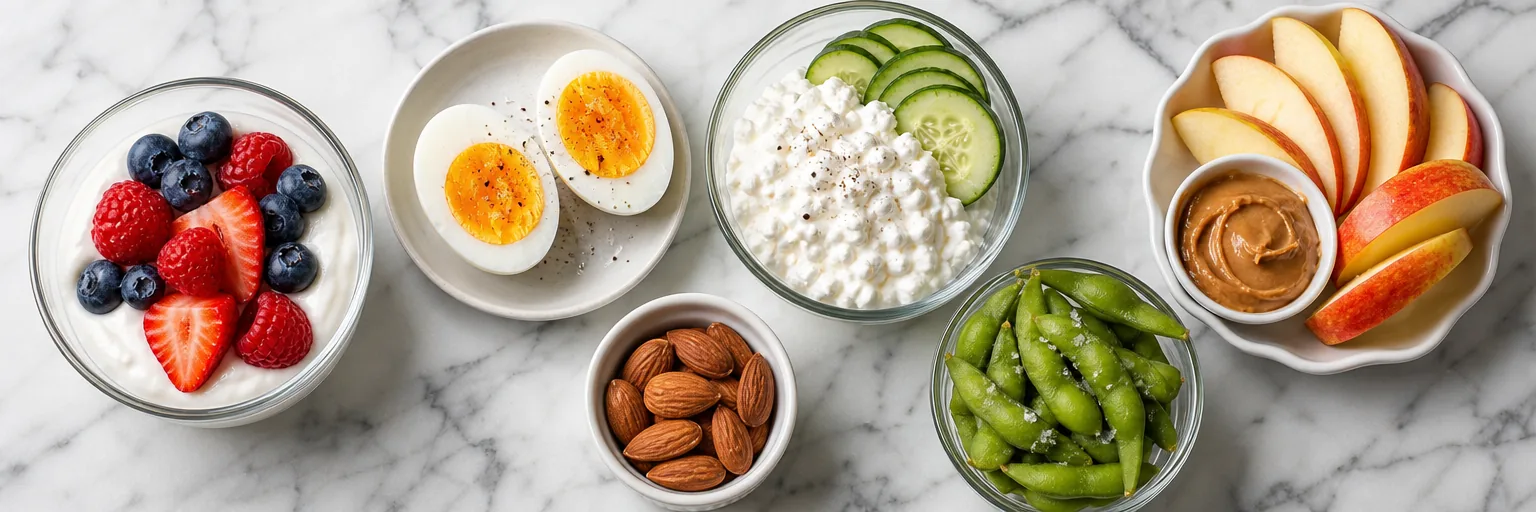
| Plain nonfat Greek yogurt + 1/2 cup berries | 3/4 cup yogurt | 140 | 17 | 3 | high satiety |
| Low-fat cottage cheese + cherry tomatoes | 1/2 cup cottage cheese | 110 | 14 | 1 | slow-digesting |
| 2 hard-boiled eggs | 2 large | 140 | 12 | 0 | grab-and-go |
| Edamame in shell, sea salt | 1 cup shelled | 120 | 11 | 5 | high fiber + protein |
| Tuna packet on cucumber rounds | 2.6 oz pouch | 100 | 17 | 1 | very lean |
| Turkey roll-ups + 1 string cheese | 2 slices turkey | 150 | 16 | 0 | no fridge needed |
| Apple + 1 tbsp natural peanut butter | 1 medium apple | 180 | 5 | 5 | balanced |
| 1 oz beef jerky + small handful grapes | 1 oz | 170 | 13 | 1 | travel-friendly |
| Roasted chickpeas | 1/4 cup | 130 | 7 | 5 | crunchy |
| Frozen banana “nice cream” | 1 small banana | 100 | 1 | 3 | dessert swap |
| Cottage cheese + pineapple | 1/2 cup each | 140 | 13 | 2 | sweet + savory |
| Single-serve skyr | 5.3 oz container | 110 | 17 | 0 | thicker than yogurt |
| Carrot + bell pepper sticks + 2 tbsp hummus | 1 cup veg | 110 | 4 | 5 | high volume |
| Edamame hummus + cucumber slices | 1/4 cup hummus | 150 | 8 | 4 | dairy-free |
| 1 medium orange + 12 almonds | 1 each | 170 | 4 | 5 | portable |
| Air-popped popcorn + parmesan | 3 cups | 130 | 4 | 4 | high volume |
| 1 string cheese + 1 small pear | 1 each | 150 | 8 | 5 | balanced |
| Smoked salmon on 2 cucumber rounds | 2 oz salmon | 120 | 12 | 0 | omega-3 |
| Roasted edamame, dry-roasted | 1/4 cup | 130 | 11 | 4 | shelf-stable |
| 1 Babybel + 1 clementine | 1 each | 100 | 5 | 2 | school-bag friendly |
| Plain rice cake + 1 tbsp almond butter | 1 cake | 140 | 4 | 2 | quick |
| Ready-to-drink protein shake | 11 oz bottle | 150 | 25 | 1 | post-workout |
| Hard-boiled egg + 1/2 avocado | 1 each | 200 | 7 | 5 | satiating |
| 1 cup raspberries + 1/4 cup cottage cheese | 1 cup berries | 130 | 7 | 8 | very high fiber |
| Microwave sweet potato + cinnamon | 1 small | 110 | 2 | 4 | warming |
For more high-volume snack options that fill the plate for very few calories, our low-calorie, high-volume foods guide covers the energy-density math behind why broth-based, water-rich, fibrous foods fill you up for so few calories.
Snack “shapes”: 5 templates that work
You don’t need 25 specific snacks memorized — you need five patterns.
1. Protein + fruit. Greek yogurt + berries. Cottage cheese + pineapple. String cheese + apple. Fruit handles sweetness and fiber; protein handles satiety. Almost always under 200 kcal.
2. Dairy + nut (portion-locked). A Babybel and 8 almonds. A string cheese and 10 walnut halves. Counted nut handful — never from the bag — keeps this under 200 kcal.
3. Vegetable + dip. Carrots and 2 tbsp hummus. Bell pepper and edamame hummus. Highest volume per calorie. Use a 1/4 cup measure for the dip.
4. Leftover + portion. A half-portion of last night’s dinner protein on a small salad. A reheated 1/2 cup of stew. The best snack is often a smaller portion of food that already worked at a meal.
5. Single-serve packet. Tuna packet, ready-to-drink shake, single-serve skyr, individually wrapped jerky. Pre-portioned by the manufacturer — critical for travel and unfamiliar kitchens. For the full trip protocol (anchor-breakfast rule, alcohol ceiling, post-vacation scale swing, and GLP-1 travel notes), see our travel and weight loss guide.
The evening-snack problem
Late-night eating isn’t metabolically worse than daytime eating in matched-calorie studies, but it’s reliably more eating — because evening snacks are usually unbudgeted and cue-driven (couch + TV + bag) rather than hunger-driven. For the fuller pattern-and-plan treatment — why late-night calories tend to cost more (decision fatigue, distracted eating, sleep-restriction hyperphagia, pantry inventory), the small-but-real insulin-sensitivity drop, and a four-step practical plan built around a fixed kitchen-close time and a pre-decided 150 to 250 kcal snack list — see late-night eating and weight loss. If the pattern is stronger than that — most of your daily calories arriving after the evening meal, morning appetite absent, and waking to eat overnight — that is not ordinary late-night snacking. It is a clinical pattern called night eating syndrome, a DSM-5-recognized circadian eating disorder with its own screening tools and treatment (CBT-NES and sertraline).
The practical playbook:
- Pre-decide. Decide before dinner whether you’re having an evening snack and what it is. “3/4 cup Greek yogurt at 9 pm” is a plan; “I’ll see how I feel” is how 400 unplanned calories appear.
- Make it a small ritual, not a free-pour. A pre-portioned bowl, eaten at the table. Five mindful bites count more than 15 distracted ones — see mindful eating for weight loss for the slowing-down practice that makes a small snack feel like enough.
- Use the 10-minute delay. Set a timer, drink water, take a short walk. About half the urges pass.
- Brush your teeth. Mint flavor + the “kitchen is closed” cue works reliably.
- Hot drink first. Herbal tea or decaf with a splash of milk fills the cup-and-couch cue without the calorie hit.
If evening eating is driven by emotion more than hunger, the emotional eating and weight loss guide covers the trigger work that’s upstream of any snack rule. And if the evening surge follows a daytime ADHD stimulant — methylphenidate or amphetamine that suppresses appetite all day and then clears around 7 to 9 pm — see ADHD and weight loss for the rebound pharmacology and the high-protein default-stocking architecture that actually defends against it.
Office, work-from-home, and kid-snack-drawer realities
The job of a snack changes by environment. The same person who eats one planned afternoon yogurt at the office eats 600 unplanned calories from their own kitchen.
Office. The vending machine and team snack drawer are the failure modes. Pack two pre-portioned snacks every day — a Greek yogurt cup, a jerky pack, a tuna pouch, a piece of fruit. If they’re in your bag at 3 pm, the vending machine doesn’t get the decision.
Work-from-home. The kitchen is 10 feet away and the line between “lunch” and “snacks made while waiting for the kettle” is thin. Write a daily snack plan and close the kitchen between meals — only open with a planned snack in mind.
Kid-snack-drawer households. Goldfish, granola bars, fruit snacks, and chips are engineered for kids’ calorie needs, not yours. Two adults grazing from the kid drawer easily add 400 to 600 calories per day. Keep adult snacks on a separate shelf and don’t open the kid drawer for yourself.
For what to keep stocked, our weight loss grocery list groups snacks by aisle, and high-protein snacks for weight loss has 20 protein-anchored options ordered by protein-per-calorie.
Snacks that seem healthy but blow the calorie budget
The “health halo” snacks are where weight-loss plans leak the most calories. None of these foods are bad. They’re just calorie-dense, marketed as healthy, and easy to over-pour.
| Snack | Typical “serving” eaten | Real kcal | The trap |
|---|---|---|---|
| Granola | 1 cup | 480 | Labeled serving is 1/4 cup |
| Smoothie (juice bar) | 16–20 oz | 450 | Mostly fruit juice + agave |
| Trail mix | Handful (1/2 cup) | 360 | Nut + dried fruit + chocolate calorie stack |
| ”Protein” bar with 15 g sugar | 1 bar | 280 | Closer to candy than protein |
| Dried fruit (raisins, mango) | 1/2 cup | 250 | 4–5x calorie density of fresh |
| Hummus + pita chips | 1/3 cup + 10 chips | 360 | Pita chips are the calorie load |
| Nut butter from the jar | ”1 spoonful” | 200 | Heaping tbsp = 16 g = 100 kcal each |
| Avocado toast | 1 slice + 1/2 avocado | 320 | Easy 2-slice creep |
| Acai bowl | 12 oz commercial | 500 | Granola + honey + banana stack |
| Coconut water + bar combo | 1 bottle + 1 bar | 380 | ”Recovery” framing, 80% sugar |
The fix isn’t elimination — it’s measurement. Granola in a measured 1/4 cup. Nut butter from a measured tablespoon. Trail mix pre-portioned into 1-oz bags before the bag opens. Once the eye is calibrated, you can go back to estimating.
Snacking and GLP-1s / appetite changes
If you’re on a GLP-1 medication (semaglutide, tirzepatide), the rules flip. Reduced appetite often means you can’t physically eat 3 large meals — and protein intake suffers. In that case, smaller, more frequent feedings become a tool, not a problem.
A typical GLP-1 snack pattern:
- 4 to 5 small “feeding occasions” per day
- Protein at every feeding (Greek yogurt, cottage cheese, single-serve shake, eggs)
- 100 to 200 kcal each, prioritizing protein density over volume
- A glass of water before each feeding to ease GLP-1 nausea
The goal during appetite suppression is hitting your protein floor and protecting muscle, not chasing a deficit. Talk to your prescriber about daily targets while on the medication.
1-day snack plan at 1,500 and 1,800 kcal
A sample showing where snacks fit alongside three balanced meals. Calories are approximate.
1,500 kcal day (~120 g protein)
| Slot | Item | Kcal | Protein (g) |
|---|---|---|---|
| Breakfast | Greek yogurt parfait + berries + walnuts | 380 | 28 |
| Morning snack | — (none needed) | 0 | 0 |
| Lunch | Chicken-and-quinoa bowl with roasted veg | 480 | 38 |
| Afternoon snack | Apple + 1 tbsp peanut butter | 180 | 5 |
| Dinner | Salmon + sweet potato + asparagus | 460 | 35 |
| Evening | Cottage cheese + raspberries | 140 | 14 |
| Total | ~1,640 | ~120 |
(Trim 100 to 140 kcal by dropping the morning snack — already done here — and tightening the olive-oil portion at dinner.)
1,800 kcal day (~130 g protein)
| Slot | Item | Kcal | Protein (g) |
|---|---|---|---|
| Breakfast | Veggie scramble + whole-grain toast + avocado | 460 | 28 |
| Morning snack | Single-serve skyr + berries | 150 | 17 |
| Lunch | Turkey-and-hummus wrap + side salad | 520 | 35 |
| Afternoon snack | Edamame + small orange | 170 | 11 |
| Dinner | Beef stir-fry + brown rice + broccoli | 560 | 38 |
| Evening | 3/4 cup Greek yogurt | 110 | 17 |
| Total | ~1,970 | ~146 |
(Trim ~150 kcal by halving the rice or skipping the evening yogurt.)
Frequently asked questions
Is snacking bad for weight loss? No. What matters is whether the snacks fit your calorie target. NHANES data shows snacks now make up about 25 percent of US adult calorie intake, much of it unplanned. A planned snack of 100 to 250 kcal anchored in protein or fiber can actually improve adherence by preventing the dinner overshoot. Grazing — 300 to 500 unplanned calories — is the real problem, not the act of eating between meals.
What’s the best snack to eat at night for weight loss? Slow-digesting, lower-calorie, pre-portioned. Strong options: 3/4 cup low-fat cottage cheese (110 kcal, 14 g protein), plain Greek yogurt with berries (140 kcal, 18 g protein), or a casein shake (120 kcal, 24 g protein). First, check whether you’re truly hungry — most late-night eating is habit, boredom, or stress rather than biological hunger.
How many calories should a snack be? Most adults losing weight do best at 100 to 250 kcal per snack. Use 100 kcal as a bridge, 150 to 200 kcal when the snack is doing real work, and 250 kcal only for pre-workout or larger eaters above 1,800 daily kcal. Above 250 kcal it’s a small meal, not a snack.
Are protein bars actually good for weight loss? Some are, most aren’t. Useful bars have at least 15 g protein, under 250 kcal, and at least 3 g fiber. Many “protein” bars hide 12 to 18 g of sugar and 250 to 300 calories. Treat bars as gap-fillers for travel or long workdays, not daily staples — whole-food snacks are usually more filling per calorie.
What about Greek yogurt — is it really a weight-loss snack? Plain nonfat Greek yogurt is one of the strongest weight-loss snacks per calorie at roughly 140 to 150 kcal and 16 to 18 g of protein per 3/4 cup. Flavored versions often add 12 to 20 g of sugar and lose the protein-per-calorie advantage. Buy plain and add your own fruit, cinnamon, or a teaspoon of honey.
Can I lose weight if I snack between meals? Yes. Total calories drive weight loss; eating frequency doesn’t. Controlled trials matching calories across 3-meal and 5- to 6-meal patterns find no meaningful difference in weight outcomes (Cameron 2010, Bachman 2012). Use the structure — 3 meals only, or 3 meals plus planned snacks — that keeps you most consistent.
Sources
- Leidy HJ, Tang M, Armstrong CL, Martin CB, Campbell WW. The effects of consuming frequent, higher protein meals on appetite and satiety during weight loss in overweight/obese men. Obesity (2011).
- Cameron JD, Cyr MJ, Doucet E. Increased meal frequency does not promote greater weight loss in subjects who were prescribed an 8-week equi-energetic energy-restricted diet. British Journal of Nutrition (2010).
- Bachman JL, Raynor HA. Effects of manipulating eating frequency during a behavioral weight loss intervention: a pilot randomized controlled trial. Obesity (2012).
- Mattes RD. Snacking: a cause for concern. Physiology & Behavior (2018).
- Njike VY, Smith TM, Shuval O, et al. Snack food, satiety, and weight. Advances in Nutrition (2016).