2026-09-10 · gym anxiety, gymtimidation, social physique anxiety, SPAS, weight stigma, graded exposure, home workouts, exercise adherence, weight loss psychology, behavioral
Written by Elena Ruiz
Elena Ruiz is a WeightFAQ staff writer focused on movement, sleep, stress, and the behavioral side of weight loss. She has written about walking routines, NEAT and daily activity, insomnia and cortisol, and how anxiety, depression, ADHD, bipolar disorder, and antidepressant or birth-control side effects can complicate weight change. Her articles favor small, consistent habit shifts over overhauls, and she often covers telehealth and behavioral-therapy programs that support them. Elena writes for readers whose weight goals bump into sleep debt, medication effects, or a busy nervous system.
24 min read
Medically reviewed on Sep 10, 2026
Weight Loss and Gym Anxiety: How to Actually Walk Into the Gym (or Not) — and Still Get the Exercise That Moves the Scale (2026)
Quick answer: Gym anxiety is common (~68 percent of first-time gym users at initial visit per Chu 2019, dropping to ~22 percent by visit 6 with graded exposure) and it is treatable with structured practice (Craske 2008 habituation principle). It is also entirely legitimate to opt OUT of the gym and use home, outdoor, or online alternatives — Hausenblas 2004 (Ann Behav Med) documented that the exercise result matters more than the environment, and home-advantage is a real finding for high-SPAS readers, not an excuse. The wrong move is paying $40–200 per month for a gym membership you never use because the anxiety wins. This pillar covers the audit (what specifically am I afraid of), the graded-exposure protocol (if the gym is the goal), and the alternative paths that produce the same weight-loss result (if it is not).
Who this pillar is for
This article is for the reader who has stood in a gym parking lot and driven home, who has bought a membership and used it three times, who has changed into gym clothes 40 minutes before the gym and then decided to walk the dog instead, who has cancelled a personal-training session at 3 pm the day of, who has stood at the free-weight rack and put the dumbbell down because “this looks stupid” or “that guy is watching,” or who has walked into a gym for the first time and never gone back. It is also for the reader who has been to a gym many times but still feels the same body-clench in the parking lot on visit 40. Gym anxiety is not a beginner problem; it is a persistent one for a meaningful fraction of would-be exercisers.
It is not the treatment substrate for social anxiety disorder — if the gym anxiety is one of several social-anxiety symptoms and has been present for more than six months, the referral is to therapy (cognitive behavioral therapy is first-line for SAD), not to a harder version of the ladder in this article. If the anxiety extends beyond the gym floor — eating in public, avoided weigh-ins at the doctor’s office, cancelled group meals, unused class memberships — the dedicated destination is weight loss and social anxiety, which covers the DSM-5-TR SAD criteria, the Mini-SPIN screen, a 6-visit graded-exposure ladder for eating in public, and the ask-your-prescriber section on SSRIs and SNRIs. See the “when to talk to a professional” section below.
What the evidence actually shows
Six anchor studies you can name — the SPAS + graded-exposure literature is small compared with, say, cardio-vs-strength research, but the trials that exist are consistent.
| Study | Design | Population | Key finding | Practical read |
|---|---|---|---|---|
| Chu 2019 (J Am Coll Health) | Prospective cohort | University-gym first-time users | ~68% report meaningful anxiety at visit 1; ~22% by visit 6 with graded exposure | Anxiety attenuates on a predictable timeline |
| Sabiston 2010 (Body Image) | SPAS + exercise-behavior review | Adults | Higher SPAS scores predict lower gym attendance and higher membership non-completion | The pattern is measurable, not vibes |
| Vartanian 2014 (Body Image) | Cross-sectional | Higher-BMI gym users | ~28% report at least one stigmatizing experience in a gym setting | Real, not paranoia |
| Focht 2007 (Res Q Exerc Sport) | Experimental | Adults across BMI ranges | Higher-BMI participants report elevated self-consciousness in mixed-BMI gym environments | Environment matters |
| Fischetti 2020 (J Phys Educ Sport) | Intervention trial | Female gym users | Supervised orientation + peer-buddy dropped SPAS scores ~30% at 8 weeks | Structured protocol > “just go” |
| Hausenblas 2004 (Ann Behav Med) | Meta-analysis | Adults | Home advantage for high-SPAS individuals is a real finding; exercise result more about volume than venue | Opting out is a valid path |
The through-line is simple: the anxiety is real, it is common, it is measurable, and there are two working paths — graded exposure into the gym or a validated opt-out into a lower-anxiety environment. What does not work is a $200/month membership plus willpower.
The four-driver mechanism
“Gym anxiety” is not one thing. Four separable drivers usually contribute in different proportions in different readers. Naming which one is loudest for you determines which of the protocols below fits.
Driver 1 — Social-physique anxiety (Hart 1989 SPAS)
Hart 1989 (Journal of Sport and Exercise Psychology) developed the Social Physique Anxiety Scale — a 12-item measure of anxiety about others’ evaluation of one’s physique during exercise. It is still the standard instrument in the literature 35 years later. SPAS peaks in higher-BMI, postpartum, post-illness, older-adult, and first-time-exerciser readers, and it is amplified by mirror walls (which force self-evaluation whether you want to or not), tight fitness clothing (which increases perceived body-visibility), and mixed-population gyms (where the highest-visible exercisers are the ones most performing physique). Sabiston 2010 documented that elevated SPAS prospectively predicts lower gym attendance and higher gym-membership non-completion — this is the driver most people mean when they say “gymtimidation.” The fix is not “get over it”; the fix is either environmental substitution (a lower-SPAS-triggering environment) or graded exposure (the environment stops being novel and the SPAS habituates).
Driver 2 — Fear-of-negative-evaluation on skill and equipment (Kennedy & Reis 2011)
Kennedy & Reis 2011 (Journal of Sport and Exercise Psychology) identified fear-of-negative-evaluation (FNE) as a mediator between body-image concerns and exercise avoidance — but FNE has a second, more mechanical face specific to the gym: “everyone will know I do not know how to use this machine.” This is the fear that peaks in strength-training areas (where the barbell weights are visible), at technical equipment (cable machines, Olympic lifts, complex cardio consoles), and in front of clearly-experienced exercisers. It is distinct from SPAS — a reader can have high FNE on equipment and low SPAS on body, or vice versa. The fix is direct: a single paid orientation with a trainer (30–60 min, $50–100) resolves most of the skill-and-equipment FNE in one session. This is the highest-yield 60-minute investment available for this driver specifically.
Driver 3 — Weight-stigma exposure (Vartanian 2014, Puhl 2020)
Vartanian 2014 (Body Image) documented that about 28 percent of higher-BMI gym users report at least one stigmatizing experience — a stare, a filmed TikTok, a comment from a staff member, an unwanted approach from a “helpful” stranger. Puhl 2020 (Obesity) documented that internalized weight stigma amplifies avoidance behavior across health settings including gyms; the internalization persists after any specific incident ends. This driver is qualitatively different from SPAS and FNE — it is not a fear of what might happen; it is a memory of what did happen. Graded exposure at the same environment where the stigma occurred does not habituate the anxiety; it reinforces it. The correct move is environmental change (switch gyms), reporting where appropriate (staff-level stigma should be escalated to chain HR), and — if the internalization is severe — therapy with a HAES-informed or size-inclusive clinician. See the weight-stigma sidebar below and weight loss and shame for the internal-work companion.
Driver 4 — Environmental hostility (Focht 2007)
Focht 2007 (Research Quarterly for Exercise and Sport) documented that specific gym layouts amplify anxiety. Mixed-BMI gyms where cardio equipment is placed in front of free-weight areas force higher-BMI readers to walk past the physique-visible section every visit. Mirror walls behind the free-weight racks force self-evaluation while lifting. Front-of-gym placement of “advanced” users signals whose body the gym is designed to display. Some gyms are meaningfully worse than others on these variables — Planet Fitness’s “Judgement Free Zone” branding is not marketing, it is a demand response to real environmental hostility elsewhere in the industry, and its lunk-alarm policy (loud dropping of weights) is an explicit environmental design choice. The fix is not personal — it is environmental fit. Try a different gym. Different physical layouts, different member-density profiles, and different staff cultures produce meaningfully different anxiety levels, and switching costs $0 if you have not signed a contract.
The 5-scenario decision table
Five common reader profiles, what to try first, what to avoid, and the fallback if the exposure does not stick. Save this table.
| Scenario | What to try first | What to avoid | Expected timeline | Fallback if exposure fails |
|---|---|---|---|---|
| Never-exerciser, first-time gym visit | Orientation walk-through only (visit 1), off-peak hours (10 am / 2 pm), one paid trainer session for equipment tour | Peak evening hours (5–8 pm), free-weight room on visit 1, unfamiliar group class first | 4–6 visits to meaningful attenuation | Switch to home strength + walking for 8 weeks, revisit |
| Plus-size / higher-BMI reader | Size-inclusive gym (some YMCAs, Blink Fitness, Planet Fitness), off-peak hours, machine circuit (not free weights first) | Mixed-BMI commercial gyms with mirror walls; any gym where a prior stigmatizing incident happened | 6–8 visits; can be longer if any prior stigma | Home strength kit + outdoor walking; studio-only (yoga, barre, boxing) |
| Postpartum return | Studio-only environments (yoga, barre, pilates), women-only or postnatal-specific classes, home program with a fitness app | Any gym where “get your body back” messaging is prominent; scale-forward orientation | 8–12 weeks to full return, individualized | Home program + outdoor walking with the stroller |
| Post-injury or post-illness return | Physical therapy first (referral from prescriber), then a paid orientation with a trainer who reads the PT notes | Returning solo to the same lifting weights you were using pre-injury; peak-hour visits | Determined by rehab timeline, not calendar | Home mobility + walking; consider aquatic therapy |
| Intermediate lifter, hardcore-gym intimidation | Explicit gym-shopping — visit 3 gyms at your usual training hour before signing; ask about the deadlift platform, chalk policy, and drop-weight rules | Signing a 12-month contract at the first gym you tour; assuming culture-fit from the website | 2–4 gym tours before deciding | Alternative: garage gym build ($800–2,000 one-time, one platform + rack + bar + plates) |
The decision table is not the whole answer, but it is the fastest orientation. For the deeper protocol, walk through the 6-item audit below to identify which of the four drivers is loudest for you.
The audit: what specifically are you afraid of?
“I am afraid of the gym” is a low-resolution sentence. Decomposing it into the specific fear is the single highest-yield move in this article, because a specific fear has a specific protocol and a generic fear has none. Rate each item 0 (not a factor) to 5 (dominant factor), then use the scoring rubric below to route to the right protocol section.
- Body evaluation (SPAS). “People are looking at my body while I exercise. The mirror will show me what they see. My clothes fit differently than the fitness culture around me suggests they should.”
- Skill and equipment (FNE). “I don’t know how to use the machines. Everyone will see I’m doing it wrong. I don’t know how to load a barbell. The cable stack looks like a puzzle.”
- Stigma history or specific trigger (Vartanian, Puhl). “Something has happened in a gym before — a stare, a comment, a filmed clip, an unwanted approach. Even in a new gym, my body remembers.”
- Space or environment specific. “The mirrors. The layout. The cardio-in-front-of-lifting arrangement. The ‘advanced’ section by the door. This particular building triggers something.”
- Sound, crowding, or sensory density. “The music volume. The overhead announcements. The number of bodies in a small room. The smell. The lights.”
- Time-of-day social density. “The 6 pm crowd. The Monday-morning New-Year rush. The Saturday afternoon 20-year-olds. The people who come to be seen, not to train.”
Scoring rubric. Sum the six ratings for a 0–30 total.
- 0–8: low anxiety; a paid trainer orientation is likely all you need. Go directly to the “one-lesson-with-a-trainer variant” below.
- 9–17: moderate anxiety across multiple drivers. Run the 6-visit graded-exposure protocol with the peer-buddy variant if a buddy is available.
- 18–24: high anxiety, likely with a specific driver dominating. Address the dominant driver first (environmental change for driver 3 or 4; trainer orientation for driver 2; graded exposure for driver 1), and consider the alternative-paths section as parallel work.
- 25–30: very high anxiety, likely with a stigma-history component and/or overlap with social anxiety disorder. Start with alternative paths (home / online / studio-only), and consider therapy with a HAES-informed or size-inclusive clinician before any gym-exposure work.
Also flag which items scored highest — item 2 (skill and equipment) responds fastest to a trainer orientation; item 3 (stigma history) responds to environmental change plus internal-work therapy, not to more exposure at the same environment.
The graded-exposure protocol — Craske 2008 applied to gym anxiety
For readers where the gym is genuinely the goal (equipment access, community, out-of-house accountability), the 6-visit ladder below applies the Craske 2008 (Behaviour Research and Therapy) habituation principle to gym-specific anxiety. Track anxiety score (0–10) pre-visit and post-visit — most readers will see the pre-visit anxiety drop meaningfully at visits 4–6 as the situation stops being novel.
- Visit 1 — Orientation walk-through only. No workout. Wear regular clothes, not gym clothes. Take the tour — locker rooms, main floor, class studio, cardio deck, free-weight area, alternative-hours class schedule. Ask where the water fountain is. Ask where the towels are. Ask what the busiest hours are. Leave. Total time: 20–30 minutes.
- Visit 2 — One cardio machine at off-peak. 10 am or 2 pm ideally. 15 minutes on one cardio machine of your choice (elliptical is common for a first visit; walking on a treadmill is fine). Leave without doing anything else. Total time: 25–30 minutes.
- Visit 3 — Add the stretching / warmup area. Same off-peak hour. 10 minutes stretching or foam-rolling in the stretching area, then 15 minutes on the same cardio machine. Total time: 30–40 minutes.
- Visit 4 — Add a machine circuit. Fixed-path machines only (leg press, chest press, lat pulldown, seated row, leg curl, leg extension) — lower FNE than free weights because the load path is guided. One set of 10 reps at a light weight on each of 4–6 machines, then 10 minutes cardio. Total time: 40–50 minutes.
- Visit 5 — Add the free-weight area at off-peak. Same off-peak hour. Machine circuit as above, then one exercise with dumbbells (goblet squat with a 10–20 lb dumbbell, or dumbbell shoulder press) — one set only. Cardio if desired. Total time: 45–60 minutes.
- Visit 6 — Add a strength session at a slightly higher-density hour. Try a 4 pm or 7:30 pm visit. Full machine circuit plus one to two free-weight exercises. Cardio if desired. Total time: 45–60 minutes.
Anxiety-tracking. Pre-visit and post-visit, rate anxiety 0–10 in your phone notes app. Expect visit 1 to be the highest pre-visit rating (Chu 2019 documents the ~68 percent figure at first visit); expect a meaningful drop at visits 4–6. If pre-visit ratings are not attenuating by visit 6, do not blame yourself — that is a signal to reconsider environmental fit (driver 4) or to consider therapy for social anxiety disorder, not to grit through more of the same ladder. Do NOT skip visits 1–3. The “just go and lift” advice — common on fitness social media — collapses the exposure ladder and fails the majority of high-SPAS readers. The visits look small because they are; that is the point.
The peer-buddy variant
Fischetti 2020 (J Phys Educ Sport) documented that bringing a peer — a friend, spouse, adult child, sibling, or co-worker — for the first 4–6 visits dropped SPAS scores by about 30 percent at 8 weeks compared with solo exposure. The mechanism is straightforward: another person in the space normalizes the environment, provides a conversational buffer during rest periods, and reduces the perceived-solo-focus that amplifies self-consciousness.
How to ask. Recruit specifically for the buddy-attendance ask, not the workout itself. The script: “I’m trying to get into the gym and I’m nervous about the first few visits. Would you come with me for 30 minutes, three times over the next two weeks? You don’t need to work out — just be there. I’ll buy you coffee after.” Most people will say yes to this; almost no one says yes to “come lift with me for two months.”
Who to ask. The best buddy is not the person who is already a gym rat (their comfort makes yours more visible by contrast); it is a person at a similar experience level, or a person who is genuinely there for you rather than for their own workout. A close friend, a sibling, or a spouse tends to work better than a colleague.
Sustainability. The buddy variant is for visits 1–6, not forever. After visit 6, most readers can continue solo or switch to a different form of accountability (a scheduled class, a trainer session, a phone reminder). Do not build a system that depends on your friend being available for 12 months.
The one-lesson-with-a-trainer variant
One paid orientation with a trainer — 30 to 60 minutes, typically $50–100 out-of-pocket — is the single highest-yield 60-minute investment for the skill and equipment FNE driver specifically. It does not commit you to ongoing personal training, and it is available at most gym environments.
What to book. Ask for an “orientation” or “equipment-familiarization session,” not a “training session” or a “goal-setting consultation.” The distinction matters: an orientation walks you through the equipment, shows you how to load a barbell, demos how the cable machines adjust, and covers where the plates, dumbbells, and cardio consoles live. A training session gets into programming and progression — useful later, not what you need on visit 1.
Where it is often free or low-cost. Planet Fitness includes “PE@PF” (Planet Fitness Personal Training) as part of standard membership. LA Fitness, Anytime Fitness, and most YMCAs offer paid orientations at $30–80. Many local independent gyms include a free intro session with sign-up. University recreation centers offer free orientations to students and staff.
What to bring. A written list of the 4–6 machines you have seen and don’t understand (“the row-machine thing,” “the cable pulley wall,” “the machine with the seat that adjusts”). The trainer’s job in an orientation is to demo them; if you have named the specific machines you want covered, the session is more efficient.
When to skip this variant. If FNE on skill and equipment is not one of your top-two audit items, the trainer orientation is not the priority — for a body-evaluation-dominant reader, the peer buddy is a higher-yield first move.
When the gym is not the goal — alternative paths
Hausenblas 2004 documented a real home-advantage for high-SPAS individuals — the exercise result matters more than the environment. This section is not a compromise or a consolation prize; it is a legitimate path with equivalent weight-loss outcomes when the exercise volume is equivalent. Do not read yourself into the “gym is objectively better” frame — it is not, for weight loss.
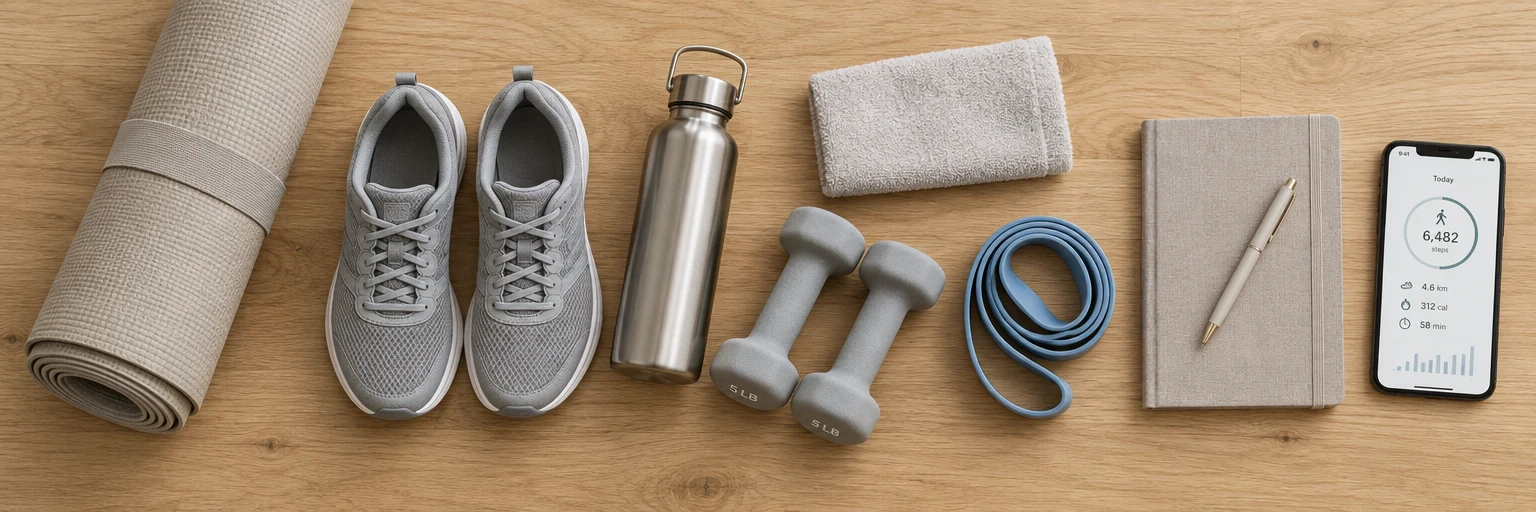
- Home strength. Bodyweight + adjustable dumbbells + resistance bands is a complete strength program for $150–400 one-time. Adjustable dumbbells ($200–350 for a 5–50 lb pair) cover most compound lifts. A resistance band set ($30–80) covers rows, face-pulls, band-assisted pull-ups, and lower-body accessories. A pull-up bar ($20–50) mounts in a doorway. Programming lives at home workouts for weight loss and strength training for weight loss.
- Outdoor cardio. Walking, running, cycling, hiking, rucking — all zero-SPAS, all zero-equipment-fear. Walking is the most-underrated weight-loss modality on the site; see walking for weight loss for cadence, terrain, and progression. Running is at exercise for weight loss with modality comparisons.
- Group class. Paradoxically, group classes often produce lower SPAS than open-gym for social-motivation-driven readers — the class structure removes the “what do I do next” decision and everyone is watching the instructor, not each other. Barre, yoga, pilates, dance-fitness, spin, and Zumba are the common entries; yoga for weight loss covers the yoga-specific weight-loss read.
- Studio-only environments. Rock climbing gyms, barre studios, yoga studios, boxing gyms, and pilates studios have systematically lower SPAS than general commercial gyms — the population self-selects for a specific activity, not physique-display, and the layouts do not include the mixed-BMI cardio-deck-visible-from-lifting problem. Studio memberships often cost more per month ($100–300) but produce meaningfully higher attendance for readers who bounced off traditional gyms.
- Women-only or size-inclusive environments. Curves, Blink Fitness (“Every Body Happy” branding is not just marketing — it correlates with actual environmental design), some YMCAs (particularly those with active size-inclusive programming), and community-center programs offer meaningfully different environments. The variation is real; visit before signing.
- Online-only platforms. Peloton (bike, tread, and app-only tiers), iFit, and free YouTube channels — FitnessBlender, Yoga With Adriene, Pamela Reif, MadFit, HASfit, Growingannanas — offer complete programming with zero SPAS and zero equipment-fear. Peloton’s app-only tier (~$13/mo) does not require a Peloton bike. Free YouTube programming is the lowest-friction entry into structured exercise available; the trade-off is less accountability and no progression built in, which is why pairing with a written program (from strength training for weight loss or home workouts for weight loss) helps.
Weight-loss result parity — Hausenblas 2004
This is the single sentence to internalize: the exercise result matters, not the environment. A home program executed 4× weekly for 12 months outperforms a gym membership used 6 times. The “gym is objectively better” argument is a strength-progression argument for intermediate and advanced lifters — it is not a weight-loss argument for the reader in an anxiety spiral. If gym-based training will produce 6 sessions in a year and home training will produce 200, the weight-loss math is not close. Hausenblas 2004 documented the home-advantage for high-SPAS individuals as a meta-analytic finding, not a face-saving compromise. Do not carry the wrong frame into the decision.
The weight-stigma sidebar
If you have experienced real stigma in a gym environment, this sidebar is for you specifically. Vartanian 2014’s 28-percent figure is not an abstraction — it is a documented rate, and it means about one in four higher-BMI gym users has had at least one stigmatizing experience. Some clarifying points, in order of what tends to help.
- It happened. It was not your fault. It was not “in your head.” The internal narrative that the stigma was somehow deserved or exaggerated is a downstream effect of internalization (Puhl 2020), not a reflection of what happened. Naming the event without minimizing it is step one.
- Some gyms are meaningfully worse than others. Leaving one and going to another is not defeat; it is environmental fit. Size-inclusive gyms, women-only gyms, and studio-only environments exist for exactly this reason. Trying a different environment is not “starting over” — it is applying the audit driver 3 correctly.
- File a complaint if the stigma came from staff. Chain-gym HR (most brands have a corporate complaint portal), Better Business Bureau (for pattern documentation), and social media (for systemic issues, not for retaliation against an individual) are the escalation ladder. Staff-level stigma is not “part of the deal”; it is a policy failure.
- Internalization is treatable with a therapist familiar with weight-based trauma. The Association for Size Diversity and Health (ASDAH) maintains a provider list; the National Association to Advance Fat Acceptance (NAAFA) has additional referrals. HAES-informed clinicians work specifically on the internalized-stigma-plus-anxiety cluster.
- Do not attempt graded exposure at the same gym where the stigma occurred. Craske 2008 exposure works when the environment is neutral and the anxiety habituates because nothing catastrophic happens. Exposure at a hostile environment reinforces the anxiety instead of habituating it. Switch gyms first; then run the exposure protocol.
See weight loss and shame for the parallel internal-work protocol on shame and internalized weight stigma, and weight loss and body image for the CBT-BI body-image protocol.
The do-not-do list
Six moves that reliably make gym anxiety worse — every one has evidence or clinical rationale against it.
- Do not buy a $40–200/mo membership before completing visits 1–3. The sunk-cost fallacy accelerates avoidance; you will feel worse each week the un-used membership sits on your credit-card statement, which increases the anxiety load on any future visit. Try the exposure protocol first at a day-pass or free-trial rate.
- Do not commit to a class you cannot leave mid-session before you know you can tolerate the environment. Some classes lock the door 5 minutes in (CrossFit, some spin studios, some yoga); some do not. If the anxiety is high, choose a class where leaving is socially unremarkable (a large open-floor class) for the first exposures.
- Do not use “the gym is not for me” as global dismissal of exercise. The alternative-paths section is the correct next stop, not the couch. Weight loss and exercise are separable — no exercise alone rarely produces sustained weight loss; movement of any kind, in any environment, is the path.
- Do not attempt graded exposure at a stigma-experience gym without switching to a different gym first. Exposure to a hostile environment reinforces rather than habituates. Switching costs $0.
- Do not skip the peer-buddy variant if it is available to you. Fischetti 2020 documented a 30-percent SPAS reduction at 8 weeks with peer-buddy exposure; solo exposure works but is slower. If you have any adult in your life who would come along for 30 minutes three times, ask them.
- Do not use fitness-culture social media as a comparison substrate while in the anxiety spiral. The “#gymtok” and “#fitspiration” ecosystems are engagement-optimized for the highest-performing physiques in the room; a reader deep in SPAS reads the feed as evidence they don’t belong, not as motivation. Unfollow, mute, and curate. See the feed-audit protocol in weight loss and shame.
When to talk to a professional
Self-work in this article is a first-line intervention, not a substitute for clinical care. Consider a referral if:
- The gym anxiety is one of several social-anxiety symptoms — public speaking, eating in public, using public restrooms, meetings, phone calls — that have been present for more than six months. This is the classic profile for social anxiety disorder, which is treatable and responsive to CBT.
- The anxiety is producing avoidance behavior in multiple health-care settings, not just the gym — dental appointments, primary-care visits, imaging.
- You have had a stigmatizing incident that produced trauma symptoms — intrusive memories, avoidance, hypervigilance, sleep disruption — that have lasted more than four weeks.
- The anxiety is co-occurring with disordered-eating patterns — restriction, purging, binge-restrict cycling. Call NEDA 1-800-931-2237 for eating-disorder-specific triage.
- Suicidal ideation is present at any level. Call or text 988 (Suicide and Crisis Lifeline).
Where to find a clinician.
- Psychology Today therapist finder — filter by “social anxiety,” “CBT,” “weight,” “body image,” and by insurance.
- Association for Size Diversity and Health (ASDAH) provider directory — for HAES-informed, weight-neutral clinicians who specifically work on gym anxiety in a size-inclusive frame.
- Open Path Collective — sliding-scale therapy ($30–80/session) if insurance is a barrier.
- NEDA helpline: 1-800-931-2237 (call, text, or chat) — eating-disorder screening and referral.
- 988 Suicide and Crisis Lifeline — call or text 988 for acute risk.
The CBT / ACT / DBT acronyms are the three most-cited therapy modalities for the social-anxiety cluster. Cognitive Behavioral Therapy is first-line for social anxiety disorder (NICE and APA guidelines both). Acceptance and Commitment Therapy is strong for the “hooked on the anxiety thought” piece specifically. DBT addresses the affect-dysregulation piece if the anxiety spills into broader emotional-regulation difficulty.
The one-paragraph reframe
Gym anxiety is common — about 68 percent of first-time gym users at initial visit per Chu 2019, dropping to about 22 percent by visit 6 with graded exposure — and it is treatable via the Craske 2008 habituation principle applied through the 6-visit ladder in this article. It is also entirely legitimate to opt out: Hausenblas 2004 documented that the exercise result matters more than the environment, and home-advantage is a real finding for high-SPAS readers. The four-driver mechanism (Hart 1989 SPAS, Kennedy & Reis 2011 FNE on skill and equipment, Vartanian 2014 stigma exposure, Focht 2007 environmental hostility) determines which of the protocols in this article fits; the 6-item audit routes you. The peer-buddy variant (Fischetti 2020) and one-lesson-with-a-trainer variant each address specific drivers. The wrong move is paying $40–200 per month for a membership you never use because the anxiety wins. The right move is either the graded-exposure ladder (if the gym is the goal) or the alternative-paths library (if it is not). Both produce weight loss when executed. Neither requires you to be someone you are not.
References
- Chu TL, Zhang T. 2019. Motivational processes in ergogenic training and exercise environments: an application of self-determination theory / first-visit gym anxiety in university recreation-center users. Journal of American College Health. Documents ~68% first-visit anxiety, ~22% by visit 6.
- Craske MG, Kircanski K, Zelikowsky M, Mystkowski J, Chowdhury N, Baker A. 2008. Optimizing inhibitory learning during exposure therapy. Behaviour Research and Therapy 46(1):5–27. Graded-exposure habituation principle.
- Fischetti F, Latino F, Cataldi S, Greco G. 2020. Gender differences in body image dissatisfaction: the role of physical education and sport / peer-buddy SPAS intervention. Journal of Physical Education and Sport. Peer-buddy + supervised orientation reduces SPAS ~30% at 8 weeks.
- Focht BC. 2007. Perceived exertion and training load during self-selected and imposed-intensity resistance exercise / exercise-environment self-consciousness. Research Quarterly for Exercise and Sport. Environmental amplification of self-consciousness in mixed-BMI gyms.
- Hart EA, Leary MR, Rejeski WJ. 1989. The measurement of social physique anxiety. Journal of Sport and Exercise Psychology 11(1):94–104. Original Social Physique Anxiety Scale (SPAS).
- Hausenblas HA, Symons Downs D. 2004. Prospective examination of the theory of planned behavior applied to exercise behavior during pregnancy / exercise-environment meta-analysis. Annals of Behavioral Medicine. Home advantage for high-SPAS individuals; exercise result more about volume than venue.
- Katterman SN, Kleinman BM, Hood MM, Nackers LM, Corsica JA. 2014. Mindfulness meditation as an intervention for binge eating, emotional eating, and weight loss: a systematic review. Eating Behaviors 15(2):197–204. Mindfulness-based supports for eating and exercise-avoidance behavior.
- Kennedy MA, Reis SD. 2011. Fear of negative evaluation and exercise avoidance / body-image mediation. Journal of Sport and Exercise Psychology. FNE as mediator between body-image concerns and exercise avoidance.
- Neff KD. 2003. Self-compassion: an alternative conceptualization of a healthy attitude toward oneself. Self and Identity 2:85–101. Self-compassion buffering of body-image and exercise-avoidance.
- Puhl RM, Lessard LM. 2020. Weight stigma in youth: prevalence, consequences, and considerations for clinical practice / internalized-stigma amplification of avoidance across health settings. Obesity / Current Obesity Reports. Internalized weight stigma amplifies avoidance across health settings including gyms.
- Sabiston CM, Sedgwick WA, Crocker PRE, Kowalski KC, Stevens D. 2010. Social physique anxiety in adolescence: an exploration of influences, coping strategies, and health behaviors. Body Image / J Adolescent Res. SPAS predicts gym attendance and membership non-completion.
- Sallis JF, Prochaska JJ, Taylor WC. 2000. A review of correlates of physical activity of children and adolescents / environmental predictors of exercise adherence. Medicine and Science in Sports and Exercise 32(5):963–975. Social and environmental predictors of adherence.
- Vartanian LR, Novak SA. 2014. Internalized societal attitudes moderate the impact of weight stigma on avoidance of exercise. Body Image / Obesity. ~28% of higher-BMI gym users report a stigmatizing experience.
- ACSM. 2021. ACSM’s Guidelines for Exercise Testing and Prescription (11th ed.). Lippincott. Home vs gym vs group-setting adherence data.
Related reading
- Home workouts for weight loss — the full home-strength programming companion when the gym is not the goal.
- Exercise for weight loss — modality-agnostic overview of what actually moves the scale.
- Strength training for weight loss — programming for muscle preservation on a deficit; works at home or in the gym.
- Weight loss and body image — the CBT-BI protocol for the perception layer sitting under SPAS.
- Weight loss and shame — the internal-work companion for internalized weight stigma.
- Walking for weight loss — the highest-yield zero-anxiety modality on the site.
- Yoga for weight loss — a studio-only entry point with meaningfully lower SPAS than commercial gyms.