
2026-06-13 · high blood pressure, hypertension, weight loss, DASH diet, cardiovascular health, sodium, metabolic syndrome
Updated 2026-06-15
Written by WeightFAQ Staff
Evidence-informed guidance from the WeightFAQ editorial team.
14 min read
Last editorial review Jun 13, 2026
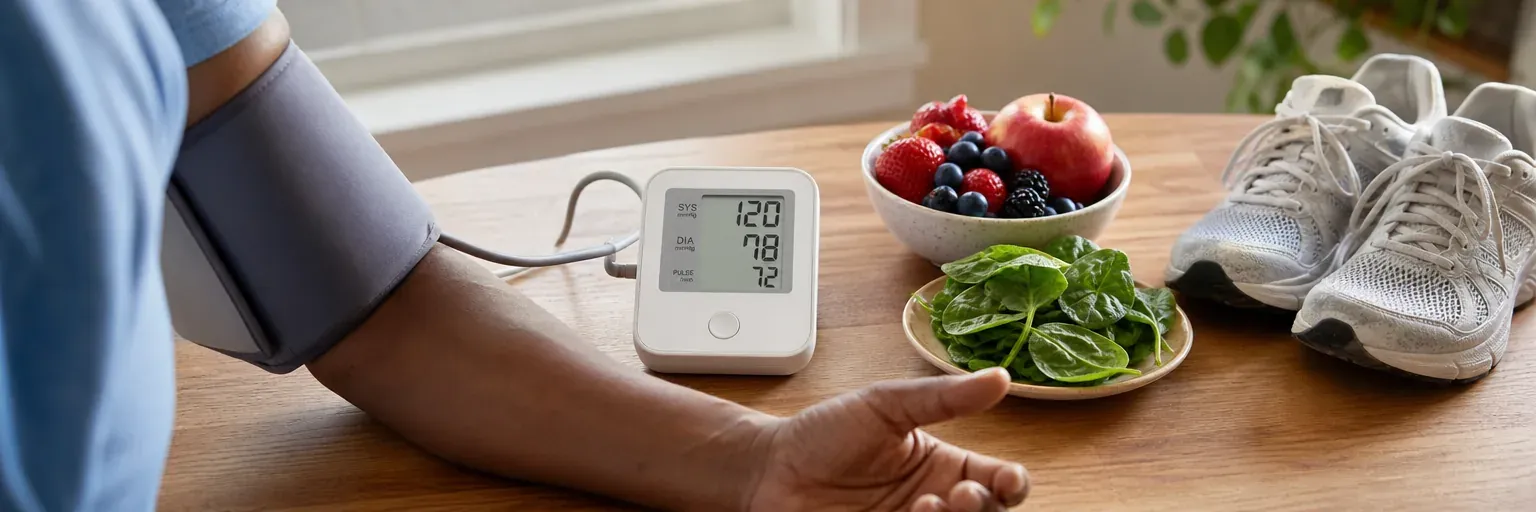
High Blood Pressure and Weight Loss: How Much to Lose to Drop Your Numbers
Quick stats
- Weight-loss dose-response: ~1 mmHg systolic per kg lost
- Target loss for a clinically meaningful drop: 5–10% body weight
- Sodium target: <2,300 mg/day (DASH); <1,500 mg/day (DASH-Sodium, larger BP drop)
- Top non-drug levers: weight loss, DASH, sodium, alcohol, exercise
- Time to first measurable drop: 2–4 weeks
What hypertension is and the 2017 ACC/AHA thresholds
Blood pressure is the force on the artery walls with each heartbeat — systolic during a beat, diastolic between beats. Hypertension is the diagnosis when those numbers stay elevated, not when one reading happens to be high. The 2017 ACC/AHA guideline split the diagnostic ladder into four tiers.
| Category | Systolic (mmHg) | Diastolic (mmHg) |
|---|---|---|
| Normal | <120 | and <80 |
| Elevated | 120–129 | and <80 |
| Stage 1 hypertension | 130–139 | or 80–89 |
| Stage 2 hypertension | ≥140 | or ≥90 |
A single reading of 180/120 or higher is a hypertensive crisis. Sit, recheck after 5 minutes — if it stays there, contact a clinician the same day, and go to the ER if you also have chest pain, shortness of breath, vision changes, severe headache, weakness on one side, or trouble speaking.
Two patterns complicate the office reading. White-coat hypertension is high in clinic but normal at home — common, often over-treated. Masked hypertension is the opposite — normal in clinic but high at home — and is the more dangerous one because it goes undiagnosed. Both are reasons every adult with borderline numbers should own a validated home monitor.
How weight loss actually lowers blood pressure — the dose-response
The relationship between weight loss and BP reduction is one of the cleanest findings in cardiovascular medicine. The defining work is the Trials of Hypertension Prevention (TOHP-I and TOHP-II) plus the Neter 2003 meta-analysis (Hypertension), which pooled 25 RCTs of weight loss in adults with elevated or high BP. Because every 1 mmHg systolic drop lowers stroke risk by roughly 2 percent in the Prospective Studies Collaboration meta-analysis, the BP lever is also the single largest weight-loss driver of stroke prevention — and through the same small-vessel pathway it is one of the cleanest modifiable drivers of dementia risk.
Pooled effect: roughly 1 mmHg systolic and 1 mmHg diastolic per kilogram lost, with diminishing returns beyond about 10 kg. The slope is slightly steeper in adults who start with frank hypertension. The same per-kilogram systolic reduction is the single largest lever weight loss has against the broader cardiovascular outcome picture — MACE, MI, and CV death — as detailed in cardiovascular disease and weight loss.
A worked example. A 220 lb adult with a home average of 145/92 — solidly Stage 2 — targets a 15 lb loss over 4 months. Fifteen pounds is about 7 kg, so the expected systolic drop is ~7 mmHg, landing the average around 138/86 — Stage 1, on the edge of Elevated. Layer on a DASH-style pattern and a sodium cut and the same person can land in Elevated by month 6, often drug-free for low-risk profiles.
The equation is not exact for any one person — salt sensitivity, kidney function, and baseline physiology vary. The direction is reliable; the magnitude is predictable enough to plan around.
How much loss is “enough” to drop a stage
Most people overestimate how much weight loss it takes to meaningfully change their BP category. The data is friendlier than that.
- 3 to 5% body-weight loss produces ~3 to 4 mmHg systolic drop — enough to move borderline Elevated toward Normal.
- 5 to 7% body-weight loss is the threshold for moving most Stage 1 readings into the Elevated range, and the lower bound of what the 2017 ACC/AHA guideline calls clinically meaningful.
- 10% body-weight loss often achieves drug-free control for early Stage 2. PREMIER’s comprehensive-lifestyle arm averaged a 6 mmHg drop on roughly this magnitude of loss.
- >15% body-weight loss (typically only reached with bariatric surgery or GLP-1 medications) can put many people on a path to full deprescribing with their clinician.
Severe hypertension, secondary hypertension (kidney disease, primary aldosteronism, renal artery stenosis), and strong family history all blunt the lifestyle response. Weight loss still helps directionally — but the goal becomes “lower doses on fewer drugs,” not “off medication.” When CKD sits alongside hypertension, the same 5–10% weight-loss target slows kidney decline as well — see chronic kidney disease and weight loss for the renal-specific protocol.
The 5 non-drug levers, ranked by evidence
The 2017 ACC/AHA guideline names five non-pharmacologic interventions with the strongest evidence base. Stacking them is where the real magnitude of effect lives.
| Lever | Average SBP drop | Time to effect | Evidence quality |
|---|---|---|---|
| Weight loss (5–10% body weight) | ~5–10 mmHg | 3–6 months | Strong — Neter 2003, TOHP, PREMIER |
| DASH eating pattern | ~5–11 mmHg | 2–8 weeks | Strong — DASH 1997, DASH-Sodium 2001 |
| Sodium reduction (to <1,500 mg/day) | ~5–6 mmHg | 1–4 weeks | Strong — DASH-Sodium |
| Alcohol moderation (≤1 drink/day women, ≤2/day men) | ~3–4 mmHg | 1–2 weeks | Moderate — Xin 2001 meta-analysis |
| Aerobic exercise (150 min/week + 2 strength sessions) | ~3–5 mmHg | 4–8 weeks | Strong — multiple meta-analyses |
Stacked, these levers do not add cleanly — the effects overlap because they touch the same pathways — but combining 3 or more typically delivers 15 to 20 mmHg systolic drops in Stage 2 hypertension. PREMIER’s comprehensive-lifestyle arm averaged a 14 mmHg drop at 6 months in hypertensive participants, vs 8 mmHg in the lifestyle-advice arm.
The practical takeaway: almost no one should be running a single lever. Weight loss is the headline number, but sodium and alcohol changes work in 1 to 2 weeks — they buy motivation while the slower weight-loss curve plays out.
5-step blood-pressure-lowering protocol
This is the simplest plan that fits the published evidence and the way primary-care clinicians actually treat early hypertension.
Step 1: Get an accurate baseline
Use a validated upper-arm cuff (wrist monitors are less reliable). For 7 days, take readings twice — morning before coffee or medication, and evening. Each session: sit quietly 5 minutes, back supported, feet flat, arm at heart level, 3 readings 1 minute apart. Discard the first; average the other two. The weekly morning and evening averages are your real numbers — not the one high reading that scared you into checking.
Step 2: Aim for 5–10% body-weight loss over 3–6 months
For a 200 lb start, that is 10 to 20 lb. A pace of 0.5 to 1% body weight per week is sustainable and gives BP time to track the loss. Rapid loss with extreme restriction often rebounds — and the BP benefit rebounds with it.
Step 3: Adopt a DASH or DASH-Sodium pattern
The DASH diet — heavy on vegetables, fruit, whole grains, low-fat dairy, lean protein, nuts, and beans — is the most BP-specific eating pattern in the literature. Adults with hypertension, anyone over 50, Black adults, and adults with diabetes or kidney disease should target the 1,500 mg/day DASH-Sodium tier, which produced the largest reductions in the original trial. Others can start at 2,300 mg/day. The Mediterranean diet is a defensible alternative with similar weight-loss data but less specific BP evidence.
Step 4: Cap alcohol — and consider lower
The upper limit is ≤1 drink/day for women, ≤2/day for men; moderating to that level cuts ~3 to 4 mmHg systolic. The dose-response continues below — going to ≤2 drinks/week or stopping adds another 1 to 2 mmHg. Full case in our alcohol and weight loss guide.
Step 5: 150 minutes/week of aerobic + 2 strength sessions/week
Default exercise prescription: 150 min/week of moderate aerobic activity (brisk walking, cycling, swimming) plus 2 full-body strength sessions. BP effect — independent of weight loss — runs ~3 to 5 mmHg systolic. Isometric grip training (3 sets of 2-minute squeezes at 30% max, 3 days a week) has its own evidence base, with average drops of 5 to 10 mmHg in small trials.
10-row sodium label-reading guide
Most US sodium comes from packaged foods and restaurant meals, not the salt shaker. Here are the high-volume offenders worth knowing by heart.
| Food | Typical serving | Sodium (mg) | Lower-sodium swap |
|---|---|---|---|
| Bread, commercial whole-grain | 2 slices | 280–380 | Look for ≤120 mg/slice; sprouted-grain often lower |
| Deli turkey breast | 2 oz | 480–600 | Roasted home turkey breast (~40 mg/2 oz) |
| Frozen pizza, supermarket | 1 slice | 600–900 | Whole-wheat tortilla pizza with no-salt-added sauce (~250 mg) |
| Canned soup, condensed | 1 cup prepared | 700–900 | ”No salt added” canned soup or homemade (~140 mg) |
| Soy sauce, regular | 1 tbsp | 880 | Lower-sodium soy sauce (~530 mg) or coconut aminos (~270 mg) |
| Restaurant pasta entrée | 1 entrée | 1,200–2,200 | Half portion + side salad; ask for sauce on the side |
| Breakfast cereal, raisin bran or flakes | 1 cup | 200–280 | Plain oatmeal (~0 mg) + fruit |
| Cottage cheese, low-fat | 1 cup | 700 | ”No salt added” cottage cheese (~30 mg) |
| Condiments — ketchup, BBQ, dressings | 2 tbsp | 300–500 | Mustard (~120 mg), vinegar-based dressings, salsa |
| Pickled / brined vegetables | 1 dill spear | 280 | Fresh cucumber + vinegar, fermented yogurt-based dips |
For more on which numbers matter on a package, see how to read nutrition labels. The 5-20 rule applies: ≥20% Daily Value of sodium per serving is high; ≤5% is low.
Medications — when weight loss is enough and when it isn’t
For Stage 1 hypertension in adults at low 10-year cardiovascular risk (<10% by the ACC/AHA risk calculator), the guideline endorses 3 to 6 months of lifestyle therapy before starting medication. For higher-risk Stage 1, and for everyone with Stage 2, medication starts immediately alongside lifestyle. Lifestyle never replaces medication for severe disease — it lets you use lower doses and fewer drugs.
The first-line classes, in plain English:
- ACE inhibitors (lisinopril, enalapril) — block a hormone that constricts blood vessels. Cheap, reliable, first choice in diabetes or kidney disease. Side effect to know: a persistent dry cough in ~10%.
- ARBs (losartan, valsartan) — block the same hormone at a different step. Same use cases without the cough; often the better-tolerated default.
- Calcium channel blockers (amlodipine, diltiazem) — relax the blood-vessel wall directly. Especially effective in older adults and Black adults. Common side effect: ankle swelling — usually bilateral and dose-dependent; if the swelling is unilateral, involves the foot, or has a positive Stemmer sign, it is likely not the medication and warrants a lymphedema workup.
- Thiazide diuretics (chlorthalidone, hydrochlorothiazide) — increase sodium and water excretion. Cheap, effective, good first choice without diabetes or kidney disease. Watch potassium.
Many people with Stage 1 or low Stage 2 hypertension can deprescribe after 10% sustained weight loss — but only with their prescriber, never on their own. Rebound hypertension after abrupt discontinuation is real. Standard process: 7-day home average confirms control → talk to your clinician → step down one drug or dose at a time → recheck the 7-day average in 4 weeks.
The SPRINT trial (NEJM 2015) is a useful counterweight to “lower is always better.” Intensive (<120 systolic) versus standard (<140 systolic) BP targets cut cardiovascular events by ~25% but increased acute kidney injury, electrolyte abnormalities, and syncope. Whether to chase a number below 120 belongs in a conversation with your prescriber.
GLP-1 / GIP medications and blood pressure
The newer obesity medications produce real blood-pressure reductions, but the magnitude tracks weight loss — they are not stand-alone hypertension drugs.
- Semaglutide (Wegovy/Ozempic). STEP-1 showed a systolic drop of about 5 to 6 mmHg at 68 weeks alongside ~15% body-weight loss.
- Tirzepatide (Zepbound/Mounjaro). SURMOUNT-1 showed a systolic drop of about 6 to 7 mmHg at 72 weeks alongside ~21% body-weight loss.
Both effects are mediated mostly by weight loss — in subgroup analyses where weight change is matched, the residual BP effect from the drug itself is small. If obesity and hypertension coexist, GLP-1 medications are one of the more reliable ways to reach a 10%+ loss, and the BP improvement comes along. They do not replace antihypertensives in anyone with moderate or higher BP, and the people who do best stack them on top of DASH, sodium reduction, and activity.
Special situations
Resistant hypertension
Resistant hypertension is BP that stays above goal on 3+ drugs (including a diuretic), or BP that needs 4+ drugs to control. About 1 in 8 adults with hypertension. Weight loss still helps, but screen for other causes: primary aldosteronism (more common than historically appreciated and treatable), obstructive sleep apnea (a frequent driver — see sleep apnea and weight loss), and renal artery stenosis in younger adults.
Hypertension in women > 40 / menopause
BP tracks upward in menopause independent of weight, driven by vascular reactivity and sympathetic tone changes. Previously well-controlled BP often climbs in the late 40s and early 50s, and the lifestyle response can feel weaker than a decade earlier. Weight loss remains one of the higher-yield levers, but the threshold for starting or stepping up medication tends to come sooner. See menopause and weight loss.
BP after bariatric surgery
The Schiavon GATEWAY trial (Circulation 2018) randomized adults with obesity and hypertension to medical therapy or Roux-en-Y gastric bypass plus medical therapy. At 12 months, 84% of the surgery arm had a ≥30% reduction in antihypertensive medications, vs 13% on medical therapy, with a third achieving full remission. Pooled remission rates run 40 to 60% at 1 to 5 years. Framework: bariatric surgery overview.
Concurrent type 2 diabetes
About 75% of adults with type 2 diabetes also have hypertension. The same lifestyle program addresses both — and the diabetes and weight loss targets (5 to 10% body-weight loss) match the BP targets exactly. ACE inhibitors and ARBs are first-line in this group because they also protect the kidneys. The same 5 to 10% loss also moves the lipid panel — see cholesterol and weight loss for the LDL and triglyceride dose-response. In men, the same vascular biology that drives hypertension shows up first in the smaller penile arteries — see erectile dysfunction and weight loss for the early-warning frame. When poorly controlled hypertension has already progressed to obesity-driven HFpEF, the same 5 to 10% loss also moves KCCQ symptom scores — see heart failure and weight loss. When BP sits alongside high triglycerides, low HDL, central adiposity, and elevated fasting glucose, the right umbrella frame is metabolic syndrome and weight loss, which covers all 5 ATP III markers at once. When hypertension co-occurs with palpitations or a known irregular rhythm, see atrial fibrillation and weight loss — the same 10% weight-loss target that lowers BP also produces a 6-fold higher AFib-free rate at 5 years.
When to call your doctor today
- Home BP ≥180/120 that does not come down on a 5-minute recheck
- Chest pain, shortness of breath, or new irregular heartbeat
- Sudden severe headache, vision changes, or weakness on one side
- New trouble speaking or understanding speech
- Fainting or near-fainting on standing
These are signs of a hypertensive emergency or related cardiovascular event — same-day evaluation, often in the ER.
7-row “lifestyle-vs-target-drop” lookup table
Use this as a planning aid, not a guarantee — the magnitudes are averages and individual response varies.
| Habit | Solo systolic drop | Stacked with 1 other lever | Stacked with 3+ levers |
|---|---|---|---|
| 5% body-weight loss | ~5 mmHg | ~8 mmHg | ~12 mmHg |
| 10% body-weight loss | ~8–10 mmHg | ~12 mmHg | ~16–18 mmHg |
| DASH eating pattern | ~5–8 mmHg | ~8 mmHg | ~14 mmHg |
| Sodium ↓ to 1,500 mg/day | ~5–6 mmHg | ~8 mmHg | ~14 mmHg |
| Alcohol moderation | ~3–4 mmHg | ~5 mmHg | ~8 mmHg |
| 150 min/wk aerobic exercise | ~3–5 mmHg | ~6 mmHg | ~10 mmHg |
| Isometric grip training | ~5–10 mmHg | (limited data) | (limited data) |
The stacked numbers are larger than any single number, but smaller than the sum of the parts — that is the right expectation, because the pathways overlap. PREMIER’s 14 mmHg systolic drop at 6 months is a realistic upper bound for what a motivated adult can achieve without medication.
High Blood Pressure and Weight Loss FAQ
How much will my blood pressure drop if I lose 10 pounds? Roughly 4 to 5 mmHg systolic — about 1 mmHg per kg lost (Neter 2003). Often enough to move from low Stage 2 into Stage 1, or from Stage 1 into Elevated — but usually not enough to come off medication.
Can weight loss replace blood pressure medication? For some adults with Stage 1 hypertension, yes. Aim for 5 to 10% body-weight loss, hold it 6 to 12 months, and ask your prescriber to recheck. Never stop BP medication on your own — rebound spikes are real.
Is the DASH diet or low-carb better for blood pressure? DASH has the stronger evidence — 5.5 to 11.4 mmHg systolic drops in the original trial, plus 3 to 8 mmHg from DASH-Sodium. Low-carb also lowers BP via weight loss, but the long-term BP evidence is thinner. Pick DASH if hypertension is the main concern.
How fast does blood pressure improve after starting to lose weight? Faster than most people expect. Sodium and alcohol changes show within 1 to 2 weeks; weight-loss effects appear by week 3 to 4. PREMIER showed ~4 mmHg drop in the first 6 weeks, continuing through 6 months.
Do GLP-1 drugs lower blood pressure? Yes, modestly. STEP-1 (semaglutide) ~5 to 6 mmHg at 68 weeks; SURMOUNT-1 (tirzepatide) ~6 to 7 mmHg at 72 weeks. The drop tracks weight loss — they are not stand-alone hypertension drugs.
What home blood pressure readings should worry me? Single readings ≥180/120 are a hypertensive crisis — call your doctor the same day, ER if you also have chest pain, vision changes, severe headache, weakness, or trouble speaking. Persistent averages ≥140/90 mean Stage 2 and need medication. Averages 130 to 139 / 80 to 89 mean Stage 1 — non-drug therapy first for low-risk adults.
Sources
- Neter JE, Stam BE, Kok FJ, Grobbee DE, Geleijnse JM. Influence of weight reduction on blood pressure: a meta-analysis of randomized controlled trials. Hypertension (2003).
- Sacks FM, Svetkey LP, Vollmer WM, Appel LJ, Bray GA, Harsha D, et al. Effects on blood pressure of reduced dietary sodium and the Dietary Approaches to Stop Hypertension (DASH) diet (DASH-Sodium). New England Journal of Medicine (2001).
- Whelton PK, Carey RM, Aronow WS, Casey DE, Collins KJ, Dennison Himmelfarb C, et al. 2017 ACC/AHA/AAPA/ABC/ACPM/AGS/APhA/ASH/ASPC/NMA/PCNA Guideline for the Prevention, Detection, Evaluation, and Management of High Blood Pressure in Adults. Journal of the American College of Cardiology (2018).
- SPRINT Research Group. A Randomized Trial of Intensive versus Standard Blood-Pressure Control. New England Journal of Medicine (2015).
- Schiavon CA, Bersch-Ferreira AC, Santucci EV, et al. Effects of Bariatric Surgery in Obese Patients With Hypertension: The GATEWAY Randomized Trial. Circulation (2018).