
2026-06-05 · weight loss mistakes, weight loss troubleshooting, calorie deficit, weight loss stall, plateau
Updated 2026-10-03
Written by WeightFAQ Staff
Evidence-informed guidance from the WeightFAQ editorial team.
15 min read
Last editorial review Aug 1, 2026
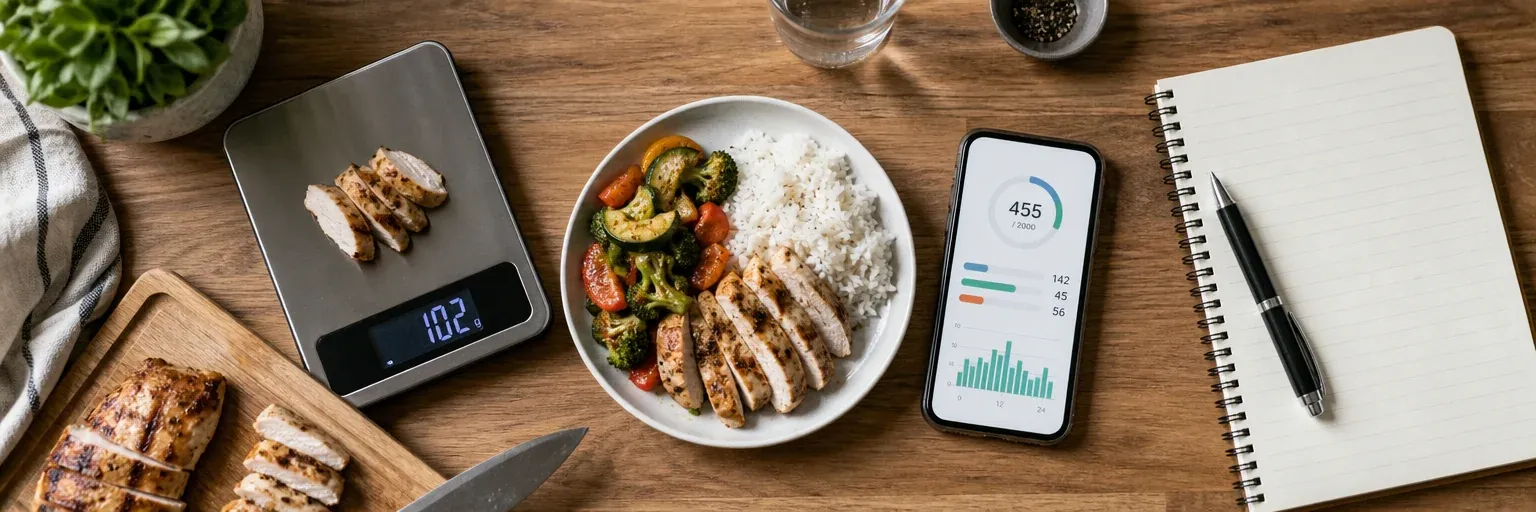
Why Am I Not Losing Weight? 12 Common Reasons and How to Fix Them
Quick answer: If the scale isn’t moving, in nearly every case the cause is the same: you aren’t in a calorie deficit, or the deficit is too small to register against normal day-to-day water shifts. The body doesn’t lie. The 12 reasons below explain the most common ways a deficit quietly closes — tracking drift, weekend eating, liquid calories, water retention, low sleep, stress, low protein, falling TDEE, and a small handful of medical and medication causes worth knowing about. Most stalls resolve once you identify which one (or two) apply to you.
First: are you actually in a calorie deficit?
Before troubleshooting the specific reasons below, set the diagnostic frame: if your 7-day average weight has not dropped over 3 to 4 weeks at the same scale time, you are not in a meaningful calorie deficit. A genuine deficit shows up as a downward trend — not always week-to-week, but reliably over a month. If you are still weighing yourself once a week or reading single-day numbers, that is where to start — see how to track weight loss progress for the daily-weigh-in and rolling-average routine that lets a real deficit actually show up in the data.
That reframes the question from “why is my body broken?” to “where are the missing calories?” Almost always, they’re coming from a small, fixable pattern below.
If you haven’t set a calorie target deliberately, start with how many calories to eat for weight loss and how to count calories. Without an honest baseline, you’re guessing at whether a deficit even exists.
The 12 reasons
1. You’re eating more than you think (calorie creep)
Calorie creep is the most common reason people stall — the calorie-deficit math only holds when the log reflects what you actually ate. Food logs quietly drift: untracked cooking oil, “rounded down” portions, bites while preparing dinner, an extra splash of cream in coffee.
Why it stalls weight loss: classic doubly-labeled-water research by Lichtman and colleagues found self-reported intake can underestimate true intake by up to 47% in adults who report trouble losing weight — enough to erase any reasonable deficit.
Fix: for 7 days, weigh every calorie-dense food (oils, nut butters, cheese, grains, meats, granola) and log every bite. Most people find 200 to 500 hidden calories per day. See our guide on how to count calories.
2. You’re eyeballing portions instead of weighing them
Eyeball portioning is reliably inaccurate for dense foods. A “tablespoon” of peanut butter is usually closer to two. A “palm” of pasta is often 1.5 to 2 servings. A home bowl of cereal runs 1.5 to 3 label servings.
Why it stalls weight loss: underestimating peanut butter by 1 tablespoon costs you ~95 kcal; olive oil, ~120 kcal. Two or three of those a day rebuilds the deficit you thought you set.
Fix: use a $10 to $20 kitchen scale on calorie-dense foods for at least 2 weeks to calibrate your eye. Volume measures are fine for vegetables and broth. See our portion control guide. Eating too fast is one of the most under-recognized causes of accidental overeating — see mindful eating for weight loss for the 20-minute meal floor and halfway fullness check-in that stop the last-30-seconds overshoot.
3. Weekends are erasing weekday deficits
Many people run a tight 500-calorie deficit Monday through Thursday — then drift 800 to 1,200 calories over Friday, Saturday, and Sunday. Each day looks fine; the weekly total is flat.
Why it stalls weight loss: weight loss is driven by the weekly calorie balance. A clean 5-day deficit of 500 kcal/day (–2,500) is wiped out by two weekend days at +1,250 kcal each. The math closes on Saturday night.
Fix: log Friday through Sunday with the same honesty as Monday — drinks, restaurant meals, and snacks especially. Round up rather than down. See our weight loss plateau guide.
4. You’re underestimating liquid calories (alcohol, lattes, juice)
Liquid calories are uniquely easy to miss because they don’t satisfy hunger the way solid food does. A 16 oz flavored latte runs ~350 kcal. A pint of beer is ~180 kcal; two glasses of wine, ~250 kcal. A “healthy” smoothie can clear 500 kcal in 10 minutes.
Why it stalls weight loss: drinks reliably add intake without reducing how much solid food you eat at meals — and they’re rarely logged as carefully as a chicken breast.
Fix: log every caloric drink for 2 weeks. Switch to black coffee, sparkling water, or unsweetened tea on weekdays. Budget alcohol for planned occasions. See our guides on alcohol and weight loss and coffee, caffeine, and weight loss.
5. You’re retaining water (sodium, carbs, cycle, new training)
The scale measures everything inside your skin — fat, muscle, fluid, food, glycogen. A flat or up week often reflects fluid shifts, not stalled fat loss.
Why it looks like it stalls weight loss: high-sodium meals can hold 1 to 3 lb of water for 24 to 72 hours. New training adds glycogen and bound water (~3 g water per 1 g glycogen). The luteal phase commonly retains 1 to 5 lb. None of this is new fat — but it can mask 2 to 3 weeks of real progress.
Fix: stop weighing daily; use a 7-day rolling average. Pair the scale with waist measurements and photos — see our guides to non-scale victories and water for weight loss.
6. Your TDEE is lower than the calculator says
TDEE calculators give a population average — not your metabolism. They can be off by ±15%, and after 10 to 20 lb of loss your real TDEE has also dropped.
Why it stalls weight loss: a 200 lb person burns more than a 180 lb version of the same person — roughly 20 to 30 fewer kcal/day per pound lost. Adaptive thermogenesis trims expenditure further during active dieting. The deficit you set at month one may not exist at month four. Set-point defense — the body’s coordinated drop in metabolic rate and rise in hunger after weight loss — is the biological reason a reasonable deficit can stall even when nothing about your eating has obviously changed. For the full mechanism see set point theory and weight loss.
Fix: recalculate TDEE every 10 to 15 lb of loss; trim 100 to 200 kcal or add daily steps (not both). See our guides on low TDEE and [how to increase TDEE].
7. You’re under-sleeping
Adults sleeping fewer than 6 hours show measurably higher hunger, lower spontaneous movement (NEAT), and worse diet adherence.
Why it stalls weight loss: in a controlled crossover trial (Nedeltcheva, 2010), the same calorie deficit produced 55% less fat loss when sleep was restricted to 5.5 versus 8.5 hours — and more lean mass was lost instead. Short sleep also raises ghrelin and lowers leptin, increasing next-day hunger — the full six-hormone appetite panel is in leptin, ghrelin, and appetite hormones.
Fix: protect a 7 to 9 hour sleep window. Consistent wake time, a dark cool room, and no screens for the last 30 minutes beat any supplement. See our sleep, stress, and weight management guide.
8. You’re stressed (cortisol, emotional eating, water retention)
Chronic stress doesn’t directly block fat loss, but it reliably pushes intake up and disrupts the conditions that make a deficit possible.
Why it stalls weight loss: stress raises cortisol, which can drive water retention (masking the scale), worsen sleep, and trigger reward-eating. For many people, the practical effect is 200 to 500 extra calories per day from late-night snacking, takeout, and “I had a hard day” food.
Fix: identify the specific cue (work email at 9 pm? commute? Sunday-night dread?) and install one replacement behavior — a 10-minute walk, a non-food ritual, a phone call. See our emotional eating guide, and for the physiology — what cortisol actually does, why “cortisol detoxes” don’t work, and which interventions hold up — see cortisol, stress, and weight gain. Behind these stress-driven adherence breaks there is usually a slower, predictable fade in weight loss motivation — the plan feels the same, but the willpower cost has quietly doubled and one external accountability layer is what closes the gap. If the replacement behavior itself keeps breaking down, the diagnostic is upstream in the cue-and-reward loop — see our guide to habit formation for weight loss for how to design a stress-cue habit that actually holds.
9. You’re not eating enough protein
Protein protects lean mass, suppresses appetite, and has a higher thermic effect than carbs or fat (~20 to 30% of its calories burned in digestion).
Why it stalls weight loss: low protein during a deficit increases muscle loss (lowering metabolic rate), worsens hunger between meals (driving snacking), and reduces meal satisfaction. The scale may still move, but body composition worsens and adherence collapses faster.
Fix: target 0.7 to 1.0 g per pound of goal body weight (1.6 to 2.2 g/kg). Anchor every meal: eggs, Greek yogurt, chicken, fish, tofu, cottage cheese, whey. See our protein intake for weight loss guide.
10. Your goal weight is unrealistic for your starting point and age
Some “stalls” aren’t stalls — they’re the body settling at a weight genuinely difficult to push below without disproportionate effort. A goal from age 22 may not be reachable at age 45 with measures most people sustain.
Why it stalls weight loss: as you approach a lean state, the body fights harder — hunger climbs, NEAT drops by 100 to 500 calories a day, training quality slips. A 5 lb fight at 130 lb is a much bigger lift than at 200 lb.
Fix: re-evaluate the goal. A weight you can hold for 5 years with normal effort beats a number from a different decade. Track waist and clothes alongside the scale. See our how long to lose weight guide. If this is your third or fourth attempt at the same weight and each cycle has gotten harder, the bottleneck is often the maintenance plan, not the goal — see yo-yo dieting and weight cycling for the cycle-breaking framework.
11. You have an undiagnosed clinical condition
A small subset of stalls reflect a real medical cause — most commonly thyroid dysfunction, PCOS, or insulin resistance. These don’t make weight loss impossible, but they change the playbook and the expected pace.
Why it stalls weight loss: hypothyroidism lowers metabolic rate by 5 to 15%; PCOS-related insulin resistance changes hunger and fat distribution; uncontrolled blood sugar drives cravings and fluid shifts. None of these resolve with more self-tracking.
Fix: if you’ve honestly tracked for 8+ weeks with no movement, or you have symptoms (fatigue, hair loss, irregular cycles, cold intolerance, excessive thirst), ask your clinician for a thyroid panel, fasting glucose, fasting insulin, and HbA1c — the full weight-loss blood-test list walks the core panel, the extended add-ons, and the 2026 cost picture. If a reasonable deficit isn’t working, insulin resistance is a common cause — see insulin resistance and weight loss. See also thyroid and weight loss and, if TPO antibodies come back positive, the autoimmune-specific picture in Hashimoto’s thyroiditis and weight loss; PCOS and weight loss and diabetes and weight loss cover the other common medical drivers. If you also have rapid central weight gain with thin extremities, purple-red striae, easy bruising, severe muscle weakness, or new uncontrolled hypertension, that pattern is the screening trigger for Cushing’s syndrome — rare but real. If your scale moves but your hips, thighs, and lower legs do not, and the affected tissue is tender or bruises easily, ask specifically about lipedema — a distinct lymphatic-fat disorder that explains exactly this “the rest of me shrinks, my legs don’t” pattern.
12. You’re on a medication that promotes weight gain
Several common medications are associated with weight gain or weight-loss resistance — not in everyone, but reliably enough to matter.
Why it stalls weight loss: mechanisms vary — appetite increase, fluid retention, fat redistribution, metabolic shifts — but the effect is the same: the plan that worked before now doesn’t. Common offenders include certain antidepressants (paroxetine, mirtazapine), antipsychotics (olanzapine, quetiapine), corticosteroids (prednisone), some beta-blockers, insulin, sulfonylureas, and DMPA (Depo-Provera) — most other hormonal birth control methods are weight-neutral, and the method-by-method numbers are in birth control and weight changes. If a second-generation antipsychotic is on your list — particularly olanzapine, clozapine, or quetiapine — the dedicated protocol with the metformin add-on, SGA switch, and GLP-1 evidence is in schizophrenia, antipsychotics, and weight loss.
Fix: do not stop a prescribed medication on your own. Talk to your prescriber about alternatives in the same class with a more favorable weight profile, or a dose adjustment. Frame it as “the medication is doing its job, but I’d like to discuss the weight effect” — most clinicians have heard the question before.
Adaptive thermogenesis and metabolic adaptation — the honest ceiling
Adaptive thermogenesis is the fall in energy expenditure beyond what body-composition change alone predicts after weight loss — in other words, a 180 lb version of a 200 lb body spends slightly less than a never-200 lb 180 lb body does.
Three trials set the honest ceiling for how much adaptive thermogenesis actually contributes to a stall:
- Hall 2011 (Lancet) modeled long-term energy expenditure after weight loss and found residual adaptive thermogenesis settles at roughly ~15 kcal/kg of sustained drop — real, but a much smaller number than short-term deficit measurements suggest once weight is held.
- Fothergill 2016 (Obesity) is the outlier: 6-year follow-up of “Biggest Loser” contestants showed ~500 kcal/day of persistent adaptive thermogenesis after ~40% body-weight loss in 30 weeks with extreme exercise. Treat it as the ceiling, not the norm.
- Rosenbaum 2010 (International Journal of Obesity) tracked a 10%-weight-loss cohort and reported ~300 kcal/day drop in energy expenditure at that loss, with leptin replacement reversing roughly two-thirds of the adaptation — pointing at the hormonal signal driving the defense.
What this means for your deficit: on a moderate (~500 kcal/day) deficit a typical adult will see roughly 100 to 300 kcal/day of adaptive thermogenesis stacked on top of underreported intake — classic doubly-labeled-water work from Lichtman 1992 (NEJM) found self-reports underestimated true intake by ~47% in diet-resistant adults, and that tracking gap closes a bigger share of real stalls than adaptive thermogenesis does. The practical response is to re-measure TDEE at every ~10 lb lost, trim 100 to 200 kcal or add daily steps, and keep protein high — not to assume metabolism is “broken”.
For the honest-read on when a stall is adaptation vs. closed deficit, see our metabolic adaptation trial summary on the weight-loss plateau page.
The 7-day diagnostic checklist
If you’re not sure which of the 12 reasons applies, run this 7-day diagnostic. It’s deliberately restrictive — the point isn’t to live this way, but to give you a clean signal.
For 7 consecutive days:
- Weigh every calorie-dense food on a kitchen scale (oils, nut butters, cheese, grains, meat, granola, sauces).
- Log every bite, sip, and taste — including weekends, restaurant meals, alcohol, and cooking tastes.
- Weigh yourself each morning after the bathroom, before food or drink, in the same clothes. Average the 7 days.
- Sleep at least 7 hours per night. Set a fixed wake time.
- Hit 8,000+ steps daily. Track them.
- Eat 0.8 g of protein per pound of body weight (or 1.6 g/kg of goal body weight). Anchor every meal.
- Zero alcohol for the 7 days. Caloric drinks count against your total.
At the end of the week, compare your 7-day average weight to the prior week’s average. If the trend is down — even by a fraction of a pound — your old plan was leaking calories, and the diagnostic just plugged the leak. Carry the practices forward. If the trend is still flat after a second 7-day cycle, that’s the signal to reassess your calorie target with a recalculated TDEE, or talk to a clinician about the clinical causes above.
When to ask for clinical help
Most stalls resolve with the steps above. A clinical conversation is worth having if:
- You’ve honestly applied the diagnostic for 8+ weeks with no trend change and you’re already at a modest intake.
- You have symptoms beyond a flat scale: unusual fatigue, hair loss, cold intolerance, irregular periods, low mood, excessive thirst, or significant digestion changes.
- You suspect an underlying condition (thyroid, PCOS, insulin resistance, sleep apnea).
- You’re on a medication associated with weight gain and want to discuss alternatives.
- You notice disordered patterns: obsessive tracking, food avoidance, binge cycles, or significant distress around eating. In those cases, behavioral support is more useful than another diet change.
A persistent stall with concerning symptoms is a reason for a medical conversation — not a reason to cut calories further on your own.
Frequently asked questions
I’m in a calorie deficit but not losing weight — what’s wrong? If the scale truly hasn’t moved on a 7-day average for 3+ weeks, you almost certainly aren’t in the deficit you think you’re in. The most common culprit is portion drift on calorie-dense foods. Re-weigh those foods for 7 days, log every bite including weekends and drinks, and recheck the trend.
Why haven’t I lost weight in two weeks? Two weeks is rarely a real stall. Water, glycogen, sodium, digestion, and cycle phase can mask 1 to 3 pounds of true fat loss for a full week. Judge progress by your 7-day rolling average and give it 3 to 4 weeks before assuming anything is wrong.
Can stress stop you from losing weight? Indirectly, yes. Chronic stress raises cortisol, which can promote water retention, drive cravings, and disrupt sleep — all of which make adherence harder. Stress doesn’t block fat loss on its own, but it reliably pushes intake up and movement down.
Does drinking water really help you lose weight? Water has no direct fat-burning effect, but staying hydrated supports satiety and replaces calorie-containing drinks if you swap it for soda, juice, or sweetened coffee. A reasonable target is roughly half your body weight in pounds, in ounces of water per day.
Why am I gaining weight while eating less and exercising? Almost always water and glycogen shifts, not new fat. New training adds 1 to 3 pounds of muscle glycogen and bound water; sore muscles retain fluid for repair; higher sodium or carb days bump the scale. Look at the 2 to 3 week trend, not the daily number.
How long should I stick with a diet before adjusting it? Give a new plan 3 to 4 weeks of honest tracking before changing anything. If your 7-day average is flat for 3 weeks on consistent intake, retighten tracking, add 1,000 to 2,000 daily steps, or trim 100 to 200 calories — not all at once. Before assuming metabolism, walk the “tracking and still not losing” 5-question audit in calorie tracking accuracy — self-reported intake under-reports by roughly 20 to 40 percent in overweight adults, and eating back watch-estimated exercise burn is the single most reliable way to erase a deficit.
Does muscle weigh more than fat? A pound is a pound, but muscle is denser. If you’ve started strength training and the scale is flat while your waist measurement, clothes, or photos look different, you may be losing fat and adding small amounts of muscle simultaneously.
Sources
- Discrepancy between self-reported and actual caloric intake and exercise in obese subjects. New England Journal of Medicine (1992).
- Insufficient sleep undermines dietary efforts to reduce adiposity. Annals of Internal Medicine (2010).
- Metabolic adaptation is an illusion, only present when participants are in negative energy balance. American Journal of Clinical Nutrition (2020).
- Persistent metabolic adaptation 6 years after "The Biggest Loser" competition. Obesity (2016).
- Self-monitoring in weight loss: a systematic review of the literature. Journal of the American Dietetic Association (2011).
- Quantification of the effect of energy imbalance on bodyweight. Lancet (2011).
- Adaptive thermogenesis in humans. International Journal of Obesity (2010).