
2026-05-26 · calories, nutrition, tracking, beginner
Updated 2026-08-02
Written by WeightFAQ Staff
Evidence-informed guidance from the WeightFAQ editorial team.
14 min read
Last editorial review Aug 2, 2026
How to Count Calories: A Practical Beginner’s Guide
Learning how to count calories for weight loss is a learnable skill: pick a daily target, weigh or measure portions for a couple of weeks, read nutrition labels carefully (serving size versus your portion), and log everything you eat and drink including cooking oils. Most beginners get within roughly 10 percent of true intake once they use a kitchen scale, and the habit usually pays off in the first 4 to 12 weeks as a calibration tool rather than a permanent obligation.
Quick answer
Counting calories comes down to four simple steps. First, pick a daily calorie target — most adults land between 1,400 and 2,000 kcal based on a TDEE estimate. Second, weigh portions in grams using a $10 to $20 kitchen scale, especially for dense foods like oils, grains, and cheese. Third, log everything you eat and drink for 2 to 4 weeks, including cooking oils, drinks, and bites while cooking. Fourth, check your 7-day rolling weight average and adjust the target by 100 to 200 kcal if the trend stalls. Consistency matters more than precision — a roughly accurate log you keep beats a perfect log you abandon. If your numbers look right but progress doesn’t, see our diagnostic guide on the 12 most common reasons people aren’t losing weight.
Calories needed to lose weight by current body weight
The table below shows rough daily calorie targets for a lightly active adult at common body weights. Use it as a starting estimate, then run your own numbers through our TDEE and calorie deficit calculator for a personalised target.
| Current weight (lb / kg) | Maintenance (kcal) | 0.5 lb / week (−250) | 1 lb / week (−500) | 2 lb / week (−1,000) |
|---|---|---|---|---|
| 140 lb / 64 kg | 1,900 | 1,650 | 1,400 | 1,200* |
| 160 lb / 73 kg | 2,050 | 1,800 | 1,550 | 1,200* |
| 180 lb / 82 kg | 2,200 | 1,950 | 1,700 | 1,300 |
| 200 lb / 91 kg | 2,400 | 2,150 | 1,900 | 1,400 |
| 220 lb / 100 kg | 2,550 | 2,300 | 2,050 | 1,550 |
| 240 lb / 109 kg | 2,700 | 2,450 | 2,200 | 1,700 |
| 260 lb / 118 kg | 2,850 | 2,600 | 2,350 | 1,850 |
*A 2 lb/week deficit is typically not appropriate at lower body weights — most clinicians cap intake at 1,200 kcal/day for women and 1,500 kcal/day for men without medical supervision.
Key takeaways
- Counting calories is a skill, not a number. The point is consistent, honest logging — not perfection.
- Use a kitchen scale for the first 1 to 2 weeks. Visual estimates skew 20 to 50 percent low without one.
- Read serving size first, then weigh your actual portion. The serving size on the label is rarely what you eat.
- Log everything: oils, drinks, sauces, bites while cooking, and the splash of cream in your coffee.
- Most people only need to track closely for 4 to 12 weeks. After that, you can shift to plate or hand portions and check in occasionally.
Who this is for
This guide is for beginners and intermediates who already know roughly how many calories they want to eat (or have a target from a clinician, app, or our calorie target guide) and now need to actually count them accurately. It is not a guide to the math behind your target — for that, see our TDEE and calorie deficit walkthrough. If you have a history of disordered eating, talk with a clinician before starting any structured tracking.
Step 1: Set a target before you start logging
Tracking without a target is just data entry. Before you start, pick a number to aim for.
- If you have not set one, use our how many calories to lose weight guide to land in the right range for your body size and activity level.
- If you want the underlying TDEE math, our TDEE and calorie deficit guide walks through the Mifflin-St Jeor formula and a beginner-safe deficit.
- Most adults land somewhere between 1,400 and 2,000 calories per day. Use your real number, not a round one that “sounds right.”
Write your target down. You will adjust it after 2 to 4 weeks of actual data, not before.
Step 2: Get a kitchen scale (or commit to measuring cups)
A small digital kitchen scale ($10 to $20) is the single biggest accuracy upgrade for new trackers. Self-reported food intake studies consistently find that adults underestimate what they eat by 20 to 50 percent without one — and the gap is usually largest for the foods that matter most for a calorie target, like oils, grains, and cheese.
A practical setup:
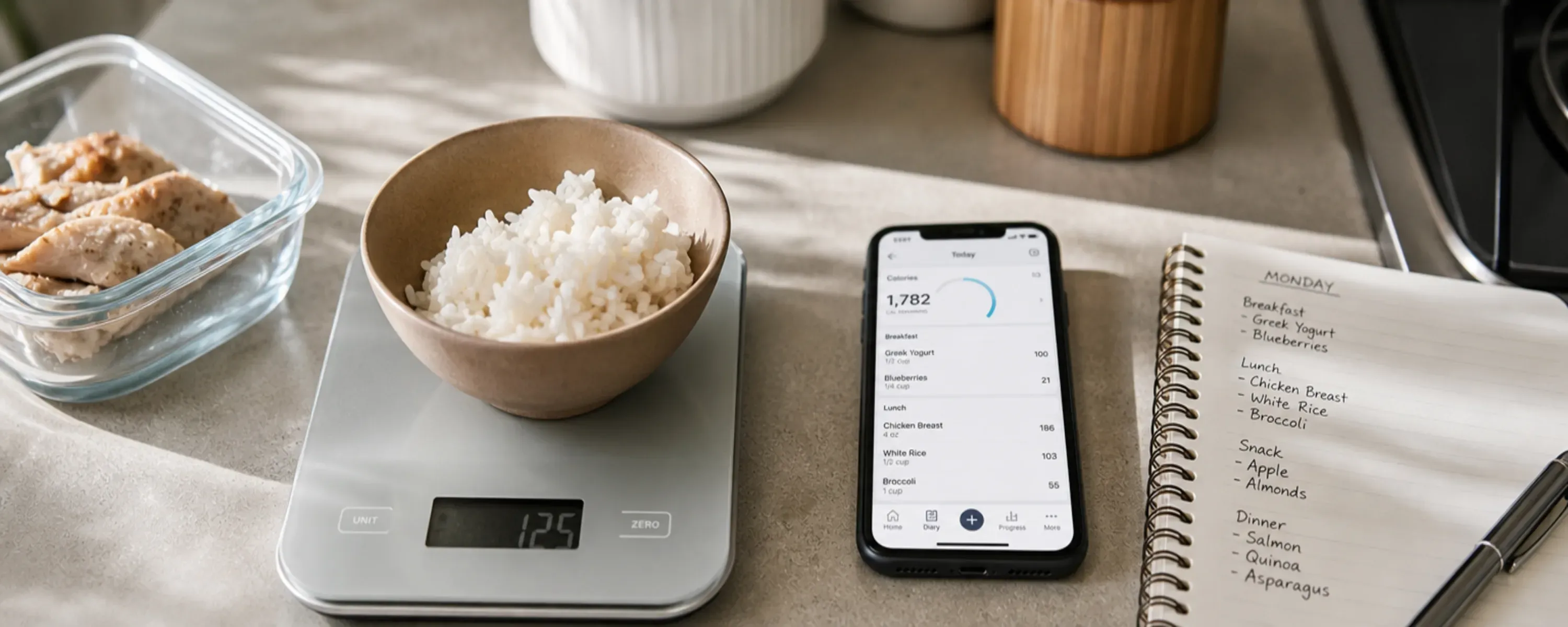
- Scale on the counter. Put your empty plate or bowl on it, press tare, and add each food separately, hitting tare between items.
- Weigh in grams. Grams are more precise than ounces and match most app and label data.
- No scale? Use measuring cups and spoons for everything dense (oils, peanut butter, rice, pasta, cereal, cheese) and accept a wider margin of error elsewhere.
Many people only need the scale for the first 1 to 2 weeks. After that, your eye has calibrated for most regular meals and you can reserve the scale for tricky items.
Step 3: Read nutrition labels (serving size versus portion)
Most label-reading errors come from one mistake: trusting the calorie number without checking the serving size. For a deeper walkthrough of every line on a US label, see our guide to how to read nutrition labels.
The fix is a two-step rule every time:
- Read the serving size first. A bag of chips might say “150 calories” — per 1 oz serving, with 3 servings per bag.
- Weigh or measure what you actually ate. If you ate the whole bag, that is 450 calories, not 150.
A few traps to know:
- “Per package” vs. “per serving.” Granola, cereal, and ice cream often list a small serving (e.g., 1/2 cup) that almost nobody eats in one sitting.
- Cooked vs. raw weights. Pasta, rice, and meat labels are usually dry/raw. 100 g of dry pasta is roughly 250 g cooked — but still ~370 calories.
- The 20 percent label rule. FDA rules let packaged food labels be off by up to 20 percent in either direction. Treat label calories as good estimates, not precise values.
- “Lightly packed” vs. weighed. A “1/4 cup” of nut butter is wildly different depending on how you scoop. Weigh dense items in grams when you can.
Step 4: Log everything (yes, everything)
The single biggest reason tracking “stops working” is selective logging. The calorie sources people most often skip are also the easiest to miss:
- Cooking oils and butters. One tablespoon of olive oil is about 120 calories. A “drizzle” is usually 2 to 3 tablespoons.
- Drinks with calories. Juice, soda, lattes with milk, smoothies, sweetened iced tea, kombucha, and alcohol. Liquid calories satiate less per calorie than solid food — our breakdown of calories in alcohol covers typical pour sizes and mixer math for spirits, wine, beer, and cocktails.
- Bites, licks, and tastes (BLTs). A spoonful of pasta sauce while cooking, the last few fries off your kid’s plate, a “small” piece of bread at dinner. These easily add 100 to 400 calories a day.
- Condiments and sauces. Salad dressing, mayo, peanut sauce, glazes, and dips. A typical 2 tbsp serving of dressing is 100 to 150 calories.
- Coffee add-ins. Cream, syrups, and sugar across 2 to 3 drinks a day can quietly total 200 to 500 calories.
- “Healthy” but calorie-dense foods. Nuts, avocado, granola, dried fruit, hummus, olive oil, and nut butters are nutritious but easy to overeat at 150 to 200+ calories per modest portion.
A useful mindset: if it has calories and went in your mouth, it gets logged. The point is not guilt, it is an accurate weekly total. If a numeric daily total feels activating and a descriptive log — time, food, portion, plus optional hunger and mood columns — is easier to sustain, the paper-side alternative and the 21-day beginner ladder are covered in weight-loss journaling.
Step 5: Handle recipes and mixed dishes
Home-cooked meals are where many beginners give up. A practical approach:
- Log each ingredient by weight when you cook the dish, including oils.
- Weigh the total finished dish (minus the empty pot or pan).
- Divide. Calories per gram = total calories / total grams.
- Weigh your serving and multiply.
Most tracking apps have a “recipe” feature that does this for you — enter the ingredients once, save the recipe, and log servings by weight after. Eating out is harder. For restaurant meals, look up the chain’s published calorie data, or pick a similar dish in your app’s database and pad the estimate by 10 to 20 percent (restaurants use more oil and butter than home cooks).
Step 6: Track for 2 to 4 weeks, then check the trend
Tracking is most useful when paired with a weight trend, not a single weigh-in.
- Weigh yourself in the morning, after using the bathroom, before eating or drinking.
- Use a 7-day rolling average rather than any single day. Daily weight swings of 1 to 4 lb are normal water shifts.
- After 2 to 3 full weeks, look at the trend:
- Down 0.5 to 1 percent of body weight per week? Your target is working. Keep going.
- Flat for 3 weeks of honest tracking? Trim 100 to 200 calories or add activity. Also revisit portion accuracy before assuming the deficit is the problem.
- Losing faster than 1 percent per week and feeling drained? Eat a bit more.
If progress stalls despite consistent logging, our weight loss plateau guide covers the most common causes.
Accuracy pitfalls that quietly add calories
| Pitfall | What happens | Quick fix |
|---|---|---|
| Eyeballing oils and dressings | 50 to 200 kcal per pour underestimated | Weigh in grams, or use a measuring spoon |
| Unlogged drinks | 100 to 600 kcal per day missed | Log every caloric drink, including coffee add-ins |
| Cooked vs. raw weights | 30 to 50 percent over- or under-count on grains and meats | Weigh dry pasta/rice; use raw weights for meat |
| Bites while cooking | 100 to 400 kcal per day uncounted | ”If it went in your mouth, it gets logged." |
| "Healthy” calorie-dense foods | Underweighed nuts, avocado, nut butters, granola | Always weigh — they are denser than they look |
| Weekend drift | Weekly total wipes out a clean weekday | Log weekends; aim for a weekly, not daily, total |
| Trusting the label calorie number | Up to 20 percent label error under FDA rules | Use brand-name database entries; pick the lower of two close matches |
A scannable version of this table is worth bookmarking on your phone for the first month. For restaurant meals, where you can’t measure cooking fats and portions are 2 to 4 times reference sizes, structural ordering rules beat trying to count — see our guide to eating out for weight loss. For an honest read on how far off a typical honest log actually is — self-reported intake under-reports by roughly 20 to 40 percent in overweight adults, and stacked with label and tracker error a “500 kcal deficit” can be closer to break-even — see calorie tracking accuracy.
Tools: scale, app, or hand portions?
You have three rough approaches with very different effort/accuracy tradeoffs.
- Kitchen scale + app (highest accuracy). Best for the first 4 to 12 weeks, plateaus, or anyone serious about a specific target. Most accurate by far. See our weight loss apps and trackers guide for picking one.
- Measuring cups + app (moderate accuracy). Works well for liquids and most home cooking. Weakest for dense foods like grains, oils, and cheese.
- Hand portions, no tracking (lower effort). A palm of protein, a cupped hand of carbs, a thumb of fats, and a fist of vegetables per meal. Roughly approximates a calorie target without any logging. Our portion control guide covers the hand and plate methods in detail.
A lower-effort approach you will actually follow beats a precise approach you abandon in week two. Many people use a scale and app for 4 to 8 weeks to calibrate, then shift to hand or plate portions long term.
How long should you count for?
Tracking is a calibration skill, not a permanent obligation. A common arc looks like:
- Weeks 1 to 2. Weigh and log everything. Expect surprises about portion sizes, oils, and drinks.
- Weeks 3 to 8. Loosen on familiar repeat meals (you know what your usual breakfast totals). Stay strict on new recipes, restaurants, and weekends.
- Weeks 8 to 12. Shift to protein targets and plate composition for most meals, with periodic check-ins (a “tracked week” every month or two).
- Long term. Many people only return to full tracking when they hit a plateau, change their training, or set a new goal.
The point is not lifelong logging — it is teaching your eye what your usual day actually contains.
When to skip counting
Counting calories is not the right tool for everyone. Consider an alternative if:
- You have a history of an eating disorder or disordered eating patterns. Work with a clinician before starting any structured tracking.
- You feel anxiety, guilt, or food avoidance around logging. Step back and use plate or hand methods instead — see our portion control guide.
- You eat mostly home-cooked, repeat meals and your weight is already trending the way you want. Repetition is doing the work tracking would.
Practical next steps
This week:
- Pick a daily calorie target (or use our calorie target guide to set one).
- Buy a kitchen scale and download a tracker (see our apps and trackers guide).
- Log every food and drink for 3 to 7 days. Do not change what you eat yet — just observe.
Next 2 to 4 weeks:
- Compare your average daily intake to your target. Adjust portion sizes, not your whole diet, to close the gap.
- Track your 7-day weight average. Look for a downward trend of 0.5 to 1 percent of body weight per week.
- Anchor each meal with protein (see our protein intake guide).
- Pre-decide one or two snacks so they do not become untracked calories — our guide to high-protein snacks under 250 calories lists 20 options with protein grams per serving.
After 8 to 12 weeks:
- If you are on track, start relaxing into plate or hand portions for repeat meals.
- Keep the scale and app on hand for new recipes, plateaus, or whenever your eye drifts.
Frequently asked questions
Do I need to count calories to lose weight? No. Counting calories is one tool, not the only path. Plenty of people lose weight using plate methods, hand portions, protein anchoring, or structured meal plans without ever opening a tracker. Counting is most useful when you want fast, specific feedback on what you actually eat, when progress has stalled, or when you are calibrating portion sizes for the first time.
Is counting calories accurate? Roughly, yes. Well-logged days with a kitchen scale typically land within about 10 percent of true intake. Without a scale, errors of 20 to 50 percent are common because labels themselves carry up to a 20 percent margin under FDA rules, and self-reported portions skew low. The point is not a perfect number but a consistent enough estimate that real weight trend data tells you whether to adjust.
How do I count calories without an app? Use a small notebook and a kitchen scale, plus label reading. Write down each food, weigh or measure the portion, and total calories at the end of the day. A hand-portion shortcut also works: a palm of protein, a cupped hand of carbs, a thumb of fats, and a fist of vegetables per meal, repeated across the day.
How long should I count calories for? Most beginners get the biggest learning gains in the first 4 to 12 weeks. After that, you can usually relax into protein targets, plate composition, or occasional check-ins because you have calibrated your eye to typical portion sizes. Some people prefer to keep tracking long term, which is fine if it does not cause stress.
Should I count calories on weekends? Yes, if you want the weekly total to match your target. A clean Monday through Thursday can be erased by two loose days, since weight loss is driven by weekly totals, not daily ones. If full tracking on weekends feels rigid, at minimum log drinks, snacks, and restaurant meals, which is where most unlogged calories come from.
Do I need to weigh every food? Not forever, but yes for the first week or two. A kitchen scale calibrates your eye to what 4 oz of chicken, a tablespoon of olive oil, or a serving of pasta actually looks like. After that you can switch to measuring cups, visual portions, or hand sizes for most foods, and reserve the scale for dense, easy-to-underestimate items like oils, nut butters, cheese, and grains.
How accurate is calorie counting? Calorie counting is roughly accurate, not precise. With a kitchen scale, careful label reading, and brand-name app database entries, most people land within about 10 percent of true intake on logged days. Without a scale, errors of 20 to 50 percent are typical, mostly from underestimating oils, grains, dressings, and bites while cooking. FDA rules also allow packaged food labels to be off by up to 20 percent in either direction. The point is consistency: a steady weekly average that you can pair with a 7-day weight trend, not a perfect daily total.
Do I need to count calories on weekends? Yes, if you want the weekly total to match your target. Weight loss is driven by the weekly calorie balance, not any single day, and two unlogged weekend days can easily erase a clean Monday to Thursday. If full tracking on weekends feels too rigid, at minimum log drinks, snacks, and restaurant meals — those are where most unlogged calories hide. A useful middle ground is to weigh and log weekday meals strictly, then estimate weekends conservatively (round up rather than down).
What if my logged calories say I should be losing but I’m not? If three weeks of honest tracking show a flat 7-day weight average, the most common cause is portion drift rather than metabolism. Re-weigh oils, dressings, nut butters, cheese, and grains for a week — these are the foods most often under-logged. Check that you are logging bites while cooking, weekend meals, and caloric drinks. Restaurant meals typically run 10 to 20 percent higher than database estimates. If portions check out, trim 100 to 200 kcal/day or add activity, and recheck the trend over the next 2 to 3 weeks.
Is counting calories safe for everyone? For most healthy adults, structured calorie counting is safe and useful as a short-term calibration tool. It is not appropriate if you have a current or past eating disorder, or if tracking triggers anxiety, guilt, or restrictive patterns — in those cases, work with a clinician and consider plate or hand-portion methods instead. Counting is also generally not recommended for children, pregnant or breastfeeding women without clinical guidance, or anyone with a medical condition that affects nutrition needs. When in doubt, talk with a registered dietitian before starting.
Sources
- Discrepancy between self-reported and actual caloric intake and exercise in obese subjects. New England Journal of Medicine (1992).
- Self-monitoring in weight loss: a systematic review of the literature. Journal of the American Dietetic Association (2011).
- Adherence to self-monitoring of dietary intake during the first six months of a behavioral weight loss intervention is associated with weight loss. Obesity (2019).
- Self-monitoring of dietary intake by daily food records versus weekly food records. Annals of Behavioral Medicine (2008).