
2026-09-15 · tempeh, fermented soy, plant protein, tempeh vs tofu, whole soybean, probiotics, vegetarian weight loss, single-food pillar, complete plant protein, fiber, NOVA classification, isoflavones, weight loss, Maya Patel
Written by Maya Patel
Maya Patel is a WeightFAQ staff writer covering sustainable weight loss through mindful eating, flexible routines, and evidence-based nutrition. She translates research on protein, fiber, portion control, and calorie awareness into practical meal-planning guidance readers can actually follow at home. Her articles favor honest expectations over fad promises — small changes that compound, calorie bands scaled to real households, and grocery lists built around whole foods with room for real life. Maya writes for people juggling family meals, busy weeks, and long-term goals, not gym-optimized single adults with unlimited prep time.
30 min read
Medically reviewed on Sep 15, 2026
Tempeh for Weight Loss: Calories per 3 oz, Fiber and Protein vs Tofu, and the Fermentation Angle That Actually Matters (2026)
Quick answer
Three ounces (~85 g) of plain tempeh carries roughly 160 to 195 kcal, ~15 to 20 g of complete plant protein (all nine essential amino acids, PDCAAS ~0.9 to 1.0), ~9 to 11 g of fat (most of it polyunsaturated), ~9 to 13 g of carbohydrate, ~7 to 9 g of fiber, ~85 to 115 mg of calcium, and ~2 mg of iron per USDA FoodData Central. The honest read on weight loss is direct: tempeh does not burn fat, and no large-N tempeh-only weight-loss RCT exists — but tempeh is a satiety-per-calorie standout because 3 oz delivers 15 to 20 g of complete plant protein plus 7 to 9 g of fiber for under 200 kcal, a protein-plus-fiber density that no other single food in the pantry matches, and one that is competitive with animal protein for satiety without the saturated-fat load. Working default: 3 oz per meal, one meal per day, or 4 oz split across two meals. Tempeh belongs alongside tofu for weight loss, beans and legumes for weight loss, and Greek yogurt in a mixed-protein weight-loss cart, and inside a plant-forward protein intake for weight loss framework — see the wider plant pattern in plant based weight loss and the lacto-ovo meal template in the vegetarian weight loss meal plan.
What is actually in a block of tempeh
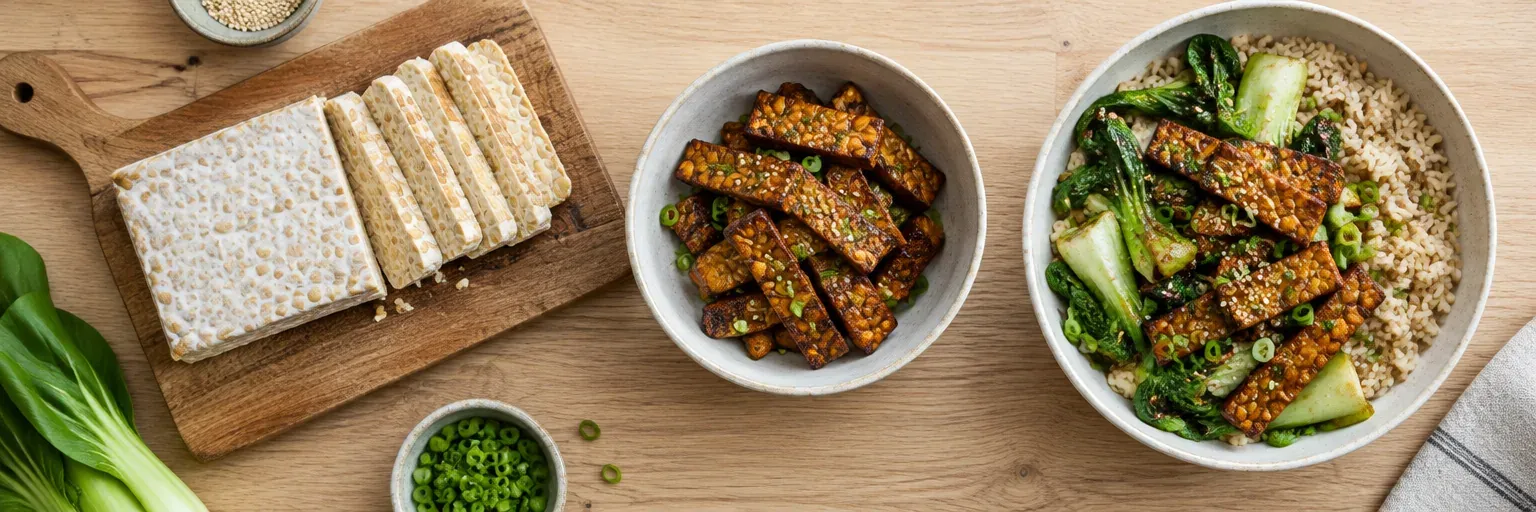
Tempeh is a whole-soybean fermented cake. Soaked, partially cooked whole soybeans are inoculated with a starter culture of Rhizopus oligosporus (a food-grade mold), spread thin, and incubated at ~30°C for 24 to 48 hours. The Rhizopus mycelium knits the beans together into a firm, sliceable block, generates modest amounts of B vitamins, and reduces phytates by roughly 30 to 50 percent — improving iron and zinc bioavailability compared with unfermented soy. The critical structural difference from tofu: tempeh keeps the entire soybean intact, so all of the bean fiber, fat, and micronutrients stay in the finished block. Tofu, by contrast, extracts soymilk from the ground bean and discards the fiber-heavy okara pulp before coagulating the remaining protein.
USDA FoodData Central puts plain tempeh at roughly 192 kcal per 100 g — a 3 oz (85 g) serving is ~163 kcal, with ~18 g of protein, ~11 g of total fat (~2 g saturated, ~2.5 g monounsaturated, ~5 g polyunsaturated), ~9 g of carbohydrate of which ~5 to 8 g is fiber depending on the specific brand, ~95 mg of calcium, ~2 mg of iron, ~65 mg of magnesium, and modest amounts of the B-vitamin family (fermentation modestly boosts riboflavin and niacin over unfermented soybeans). Some U.S. tempeh is soy-plus-grain (millet, brown rice, barley, or quinoa fermented alongside the soybeans); those varieties run 10 to 20 kcal higher per 3 oz and carry a slightly different amino-acid profile. Read the label if you specifically want soy-only.
Three features make tempeh nutritionally distinctive for a weight-loss plate:
- Complete plant protein with a PDCAAS around 0.9 to 1.0. The Protein Digestibility-Corrected Amino Acid Score is the FDA and WHO standard for protein quality; tempeh sits at the top of the plant-protein range, comparable to whey and egg and slightly ahead of most beans and grains eaten alone. Kim 2016 (Nutrients), a meta-analysis of 40+ soy-protein intervention trials, is the anchor evidence for the class-level protein-quality claim. As with tofu, tempeh does not need to be “combined” with a grain in the same meal to hit essential-amino-acid targets — the retired 1970s complementary-protein model has not held up in the literature.
- Standout fiber content. At ~7 to 9 g of fiber per 3 oz, tempeh delivers more fiber per serving than any other single main-course protein in a typical grocery cart — more than any meat (near zero), more than most cheeses (near zero), more than tofu (<1 g), more than eggs (near zero), and comparable to a cup of cooked lentils or a small apple. Swapping a lower-fiber animal protein for tempeh at one meal per day can add 5 to 8 g of daily fiber without changing anything else on the plate. See fiber for weight loss for the wider fiber-and-satiety frame.
- Fermentation-improved digestibility. Rhizopus fermentation partially predigests the soybean, reducing raffinose-family oligosaccharides (the gas-producing sugars that make plain beans hard on some digestive systems) and cutting phytate content by ~30 to 50 percent. The practical read: tempeh is often easier to digest than a comparable serving of whole soybeans or edamame, and the iron and zinc that are in the block are more bioavailable than they would be in an unfermented soy food.
A note on tracking: an 8 oz U.S. block is a standard package size and yields roughly two 4 oz slabs or 2.5 to 3 servings at 3 oz each. Slicing the block into 8 equal slabs gives roughly 1 oz per slab (a snack portion at ~55 kcal each), which is a useful convenience for readers who prefer to portion visually without a scale. Weigh one block once on a $12 kitchen scale and your future estimates will be far closer.
Tempeh vs tofu — the direct comparison
Tempeh and tofu are the two big fermented-soy versus fresh-coagulated-soy siblings, and the choice between them is not “which is better” — it is which tool fits the meal.
| Feature (per 3 oz) | Tempeh | Tofu (extra-firm) |
|---|---|---|
| Kcal | ~160–195 | ~70–95 |
| Protein (g) | ~15–20 | ~8–11 |
| Fat (g) | ~9–11 (mostly PUFA) | ~4–5 (mostly PUFA) |
| Carb (g) | ~9–13 | ~2–3 |
| Fiber (g) | ~7–9 | ~<1 |
| Kcal per g protein | ~10.6 | ~8 |
| Texture | Firm, nutty, whole-bean bite | Smooth, curd, softer |
| Format range | Slabs, cubes, crumbles, strips | Silken → super-firm; blendable to slabs |
| Best weight-loss context | Satiety + fiber + fewer bites; whole-food anchor | Lower-kcal high-volume dishes; blended sauces and desserts; gastroparesis-friendly delivery |
Practical takeaways from the table:
- Neither is objectively better. Tempeh delivers more protein and dramatically more fiber per portion, but at roughly twice the calories. Kcal per gram of protein is close.
- Tempeh wins when the goal is a single-food anchor — one 3 oz slab covers a full protein target and a meaningful fiber block simultaneously, which no other single food in the cart does.
- Tofu wins for lower-kcal, higher-volume dishes and for the format range that only tofu provides (silken tofu blends into miso soup, salad dressings, chocolate pudding, smoothies; tempeh does not).
- The most useful answer is to keep both. A block of tempeh for meal-prep bowls and taco crumbles, and a block of tofu for stir-fries and blended sauces, is one of the tightest plant-protein setups a weight-loss kitchen can carry.
Evidence, read honestly
The tempeh literature is small — smaller than tofu, smaller than beans, much smaller than nuts. There is no large-N randomized controlled trial of whole tempeh against a matched control showing an independent weight-loss effect. The evidence base is class-level (soy protein plus high-fiber plant foods) plus mechanism (satiety, complete protein, high fiber, low kcal-per-gram-protein).
Kim 2016 (Nutrients) is the anchor soy-protein weight-loss meta-analysis — a review of soy-protein intervention trials that showed a modest but consistent effect on body weight and body composition when soy protein was substituted for other protein sources, most reliably when total protein was matched. The effect size is small; the practical read is that tempeh (as a soy-protein-rich whole food) is not worse than animal protein for weight loss, and often modestly better when it is displacing a higher-saturated-fat protein.
Mueller 2010 (American Journal of Clinical Nutrition) is the plant-protein satiety paper — a controlled feeding study comparing plant-protein preloads to animal-protein preloads on subsequent energy intake, finding roughly equivalent satiety when total protein was matched. Gram-for-gram, plant protein is not less filling than animal protein at typical intakes.
Neacsu 2014 (American Journal of Clinical Nutrition) directly compared a soy-protein-based lunch to a meat-protein-based lunch at matched calories and protein in overweight men, and reported equivalent satiety and subsequent energy intake across the two conditions — a useful direct data point for the “does soy keep you full as well as meat” question.
Fontecha 2019 (Advances in Nutrition) reviewed plant versus animal protein for body composition across randomized trials, finding no meaningful advantage of animal protein over plant protein for lean-mass retention at matched total-protein intakes — a useful correction to the “plant protein is second-tier for muscle” claim that circulates in fitness culture.
Messina 2016 (Nutrients) is the comprehensive soy-foods review — cancer, thyroid, bone, cardiovascular, and body-weight endpoints in one paper. This is the anchor evidence for the site’s isoflavone, thyroid, and breast-cancer-safety claims.
Nachvak 2019 (Advances in Nutrition) is the long-term safety meta-analysis — over 465,000 participants across observational cohorts, showing that soy-food intake is associated with lower all-cause mortality, not higher. The signal is small but the direction is unambiguous.
Slavin 2013 (Nutrients) reviewed dietary fiber and satiety and confirmed the mechanism most relevant to tempeh specifically: higher-fiber meals produce greater postprandial satiety, slower gastric emptying, and modestly lower subsequent energy intake than matched-calorie lower-fiber meals. Tempeh’s 7 to 9 g of fiber per 3 oz is a meaningful contribution to that mechanism.
Reis 2020 (Foods) is one of the more recent tempeh-specific reviews — covering fermentation, nutrient bioavailability, isoflavone conversion during fermentation, and food-safety considerations. It is the anchor for the “fermentation improves bioavailability” claim, and for the food-safety guidance on commercially pasteurized U.S. tempeh.
Nout & Kiers 2005 (Journal of Applied Microbiology) is the classic microbiology review of Rhizopus-based tempeh fermentation — the mechanism paper for phytate reduction, B-vitamin generation, and Rhizopus survival characteristics under cooking heat (spoiler: it does not survive).
The honest read: tempeh does not burn fat, and no tempeh-only weight-loss RCT has been run at meaningful scale. What tempeh brings is a high-quality complete plant protein at ~10.6 kcal per gram of protein plus 7 to 9 g of fiber per 3 oz, well-documented long-term soy-food safety, and a modest class-level weight-loss signal. A reader who adds a 3 oz slab of tempeh to their dinner and expects the scale to move without other changes will be disappointed.
The fermentation and probiotic honest read
Tempeh is fermented by Rhizopus oligosporus, a food-grade mold. Not a bacterium, not a live probiotic in the yogurt-and-kefir sense. The Rhizopus mycelium is what knits the loose beans into a firm, sliceable cake — you can see it as the white, cotton-like matrix wrapping every bean when you cut a block open. During the 24- to 48-hour incubation, the mold enzymes partially break down proteins into peptides and free amino acids, reduce phytate content by roughly 30 to 50 percent (improving iron and zinc absorption), and generate modest amounts of B vitamins (Nout & Kiers 2005; Reis 2020).
Here is where the popular framing overreaches. Live Rhizopus does not survive the temperatures of steaming (100°C), pan-searing (~180°C), oven-baking (190–220°C), or air-frying (200°C). It is destroyed at well under 80°C. Refrigerated raw tempeh technically contains live Rhizopus mycelium and spores; cooked tempeh does not. Reis 2020 covers this explicitly, and it lines up with the Rhizopus thermal-inactivation literature.
So what is actually valid about the fermentation claim?
- Improved nutrient bioavailability. Phytate reduction meaningfully improves the absorption of iron, zinc, and calcium from the finished block. This is the main real benefit that survives cooking.
- Improved digestibility. Predigested protein and reduced raffinose-family oligosaccharides mean less gas and bloating than an equivalent serving of plain soybeans or edamame for many people.
- Bioactive isoflavone conversion. Rhizopus fermentation partially converts inactive glycoside isoflavones (genistin, daidzin) into their bioactive aglycone forms (genistein, daidzein). Whether that translates into any meaningful health outcome is unresolved in the current literature.
What is not valid: the framing of tempeh as a “probiotic superfood” once cooked. If you specifically want live probiotics in your diet, reach for live-culture yogurt, kefir, unpasteurized sauerkraut or kimchi, or unpasteurized miso — see probiotics for weight loss and gut microbiome and weight loss for the full frame. Tempeh belongs on a weight-loss plate for its protein-plus-fiber density and its NOVA-3 whole-food profile, not for a probiotic effect that mostly does not survive the pan.
Is tempeh ultra-processed? An honest NOVA read
The NOVA food-classification system splits foods into four categories: unprocessed (category 1), processed culinary ingredients (2), processed foods (3), and ultra-processed foods (4). Plain tempeh — whole soybeans + water + starter culture, optionally + a whole grain and salt — is NOVA category 3, a processed food, not ultra-processed. Because tempeh is made from the whole soybean with nothing extracted, it sits slightly closer to the whole-food end of NOVA 3 than tofu does.
Where tempeh slips into NOVA 4: heavily flavored, breaded, glazed, smoked, or plant-based-meat-style tempeh strips can carry emulsifiers, texturants, added sugars, natural flavors, and long ingredient lists. Marinated teriyaki tempeh strips, tempeh-based deli slices, and pre-seasoned tempeh crumbles often fall into NOVA 4 depending on the specific product.
Practical rule: if the label reads soybeans, water, culture (Rhizopus oligosporus), optional whole grain (millet, brown rice, barley, quinoa), optional salt, optional vinegar, it is minimally processed. If the list runs longer than 6 to 7 items and includes emulsifiers, isolated proteins, added sugars, or long chains of “natural flavor” ingredients, treat it as UPF. See ultra-processed foods and weight loss for the wider framework and the mechanism (Hall 2019 metabolic-ward crossover) by which UPFs drive higher spontaneous energy intake.
Cooking method — the calorie ladder
As with tofu, the cooking method changes calories more than the tempeh itself does. Tempeh starts at ~163 kcal per 3 oz baseline; the oil and glaze you cook it in can add 30 to 100 percent more.
| Method | Added kcal per 3 oz | Best texture outcome | Weight-loss verdict |
|---|---|---|---|
| Steamed, 10 min | 0 | Soft, mild, no bitter edge | Best for a low-kcal add-in to grain bowls; the pre-step for any marinade |
| Oven-baked, 375°F, on parchment, no oil | 0–15 | Chewy, moderate crisp | Batch-friendly; lowest calorie add |
| Pan-seared in 1 tsp oil | 30–40 | Crisp edges, tender center | Fine for one-pan dinners; watch oil creep |
| Air-fried, 400°F, 15 min, 1 tsp oil per 3 oz | 15–25 | Crispy outside, tender inside | Best texture-per-calorie ratio |
| Crumbled and browned in 1 tsp oil | 15–30 | Ground-beef substitute texture | Best for taco filling, chili, and pasta sauce |
A worked example to keep in your head: 3 oz of tempeh sliced into 6 slabs, marinated 15 minutes in 1 tbsp soy sauce, 1 tsp rice vinegar, 1 clove garlic, and pan-seared in 1 tsp neutral oil ≈ 210 kcal, 18 g complete plant protein, 8 g fiber. That is a legitimate weight-loss protein anchor — comparable to 3 oz of chicken breast at 140 kcal and 26 g of protein, with a fiber bonus chicken cannot offer and no saturated-fat penalty.
Tempeh with a heavy sweet glaze (maple syrup or teriyaki bottle-sauce) can push a 3 oz portion into 300+ kcal territory. Use aromatics, vinegar, soy sauce, and 1 tsp of a mild syrup at most — the flavor is already there in the bean.
Steaming raw tempeh for 10 minutes before any other cooking step is a small but useful trick that removes any residual bitter edge and slightly softens the block for marinade absorption. It is optional but recommended for readers who found their first taste of tempeh dry or bitter.
The soy safety questions — the three that come up
Coverage of soy foods on social media often lands on isoflavones, breast cancer, thyroid, and testosterone. The current evidence is much less alarming than the internet framing suggests, and it applies to tempeh in the same way it applies to tofu.
1. Breast cancer and isoflavones
Nechuta 2012 (American Journal of Clinical Nutrition) pooled three prospective cohorts totaling 9,514 breast-cancer survivors and reported that soy-food intake was associated with lower recurrence and lower mortality — not higher. The American Cancer Society and the World Cancer Research Fund both explicitly state that moderate soy foods (1 to 2 servings per day) are safe for breast-cancer survivors, and the population-level cohort data suggests possibly protective. Messina 2016 (Nutrients) reviews the mechanism: soy isoflavones are selective estrogen-receptor modulators and behave more like tamoxifen than like endogenous estrogen in breast tissue at typical intakes.
Practical read for survivors: 1 to 2 servings of tempeh, tofu, edamame, or soy milk per day is safe and possibly protective. Isolated soy-isoflavone supplements at supraphysiologic doses are a separate question and should be discussed with an oncology team.
2. Thyroid
Messina & Redmond 2006 (Thyroid) reviewed 14 clinical trials of soy foods or isoflavones in adults with normal thyroid function and found no impairment of thyroid function — TSH, free T4, and free T3 did not shift meaningfully at typical intakes. The one real interaction is with levothyroxine absorption: soy fiber and soy protein modestly reduce gut absorption of the pill, so hypothyroid patients on levothyroxine should space tempeh 4 hours from the dose. This is a timing issue, not a thyroid-harm issue.
Cross-links: hashimotos thyroiditis and weight loss for the wider hypothyroid weight-management framework and the levothyroxine-timing playbook.
3. Men and testosterone
Reed 2021 (Reproductive Toxicology) meta-analyzed 41 studies on soy or isoflavones and male hormones and found no clinically meaningful effect on total or free testosterone at intakes up to ~70 g of soy protein per day — well above what a typical culinary intake of 1 to 2 servings per day delivers (~15 to 30 g of soy protein). Messina 2010 (Fertility and Sterility) reached the same conclusion in an earlier meta. The “soy feminizes men” claim comes from a small number of case reports at supraphysiologic isoflavone-supplement doses and does not generalize to tempeh, tofu, edamame, or soy milk at culinary amounts.
Practical read: tempeh at 3 to 6 oz per day has no documented effect on male hormones.
The fiber angle — where tempeh actually pulls ahead
Tofu carries essentially no fiber. Chicken breast, Greek yogurt, cottage cheese, eggs, and hard cheeses carry essentially no fiber. Tempeh carries 7 to 9 g of fiber per 3 oz, more per serving than most vegetables.
This matters for weight loss for three reasons that Slavin 2013 (Nutrients) covers directly:
- Satiety. Higher-fiber meals produce greater postprandial satiety, longer time-to-hunger, and modestly lower subsequent energy intake than matched-calorie lower-fiber meals.
- Glycemic response. Adding a fiber-rich food to a mixed meal blunts the postprandial glucose and insulin spike, which for readers on GLP-1 medications, with insulin resistance, or with type 2 diabetes translates into more even energy through the afternoon and less post-meal drowsiness.
- Aggregate daily fiber intake. The average U.S. adult eats ~15 to 17 g of fiber per day; the DGA target is 25 to 38 g. Adding a 3 oz portion of tempeh in place of a lower-fiber protein picks up 5 to 8 g of fiber at zero cost to the rest of the plate — one of the highest-return single swaps a deficit-focused plate can carry.
See fiber for weight loss for the wider fiber-and-weight-loss frame, and beans and legumes for weight loss for the other whole-food, high-fiber plant-protein anchor.
How to actually use tempeh — six meal formats
Beyond the standalone stir-fry, tempeh shows up reliably in six specific meal formats that fit inside a real deficit.
- Pan-seared tempeh strips over kale and sweet potato (~500 kcal, 24 g protein, 12 g fiber): 3 oz tempeh sliced into 6 slabs, marinated in soy sauce and rice vinegar, pan-seared in 1 tsp oil; served over 2 cups massaged kale with lemon and 1 cup roasted sweet-potato cubes. A high-fiber, high-protein weekday lunch template.
- Crumbled tempeh taco filling (~350 kcal for 4 oz filling, 20 g protein, 8 g fiber): 4 oz tempeh crumbled, dry-toasted 3 min, then seasoned with chili powder, cumin, smoked paprika, and a splash of vegetable broth. Fills 2 corn tortillas with pico, cabbage slaw, avocado, and lime. Ground-beef-replaceable at a fraction of the saturated fat.
- Tempeh and brown rice stir-fry with broccoli (~520 kcal, 24 g protein, 10 g fiber): 3 oz tempeh cubed and pan-seared, tossed with ½ cup cooked brown rice, 2 cups broccoli, garlic, ginger, soy sauce, and 1 tsp sesame oil. The default plant-protein weeknight dinner.
- Tempeh BLT (~420 kcal, 22 g protein, 8 g fiber): 3 oz tempeh sliced into thin strips, marinated in soy sauce + smoked paprika + maple syrup, pan-seared until crispy; layered on whole-grain toast with lettuce, tomato, and 1 tsp avocado. A saturated-fat-free swap for a bacon BLT.
- Air-fryer tempeh cubes as a snack (~180 kcal, 17 g protein, 7 g fiber per 3 oz): 3 oz tempeh cubed, tossed with 1 tsp oil, 1 tsp soy sauce, and paprika, air-fried at 400°F for 15 min. A legitimate high-protein afternoon snack — comparable to a hard-boiled egg for protein at three times the fiber.
- Tempeh crumbles in three-bean chili (~400 kcal, 22 g protein, 14 g fiber per bowl): 3 oz tempeh crumbled and browned, simmered with black beans, kidney beans, pinto beans, canned tomatoes, and chili spices. A one-pot dinner that stretches across 4 servings and reheats better on day 2.
For the wider meal-prep framework, see meal prep for weight loss and the vegetarian weight loss meal plan for a 7-day lacto-ovo template that includes a tempeh stir-fry night and a tempeh taco night.
The “mold on the surface” question
Some white to light-grey powdery mold on the surface of raw tempeh is normal — it is the Rhizopus oligosporus culture that fermented the block. That mold is the food. Small dark grey or black spots on the fermentation surface can also be normal Rhizopus sporulation and can be safely trimmed or eaten. Slightly earthy, mushroom-like smell: also normal.
What is not normal, and means throw it out:
- Pink, orange, red, or bright yellow discoloration
- A wet, slimy, or fuzzy-cotton texture that was not there when the package was fresh
- A strong ammonia, sour-milk, or rotten smell
- Fuzzy green or blue-black mold (not the fine, uniform white/grey of Rhizopus)
Any of those means the block has been contaminated by bacteria or a wild mold species — discard it, and do not attempt to salvage. Refrigerated raw tempeh keeps 7 to 10 days in the sealed package; once opened, wrap tightly in plastic or a beeswax wrap and use within 5 to 7 days. Frozen tempeh keeps 3 to 6 months and defrosts without meaningful texture loss.
Can you eat it raw?
Commercial U.S. tempeh — yes. Nearly all U.S.-market tempeh (Lightlife, Tofurky, Trader Joe’s house tempeh, most Whole Foods 365 tempeh, most refrigerated grocery brands) is pasteurized after fermentation as a food-safety step, so raw or lightly-warmed tempeh straight from the package is safe. Reis 2020 (Foods) and USDA/FDA guidance both cover this. In practice, most people prefer at least a 10-minute steam or pan-sear, because raw tempeh has a slight bitter, chalky edge that heat mellows.
Fresh, unpasteurized tempeh — cook it. In Indonesia, at traditional street markets, and from some artisan U.S. producers who ship fresh unpasteurized product on ice, tempeh is not pasteurized, and cooking to at least 165°F internal is the correct food-safety step.
Any immune-compromise, pregnancy, chemotherapy, or advanced age — cook all tempeh regardless of source. The safety margin at population level is fine; individually, the cost of a 10-minute steam is trivial and worth the peace of mind.
Carveouts and special situations
Tempeh is a broadly safe, broadly useful food. Seven specific situations warrant a note.
- GLP-1 users (semaglutide, tirzepatide). Extra-firm tempeh can be dry, rubbery, or hard to swallow on a slow-emptying stomach. Steam or braise before searing, chew thoroughly, and start at 2 oz portions if standard 3 oz feels heavy. Crumbled tempeh in a moist chili or soup is often better tolerated than a dense pan-seared slab. See preventing muscle loss on GLP-1 for the protein-target playbook and managing GLP-1 side effects for the wider nausea and portion framework.
- Soy allergy (IgE-mediated). Real IgE-mediated soy allergy affects roughly 0.3 to 0.4 percent of adults per NIAID prevalence estimates — real but uncommon. Tempeh contains soy protein and is unsafe for these patients. This is not the same as self-reported “soy sensitivity,” which lacks a validated diagnostic test; anyone with true allergy will already know.
- CKD stage 3+ (chronic kidney disease). Plant-source protein is often easier on kidneys than animal protein — lower dietary acid load, lower phosphorus bioavailability (plant phosphorus is phytate-bound and less absorbable), lower saturated fat. Multiple KDOQI and ISRNM guidelines now recommend a plant-forward approach at earlier CKD stages. Tempeh is a legitimate anchor within a total-protein target set with a renal dietitian; the higher potassium load of tempeh (~400 mg per 3 oz) matters at CKD stage 4+ with hyperkalemia — check with your team.
- Breast cancer survivors. 1 to 2 servings per day of tempeh, tofu, edamame, or soy milk is safe and possibly protective (Nechuta 2012). Isolated soy-isoflavone supplements at supraphysiologic doses are a separate conversation.
- Hypothyroid on levothyroxine. Space tempeh (or any soy food) 4 hours from the levothyroxine dose. This is a modest absorption interaction, not a thyroid-harm issue. Take levothyroxine on waking with water, wait 4+ hours, then eat any soy-containing meal.
- Gout. Contrary to older diet-lore, soy is not associated with gout attacks. Choi 2004 (New England Journal of Medicine), the anchor purine-and-gout prospective cohort in the Health Professionals Follow-Up Study, showed that plant sources of purines (including soy and legumes) do not raise gout risk, in contrast to meat and seafood which do. Tempeh is a legitimate protein choice for readers with gout or hyperuricemia. Very high daily intakes (> 6 oz/day of tempeh) have not been specifically studied against gout endpoints, so moderation is sensible; typical culinary intakes are fine.
- IBS with high-fiber sensitivity. 7 to 9 g of fiber per 3 oz can trigger bloating or urgency in IBS-sensitive readers, particularly in the first 2 to 3 weeks of introduction. A 2 oz starting portion with a plain preparation (steamed, not seared) is a reasonable trial. Well-fermented tempeh is generally lower in FODMAPs than plain edamame or whole cooked soybeans because of the Rhizopus pre-digestion, but individual tolerance varies. See our IBS-and-weight-loss guidance and increase portions slowly over 4 to 6 weeks.
Cost and practicality
Tempeh is more expensive per pound than tofu but still cheap per gram of protein.
- Store-brand 8 oz tempeh (Lightlife, Tofurky, Trader Joe’s, Whole Foods 365): ~$2.50 to $4.00 per 8 oz block — roughly $0.30 to $0.50 per 3 oz portion (~17 g protein and ~8 g fiber).
- Organic and specialty (Rhapsody, SoyBoy, artisan local): ~$4.00 to $7.00 per 8 oz block.
- Flavored tempeh strips (Lightlife smoky, Tofurky sesame-garlic): ~$4.00 to $6.00 per package — convenient but often NOVA 4; the plain block is cheaper and closer to a whole food.
Store brands are fine. The USDA and FDA identity standards for tempeh are consistent across major U.S. brands. Splurge on organic if you value the pesticide profile; do not expect it to change the weight-loss math.
Storage: unopened refrigerated tempeh keeps 7 to 10 days past the sell-by date in the sealed package. Once opened, wrap tightly and use within 5 to 7 days. Frozen tempeh keeps 3 to 6 months and defrosts without meaningful texture loss — a legitimate way to keep a stash for weekday cooking.
For the wider grocery-list framing, see plant based weight loss and the plant-forward cart section.
What tempeh does not do
Tempeh is a useful, complete-plant-protein, high-fiber whole food, and it is not a lot of other things.
- Tempeh does not burn fat. No mechanism, no RCT. It is a satiety-and-fiber-and-lean-mass tool inside a deficit, not a fat-burner.
- Tempeh is not a live probiotic once cooked. Live Rhizopus does not survive the pan. The fermentation-improved-bioavailability claim is valid; the probiotic-superfood claim is not.
- Tempeh does not feminize men. Reed 2021 and Messina 2010 both meta-analyzed the question and found no clinically meaningful effect on total or free testosterone at typical intakes.
- Tempeh does not cause breast cancer or promote recurrence. Nechuta 2012 (9,514 survivors) found the opposite direction — lower recurrence, lower mortality — at 1 to 2 servings per day.
- Tempeh does not impair thyroid function in adults with normal thyroid status (Messina & Redmond 2006). The levothyroxine timing interaction is real but trivially manageable.
- Plain tempeh is not ultra-processed (soy + water + culture, optional whole grain and salt). Flavored, breaded, or plant-meat-style tempeh products are a different category.
- Tempeh does not replace tofu one-for-one. They are different textures and different calorie loads. The dish plans around one or the other, not a silent swap.
Bottom line
Three ounces of tempeh, one to two times per day, is a complete plant protein, high-fiber, minimally-processed staple that fits inside any weight-loss framework — plant-based, vegetarian, flexitarian, or mixed. The class-level evidence (Kim 2016 meta, Nachvak 2019 mortality meta, Mueller 2010 and Neacsu 2014 satiety trials, Slavin 2013 fiber review) supports the practical claim: tempeh is a legitimate satiety-per-calorie protein-plus-fiber anchor, not a magic fat-burner. It costs more calories than tofu but earns more fiber, and its whole-soybean structure gives it a fiber bonus no other single main-course protein in the grocery cart offers. The probiotic claims collapse once the block hits a hot pan, so treat tempeh as a great fermented whole food rather than a probiotic supplement. The isoflavone, breast-cancer, thyroid, and testosterone worries are overblown by current evidence — moderate soy is safe and possibly beneficial across those endpoints. The single biggest lever is cooking method: steam or air-fry for the leanest calorie load, keep glazes light, and treat deep-fried and heavily marinated commercial products as occasional foods. Rotate tempeh with tofu, beans and legumes, Greek yogurt, cottage cheese, and (if you eat animal protein) chicken breast — no single food does the whole job.
Frequently asked questions
Is tempeh better than tofu for weight loss? Neither is objectively better; they are different tools. Per 3 oz, tempeh is ~180 kcal, ~17 g protein, ~8 g fiber; tofu is ~80 kcal, ~10 g protein, less than 1 g fiber. Tempeh wins on protein-plus-fiber density and satiety-per-portion — one 3 oz slab covers a full protein anchor and a meaningful fiber block in a single food. Tofu wins on kcal-per-portion and format range — silken tofu blends into dressings and desserts in a way tempeh cannot. On kcal per gram of protein the two are close (tempeh ~10.6, tofu ~8), so neither has a decisive protein-density edge. The practical answer is to rotate both: tempeh at 3 oz one to two times per day for its fiber-plus-protein anchor, tofu at 3 to 6 oz one to two times per day for lower-kcal, higher-volume meals.
How much tempeh should I eat per meal? Three ounces (85 g) per meal, one to two meals per day — roughly 85 to 170 g total, delivering 15 to 34 g of complete plant protein and 7 to 16 g of fiber at 160 to 390 kcal. A standard US block is 8 oz and yields two 4 oz portions or roughly two-and-a-half 3 oz portions. There is no established safety ceiling for culinary tempeh intake; Nachvak 2019 in Advances in Nutrition, the largest soy-foods mortality meta-analysis to date, found no mortality signal at typical intakes of 1 to 3 servings per day. Practical range for weight loss: 3 to 6 oz of tempeh per day, most reliably as one lunch bowl and either a snack or a light dinner. Above 6 oz per day the fiber load starts to matter for IBS-sensitive readers.
Does the fermentation actually give me probiotic benefits after cooking? Largely no. Tempeh is fermented by Rhizopus oligosporus — a mold, not a bacterium — which knits the beans into a firm cake, generates B vitamins, and reduces phytates by roughly 30 to 50 percent so iron and zinc absorb better. But live Rhizopus does not survive the temperatures of steaming, pan-searing, baking, or air-frying. The valid claim is that fermentation improves digestibility and nutrient bioavailability, not that tempeh is a probiotic superfood. If you specifically want live probiotics, reach for live-culture yogurt, kefir, sauerkraut, kimchi, or miso. The fermentation-bioavailability angle still matters; the probiotic-superfood framing does not.
Is tempeh a whole food or ultra-processed? Plain tempeh — whole soybeans, water, and a starter culture, optionally with a whole grain like millet or brown rice — is NOVA category 3 (a processed food, minimally processed), not NOVA 4 (ultra-processed). Because tempeh is made from the whole soybean (nothing extracted) it sits closer to the whole-food end of the spectrum than tofu, which strains soybean fiber out. Where tempeh slips into NOVA 4: heavily marinated, breaded, glazed, smoked, or plant-based-meat-style tempeh strips can carry emulsifiers, added sugars, and long ingredient lists. Practical rule: if the label reads soybeans + water + culture (+ optional grain + optional salt), it is minimally processed.
Is tempeh safe for breast cancer survivors and thyroid patients? Yes, at typical culinary intakes. The Nechuta 2012 pooled analysis in the American Journal of Clinical Nutrition combined 9,514 breast-cancer survivors across three cohorts and found that soy-food intake was associated with lower breast-cancer recurrence and lower all-cause mortality — not higher. The American Cancer Society guidance is that 1 to 2 servings of soy foods per day are safe for survivors. For thyroid: Messina and Redmond 2006 in Thyroid concluded that soy does not impair thyroid function in adults with normal thyroid status. Hypothyroid patients on levothyroxine should space tempeh 4 hours from the pill because soy modestly reduces levothyroxine absorption — a timing issue, not a thyroid-harm issue.
Why does tempeh have more calories than tofu? Because tempeh is made from the whole soybean and tofu strains most of the soybean fiber out. Tofu is a curdled soymilk product: soymilk is extracted from ground beans, the fiber-heavy pulp (okara) is discarded, and the remaining protein is coagulated into a block that ends up ~80 to 85 percent water. Tempeh is a whole-bean fermentation: soaked, partially cooked whole beans are inoculated with Rhizopus culture and incubated into a firm cake at roughly 55 to 60 percent water, with all the bean fiber and fat intact. So 3 oz of tempeh delivers roughly twice the calories of 3 oz of tofu (~180 vs ~80), but it also delivers roughly twice the protein (~17 vs ~10 g) and roughly ten times the fiber (~8 vs less than 1 g).
Does the white or grey mold on the surface mean it is off? No — some white or light grey powdery mold on the surface of raw tempeh is normal Rhizopus oligosporus. That mold is the culture; it is what turned a pile of soybeans into a firm cake. Small dark grey or black spots on the fermentation surface can also be normal and safely trimmed. What is not normal: pink, orange, red, or yellow discoloration; a wet, slimy, or fuzzy-cotton texture that was not there before; an ammonia, sour-milk, or rotten smell. Any of those means the block has been contaminated by bacteria or a wild mold — discard it. When in doubt, discard.
Can I eat tempeh raw? Yes, if it is US-produced commercial tempeh. Commercial US tempeh is typically pasteurized after fermentation as a food-safety step, so raw or lightly-warmed tempeh is safe to eat straight from the package. In practice, most people prefer at least a 10-minute steam or pan-sear because raw tempeh has a slightly bitter, chalky edge that heat mellows. In countries where tempeh is sold fresh and unpasteurized, always cook it. If you have any immune-suppressing condition, chemotherapy, pregnancy, or advanced age, cook it regardless of source.
Sources
- Messina M. Soy and health update: evaluation of the clinical and epidemiologic literature. Nutrients (2016).
- Mueller S, Karhu D, Bertsch T, et al. Plant versus animal protein preload and subsequent energy intake: a controlled feeding study. American Journal of Clinical Nutrition (2010).
- Neacsu M, Fyfe C, Horgan G, Johnstone AM. Appetite control and biomarkers of satiety with vegetarian (soy) and meat-based high-protein diets for weight loss in obese men: a randomized crossover trial. American Journal of Clinical Nutrition (2014).
- Nachvak SM, Moradi S, Anjom-Shoae J, et al. Soy, soy isoflavones, and protein intake in relation to mortality from all causes, cancers, and cardiovascular diseases: a systematic review and dose-response meta-analysis of prospective cohort studies. Advances in Nutrition / Journal of the Academy of Nutrition and Dietetics (2019).
- Nechuta SJ, Caan BJ, Chen WY, et al. Soy food intake after diagnosis of breast cancer and survival: an in-depth analysis of combined evidence from cohort studies of US and Chinese women. American Journal of Clinical Nutrition (2012).
- Messina M, Redmond G. Effects of soy protein and soybean isoflavones on thyroid function in healthy adults and hypothyroid patients: a review of the relevant literature. Thyroid (2006).
- Reed KE, Camargo J, Hamilton-Reeves J, et al. Neither soy nor isoflavone intake affects male reproductive hormones: an updated meta-analysis of clinical studies. Reproductive Toxicology (2021).
- Messina M. Soybean isoflavone exposure does not have feminizing effects on men: a critical examination of the clinical evidence. Fertility and Sterility (2010).
- Slavin JL. Fiber and prebiotics: mechanisms and health benefits. Nutrients (2013).
- Reis FS, Ferreira ICFR, Barros L, et al. Tempeh: a review on its production, composition, and health benefits. Foods (2020).
- Nout MJR, Kiers JL. Tempe fermentation, innovation and functionality: update into the third millennium. Journal of Applied Microbiology (2005).
- Choi HK, Atkinson K, Karlson EW, et al. Purine-rich foods, dairy and protein intake, and the risk of gout in men. New England Journal of Medicine (2004).
- U.S. Department of Agriculture, FoodData Central. Tempeh — nutrient profile per 100 g and per 3 oz portion.
- American Cancer Society. Nutrition for people with cancer — soy foods and breast cancer survivorship guidance.
Editorial note
This guide is educational and does not replace individualized medical or dietary advice. Tempeh and soy foods are broadly safe at culinary intakes, but readers with a documented IgE-mediated soy allergy, active breast-cancer treatment, late-stage CKD on a strict protein or potassium restriction, or who take levothyroxine should confirm timing and portions with a clinician or dietitian. Tempeh does not treat or cure any medical condition, and it is not a substitute for pharmacological therapy.