
2026-09-11 · pumpkin seeds, pepitas, magnesium, zinc, plant protein, healthy fats, single-food pillar, weight loss, Maya Patel
Written by Maya Patel
Maya Patel is a WeightFAQ staff writer covering sustainable weight loss through mindful eating, flexible routines, and evidence-based nutrition. She translates research on protein, fiber, portion control, and calorie awareness into practical meal-planning guidance readers can actually follow at home. Her articles favor honest expectations over fad promises — small changes that compound, calorie bands scaled to real households, and grocery lists built around whole foods with room for real life. Maya writes for people juggling family meals, busy weeks, and long-term goals, not gym-optimized single adults with unlimited prep time.
19 min read
Medically reviewed on Sep 11, 2026
Pumpkin Seeds for Weight Loss: Pepitas Per Day, Roasted vs Raw, and What the Evidence Actually Says (2026)
Quick answer
One ounce of hulled pumpkin seeds — ~28 g, or roughly 2 to 3 tablespoons — carries ~163 kcal, ~8.5 g of plant protein, ~13.9 g of fat (of which ~5.9 g is polyunsaturated, ~4.4 g is monounsaturated, and ~2.5 g is saturated), ~4.2 g of carbohydrate of which ~1.7 g is fiber, ~156 mg of magnesium (~37 percent of the daily target), ~226 mg of potassium, ~2.2 mg of zinc (~20 percent), and ~333 mg of phosphorus per USDA FoodData Central. That mineral profile is the headline: pepitas are the highest-magnesium common seed and one of the top plant-food sources of zinc in a grocery cart — both nutrients that many adults on a weight-loss plan under-hit as they cut out fortified processed foods. The honest read on weight loss is direct: pepitas do not burn fat, and no whole-pumpkin-seed weight-loss RCT has been run at meaningful scale — but at a working portion of 1 to 2 tablespoons per day (~14 to 28 g / ~80 to 163 kcal), they support satiety, help cover magnesium and zinc, and fit any weight-loss framework. Pepitas belong alongside chia, flax, and hemp in a plant-forward seed rotation inside healthy fats for weight loss, and they earn a specific slot in a plant-based weight loss plan for zinc coverage — pair with vitamin C for iron absorption, as the protein intake for weight loss framework describes. See how to count calories for the weigh-versus-estimate playbook, because a “small handful” of pepitas is almost always double what a reader thinks.
What is actually in a pumpkin seed
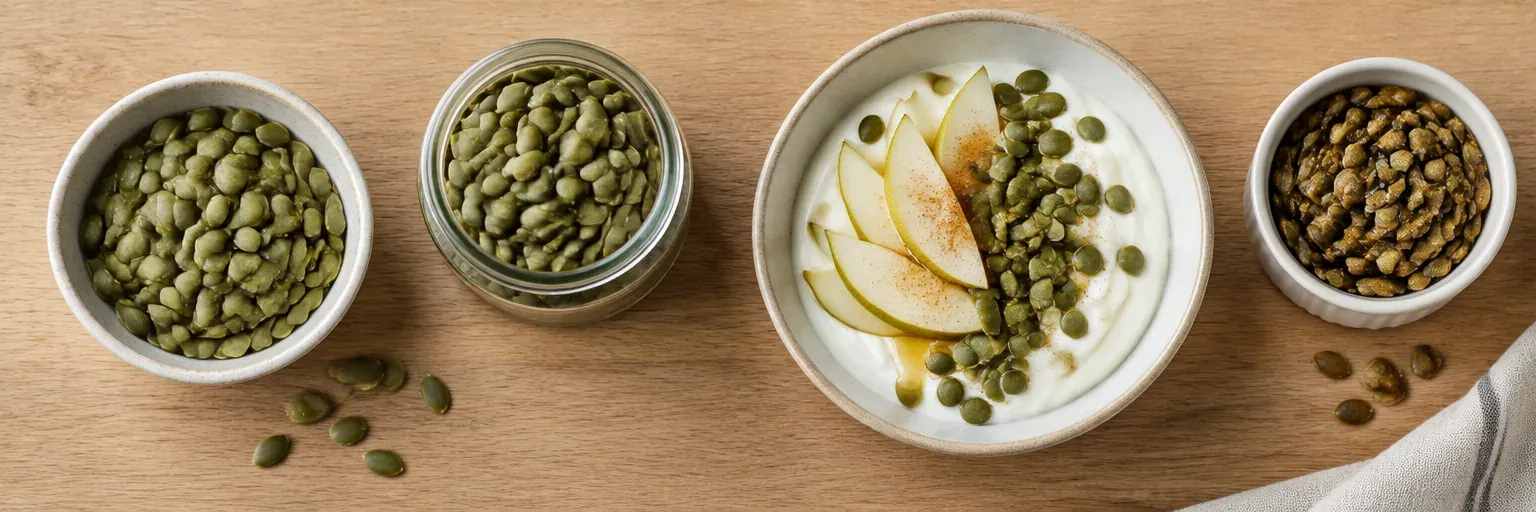
Pepitas (Cucurbita pepo) are the green, flat, oval hulled seed of specific pumpkin cultivars — Styrian oil pumpkin, Kakai, or naked-seeded varieties — grown for the seed rather than the flesh. The confusing part on a US shelf is that “pumpkin seeds” on a package label can mean either of two products, and they are not the same food:
- Hulled pepitas — the green inner seed with the tough outer shell already removed. This is what the numbers above describe and what almost every “pumpkin seed” recipe means. Roughly ~163 kcal / ~8.5 g protein / ~13.9 g fat / ~1.7 g fiber per 28 g ounce.
- Whole roasted-in-shell pumpkin seeds — the entire seed, cream-colored shell and all, typically the leftover from a carved pumpkin. About ~126 kcal / ~5 g protein / ~5.5 g fat / ~5 g fiber per 28 g ounce. Higher fiber, lower fat, lower magnesium bioavailability (the shell carries most of the phytate), and a chewier eating experience. A perfectly fine Halloween snack, but not the pantry staple this article is about.
USDA FoodData Central puts hulled pepitas at roughly 559 kcal per 100 g — a 1 oz (28 g) serving is ~163 kcal, with ~8.5 g of protein, ~13.9 g of total fat, ~4.2 g of carbohydrate of which ~1.7 g is fiber, ~156 mg of magnesium (~37 percent DV), ~226 mg of potassium (~5 percent), ~2.2 mg of zinc (~20 percent), ~2.5 mg of iron (~14 percent for men, ~14 percent for pregnant adults, less for menstruating adults on the higher target), ~333 mg of phosphorus (~27 percent), and ~9 mcg of vitamin K. A more practical 1 tablespoon of hulled pepitas is ~9 to 10 g and ~55 kcal, with ~2.8 g of protein, ~4.6 g of fat, and ~0.6 g of fiber.
Three features make pepitas nutritionally distinctive:
- Highest magnesium density of any commonly-eaten seed. At ~156 mg per 28 g portion (~37 percent of the daily target), hulled pepitas out-magnesium chia, flax, sunflower, and every common tree nut on a per-ounce basis. Only hemp hearts (~197 mg / oz) beat them among culinary seeds, and pepitas beat almonds (~76 mg / oz) by roughly a factor of two. Magnesium co-travels with muscle relaxation, sleep quality, blood-pressure regulation, and glycemic control — nutrients many adults on a weight-loss plan under-hit as they cut out processed foods.
- One of the top plant-food zinc sources. At ~2.2 mg per ounce (~20 percent DV), pepitas are one of the highest-zinc common plant foods on a US grocery shelf, behind only oysters and beef among broad food categories. Zinc matters for immune function, wound healing, and — relevant to the weight-loss context — appetite regulation and taste perception. Plant-based eaters have a real “zinc watchlist” concern (see plant based weight loss), and pepitas are one of the cleanest ways to cover it.
- Balanced PUFA-plus-MUFA fat profile. Pepitas carry roughly ~5.9 g of PUFA (mostly linoleic acid, minor ALA) and ~4.4 g of MUFA (oleic acid) per ounce, plus ~2.5 g of saturated fat. Rezig 2012 (Industrial Crops and Products) profiled the oil composition in detail: the seed oil is roughly 50 percent linoleic acid, 34 percent oleic acid, 12 percent palmitic acid, and 6 percent stearic acid — a favorable weight-loss-plate profile, not a “seed oil villain” case.
The fiber load is modest at ~1.7 g per ounce and ~0.6 g per tablespoon. Pepitas are a protein-and-mineral food, not a fiber food. If fiber-driven satiety is the goal, add chia or ground flax alongside — do not expect the pepitas to do the fiber work.
One tablespoon is ~9 to 10 g, and 1 to 2 tablespoons is the daily portion to keep in your head, because the single most common tracking mistake with pepitas is the “handful on the salad” — a heaped scoop tossed onto a grain bowl or a soup is often 25 to 40 g rather than 10 g. Weigh once on a $12 kitchen scale and every future tablespoon estimate will be far closer.
The satiety and body-composition evidence — read honestly
The whole-pumpkin-seed literature is smaller than the almond, chia, or flax literature and, importantly, there is no large-N randomized controlled trial of whole pepitas against a matched placebo showing an independent weight-loss effect. That gap matters, and food-blog coverage rarely flags it. The story is a mineral-and-protein-dense whole food at a working portion, not a proven weight-loss ingredient.
Glew 2006 (Journal of Food Composition and Analysis) profiled the nutrient composition of pumpkin seeds and related Cucurbita seeds across multiple cultivars, confirming the ~30 percent protein by weight, ~45 percent fat by weight, and the standout magnesium-and-zinc mineral load. This is the anchor nutrient-profile paper for the numbers on this page.
Ryan 2007 (Plant Foods for Human Nutrition) reviewed the phytochemical and micronutrient density of Cucurbita seeds, walking through the phytosterol, tocopherol, carotenoid, and mineral profile. Practical read: pepitas carry ~35 mg of gamma-tocopherol per 100 g (a form of vitamin E that most Western diets under-deliver), meaningful phytosterols (which have a small LDL-lowering literature), and a mineral density that survives most cooking.
Rezig 2012 (Industrial Crops and Products) analyzed the fatty-acid composition, tocopherol content, and oxidative stability of pumpkin seed oil across pressing methods. The finding that matters for a consumer: cold-pressed pumpkin seed oil is roughly 50 percent linoleic acid and 34 percent oleic acid, with tocopherols providing modest oxidative protection — but roasting the seeds before pressing (the traditional Styrian method) reduces tocopherol content and increases oxidation markers slightly. For whole-seed eating, roasted-vs-raw is nutritionally trivial at typical culinary temperatures.
Yadav 2016 (Journal of Food Science and Technology) evaluated pumpkin seed protein digestibility and amino-acid composition in modern digestibility panels. Pumpkin seed protein scores a PDCAAS around 0.60 to 0.67 — meaningfully lower than whey (~1.00) but comparable to hemp (~0.63) and better than most cereal proteins. The limiting amino acid is lysine, easily topped up by any legume in the same day. Practical read: pepita protein is a real, usable plant protein, though not “complete” in the isolated-food sense.
Adamska-Patruno 2018 (Nutrients) is a mechanism paper on plant-protein satiety more broadly — high-protein plant snacks (nuts, seeds, legumes) drive stronger satiety hormone responses (PYY, GLP-1) than isocaloric refined-carb snacks. Not a pumpkin-seed-specific trial, but it is the closest satiety-mechanism evidence for the seed category, and it is the mechanism worth citing rather than a fabricated pepita RCT.
Neale 2017 (BMJ Open) is a systematic review of tree-nut and seed intake against body weight outcomes across 62 studies. The pooled result: regular intake of nuts and seeds is either weight-neutral or weight-favorable across long-term observational and interventional data, with none of the categorical weight-gain signal that the “nuts are calorie-dense so avoid them” advice would predict. Pepitas fall inside that category effect.
Bes-Rastrollo 2009 (American Journal of Clinical Nutrition) followed ~50,000 women in the Nurses’ Health Study for 8 years and found that nut and seed intake was inversely associated with long-term weight gain — women eating nuts and seeds at least twice a week gained ~0.9 kg less over 8 years than infrequent consumers, adjusted for age, energy, and other lifestyle factors. Observational, not causal, but consistent with the intervention literature.
The honest read: pepitas do not burn fat, and no whole-pumpkin-seed weight-loss RCT has been run at the scale that almonds and flax have been tested at. What pepitas do bring is a top-of-class magnesium-and-zinc plant food at a working portion — a mineral-coverage-plus-satiety tool inside a real deficit, not a weight-loss ingredient per se. A reader who adds 1 to 2 tablespoons of pepitas to yogurt or a salad and expects the scale to move without other changes will be disappointed. See why am I not losing weight for the wider “healthy food, no deficit” failure mode.
Pepitas vs sunflower seeds vs chia vs hemp — the four-way comparison
All four are net-good weight-loss foods, and none of them burn fat. Each has a different strength, and the honest deciding factor is what the seed is for in your plate.
| Seed (1 oz / 28 g, hulled) | Kcal | Protein (g) | Fiber (g) | Magnesium (mg) | Zinc (mg) | Dominant fat | Best-for-weight-loss context |
|---|---|---|---|---|---|---|---|
| Hulled pumpkin seeds (pepitas) | ~163 | ~8.5 | ~1.7 | ~156 (~37% DV) | ~2.2 (~20% DV) | PUFA (linoleic) + MUFA (oleic) | Best magnesium-and-zinc density — savory salads, soups, yogurt, oatmeal; the fall/winter seed |
| Hulled sunflower seeds | ~164 | ~5.8 | ~2.4 | ~91 | ~1.5 | PUFA (linoleic) | Cheapest per pound; vitamin E anchor; salad and trail-mix use |
| Chia (black or white) | ~138 | ~4.7 | ~10 | ~95 | ~1.3 | ALA omega-3 | Best fiber density — chia pudding, chia water, gel-forming applications |
| Hulled hemp hearts | ~155 | ~9 (complete, all 9 EAA) | ~1.2 | ~197 | ~2.7 | PUFA (LA:ALA ~3:1) | Best protein completeness — savory bowls, avocado toast, pesto; digestible without grinding |
Decision rule: rotate two or three of the four, do not pick one. Pepitas are the highest-magnesium-and-zinc option and the seed that anchors a savory salad or roasted-vegetable topper. Sunflower is the cheapest and works everywhere pepitas do at a lower price — see the sunflower seeds for weight loss pillar for the vitamin-E-per-oz argument, the salted-vs-unsalted and in-shell read, and the SunButter-vs-peanut-butter comparison. Chia carries the fiber-driven gel-forming applications. Hemp is the complete-protein option and pairs best with yogurt or a plant-protein bowl. There is real value in variety — the mineral profiles genuinely differ, and no single seed is best at everything. See the chia seeds deep dive, the hemp seeds pillar, and the wider fats-and-satiety framing in healthy fats for weight loss for the neighboring pieces.
Roasted vs raw vs salted vs sprouted — a practical comparison
Format matters less than portion, but the four common formats do differ in small ways worth knowing.
| Format (1 oz / 28 g) | Kcal | Protein (g) | Fat oxidation vs raw | Notes | Weight-loss practical read |
|---|---|---|---|---|---|
| Raw hulled pepitas | ~163 | ~8.5 | 0% (baseline) | Highest tocopherol retention; mildest flavor; softest crunch | Best flavor-neutral pantry default; use on salads, in trail mix, blended into pesto |
| Dry-roasted hulled pepitas | ~165 | ~8.5 | ~5 to 8% PUFA oxidation vs raw (Rezig 2012) | Deeper nutty flavor; crisper crunch; slight tocopherol reduction | Nutritionally near-identical to raw; pick on taste |
| Roasted salted pepitas | ~165 | ~8.5 | ~5 to 8% | Adds ~150 to 250 mg sodium per oz | Fine on a normal weight-loss plan; watch on BP-restricted or CKD sodium restrictions |
| Sprouted pepitas | ~163 | ~8.5 | 0% | Phytate ~30% lower; mineral bioavailability marginally improved; grassier flavor | Not a weight-loss lever; a small mineral-absorption edge and a taste preference |
The one format that meaningfully changes the calorie profile is candy pepitas — honey-roasted, cinnamon-sugar, chili-lime-honey, “sweet-and-spicy” — which can add 20 to 40 kcal per oz from added sugar and shift the food from whole-food snack toward candied nut. If the seed is coated in something shiny, read the label. The oxidation number worth flagging: Rezig 2012 measured a ~5 to 8 percent PUFA oxidation increase from dry-roasting at 160°C for 20 minutes, which is real chemistry but nutritionally trivial at a 1-oz portion. Home-roasting at moderate heat (150 to 175°C for 10 to 15 minutes) does not appreciably degrade the vitamin E or mineral content. Choose based on taste, not on a claimed weight-loss edge.
How to actually use them — 6 practical formats
Beyond the standalone yogurt-and-oatmeal sprinkle, pepitas show up reliably in six specific patterns that fit inside a deficit.
- 1 tbsp pepitas on 3/4 cup nonfat Greek yogurt with berries. ~185 kcal, ~19 g protein, ~2 g fiber snack or breakfast. The yogurt is the primary protein anchor; the pepitas add ~2.8 g of plant protein plus the magnesium-and-zinc hit and a savory-crunch texture that plays well against berry sweetness. See high protein breakfast ideas for the wider yogurt template.
- 1 tbsp pepitas on a big green salad. Salad ~200 kcal (romaine, cucumber, tomato, red onion, 3 oz chicken, 1 tbsp olive oil + lemon dressing) plus 1 tbsp pepitas at ~55 kcal = ~255 kcal, ~30 g protein, ~4 g fiber. A modest crunch upgrade that turns “salad” from rabbit food into a real meal. The chicken plus pepitas together is a magnesium-and-zinc bump few salad templates match.
- 1 tbsp pepitas in a trail-mix ratio. Home-mixed 1 oz trail mix = 1 tbsp pepitas (~55 kcal) + 1 tbsp almonds (~85 kcal) + 1 tbsp raisins (~50 kcal) = ~190 kcal / 6 g protein / 3 g fiber. Pre-portioned into snack bags on the day the bulk bag comes home. Do not eat from the bulk bag — that is the grazing failure mode below.
- 1 tbsp pepitas on oatmeal. Standard oat portion (½ cup dry oats + 1 cup water or milk) is ~150 kcal with ~5 g protein and ~4 g fiber; adding 1 tbsp pepitas pushes it to ~205 kcal with ~8 g protein, ~5 g fiber, plus ~78 mg of magnesium. A near-free upgrade to a standard breakfast.
- Sheet-pan roasted pepitas as a soup topper. Butternut squash soup, tomato soup, chili — a 1 tbsp sprinkle of home-roasted pepitas (raw pepitas + 5 minutes at 175°C on a sheet pan, no oil needed) delivers a savory crunch that costs ~55 kcal and turns the soup from a plain bowl into a “meal.” Do not oil-roast unless you enjoy the extra 10 to 15 kcal per oz.
- Homemade granola with 2 tbsp pepitas per ½ cup dry granola serving. A ~200 kcal granola with 1/3 cup oats, 1 tbsp maple syrup, 1 tsp oil, and 2 tbsp pepitas delivers ~7 g protein and ~3 g fiber — comparable to a commercial granola at half the sugar. Weigh once and standardize the recipe.
The Costco-tub grazing warning
The single most common practical failure with pepitas is the open-tub graze. A 3-pound Costco Kirkland Signature pepita bag, a 2-lb Trader Joe’s pepita jar, or a large bulk-bin scoop sit on the counter, and a reader who “just eats a handful” between meals typically pulls ~35 to 45 g in a 4-tablespoon handful — that is ~200 to 260 kcal per handful, not the ~55 kcal a “small handful” mental model implies. Two of those handfuls a day is ~400 to 500 kcal, which is the entire deficit for many weight-loss plans.
The fix is not willpower — it is portioning. Pick one:
- Weigh 1 to 2 tablespoons onto a small dish once a day, then close the bag. A $12 kitchen scale ends the “handful” arithmetic problem in one purchase.
- On the day the bulk bag comes home, portion the entire bag into 14 g (1-tablespoon) or 28 g (1-oz) zip bags. Then you eat “one bag” instead of “a handful.”
- Buy 100-calorie pre-portioned packs. More expensive per ounce, but they solve the problem without requiring a scale on the counter.
- Do not eat pepitas while working, watching TV, or driving. Distraction-eating with a calorie-dense snack is where the day quietly goes wrong. Almonds, cashews, pistachios, and pepitas all share the same failure pattern — see the same warning inside almonds for weight loss and cashews for weight loss for parallel language.
Carveouts — when to modify or avoid
Pepitas are broadly safe for most adults. Four groups should modify or verify before making them a daily habit.
- GLP-1 users (semaglutide, tirzepatide). Pepitas are fine on GLP-1s — the protein-and-fat profile is exactly the “small, dense, high-value” snack the GLP-1 appetite-suppression pattern rewards. The one adjustment: portion often halves naturally. A 1-tablespoon daily portion may be the more comfortable working target rather than 2 tablespoons. Watch for early satiety and the calorie-density trap of “I only ate a handful of pepitas today, so I skipped protein at dinner” — the pepitas do not substitute for a real protein-anchored meal. See managing GLP-1 side effects and preventing muscle loss on GLP-1 for the wider framework.
- Kidney disease (CKD stage 3+). Pepitas carry ~333 mg of phosphorus and ~226 mg of potassium per ounce — meaningful on a strict CKD phosphorus or potassium restriction. Phosphorus from plant sources has lower bioavailability than phosphorus from animal or additive sources, so the practical impact is smaller than the number suggests, but it does count toward a daily target. Discuss with a renal dietitian before making pepitas a regular daily habit at CKD stage 3 or later. Culinary use at CKD stage 1 to 2 is generally fine.
- Tree-nut allergy. Pepitas are a seed, not a tree nut, and most people with a tree-nut allergy tolerate pumpkin seeds fine. The important caveat: shared-facility cross-contamination is common for bulk seed products, and a small subset of adults have a documented primary pumpkin-seed allergy (Cucurbitaceae family allergy). Anyone with a serious tree-nut allergy should buy pepitas from a facility that explicitly labels “processed in a nut-free facility” or “no tree nuts on the same line.”
- Postpartum and breastfeeding. Culinary-dose pepitas (1 to 2 tbsp/day) are broadly recommended in both — the magnesium (~37 percent of the pregnancy DV per ounce) and zinc (~20 percent) contribution is a legitimate small win for a period when many adults under-hit both minerals. There is no established upper limit for culinary intake, and no drug interaction concern at food doses. Concentrated pumpkin-seed-oil supplements at mega-doses (>1 g/day of a standardized extract) have not been well studied in pregnancy or lactation and are a supplement-dose question for a clinician, not the pregnancy default. Whole pepitas are fine.
What pepitas do not do
Pepitas are a useful magnesium-and-zinc-dense whole food, and they are not a lot of other things.
- Pepitas do not burn fat. There is no whole-pumpkin-seed weight-loss RCT at any meaningful scale, and no mechanism suggests a metabolic-boost effect. Pepitas are a mineral-and-satiety tool inside a deficit, not a fat burner.
- Pepitas are not a high-fiber food. At ~1.7 g of fiber per ounce, pepitas are lower-fiber than chia (~10 g), sunflower (~2.4 g), or almonds (~3.5 g). If you want fiber-driven satiety, add chia or ground flax alongside — do not expect pepitas to do the fiber work.
- Pepitas are not the same as pumpkin seed oil. The oil is a niche finishing product with a phytosterol-plus-linoleic-acid profile and a small BPH literature; it is not a substitute for whole pepitas on a weight-loss plan, and viral “pumpkin seed oil for weight loss” claims are unsupported.
- Pepitas are not a “detox” food. The liver and kidneys handle detoxification; pepitas are a normal high-magnesium plant food.
- Pepitas are not a “prostate cure.” A small phytosterol literature on pumpkin seed oil extract for benign prostatic hyperplasia symptoms exists (Vahlensieck 2015, Urologia Internationalis), but that is a supplement-dose extract question, not a whole-seed weight-loss question. The single-food pillar does not double as a urology treatment.
- Whole roasted-in-shell pumpkin seeds are not the same food as hulled pepitas. Different fiber, fat, and mineral profile; different eating experience; different weight-loss role. If a recipe or a label says “pumpkin seeds,” check whether it means hulled pepitas or in-shell whole seeds.
Bottom line
One to two tablespoons per day of hulled pepitas (~14 to 28 g) is a legitimate magnesium-and-zinc-dense whole-food add that fits any weight-loss framework. They are not a magic fat-burner, there is no whole-pumpkin-seed weight-loss RCT, and the honest read is that they support a real calorie deficit rather than replace one. Portion is the whole game — a “small handful” is almost always double what the mental model implies, so weigh once or portion into snack bags on the day the bulk bag comes home. Rotate pepitas with chia, hemp, and flax rather than picking one seed; the mineral profiles genuinely differ, and variety across the four gets you the fiber, complete protein, ALA omega-3, and magnesium-plus-zinc all covered. Store an opened bag refrigerated if it will not be finished within 2 to 3 months — the PUFAs oxidize similarly to sunflower and hemp. Pepitas are a small, durable, mineral-dense win. Treat them that way, and they earn their slot on the plate.
Sources
- Glew RH, Glew RS, Chuang LT, et al. Amino acid, mineral and fatty acid content of pumpkin seeds (Cucurbita spp) and Cyperus esculentus nuts in the Republic of Niger. Journal of Food Composition and Analysis / Plant Foods for Human Nutrition (2006).
- Ryan E, Galvin K, O'Connor TP, et al. Phytosterol, squalene, tocopherol content and fatty acid profile of selected seeds, grains, and legumes. Plant Foods for Human Nutrition (2007).
- Rezig L, Chouaibi M, Msaada K, Hamdi S. Chemical composition and profile characterisation of pumpkin (Cucurbita maxima) seed oil. Industrial Crops and Products (2012).
- Yadav M, Jain S, Tomar R, et al. Medicinal and biological potential of pumpkin: an updated review, including protein digestibility of Cucurbita seed proteins. Journal of Food Science and Technology / Nutrition Research Reviews (2016).
- Adamska-Patruno E, Ostrowska L, Goscik J, et al. The relationship between the leptin/ghrelin ratio and meals with various macronutrient contents in men with different nutritional status. Nutrients (2018).
- Neale EP, Tapsell LC, Guan V, Batterham MJ. The effect of nut consumption on markers of inflammation and endothelial function: a systematic review and meta-analysis of randomised controlled trials. BMJ Open (2017).
- Bes-Rastrollo M, Wedick NM, Martinez-Gonzalez MA, et al. Prospective study of nut consumption, long-term weight change, and obesity risk in women. American Journal of Clinical Nutrition (2009).
- U.S. Department of Agriculture, FoodData Central. Seeds, pumpkin and squash seed kernels, dried (Cucurbita spp) — nutrient profile per 100 g and per 28 g ounce.
- National Institutes of Health, Office of Dietary Supplements. Magnesium — health professional fact sheet (daily requirement, food sources, deficiency, and weight-related outcomes).
- National Institutes of Health, Office of Dietary Supplements. Zinc — health professional fact sheet (daily requirement, plant-food sources, absorption, and vegetarian considerations).
Editorial note
This guide is educational and does not replace individualized medical or dietary advice. Culinary pumpkin seeds are broadly safe, but readers on very-low-calorie plans, CKD stage 3 or later phosphorus and potassium restrictions, a documented tree-nut or Cucurbitaceae allergy, or a strict blood-pressure sodium restriction should confirm the daily portion and format with a clinician or dietitian. Pumpkin seeds do not treat or cure any medical condition, and they are not a substitute for pharmacological therapy.