
2026-09-14 · tofu, soy protein, plant protein, extra-firm tofu, silken tofu, isoflavones, vegetarian weight loss, plant-based weight loss, single-food pillar, complete plant protein, PDCAAS, GLP-1 friendly protein, weight loss, Maya Patel
Written by Maya Patel
Maya Patel is a WeightFAQ staff writer covering sustainable weight loss through mindful eating, flexible routines, and evidence-based nutrition. She translates research on protein, fiber, portion control, and calorie awareness into practical meal-planning guidance readers can actually follow at home. Her articles favor honest expectations over fad promises — small changes that compound, calorie bands scaled to real households, and grocery lists built around whole foods with room for real life. Maya writes for people juggling family meals, busy weeks, and long-term goals, not gym-optimized single adults with unlimited prep time.
28 min read
Medically reviewed on Sep 14, 2026
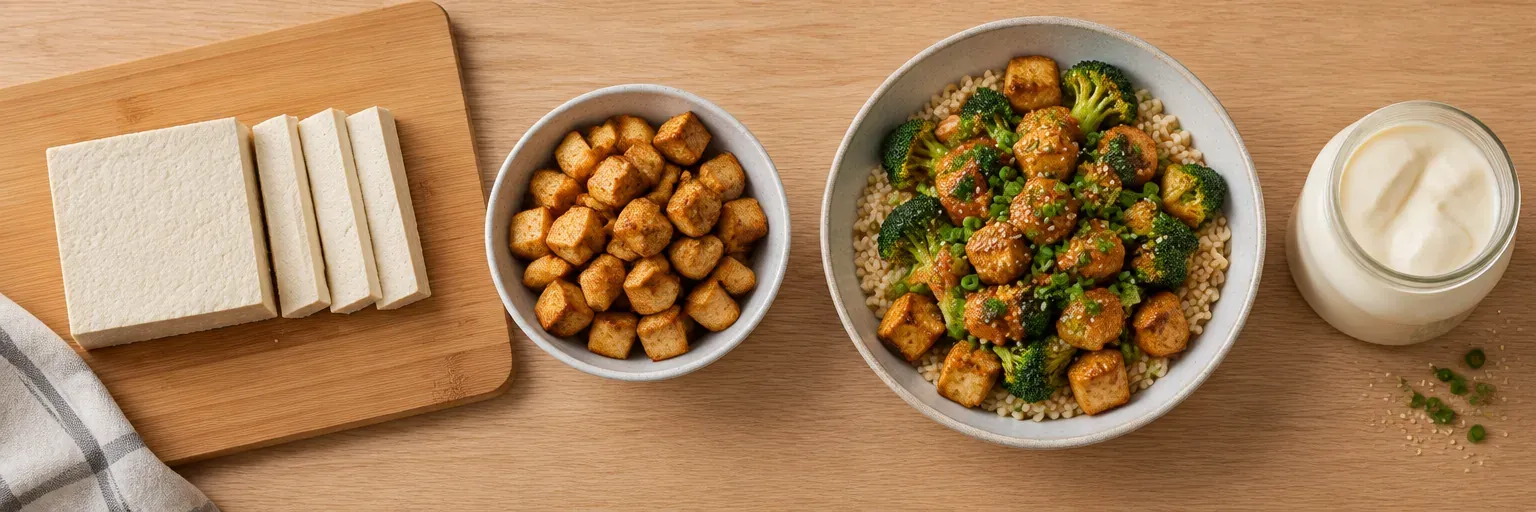
Tofu for Weight Loss: Calories per Block, Extra-Firm vs Silken, Air-Fryer Method, and What the Evidence Actually Says (2026)
Quick answer
Three ounces (~85 g) of extra-firm tofu carries roughly 70 to 95 kcal, ~8 to 11 g of complete plant protein (all nine essential amino acids, PDCAAS ~1.0), ~4 to 5 g of fat (most of it polyunsaturated, ~0.7 g of that saturated), ~2 to 3 g of carbohydrate, ~200 to 350 mg of calcium if the coagulant is calcium sulfate, and ~1 to 2 mg of iron per USDA FoodData Central. Silken tofu at the same 3 oz portion is closer to 45 to 55 kcal and 4 to 5 g of protein — the format is different because silken sits at ~85 percent water while extra-firm sits closer to ~50 percent water. The honest read on weight loss is direct: tofu does not burn fat, and no large-N tofu-only weight-loss RCT exists — but tofu is a satiety-per-calorie standout because it delivers complete plant protein at ~10 to 14 kcal per gram of protein, competitive with chicken breast (~5 to 9 kcal/g) and meaningfully better than most beans (~15 to 20 kcal/g). Working default: 3 to 6 oz per meal, one to two meals per day, most often in a stir-fry, air-fryer bowl, or silken-blended sauce. Tofu belongs alongside beans, tempeh, Greek yogurt, and cottage cheese in a mixed-protein weight-loss cart and inside a plant-heavy protein intake for weight loss framework — see the wider plant-forward pattern in plant based weight loss and the lacto-ovo meal template in the vegetarian weight loss meal plan.
What is actually in a block of tofu
Tofu is a curdled soymilk product: soybeans are soaked, ground, cooked, and pressed into soymilk, then a coagulant (calcium sulfate, magnesium chloride/nigari, or an organic acid like glucono-delta-lactone) is added to precipitate the soy proteins into curds. The curds are pressed to remove water; the more water pressed out, the firmer the block. That single mechanical variable — water content — controls firmness, protein density per gram, and cooking behavior.
USDA FoodData Central puts extra-firm tofu at roughly 91 kcal per 100 g — a 3 oz (85 g) serving is ~77 kcal, with ~10 g of protein, ~5.3 g of total fat (~0.7 g saturated, ~1 g monounsaturated, ~3 g polyunsaturated), ~2.2 g of carbohydrate of which ~0.4 g is fiber, ~350 mg of calcium (if calcium-sulfate-set), ~1.5 mg of iron, and negligible sodium. Silken tofu at 3 oz is closer to ~47 kcal, ~4 g protein, ~2.7 g fat, and ~1.5 g carbohydrate. A standard US block is 14 to 16 oz and yields 4 to 5 3-oz portions after pressing.
Three features make tofu nutritionally distinctive for a weight-loss plate:
- Complete plant protein with a PDCAAS around 1.0. The Protein Digestibility-Corrected Amino Acid Score is the FDA and WHO standard for protein quality; tofu (and soy protein isolate) score at the top of the plant-protein range, comparable to whey and egg. Kim 2016 (Nutrients), a meta-analysis of 40+ soy-protein trials, is the anchor evidence for the protein-quality claim. That means tofu does not need to be paired with a cereal grain to hit the essential-amino-acid targets — a common misconception left over from the 1970s “complementary proteins” model that has since been retired.
- Very low saturated fat. At ~0.7 g of saturated fat per 3 oz portion, extra-firm tofu is one of the lowest-saturated-fat main-course proteins in the grocery cart — meaningfully lower than chicken thigh (~2 g), ground beef 90/10 (~3.5 g), or cheese-based vegetarian dishes. The polyunsaturated-fat fraction (~3 g per 3 oz) is largely linoleic acid with a small amount of ALA. See healthy fats for weight loss for the wider fat-quality frame.
- Calcium content depends entirely on the coagulant. Calcium-sulfate-set tofu (the US default; check the label for “calcium sulfate” as the setting agent) delivers 200 to 350 mg of calcium per 3 oz — roughly a third of the daily target from one portion. Magnesium-chloride-set tofu (nigari, common in Japanese-style silken and some artisan blocks) can carry less than 50 mg of calcium per 3 oz. This is one of the few label details worth reading if calcium coverage is a goal.
The fiber load is small (~0.4 g per 3 oz) and not the reason to eat tofu; the reason is complete plant protein at low kcal per gram of protein.
A note on tracking: a 14 oz block sliced into 4 equal slabs is 3.5 oz per slab; a 16 oz block into 5 slabs is 3.2 oz per slab. Both land in the working 3 to 4 oz portion range without needing a scale — but if you press the block for 20 to 30 minutes before cooking (a plate on top plus a heavy pan, or a purpose-built tofu press), the block loses roughly 15 to 25 percent of its weight as water and concentrates protein per bite. A 14 oz block pressed down to ~11 oz still yields ~4 portions of ~2.75 oz each, but the protein density per bite rises meaningfully. Weigh the pressed block once on a $12 kitchen scale and your future estimates will be far closer; for the wider weigh-versus-estimate playbook, see how to count calories.
Firmness and water-content spectrum — a table
Tofu firmness is not a flavor variable, it is a water-content spectrum. Higher water = softer, lower protein per gram, and different cooking behavior.
| Firmness | Water content (approx) | Kcal per 3 oz | Protein per 3 oz (g) | Best use |
|---|---|---|---|---|
| Silken | ~85% | ~45–55 | ~4–5 | Smoothies, salad dressings, blended chocolate pudding, miso soup, vegan mayo, raw dips |
| Soft | ~80% | ~55–65 | ~5–6 | Scrambles, gentle simmers, mapo tofu, silken-adjacent uses that need a little more body |
| Firm | ~65% | ~65–75 | ~7–9 | Everyday stir-fries, curries, soups, cubed pan-fry |
| Extra-firm | ~50% | ~75–95 | ~9–11 | Air-fryer, oven-bake, sheet-pan, grill, marinades, meal-prep containers |
| Super-firm / high-protein | ~40% | ~95–115 | ~12–15 | Sear direct out of the package (no pressing needed), sandwiches, skewers, restaurant-style crispy tofu |
Pressing extra-firm for 20 to 30 minutes concentrates protein by roughly 15 to 25 percent and doubles the crispness ceiling in an air-fryer or oven — the single highest-return prep step for weight-loss tofu. Skip pressing for silken and soft; it defeats the point.
Evidence, read honestly
The tofu literature is small compared to the almond, walnut, or oat literature, and there is no large-N randomized controlled trial of whole tofu against a matched placebo showing an independent weight-loss effect. The evidence base is class-level (soy protein) plus mechanism (satiety, complete protein, low energy density, low saturated fat).
Kim 2016 (Nutrients) is the anchor weight-loss meta-analysis — a review of soy-protein intervention trials that showed a modest but consistent effect on body weight and body composition when soy protein was substituted for other protein sources, most reliably when total protein was matched and calories were controlled. The effect size is small; the practical read is that tofu is not worse than animal protein for weight loss, and often modestly better when it is displacing a higher-saturated-fat protein.
Mueller 2010 (American Journal of Clinical Nutrition) is the plant-protein satiety paper — a controlled feeding study comparing plant-protein preloads to animal-protein preloads on subsequent energy intake, finding roughly equivalent satiety when total protein was matched. The practical read: gram-for-gram, plant protein is not less filling than animal protein at typical intakes.
Neacsu 2014 (American Journal of Clinical Nutrition) directly compared a soy-protein-based lunch to a meat-protein-based lunch at matched calories and protein in overweight men, and reported equivalent satiety and subsequent energy intake across the two conditions — a useful direct data point for the “does tofu keep you full as well as chicken” question.
Fontecha 2019 (Advances in Nutrition) reviewed plant versus animal protein for body composition across randomized trials, finding no meaningful advantage of animal protein over plant protein for lean-mass retention at matched total-protein intakes — a useful correction to the “plant protein is second-tier for muscle” claim that shows up in fitness-culture coverage.
Messina 2016 (Nutrients) is the comprehensive soy-foods review — cancer, thyroid, bone, cardiovascular, and body-weight endpoints all in one paper. This is the paper the site’s isoflavone, thyroid, and breast-cancer-safety claims lean on.
Nachvak 2019 (Advances in Nutrition) is the long-term safety meta-analysis — over 465,000 participants across observational cohorts, showing that soy-food intake is associated with lower all-cause mortality, not higher. The signal is small but the direction is unambiguous.
Kang 2022 (Nutrients) meta-analyzed soy isoflavones on BMI and found a small BMI-lowering signal at typical intakes — supporting the “not harmful” read for weight-loss populations.
Nechuta 2012 (American Journal of Clinical Nutrition) pooled three prospective cohorts (Shanghai Breast Cancer Survival Study, Life After Cancer Epidemiology, and Women’s Healthy Eating and Living) covering 9,514 breast-cancer survivors and found soy-food intake associated with lower recurrence and lower mortality — the anchor evidence that moderate soy is safe for survivors, not a risk factor.
Messina & Redmond 2006 (Thyroid) reviewed the soy-and-thyroid literature and concluded that soy does not impair thyroid function in euthyroid adults. The one real interaction is with levothyroxine absorption — patients on thyroid replacement should space soy 4 hours from the pill, which is a timing issue, not a thyroid-harm issue.
Reed 2021 (Reproductive Toxicology) meta-analyzed 41 studies on soy and testosterone in men and found no clinically meaningful effect on total or free T at intakes up to ~70 g of soy protein per day — well above typical culinary tofu intake. Messina 2010 (Fertility and Sterility) reached the same conclusion.
The honest read: tofu does not burn fat, and no tofu-only weight-loss RCT has been run at meaningful scale. What tofu brings is a high-quality complete plant protein at low kcal per gram of protein, well-documented long-term safety, and a modest class-level weight-loss signal (Kim 2016). A person who adds a 4 oz slab of extra-firm to their dinner and expects the scale to move without other changes will be disappointed. See why am I not losing weight for the wider “healthy food, no deficit” failure mode.
Tofu vs chicken breast vs Greek yogurt vs cottage cheese vs tempeh — the comparison
The most useful comparison for a weight-loss reader is against the four other high-protein staples that tofu most often displaces or rotates with.
| Food (per 3 oz cooked) | Kcal | Protein (g) | Sat fat (g) | Carb (g) | Kcal per g protein | Plant / animal | Best-for-weight-loss context |
|---|---|---|---|---|---|---|---|
| Extra-firm tofu | ~80 | ~10 | ~0.7 | ~2 | ~8 | Plant, complete | Lowest saturated fat, lowest kcal per portion, meal-prep-friendly, most flexible cooking method range |
| Chicken breast, skinless | ~140 | ~26 | ~0.9 | 0 | ~5.4 | Animal | Highest raw protein-per-calorie; the tool when hitting 130+ g/day at 1,500 kcal is hard |
| Nonfat Greek yogurt | ~55 | ~10 | 0 | ~3 | ~5.5 | Animal | Convenience anchor; the highest-return breakfast and snack protein |
| 2% cottage cheese | ~85 | ~10 | ~1 | ~3.5 | ~8.5 | Animal | Cheapest casein per gram of protein; slow-digesting for late-day satiety |
| Tempeh | ~165 | ~16 | ~1.3 | ~8 | ~10.3 | Plant, complete | Higher protein density than tofu but more calories per portion; fiber-carrying |
Practical takeaways from the table:
- Tofu wins for lowest saturated fat and lowest kcal per portion — the tool if you are watching sat fat load, prefer plant options, or want the smallest calorie footprint per gram of protein at low absolute intake.
- Chicken wins raw protein-per-calorie — the tool if hitting a 130+ g/day protein target at 1,500 kcal is genuinely hard.
- Greek yogurt wins convenience — no cooking, no prep, portable.
- Cottage cheese wins low-cost casein — the slow-digesting casein fraction is useful for late-day satiety.
- Tempeh wins protein-plus-fiber density — but at meaningfully higher kcal per portion. See our sibling tempeh for weight loss pillar for the fermented-soy counterpart, the per-3-oz kcal and fiber math, and the honest read on the probiotic and NOVA-classification questions that come up alongside tofu.
There is no need to pick one. Rotating three of the five across a week keeps meals varied and prevents the “same-food fatigue” that drives most silent adherence breakdowns. For the wider protein-anchor logic, see preserve muscle during weight loss and protein intake for weight loss.
Cooking method — the calorie ladder that matters more than the tofu itself
The single biggest tracking mistake with tofu for weight loss is treating “tofu” as one food regardless of how it is cooked. The cooking method changes calories more than the tofu itself does.
| Method | Added kcal per 3 oz | Best texture outcome | Weight-loss verdict |
|---|---|---|---|
| Raw silken (blended into a dressing, smoothie, chocolate pudding) | 0 | Creamy, no chew | Best for low-kcal sauce and dessert applications |
| Oven-baked, 400°F, on parchment, no oil | 0–15 | Chewy, moderate crisp | Best for meal prep; batch-friendly; lowest calorie add |
| Air-fried, 400°F, 15 min, 1 tsp oil per 3 oz | 15–25 | Crispy outside, tender inside | Best texture-per-calorie ratio for a deficit |
| Pan-fried in 1 tsp oil | 30–40 | Crispy on 2 sides | Fine for one-pan dinners; watch oil creep |
| Deep-fried | 150–250 | Very crispy, very calorie-dense | Avoid as the default for a deficit |
A worked example to keep in your head: 5 oz of pressed extra-firm tofu, cubed, tossed with 1 tsp neutral oil and 1 tsp soy sauce, air-fried at 400°F for 15 minutes, then finished with a rice-vinegar-and-sesame glaze ≈ 165 kcal and 18 g of complete plant protein. That is a legitimate weight-loss protein anchor — comparable to 3 oz of chicken breast at 140 kcal and 26 g of protein, with lower saturated fat and higher polyunsaturated fat.
Restaurant-style crispy tofu (deep-fried, corn-starch-coated, glazed) is a different food nutritionally — often 350 to 500 kcal for the same 5 oz of raw tofu — and does not fit the same slot in a deficit as home air-fried tofu.
The soy safety questions — the three that come up
Coverage of tofu on social media often lands on isoflavones, breast cancer, thyroid, and testosterone. The current evidence is much less alarming than internet framing suggests.
1. Breast cancer and isoflavones
Nechuta 2012 (American Journal of Clinical Nutrition) pooled three prospective cohorts totaling 9,514 breast-cancer survivors and reported that soy-food intake was associated with lower recurrence and lower mortality — not higher. The American Cancer Society and the World Cancer Research Fund both explicitly state that moderate soy foods (1 to 2 servings per day) are safe for breast-cancer survivors, and the population-level cohort data suggests possibly protective. Messina 2016 (Nutrients) reviews the mechanism: soy isoflavones are selective estrogen-receptor modulators and behave more like tamoxifen than like endogenous estrogen in breast tissue at typical intakes.
Practical read for survivors: 1 to 2 servings of tofu, edamame, tempeh, or soy milk per day is safe and possibly protective. Isolated soy-isoflavone supplements at supraphysiologic doses are a different question and should be discussed with an oncology team.
2. Thyroid
Messina & Redmond 2006 (Thyroid) reviewed 14 clinical trials of soy foods or isoflavones in adults with normal thyroid function and found no impairment of thyroid function — TSH, free T4, and free T3 did not shift meaningfully at typical intakes. The one real interaction is with levothyroxine absorption: soy fiber and soy protein modestly reduce gut absorption of the pill, so hypothyroid patients on levothyroxine should space soy 4 hours from the dose. This is a timing issue, not a thyroid-harm issue.
Cross-links: hashimotos-thyroiditis-and-weight-loss and thyroid and weight loss for the wider hypothyroid weight-management framework and the levothyroxine-timing playbook.
3. Men and testosterone
Reed 2021 (Reproductive Toxicology) meta-analyzed 41 studies on soy or isoflavones and male hormones and found no clinically meaningful effect on total or free testosterone at intakes up to ~70 g of soy protein per day — well above what a typical culinary intake of 1 to 2 servings per day delivers (~15 to 30 g of soy protein). Messina 2010 (Fertility and Sterility) reached the same conclusion in an earlier meta. The “soy feminizes men” claim comes from a small number of case reports at supraphysiologic isoflavone-supplement doses and does not generalize to tofu, edamame, or soy milk at culinary amounts.
Practical read: tofu at 3 to 6 oz per meal, one to two meals per day, has no documented effect on male hormones.
Is tofu ultra-processed? An honest NOVA read
The NOVA food-classification system splits foods into four categories: unprocessed (category 1), processed culinary ingredients (2), processed foods (3), and ultra-processed foods (4). Plain tofu — soybeans + water + a coagulant, optionally salt — is NOVA category 3, a processed food, not an ultra-processed food. That places tofu in the same category as cheese, canned beans, or fresh-baked bread — a minimally processed staple, not a package of industrial ingredients.
Where tofu can slip into NOVA 4: heavily flavored, breaded, smoked, marinated, or plant-based-meat-style tofu products (crispy teriyaki tofu strips, tofu-based deli slices, hot-dog-style tofu franks) often carry emulsifiers, texturants, added sugars, and long ingredient lists. Those products are ultra-processed and count as such in a weight-loss framework.
Practical rule: if the ingredient list is soy, water, and a coagulant (calcium sulfate or magnesium chloride/nigari), plus optional salt, it is minimally processed. If the list runs longer than 4 to 5 items and includes emulsifiers or flavorings, treat it as UPF. See ultra-processed-foods-and-weight-loss for the wider framework and the mechanism by which UPFs drive higher spontaneous energy intake (Hall 2019).
How to actually use tofu — six meal formats
Beyond the standalone stir-fry, tofu shows up reliably in six specific meal formats that fit inside a real deficit.
- Air-fried tofu cubes over brown rice and veg (~450 kcal, 22 g protein): 5 oz pressed extra-firm cubed and air-fried at 400°F for 15 min with 1 tsp oil, served over ½ cup cooked brown rice with 1 cup roasted broccoli and a rice-vinegar-and-sesame glaze. The default weight-loss lunch.
- Silken tofu miso soup at the start of a meal (~90 kcal, 6 g protein): 3 oz silken tofu cubed into 1 cup hot dashi with 1 tbsp miso paste, scallions, and wakame. A legitimate volume-preload — high water, hot temperature, and complete protein — that modestly lowers subsequent meal energy intake (Rolls 2005 in the volume-preload literature).
- Tofu scramble with turmeric and vegetables (~250 kcal, 20 g protein): 6 oz firm tofu crumbled and pan-cooked with 1 tsp oil, turmeric, black salt (kala namak for eggy flavor), diced bell pepper, spinach, and 1 tbsp nutritional yeast. A high-protein breakfast that swaps into any high protein breakfast ideas template.
- Blended silken tofu chocolate pudding (~180 kcal, 10 g protein per 1 cup): 1 cup silken tofu blended with 2 tbsp cocoa powder, 2 tbsp maple syrup, 1 tsp vanilla, and a pinch of salt. Chill 30 min. A legitimate dessert swap at roughly a quarter of the calories of a comparable dairy-based pudding.
- Tofu-and-broccoli sheet-pan dinner (~400 kcal, 22 g protein): 5 oz pressed extra-firm cubed, tossed with 2 cups broccoli florets, 1 tsp oil, garlic, and soy sauce, roasted at 425°F for 20 min. Serve with ½ cup jasmine rice. The single easiest weight-loss dinner template.
- Crumbled tofu taco filling (~300 kcal for 4 oz filling, 14 g protein): 4 oz firm tofu crumbled, dry-toasted, then seasoned with taco spices and a splash of vegetable broth. Fills 2 corn tortillas with pico, cabbage slaw, and lime.
For the wider meal-prep framework, see meal prep for weight loss and the vegetarian weight loss meal plan for a 7-day lacto-ovo template that includes a tofu scramble and a tofu stir-fry night.
The pressing routine — 30 seconds on why and how
Pressing extra-firm or super-firm tofu concentrates protein per bite, doubles the crispness ceiling in the air-fryer or oven, and prevents watery stir-fries. It is the single highest-return prep step for weight-loss tofu.
How to press: wrap the block in a clean kitchen towel or 2 layers of paper towel, set it on a plate, and put another plate on top with a heavy pan or a 2 to 4 lb weight on the top plate. Wait 20 to 30 minutes. The block will lose 15 to 25 percent of its weight as water. A dedicated tofu press ($15 to $25) does the same thing more consistently but is not required.
When to skip pressing: silken, soft, and pre-pressed “super-firm” or “high-protein” blocks. Silken and soft break apart if pressed. Super-firm and high-protein blocks (Wildwood, Nasoya High Protein, Trader Joe’s Super Firm) are already dry-packed at ~40 percent water and can go straight into the pan.
Carveouts and special situations
Tofu is a broadly safe, broadly useful food. Five specific situations warrant a note.
- GLP-1 users (semaglutide, tirzepatide). Silken tofu is one of the best gastroparesis-friendly protein delivery vehicles in a grocery cart — soft, low-volume, complete protein, minimal digestive load. Blended into miso soup, a smoothie, or a chocolate pudding, 3 to 6 oz of silken adds 4 to 10 g of complete plant protein with a very low mechanical burden on a slowed stomach. Extra-firm is also fine at typical portions; chew thoroughly to compensate for reduced gastric mixing. Cross-link preventing muscle loss on GLP-1 for the wider protein-target playbook and managing GLP-1 side effects for the nausea framework.
- Soy allergy (IgE-mediated). True soy allergy affects roughly 0.3 to 0.4 percent of adults per the NIAID food-allergy prevalence estimates — real, but not common. It is not the same as “soy sensitivity,” which is largely self-reported and lacks a validated diagnostic test. Anyone with a documented IgE-mediated soy allergy should avoid all soy foods and read labels carefully. Everyone else does not need to avoid soy on general principle.
- CKD stage 3+ (chronic kidney disease). Plant-source protein is often easier on kidneys than animal protein — lower dietary acid load, lower phosphorus bioavailability (plant phosphorus is bound in phytate and less absorbable), and lower saturated fat. Multiple guidelines from the KDOQI (Kidney Disease Outcomes Quality Initiative) and the ISRNM (International Society of Renal Nutrition and Metabolism) now recommend a plant-forward approach at earlier CKD stages. Total protein target should still be set with a renal dietitian; tofu is a legitimate anchor within that target.
- Breast cancer survivors. 1 to 2 servings of tofu, edamame, tempeh, or soy milk per day is safe and possibly protective (Nechuta 2012). Isolated-isoflavone supplements at supraphysiologic doses are a different conversation.
- Hypothyroid on levothyroxine. Space tofu (or any soy food) 4 hours from the levothyroxine dose. This is a modest absorption interaction, not a thyroid-harm issue. The workaround is trivial: take levothyroxine on waking with water, wait 4+ hours, then eat any soy-containing meal.
- Gout. Contrary to older diet-lore, soy is not associated with gout attacks. Choi 2004 (New England Journal of Medicine), the anchor purine-and-gout prospective cohort, showed that plant sources of purines (including soy and legumes) do not raise gout risk, in contrast to meat and seafood which do. Tofu is a legitimate protein choice for readers with gout or hyperuricemia. See gout and weight loss for the wider frame.
Cost and practicality
Tofu is one of the cheapest complete proteins per gram of protein in the grocery cart. Approximate 2026 US shelf prices:
- Store-brand extra-firm tofu (Costco Kirkland, Trader Joe’s, Whole Foods 365, supermarket house brands): ~$1.50 to $2.50 per 14 to 16 oz block — roughly $0.10 to $0.18 per 3 oz portion (~10 g protein).
- National brand (Nasoya, House Foods, Wildwood): ~$2.50 to $4.00 per block.
- Organic and specialty (Hodo, Wildwood high-protein, artisan blocks): ~$4.00 to $7.00 per block.
- Silken (Mori-Nu shelf-stable, House Foods refrigerated): ~$1.75 to $3.50 per 12 to 14 oz box.
Store brands are fine. The USDA and FDA standards for tofu identity are consistent across major brands, and the protein and calorie profile is essentially identical block-to-block within a firmness class. Splurge on organic if you value the pesticide profile; do not expect it to change the weight-loss math.
Storage: unopened refrigerated tofu keeps 2 to 3 months in the sealed package. Once opened, transfer any unused portion to a container of fresh cold water, cover, refrigerate, and change the water daily — it keeps 5 to 7 days. Shelf-stable silken (Mori-Nu) keeps 6 to 12 months at room temperature until opened.
Freezing extra-firm tofu changes its texture — the water crystallizes and creates a spongier, chewier block that soaks up marinades better. Some cooks prefer it; the protein and calorie profile does not change. Silken should not be frozen (the texture breaks entirely).
For the wider grocery-list framing, see weight loss grocery list and the plant-forward cart in plant based weight loss.
What tofu does not do
Tofu is a useful complete-plant-protein whole food, and it is not a lot of other things.
- Tofu does not burn fat. No mechanism, no RCT. It is a satiety-and-lean-mass tool inside a deficit, not a fat-burner.
- Tofu is not a fiber food. At ~0.4 g of fiber per 3 oz, tofu is a protein food, not a fiber food. If fiber is the goal, pair tofu with beans, lentils, whole grains, or vegetables.
- Tofu does not feminize men. Reed 2021 and Messina 2010 both meta-analyzed the question and found no clinically meaningful effect on total or free testosterone at typical intakes.
- Tofu does not cause breast cancer or promote recurrence. Nechuta 2012 (9,514 survivors) found the opposite direction — lower recurrence, lower mortality — at 1 to 2 servings per day.
- Tofu does not impair thyroid function in adults with normal thyroid status (Messina & Redmond 2006). The levothyroxine timing interaction is real but trivially manageable.
- Tofu is not ultra-processed in its plain form (soy + water + coagulant). Flavored, breaded, or plant-meat-style products are a different category.
- Silken tofu is not a substitute for extra-firm in stir-fries or air-fryer bowls; it is a raw-blended or gently-simmered ingredient.
Bottom line
Three to six ounces of extra-firm tofu, one to two times per day, is a complete plant protein, low-saturated-fat, low-kcal-per-gram-protein staple that fits inside any weight-loss framework — plant-based, vegetarian, flexitarian, or mixed. The class-level evidence (Kim 2016 meta, Nachvak 2019 mortality meta, Mueller 2010 and Neacsu 2014 satiety trials) supports the practical claim: tofu is a legitimate satiety-per-calorie protein anchor, not a magic fat-burner. The isoflavone, breast-cancer, thyroid, and testosterone worries are overblown by current evidence — moderate soy is safe and possibly beneficial across those endpoints. The single biggest lever is cooking method: air-fry or oven-bake for texture-per-calorie, blend silken raw for dressings and desserts, and treat deep-fried as an occasional food rather than a default. Rotate tofu with beans, tempeh, Greek yogurt, cottage cheese, and (if you eat animal protein) chicken breast — no single food does the whole job.
Frequently asked questions
Does tofu help you lose weight? Indirectly. Tofu does not burn fat, and no large-N tofu-only randomized controlled trial exists — the class-level evidence for soy protein (Kim 2016 in Nutrients, a soy-and-weight meta-analysis) is what supports the claim. What tofu does deliver is a complete plant protein at roughly 10 to 14 kcal per gram of protein — competitive with chicken breast (~9 kcal/g) and better than most beans (~15 to 20 kcal/g) — plus low saturated fat and a PDCAAS around 1.0. Inside a real calorie deficit at 3 to 6 oz per meal one or two times per day, tofu is a satiety-per-calorie standout that supports lean-mass preservation without a meaningful calorie penalty. It is not a magic fat-burner and is not a substitute for the deficit itself.
How much tofu should I eat per day? Three to six ounces per meal, one to two meals per day — roughly 85 to 340 g total, delivering 8 to 44 g of complete plant protein at 70 to 380 kcal depending on firmness and cooking method. A standard US block is 14 to 16 oz and yields 4 to 5 3-oz portions after pressing. There is no established safety ceiling for culinary tofu intake; Nachvak 2019 in Advances in Nutrition, a meta-analysis of over 465,000 participants, found no mortality signal at typical intakes of 1 to 3 servings per day and a modest all-cause-mortality benefit at higher soy-food intake. The working range for weight loss is 6 to 12 oz per day of extra-firm tofu, most reliably split across a lunch bowl and a dinner stir-fry.
Tofu vs chicken breast for weight loss — which is better? Neither, in a way that matters for the scale. Per 3 oz cooked: extra-firm tofu is ~80 kcal / 10 g protein / 0.7 g saturated fat, and chicken breast is ~140 kcal / 26 g protein / 0.9 g saturated fat. Chicken wins raw protein density (a higher gram-per-calorie ratio); tofu wins lowest saturated fat and lowest kcal per portion. On the metric that actually matters for a deficit — kcal per gram of protein — they are close: tofu at 8 to 10 kcal/g, chicken at 5.4 kcal/g. Chicken is the denser tool if hitting 130+ g/day protein at 1,500 kcal is hard. Tofu is the tool if saturated-fat load, plant-based preference, GLP-1 tolerance, or a lower per-portion calorie count is the priority. Most weight-loss diets are better with both in rotation.
Extra-firm vs firm vs silken tofu — which is best for weight loss? Extra-firm is the default weight-loss workhorse: highest protein per portion (~15 g protein per 100 g), best texture ceiling for air-frying and stir-frying, and the format that presses down into a low-water, high-protein slab. Firm sits one step down (~13 g protein per 100 g) and works for the same uses with slightly softer texture. Silken is a different tool — closer to 45 to 55 kcal and 4 to 5 g protein per 3 oz — and its value is not raw protein density but format range: silken blended into miso soup, salad dressings, chocolate pudding, and smoothies is one of the best low-kcal ways to add a small dose of complete plant protein to a dish that would not otherwise carry it. For most readers, keep a block of extra-firm and a jar of silken in the fridge simultaneously.
Is tofu safe for breast cancer survivors or with a thyroid condition? Yes, at typical culinary intakes. The Nechuta 2012 pooled analysis in the American Journal of Clinical Nutrition combined 9,514 breast-cancer survivors across three cohorts and found that soy-food intake was associated with lower breast-cancer recurrence and lower all-cause mortality — not higher. The American Cancer Society guidance is that moderate soy foods (1 to 2 servings per day) are safe for survivors. For thyroid: Messina and Redmond 2006 in Thyroid concluded that soy does not impair thyroid function in adults with normal thyroid status. Hypothyroid patients on levothyroxine should still space tofu 4 hours from their pill because soy modestly reduces levothyroxine absorption — this is a timing issue, not a thyroid-harm issue.
Is the isoflavone or phytoestrogen worry real? Not at culinary intakes. Isoflavones (genistein, daidzein, glycitein) are the plant estrogens in soy, and internet coverage sometimes frames them as feminizing, cancer-driving, or thyroid-destroying. The current evidence does not support any of that at typical intakes. Reed 2021 in Reproductive Toxicology, a meta-analysis of 41 studies, found no clinically meaningful effect of soy or isoflavones on total or free testosterone in men at intakes up to ~70 g of soy protein per day. Messina 2010 in Fertility and Sterility reached the same conclusion. Kang 2022 in Nutrients found a small BMI-lowering signal for isoflavones. Nachvak 2019 in Advances in Nutrition found a mortality benefit, not harm.
Does the way you cook tofu matter for weight loss? Yes — the cooking method changes calories more than the tofu itself does. Baseline extra-firm at 3 oz is ~80 kcal. Air-fried at 400°F for 15 minutes with 1 tsp oil adds ~15 to 25 kcal and produces the best texture-per-calorie ratio for a deficit. Pan-fried in 1 tsp oil adds ~30 to 40 kcal. Oven-baked at 400°F on parchment adds ~0 to 15 kcal (depending on oil use). Deep-fried adds ~150 to 250 kcal and pushes a 3 oz portion into 250+ kcal territory — the same protein at three times the calories. Raw silken (blended into a dressing, smoothie, or pudding) adds zero cooking calories. Practical rule: air-fry or oven-bake for texture, blend silken raw for dressings and desserts, avoid deep-fried as the default.
Is soy processed enough to be an ultra-processed food? Plain tofu is not ultra-processed. Under the NOVA classification, tofu (soybeans plus water plus a coagulant like calcium sulfate or magnesium chloride) sits in category 3 — a processed food, not an ultra-processed food. Highly-flavored, breaded, smoked, marinated, or plant-based-meat-style tofu products can slip into NOVA category 4 depending on the ingredient list. Practical read: if the ingredient list is soy, water, and a coagulant (plus optional salt), it is minimally processed. If the list runs longer than 4 to 5 items and includes emulsifiers, texturants, flavorings, or added sugars, it is ultra-processed.
Sources
- Kim JI, Kim JC, Kang MJ, et al. Effects of soy protein on weight loss and body composition: a meta-analysis of randomized controlled trials. Nutrients (2016).
- Messina M. Soy and health update: evaluation of the clinical and epidemiologic literature. Nutrients (2016).
- Mueller S, Karhu D, Bertsch T, et al. Plant versus animal protein preload and subsequent energy intake: a controlled feeding study. American Journal of Clinical Nutrition (2010).
- Neacsu M, Fyfe C, Horgan G, Johnstone AM. Appetite control and biomarkers of satiety with vegetarian (soy) and meat-based high-protein diets for weight loss in obese men: a randomized crossover trial. American Journal of Clinical Nutrition (2014).
- Fontecha J, Calvo MV, Juarez M, et al. Milk and dairy product consumption and cardiovascular diseases: an overview of systematic reviews and meta-analyses. Advances in Nutrition (2019).
- Nachvak SM, Moradi S, Anjom-Shoae J, et al. Soy, soy isoflavones, and protein intake in relation to mortality from all causes, cancers, and cardiovascular diseases: a systematic review and dose-response meta-analysis of prospective cohort studies. Advances in Nutrition / Journal of the Academy of Nutrition and Dietetics (2019).
- Kang J, Wang X, Xie J, et al. Soy isoflavones and body mass index: an updated meta-analysis of randomized controlled trials. Nutrients (2022).
- Nechuta SJ, Caan BJ, Chen WY, et al. Soy food intake after diagnosis of breast cancer and survival: an in-depth analysis of combined evidence from cohort studies of US and Chinese women. American Journal of Clinical Nutrition (2012).
- Messina M, Redmond G. Effects of soy protein and soybean isoflavones on thyroid function in healthy adults and hypothyroid patients: a review of the relevant literature. Thyroid (2006).
- Reed KE, Camargo J, Hamilton-Reeves J, et al. Neither soy nor isoflavone intake affects male reproductive hormones: an updated meta-analysis of clinical studies. Reproductive Toxicology (2021).
- Messina M. Soybean isoflavone exposure does not have feminizing effects on men: a critical examination of the clinical evidence. Fertility and Sterility (2010).
- Choi HK, Atkinson K, Karlson EW, et al. Purine-rich foods, dairy and protein intake, and the risk of gout in men. New England Journal of Medicine (2004).
- U.S. Department of Agriculture, FoodData Central. Tofu, extra-firm, prepared with calcium sulfate — nutrient profile; Tofu, silken — nutrient profile.
- American Cancer Society. Nutrition for people with cancer — soy foods and breast cancer survivorship guidance.
Editorial note
This guide is educational and does not replace individualized medical or dietary advice. Tofu and soy foods are broadly safe at culinary intakes, but readers with a documented IgE-mediated soy allergy, active breast-cancer treatment, late-stage CKD on a strict protein or potassium restriction, or who take levothyroxine should confirm timing and portions with a clinician or dietitian. Tofu does not treat or cure any medical condition, and it is not a substitute for pharmacological therapy.