
2026-05-18 · meal prep, weight loss, meal plan, batch cooking, nutrition
Updated 2026-08-06
Written by WeightFAQ Staff
Evidence-informed guidance from the WeightFAQ editorial team.
30 min read
Last editorial review Aug 6, 2026
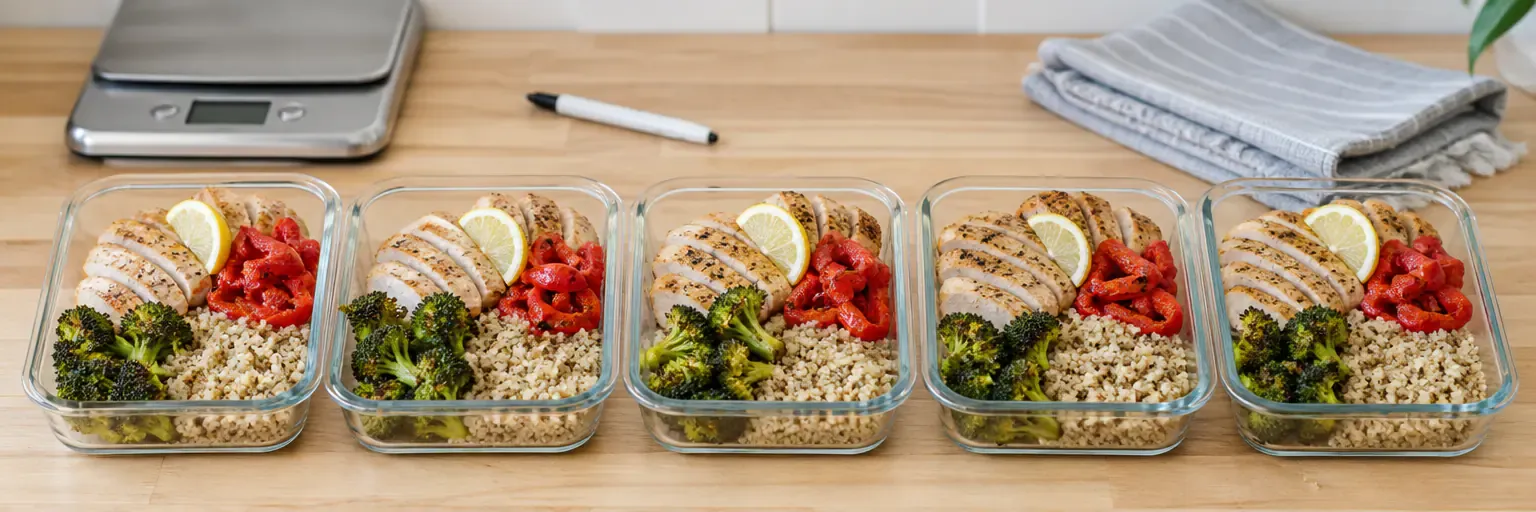
Meal Prep for Weight Loss: A 90-Minute Sunday Routine
Quick stats
- Prep time: 90–120 minutes for a full week
- Weekly cost: ~$50–$80 / adult (US 2026)
- Calories per meal: 400–550 kcal (scales to any weekly target)
- Container count: 12–15 for one adult (3 meals × 5 days + snacks)
- Fridge shelf life: 4 days for cooked proteins, 3 days for dressed grains
Most people who fall off a weight-loss plan do not fail at willpower — they fail at 12:30 p.m. on a Tuesday, when there is nothing in the fridge and the easiest option is a 900-calorie lunch from down the street. Meal prep solves that single problem. Ninety minutes on Sunday gets you four or five protein-anchored lunches, a tray of vegetables, and enough cooked grains to fill in the gaps. You stop deciding what to eat in the moment, and your daily calories stop swinging by 600 either way. This guide covers a minute-by-minute Sunday timeline, the proteins that hold up for the week, and the storage rules that keep it safe. For the meal-planning side, our weight loss meal plan gives you a ready-made 7-day template, while our DIY framework to build your own weight loss meal plan walks through setting your own calorie target, protein floor, and meal rotation from scratch. The behavioral-science read on why a Sunday prep beats deciding at 6 pm — and the 6-lever protocol that shrinks daily food decisions from Wansink’s ~200 to about 5 — is in weight loss and decision fatigue.
Quick answer
To meal prep a week of weight-loss meals in one session, batch-cook two proteins, one grain, and three roasted vegetables in about 90 minutes, then portion them into five containers using a simple mix-and-match template.
- One session: ~90 minutes on Sunday covers Monday through Thursday (3 to 4 fridge-safe days); eat fresh or do a small batch on Friday.
- Per meal: 1 protein + 1 grain + 2 vegetables, aiming for 25 to 35 g of protein.
- For a calorie target: portion to roughly 1,500 calories a day using the worked example below.
Jump to the 7-day prep map to see which session covers which meals.
Key takeaways
- One Sunday session covers Monday through Thursday. Cooked proteins, grains, and roasted vegetables stay safe in the fridge for 3 to 4 days.
- Cook the protein first — it takes the longest and limits everything else. Two proteins per week is enough variety.
- Aim for 25 to 35 grams of protein per main meal. Under-portioning protein is the most common meal-prep mistake.
- Use a mix-and-match template (1 protein + 1 grain + 2 vegetables) instead of full recipes. Five containers from the same building blocks feel like five different meals.
- Buy more containers than you think you need. Running out of containers is the silent reason most weekly preps fall apart by Wednesday.
What you need before you start
Meal prep gets easier when the gear is already on the counter. Set this up once and you will not think about it again.
Containers. Eight to ten glass or BPA-free plastic containers, 3 to 4 cups each, with leak-proof lids. Glass goes from fridge to microwave to dishwasher; plastic is lighter to carry. Two per weekday plus extras for snacks and breakfasts.
Kitchen tools. One large sheet pan (half-sheet, 13” x 18”), one large pot for grains and beans, a sharp chef’s knife, a sturdy cutting board, and a digital food scale. The food scale is non-negotiable — eyeballing protein portions is the single biggest source of calorie error at home.
Pantry staples. Olive oil, soy sauce or tamari, lemons, garlic, salt, black pepper, smoked paprika, cumin, and one bottled sauce you like (a peanut sauce or tahini dressing). Flavor variety comes from sauces, not from cooking three different recipes.
A shopping list. Walk in with a written list built from your weekly template. Our weight loss grocery list is a printable starting point with a matching 7-day meal plan — adjust for the two proteins and three vegetables you will use this week.
If you just moved. The Sunday routine below assumes an unpacked kitchen and a re-anchored grocery. If you are inside the first 90 days of a relocation, the weight loss after moving or relocating pillar covers the day-1 pantry rebuild list, the minimum-viable-kitchen setup (one pot, one pan, one knife, one cutting board), and the “cook 3 meals the first weekend” rule that installs the kitchen as a cooking cue rather than a takeout cue. Run that scaffold first; the 90-minute Sunday routine here is the day-30 upgrade, not the day-1 move.
The 90-minute Sunday timeline
This timeline assumes two proteins, one grain, and three roasted vegetables. Total active time is about 90 minutes; passive cooking overlaps.
| Time | Task |
|---|---|
| 0:00 – 0:10 | Preheat oven to 425°F. Wash and chop all vegetables. Pat proteins dry, season. |
| 0:10 – 0:30 | Sheet-pan protein 1 (chicken thighs or salmon) in oven. Start large pot of water for grain. |
| 0:30 – 0:45 | Add grain (rice, quinoa, or farro) to boiling water. Toss vegetables in oil, salt, pepper. |
| 0:45 – 1:10 | Rotate: pull cooked protein, rest. Roast vegetables on the same pan. Cook protein 2 on the stovetop (ground turkey skillet, tofu sear, or hard-boiled eggs). |
| 1:10 – 1:30 | Pull grain. Pull vegetables. Portion everything into containers: protein in one corner, grain in another, vegetables on top. Label or stack by day. Wipe counters. |
Three rules make the timeline hold:
- Start the oven first. The 425°F sheet-pan window covers protein, then vegetables, on the same pan. Do not skip the preheat — cold-oven roasting adds 10 minutes and softens textures.
- Cook in parallel, not in sequence. While the oven runs, the stovetop is making a grain. While the grain cools, the second protein is searing. Idle counter time is wasted Sunday.
- Portion while everything is still warm. Cold food sticks to containers and skin-on chicken loses its crispness if you wait until after dishes are done.
7-day meal prep to lose weight
A single Sunday session is enough to map a full week if you cook with the whole seven days in mind. The table below shows what to prep once and exactly which meals each item covers. Because cooked proteins, grains, and roasted vegetables stay safe in the fridge for only 3 to 4 days, this maps Monday through Thursday from one session — then you either run a smaller 20-minute batch on Wednesday or Thursday, or eat the freezer backups and fresh add-ons on Friday.
| Component | Prep once (Sunday) | Covers which meals |
|---|---|---|
| Protein 1 | 1.5 lb chicken thighs, sheet pan | Lunches Mon–Wed (3 portions) |
| Protein 2 | 1.25 lb ground turkey, skillet | Dinners Mon–Tue + Thu lunch (3 portions) |
| Backup protein | 6–8 hard-boiled eggs | Breakfasts and emergency lunches all week |
| Grain | 3 cups cooked rice or quinoa | A grain side for 5 main meals |
| Vegetable 1 | Sheet-pan roasted broccoli | 2–3 lunches |
| Vegetable 2 | Roasted bell peppers | 2 dinners |
| Vegetable 3 | Roasted sweet potato | 2 dinners plus a breakfast hash |
| Sauces | 3 small cups: peanut-soy, lemon-tahini, sriracha-yogurt | Rotate flavor across all 5 days |
The point of the map is that you are not cooking seven different meals — you are cooking a small set of building blocks once and recombining them. Friday is deliberately left light: by then the Sunday batch is at the edge of its fridge window, so plan a fresh option, a frozen backup, or a meal out. For a calorie-counted version of the same week, the 1,500-calorie meal plan and the broader 7-day weight loss meal plan show portions for each day.
Meal-prep frequency by weekly goal
One Sunday session covers 4 days for most calorie targets, but the answer changes at the extremes: very small portions dry out faster on reheat, and very large weekly volumes push you past the fridge-safety window before Friday. Match your prep cadence to the target you are actually eating.
| Weekly calorie target | Prep once or twice | Best prep day | Container count | Notes |
|---|---|---|---|---|
| 1,200 kcal/day | Once weekly | Sunday | 10–12 for one adult | Small portions dry out fast — reheat with a spoon of broth or water; freeze one dinner for Friday |
| 1,500 kcal/day | Once weekly (± Wed top-up) | Sunday | 12–15 for one adult | The default cadence; Wed 20-min top-up refreshes the last two days |
| 1,800 kcal/day | Twice weekly | Sunday + Wednesday | 14–18 for one adult | More grain / more vegetable volume — pot capacity, not fridge safety, is usually the limit |
| 2,000 kcal/day (maintenance) | Twice weekly | Sunday + Wednesday | 16–20 for one adult | Two proteins per session, three sauces to keep flavor variety across 5–6 dinners |
| 2,200+ kcal/day (active male) | Twice weekly + freezer stash | Sunday + Wednesday | 18–22 for one adult | Batch a freezer chili or turkey bolognese on week 1 to backfill any missed session |
Anything above 2,000 kcal/day is generally not a weight-loss target for one adult but a maintenance or active-male load — see our maintenance calorie guide for the intake bucket that fits your body before you set a prep cadence.
Protein-first batch cooking
Protein is the bottleneck. It takes the longest, dictates how long the prep lasts, and is the thing under-portioned the most often. Pick two of these per week and rotate.
| Protein | Cook method | Cook time | Yield | Fridge life |
|---|---|---|---|---|
| Boneless skinless chicken thighs | Sheet pan, 425°F | 22-25 min | 1.5 lb feeds 5 portions | 4 days |
| Ground turkey (93/7) | Skillet with onion, garlic, spices | 12-15 min | 1.25 lb feeds 5 portions | 4 days |
| Extra-firm tofu, baked | Pressed, cubed, 425°F | 25-30 min | 1 block feeds 3-4 portions | 4 days |
| Hard-boiled eggs | Pot, 10-minute boil | 12 min total | 6-8 eggs as anchors or snacks | 7 days (in shell) |
| Salmon fillet | Sheet pan, 400°F | 12-15 min | 1 lb feeds 3-4 portions | 3 days |
A 4-ounce cooked portion of chicken thigh or salmon delivers 25 to 28 grams of protein. A 4-ounce cooked portion of skinless chicken breast delivers ~35 grams for ~187 calories — the leanest protein-per-calorie ratio of any option on this table, and the swap to make when the calorie budget is tight. A 1/2-cup serving of baked tofu lands around 18 grams. Two large eggs add 12 grams. Match these to your daily target — for most adults trying to lose weight, that is 0.7 to 1.0 grams of protein per pound of body weight. Our protein intake for weight loss guide has the math by body weight and activity level.
What actually goes in each container
Once the protein is picked, the rest of the container is fill-in-the-blank. Six protein anchors carry the whole weight-loss meal-prep menu — each with the vegetable, carb, fat, and sauce that keep the flavor honest and the macros on target. Use this table when portioning on Sunday night: build one container per row, then repeat the row across days.
| Protein anchor | Vegetable | Carb | Fat | Sauce | Total macros (per container) |
|---|---|---|---|---|---|
| 4 oz grilled chicken thigh | 1 cup roasted broccoli | 3/4 cup jasmine rice | 1 tsp sesame oil | 2 tbsp peanut-soy | ~470 kcal · 32 g P · 42 g C · 18 g F |
| 4 oz ground turkey (93/7) | 1 cup roasted bell peppers | 3/4 cup farro | 1/4 avocado | 2 tbsp lemon-tahini | ~490 kcal · 30 g P · 45 g C · 20 g F |
| 1/2 block baked tofu (5 oz) | 1 cup roasted sweet potato | 3/4 cup quinoa | 2 tsp tahini | 1 tbsp sriracha-yogurt | ~450 kcal · 22 g P · 55 g C · 15 g F |
| 4 oz baked salmon | 1 cup roasted asparagus | 1/2 cup wild rice | (in-fish omega-3s) | 1 tbsp lemon-dill yogurt | ~430 kcal · 30 g P · 30 g C · 18 g F |
| 2 hard-boiled eggs + 1/2 cup chickpeas | 1 cup arugula + tomato | 1 slice whole-grain toast | 1 tsp olive oil | 1 tbsp mustard-vinaigrette | ~410 kcal · 25 g P · 38 g C · 17 g F |
| 3/4 cup cottage cheese + 1/2 cup berries | 1/2 cup cucumber slices | 1/4 cup granola | 1 tbsp chia | 1 tsp honey | ~380 kcal · 26 g P · 40 g C · 12 g F |
The last two rows are cold-plate combinations — no reheat needed, which is why they slot in as Friday lunches or a fast Wednesday breakfast when the fridge window is closing. Everything else is stackable in a 3- to 4-cup container: protein one side, carb the other, vegetables on top, sauce in a separate ramekin so the bowl does not go soggy overnight.
Mix-and-match meal templates
Three pairings carry an entire week if you swap the sauce. Build the container in this order: protein on one side, grain on the other, vegetables on top, sauce in a small separate cup so the bowl does not get soggy.
- Chicken + rice + broccoli + peanut-soy sauce. Pull the sauce in a separate ramekin. Day-of, microwave the bowl and pour the sauce on after.
- Ground turkey + farro + roasted bell peppers + lemon-tahini. Add a handful of arugula at the office for crunch.
- Baked tofu + quinoa + roasted sweet potato + sriracha-yogurt. Crumble feta on top of the bowl right before eating.
A fourth combination to keep ready: hard-boiled eggs + a roasted vegetable + a slice of whole-grain bread, for breakfasts or emergency lunches. These templates produce 5 visibly different meals across the week without cooking five different recipes. If you want a calorie-counted version of the same idea, the 1,500-calorie meal plan shows portion sizes for a full week.
A 1,500-calorie meal prep day
Meal prep only works for weight loss if the portions land on a calorie target — otherwise a “healthy” prepped bowl can still run 800 calories. Here is how the prepped components above assemble into a single day at roughly 1,500 calories, a common moderate-deficit target for many adults:
| Meal | Built from your prep | Approx calories |
|---|---|---|
| Breakfast | 2 hard-boiled eggs + roasted sweet potato hash | ~370 |
| Lunch | 4 oz chicken thigh + 3/4 cup rice + broccoli + peanut-soy sauce | ~450 |
| Dinner | 4 oz ground turkey + 3/4 cup quinoa + roasted peppers + lemon-tahini | ~490 |
| Snack | 3/4 cup plain Greek yogurt + 1/4 cup berries | ~190 |
| Total | ~1,500 |
The single tool that makes this work is a food scale. Weighing the protein and measuring the grain and any oil at portioning time is what keeps a prepped day on target, because eyeballing those is the biggest source of calorie error at home. If your target is higher, add 1 to 2 oz of protein or a second snack; if it is lower, trim the grain. For a full 7-day calorie-counted week with a matching grocery list, follow our 1,500-calorie meal plan for weight loss, and use the calorie intake guide to set the number that fits your body.
Storage and food safety
Cooked proteins, grains, and roasted vegetables are safe at refrigerator temperature (≤40°F) for 3 to 4 days, per USDA guidance. Reheat to 165°F before eating — a quick test is steam rising from the center, not just the edges.
Freezer-friendly: ground turkey, cooked rice, soups, chili, lentil mixes, and whole grain wraps freeze well in single portions for up to 2 to 3 months. Label with the date.
Do not freeze well: raw greens, cucumbers, tomatoes, hard-boiled eggs (whites turn rubbery), creamy yogurt-based sauces, and roasted potatoes (they go grainy). Keep these as fresh add-ons.
Reheat vs. eat cold: chicken thighs and ground turkey are better warm; tofu and salmon are fine cold over greens; grains go either way. If a container has been open in the fridge for 24 hours, eat it that day.
If meals smell sour or turn slimy before day 4, the prep got contaminated during portioning — usually a wet cutting board or a spoon that touched raw protein. Clean as you go.
Freezer-meal templates: 10 batch recipes you can prep once and eat for 2 weeks
Freezer meals are the highest-leverage pattern for anyone with a genuinely busy week ahead. A single 2 to 3 hour session yields two weeks of dinners that skip the mid-week cook entirely — no decision fatigue, no fridge-window pressure, and no scramble on the days a Sunday session gets missed. Because everything is portioned before it hits the freezer, you also inherit the same calorie and protein control the fridge prep gives you, minus the 3- to 4-day shelf-life ceiling.
The template below is 10 batch recipes that freeze well, reheat cleanly, and stay on the weight-loss macro profile: each portion runs 210 to 415 kcal with at least 15 g of protein, and every dish holds for 2 to 3 months at 0°F. Cook two or three from the list on the same day, portion into single-meal containers, and rotate through them across the next two weeks.
| # | Freezer meal | Yield (portions) | Kcal / protein per portion | Freezer life | Reheat method |
|---|---|---|---|---|---|
| 1 | Chicken-and-vegetable soup (chicken, kale, carrot, celery, white bean, broth) | 8 | 340 / 32 g | 3 months | Stovetop 8 min from thawed |
| 2 | Turkey-quinoa stuffed bell peppers | 6 | 385 / 30 g | 2 months | Microwave 3 min covered |
| 3 | Beef-and-lentil chili | 8 | 415 / 35 g | 3 months | Stovetop 10 min |
| 4 | Baked cod with pesto (individually wrapped) | 4 | 265 / 28 g | 2 months | Oven 400°F 15 min from frozen |
| 5 | Vegetable-lentil dal | 8 | 320 / 18 g | 3 months | Stovetop 8 min |
| 6 | Tofu-vegetable stir-fry base (no rice) | 6 | 245 / 20 g | 2 months | Skillet 6 min |
| 7 | Chicken sausage + roasted vegetables | 6 | 340 / 26 g | 2 months | Oven 400°F 12 min |
| 8 | Overnight-oat freezer cups (banana + peanut butter + oats) | 6 | 350 / 15 g | 2 months | Thaw overnight; eat cold |
| 9 | Turkey-black-bean burrito bowls (unassembled) | 8 | 410 / 30 g | 3 months | Microwave 4 min |
| 10 | Salmon patties (individually wrapped) | 8 | 210 / 22 g | 2 months | Skillet 3 min/side |
How to portion, wrap, and label each batch: (1) let the cooked food cool for 20 to 30 minutes on the counter — hot food raises the freezer’s ambient temperature and slows the freeze on everything else in there; (2) portion into single-meal containers — glass for anything you will microwave or bake, thick freezer-grade zip bags flattened for space-efficient stacking; (3) for oven-safe items (cod, salmon patties, chicken sausage sheet-pan combos), double-wrap in aluminum foil then freezer paper so you can go straight from freezer to a 400°F oven; (4) label every container with the meal name and the date you froze it, and pull with a first-in-first-out rule so nothing lingers past its freezer-life window.
Container materials compared: glass vs BPA-free plastic vs stainless vs silicone
The container choice quietly decides whether your weekly prep survives 12 months of dishwasher cycles or becomes a stained, warped drawer of orphaned lids after eight weeks. It also affects adherence in subtler ways — a 1-pound glass container adds real weight to a lunch bag, a plastic container that microwaves poorly means the lunchtime reheat scorches the edges, and a lid that leaks on the commute makes people quietly stop bringing lunch by month two.
The comparison below is across the four material families that dominate the meal-prep market. None of them is strictly best — the right answer is usually a small mix, weighted toward glass for home eating and lighter materials for on-the-go.
| Attribute | Glass | BPA-free plastic (PP) | Stainless steel | Silicone |
|---|---|---|---|---|
| Dishwasher safe | Yes | Yes (top rack) | Yes | Yes |
| Microwave safe | Yes | Yes (rated ones) | No | Yes |
| Oven safe | Yes to 425°F | No | Yes | Yes to 400°F |
| Freezer safe | Yes (with headspace) | Yes | Yes | Yes |
| Staining/odor | Very resistant | Common (tomato, curry) | Very resistant | Some (curry) |
| Weight (16 oz) | ~1.0 lb | ~0.15 lb | ~0.35 lb | ~0.20 lb |
| Typical cost/piece | $6–$12 | $2–$5 | $12–$25 | $6–$15 |
| Best for | Home eating, oven-reheat | Kids’ lunches, backpacks | Long-term durability | Freezer-to-oven versatility |
A practical starter set for one adult who eats most prepped meals at home but takes 2 or 3 to work each week: 4 glass 4-cup containers for the main lunches and dinners, 4 glass 2-cup containers for breakfasts and grain sides, 6 polypropylene 1-cup containers for portioned snacks (nuts, cottage cheese, fruit), and 4 stainless bento boxes for the days you commute and want a lighter bag. That mix runs roughly $110 to $160 up front and covers a full week without needing to run the dishwasher mid-week.
On plastic safety specifically: the FDA regulates food-contact substances by recycling code, and the three codes to avoid for repeated food storage are #3 (PVC), #6 (polystyrene), and #7 (other/mixed plastics — including older polycarbonate that may contain BPA). Modern reusable food containers are almost always #5 (polypropylene, “PP”) and are safe for repeat use, dishwasher, and microwave when rated for it — but check the recycling code stamped on the bottom before buying, especially for anything sold as “reusable” but priced suspiciously low.
Food safety: USDA reheating temperatures and safe shelf-life reference
“When in doubt, throw it out” is the sound-bite version of food safety, and it works — but meal preppers who cook the same four proteins 50 weeks a year need real numbers, not aphorisms. The number that matters most is the internal temperature that kills the bacteria most likely to survive refrigeration: 165°F (74°C) for reheated leftovers, verified with a probe thermometer, not eyeballed from the steam.
The USDA’s public FoodSafety.gov guidance is the reference the tables below draw from. Both are conservative — err on the shorter shelf life if a container has been repeatedly opened, cross-contaminated with a raw-food spoon, or held at borderline fridge temperatures (above 40°F).
| Food category | Safe internal reheat temperature | Notes |
|---|---|---|
| All previously cooked leftovers | 165°F (74°C) | Use a food thermometer; microwaves heat unevenly |
| Ground meats (turkey, beef, pork) | 165°F | Same for meatballs, meatloaf |
| Whole poultry pieces | 165°F | Chicken breasts, thighs, drumsticks |
| Fish and shellfish | 145°F | Or until flesh flakes and is opaque |
| Egg dishes (frittatas, quiche) | 165°F | Reheat covered to hold moisture |
| Soups, stews, chili | 165°F, bring to boil | Stir midway |
| Food | Refrigerator (40°F/4°C) | Freezer (0°F/-18°C) |
|---|---|---|
| Cooked chicken/turkey (whole pieces) | 3–4 days | 2–6 months |
| Cooked ground meat | 3–4 days | 2–3 months |
| Cooked fish | 3–4 days | 4–6 months |
| Cooked rice, quinoa, pasta | 4–5 days | 1–2 months |
| Cooked legumes (lentils, beans) | 3–5 days | 3 months |
| Cooked eggs (hard-boiled in shell) | 1 week | Not recommended |
| Fresh cut vegetables (sealed) | 3–5 days | Blanched: 8–12 months |
| Homemade soups/stews | 3–4 days | 2–3 months |
| Cooked marinades / sauces | 3–4 days | 4–6 months |
The other number worth memorizing is the “danger zone” between 40°F and 140°F, the temperature band where foodborne bacteria (Salmonella, Listeria, Staphylococcus aureus, Clostridium perfringens) double every 20 to 30 minutes. Cooked food left in that band for more than 2 hours — 1 hour if the room is above 90°F — is no longer fridge-safe, no matter how it smells. For meal-prep specifically, the 2-hour rule is the reason to portion warm food directly into containers and get them into the fridge before starting on dishes, rather than cooling a giant sheet pan on the counter for an hour first.
Sample batch-cook menus by dietary lens (high-protein, vegetarian, anti-inflammatory)
Every weight-loss reader has a slightly different constraint set: some are chasing a protein floor of 150 grams a day, some are lacto-ovo vegetarian and need real protein from non-meat sources, and some are managing an anti-inflammatory diet for a joint or autoimmune reason. The three sample menus below share the same 90-minute Sunday framework but land the batch weight in different places.
High-protein batch cook (150 g+ daily protein target)
The target here is a daily protein intake that supports strength training and moderate weight loss simultaneously — typically 1.2 to 1.6 grams per kilogram of body weight, which lands at 130 to 180 grams for most adults. Meeting that on a prepared week means centering the batch around dense protein anchors and pairing every meal with an obvious protein source.
The Sunday session cooks two proteins in parallel (an oven tray of chicken thighs plus a stovetop pot for hard-boiled eggs), then assembles a cottage-cheese parfait tray and a bean-and-tuna salad while the proteins cool. Because cottage cheese and tuna are the two highest-density prepared proteins you can put in a container without cooking, they’re the ones that keep the daily total up without another cook session.
- Grilled chicken thighs, 3 lb (yields ~12 four-ounce portions at 25 g protein each)
- Hard-boiled eggs × 12 (6 g protein each; snack or breakfast anchor)
- Cottage-cheese-and-flax parfait × 5 cups (28 g protein per cup)
- Tuna-and-white-bean salad, 4 servings (32 g protein each)
Total: ~1,050 g of prepared protein across the week — enough to hit 150 g/day with 20 to 30 g headroom for a daily protein shake or a Greek-yogurt breakfast.
Vegetarian batch cook (80+ g daily protein, lacto-ovo)
The vegetarian menu targets 80 to 100 grams of daily protein by leaning on tofu, lentils, cottage cheese, and eggs — the four vegetarian protein sources that survive a batch-cook without going watery, mealy, or bland. This is a realistic weight-loss floor for a vegetarian adult, though athletes or heavier readers should scale toward 1.2 g/kg (see the high-protein menu above for the pattern).
Baked marinated tofu is the anchor because it holds its texture in the fridge for 4 to 5 days and pairs equally well with grain bowls, salads, or a quick stir-fry. A lentil-farro grain-bowl base — cooked once and portioned into six containers — replaces the animal-protein slot in a typical meal-prep template without dropping the fiber or micronutrient density.
- Baked marinated tofu, 2 lb (pressed, cubed, roasted with soy-ginger; ~10 half-cup portions at 18 g)
- Lentil-farro grain-bowl base, 6 servings (each: 3/4 cup cooked farro + 1/2 cup cooked lentils; 18 g protein per bowl)
- Cottage-cheese-and-berry cups × 6 (24 g protein each)
- Hard-boiled eggs × 8 (6 g each)
Cross-link: our full vegetarian weight loss meal plan has a complete 7-day version with breakfast and snack rotation.
Anti-inflammatory batch cook (Mediterranean-adjacent)
The anti-inflammatory menu is closer to a Mediterranean template: fatty fish twice a week, extensive olive-oil roasted vegetables, whole legumes, and minimal added sugar. The evidence base for anti-inflammatory eating patterns is strongest around omega-3-rich fish, extra-virgin olive oil, and high vegetable variety — the specific batch here reflects that.
Because roasted vegetables are the dominant volume, plan for two large sheet pans in the same session. Homemade tzatziki does double duty as a sauce for the fish and a dip for raw vegetables during the week.
- Baked salmon, 4 fillets (~5 oz each; 30 g protein per fillet)
- Olive-oil-roasted vegetables (broccoli + red peppers + cauliflower + red onion, 2 large sheet pans)
- Lentil-and-chickpea salad with lemon, 6 servings (18 g protein each)
- Homemade tzatziki, 2 cups (Greek yogurt + cucumber + garlic + dill; 10 g protein per 1/2 cup)
Cross-link: the Mediterranean diet for weight loss guide covers the food-group rules that decide what belongs in an anti-inflammatory batch cook and what does not.
Meal-prep budget: what a week of prep actually costs in 2026
Meal prep has a reputation for being cheaper than restaurants but expensive compared to instant noodles — both halves of that reputation are true, and the real weekly cost depends heavily on the protein anchor. A high-protein pattern anchored on lean chicken and eggs costs less than a Mediterranean pattern anchored on salmon and olive oil, but both cost less than the equivalent number of takeout lunches over a month.
The estimates below are based on US grocery-store retail prices in mid-2026, averaged across national chains (Kroger, Safeway, HEB, Publix). Local variation is real — Whole Foods and small-format urban markets can run 25 to 40% higher, and warehouse-club prep (Costco, Sam’s Club) can trim 15 to 20% off the bottom of each range.
| Prep pattern | Weekly cost / 1 adult | Weekly cost / 2 adults | Weekly cost / family of 4 |
|---|---|---|---|
| High-protein (chicken/turkey/eggs anchor) | $68–$82 | $128–$155 | $220–$275 |
| Vegetarian (tofu/tempeh/legumes/dairy anchor) | $52–$68 | $98–$125 | $180–$225 |
| Anti-inflammatory (salmon/olive-oil/lentils anchor) | $85–$105 | $160–$195 | $290–$355 |
| Budget-lean (frozen chicken, rice, beans, frozen veg) | $42–$58 | $80–$105 | $150–$195 |
Four cost-cutting rules that trim the weekly total without breaking the plan:
- Buy chicken thighs instead of chicken breasts. Thighs run $2.50 to $3.50 per pound; breasts run $4.50 to $6.50. Thighs are also more forgiving on reheat, which is why they land in the protein table above.
- Use frozen vegetables for anything that gets roasted or blended. Frozen broccoli, spinach, and cauliflower run about $1.50 per pound at the store; fresh runs $3.00 to $4.00. Blanched-and-frozen keeps the nutrient profile intact for the cooked applications where texture is not primary.
- Bulk rolled oats over instant packets. A 42-oz canister of rolled oats runs about $4.50 and yields 30 half-cup servings — roughly 15¢ per serving. Individual instant-oat packets run about $1.50 each: 10× the cost per gram of oats.
- Base grains and legumes bought dry. Dry lentils run about $2.00 per pound and yield roughly 6 cups cooked; canned lentils run about $1.50 per 15-oz can (~1.75 cups cooked), which is about 3× the cost per cooked serving.
Common pitfalls
Cooking too much of one thing. A giant pot of one stew on Sunday means eating the same stew five days in a row. By Thursday it is in the trash. Cook two proteins and split the vegetables instead.
Forgetting to portion. A tray of chicken in the fridge gets sliced unevenly all week — Monday’s serving is 8 ounces, Friday’s is 3. Portion into containers Sunday night with the food scale.
No flavor variety. Olive oil, salt, and pepper for five days gets boring fast. Three sauces (one creamy, one acidic, one spicy) cover a week of the same proteins.
Containers too small. A 2-cup container leaves no room for vegetables, so vegetables get skipped. 3- to 4-cup containers solve this and stack the same in the fridge.
Skipping breakfast prep. Most weight-loss preps cover lunch but leave breakfast to grain bars or skipping. A jar of overnight oats or Greek yogurt with berries takes 90 seconds Sunday night and saves 200 calories of vending-machine food Monday morning. Our guide to breakfast options for weight loss lists 15 prep-friendly picks that all hit 20 to 34 grams of protein.
Skipping snack prep too. Pre-portioned protein snacks prevent the 4 p.m. vending-machine pull. Hard-boiled eggs, single-serve cottage cheese cups, edamame, and shake bottles all hold for the week. Our guide to high-protein snacks covers 20 prep-friendly options under 250 calories with grams of protein per serving.
Frequently asked questions
How do I meal prep a week of weight-loss meals? Cook in one roughly 90-minute session: roast two proteins and three vegetables on sheet pans while a pot of grain simmers, then portion everything into five containers using a 1 protein + 1 grain + 2 vegetables template. One session covers Monday through Thursday, because cooked proteins, grains, and roasted vegetables keep 3 to 4 days in the fridge. Cook a smaller midweek batch or eat fresh on Friday, and rotate two or three sauces so the same components taste like different meals. The 7-day prep map above shows which session covers which meals.
Can I meal prep 1,500 calories a day? Yes. Portion each prepped meal to the target — a breakfast around 370 calories, a lunch near 450, a dinner near 490, and one snack near 190 lands close to 1,500. A food scale is what keeps it accurate, since eyeballing protein and oils is the biggest source of calorie error. For a full calorie-counted week and matching grocery list, follow our 1,500-calorie meal plan.
How long does meal prep last in the fridge? Cooked proteins, grains, and roasted vegetables keep for 3 to 4 days at ≤40°F, per USDA guidance for cooked leftovers. That is why most weight-loss preppers cook Sunday for Monday through Thursday, then either repeat a smaller prep midweek or eat fresh on Friday. Anything past four days should go to the freezer in single portions and be reheated to 165°F.
Do I have to meal prep to lose weight? No. Meal prep is a tool, not a rule. Weight loss comes from a sustained calorie deficit with enough protein and fiber, and you can hit that with frozen meals, restaurants, or daily cooking. What meal prep buys you is decision fatigue protection — a portioned lunch already in the fridge is much harder to swap for 900-calorie takeout.
What’s the easiest way to start meal prepping for weight loss? Prep one meal, not three. Pick whichever meal you most often eat out — usually lunch — and prep four or five portions of it. Use one protein, one grain, and one or two roasted vegetables, repeat the template, and skip recipes for the first month. Add breakfast or a second template once the habit sticks.
Is meal prepping cheaper than buying lunch? Almost always. A homemade lunch with chicken thighs, brown rice, and vegetables runs about $3 to $5 per serving, versus $12 to $18 for a comparable cafe meal. Over a 5-day week, that is $50 to $75 in savings, and weight-loss staples (beans, lentils, eggs, frozen vegetables, oats) are some of the cheapest food at the store.
What’s the best protein to meal prep for weight loss? Boneless skinless chicken thighs are the most forgiving — tender for four days, reheat well, about 25 grams of protein per 4-ounce cooked portion at around 180 calories. Ground turkey, baked tofu, hard-boiled eggs, and salmon are the other top picks. Rotate two per week and aim for 25 to 35 grams of protein per main meal. See our protein intake for weight loss guide for daily targets.
How many days can I safely eat meal-prepped chicken? Cooked chicken keeps for 3 to 4 days in the refrigerator at or below 40°F, per USDA guidance for cooked leftovers. Thighs hold their texture through day 4; boneless breast dries out on reheat by day 3, so plan it earlier in the week or shred it into a sauced form (curry, chicken salad, tinga) to extend palatability. Anything past four days should go to the freezer in single portions and be reheated to 165°F before eating. Sniff-and-taste is not a reliable safety check — foodborne bacteria can multiply without changing smell or appearance, so trust the calendar, not the nose. See the 7-day prep map above for how to schedule chicken across Monday–Thursday without pushing that window.
Can I freeze meal-prepped meals for weight loss? Yes — most weight-loss prep components freeze well for 2 to 3 months in single-portion containers. Ground turkey, cooked rice, chili, lentil bowls, cooked chicken thighs, whole-grain wraps, and pre-portioned smoothie bags all hold their texture on thaw. What does not freeze well: leafy greens, raw cucumbers and tomatoes, hard-boiled eggs (whites turn rubbery), creamy yogurt-based sauces, and roasted potatoes (they go grainy). Label every container with the date, and reheat to 165°F before eating. Treat the freezer stash as the backstop for a missed weekly prep — a rotation of two frozen dinners means one skipped Sunday does not derail the week.
What if I get bored eating the same meal 5 days in a row? Boredom is the top reason weekly preps fall apart, and the fix is variety in sauce, not variety in proteins or grains. Rotate two proteins (chicken + turkey, or tofu + eggs) and three sauces (one creamy, one acidic, one spicy) — five containers with the same base will taste like five different meals when the sauce shifts. Add a fresh element the morning-of: arugula on top, a squeeze of lemon, a spoon of pickled onions, or crumbled feta. If you still burn out by day 4, cook a smaller batch that covers three days and eat fresh on the other two, or swap one container for a high-protein breakfast idea at lunch to break the pattern.
Is meal prep worth it if I’m feeding a family, not just myself? Yes, but the format changes — scale up to family-style trays instead of individual portions. Roast a large sheet pan of protein, a big pot of grain, and two vegetable pans; portion your own weight-loss containers first (with the food scale, so you hit calorie and protein targets), then serve the rest family-style at dinner. This lets one Sunday session cover both your calorie-controlled plan and everyone else’s meals without cooking twice. The weight loss grocery list shows how to double specific ingredient rows — proteins and grains — without doubling the portion that lands in your calorie-controlled container. For the wider one-meal-two-plates protocol that runs a family dinner without a second dinner, see weight loss when cooking for the family.
How long can I keep meal-prep containers in the fridge? 3 to 5 days for most cooked proteins and grains at 40°F or below, per USDA FoodSafety.gov guidance. Cooked chicken, ground meat, and fish sit at the shorter end (3 to 4 days); cooked rice, quinoa, and legumes stretch closer to 4 to 5 days. Anything still sealed at day 5 needs to be reheated to 165°F and eaten that same day — do not return a partially eaten container to the fridge for a sixth day, and do not freeze it at that point either. The shelf-life table in the food-safety section above lists exact days for each category so you can plan the week without guessing.
Is it safe to prep 5 days of chicken on Sunday? Yes, if the cooked chicken is refrigerated within 2 hours of coming off the heat and reheated to 165°F each day. The 3- to 4-day USDA fridge window is the constraint on Thursday and Friday specifically — by then, chicken breast (which dries out fastest) is safer if it was portioned into single-meal containers on Sunday rather than pulled from a large communal tray all week. Portioning immediately after cooking limits cross-contamination and lets each container cool faster, both of which reduce bacterial load through Friday. Chicken thighs hold texture through day 4 more forgivingly than breasts.
Can I meal-prep on a GLP-1 medication if my appetite is low? Yes, and the format changes in a specific direction: portion sizes should shrink 20 to 30% during the first 12 weeks on semaglutide or tirzepatide, and every container should skew protein-dense (30 g+ per meal) to protect lean mass while calories are low. Prep a few “starter-friendly” small portions that are easy to eat when appetite is minimal — Greek yogurt cups, tuna-and-white-bean salad, salmon patties, and cottage-cheese-and-berry parfaits are the four that GLP-1 patients tolerate most consistently. Our GLP-1 weight loss overview covers the appetite-and-nausea trajectory that decides which weeks need the smallest portions.
Sources
- Ducrot P et al. Meal planning is associated with food variety, diet quality and body weight status in a large sample of French adults. International Journal of Behavioral Nutrition and Physical Activity (2017).
- Wolfson JA, Bleich SN. Is cooking at home associated with better diet quality or weight-loss intention? Public Health Nutrition (2015).
- Leidy HJ et al. The role of protein in weight loss and maintenance. American Journal of Clinical Nutrition (2015).
- Mattes RD et al. Snacking, satiety, and weight: a randomized, controlled trial. Appetite (2016).