
2026-09-11 · remote work weight gain, work from home, WFH, WFH weight gain, remote work weight loss, NEAT, kitchen proximity, walking pad, routine anchors, commute-analog movement, life-stage pillar, weight loss, Tessa Morgan
Written by Tessa Morgan
Tessa Morgan is a WeightFAQ staff writer focused on the long-game side of weight loss: habits, motivation, tracking, and what happens after the first pound comes off. She has written about weight-loss maintenance, plateaus, why the scale sometimes stops moving, water-weight fluctuations, and adaptive thermogenesis, as well as practical guides to weight-loss apps, non-scale victories, emotional eating, and cheat meals and refeed days. Tessa covers realistic timelines — how long weight loss actually takes — and travel-friendly strategies. She writes for readers building routines they can hold for years, not weeks.
21 min read
Medically reviewed on Sep 11, 2026
Weight Loss and Remote Work: Why WFH Drives Weight Gain and What to Actually Do About It
Quick answer
The commute-to-remote transition removes roughly 800 to 1,500 daily NEAT steps and adds 5 to 15 unmonitored kitchen visits per day, and both stack with cognitive-load-without-physical-output and the loss of clock-in/clock-out edges to produce a documented 1.5 to 2 kg of weight gain across the first 6 months for the average WFH-transitioned worker (Zeigler 2021 in International Journal of Environmental Research and Public Health; Bhutani 2021 in Obesity; Perez 2022 in International Journal of Environmental Research and Public Health). The driver is structural, not motivational — and the fix is structural too.
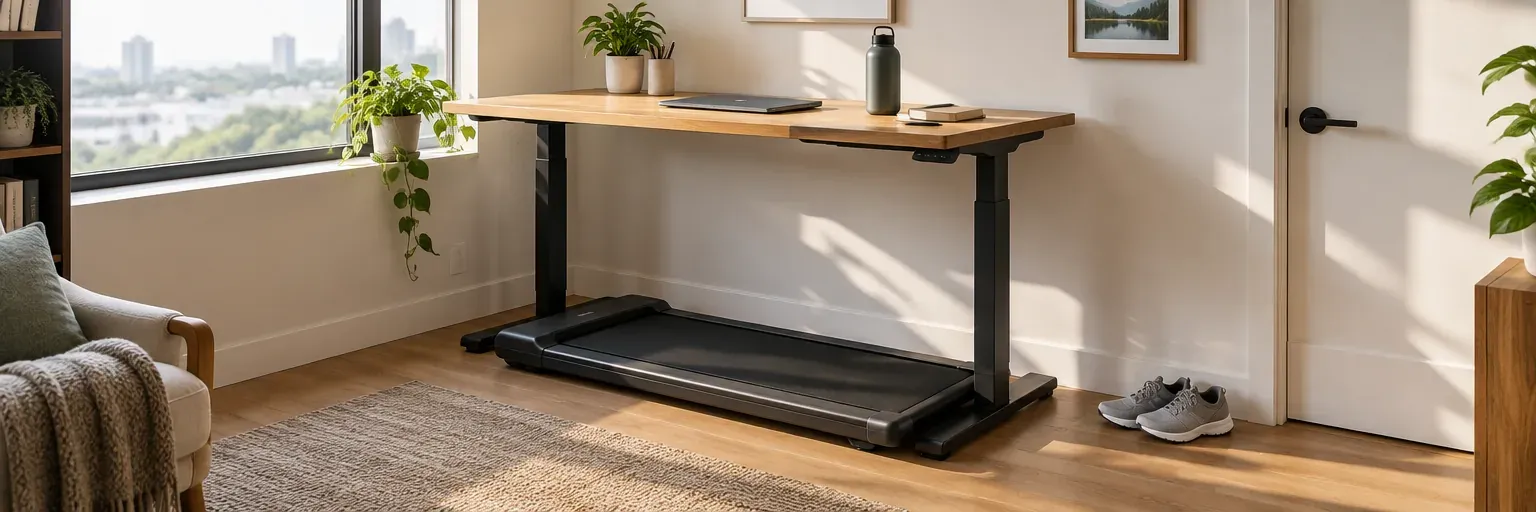
The working recipe: (a) reinstall commute-analog movement — a 7 to 10 minute walk before “clocking in,” a 15 to 20 minute walk at lunch, a 7 to 10 minute walk after “clocking out”; (b) pre-portion the day’s snacks into labeled containers at breakfast so grazing becomes a conscious decision, not an accident; (c) hydrate from a 32 oz labeled desk-cup, not the kitchen counter; (d) protect at least one anchor meal per day at the table, not at the desk. A walking pad or under-desk treadmill is a fine supplement, not a solution — expect 100 to 150 kcal per hour at 1.5 to 2 mph, prove usage on a $30 to $60 pedal machine first, and do not lean on it for deep-focus work. If low mood, poor sleep, or a positive PHQ-2 screen are also in play, treat the mood layer first — a deficit stacked on undiagnosed depression is a documented setup for lapse.
Who this is for — and who it is not for
This pillar is written for:
- Fully-remote workers who moved from in-office to WFH and have seen the scale drift 3–15 lb across the first 6–12 months
- Hybrid workers (2–3 days remote, 2–3 days office) whose remote days quietly cost more calories than the office days
- Newly-remote workers in the first 3 months of the transition, who can install anchors before the pattern sets
- Workers with back-to-back Zoom days who cannot leave the desk during work hours and need in-place strategies
- Remote workers with a shared living space, a small apartment, or a home without room for a walking pad
It is not written for:
- Chronic-sedentary in-office desk workers — see the weight loss and desk jobs pillar for the 20-8-2 break cadence, the 500-500-200-500 meal template, and the office-food anti-patterns
- First-6-months new-job transitions, remote or not — see weight loss and a new job for the “protect a minimum, do not chase a deficit” scaffold
- Rotating-shift or night-shift workers — the circadian and meal-timing mechanism is different; see shift work and weight loss
- Frequent business travelers on 2 to 4 nights per week for 6 or more months — the opposite pattern of this pillar, where chronic circadian disruption, hotel and airline food defaults, and movement collapse dominate rather than kitchen proximity and NEAT collapse. See weight loss and frequent business travel for the four-floors protocol, the 5-scenario road-warrior decision matrix, and the switch-to-maintenance rule for peak-travel quarters.
- Job loss without a landing role — that is a different stress and routine collapse than remote-work drift
- Workers whose company is ending WFH and mandating a return to office — the mirror-image transition, where cafeteria calories, commute time-collapse, and happy-hour stacking replace the WFH driver stack. See weight loss and return to office for the 4-week rebuild protocol and the office-cafeteria decision matrix.
What actually changes when you go remote
The change is not one event. It is a stack of four concurrent shifts that individually look small and collectively add to a real deficit-eating driver.
Commute-swap NEAT loss. Perez 2022 (International Journal of Environmental Research and Public Health) documented remote workers averaging about 1,200 fewer daily steps than matched in-office workers, and Zeigler 2021 (International Journal of Environmental Research and Public Health) put the pandemic-transition NEAT loss at 800–1,500 steps/day for the average worker. The lost pieces are individually tiny — the 6-minute walk from the parking lot, the 3-minute walk to the printer, the 8-minute walk to a colleague’s desk, the 15-minute waiting-for-elevator time across the day, the walk-to-coffee-shop-at-lunch — and structurally they are what a commute used to give a worker for free.
Kitchen proximity. Christensen 2021 (Appetite) documented that pandemic-era kitchen-proximity grazing added an average 200–500 unlogged kcal per day for remote workers relative to matched in-office workers. The mechanism is not hunger — it is decision-point exposure. In an office, the snack cabinet is a floor away; at home, it is 15 feet away in both directions, and every glance is a fresh decision most workers lose by default.
Cognitive load without physical output. Bailenson 2021 (Technology, Mind, and Behavior) documented the specific cognitive cost of always-on video meetings — the “Zoom fatigue” pattern is real, and the physiology is a cortisol-plus-decision-fatigue signal without the physical output that in-person meetings incidentally provide (the walk to and from the room, the standing at a whiteboard, the fidgeting in a chair). By 5 or 6 PM the drift is toward carb-and-fat reward eating.
Routine-anchor loss. Wing & Phelan 2005, drawing on the National Weight Control Registry, put consistent daily routine at the top of the maintenance-predictor list — regular meal times, regular bedtimes, regular exercise cues. A WFH transition erases the clock-in/clock-out edges that used to enforce the routine, and the workday bleeds into the evening: dinner shifts later, snacking after dinner appears, sleep debt builds, morning starts under-slept, and the cycle repeats.
The evidence, read honestly
The remote-work weight-gain signal is real, modest, and reasonably well-documented. It is not a panic pattern; it is a 1–2 kg / 6-month drift with a small handful of predictable drivers.
- Zeigler 2021 (International Journal of Environmental Research and Public Health), a n=1,853 pandemic-transition cohort, documented mean weight gain of 1.5 to 2 kg across the first 6 months of WFH.
- Chopra 2020 (Diabetes & Metabolic Syndrome), a pandemic-era meta-review, put unwanted weight gain in remote-transitioned adults at roughly 30–45 percent of the cohort.
- Bhutani 2021 (Obesity), a n=7,753 US survey, found ~40 percent reported unwanted weight gain during pandemic remote-work stretches, correlated with snacking frequency and reduced physical activity.
- Perez 2022 (International Journal of Environmental Research and Public Health) documented a ~1,200 daily-step gap between remote workers and matched in-office workers.
- Wilms 2022 (International Journal of Environmental Research and Public Health) documented the counter-intuitive finding that remote workers take fewer breaks than in-office workers, not more — the “roomier calendar” assumption is a myth.
- Levine 1999 (Science) established the NEAT framework: non-exercise activity thermogenesis explains most of the between-person variance in daily energy expenditure and is the mechanism a commute affects.
- Buman & King 2010 (American Journal of Lifestyle Medicine) added the light-intensity activity signal — the small walks a workday incidentally generates matter more than the “I go to the gym after work” mental accounting assumes.
- Wing & Phelan 2005 (National Weight Control Registry) put routine-anchor consistency at the top of the maintenance-predictor list.
- Bailenson 2021 (Technology, Mind, and Behavior) documented the cognitive-load cost of continuous video meetings.
- Paluch 2022 (Lancet Public Health) put the daily-step mortality-benefit band at ~6,000–8,000 steps/day for adults 60 and over, with a similar dose-response for younger adults — the target most remote workers should defend.
Cite these honestly. No single study says WFH is a metabolic catastrophe; the read is that a modest, structural signal exists and has structural fixes.
The four-driver mechanism
1. NEAT collapse
The commute is the piece that goes first and matters most. A pre-remote worker who took public transit or walked to the office reliably logged 1,000–2,000 daily steps on the commute alone, plus another 500–1,500 steps across the office day (walks to meetings, walks to lunch, walks to the printer, hallway steps, waiting-for-elevator standing time). A WFH transition removes 60–90 percent of that. Levine 1999 (Science) established that spontaneous NEAT — not exercise — accounts for most of the between-person variance in daily energy expenditure, and Buman & King 2010 (American Journal of Lifestyle Medicine) added the light-intensity signal. The math: an 800–1,500 step loss is about 40–90 kcal/day of direct NEAT deficit — small individually, roughly 1–2 lb/month of headroom lost when stacked with the other drivers below.
2. Kitchen proximity → unmonitored grazing
At the office the pantry is a floor away; at home it is 15 feet away in both directions, and every glance is a fresh decision. Christensen 2021 (Appetite) documented 200–500 unlogged kcal/day of grazing drift in pandemic remote workers. The pattern is not hunger — it is decision-point exposure. Five to fifteen extra kitchen visits per day, each with a “since I’m here” pull toward a handful of nuts, a spoon of peanut butter, a couple of crackers, a piece of fruit, a coffee refill with cream — and none of it hits a food log. This is the driver most likely to be misdiagnosed as “my metabolism slowed down.”
3. Zoom fatigue → evening reward-eating
Cognitive load without physical output is a cortisol pattern. Bailenson 2021 (Technology, Mind, and Behavior) documented the specific cognitive cost of always-on video meetings, and the downstream signal is a 5–7 PM carb-and-fat drift that mirrors the “hard workday” pattern of decision fatigue plus reward eating. In-person meetings incidentally provide the physical output — the walk to the room, the standing at a whiteboard, the walk back — that a Zoom day removes. The result is a workday that reads as “I just sat there” but produced enough cognitive drain to trigger evening compensatory eating.
4. Routine-anchor loss
Wing & Phelan 2005 (National Weight Control Registry) put consistent daily routine at the top of the maintenance-predictor list. A WFH transition erases the clock-in/clock-out edges that enforced meal times, exercise cues, and bedtimes. The workday bleeds into the evening: dinner shifts later, snacking after dinner appears, sleep debt builds, morning starts under-slept, and the cycle repeats. The fix is not a heroic new routine — it is the small, non-negotiable edges (a start-of-day walk, a scheduled lunch, a hard 5 PM stop) that recreate what a commute enforced by accident.
Office day vs WFH day: the step budget
Realistic numbers for a 155 lb and 195 lb adult, no formal workout on either day.
| Movement source | Office day (155 lb) | Office day (195 lb) | WFH day (155 lb) | WFH day (195 lb) |
|---|---|---|---|---|
| Commute walking (to/from transit, parking lot) | ~1,200 steps / ~50 kcal | ~1,200 steps / ~65 kcal | 0 / 0 | 0 / 0 |
| Office-hallway steps (meetings, printer, colleague desks) | ~1,500 steps / ~60 kcal | ~1,500 steps / ~80 kcal | ~200 steps / ~10 kcal | ~200 steps / ~12 kcal |
| Lunch-walk steps (cafeteria, café, block loop) | ~1,000 steps / ~40 kcal | ~1,000 steps / ~55 kcal | ~200 steps / ~10 kcal | ~200 steps / ~12 kcal |
| Ambient / other (bathroom, kitchen, kids, dog) | ~2,300 steps / ~90 kcal | ~2,300 steps / ~120 kcal | ~2,600 steps / ~110 kcal | ~2,600 steps / ~140 kcal |
| Total NEAT | ~6,000 steps / ~240 kcal | ~6,000 steps / ~320 kcal | ~3,000 steps / ~130 kcal | ~3,000 steps / ~165 kcal |
The daily NEAT delta is roughly 100–160 kcal for the average adult — small individually, real over a month, and worth about 1–2 lb of weight-loss headroom per month on unchanged eating. Add the kitchen-proximity 200–500 kcal/day grazing drift and the evening-reward drift, and the total drift lands squarely inside the 1.5–2 kg / 6 months Zeigler 2021 figure. See NEAT (non-exercise activity thermogenesis) for the underlying framework and daily step count for weight loss for the dose-response read.
The 5 commute-analog movement anchors
Reinstall the walks the commute used to give you for free. These are the specific, calendar-blockable replacements — pick the ones that fit and defend them for at least 4 weeks before deciding what to keep.
- 7–10 minute “commute-out” walk before clocking in. Around the block, up and down the driveway, once around the neighborhood loop. Ends when you sit at the laptop. Adds ~800–1,000 steps and cues the workday start.
- 3-minute stand-and-stretch every 60 minutes. Set a physical timer (wrist, kitchen, phone). Stand up, walk to the water bottle, stretch the hip flexors, do 10 air squats, look at something 20 feet away for 20 seconds. Six to eight of these a day is 1,500–2,500 steps.
- 15–20 minute lunch walk. Outdoors if possible for the daylight signal, indoors on a treadmill or hallway loop if not. This replaces the walk to the cafeteria and the walk to a lunch spot. About 2,000 steps.
- Walking-meeting rule for 1:1 phone-only calls. Headphones, mute-when-not-speaking, no screen share. A 30-minute 1:1 phone-only call adds ~2,500 steps and costs zero calendar time.
- 7–10 minute “commute-home” walk at end of day. Ends the workday, downgrades the evening reward-eating cue (see the emotional eating pillar for the mechanism), and mirrors the commute home. About 800–1,000 steps.
Together, this pattern adds roughly 3,500–5,000 additional steps per day — enough to land most remote workers inside the 6,000–8,000 step mortality-benefit band. See walking for weight loss for the calorie and cadence read.
Kitchen and desk hygiene protocol
Grazing is decision fatigue in slow motion. The fix is to remove the decision, not to white-knuckle it.
- Pre-portion the day’s snacks at breakfast into labeled containers on the counter — one 3 PM snack (200 kcal, protein-and-fiber tier) and one afternoon snack if you know you need it. If it is not in a labeled container by 8 AM, it is not part of the day.
- Labeled 32 oz water bottle at the desk, refilled twice per day. A refill is a 30-second stand, not a kitchen browse. Mild dehydration reads as low-grade hunger — most 3 PM “I need a snack” is 16 oz of water.
- Kitchen closed 10 AM–noon and 2–5 PM. A physical cue helps — pantry door closed, snack containers put away, a “kitchen closed” sticky on the fridge for the first two weeks. The purpose is to concentrate eating into a handful of intentional windows.
- One anchor meal per day at the table, not at the desk. Lunch or dinner — pick one and defend it. Plate the food, sit at the table, no laptop, no phone. The anchor meal is the single strongest weight-stability signal on a WFH day.
- Do not eat while checking email. Attention-diluted eating reliably under-registers satiety and drives second helpings. If you must eat at the desk, close the laptop for the meal.
- 8 PM kitchen close. Physically move visible food off the counter into a cabinet by 8 PM. Wansink’s food-visibility literature is unusually consistent — out of sight quietly wins. See late-night eating and weight loss for the timing read.
Walking pad and under-desk treadmill: the honest read
Walking pads are the most-asked-about remote-work weight-loss purchase. The honest evidence is more modest than the marketing.
Ainsworth 2011 (Medicine and Science in Sports and Exercise) puts walking at 2 mph at about 2.8 METs. A 175 lb adult walking 60 minutes at 2 mph while working spends roughly 150–200 additional kcal above sitting. That is a real signal — meaningful over weeks, not transformative in a single day. A full 4-hour walking-pad session in a low-cognitive-load work block adds ~400–600 kcal, which is a real weekly contribution.
The downsides are also real:
- Cost: $200–$800 for a decent unit, $600–$1,500 for a quieter one that fits under a standing desk.
- Noise: audible on video calls; look for a unit rated <45 dB or plan camera-and-mic-off during use.
- Focus penalty: real for detail-heavy work (coding, writing, editing, spreadsheets). Fine for email, listening meetings, admin, brainstorming, and reading.
- Ergonomics: a standing desk not built for a walking pad can drift into a bad wrist and elbow position — check that your keyboard height stays at ~elbow 90 degrees when walking.
- Return rate: unusually high in the first 4 weeks. Most stall out.
The honest sequence is prove usage on a $30–$60 under-desk pedal machine first. Use it for 30 minutes a day, 4 days a week, for 2–4 weeks. If the pedal collects dust, the walking pad will too. If the pedal stays in use, a walking pad is a reasonable step up.
Treat a walking pad as a supplement to outdoor walking, not a replacement for it. Outdoor daylight, terrain variety, and the small mental-health signal of being outside are not replicated by walking indoors — the walking pad is best used for the hours of the workday you cannot leave the desk anyway. See home workouts for weight loss for the wider at-home movement stack.
5-scenario decision matrix
| Scenario | Loudest driver | Highest-leverage move | Skip |
|---|---|---|---|
| (a) Fully-remote, no meetings before 10 AM | Routine-anchor loss | Morning walk + walking pad for the afternoon email/admin block | Walking pad during 9–10 AM deep-focus work |
| (b) Back-to-back Zooms, 9 AM to 5 PM | Zoom fatigue + NEAT collapse | 3-min stand every 60 min; 20-min hard walk after 5 PM; switch to 25/50-min meetings | Trying to walking-pad through detail-heavy meetings — cognitive cost is real |
| (c) Hybrid: 3 office days + 2 remote days | Weekend-adjacent WFH drift | Front-load steps on office days; defend the 2 WFH days with the same template (breakfast, lunch, 3 PM snack, 8 PM kitchen close) | Assuming the office days “cover” the WFH days — they do not; the NEAT drops on the WFH ones |
| (d) Traveled a lot pre-remote, now home | Loss of ambient business-travel activity | Structured strength 3× per week to replace prior activity; a Saturday long walk | Chasing 15,000 steps every day — you will burn out; aim for the 6,000–8,000 band |
| (e) Shared living space, no room for walking pad | Kitchen proximity + no space for indoor movement | Outdoor loops at commute-analog times + bodyweight breaks (10 air squats, hip-flexor stretch) every hour | Buying a walking pad you cannot use; noise-cancelling headphones plus outdoor walks is the pattern |
Pick the row that fits and defend it for 4 weeks before deciding what to change. Mixing rows tends to produce a plan you cannot keep.
Hybrid vs fully-remote: different playbook
Fully-remote and hybrid workers face the same drivers, but the weights are different.
Fully-remote readers need daily structure. The routine-anchor loss is the loudest driver, and without a commute to enforce edges the workday bleeds. The scaffold: fixed weekday wake, a 7–10 minute morning walk before the laptop opens, a 15–20 minute scheduled lunch walk, a hard 5 PM stop with a “commute-home” walk, one anchor meal at the table, an 8 PM kitchen close, a Sunday morning weigh-in. Same template every weekday. Weekends drift by ±300 kcal — plan the weekly deficit around it, don’t fight it.
Hybrid readers get natural NEAT and meal structure on office days, and the real risk is that the 2 to 3 remote days drift 200–400 kcal/day higher on unchanged tracked eating. The fix is to front-load steps on office days (parking-far, one-stop-early on transit, walking cafeteria, stairs) and defend the remote days specifically with the fully-remote scaffold. A single template that runs both day types beats two separate patterns.
The hybrid trap most workers fall into: treating the remote days as “recovery days” from the office days. They are not — the office day is the day the calendar is already helping you. The remote day is the day the calendar isn’t.
What does NOT work
- “Just get up more.” Vague advice does not produce a step-count change. Concrete calendar blocks do.
- Ambitious 10,000-step goal without a routine anchor. 10,000 is a 1965 pedometer marketing figure, not a physiologic threshold. Chasing it without a scheduled walk block reliably backfires — see daily step count for weight loss for the honest dose-response read.
- Late-evening 1-hour gym make-ups that push dinner past 9 PM. Circadian-timed eating matters — see meal timing and chrononutrition for the reason a late dinner reliably drives worse next-day appetite.
- A blanket “no snacks at home” rule. Cracks by week 3. The pre-portioned-snack pattern beats total abstinence for almost every remote worker.
- Chasing a deficit while sleep-debted. Under 6 hours of sleep for more than 2 weeks predicts higher hunger and lower adherence — sleep is a prerequisite, not a bonus.
- Camera-on for every meeting. Bailenson 2021 documented the cognitive cost — protect camera-off time for internal meetings when appropriate.
- Buying a walking pad before proving usage. Prove on a $30 pedal machine first.
Carveouts
- Parent of a young child at home. Grazing risk is roughly 2× — the same pantry that opens for you also opens for the toddler. Snack-station hygiene matters more, and outdoor loops with a stroller are worth double (movement + daylight + mental-health signal).
- One-bedroom apartment. A walking pad may not fit. Outdoor loops at commute-analog times are the pattern; a $30 pedal machine under the desk if outdoor time is unreliable.
- Shared home office (partner also remote). Headphones for calls, alternating outdoor-walk time, one shared kitchen-close window. Explicit calendar-blocked movement time reduces the “who’s on the walking pad now” friction.
- Night-owl chronotype. Anchor the eating window to the sleep window, not the clock. If you naturally sleep 2 AM–10 AM, an 8 PM kitchen close is wrong for you — try a “3 hours before sleep” rule instead. See meal timing and chrononutrition.
- Chronic pain or mobility limits. Substitute a recumbent-bike 20-minute block for the outdoor walk; swap the 3-minute stand break for a 3-minute seated mobility flow. Movement quality matters more than step count in this window.
- Full-remote and living alone. The social-isolation signal is real (Buecker 2021 documented elevated loneliness in remote cohorts). Build one in-person social touchpoint per weekday — coffee shop for the morning walk, gym class, library, coworking day. The weight loss and social media comparison pillar covers the parallel Instagram-as-substitute pattern.
When this is depression, not remote-work drift
Full-remote work carries a documented social-isolation signal. Buecker 2021 (Perspectives on Psychological Science) documented elevated loneliness across pandemic remote-work cohorts, and full-remote workers report higher rates of low mood, poor sleep, and disordered eating than matched hybrid workers.
PHQ-2 screen — over the past 2 weeks, have you been bothered by (1) little interest or pleasure in doing things, or (2) feeling down, depressed, or hopeless? A score of 3 or more on the 0–6 scale is a positive screen and warrants a clinician conversation. If either question is a “nearly every day,” see a primary-care clinician within 2 weeks.
Do not layer a calorie deficit on undiagnosed depression — every deficit trial that stacks on top of a positive depression screen produces worse adherence and worse mood, not better weight. Treat the mood layer first.
Crisis resources. If you are in crisis or having thoughts of self-harm, call or text 988 (the Suicide and Crisis Lifeline in the US). NAMI (1-800-950-6264) is the mental-health resource for work-and-isolation stress that has crossed a threshold. SAMHSA’s National Helpline (1-800-662-4357) is the free confidential resource for mental-health and substance-use referrals.
Bottom line
Remote-work weight gain is real, modest, and structural. The four-driver mechanism — NEAT collapse, kitchen proximity, Zoom fatigue, routine-anchor loss — has four structural fixes: commute-analog movement anchors, pre-portioned snacks with a labeled desk water bottle, camera-off recovery between blocks, and one anchor meal at the table with a hard end-of-day stop. A walking pad is a fine supplement once you have proved usage; it is not the intervention on its own. Hybrid readers front-load steps on office days and defend the remote days specifically; fully-remote readers need daily structure and a Sunday weigh-in. If a positive PHQ-2 screen is also in play, treat the mood layer first — a deficit stacked on undiagnosed depression is a documented setup for lapse. Small, calendar-blocked, non-negotiable moves compound. That is the whole game.
Sources
- Zeigler Z, Forbes B, Lopez B, et al. Self-quarantine and weight gain related risk factors during the COVID-19 pandemic. International Journal of Environmental Research and Public Health (2021).
- Chopra S, Ranjan P, Singh V, et al. Impact of COVID-19 on lifestyle-related behaviours — a cross-sectional audit of responses from nine hundred and ninety-five participants from India. Diabetes & Metabolic Syndrome (2020).
- Bhutani S, vanDellen MR, Cooper JA. Longitudinal weight gain and related risk behaviors during the COVID-19 pandemic in adults in the US. Obesity (2021).
- Perez LG, Arredondo EM, Elder JP, et al. Physical activity and sedentary behavior changes during the COVID-19 pandemic — a longitudinal study. International Journal of Environmental Research and Public Health (2022).
- Wilms P, Schröder J, Reer R, Scheit L. The impact of "home office" work on physical activity and sedentary behavior during the COVID-19 pandemic: a systematic review. International Journal of Environmental Research and Public Health (2022).
- Levine JA, Eberhardt NL, Jensen MD. Role of nonexercise activity thermogenesis in resistance to fat gain in humans. Science (1999).
- Buman MP, King AC. Exercise as a treatment to enhance sleep. American Journal of Lifestyle Medicine (2010).
- Wing RR, Phelan S. Long-term weight loss maintenance. American Journal of Clinical Nutrition (2005).
- Bailenson JN. Nonverbal overload: a theoretical argument for the causes of Zoom fatigue. Technology, Mind, and Behavior (2021).
- Christensen A, Bond S, McKenna J. Kitchen proximity, home food environment, and eating behaviors during COVID-19 lockdowns. Appetite (2021).
- Ainsworth BE, Haskell WL, Herrmann SD, et al. 2011 Compendium of Physical Activities: a second update of codes and MET values. Medicine and Science in Sports and Exercise (2011).
- Paluch AE, Bajpai S, Bassett DR, et al. Daily steps and all-cause mortality: a meta-analysis of 15 international cohorts. Lancet Public Health (2022).
- Buecker S, Mund M, Chwastek S, et al. Is loneliness in emerging adults increasing over time? A preregistered cross-temporal meta-analysis and systematic review. Psychological Bulletin (2021).