
2026-09-10 · cashews, healthy fats, satiety, portion control, single-food pillar, weight loss
Written by Maya Patel
Maya Patel is a WeightFAQ staff writer covering sustainable weight loss through mindful eating, flexible routines, and evidence-based nutrition. She translates research on protein, fiber, portion control, and calorie awareness into practical meal-planning guidance readers can actually follow at home. Her articles favor honest expectations over fad promises — small changes that compound, calorie bands scaled to real households, and grocery lists built around whole foods with room for real life. Maya writes for people juggling family meals, busy weeks, and long-term goals, not gym-optimized single adults with unlimited prep time.
34 min read
Medically reviewed on Sep 10, 2026
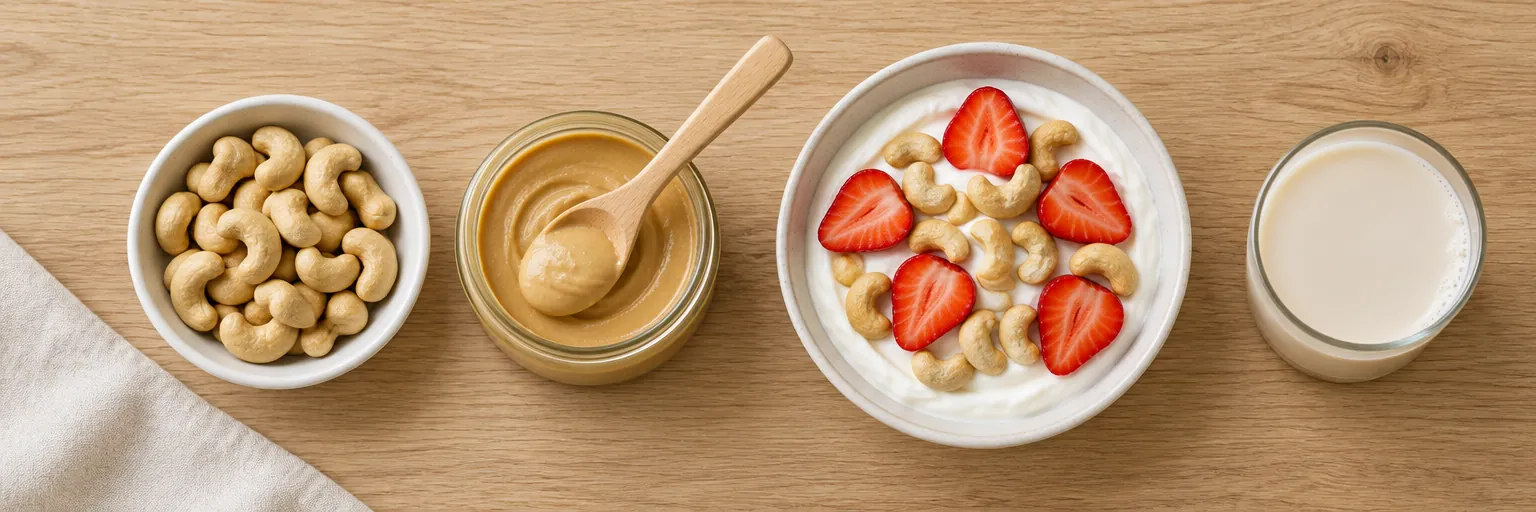
Cashews for Weight Loss: How Many Per Day, Cashews vs Almonds, and What the Evidence Actually Says (2026)
Quick answer
One ounce of cashews — about 18 whole cashews, or roughly ¼ measuring cup — carries roughly 157 kcal, ~5.2 g of protein, ~12.4 g of total fat (of which ~2.2 g is saturated, ~6.7 g is monounsaturated, and ~2.2 g is polyunsaturated), ~8.6 g of carbohydrate of which only ~0.9 g is fiber, ~83 mg of magnesium, ~187 mg of potassium, ~1.6 mg of zinc, and ~0.6 mg of iron per USDA FoodData Central. The cashew intervention literature — Mah 2017 (Am J Clin Nutr, 12-week 20%-of-energy RCT in healthy adults), Mohan 2018 (J Nutr, 12-week RCT in adults with type 2 diabetes, n=300), Baer & Novotny 2019 (J Nutr, metabolizable-energy crossover), Tey 2011 (Nutr Metab Lond, satiety review), Neale 2017 (BMJ Open, systematic review of tree-nut intake and body weight), and Grosso 2015 (Am J Clin Nutr, meta-analysis of nut intake and cardiovascular outcomes) — points to a neutral weight signal at realistic 1 to 2 oz/day intake, no cardiometabolic downside, and a small but real metabolizable-energy discount of roughly 5 to 15 percent — smaller than almond’s ~20 percent, but honest. Cashews do not burn fat, and no trial has ever shown that. The working portion for a weight-loss plan is 1 oz per day, dry-roasted unsalted for daily use; two ounces on a hard training day is a reasonable ceiling. Cashews belong in a rotation alongside almonds, walnuts, and pistachios in the broader healthy fats for weight loss picture — with the fiber caveat below (cashews are the lowest-fiber tree nut on this list, and that matters for satiety more than the 7-kcal per-oz difference from almonds).
What is actually in a cashew
Cashews are the seed of the cashew apple (Anacardium occidentale), a South American tree now grown mostly in India, Vietnam, and West Africa. Nutritionally, cashews are a MUFA-dominant tree nut — roughly 54 percent of the total fat is monounsaturated (predominantly oleic acid, the same fatty acid that makes olive oil MUFA-forward), with 18 percent saturated and 18 percent polyunsaturated. That fat profile is why cashews land next to almonds in the “cardiometabolic-friendly” category rather than next to coconut or macadamia.
USDA FoodData Central puts raw cashews at roughly 553 kcal per 100 g — a 1 oz (28 g) serving is ~157 kcal, with ~5.2 g of protein, ~12.4 g of total fat (~2.2 g saturated, ~6.7 g monounsaturated, ~2.2 g polyunsaturated, of which only trace ALA omega-3), ~8.6 g of carbohydrate of which ~0.9 g is fiber, and 0 mg of sodium in unsalted form. The protein-per-calorie ratio (~3.3 g of protein per 100 kcal) is respectable but slightly lower than almonds (~3.7 g / 100 kcal) and pistachios (~3.6 g / 100 kcal). One ounce is ~18 whole cashews, which is also ~¼ measuring cup, which is also 28 g on the kitchen scale. That number is worth memorizing because the single most common tracking mistake with cashews is the “handful” — a hand scoop from a bag is typically 35 to 55 g, not 28 g, and a heaping scoop from a Costco tub is easily 60 to 80 g. That is 195 to 445 kcal, not 157.
The micronutrient profile has three real standouts:
- Magnesium: ~83 mg per oz (~20 percent of the 420 mg daily value for adult men, ~26 percent for adult women). Cashews are among the most magnesium-dense common foods. This matters for anyone on a proton pump inhibitor (chronic PPI use is linked to lower serum magnesium), for people with prediabetes or metabolic syndrome (magnesium status tracks with insulin sensitivity), and for anyone eating a low-processed-food diet where cereals and fortified breads are not doing the magnesium work. See magnesium and weight loss for the broader picture.
- Zinc: ~1.6 mg per oz (~15 percent of the 11 mg daily value for adult men, ~20 percent for adult women). Zinc is one of the harder micronutrients to hit on a lower-calorie or plant-forward plan. Beef, oysters, and pumpkin seeds are the top-density sources; cashews sit reasonably high for a nut.
- Copper: ~0.6 mg per oz (~67 percent of the 0.9 mg daily value). Cashews are one of the top common food sources of copper, which matters for iron metabolism and connective-tissue health.
The one nutrient cashews do not deliver in meaningful amount is fiber. At ~0.9 g per oz, cashews sit near the bottom of the common tree-nut list — much lower than almonds (~3.5 g), pistachios (~3.0 g), or walnuts (~1.9 g). Fiber is one of the most consistent satiety-per-calorie drivers in the tree-nut set, so this is not a rounding-error difference: it is the honest reason cashews are a rotation snack rather than a satiety-anchor snack. Anyone leaning on cashews as their fiber source is under-buying satiety per calorie. See protein intake for weight loss and snacking for weight loss for the broader satiety framework where cashews fit as a rotation, not a staple.
Cashews also carry only trace plant-source omega-3 ALA — for the ALA-anchor conversation, walnuts and ground flax are the whole-food picks.
The satiety and body-composition evidence
The cashew intervention literature is smaller than the almond, walnut, or pistachio literature, but it points in the same direction on the two things that matter most: cashews do not cause the weight gain their calorie load predicts at realistic 1 to 2 oz/day intake, and the cardiometabolic signal at those doses is modestly favorable. Reading the trials honestly matters because “cashews for weight loss” is one of the more oversold TikTok claims of the last few years, and no trial supports a fat-burning effect.
Mah 2017 (American Journal of Clinical Nutrition) is the closest thing to a reference RCT on cashews and body weight in healthy adults. The team randomized 51 adults to a diet in which cashews supplied roughly 20 percent of daily energy (about 2 to 3 oz per day at typical calorie levels) versus a matched-calorie control diet for 12 weeks. At 12 weeks the cashew arm showed no weight gain despite the substantial added calorie load, plus modest but statistically significant reductions in total cholesterol and LDL cholesterol versus the control. As with the almond and pistachio trials, the story was calorie substitution and satiety, not accelerated fat oxidation.
Mohan 2018 (Journal of Nutrition) is the largest cashew trial to date and one of the few nut trials run outside a Western population. The team randomized 300 adults with type 2 diabetes in Chennai, India, to a diet including roughly 30 g/day of cashews (about 1 oz) or a matched-calorie control diet for 12 weeks. Body weight and glycemic control did not differ meaningfully between arms, but the cashew arm showed a ~4.9 mmHg drop in systolic blood pressure and a ~1.7 mg/dL rise in HDL cholesterol versus control — clinically meaningful directions for a low-cost dietary intervention. Weight was neutral, cardiometabolic markers moved favorably, and the study population was one that most Western nut trials do not reach.
Baer & Novotny 2019 (Journal of Nutrition) is the study that changed the cashew calorie math. In a Beltsville metabolic-ward crossover trial in 18 healthy adults, the researchers measured the true metabolizable energy of whole cashews using bomb calorimetry and stool collection. The Atwater-factor label value is ~157 kcal per oz; the measured metabolizable energy was closer to ~137 kcal per oz in most participants — a ~12 to 16 percent discount on the calorie load. As a working range, cite this as roughly 5 to 15 percent to be honest about between-person variation and the smaller published effect sizes in some subgroups. The mechanism mirrors the earlier Novotny 2012 almond finding (a ~20 percent discount), the Baer 2016 walnut finding (~21 percent), and the Baer 2012 pistachio finding (~6 percent): intact cell walls in whole nuts resist chewing and digestion, and a portion of the lipid passes through unabsorbed. The cashew ME gap is real but smaller than almond’s ~20 percent — a meaningful line to keep in mind rather than a permission slip to eat more.
Tey 2011 (Nutrition and Metabolism [Lond]) reviewed the satiety and subsequent-meal literature across tree nuts and concluded that cashews (like almonds and pistachios) reliably reduce subsequent-meal intake in acute-load trials, with mixed evidence on the magnitude of chronic body-composition benefit — a fair read of the state of the field.
Neale 2017 (BMJ Open) is the systematic review that matters for the “are nuts fattening” question in general. Pooling long-term tree-nut interventions (including the cashew subgroup), the review concluded that habitual tree-nut intake at 1 to 2 oz/day does not produce adverse body-weight effects and is associated with a modestly better weight trajectory at matched calories.
Grosso 2015 (American Journal of Clinical Nutrition) is the cardiovascular meta-analysis that includes a cashew subgroup, reporting an inverse association between tree-nut intake and coronary heart disease and stroke — driven mostly by almond, walnut, and mixed-nut trials, but with cashews fitting the same direction of effect.
Rock 2020 (Nutrients) — the pretzel-swap trial cited above in the pistachio literature — provides a template result that applies to cashews too: swapping a refined-carb snack for a whole tree-nut snack of comparable calories does not slow weight loss and improves cardiometabolic markers.
The USDA MyPlate 2024 nuts-and-seeds guidance counts 1 oz of nuts (cashews included) as 2 oz-equivalents toward the daily protein target — worth noting for anyone using MyPlate as a food-group framework rather than a calorie framework.
The honest read: cashews are a neutral-to-slightly-favorable whole food at 1 to 2 oz/day, with a modest metabolizable-energy discount and a directionally favorable cardiometabolic profile. They are not a weight-loss food per se — no whole-food snack is — and they are one of the lower-fiber tree nuts, which is why they sit in the “rotation” tier rather than the “daily anchor” tier. See why am I not losing weight for the wider portion-drift framework where “healthy” foods stall a deficit.
Cashews vs almonds vs walnuts vs pistachios — the tree-nut quartet
The four tree nuts most searched together are almonds, walnuts, pistachios, and cashews. All four fit inside a weight-loss deficit and none of them “burn fat.” The honest read on the differences, per 1 oz serving:
| Nut (1 oz / 28 g) | Kcal (label) | Kcal (measured / ME) | Protein (g) | Fiber (g) | MUFA (%) | PUFA / ALA (g) | Best weight-loss use | Most common tracking mistake |
|---|---|---|---|---|---|---|---|---|
| Almonds (~23 nuts) | ~164 | ~131 (Novotny 2012, ~20% discount) | 6.0 | 3.5 | ~63% | ~3.5 / trace | Daily satiety anchor — highest fiber and largest ME discount in the set | ”Handful” that is really 40 to 60 g / 230 to 350 kcal, not 28 g |
| Walnuts (~14 halves) | ~185 | ~146 (Baer 2016, ~21% discount) | 4.3 | 1.9 | ~14% | ~13.4 / ~2.5 | Plant-source omega-3 anchor; PREDIMED-style cardiovascular slot | Whole-fat baked goods and salads treating them like a garnish; oxidation from stale bulk-bin walnuts |
| Pistachios (~49 kernels) | ~159 | ~149 (Baer 2012, ~6% discount) | 5.7 | 3.0 | ~54% | ~3.9 / ~0.1 | Portion-control snack — in-shell format cuts intake ~40% (Pistachio Principle) | Shelled-kernel handful without shell pacing; salted-in-shell sodium creep |
| Cashews (~18 nuts) | ~157 | ~137 (Baer 2019, ~5–15% discount) | 5.2 | 0.9 | ~54% | ~2.2 / trace | Rotation snack; magnesium + zinc + copper micronutrient contribution | Costco tub grazing; cashew-cream sauce absorbing 500+ kcal into a “healthy” recipe |
Decision rule: rotate two or three rather than picking one. Cashews earn a slot for their magnesium, zinc, and copper density and their milder flavor for cooking, but they are the lowest-fiber and third-lowest-protein of the four and do not have a portion-control gimmick like the pistachio shell. If you can only stock two nuts in a weight-loss plan, almonds and walnuts (or almonds and pistachios in-shell) are the higher-return pair. If you rotate three or four, cashews are a fine addition — especially in cooked applications where the neutral flavor works better than walnut’s tannic bitterness or pistachio’s green profile. For the deep dives, see almonds for weight loss, walnuts for weight loss, and pistachios for weight loss.
Portion & tracking — the single most useful sentence in this article
One ounce is 18 whole cashews, or ~¼ measuring cup, or 28 g on the scale, or roughly 157 label kcal / 137 measured kcal — and every one of those is a specific number, not a vibe. The “palm of your hand ≈ 1 oz” shortcut is off by ±30 percent for most adult hands, and cashews have a specific problem the other tree nuts do not: they are lower in fiber and higher in carbohydrate, so the satiety-per-calorie signal is weaker. That means the drift from “1 oz” to “2 oz” happens faster on cashews than on almonds or pistachios, and the deficit gets erased more quietly.
The rule is mechanical: if cashews are a food you eat more than twice a week, pre-portion them. Count 18 whole cashews onto a small dish or a napkin before you sit down, or weigh 28 g on a $12 kitchen scale. Do this three or four times over a week and your eyeball estimate becomes more reliable. After that you can approximate, but the drift back to “just one more scoop” is real and it is the most common failure mode with this specific nut.
Two structural fixes for people who know bag-grazing is a pattern:
- 100-calorie pre-portioned packs (Planters, Kirkland, store-brand equivalent) — each pack is roughly 11 to 14 cashews and ~100 kcal, in a resealable pouch. About 40 to 80 percent more expensive per ounce than a warehouse-store tub, and worth it if the tub is a landmine. The lower fiber content of cashews compared to almonds makes the pre-portioned format more valuable, not less, for this nut specifically.
- Costco / Kirkland 3 lb tub portioned into 1 oz zip bags on the day it comes home — 48 pre-portioned snacks for the cost of the bag plus 30 minutes on a Sunday. Store the day’s ration in a jar on the counter and the rest in the freezer for shelf life. This is the cheapest way to buy cashews and keep the portion honest at the same time. The Costco 3-lb tub failure mode is famous for a reason: the intended 3-to-4-week consumption timeline typically compresses to 4 or 5 sittings if the tub lives on the counter with the lid off.
And take the Baer 2019 metabolizable-energy discount as a small tailwind, not a permission slip. The absorbed calories from 1 oz of whole cashews are ~137, not 157 — a real discount, but a smaller one than almonds’ ~131 absorbed from a 164-kcal label, and it applies only to whole cashews. Cashew butter absorbs closer to the label number because grinding disrupts the cell walls. Two ounces of whole cashews is still ~275 absorbed calories, and if that lands on top of the daily calorie plan, the day is over. For the calorie-counting mechanics see how to count calories.
Salted vs unsalted vs roasted vs raw — the honest comparison
Cashews are sold in more format permutations than almost any other tree nut. Here is the honest read for a weight-loss plan:
| Format | Portion (1 oz) | Kcal | Sodium (mg) | Real weight-loss use | Notes |
|---|---|---|---|---|---|
| Dry-roasted, unsalted | 18 nuts | ~157 (label) / ~137 (absorbed) | ~0 | Daily-driver default. Same calories as raw with better flavor. | Widely available (365, Trader Joe’s, store brands). No added oil. |
| Dry-roasted, salted | 18 nuts | ~157 / ~137 | ~120 to 180 | Fine for most adults at 1 oz/day; watch on low-sodium prescriptions or hypertension. | Wonderful, Planters, Kirkland — most common grocery format. |
| Raw (“raw”) | 18 nuts | ~157 / ~137 | ~0 | Cooking and cashew-cream recipes; essentially identical to dry-roasted on the calorie line. | All US retail “raw” cashews are steam-treated — true raw is not sold retail. Not dangerous. |
| Oil-roasted, salted | 18 nuts | ~163 to 170 / ~140 | ~130 to 200 | Rotation snack; slightly higher calorie load from added oil. | Common in warehouse-store tubs; typically peanut or cottonseed oil. |
| Flavored (honey-roasted, chili-lime, cinnamon-sugar) | 18 nuts | ~175 to 210 / ~155 to 190 | ~120 to 300 | Treat as candy, not a whole-food staple. | Adds 20 to 40 kcal per oz from sugar and oil; shifts profile off the Mah 2017 evidence base. |
Salted vs unsalted — the sodium math. A 1 oz portion of salted cashews adds roughly 120 to 180 mg of sodium depending on brand (Planters is ~160 mg per oz, Kirkland is ~125 mg per oz, Wonderful is ~140 mg per oz, some flavored lines exceed 250 mg per oz). That is 5 to 8 percent of the 2,300 mg FDA / DGA 2020–2025 daily reference at a snack that otherwise carries no processed-food sodium load. For a healthy adult at 1 oz per day, salted is not a weight-loss deal-breaker. But if you already have hypertension, are on a low-sodium heart-failure or CKD diet with a physician-set 1,500 to 2,000 mg target, or are eating multiple ounces per day, default to dry-roasted unsalted. The unsalted format is widely available, tastes identical to your palate within about a week of switching (a well-documented salt-taste adaptation window), and lets you spend the sodium budget where it earns more.
Roasted vs raw — negligible calorie difference. Dry-roasted and raw cashews differ by roughly 0 to 5 kcal per oz — most of the water is already gone in shipping and the calorie label rounds identically for both formats. Oil-roasted adds ~5 to 10 kcal per oz from the added oil. Raw is not dangerous, and it is also not really raw. The cashew shell contains anacardic acid (a skin irritant related to poison ivy urushiol), so every cashew sold in US retail is steam-treated to inactivate the shell oil before packaging — the FDA does not permit truly raw in-shell cashews on the retail market. The “raw cashews are dangerous” viral claim is over-indexed for what is actually on shelves; the “true raw is a health hazard” claim is technically true for freshly harvested nuts in producer countries and irrelevant for anything in your grocery cart.
Flavored formats are candy. Honey-roasted (~40 kcal added sugar per oz), chili-lime (~10 to 20 kcal added sugar and oil), cinnamon-sugar (~30 to 50 kcal added sugar), and salt-and-vinegar cashews are snack food, not a whole-food staple. Wang, Mah, Mohan, and Baer trials were all run on plain (mostly unsalted) cashews. Flavored formats do not inherit those results.
Cashew butter — the niche spread
Natural cashew butter (cashews, sometimes salt, occasionally a touch of oil; nothing else) runs about 90 to 100 kcal per tablespoon, ~3 g protein, ~1 g fiber, ~8 g fat, and costs 2 to 2.5× as much as peanut butter and 1.2 to 1.5× as much as almond butter. A 2 tbsp serving is closer to ~185 to 195 kcal, ~6 g protein, and ~16 g fat — comparable to a 2 tbsp peanut butter serving on the calorie side, with a smoother, milder flavor and less fiber.
Unlike whole cashews, cashew butter does not get the Baer 2019 metabolizable-energy discount because the cell walls are disrupted by grinding — the calorie count on the label is what actually absorbs. Cashew butter is also slightly higher glycemic than peanut butter in some readers, likely because of the lower fiber (~1 g per 2 tbsp vs ~2 g for peanut butter). That is not a disaster, but it is worth noting for anyone using nut butter as a stabilizer on a piece of toast or a rice cake — a walnut or almond butter with more fiber will pace the carb hit more effectively.
Where cashew butter earns its place: a rotation spread for people who specifically like the flavor, want variety over daily peanut or almond butter, or are using it in a specific recipe (drizzled on rice cakes, blended into a sauce, or stirred into oats). For everyone else, peanut butter for weight loss at ~$0.20 per 2 tbsp or almond butter at ~$0.60 per 2 tbsp is the more practical daily-driver spread.
Portion trap: cashew butter is smoother and less sticky than peanut butter, which means it pours and spreads faster — the eyeballed “spoonful” is typically 25 to 40 g rather than the measured 16 g of a tablespoon, and that is 150 to 250 kcal, not 90 to 100. And do not substitute cashew butter 1:1 by volume for other nut butters in recipes — it is denser and softer than PB or almond butter, so a “1 cup” swap can quietly add or subtract 100 to 200 kcal from a batch of energy balls or a smoothie base. Weigh a serving once with a kitchen scale so the tablespoon is calibrated.
Cashew milk — the plant-milk sub-category
Commercial cashew milk (Silk, Elmhurst, So Delicious, Forager, store brands) runs from about 25 to 90 kcal per cup, depending on brand and whether it is sweetened. The lowest-calorie option is unsweetened cashew milk at ~25 to 40 kcal per cup, which fits cleanly into a coffee, cereal, or smoothie without meaningfully affecting the daily calorie plan. Sweetened cashew milk adds 5 to 8 g of sugar and 40 to 70 kcal per cup — read the label, because the “cashew milk” halo makes it easy to grab the sweetened version by mistake.
Cashew milk contributes essentially no protein (~0 to 1 g per cup) and no meaningful whole-cashew nutrient profile — the milk is mostly water with a small amount of ground cashew, and the magnesium, zinc, and copper density of whole cashews does not transfer at any useful density. If you want a plant milk for calorie substitution, unsweetened almond milk, soy milk (for the protein), or oat milk (for texture) are the more established picks; cashew milk is a rotation for flavor variety, not a protein or micronutrient source. Elmhurst’s higher-nut-content lines (~4 to 5 g protein per cup) are the exception and cost roughly 2× the mainstream brands.
For the broader plant-milk and low-calorie-swap picture see the weight loss grocery list and the high-protein snacks for weight loss framework — the calorie and protein math applies to any plant milk you rotate in.
Five low-friction weight-loss patterns for cashews
Beyond the plain handful, cashews show up in five specific patterns that reliably fit inside a deficit — with one big warning about a sixth pattern (cashew-cream sauces) that reliably does not.
- 1 oz dry-roasted unsalted cashews on plain Greek yogurt + berries. ~305 kcal breakfast or snack built from 1 cup nonfat plain Greek yogurt (~130 kcal, ~23 g protein), ½ cup berries (~40 kcal), and 1 oz cashews (~135 kcal absorbed). Roughly 28 g of protein plus a real magnesium and zinc contribution and enough fat to hold two to three hours.
- Overnight oats + 1 tbsp chopped cashews + ½ banana. ~340 kcal breakfast: ½ cup rolled oats (~150 kcal), 1 tbsp chopped cashews (~50 kcal), ½ banana (~50 kcal), 1 cup unsweetened almond milk (~30 kcal), and 1 scoop whey protein (~120 kcal, ~24 g protein). See oatmeal for weight loss for the fuller oatmeal framework.
- 1 oz cashews + 1 medium apple as a portable snack. ~230 kcal, ~6 g protein, ~5 g fiber, real chewing time. The apple brings volume and fiber (which cashews are short on); the cashews bring the protein and fat anchor. Count out 18 cashews the first few times so “one handful” does not drift to two.
- Cashews in stir-fry — a small handful, on purpose. Traditional Thai and Indian recipes use 1 to 2 oz of cashews per 3-to-4-serving dish (roughly ~40 to 55 kcal of cashews per serving). This is a legitimate use where cashew’s mild flavor and softer texture earn their place over almonds or walnuts. The failure mode is not the technique — it is doubling the cashews “because they are healthy,” which pushes a 500-kcal serving to 650 kcal.
- 1 oz cashews + a square of 70% dark chocolate as evening dessert. ~210 kcal genuinely satisfying dessert (cashews ~135 absorbed + ~1 oz 70% dark chocolate ~55 kcal for a small square). The fat-and-cocoa combination reads as an indulgence, closes the day on a whole food, and does not require a 400 kcal cookie or brownie to feel like dessert.
Sixth pattern — the trap. Cashew-based “cream” sauces (soaked whole cashews blended with water for pasta, curry, or “vegan alfredo”) often use ½ to 1 cup of dry cashews per recipe, which is 360 to 720 kcal in the sauce alone before the pasta and other ingredients. These recipes are marketed as “healthy” or “dairy-free” but they are dense, calorie-heavy dishes that need to be weighed and portioned like any other cream sauce. A “vegan cashew alfredo” can easily hit 700 to 900 kcal per serving. Do it on purpose, on the scale, and log it — do not treat it as a “light” dinner.
Failure modes — where cashews go wrong
Cashews are a fine whole food inside a weight-loss plan, and they still have specific failure modes that cost more calories than the food itself is worth. Naming them keeps them tractable.
- Costco 3-lb tub grazing is the single biggest portion-creep pattern. The Kirkland 3-lb tub is intended to last 40 to 45 servings (about 3 to 4 weeks at 1 oz/day). Actual field consumption when the tub sits on the counter is closer to 4 to 5 sittings. That is 180 to 240 g per sitting (~1,020 to 1,360 kcal), and it never gets logged because “just a few cashews” was the mental model. Portion into 1 oz zip bags on the day the tub comes home, or move to 100-calorie packs if you know this is your pattern.
- Cashew butter “by feel” onto toast. A single measured tablespoon is 16 g / ~95 kcal. An eyeballed scoop is typically 30 to 55 g / ~180 to 320 kcal. Two of them on a piece of toast is easily 400 kcal of nut butter on 100 kcal of bread — a “healthy breakfast” that lands at 500 kcal without any protein anchor. Weigh a serving once with a kitchen scale and keep the tablespoon calibrated.
- Cashew-cream sauces in “healthy” recipes. As above — ½ to 1 cup dry cashews per recipe is 360 to 720 kcal in the sauce. This is the recipe pattern most likely to quietly cancel a deficit. Cook it on purpose, on the scale, and log the calorie load.
- Flavored cashews sold as “protein snacks.” Honey-roasted cashews are 25 to 35 percent added sugar by weight in some brands. Chili-lime, salt-and-vinegar, and cinnamon-sugar cashews are candy with a protein halo. Read the label for added sugars and treat the flavored formats as dessert, not a daily-driver snack.
- Cashews in trail mix. In most bagged trail mixes cashews are 15 to 25 percent of the volume but only 8 to 12 percent of the calories — the raisins, yogurt-covered pretzels, and dried mango do the calorie work. Bagged trail mix typically runs 130 to 160 kcal per oz with an added-sugar load hidden under the “healthy nut” halo. Buy the components separately if cashews are what you actually want.
- Cashews in a smoothie or blended dish. No chewing, no whole-food visual cue, and the calorie load is easy to miss. A 2 tbsp scoop of cashew butter or ¼ cup whole cashews blended into a smoothie is ~190 to 210 kcal that vanishes into a drink. Add on purpose, on the scale, once.
- The Baer 2019 metabolizable-energy discount does NOT license eating twice as many. The real absorbed calories from 1 oz of whole cashews are ~137, not 157 — a modest tailwind, not a doubling permission. And the discount only applies to whole cashews; cashew butter and cashew milk get little to no discount because the cell walls are disrupted.
Safety and interactions
Cashews are safe for most adults inside a weight-loss plan, with three real cautions.
- Tree-nut allergy — cashews are one of the top three tree-nut allergens. Cashew allergy is one of the most common adult-onset tree-nut allergies (behind almonds and walnuts by different regional estimates) and is a common trigger of anaphylaxis in children. Cashew and pistachio cross-reactivity runs roughly 30 percent in tree-nut-allergic patients — the two nuts share a major storage-protein family (Ana o 1/Ana o 2 in cashew, Pis v 1/Pis v 2 in pistachio). Anyone with a diagnosed pistachio allergy should treat cashews as a probable co-allergen and consult an allergist before introducing them. Do not introduce cashews into a tree-nut-allergic household. Sunflower seed butter, tahini (sesame), and pumpkin seeds are the standard tree-nut-free swaps.
- Anacardic acid in raw-in-shell cashews. The cashew shell contains a poison-ivy-family irritant (anacardic acid / cardanol / urushiol-family compounds). This is a real hazard for cashew-processing workers in producer countries and a non-issue for anything on US retail shelves — all US retail “raw” cashews are steam-treated to inactivate the shell oil. Do not attempt to purchase or process truly raw in-shell cashews at home. What you see labeled “raw” in a US grocery store is safe.
- No known drug interactions at culinary doses. Cashews do not interact meaningfully with common weight-loss or cardiometabolic medications at 1 to 2 oz/day. The magnesium contribution (~83 mg per oz, ~20 percent DV) is worth noting for anyone on long-term proton pump inhibitors (PPIs are associated with lower serum magnesium over years of use) — cashews are one of the higher-density magnesium foods available and can help close that gap.
Cost and practicality
Cashews are pricier per pound than peanuts and comparable to almonds and walnuts. Approximate 2026 US shelf prices:
- Kirkland Signature 3-lb dry-roasted unsalted or salted cashews (Costco): ~$16 to $22 per bag — ~$0.35 to $0.50 per 1 oz serving, the cheapest reliable source per ounce.
- Trader Joe’s 16 oz dry-roasted unsalted cashews: ~$8 to $12 per bag — ~$0.50 to $0.75 per oz.
- Whole Foods / 365 organic raw cashews (16 oz): ~$10 to $16 per bag — ~$0.65 to $1.00 per oz.
- Planters 12 oz salted cashews: ~$6 to $9 per canister — ~$0.55 to $0.75 per oz.
- 100-calorie pre-portioned packs (Planters, Kirkland, store-brand): ~$0.80 to $1.10 per pack — the most expensive per ounce, worth it if bag-grazing is the pattern the packs prevent.
- Natural cashew butter (365, Trader Joe’s, small-brand): ~$10 to $18 per 12 oz jar — ~$0.85 to $1.40 per 2 tbsp serving, roughly the second-priciest common nut butter after pistachio butter.
- Unsweetened cashew milk (Silk, So Delicious, Elmhurst, store-brand): ~$3 to $6 per half-gallon — ~$0.20 to $0.40 per cup.
The cheapest and best format for daily use is the warehouse-store 3-lb bag, portioned into 1 oz zip bags on the day it comes home, with the extras kept in the fridge or freezer for shelf-life. This is roughly one-third the cost per ounce of pre-portioned packs, and it keeps the portion honest at the same time. The “raw” premium at natural-foods stores (~30 to 60 percent more expensive than dry-roasted) is a marketing artifact — there is no meaningful nutritional edge, and true raw is not sold retail anyway.
Storage: cashews oxidize slower than walnuts because they are lower in polyunsaturated fat, but they still degrade at room temperature after a few months. Refrigerate the open bag (up to ~6 months) or freeze (up to ~1 year). An off, bitter, or crayon-like flavor is oxidized fat — throw the batch out and buy fresh from a higher-turnover store.
For the wider budget-protein comparison see the weight loss grocery list, which also covers where cashews fit alongside beans, canned tuna, eggs, and Greek yogurt as cheap-per-serving whole foods.
Special situations — when cashews are the right (or wrong) food to add
Cashews are a fine food for most weight-loss plans but not all of them.
- GLP-1 users (semaglutide, tirzepatide, and related). A 1 oz cashew portion adds ~5.2 g of protein, ~83 mg of magnesium, and ~1.6 mg of zinc without a large calorie load — useful during appetite suppression to help hit protein and micronutrient targets. But early GLP-1 users often have fat-driven nausea sensitivity for the first 4 to 8 weeks; the ~12 g of fat in a 1 oz cashew portion can trigger nausea in that window. Start with ½ oz (~9 nuts, ~80 kcal) and titrate up as tolerated. See food noise and GLP-1s for the fuller framework.
- Type 2 diabetes and prediabetes. Mohan 2018 showed no adverse weight or glycemic effect at 1 oz/day over 12 weeks and a ~4.9 mmHg SBP drop. Cashews have a low glycemic load at 1 oz portions, and the magnesium contribution (~83 mg per oz, ~20 percent DV) is meaningful given the consistent link between low serum magnesium and worse insulin sensitivity. Cashews earn a rotation slot in a diabetes-friendly plan.
- Postpartum and pregnancy. Culinary doses of cashews (1 to 2 oz/day) are safe in pregnancy and lactation — protein, magnesium, zinc, copper, and iron are all pluses. Watch for allergy introduction in a weaning infant — cashews are one of the top pediatric tree-nut allergens, and current AAP guidance is to introduce common allergens early (4 to 6 months) in a controlled way, ideally after peanut and egg have been tolerated. Discuss the introduction protocol with the pediatrician.
- Kidney disease with a potassium restriction. Cashews carry ~187 mg of potassium per oz — moderate for a nut, slightly lower than almonds’ 208 mg per oz but still meaningful on a physician-set 2,000 to 3,000 mg CKD-restricted budget. Portion carefully or swap to a lower-potassium alternative (rice cakes, plain popcorn, cucumber slices) if you are on a strict CKD stage 3b to 5 diet.
- Tree-nut-allergic families. Do not introduce. Pistachio-allergic readers have ~30 percent cross-reactivity with cashew — treat cashews as a probable co-allergen and consult an allergist. Sunflower seed butter and pumpkin seeds are the standard whole-food swaps.
- Hypertension on a low-sodium prescription. Default to dry-roasted unsalted. Salted cashews add 120 to 180 mg of sodium per oz, which is not a deal-breaker at 1 oz/day for a healthy adult but is a real load on a physician-set 1,500 to 2,000 mg/day target.
- Very-low-calorie plans under ~1,200 kcal/day. A 1 oz cashew portion is ~13 percent of the day’s calories on a 1,200 kcal plan. Drop to a chopped-cashew topping (~1 tbsp / ~50 kcal) rather than a full ounce, and prioritize the higher-fiber tree nuts (almonds, pistachios) as the daily-driver satiety anchor.
- A history of eating past a portion on nuts specifically. Some people find cashews are a food they cannot keep in the house in a 3-lb tub and stay within a portion. Pre-portioned 100-kcal packs, in-shell pistachios (for the pacing effect), or a different snack format are the honest workarounds — the pattern is the problem, not the food.
What cashews do not do
Cashews are a useful food in a weight-loss diet, and they are not a lot of other things.
- Cashews do not “burn belly fat.” No trial has ever shown a cashew-specific fat-burning effect independent of calorie substitution and satiety. Mah 2017, Mohan 2018, Baer 2019, and Neale 2017 all point to neutral weight outcomes at matched calories, not fat oxidation acceleration. TikTok “eat 20 cashews every night to melt belly fat” claims are not evidence-based.
- Cashews are not a fiber food. At ~0.9 g per oz they contribute a small amount versus almonds (~3.5 g), pistachios (~3.0 g), or chia (~10 g per oz). Do not lean on cashews for the fiber target.
- Cashews are not a plant-source omega-3 food. Trace ALA per oz means cashews contribute essentially nothing to an ALA target. Walnuts, ground flax, and chia are the whole-food picks.
- Cashews do not make dessert healthy. A cashew-topped ice cream, a cashew-brittle candy bar, a cashew-crusted cheesecake, and a “cashew energy ball” recipe with 400 kcal per ball are all dessert. The presence of cashews does not change the underlying sugar-and-fat load. Track the dessert on its own terms.
- Cashew milk is a marketing category, not a protein source. Unsweetened cashew milk at ~25 kcal per cup is a fine low-calorie substitute for whole milk in coffee or a smoothie, but it contributes 0 to 1 g of protein per cup. Do not swap dairy milk 1:1 for cashew milk and expect the protein math to work.
- The Baer 2019 -5 to 15 percent metabolizable-energy discount is smaller than almonds’ ~20 percent and walnuts’ ~21 percent. Cashews’ portion-honesty problem is bigger than their calorie-math advantage. Do not double-count the discount and do not use it as a rationalization to eat two ounces “because they only really absorb 275 calories anyway.”
Frequently asked questions
Are cashews good for weight loss? Yes, in measured portions. One ounce of cashews (about 18 whole nuts) is ~157 kcal on the USDA label with ~5.2 g of protein, ~12.4 g of fat (of which ~2.2 g is saturated and ~6.7 g is monounsaturated), ~8.6 g of carbohydrate of which only ~0.9 g is fiber, ~83 mg of magnesium, ~187 mg of potassium, and ~1.6 mg of zinc. Cashews do not burn fat. The Mah 2017 (Am J Clin Nutr) 12-week 20%-of-energy RCT, the Mohan 2018 (J Nutr) 12-week trial in adults with type 2 diabetes, and the Neale 2017 (BMJ Open) systematic review of tree-nut intake all point to a neutral weight signal at realistic 1 to 2 oz/day intake, with modest cardiometabolic benefits. Baer 2019 (J Nutr) also showed measured metabolizable energy for cashews is roughly 5 to 15 percent lower than the Atwater label — a smaller gap than almonds’ ~20 percent, but real. Portion still rules.
How many cashews should I eat per day to lose weight? The working default is 1 oz per day — about 18 whole cashews, or roughly ¼ measuring cup. That is ~157 kcal on the label and ~137 kcal actually absorbed after the Baer 2019 metabolizable-energy discount. Two ounces (~314 kcal label / ~275 kcal absorbed) is a reasonable ceiling on a hard training day; above that on a 1,500 to 1,800 kcal deficit, portion creep tends to quietly cancel the day. A Costco Kirkland 3-lb tub scoop is typically 40 to 70 g (~225 to 395 kcal) and rarely gets logged. Count 18 cashews onto a small dish, or portion the tub into 1 oz zip bags on the day it comes home, or buy 100-calorie packs if bag-grazing is your pattern.
Cashews vs almonds — which is better for weight loss? Almonds win on the numbers that matter for a weight-loss plan. Per 1 oz: almonds ~164 kcal / 6 g protein / 3.5 g fiber / 14 g fat and a metabolizable-energy discount of ~20 percent (Novotny 2012), so real absorbed calories are closer to ~131 kcal. Cashews ~157 kcal / 5.2 g protein / 0.9 g fiber / 12.4 g fat with a smaller ~5 to 15 percent ME discount (Baer 2019), so absorbed calories are ~137. Cashews are slightly lower in calories on the label but much lower in fiber (0.9 g vs 3.5 g), and fiber is a bigger factor in satiety than the 7 kcal difference. Cashews contribute more magnesium (83 mg vs 76 mg) and more zinc (1.6 mg vs 0.9 mg), so they earn a rotation slot for those micronutrients — but as the daily-driver snack, almonds are the more satiety-forward choice.
Are cashews fattening? Not at a 1 oz portion. Cashews are calorie-dense (~157 kcal per oz, ~560 kcal per 100 g) like every other nut, so eating a tub in one sitting will absolutely add calories a deficit does not have room for. But at measured portions the intervention evidence is neutral to slightly favorable: Mah 2017 (Am J Clin Nutr) ran a 12-week RCT with 20 percent of daily energy from cashews (a big dose — ~2 to 3 oz/day) and found no weight gain versus a matched-calorie control, plus modest LDL and total-cholesterol drops. Mohan 2018 (J Nutr) fed cashews for 12 weeks to adults with type 2 diabetes and found no adverse weight or glycemic effect and a ~4.9 mmHg drop in systolic blood pressure. The failure mode is not the food — it is grazing an open tub without weighing.
Roasted vs raw cashews — is there a real difference? Not for weight loss. Dry-roasting adds essentially no calories (roughly 0 to 5 kcal per oz — most of the water is already gone in shipping). Oil-roasting adds ~5 to 10 kcal per oz from the added oil. Raw and dry-roasted are effectively identical on the calorie line. What matters more is whether the roasted format is flavored: honey-roasted, chili-lime, cinnamon-sugar, and salt-and-vinegar cashews add 20 to 40 kcal per oz from added sugar and oil and shift the profile from whole-food snack toward candy. Also worth noting — true raw cashews are not sold in the US retail market. All “raw” cashews sold in US grocery stores are steam-treated to inactivate the anacardic-acid shell oil, which is a skin irritant. The “raw is dangerous” viral claim is overblown for what is actually on shelves.
Is cashew butter better than peanut butter for weight loss? Not meaningfully. Two tablespoons of natural cashew butter is ~185 to 195 kcal versus ~190 kcal for peanut butter, with cashew butter running slightly lower in protein (~6 g vs ~7 g), roughly the same fat (~16 g), and less fiber (~1 g vs ~2 g). Cashew butter is smoother and milder than peanut butter, which some readers prefer, and it costs roughly two to three times as much per ounce with no unique weight-loss advantage. It also does not get the Baer 2019 metabolizable-energy discount that whole cashews get, because grinding disrupts the cell walls. The honest decision rule is the same as with any nut butter: pick whichever keeps you at a measured tablespoon, not the brand or nut species.
Do cashews cause allergic reactions? Yes — cashews are one of the more common tree-nut allergens and a frequent trigger of anaphylaxis in children. Cashew and pistachio cross-reactivity runs roughly 30 percent in tree-nut-allergic patients because the two nuts share a major storage-protein family (Ana o 1/Ana o 2 in cashew, Pis v 1/Pis v 2 in pistachio). Anyone with a diagnosed pistachio allergy should treat cashews as a probable co-allergen and talk to an allergist before introducing them. Do not introduce cashews into a tree-nut-allergic household. In infants and toddlers, cashew is one of the top pediatric tree-nut allergens — current AAP guidance is to introduce common allergens early (4 to 6 months) in a controlled way, ideally after peanut and egg have been tolerated. Discuss the introduction protocol with the pediatrician.
Sources
- Mah E, Schulz JA, Kaden VN, et al. Cashew consumption reduces total and LDL cholesterol: a randomized, crossover, controlled-feeding trial. American Journal of Clinical Nutrition (2017) — 12-week RCT in healthy adults.
- Mohan V, Gayathri R, Jaacks LM, et al. Cashew nut consumption increases HDL cholesterol and reduces systolic blood pressure in Asian Indians with type 2 diabetes. Journal of Nutrition (2018) — 12-week RCT, n=300.
- Baer DJ, Novotny JA. Metabolizable energy from cashew nuts is less than that predicted by Atwater factors. Journal of Nutrition (2019) — metabolizable-energy crossover, n=18.
- Tey SL, Brown RC, Chisholm AW, et al. Nuts and satiety: a critical review of the literature. Nutrition and Metabolism (Lond) (2011).
- Neale EP, Tapsell LC, Guan V, Batterham MJ. Tree-nut consumption and body-weight outcomes — systematic review. BMJ Open (2017).
- Grosso G, et al. Nut consumption and cardiovascular disease outcomes — meta-analysis. American Journal of Clinical Nutrition (2015).
- Rock CL, Zunshine E, Nguyen HT, et al. Snack-swap intervention effects on weight change, cardiometabolic factors, and dietary intake. Nutrients (2020) — pretzel-swap template result.
- U.S. Department of Agriculture, Agricultural Research Service. FoodData Central — Nuts, cashew nuts, raw (reference).
- U.S. Department of Agriculture, MyPlate. Protein foods group — 1 oz of nuts counts as 2 oz-equivalents (2024 update).