
2026-05-24 · nutrition, calorie deficit, satiety, weight loss
Updated 2026-07-28
Written by WeightFAQ Staff
Evidence-informed guidance from the WeightFAQ editorial team.
10 min read
Last editorial review Jul 28, 2026
Low-Calorie, High-Volume Foods: How Volume Eating Helps You Feel Full in a Deficit
Quick answer: Volume eating means filling your plate with foods that give you a lot of food for very few calories, so you stay full while eating less overall. It works because these foods are high in water and fiber, which gives them a low energy density (few calories per gram). Since people tend to eat a similar weight of food each day, swapping calorie-dense foods for high-volume ones lets you eat a satisfying amount while quietly lowering your calorie intake, which is what makes a deficit easier to stick to.
The hardest part of a calorie deficit usually is not knowing what to do. It is the hunger. When meals shrink, the plate looks sad, and you are reaching for snacks an hour later, even a well-designed deficit becomes hard to sustain. Volume eating is the practical fix: instead of eating less food, you eat less energy by choosing foods that are naturally bulky and filling for their calorie cost. This guide explains the science of energy density, gives you a categorized list of the best high-volume foods, and shows the simple swaps that make a satisfying plate and a calorie deficit work together.
What “energy density” actually means
Energy density is simply the number of calories packed into a given weight of food, usually expressed as calories per gram. It is the single most useful concept in volume eating.
- Low energy density foods (under ~1 calorie per gram) include most non-starchy vegetables, broth-based soups, and high-water fruits. You can eat a large, filling portion for very few calories.
- Medium energy density foods (~1.5 to 4 calories per gram) include things like lean meats, legumes, whole grains, and starchier produce.
- High energy density foods (~4 to 9 calories per gram) include oils, butter, nuts, chocolate, chips, and most fried or heavily processed snacks. A small amount carries a lot of calories.
Two things drive energy density down: water and fiber. Water adds weight and volume to a food without adding any calories, and fiber adds bulk while slowing digestion — see our guide on fiber for weight loss for daily targets and the highest-yield sources. A cup of grapes and a small handful of raisins contain similar calories, but the grapes are mostly water, so they fill far more of your stomach and take longer to eat.
This matters because of a well-documented quirk of how we eat: people tend to consume a fairly consistent weight or volume of food each day, somewhat independent of its calories. In controlled feeding studies, lowering the energy density of meals leads people to eat fewer calories while reporting the same fullness. In one classic experiment, blending the same ingredients into a soup, so water was built into the food rather than drunk alongside it, reduced how much people ate at the following meal. The lesson is that where the water lives matters: water cooked into a stew, soup, or oatmeal lowers energy density in a way that a glass of water on the side does not. The Volumetrics diet is the eating pattern built entirely around this energy-density principle.
For the bigger picture of how this fits into total daily calories, see our TDEE and calorie deficit guide for beginners.
The high-volume food list
Below is a practical, category-by-category list of foods that deliver a lot of volume for their calories. Calorie figures are approximate and meant as ballpark guidance, not exact numbers.
Non-starchy vegetables (the foundation)
These are the highest-volume foods you can eat. They are roughly 90 to 95 percent water, loaded with fiber, and almost impossible to overeat in calorie terms.
| Food | Typical serving | Rough calories | Why it’s high-volume |
|---|---|---|---|
| Leafy greens (spinach, lettuce, kale) | 2 cups raw | ~15–20 cal | Mostly water and fiber; huge bulk per calorie |
| Broccoli / cauliflower | 1 cup cooked | ~30–55 cal | Fiber-dense, filling, slow to eat |
| Zucchini / summer squash | 1 cup cooked | ~20–30 cal | High water, works as a pasta swap |
| Bell peppers | 1 cup sliced | ~30 cal | Crunchy, satisfying raw |
| Cucumber / celery / tomatoes | 1 cup | ~15–30 cal | Very high water content |
Fruits (high-water, naturally sweet)
Whole fruits give you sweetness, fiber, and water. The key is choosing whole, high-water fruits over dried versions, which are concentrated and calorie-dense. Berries in particular deliver 50 to 85 kcal per cup with 3 to 8 g of fiber and up to 91 percent water — the full breakdown by blueberries, strawberries, raspberries, and blackberries lives in berries for weight loss.
| Food | Typical serving | Rough calories | Why it’s high-volume |
|---|---|---|---|
| Berries (strawberries, raspberries) | 1 cup | ~50–65 cal | High water and fiber, very filling |
| Watermelon / cantaloupe | 1 cup cubed | ~45–55 cal | ~90% water |
| Apple / orange | 1 medium | ~70–80 cal | Fiber-rich, takes time to chew |
Lean proteins (volume plus strong satiety)
Protein is not the lowest in energy density, but it is the most filling macronutrient, so it earns a central place in volume eating.
| Food | Typical serving | Rough calories | Why it’s high-volume |
|---|---|---|---|
| Chicken or turkey breast | 4 oz cooked | ~180 cal | Large protein dose, strong fullness |
| White fish (cod, tilapia) | 4 oz cooked | ~110–130 cal | Lots of protein for few calories |
| Plain Greek yogurt (nonfat) | 1 cup | ~130–150 cal | Thick, protein-rich, filling |
| Egg whites | 4 whites | ~70 cal | High protein, very low calorie |
Broth-based soups and legumes
| Food | Typical serving | Rough calories | Why it’s high-volume |
|---|---|---|---|
| Vegetable or broth-based soup | 1.5 cups | ~100–150 cal | Water built into the food; a proven appetite preload |
| Lentils / beans | 1 cup cooked | ~200–230 cal | Fiber and protein together; very filling |
| Air-popped popcorn | 3 cups | ~90 cal | Light, bulky whole grain |
| Oatmeal (cooked with water) | 1 cup | ~150 cal | Absorbs water, expands, slow to digest |
High-volume swaps and meal ideas
You do not need to overhaul your diet. Most of the benefit comes from a handful of swaps that lower the energy density of meals you already eat.
Start lunch or dinner with a broth-based soup or big salad. This is one of the most reliable volume-eating tactics. Eating a low-calorie soup or a large low-energy-density salad before the main course consistently reduces total calories at the meal, because it takes the edge off your appetite for very little cost. Keep the salad dressing light, since oil-heavy dressings can erase the benefit.
Bulk up mixed dishes with vegetables. Stir an extra two cups of spinach, peppers, or zucchini into pasta, stir-fries, curries, scrambled eggs, and rice bowls. You keep the dish you love but lower its calories per bite and walk away fuller.
Swap dried fruit for fresh. A quarter cup of raisins and a full cup of grapes have similar calories, but the grapes fill far more of your stomach. The same goes for choosing whole fruit over juice.
Trade chips for popcorn or crunchy vegetables. Air-popped popcorn or sliced peppers and cucumber satisfy the urge to crunch for a fraction of the calories of chips.
Use vegetables as a partial carb swap. Replacing half your pasta or rice with zucchini noodles, cauliflower rice, or extra vegetables keeps the portion large while cutting calories.
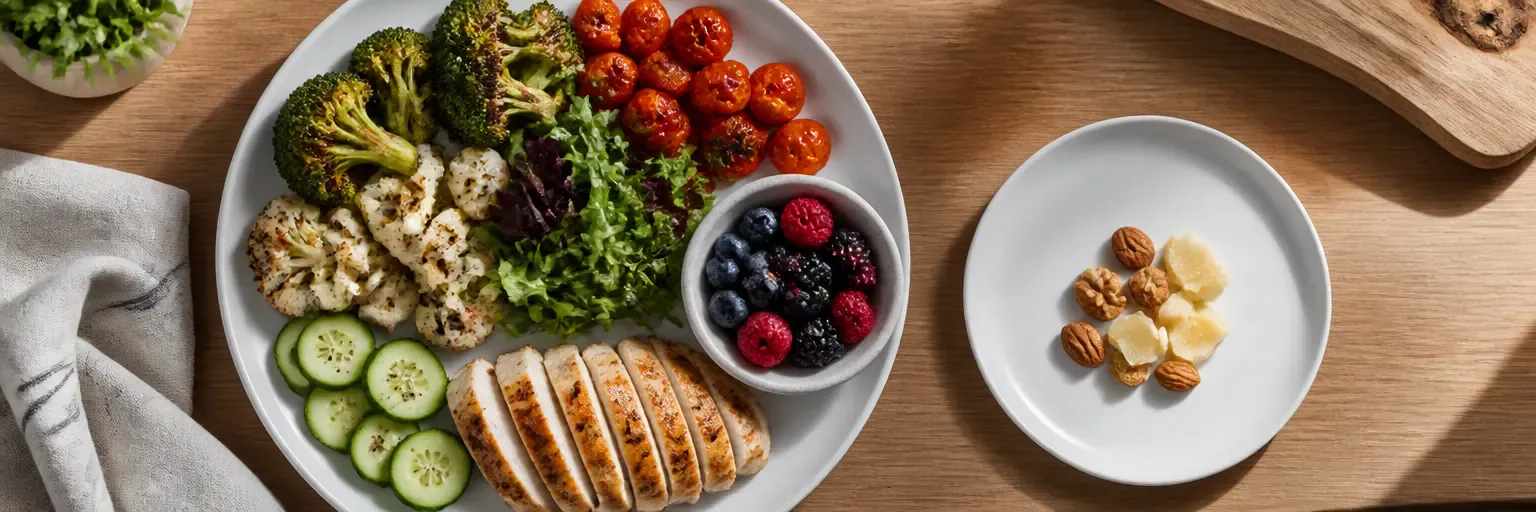
Build a “volume plate.” Aim for roughly half the plate non-starchy vegetables, a palm of lean protein, and a modest portion of whole grains or starch. This is the same template behind most balanced menus; our weight loss meal plan and the fixed-target 1,500 calorie meal plan both build meals this way. For ideas that bridge meals, our list of high-protein snacks for weight loss leans on the same high-volume, high-satiety principles, and our broader healthy snacking for weight loss guide covers when to snack, the calorie-budget math, and the evening playbook.
The honest limits of volume eating
Volume eating is a genuinely useful tool, but it is not magic, and a few caveats keep it honest.
It still has to produce a calorie deficit. Filling foods make a deficit easier to reach and sustain, but weight loss still comes down to eating less than you burn. High-volume foods help only if they replace higher-calorie ones rather than getting added on top.
“High-volume” is not “calorie-free.” Starchy carbs, legumes, and even lean proteins still carry real calories. And the things people add to vegetables, olive oil, cheese, creamy dressings, butter, can turn a low-calorie plate into a high-calorie one in seconds. A salad drowning in dressing can out-calorie a sandwich. Avocado is the classic counter-example inside a “healthy” plate — a nutrient-dense whole food that behaves like a fat source at ~240 kcal per medium Hass, so it belongs in a deficit as a measured half-fruit portion, not as a volume food you fill up on.
Protein and total nutrition still matter. A plate of plain steamed vegetables is high-volume but low in protein, and protein is what protects muscle and drives lasting fullness in a deficit. Volume eating works best layered on top of an adequate protein intake, not instead of it. See our protein intake for weight loss guide for targets.
Very high fiber, very fast, can cause discomfort. Ramping fiber up suddenly can cause bloating or gas. Increase vegetables, beans, and whole grains gradually, and drink enough water.
It is not the only lever. If hunger is still relentless despite a sensible deficit and high-volume meals, other factors like sleep, protein timing, and habits matter too. Some people also ask about supplements; our evidence-based look at appetite suppressant supplements covers what the research does and does not support there.
The bottom line: volume eating is one of the most effective, lowest-effort ways to make a calorie deficit feel survivable. Use it as your default meal-building strategy, keep an eye on the add-ons, and pair it with enough protein.
Frequently asked questions
What is volume eating? Volume eating is a strategy of building meals around foods that provide a large amount of food for very few calories, so you can eat a satisfying, filling plate while staying in a calorie deficit. It works by prioritizing low-energy-density foods like vegetables, fruit, broth-based soups, and lean proteins, which are high in water and fiber. The goal is not to eat as much as humanly possible, but to get more food, chewing, and stomach fullness per calorie so a deficit feels less like deprivation.
What foods keep you full on a diet? The most filling foods per calorie are non-starchy vegetables (greens, broccoli, peppers, zucchini), high-water fruits (berries, melon, oranges, apples), broth-based vegetable soups, lean proteins (chicken breast, white fish, egg whites, plain Greek yogurt), and legumes like beans and lentils. They are filling because they combine a high water content, plenty of fiber, and in the case of protein a strong effect on appetite hormones, all of which stretch the stomach and slow digestion for very few calories.
Do low-calorie foods help you lose weight? Low-calorie, high-volume foods help with weight loss by making it easier to eat fewer total calories without feeling starved, which improves how long you can stick to a deficit. In a year-long trial, people told to add water-rich foods lost more weight than those simply told to eat less fat. But the foods themselves do not burn fat or have magical properties. They only help if they replace higher-calorie foods and keep your overall intake below what you burn.
What is energy density and why does it matter for weight loss? Energy density is the number of calories in a given weight of food, usually measured as calories per gram. Foods high in water and fiber, like vegetables and broth-based soups, have a low energy density, so you get a large portion for few calories. Calorie-dense foods like oils, nuts, chips, and chocolate pack many calories into a small amount. Research shows people tend to eat a fairly consistent weight of food each day, so lowering the energy density of your meals lets you eat the same satisfying volume while taking in fewer calories.
Can you eat as much as you want of high-volume foods? Almost, but not quite. Non-starchy vegetables and most whole fruits are so low in calories that you can eat generous amounts without much concern. But high-volume does not mean calorie-free: starchy carbs, legumes, and even lean proteins still add up, and the oils, dressings, cheese, and sauces you add to vegetables can quietly turn a low-calorie plate into a high-calorie one. Volume eating works best as a way to feel full while staying in a deficit, not as a license to ignore total calories.
Sources
- Ello-Martin JA, Roe LS, Ledikwe JH, Beach AM, Rolls BJ. Dietary energy density in the treatment of obesity: a year-long trial comparing 2 weight-loss diets. American Journal of Clinical Nutrition (2007).
- Rolls BJ, Bell EA, Thorwart ML. Water incorporated into a food but not served with a food decreases energy intake in lean women. American Journal of Clinical Nutrition (1999).
- Flood JE, Rolls BJ. Soup preloads in a variety of forms reduce meal energy intake. Appetite (2007).
- Rolls BJ, Roe LS, Meengs JS. Salad and satiety: energy density and portion size of a first-course salad affect energy intake at lunch. Journal of the American Dietetic Association (2004).
- Howarth NC, Saltzman E, Roberts SB. Dietary fiber and weight regulation. Nutrition Reviews (2001).