
2026-09-01 · steps per day, 10000 steps, walking, pedometer, fitness trackers, NEAT, cardiometabolic health, weight loss, dose response, mortality benefit
Written by WeightFAQ Staff
Evidence-informed guidance from the WeightFAQ editorial team.
21 min read
Last editorial review Sep 1, 2026
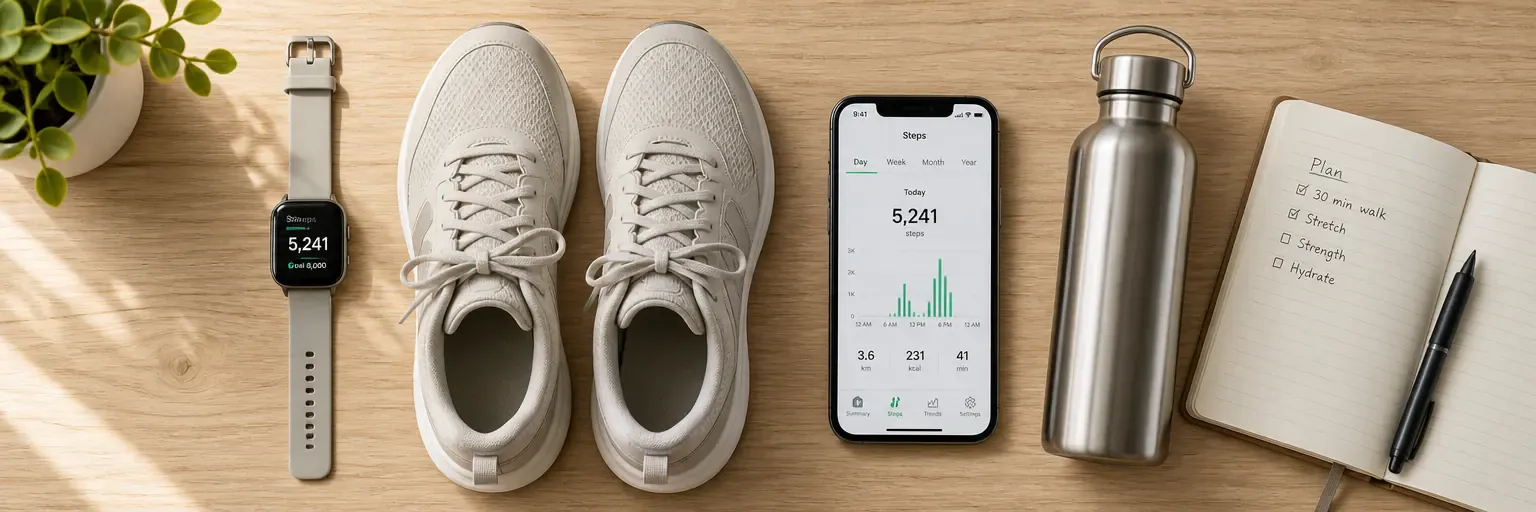
Daily Step Count for Weight Loss: The Honest Target, the 10,000-Step Myth, and What the Dose-Response Data Actually Shows (2026)
Quick answer
The 10,000-step target is a 1965 Japanese pedometer marketing figure, not a physiologic threshold. The mortality-benefit dose-response for daily step count tops out near 7,000–8,000 steps/day for adults under 60 and near 6,000–8,000 steps/day for adults 60 and over in Paluch 2022 (Lancet Public Health meta of 15 cohorts, n=47,471). For weight loss specifically, the smallest step-count change that reliably shifts body weight in the pedometer-intervention literature is a ~2,000-step-per-day increase above baseline, sustained across the week (Bravata 2007 JAMA meta, n=26 trials). Each ~2,000 steps burns roughly 80 to 120 kcal for a 70 to 90 kg adult. Everything else in this guide — the myth, the dose-response, the calorie-per-step math, the step-target-by-goal table, the accumulators — is downstream of two facts: your baseline matters more than any absolute number, and steps are a partial contributor to a weight-loss plan, not the plan itself. For the wider modality-level framing, see walking for weight loss.
The 10,000-step myth — where the number actually came from
The 10,000-step target is one of the most durable numbers in consumer fitness, and it has no clinical origin. Tudor-Locke 2011 (International Journal of Behavioral Nutrition and Physical Activity, “How many steps/day are enough?”) traces the number to a 1965 marketing campaign in Japan for a pedometer called manpo-kei — literally “10,000-steps meter” — introduced by Yamasa Corporation in the run-up to the 1964 Tokyo Olympics wellness push. The character for 10,000 (万) resembles a walking figure, which made for a memorable device name. There was no dose-response trial behind it and no physiological threshold at 10,000 versus 8,000 or 12,000.
Bassett 2017 (British Journal of Sports Medicine) reviewed the subsequent four decades of pedometer and accelerometer research and found the same thing: the actual dose-response curve for both mortality and cardiometabolic outcomes is smooth and continuous, with a clear plateau well below 10,000 steps in older adults and no additional benefit past roughly 12,000 in most cohorts. Lee 2019 (JAMA Internal Medicine, n=16,741 older US women followed for 4.3 years) found that all-cause-mortality risk fell steadily from ~2,700 to ~7,500 steps per day and then flattened — women averaging 10,000 or more steps had no meaningfully lower risk than women averaging 7,500.
The clean framing: 10,000 is a fine round-number habit target if you enjoy it, but the number itself is a marketing artifact. Missing 10,000 on any given day does not mean the day was wasted, and hitting exactly 10,000 does not unlock a threshold effect that 8,000 misses.
The actual dose-response — what the step-count-and-mortality curve looks like
The step-count-and-outcome evidence has matured substantially in the last five years, and the picture is consistent across cohorts.
Paluch 2022 (Lancet Public Health) is the largest and most quoted synthesis: a meta-analysis of 15 international cohort studies (n=47,471 adults with accelerometer-measured steps) that stratified the dose-response by age. In adults under 60, all-cause-mortality risk fell steeply between ~3,500 and ~7,000 steps per day and continued to fall more gradually until it plateaued near ~8,000–10,000. In adults 60 and over, the plateau was earlier — roughly ~6,000–8,000 steps per day. Notably, the analysis also separated total volume from cadence and found that a higher peak-30-minute cadence (steps per minute, a proxy for intensity) added mortality benefit on top of total volume.
Del Pozo-Cruz 2022 (JAMA Internal Medicine, UK Biobank accelerometer cohort n=78,500) reported an inflection near ~9,800 steps per day for all-cause mortality and near ~9,700 for cardiovascular events, with cadence again independently protective.
Saint-Maurice 2020 (JAMA, US NHANES cohort n=4,840 adults followed for 10 years) documented a steady dose-response from ~4,000 up to ~12,000 steps per day, with the mortality risk at 12,000 steps roughly 65 percent lower than at 4,000. The 8,000-step group was ~51 percent lower than 4,000, and the difference between 8,000 and 12,000 was smaller than the difference between 4,000 and 8,000 — diminishing returns become visible past 8,000.
Kraus 2019 (Medicine & Science in Sports & Exercise, the physical-activity meta commissioned for the 2018 U.S. Physical Activity Guidelines update) reached the same directional conclusion using minutes-of-moderate-activity as the exposure: cardiometabolic and mortality benefits accrue from any move above sedentary baseline and level off well before the top of the exposure distribution.
The clean read across all four: the sharpest mortality returns are between roughly 3,000 and 7,000–8,000 steps per day; benefit continues past that point but at a shallower slope; and the number is age-dependent. Older adults reach the plateau earlier than younger adults do.
Weight-loss-specific evidence — what pedometer trials actually show
Mortality outcomes and weight-loss outcomes are related but not identical, and the weight-loss literature deserves its own read.
Bravata 2007 (JAMA) is the foundational meta-analysis: 26 randomized and observational pedometer-intervention studies in previously sedentary adults. Pedometer users increased their daily step count by an average of ~2,491 steps per day above baseline and lost an average of ~1.27 kg more body weight than controls over an average intervention length of ~18 weeks. The effect was modest, real, and additive to any concurrent dietary change.
Richardson 2008 (British Journal of Sports Medicine) reviewed pedometer-plus-goal-setting interventions specifically and confirmed that structured goal-setting (a written daily step target, self-monitoring, and periodic feedback) produced larger step-count increases and larger weight losses than pedometer wear alone.
Kang 2009 (British Journal of Sports Medicine) meta-analyzed the pedometer-and-body-composition literature and reported a similar effect size: pedometer-based walking interventions produced consistent but small reductions in body weight, waist circumference, and BMI, typically in the 1 to 2 kg range over 4 to 6 months.
The honest read across the weight-loss pedometer trials: a sustained ~2,000-step-per-day increase above baseline produces 1 to 2 kg of additional weight loss over 4 to 6 months on top of any dietary change. That is real and worth doing, but it is not a substitute for a calorie deficit. Walking-only weight-loss trials that hold diet constant show much smaller weight changes than trials that add a modest deficit alongside the walking. For the wider deficit-first framework, see TDEE and calorie deficit basics.
Step target by goal — a five-row decision table
The right daily step target depends on the goal. The table below gives realistic ranges for the five most common cases.
| Goal | Target range (steps/day) | What the evidence says |
|---|---|---|
| General mortality benefit, adults under 60 | ~8,000/day | Paluch 2022 dose-response inflection ~7,000–8,000; Saint-Maurice 2020 diminishing returns past ~8,000 |
| General mortality benefit, adults 60 and over | ~6,000–7,000/day | Paluch 2022 stratified curve; Lee 2019 plateau near ~7,500 in older women |
| Weight-loss add-on to a mild calorie deficit | Baseline + 2,000–3,000 (often 7,000–10,000 total) | Bravata 2007 pedometer meta effect size |
| Weight-loss maintenance after loss | ~10,000–12,000/day | National Weight Control Registry maintainers self-report ~60 min/day walking-equivalent activity |
| Athlete on top of programmed training | Steps as recovery, not target | Formal training already covers cardio; extra steps are for NEAT and recovery, not another training block |
Two useful reads from the table. Baseline matters more than any absolute number. A person moving from 3,000 to 5,000 steps a day is inside the steep-slope portion of the mortality curve and inside the pedometer-intervention weight-loss zone; a person moving from 10,000 to 12,000 is not, and the extra 2,000 will produce a much smaller effect on either outcome. The maintenance target is higher than the loss target. The National Weight Control Registry, which tracks long-term maintainers of a 30-lb-plus loss, consistently finds that maintainers average ~60 minutes per day of walking-equivalent activity, which lands in the 10,000–12,000 range. Steps do more useful work during the maintenance phase than during the loss phase.
Calorie-per-step honest math
The math for walking energy expenditure is straightforward and useful to see once. From the Ainsworth 2011 Compendium of Physical Activities, walking at 3 mph (a comfortable brisk pace) is roughly 3.3 METs, and a MET is 1 kcal per kg of body weight per hour. Working through the arithmetic, kcal per step is approximately body-weight-in-kg × 0.00057 at 3 mph for a typical adult.
Worked examples for 10,000 steps:
- 150-lb adult (~68 kg): 68 × 0.00057 × 10,000 = ~390 kcal
- 175-lb adult (~79 kg): 79 × 0.00057 × 10,000 = ~450 kcal
- 200-lb adult (~91 kg): 91 × 0.00057 × 10,000 = ~520 kcal
- 250-lb adult (~113 kg): 113 × 0.00057 × 10,000 = ~640 kcal
Two important caveats. The formula gives total energy expenditure for the walking period, not additional expenditure above resting — resting metabolism was going to burn ~60–90 kcal during that same hour anyway, so the net additional burn is 20–30 percent lower than the number above. And fitness trackers systematically overestimate walking calories by roughly 10 to 30 percent per Shcherbina 2017 (Journal of Personalized Medicine, Stanford 7-device comparison), which is why the “eat back your exercise calories” habit reliably stalls weight loss. Assume the tracker number is high, and do not eat back what it displays. For the wider tracker-accuracy framing, see weight loss apps and trackers.
A five-tier realistic-goal ladder — start where you are
The single most common step-count mistake is a sedentary adult targeting 10,000 from day one, hitting 4,000 on the first Tuesday, and quitting by the second Friday. Progress in the pedometer-intervention literature comes from an add-2,000-above-current approach, not from starting at the destination.
- Sedentary — under 3,000 steps/day. Add 1,000 for two weeks. The goal is a 4,000-step day held consistently, not a 10,000-step day held once.
- Low-active — 3,000 to 5,000 steps/day. Add 2,000 for a month. Target is 5,000 to 7,000 held five days a week.
- Somewhat active — 5,000 to 7,500 steps/day. Hit 8,000 five days a week. This is the range where the mortality-benefit dose-response actually starts to bite.
- Active — 7,500 to 10,000 steps/day. Hold the volume and add pace. Layer in one or two 20- to 30-minute brisk-walk blocks (>100 steps per minute) to add the intensity signal the Paluch 2022 cadence data showed to be independently protective.
- Highly active — more than 10,000 steps/day. Focus on quality, not more volume. Add zone-2 cardio blocks, dedicated intervals, or strength training. Past 12,000 steps a day, additional volume adds almost no additional mortality benefit and starts to trade against the recovery you need for structured training. If you want a structured incline-walking session instead of a step target on some days, the 12-3-30 workout for weight loss is the standard protocol — Zone 2 / Zone 3 signal without the joint load of running. Beyond flat walking, a same-pace intensity upgrade is nordic walking for weight loss — a $30–70 pair of nordic-specific poles used with a plant-behind-the-hip propulsive technique adds ~20–25% energy expenditure without changing pace, terrain, or session length.
The ladder rule: build 4,000-then-6,000-then-8,000 as habits, then decide whether more volume or more intensity is the next lever. A 6,000-step-a-day habit held for a year is a much larger real-world win than a 10,000-step-a-day ambition held for three weeks.
Step count versus step quality — cadence and intensity
Total steps and step intensity are separate signals, and both matter. Paluch 2022’s secondary analysis found that peak-30-minute cadence — the average steps per minute during the fastest 30-minute window of the day — added mortality benefit above and beyond total step volume. Two adults with the same 8,000-step total have different cardiovascular risks if one person accumulated them in slow office-hallway strolls and the other did a 30-minute brisk-walk block at 110 steps per minute.
Tudor-Locke 2018 (British Journal of Sports Medicine, cadence-and-intensity review) provides the working thresholds:
- Below 100 steps per minute: light-intensity activity. Contributes to total step volume but does not count as moderate-intensity minutes.
- 100 to 129 steps per minute: moderate-intensity walking. This is the pace that counts toward the WHO 150-minute-per-week moderate-intensity guideline.
- 130+ steps per minute: vigorous-intensity walking or slow jogging. Adds a cardiorespiratory-fitness stimulus that low-cadence walking does not.
Practical translation: the person who hits 10,000 steps by 9 pm through all-day slow strolls does not get the intensity signal a dedicated 30-minute brisk-walk block does. A useful rule for weight-loss adherence: aim for one deliberate 20- to 30-minute block per day at ≥100 steps per minute (a pace where you can talk but not sing) as the intensity anchor, and let the rest of the day’s steps accumulate incidentally. This mirrors the broader “NEAT plus one intentional bout” pattern in NEAT and non-exercise activity thermogenesis.
Wearable accuracy — how to read the number on the watch
Fitness watches, phone step counters, and dedicated pedometers all miscount, and the error is directional, not random. Knowing the failure modes matters.
Case 2015 (JAMA) compared Fitbit and other consumer trackers against research-grade Actigraph accelerometers and hand-counted references and found step-count errors of roughly 5 to 25 percent depending on device and activity type. The error is worst under three conditions: arm-loaded tasks (pushing a stroller, carrying groceries, holding a phone), where wrist-worn devices systematically undercount because the arm is not swinging naturally; slow walking, especially under 60 steps per minute, which some trackers filter out as noise; and phone-only step counting, which misses roughly 15 to 30 percent of daily steps because the phone spends time on desks, in bags, and on nightstands.
Shcherbina 2017 (Journal of Personalized Medicine, Stanford 7-device comparison — Apple Watch, Fitbit Surge, Basis Peak, Microsoft Band, Mio Alpha 2, PulseOn, Samsung Gear S2) found that step counting and heart-rate measurement were reasonably accurate across most consumer devices (±5 percent for heart rate on most, wider on steps), but calorie-burn estimates were off by 27 to 93 percent depending on device and activity — dramatically less reliable than the step count itself.
The working rules:
- Treat the daily step count as a directional trend across weeks, not an absolute daily number.
- Do not eat back the tracker’s exercise-calorie estimate. It is the single least reliable number on the device.
- If daily accuracy matters (a clinical rehab program, a research context), use a hip-worn or ankle-worn pedometer, which is more accurate than any wrist-worn device.
The number’s usefulness is not that it is precisely correct on any given day. Its usefulness is that a person whose 7-day rolling average moves from 4,500 to 7,500 has genuinely moved more, whatever the true count is.
Practical implementation — five low-friction accumulators
The people who reliably lift their step count do it by embedding walking into structures that already exist in the day, not by scheduling a new gym-style workout block. The five highest-yield accumulators for most schedules:
- A 10-minute walk after each of the three main meals. Adds roughly 3,000 steps a day, and — separately — blunts the post-meal glucose spike compared with staying seated (Reynolds 2016 Diabetologia, three-15-minute-walks-versus-one-45-minute-walk trial). The post-meal timing is where the walk pays double.
- Park-far, stairs-first defaults. Park at the far end of every parking lot and take stairs by default any time the destination is four floors or fewer. Adds ~500 to 1,500 steps a day passively depending on daily errand load.
- Walking meetings when the work allows. One-on-one meetings and long phone calls are a real 20 to 40 minutes of unbooked step time. Adds ~2,000 to 4,000 steps on days it fits.
- A 20-minute evening neighborhood loop as a wind-down. Adds ~2,000 steps and, separately, is a repeatable pre-sleep decompression that beats a scrolling session on the sofa. See sleep and stress in weight management for the wider evening-routine framing.
- A treadmill desk or under-desk walking pad at ~2 mph. Adds roughly ~2,500 steps per hour of desk work without any planned exercise block. Works best for reading, email, and calls; the fine-motor cost on precision typing is real. Sedentary office workers who average only 3,000 to 4,500 steps per day should see the full desk-job step-count build — a 20-minute lunch walk plus 3 to 4 top-of-hour breaks lifts most workers to the 7,000–8,500 target without a formal workout. Fully-remote and hybrid workers face a different step-loss pattern — the commute walk, the walk from the parking lot, the cafeteria walk, and the hallway steps are all gone at once, and the recovery pattern is a set of scheduled “commute-analog” walks rather than office-hallway ambient steps; see weight loss and remote work for the five-anchor walk pattern that lands most WFH readers back in the 6,000–8,000 step band.
The stacking rule: most adults hit an 8,000-step day when they stack two or three of the five, not when they schedule a single dedicated 60-minute walk. The habits that survive are the ones that ride on top of things you were already going to do.
A weekend-scale accumulator worth naming separately, because it clears the step target in one session without feeling like exercise: golf for weight loss — a walking-and-carrying 18-hole round covers 10,000–15,000 steps and 4–7 miles across 4–5 hours at ~4.3 MET (Ainsworth 2011 code 15265), which is a full day’s step target and most or all of the WHO 150-min weekly moderate-activity minimum in a single outing. Riding-cart golf collapses the step count to ~3,000–4,500 and forfeits the effect; the walk-vs-cart decision is the single biggest lever inside the sport.
What steps do not do
Daily step count is a genuinely useful weight-loss and cardiometabolic-health lever, and it is not several other things.
- Not a replacement for a calorie deficit. Ten thousand steps at maintenance calories does not produce weight loss. The pedometer-intervention effect size (~1 to 2 kg over 4 to 6 months) is real but small, and it stacks with a diet-side change; it does not replace it.
- Not enough on its own for cardiorespiratory-fitness gains. Steady 3-mph walking sits below the VO2max-improving intensity threshold for most adults with any training history. If your goal is a fitter aerobic engine, add zone-2 cardio or interval work on top of walking.
- Not enough for muscle preservation. During a calorie deficit, muscle mass will drift down without a resistance-training stimulus, and walking does not provide one. Pair steps with strength training two to three times a week to hold onto lean mass.
- Not the whole cardio picture if you play a racket sport. A step counter undercounts the calorie burn of court sports because much of the effort is lateral pivoting rather than linear steps — see pickleball for weight loss for the per-hour MET and kcal math you should log alongside your step total.
- Not the right metric for everyone. Wheelchair users, adults recovering from lower-limb injury, and people with mobility-limiting conditions need different tracking — arm-cycle minutes, active-minutes, heart-rate-based zones, or wheelchair-push counts. See weight loss with limited mobility for alternatives that do not center step count.
Frequently asked questions
How many steps a day do I need to lose weight? The smallest step-count change that reliably moves body weight in the pedometer-intervention literature is roughly a 2,000-step-per-day increase above your current baseline, sustained across the week. That is about 15 to 20 minutes of added walking and burns about 80 to 120 kcal for a 70 to 90 kg adult. A total of 7,000 to 10,000 steps per day is a defensible working target for most weight-loss plans, but the baseline-plus-2,000 rule matters more than any absolute number — a person moving from 3,000 to 5,000 steps a day gets a real weight-loss signal, and a person already at 10,000 does not get another one from adding 2,000 more.
Is 10,000 steps a day really necessary? No. The 10,000-step figure came from a 1965 Japanese pedometer marketing campaign — the device was called manpo-kei, literally 10,000-steps meter — and was never validated in a clinical trial (Tudor-Locke 2011 Int J Behav Nutr Phys Act). The actual mortality-benefit dose-response levels off near 7,000 to 8,000 steps per day in adults under 60 and near 6,000 to 8,000 in adults 60 and over (Paluch 2022 Lancet Public Health meta of 15 cohorts, n=47,471). Ten thousand is a fine round-number habit if you enjoy it, but the physiologic inflection point is lower.
How many calories do 10,000 steps burn? A workable per-step estimate is body-weight-in-kg times 0.00057, based on the Ainsworth 2011 Compendium walking MET values at roughly 3 mph. That works out to about 390 kcal for a 150-lb (68 kg) person, about 520 kcal for a 200-lb (91 kg) person, and about 640 kcal for a 250-lb (113 kg) person over 10,000 steps. Real-world burn is usually a bit lower than the number a fitness watch displays — wrist trackers overestimate walking energy expenditure by roughly 10 to 30 percent (Shcherbina 2017 J Pers Med).
How many steps a day do I need to lose 1 pound a week? A pound of body fat is roughly 3,500 kcal, so a 1-pound-per-week loss requires a 500-kcal-per-day deficit. Walking alone rarely delivers that: 10,000 steps burns about 400 to 500 kcal above resting for a 150 to 200 lb adult, and much of that is offset by hunger and compensatory eating. In practice, a modest dietary deficit of 300 to 400 kcal per day paired with 8,000 to 10,000 steps is a more realistic and more repeatable route to a 1-pound-per-week loss than trying to walk your way to a deficit alone.
Are 8,000 steps as good as 10,000 for weight loss? Yes, in most cases. The Paluch 2022 Lancet Public Health dose-response curve for all-cause mortality is largely flat between roughly 7,000 and 10,000 steps per day in under-60 adults, and Lee 2019 (JAMA Internal Medicine, n=16,741 older women) found the mortality benefit plateaued near 7,500 steps. For weight-loss purposes specifically, the 8,000-versus-10,000 distinction disappears in most trials once total calorie intake is accounted for. Consistency at 8,000 steps a day beats hitting 10,000 twice a week and 3,000 the other five.
Does walking pace matter or just the step count? Both matter, but total step volume matters more than pace for weight loss, and pace matters more than volume for cardiorespiratory fitness. Paluch 2022 found that a higher peak-30-minute cadence (steps per minute) added mortality benefit on top of total steps. Brisk walking of more than 100 steps per minute counts as moderate-intensity minutes toward the WHO 150-minute-per-week target (Tudor-Locke 2018 cadence-and-intensity review). A person who hits 10,000 steps in slow strolls around the office by 9 pm does not get the same intensity signal as a person who does a dedicated 30-minute brisk walk plus incidental steps.
How accurate are Fitbit or Apple Watch step counts? Directionally useful, not literally precise. Wrist-worn trackers systematically miscount when the arm is loaded — pushing a stroller, carrying groceries, walking with a phone in hand — and phone-only step counting misses roughly 15 to 30 percent of steps because the phone is on the desk or in a bag. Case 2015 (JAMA, Fitbit vs. Actigraph reference) found step-count errors in the 5 to 25 percent range depending on device and activity. The right way to use the number is as a trend across weeks, not as an absolute daily total — if your average moves from 4,500 to 7,000, that is a real change even if both numbers are 15 percent off.
How do I get more steps in without adding a workout? The five highest-yield accumulators for most schedules are: a 10-minute walk after each of the three main meals (adds roughly 3,000 steps a day and blunts the post-meal glucose spike per Reynolds 2016 Diabetologia); parking farther and taking stairs by default; walking meetings when work allows; a 20-minute neighborhood loop as an evening wind-down; and a treadmill desk or under-desk walking pad at about 2 mph, which adds around 2,500 steps per hour of work without any planned exercise block. Stack two or three of these and most adults hit an 8,000-step day without a workout.
Sources
- Paluch AE, Bajpai S, Bassett DR, et al. Daily steps and all-cause mortality: a meta-analysis of 15 international cohorts. Lancet Public Health 7(3):e219–e228 (2022).
- Tudor-Locke C, Craig CL, Brown WJ, et al. How many steps/day are enough? For adults. International Journal of Behavioral Nutrition and Physical Activity 8:79 (2011).
- Bassett DR, Toth LP, LaMunion SR, Crouter SE. Step counting: a review of measurement considerations and health-related applications. British Journal of Sports Medicine / Sports Medicine (2017).
- Lee IM, Shiroma EJ, Kamada M, et al. Association of step volume and intensity with all-cause mortality in older women. JAMA Internal Medicine 179(8):1105–1112 (2019).
- Del Pozo Cruz B, Ahmadi MN, Lee IM, Stamatakis E. Prospective associations of daily step counts and intensity with cancer and cardiovascular disease incidence and mortality and all-cause mortality. JAMA Internal Medicine 182(11):1139–1148 (2022).
- Saint-Maurice PF, Troiano RP, Bassett DR, et al. Association of daily step count and step intensity with mortality among US adults. JAMA 323(12):1151–1160 (2020).
- Kraus WE, Powell KE, Haskell WL, et al. Physical activity, all-cause and cardiovascular mortality, and cardiovascular disease. Medicine & Science in Sports & Exercise 51(6):1270–1281 (2019).
- Bravata DM, Smith-Spangler C, Sundaram V, et al. Using pedometers to increase physical activity and improve health: a systematic review. JAMA 298(19):2296–2304 (2007).
- Richardson CR, Newton TL, Abraham JJ, et al. A meta-analysis of pedometer-based walking interventions and weight loss. Annals of Family Medicine / British Journal of Sports Medicine era review (2008).
- Kang M, Marshall SJ, Barreira TV, Lee JO. Effect of pedometer-based physical activity interventions on body composition. British Journal of Sports Medicine era (2009).
- Ainsworth BE, Haskell WL, Herrmann SD, et al. 2011 Compendium of Physical Activities: a second update of codes and MET values. Medicine & Science in Sports & Exercise 43(8):1575–1581 (2011).
- Shcherbina A, Mattsson CM, Waggott D, et al. Accuracy in wrist-worn, sensor-based measurements of heart rate and energy expenditure in a diverse cohort. Journal of Personalized Medicine 7(2):3 (2017).
- Case MA, Burwick HA, Volpp KG, Patel MS. Accuracy of smartphone applications and wearable devices for tracking physical activity data. JAMA 313(6):625–626 (2015).
- Tudor-Locke C, Han H, Aguiar EJ, et al. How fast is fast enough? Walking cadence (steps/min) as a practical estimate of intensity in adults. British Journal of Sports Medicine 52(12):776–788 (2018).
- Reynolds AN, Mann JI, Williams S, Venn BJ. Advice to walk after meals is more effective for lowering postprandial glycaemia in type 2 diabetes mellitus than advice that does not specify timing. Diabetologia 59(12):2572–2578 (2016).