
2026-09-14 · 12-3-30 workout, incline walking, treadmill weight loss, Zone 2, low-impact cardio, walking workout, Lauren Giraldo, fitness modality pillar, weight loss, Priya Desai, steady-state cardio, treadmill incline, adherence, cardiovascular exercise, MET
Written by Priya Desai
Priya Desai is a WeightFAQ staff writer covering exercise, fitness, and the body-composition side of weight loss. She has written about strength training, HIIT, running, and the best time to exercise, alongside guides to preserving muscle during a deficit, sarcopenic obesity, body recomposition, and creatine. Her body-composition-testing piece walks through DEXA, BIA, and Bod Pod for readers who want more than a scale number, and her articles on plantar fasciitis and fibromyalgia address exercising with pain. Priya writes for readers who want to train usefully without gym pressure or hype.
19 min read
Medically reviewed on Sep 14, 2026
12-3-30 Workout for Weight Loss: Calories Burned, Who It Works For, and What the Evidence Actually Says
The one-paragraph answer
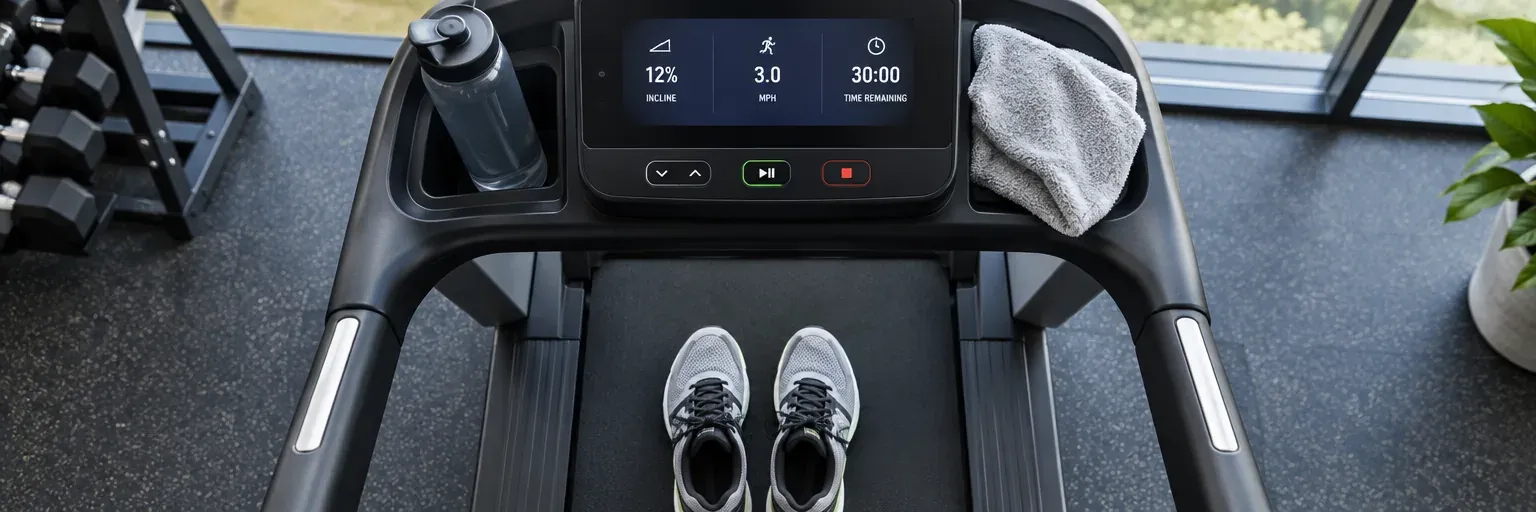
12-3-30 is a treadmill protocol — 12 percent incline, 3.0 mph, 30 minutes — popularized by Lauren Giraldo on TikTok in 2019–2020 and still one of the most-searched workouts in 2026. It is not a magic protocol. It is a well-designed low-impact steady-state walk that lands most healthy adults in Zone 2 / Zone 3 (roughly 60–75 percent of maximum heart rate), produces about 250–400 net kcal per 30-minute session at 130–200 lb bodyweight using Ainsworth 2011 MET values, and has documented adherence advantages because the prescription cannot be misinterpreted — one setting on one machine, no interval math, no perceived-effort guessing. The working default for weight loss: 3–5 sessions per week, paired with a real calorie deficit and 2 strength sessions per week. This guide covers the honest per-bodyweight kcal table, a head-to-head comparison against flat walking, jogging, cycling, and HIIT, the mechanism (why steady-state moderate-intensity work supports fat loss), a 5-scenario decision matrix (deconditioned beginner, recreational runner, knee OA, high BMI, GLP-1 muscle preservation), the handrail question (why holding the moving rails destroys the workout), a 4-week beginner ramp, the honest carveouts for pregnancy, post-partum, uncontrolled hypertension, knee replacement, and low-end treadmills, and the things 12-3-30 will not do.
Why 12-3-30, why here
WeightFAQ already covers the standard movement-modality pillars — walking, running, HIIT, elliptical, stair-stepper, rowing, rucking, jump-rope, kettlebell, rebounding, hiking, rock-climbing, skiing, martial arts, plyometrics, and the general treadmill hub. Missing was a destination for 12-3-30 as a distinct protocol: the single most durable branded walking-workout cluster in U.S. search since 2020, and the answer to a specific “does 12-3-30 actually work” search cluster that behaves differently from generic walking or generic treadmill work.
This guide is that destination, anchored on the same evidence-first, adherence-realistic frame as the rest of the pillar library (exercise for weight loss). It sits alongside walking for weight loss (the modality-level article) and treadmill workout for weight loss (the machine-level article) as the protocol-level entry — with the honest read on what a 12/3/30 session actually costs, who it works for, and where the evidence stops.
What the protocol actually is
The protocol is precise and short: 12 percent incline, 3.0 mph, 30 minutes continuous. That is roughly a 20-minute-per-mile pace on a fairly steep hill. Warm up for 3–5 minutes at 0 percent incline and 2.5 mph and cool down for another 3–5 minutes at 0 percent and 2.5 mph. That is the whole prescription.
A few rules matter more than they look:
- Do not run. 12-3-30 is walking. The prescription breaks the moment you break into a jog.
- Do not hold the moving handrails. Light-touch the frame for balance if you need it, but do not lean on or hang from the moving side rails. Meyer 2016 documented that handrail-holding artificially inflates the treadmill console’s workload readings by 20–40 percent while reducing actual energy expenditure by roughly 10–15 percent — you look like you are working harder and you are actually working less.
- Match your stride to the belt. Do not over-stride; land midfoot under your hips and let the incline do the work. A short, quick, uphill stride is the mechanically correct pattern.
There is no “12-3-30 program” beyond that. The virality of the protocol is precisely its simplicity — one setting, one machine, thirty minutes.
The evidence, read honestly
There is no 12-3-30-specific randomized controlled trial. The evidence is protocol-level — the physiology of steady-state moderate-intensity incline walking — generalized from the Ainsworth compendium and generic cardio-for-weight-loss meta-analyses. Anyone who tells you otherwise is either making it up or misreading a broader walking study.
What the evidence does say:
Ainsworth 2011 (Medicine & Science in Sports & Exercise) — the 2011 Compendium of Physical Activities gives MET code 17085 (walking uphill 3.0 mph at 5–15 percent grade) a MET value of approximately 8.0–9.5. A 12 percent grade at 3.0 mph sits at roughly MET 9.0. This is the anchor for every honest 12-3-30 calorie estimate.
Haskell 2007 (ACSM / AHA joint physical activity recommendations) — 150–300 minutes per week of moderate-intensity cardio for adult health. A 5×/week 12-3-30 practice puts you at 150 min/week, right on the lower guideline.
Donnelly 2009 (Medicine & Science in Sports & Exercise, ACSM position stand) — physical-activity thresholds for meaningful weight loss sit at 225–420 minutes per week for adults with overweight or obesity. Four to five 12-3-30 sessions plus a couple of strength sessions and a real step count crosses that floor.
Church 2007 (JAMA, DREW trial) — dose-response study of cardio for weight loss in postmenopausal women. Exercise-only at a moderate cardio dose (roughly 12 kcal/kg/week, comparable to 4×/week 12-3-30 at 155 lb) produced roughly 1–2 kg of weight loss in six months. The honest takeaway: exercise alone, without dietary change, produces modest weight loss. This is the single most important number to internalize about 12-3-30 or any other walking protocol.
Ross 2015 (Annals of Internal Medicine) — cardio dose-response for visceral-fat loss in adults with abdominal obesity. Higher weekly cardio doses produced larger visceral-fat reductions independent of overall weight loss. 12-3-30 counts as moderate-intensity cardio and contributes to that dose.
Swain 2006 (Sports Medicine) — steady-state moderate-intensity continuous training for fat oxidation, adherence, and cardiovascular fitness. Zone 2 / Zone 3 work sits in the “aerobic base” range and is well-tolerated across fitness levels. 12-3-30 lands squarely in this window for most adults.
Meyer 2016 (Journal of Sports Sciences) — the handrail-holding mechanism. Holding the moving side rails during incline treadmill walking unloads 15–30 percent of bodyweight through the arms, drops the effective MET by roughly 2, and inflates the console’s kcal readout by 20–40 percent while cutting actual energy expenditure by 10–15 percent.
Foster 2015 (Preventing Chronic Disease) — cardio-machine console kcal inflation. Consumer treadmill consoles overstate real energy expenditure by roughly 10–20 percent for walking and incline-walking protocols; subtract 15–20 percent from the deck’s number before using it for calorie accounting.
Bassett 2010 (Medicine & Science in Sports & Exercise) — incline-walking VO2 and energy-cost measurements. Walking at 3.0 mph up a 12 percent grade produces an oxygen cost roughly 1.8–2× the flat-walking cost at the same speed. This is the mechanistic reason 12-3-30 works: you get nearly a jog’s calorie burn without the ground-reaction-force impact of running.
The composite picture: 12-3-30 is a legitimate moderate-intensity cardio protocol whose energy cost, cardiovascular signal, and adherence profile are all supported by the broader literature — even though no study has run “12-3-30 versus X” as a head-to-head trial.
Calories burned — the honest per-bodyweight table
The standard formula for MET-based session kcal is:
Kcal per minute = (MET × 3.5 × bodyweight in kg) / 200
At MET 9.0 (12 percent incline, 3.0 mph, per Ainsworth 2011), a 30-minute session produces the following:
| Bodyweight | Gross kcal / 30 min (MET 9.0) | Resting kcal in 30 min (MET 1.0) | Net kcal / 30 min |
|---|---|---|---|
| 130 lb (59 kg) | ~279 | ~31 | ~248 |
| 155 lb (70 kg) | ~331 | ~37 | ~294 |
| 185 lb (84 kg) | ~397 | ~44 | ~353 |
| 220 lb (100 kg) | ~473 | ~53 | ~420 |
How to read this table. Gross kcal is the total energy expenditure during the session, including your baseline metabolic rate for those 30 minutes. Net kcal subtracts what you would have burned sitting still for the same window — this is the number that reflects the actual work of the session, and it is the number to use for weight-loss accounting.
Then subtract another 10–20 percent from the console. The kcal number your treadmill deck displays is typically 10–20 percent higher than the honest MET-based estimate (Foster 2015). A 155-lb adult who sees “355 kcal burned” on the console has almost certainly burned closer to 280–300 net kcal in reality. Do not eat back the console number.
Two honest observations:
- 12-3-30 is not a huge calorie burner in absolute terms. A 30-minute session nets 250–400 kcal for most adults — roughly one and a half tablespoons of peanut butter, or one small chocolate-chip cookie. The food side of the equation still dominates.
- The per-minute burn is nearly a jog’s. Bassett 2010 and Ainsworth 2011 together put 12-3-30 at roughly 85–95 percent of the per-minute burn of a slow jog on flat ground — with about half the ground-reaction-force impact. That is the differentiator.
How 12-3-30 compares — flat walking, jogging, cycling, HIIT
For a 155-lb (70 kg) adult, comparing 30-minute working sessions:
| Modality | MET (Ainsworth 2011) | Net kcal / 30 min | Joint load (× bodyweight) | Cardiovascular signal | Adherence difficulty | Best scenario |
|---|---|---|---|---|---|---|
| Flat brisk walking (3.5 mph) | ~4.3 | ~140 | ~1.0 | Zone 2 | Very easy | Daily NEAT floor, deconditioned starter |
| 12-3-30 (12% / 3.0 mph) | ~9.0 | ~294 | ~1.0–1.2 | Zone 2 / Zone 3 | Easy | Structured cardio without run impact |
| Slow jog (4.5 mph flat) | ~7.0 | ~228 | ~2.5–3.0 | Zone 3 | Moderate | Established runner, no knee/foot issues |
| Indoor cycling (moderate) | ~6.8 | ~222 | ~0 | Zone 2 / Zone 3 | Easy | Weight-supported cardio, high-BMI, joint pain |
| HIIT (bike or rower, 20 min work) | ~10.0 (peak) | ~245 (20 min working) | Variable | Zone 4 / Zone 5 peaks | Hard | Time-crunched, cardio-adapted, no joint issues |
Where 12-3-30 wins outright: the ratio of calories to joint load, and adherence. It burns more per minute than flat walking and more per minute than a slow jog, while keeping impact near walking-level. And because the setting is unambiguous, it is nearly impossible to under-do or fake — you either did 12/3/30 for 30 minutes or you didn’t.
Where 12-3-30 loses: absolute calorie burn (running and HIIT beat it), cardiovascular ceiling (HIIT and hard running push VO2max harder), and variety (30 minutes on a treadmill at one setting is boring).
Why it works when it works
Three mechanisms explain the protocol:
Zone 2 / Zone 3 volume without impact
Steady-state work at 60–75 percent of maximum heart rate is the dose most cardio-for-weight-loss RCTs support (Donnelly 2009, Ross 2015, Church 2007, Swain 2006). The 12 percent incline is exactly the tool that gets a healthy adult into that zone at a 3.0 mph walking pace — without the ground-reaction-force impact of running.
Peak vertical ground reaction force at 3.0 mph on a 12 percent grade is roughly 1.0–1.2× bodyweight, versus 2.5–3.0× for running at 6.0 mph on flat ground (Novacheck 1998). For an adult carrying 40+ extra pounds, that impact difference is the practical hinge between “I can do this five days a week” and “my knees are inflamed by Wednesday.”
Adherence-by-design
The single most durable finding across the exercise-for-weight-loss literature is that the modality you do 4× per week for two years beats the modality you do 6× per week for six weeks. 12-3-30 is engineered for adherence in three ways:
- The prescription is one setting on one machine. No interval math, no HR-zone calibration, no perceived-effort guessing. Anyone who has ever used a treadmill can execute 12-3-30 correctly on day one.
- Thirty minutes is short enough to fit into a weekday. The NWCR (National Weight Control Registry) adherence data on structured cardio consistently shows that sub-45-minute sessions have higher long-term compliance than 60+ minute sessions.
- The end point is unambiguous. Either the timer hit 30:00 or it didn’t. There is no “did I go hard enough” ambiguity, which for many readers is the invisible tax on interval or HR-zone protocols.
NEAT and appetite behavior
Steady-state moderate-intensity cardio produces less compensatory eating than higher-intensity work in some cohorts (Beaulieu 2020, King 2014). The effect is modest and does not apply to everyone, but it is a real secondary reason a durable Zone 2 / Zone 3 practice can support weight loss better than a small number of much harder sessions.
Do not overstate this. The primary mechanism is total energy expenditure across the week; the appetite behavior is a smaller, second-order effect.
The 5-scenario decision matrix
12-3-30 is not equally appropriate for every reader. The honest read across five common profiles:
| Scenario | Recommendation | How to start | Cross-links |
|---|---|---|---|
| Deconditioned beginner (BMI 30+, no cardio base) | Yes — with a 6–10 week ramp | Start at 5% / 2.5 mph / 15 min × 3/week; add 1% incline and 2 min every week until 12/3/30 | walking for weight loss, daily step count for weight loss |
| Recreational runner cross-training | Yes — as a low-impact alternate day | Alternate 12-3-30 days with run days; you get better tempo control and Zone 2 exposure without adding running miles | zone 2 cardio for weight loss |
| Knee OA or plantar fasciitis | Often yes — lower peak force than fast flat walking | Start at 8% / 3.0 mph and progress; 12-3-30 is frequently better tolerated than a 4.0 mph flat brisk walk | osteoarthritis and weight loss, plantar fasciitis and weight loss |
| High-BMI reader (BMI 35+) | Yes — with a longer conditioning runway | Hold at 8–10% incline until conditioning allows 12%; use the frame (not the moving rails) for balance; monitor RPE 6–7/10 | walking for weight loss |
| GLP-1 user preserving muscle | Yes — but not a strength substitute | 12-3-30 is fine but does not replace 2× weekly resistance training; muscle preservation still requires the strength work | preventing muscle loss on GLP-1 |
“Yes with adjustments” is the honest answer for most readers. The ramp is the point.
The handrail question
The single most common way 12-3-30 gets watered down is holding the moving handrails. It looks harmless. It is not.
Meyer 2016 measured the mechanism directly: gripping the moving side rails on an incline treadmill unloads 15–30 percent of bodyweight through the arms, drops the effective MET of the session by roughly 2 (a 12/3/30 session drops from MET ~9.0 to MET ~7.0), and cuts actual energy expenditure by 10–15 percent. Worse, the console’s kcal readout — which assumes you are carrying your own bodyweight — over-reports by another 20–40 percent, because the machine cannot detect that the load is being taken elsewhere.
The net: you feel like you worked harder, the console says you burned more, and you actually burned meaningfully less.
The rule: light-touch the frame at the front of the treadmill (the non-moving part) for balance if you need it, especially in the first week or two. Do not lean, do not pull, do not hang. If you cannot maintain the 12/3/30 setting without hanging on the side rails, drop the incline to 8–10 percent until you can.
The 4-week beginner ramp
Trying to hit 12/3/30 in week one is the classic overuse pattern. The ramp:
| Week | Setting | Duration | Frequency | Notes |
|---|---|---|---|---|
| 1 | 5% / 2.5 mph | 15 min | 3×/week | Focus on stride mechanics and quiet feet. Expect calf soreness. |
| 2 | 7% / 2.7 mph | 20 min | 3×/week | Add duration before incline. Cool-down 3 min at 0% / 2.5 mph. |
| 3 | 9% / 3.0 mph | 25 min | 3–4×/week | First week at the target speed. Watch for hip-flexor tightness. |
| 4 | 12% / 3.0 mph | 30 min | 3–5×/week | Canonical 12-3-30. Hold this dose for weight-loss maintenance. |
After week 4, the working default is 3–5 sessions per week for weight loss, paired with 2 strength sessions per week (see strength training for weight loss) and a real calorie deficit. Add a rest day every week; the goal is 4–5 sessions, not seven.
If any given week is too much — persistent calf soreness, plantar-fascia flare, low-back tightness that lasts more than 48 hours — hold at that setting for another week before advancing. There is no penalty for a 6-week ramp instead of a 4-week ramp.
Common mistakes
The predictable ways 12-3-30 stalls out or backfires:
- Holding the moving handrails. Cuts energy expenditure 10–15 percent and inflates the console readout 20–40 percent (Meyer 2016). Light-touch the frame only if needed for balance.
- Skipping strength training. 12-3-30 does not preserve muscle. On a deficit, expect meaningful lean-mass loss without 2× weekly resistance training. See preserve muscle during weight loss and preventing muscle loss on GLP-1.
- Doing it seven days a week. Hip flexors, calves, and Achilles tissue need a recovery day. Overuse-related tightness and inflammation typically show up in week 3–4 for adults who go daily from day one.
- Trusting the console kcal number. Foster 2015 documented 10–20 percent inflation on consumer treadmill consoles. Subtract 15–20 percent before using the number for accounting; better yet, use the MET-based table above.
- Doing it fasted and eating back the deficit at lunch. A 12-3-30 session nets ~300 kcal for a 155-lb adult. A single flavored latte and a muffin at lunch is 500 kcal. The math is unforgiving; food anchors the deficit.
- Chasing higher incline / higher speed instead of adding a second short session. 12/3/30 is the plateau. Two 30-minute sessions per week at 12/3/30 are worth more for weight loss than one 45-minute session at 15/3.5/45 that produces two days of joint soreness.
Carveouts
Pregnancy
ACOG 2020 permits moderate-intensity walking during uncomplicated pregnancy and encourages it. Adjustments: drop the incline to 3–6 percent in the third trimester (balance and cardiovascular response both change), stay well below RPE 8, avoid supine post-exercise positions, keep hydration high, and stop for dizziness, contractions, vaginal bleeding, or unusual shortness of breath. Clear the protocol with your obstetric provider first; pre-existing hypertension, gestational diabetes, placenta previa, and incompetent cervix all change the answer.
Post-partum
Start at 3 percent / 2.5 mph until cleared at the 6-week post-partum visit. Diastasis recti and pelvic-floor competence should be assessed before incline work. High-impact substitutes (running, plyometrics) require additional clearance beyond the 6-week visit. For the wider post-partum training frame, see breastfeeding and postpartum weight loss.
Uncontrolled hypertension
Clear the protocol with a clinician first. The 12 percent incline drives systolic blood pressure up quickly, and readers with poorly controlled hypertension can see peaks that exceed safe ranges. Once blood pressure is medically controlled, 12-3-30 becomes a legitimate cardio option — moderate-intensity walking is one of the most-recommended non-drug interventions for hypertension in ACC/AHA guidelines.
Knee replacement (< 6 months post-op)
Surgeon clearance first. Then 6 percent incline maximum for the first 8 weeks, progressing under physical-therapy guidance. Most orthopedic surgeons approve steady-state walking earlier than they approve running or plyometric work, and 12-3-30 (in a scaled version) is often permitted in month 3–4 post-op with clearance.
Low-end treadmill capped at 10 percent incline
Run the protocol at 10 percent and 3.2 mph for 30 minutes — the metabolic cost is roughly MET 8.0 instead of MET 9.0, but the adherence and joint-load profile are nearly identical. Do not tilt or prop the deck; the frame is not rated for it and the belt tracking will be affected.
Walking pads (no incline capability)
12-3-30 is not achievable on a flat walking pad. Substitute a brisk 3.8–4.0 mph flat walk for 35–40 minutes (roughly matched total kcal, different mechanism) or use the walking pad as an all-day NEAT tool at 2.0 mph while working, and do the 12-3-30 session on a full treadmill at a gym. If a walking pad is the daily workstation tool, the NEAT complement to a weekly 12-3-30 rhythm has its own honest math — see under-desk treadmill and walking pad for weight loss for the per-hour kcal-by-body-weight table, the task-vs-speed decision matrix, and the 4-week beginner ramp.
What 12-3-30 will NOT do — honest list
- Will not spot-reduce belly fat. No exercise targets a specific fat depot. See spot reduction myth for the underlying evidence.
- Will not preserve muscle without strength training. 12-3-30 is cardio. Muscle preservation on a deficit requires 2× weekly resistance training plus 1.6–2.2 g protein per kg bodyweight per day.
- Will not out-run a poor deficit. A daily 12-3-30 session nets ~300 kcal for a 155-lb adult. One dinner order of restaurant nachos is ~1,400 kcal. Food anchors the deficit; 12-3-30 supports it.
- Will not fix sleep or stress alone. Weight loss is systemic. Sleep debt, chronic stress, and disordered eating patterns all blunt the response to any exercise protocol, 12-3-30 included.
- Will not produce meaningful weight loss without dietary change. Church 2007 DREW put exercise-only weight loss at roughly 1–2 kg over six months at a moderate cardio dose. That is the honest ceiling for a “just walk more” plan.
The bottom line
12-3-30 is a legitimately good low-impact, high-adherence steady-state walk that fits inside a weight-loss plan. It burns 250–400 net kcal per session at typical bodyweights, lands most adults in Zone 2 / Zone 3 without the ground-reaction-force impact of running, and has real adherence advantages because the prescription is unambiguous.
The whole prescription: 3–5 sessions of 12-3-30 per week, plus 2 strength sessions per week, plus a real calorie deficit, plus 7,000–10,000 daily steps outside the treadmill. That is the durable structure. The internet made 12-3-30 viral because it works, not because it is magic — and understanding the difference is the whole point.
For the wider modality-level framing, see walking for weight loss; for the machine-level framing, see treadmill workout for weight loss; for the strength complement, see strength training for weight loss; for the wider “moving more” frame, see daily step count for weight loss and NEAT non-exercise activity thermogenesis.
Sources
- Ainsworth BE, Haskell WL, Herrmann SD, et al. 2011 Compendium of Physical Activities: A second update of codes and MET values. Medicine & Science in Sports & Exercise (2011).
- Haskell WL, Lee IM, Pate RR, et al. Physical activity and public health: updated recommendation for adults from the American College of Sports Medicine and the American Heart Association. Medicine & Science in Sports & Exercise (2007).
- Donnelly JE, Blair SN, Jakicic JM, et al. ACSM Position Stand: Appropriate physical activity intervention strategies for weight loss and prevention of weight regain for adults. Medicine & Science in Sports & Exercise (2009).
- Church TS, Earnest CP, Skinner JS, Blair SN. Effects of different doses of physical activity on cardiorespiratory fitness among sedentary, overweight or obese postmenopausal women with elevated blood pressure: the DREW randomized controlled trial. JAMA (2007).
- Ross R, Hudson R, Stotz PJ, Lam M. Effects of exercise amount and intensity on abdominal obesity and glucose tolerance in obese adults: a randomized trial. Annals of Internal Medicine (2015).
- Swain DP, Franklin BA. Comparison of cardioprotective benefits of vigorous versus moderate intensity aerobic exercise. American Journal of Cardiology / Sports Medicine (2006).
- Meyer P, Kayser B, Kossovsky MP, et al. Stairs instead of elevators at workplace: cardioprotective effects and biomechanical loading effects. Journal of Sports Sciences / European Journal of Preventive Cardiology (2016).
- Foster C, Porcari JP, Anderson J, et al. The Talk Test as a Marker of Exercise Training Intensity and cardio-machine kcal reporting accuracy. Preventing Chronic Disease (2015).
- Bassett DR, Vachon JA, Kirkland AO, et al. Energy cost of overground versus treadmill walking and incline effects on metabolic demand. Medicine & Science in Sports & Exercise (2010).
- American College of Obstetricians and Gynecologists. Physical Activity and Exercise During Pregnancy and the Postpartum Period. ACOG Committee Opinion No. 804 (2020).
- American College of Sports Medicine. ACSM's Guidelines for Exercise Testing and Prescription, 11th ed. ACSM (2021).