
2026-08-24 · limited mobility, chair exercises, seated cardio, accessibility, osteoarthritis, back pain, post-stroke, deconditioning, weight loss
Written by WeightFAQ Staff
Evidence-informed guidance from the WeightFAQ editorial team.
16 min read
Last editorial review Aug 24, 2026
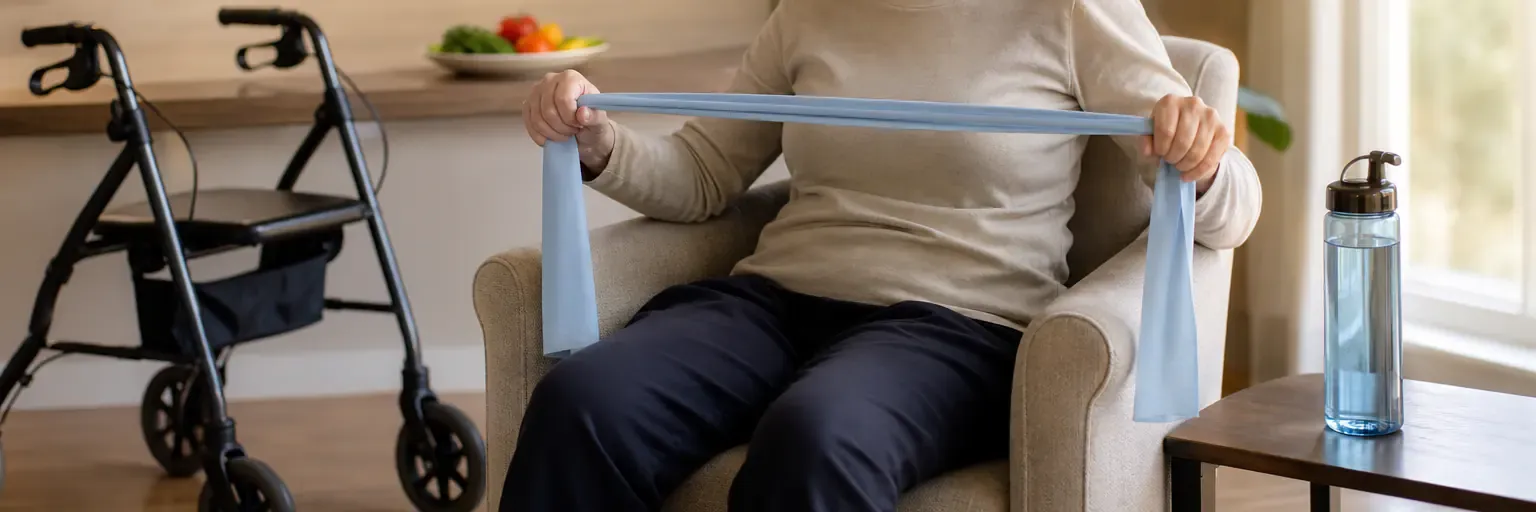
Weight Loss with Limited Mobility: Chair Cardio, Seated Strength, and Nutrition First
Quick stats
- Calorie deficit for ~1 lb/week loss: ~500 kcal/day (regardless of exercise)
- Diet-only weight loss at 6 months: ~10% body weight on average (Miller 1997)
- Joint offloading in chest-deep water: ~70% of body weight (aquatic therapy)
- Protein target during weight loss: ~1.6 g/kg body weight per day
- US adults over 50 with chronic pain or mobility limitation: ~30% (CDC 2024)
- Typical GLP-1 weight loss without prescribed exercise: 15–22% at 68–72 weeks
The one-sentence answer
Weight loss with limited mobility follows the same math as it does for anyone else — a sustained calorie deficit — but with the nutrition column doing roughly 80 percent of the work and the exercise column shifting from walking-and-running progressions to seated cardio, resistance bands, aquatic therapy, and non-exercise activity thermogenesis (NEAT) accumulation. Start with how many calories to lose weight and TDEE and calorie deficit for beginners for the numeric baseline, then use the sections below to build the movement side around what your body can actually do today.
Why this guide exists
Standard weight-loss advice — “walk 10,000 steps a day,” “do HIIT three times a week,” “get to the gym” — assumes a body that can walk unaided, stand for 30 or more minutes at a time, and load its joints with impact. For an estimated 30 percent of US adults over the age of 50 who live with chronic pain or a mobility limitation (CDC 2024), that advice is not just unhelpful — it can actively worsen the underlying condition.
This guide is for readers with any of the following:
- knee or hip osteoarthritis
- chronic low back pain
- fibromyalgia
- post-stroke motor deficit
- post-bariatric-surgery recovery
- severe deconditioning at BMI ≥ 40
- congestive heart failure (Class II–III)
- plantar fasciitis or heel pain that flares with weight-bearing
- knee or hip replacement recovery
- balance or fall-risk limitations that make standing exercise unsafe
The condition-specific pillars — knee osteoarthritis and weight loss, back pain and weight loss, fibromyalgia and weight loss, plantar fasciitis and weight loss, and stroke and weight loss — cover the why of each condition’s link to body weight. This guide covers the how when standard exercise programs are off the table.
Nutrition is the primary lever
When exercise options shrink, nutrition has to do more of the work. The good news is that nutrition can carry most of a weight-loss program on its own — the exercise column is nice-to-have for muscle preservation and cardiovascular health, but it is not the main driver of the pounds coming off.
The math still works
A 500 kcal per day deficit produces roughly 1 pound per week of weight loss, regardless of whether that deficit comes from eating less, moving more, or both. For most sedentary adults, cutting 500 kcal from daily intake is easier and more reliable than trying to burn 500 kcal through exercise — and it does not depend on joint tolerance. Full breakdown in how many calories to lose weight.
Diet-only weight loss is real weight loss
Miller 1997’s meta-analysis in the International Journal of Obesity pooled 493 studies of adult weight loss and found that diet-only interventions produced about a 10 percent body-weight loss at 6 months on average — the same range as diet-plus-exercise arms in most trials. Exercise mattered for maintenance and body composition, not for how much came off in the first six months.
Protein target: 1.6 g/kg body weight
Preserving lean mass in a deficit is more important when exercise is limited, not less — because you have less stimulus for muscle protein synthesis. The target is about 1.6 g of protein per kg body weight per day, spread across 3 to 4 meals of 25 to 40 g each. Full protocol in protein intake for weight loss and how to preserve muscle during weight loss.
Portion control and calorie density do not require mobility
Two of the most reliable diet strategies work entirely from a seated position: portion control (measuring, plating in advance, and using smaller dishes) and calorie density (choosing foods that fill you up per calorie — vegetables, lean protein, broth-based soups, fruit). See portion control for weight loss and low-calorie high-volume foods for the full playbooks.
Seated cardio — the 20-minute protocol
Seated cardio raises heart rate and burns calories without standing, walking, or loading painful joints. The evidence base is anchored in ACSM 2018 guidelines on exercise in special populations and the SilverSneakers program used by roughly 15 million US Medicare beneficiaries.
Target intensity: 100 to 120 beats per minute, rate of perceived exertion (RPE) 4 to 5 on a 10-point scale, 3 to 5 sessions per week.
The 4-exercise seated cardio menu
| Exercise | Duration | Notes |
|---|---|---|
| Seated marching in place (arms and legs together) | 3 sets × 5 min | No equipment; use armrests for balance |
| Seated shadow-boxing / seated punches | 3 sets × 2 min | 1–2 lb hand weights optional; alternate jabs and crosses |
| Arm-cycle ergometer (UBE / Cybex / Life Fitness) | 20 min continuous | Home units ~$150–$400; gym or clinic units common |
| Chair “dance” or cardio class (SilverSneakers YouTube) | 20–30 min | Free on YouTube; guided instruction |
If you can only manage 5 to 10 minutes at first, do 5 to 10 minutes. Volume builds fast — most adults double their tolerance within 4 to 6 weeks. Stop and rest if you feel chest pain, sudden shortness of breath, or dizziness, and see a clinician before restarting.
Once seated cardio tolerance is well established (typically month 3–4 for adults who started deconditioned), an accessible next step for readers whose lower-body impact tolerance is still limited is battle ropes for weight loss — a standing-braced, upper-body-driven modality with ground reaction force close to normal standing (~1.0–1.2 body weight) and a measured 10.3 MET intensity (Fountaine 2015). Skip it if shoulder or elbow pathology is present, and see the contraindications section of that guide first.
Seated strength — resistance bands and light dumbbells
Resistance work preserves muscle in a calorie deficit even when you cannot load standing exercises. Villareal 2011 (NEJM) tested diet-plus-resistance vs. diet-alone in adults aged 65 and older with obesity and found the resistance-training arm preserved significantly more lean mass and had better functional outcomes at 12 months — even though total weight loss was the same.
The 8-exercise seated protocol
Perform 2 sets of 10 reps at RPE 6/10, 2 to 3 sessions per week. Use a light-to-medium resistance band, plus 2 to 8 lb dumbbells for the pressing and curl movements.
- Seated shoulder press — press dumbbells or band handles overhead from shoulder height
- Seated row — band anchored under seat cushion, pull handles toward ribs
- Seated chest press — band behind back, press handles forward at chest height
- Seated bicep curl — dumbbells or band, curl to shoulder
- Seated tricep extension — dumbbell or band overhead, extend elbows
- Seated leg extension — straighten one knee against band or light ankle weight
- Seated calf raise — feet flat, raise heels off floor, hold 2 seconds
- Seated knee-tuck (core) — hands on armrests, pull knees toward chest, control down
For a fuller strength framework once you have baseline tolerance, see strength training for weight loss.
Aquatic therapy — the highest-leverage mobility tool
Warm-water aquatic therapy is one of the single best tools available for adults with weight-related mobility limitations, and it is chronically underused because most patients do not know it is often covered by insurance.
Why water works
In a therapy pool heated to 94 to 98 °F, buoyancy offloads roughly:
- 50 percent of body weight at waist depth
- 70 percent of body weight at chest depth
- 90 percent of body weight at neck depth
That means a 30 to 45 minute pool session at RPE 5/10 produces calorie burn comparable to brisk walking on land — without the joint load that would flare knee osteoarthritis, back pain, or plantar fasciitis. The warmth reduces muscle guarding and pain-related inhibition, so you can often move through a fuller range than on land.
The evidence
Bartels 2016’s Cochrane systematic review pooled aquatic-therapy trials for knee and hip osteoarthritis and found consistent, clinically meaningful improvements in pain and function with 30 to 45 minute sessions performed 2 to 3 times per week over 8 to 12 weeks.
Coverage — the piece most patients miss
Medicare Part B covers medically necessary aquatic therapy with a written prescription from a physical therapist or physiatrist, typically for 8 to 20 sessions per year, at outpatient PT clinics with a therapy pool. Commercial insurance varies — many plans cover it identically to land-based PT, but a subset require prior authorization. Ask your primary-care clinician for a referral; if you have Medicare Advantage, call the plan directly to confirm in-network aquatic-therapy providers. Once a formal PT course ends and you want to continue in the water on your own, community-pool aqua aerobics classes — many covered zero out-of-pocket through Silver Sneakers — are the standard graduation path. For readers with lake or protected-bay access whose joint limitation rules out running but not standing balance, stand-up paddleboarding for weight loss is another rare high-kcal, near-zero-impact modality — 5–8 MET at conversational touring pace with ground reaction force at essentially the standing-balance baseline, appropriate for knee or hip osteoarthritis once acute pain is controlled and clinician-cleared. For readers who cannot manage standing balance on a paddleboard but can sit comfortably in a low-backed seat, kayaking for weight loss is the seated equivalent — a 3–7 MET seated water paddle modality with zero ground reaction force on the knees and feet, upper-body-and-core dominant, and available on rental at most public lakes and coastal parks for $20–$50/hour.
NEAT — the underappreciated lever
Non-exercise activity thermogenesis (NEAT) is everything you burn that is not sleeping, eating, or formal exercise: standing, fidgeting, cooking, folding laundry, walking to the mailbox, hand and arm movements while seated. Levine 2005 (Arteriosclerosis, Thrombosis, and Vascular Biology) documented that NEAT accounts for 15 to 50 percent of daily energy expenditure — a range wider than most macronutrient variables and one that shifts with intentional effort. Full protocol in NEAT and non-exercise activity thermogenesis.
Concrete NEAT wins for limited-mobility adults
- Stand or fidget while folding laundry instead of sitting
- Walk to the mailbox or door rather than having someone bring things in
- Prepare meals standing at the counter rather than seated at the table
- Move to the couch, then to the kitchen, then back — mini-transfers count
- Seated leg swings, ankle circles, and shoulder rolls during TV time
- Stand for 2 minutes every commercial break or every 30 minutes if streaming
The concrete target is an extra 30 minutes of standing or fidgeting activity per day, which produces roughly 100 extra kcal/day in most adults. Compounded across a year at maintenance intake, that is about 10 lb of weight loss on its own — before any formal exercise or dietary change.
Once you are past chair-cardio-only and can tolerate a longer, low-intensity outdoor walk, a durable adherence-first modality worth naming is golf for weight loss — a walking-and-carrying (or push-cart) 18-hole round is ~4.3 MET across 4–5 hours and 10,000–15,000 steps, covers most or all of WHO’s 150-min weekly moderate-activity minimum in one session, and carries Farahmand 2009’s ~5-year longevity signal from a 300,818-golfer Swedish cohort. It is not a rapid-deficit strategy, but it is one of the few individual sports 25M US adults already play into their 70s and 80s.
Medication considerations
Many adults with limited mobility are on medications that quietly affect body weight, and those effects can neutralize an honest 500 kcal per day deficit. Do not stop a medication on your own — but do have a medication-review conversation with your prescriber if the scale will not move despite consistent tracking.
Common categories to review:
- Antidepressants — mirtazapine, paroxetine, and long-term SSRIs are associated with weight gain of 3 to 15 lb per year; bupropion is the usual weight-neutral alternative. See antidepressants and weight changes.
- Antipsychotics — olanzapine, quetiapine, and risperidone drive substantial weight gain; aripiprazole and lurasidone are relatively weight-neutral. See antipsychotics and weight changes.
- Corticosteroids — prednisone and equivalents drive fluid retention and appetite; look for the lowest effective dose and shortest duration. See corticosteroids and weight gain.
- Beta-blockers — propranolol and metoprolol modestly reduce resting metabolic rate; carvedilol and nebivolol are typically more weight-neutral options. See beta-blockers and weight.
- Insulin and sulfonylureas — both drive weight gain in type 2 diabetes; GLP-1 and SGLT2 alternatives usually do not.
- Gabapentin and pregabalin — commonly used for neuropathic pain and fibromyalgia; both are associated with modest weight gain.
Anchor: medication weight effects can undo a 500 kcal per day deficit — if the scale will not move despite honest tracking, review your medication list with your prescriber before assuming the problem is your effort.
When GLP-1s and bariatric surgery enter the conversation
For adults with a BMI of 30 or more (or 27 with a weight-related comorbidity) and a mobility limitation, GLP-1 medications and bariatric surgery are legitimate first-line options — and the case for them is arguably stronger when standard exercise is not accessible, not weaker.
GLP-1 medications
Semaglutide (Wegovy) and tirzepatide (Zepbound) produce large, durable weight losses without requiring an exercise prescription. The SURMOUNT-1 trial (Jastreboff 2022, NEJM) of tirzepatide achieved 15 to 22 percent body-weight loss at 72 weeks on diet-only lifestyle advice — no walking targets, no gym program, no formal training. The STEP program for semaglutide showed similar magnitude (14 to 17 percent) on the same design.
Weight-related joint pain, back pain, sleep apnea, and deconditioning typically improve as weight comes off, which often makes exercise more accessible after 6 to 12 months of treatment than it was at baseline. See Wegovy weight loss and Zepbound weight loss for detailed protocols, cost, and coverage.
Bariatric surgery
For adults with BMI ≥ 40 (or ≥ 35 with a weight-related comorbidity), bariatric surgery — sleeve gastrectomy or gastric bypass — produces 25 to 35 percent body-weight loss at 1 year with minimal exercise prescription. Courcoulas 2023 (JAMA) documented durable outcomes at 12-year follow-up. See bariatric surgery overview for eligibility, procedure types, and recovery.
Anchor: if standard exercise is not accessible, medical weight management is more justified, not less.
A realistic 12-week starter plan
This is the simplest plan that fits the evidence and works for most adults with limited mobility. Adjust downward if any single week’s targets are aggravating pain, and upward if a week feels comfortably manageable.
Weeks 1–2: baseline
- Log all food for 7 days without changing intake — use a free app or paper log
- Set a 500 kcal per day deficit from your logged baseline
- Add seated marching 10 minutes per day, most days
- Buy a light resistance band (
$10) and a set of 2 to 5 lb dumbbells ($20)
Weeks 3–4: add strength and protein
- Add the seated resistance-band routine 2 times per week
- Hit the 1.6 g/kg protein target at 3 meals per day
- Extend seated cardio to 15 minutes per day
Weeks 5–8: add aquatic therapy and volume
- Book an aquatic-therapy referral if not already done — begin 2 sessions per week if accessible
- Extend seated cardio to 20 minutes per session, 3 to 5 sessions per week
- Add 30 minutes of intentional NEAT per day (standing, fidgeting, cooking upright)
Weeks 9–12: assess and consider next steps
- Weigh in on a consistent schedule (same day, same time, weekly average)
- If loss is ≥ 5 percent of starting weight: stay the course; you are on a durable trajectory
- If loss is < 3 percent despite honest tracking: book a prescriber conversation on GLP-1 eligibility, medication review, and bariatric-surgery referral criteria
- Re-scope the plan for weeks 13–24 based on what has actually been sustainable
Two practical signs the program is working before the scale moves: clothes fit differently around the waist, and you can sustain 5 more minutes of seated cardio than you could in week 1.
Weight Loss with Limited Mobility FAQ
Can I lose weight without exercising at all? Yes. A 500 kcal per day deficit produces about 1 lb per week regardless of exercise. Miller 1997’s meta-analysis showed diet-only weight loss averages ~10 percent at 6 months. Exercise adds muscle preservation and cardiovascular benefit, not most of the pounds.
What are the best chair exercises for weight loss? Seated marching, seated shadow-boxing with light weights, chair-dance videos (SilverSneakers YouTube is free), and arm-cycle ergometer sessions. Target 100–120 bpm at RPE 4–5/10, 3–5 sessions per week, paired with a seated resistance-band strength program 2–3 times per week.
Does aquatic therapy actually burn calories? Yes — comparable to brisk walking on land, without joint load. Warm-water pools offload 50–90% of body weight depending on depth. Bartels 2016 Cochrane review showed consistent pain and function benefit at 30–45 minutes 2–3 times per week. Medicare covers it with a PT prescription.
I’m on antidepressants and my weight won’t move — what should I do? Book a medication review — mirtazapine, paroxetine, and long-term SSRIs commonly drive 3–15 lb per year of weight gain. Do not stop on your own. Bupropion is the usual weight-neutral alternative when clinically appropriate.
Should I get a GLP-1 medication if I can’t exercise? For adults with BMI ≥ 30 (or 27 with a comorbidity), yes — arguably it is a stronger case, not weaker. SURMOUNT-1 achieved 15–22% weight loss at 72 weeks on diet-only advice with no exercise prescription.
How much weight can I realistically lose in 12 weeks with limited mobility? About 12–15 lb (roughly 1 lb per week) on a well-executed 500 kcal per day deficit — 5–8% of body weight for a 200 lb adult, above the clinically meaningful 5% threshold.
What if my mobility limit is joint-specific, not full-body — can I play a modified racket sport? Sometimes yes, and it often works better than a general “just walk more” prescription because the sport is social and scheduled. Doubles pickleball (see pickleball for weight loss — smaller court, lighter paddle, ~4.1-MET recreational-doubles kcal math) is the lower-impact starting point; tennis hitting sessions and full doubles (see tennis for weight loss — 5.5-MET hitting practice, 5.0-MET recreational doubles, per Ainsworth 2011) work for players with an existing skill base and stable knees, hips, and Achilles. Both need surgeon or PT clearance if the mobility limit is post-surgical, and both require dedicated court shoes (never running shoes) plus 2 short strength sessions per week focused on the calves, glutes, and posterior shoulder.
Is walking with a walker or cane enough exercise? It counts and it helps, but it usually is not the whole program. Assistive-device walking under-loads the arms and can under-load the legs. Pair it with 2–3 seated resistance-band sessions per week.
What protein target should I aim for if I’m not moving much? About 1.6 g per kg body weight per day — the same target as any adult in a deficit, and arguably more important when exercise stimulus is low. For a 165 lb adult, that is ~120 g per day across 3–4 meals.
Sources
- Miller WC, Koceja DM, Hamilton EJ. A meta-analysis of the past 25 years of weight loss research using diet, exercise or diet plus exercise intervention. International Journal of Obesity (1997).
- Villareal DT, Chode S, Parimi N, Sinacore DR, Hilton T, Armamento-Villareal R, et al. Weight loss, exercise, or both and physical function in obese older adults. New England Journal of Medicine (2011).
- Bartels EM, Juhl CB, Christensen R, Hagen KB, Danneskiold-Samsøe B, Dagfinrud H, Lund H. Aquatic exercise for the treatment of knee and hip osteoarthritis. Cochrane Database of Systematic Reviews (2016).
- Levine JA, Vander Weg MW, Hill JO, Klesges RC. Non-exercise activity thermogenesis: the crouching tiger hidden dragon of societal weight gain. Arteriosclerosis, Thrombosis, and Vascular Biology (2005).
- American College of Sports Medicine. ACSM's Guidelines for Exercise Testing and Prescription — special populations and seated exercise recommendations. ACSM (2018 edition).
- Rikard SM, Strahan AE, Schmit KM, Guy GP Jr. Chronic pain among adults — United States, 2019–2021. MMWR / CDC (2023–2024 updates).
- Jastreboff AM, Aronne LJ, Ahmad NN, Wharton S, Connery L, Alves B, et al. Tirzepatide once weekly for the treatment of obesity (SURMOUNT-1). New England Journal of Medicine (2022).
- Courcoulas AP, King WC, Belle SH, Berk P, Flum DR, Garcia L, et al. Long-term outcomes of bariatric surgery: the LABS-2 12-year follow-up. JAMA (2023).