
2026-09-09 · hemp seeds, hemp hearts, complete plant protein, healthy fats, ALA omega-3, GLA, single-food pillar, weight loss
Written by Maya Patel
Maya Patel is a WeightFAQ staff writer covering sustainable weight loss through mindful eating, flexible routines, and evidence-based nutrition. She translates research on protein, fiber, portion control, and calorie awareness into practical meal-planning guidance readers can actually follow at home. Her articles favor honest expectations over fad promises — small changes that compound, calorie bands scaled to real households, and grocery lists built around whole foods with room for real life. Maya writes for people juggling family meals, busy weeks, and long-term goals, not gym-optimized single adults with unlimited prep time.
28 min read
Medically reviewed on Sep 9, 2026
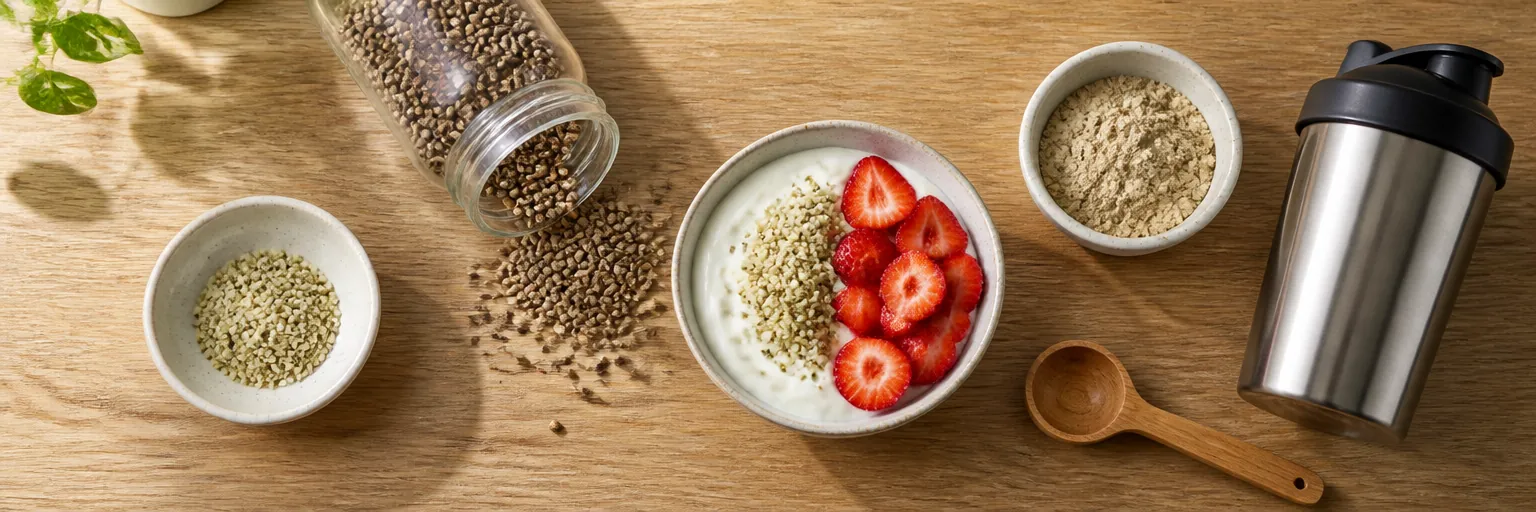
Hemp Seeds for Weight Loss: Hemp Hearts vs Chia vs Flax, How Much Per Day, and What the Evidence Actually Says (2026)
Quick answer
Three tablespoons of hulled hemp hearts — about 30 g — carry roughly 166 kcal, ~9.5 g of complete plant protein (all nine essential amino acids), ~14.6 g of fat (of which ~9.3 g is polyunsaturated, including ~2.6 g of alpha-linolenic acid omega-3 and ~5.3 g of linoleic acid, a favorable ~3:1 LA-to-ALA ratio), ~2.6 g of carbohydrate of which ~1.2 g is fiber, ~210 mg of magnesium (~50 percent of the daily target), and ~495 mg of potassium per USDA FoodData Central. That protein density — roughly 32 percent protein by weight — is the single highest of any commonly-eaten culinary seed, and the amino-acid profile is complete: Callaway 2004 (Euphytica) established that hempseed protein contains all nine essential amino acids in usable ratios, with a PDCAAS around 0.63 for hulled hearts and 0.49 to 0.53 for whole seeds. The honest read on weight loss is direct: hemp does not burn fat, and there is no large-N whole-hempseed weight-loss RCT — but hemp hearts are one of the highest-quality plant proteins in a grocery cart, and at 2 to 3 tablespoons per day (20 to 30 g) they support satiety and lean-mass preservation inside a real calorie deficit without a meaningful calorie penalty. Unlike flax, hulled hemp hearts do not need to be ground — the soft hull is fully digestible. Hemp belongs alongside beans, tofu, and Greek yogurt in a plant-forward protein intake for weight loss framework and in the plant-source omega-3 group inside healthy fats for weight loss — with the same ALA-to-EPA conversion caveat that applies to chia seeds and flaxseeds.
What is actually in a hemp seed
Hemp (Cannabis sativa L., non-drug industrial varieties) is a small, oval, cream-and-green-colored seed from the same plant genus as marijuana but a fully separate cultivar bred for food, fiber, and oil rather than THC. The commercial food-grade product sold as “hemp hearts,” “hulled hemp seeds,” or “shelled hemp” is the inner seed with the hard outer shell mechanically removed. Nutritionally it behaves like a concentrated plant-protein-and-fat source with a modest carbohydrate contribution and a mineral profile that punches above its weight.
USDA FoodData Central puts hulled hemp hearts at roughly 553 kcal per 100 g — a 1 oz (28 g) serving is ~155 kcal, with ~9 g of protein, ~13.7 g of total fat (of which ~2.4 g is ALA omega-3 and ~4.9 g is linoleic acid), ~2.5 g of carbohydrate of which ~1.2 g is dietary fiber, ~197 mg of magnesium, and ~462 mg of potassium. A more practical 1 tablespoon of hulled hemp hearts is ~10 g and ~55 kcal, with ~3.2 g of protein, ~4.9 g of fat (~0.9 g ALA and ~1.8 g LA), and ~0.9 g of carbohydrate of which ~0.4 g is fiber.
Three features make hemp nutritionally distinctive:
- Complete plant protein with all nine essential amino acids. Callaway 2004 (Euphytica) is the anchor reference: hempseed protein is roughly two-thirds edestin (a globulin) and one-third albumin, both of which are highly digestible and carry a balanced amino-acid profile. Hulled hearts score a PDCAAS (Protein Digestibility-Corrected Amino Acid Score) around 0.63 — meaningfully lower than whey (~1.00) or soy isolate (~1.00) but higher than most other whole plant proteins, and complete in the sense that it does not need to be combined with rice or another cereal to hit the essential-amino-acid targets. Farinon 2020 (Foods) and Weber 2020 (Foods) both confirm the profile in modern digestibility panels, with Weber showing hemp protein digestibility comparable to pea and better than most cereal grains.
- Favorable polyunsaturated-fat ratio. Hempseed carries roughly a 3-to-1 linoleic-acid-to-alpha-linolenic-acid ratio — favorable relative to a typical Western diet that runs 15:1 or higher — plus a small amount of gamma-linolenic acid (GLA), the anti-inflammatory omega-6 more commonly associated with evening primrose oil. Rodriguez-Leyva 2010 (Nutrition & Metabolism) reviews the mechanism: the ALA-plus-GLA-plus-LA combination is the reason hemp oil shows up in the cardiovascular-mechanism literature more often than the whole-food literature.
- Highest magnesium density among culinary seeds. At ~210 mg per 30 g portion (about half the daily target), hemp hearts are one of the most magnesium-dense whole foods in a grocery cart — a nutrient that co-travels with muscle relaxation, sleep quality, and glycemic control, and one that many adults on weight-loss plans under-hit as they cut out processed foods.
The fiber load, on the other hand, is not a headline for hemp. At ~1.2 g per 30 g / ~0.5 g per tablespoon, hemp is a low-fiber food compared to chia (~2.5 g/tbsp) or ground flax (~2 g/tbsp). That is worth stating directly: hemp is a protein food, not a fiber food. The satiety mechanism is protein-driven and fat-driven, not fiber-driven.
One tablespoon is ~10 g, and 2 to 3 tablespoons is the daily portion to keep in your head, because the single most common tracking mistake with hemp is the “handful on the salad” — a heaped scoop tossed onto a grain bowl is often 25 to 40 g rather than 10 g. Weigh once on a $12 kitchen scale and your future tablespoon estimates will be far closer. For the wider weigh-versus-estimate playbook, see how to count calories.
The satiety and body-composition evidence — read honestly
The hemp literature is smaller than the almond, oat, chia, or flax literature and, importantly, there is no large-N randomized controlled trial of whole hemp seeds against a matched placebo showing an independent weight-loss effect. That gap matters and does not get flagged enough in food-blog coverage. The story is a high-quality plant protein at a working portion, not a proven weight-loss ingredient.
Callaway 2004 (Euphytica) is the anchor protein-completeness paper. It established the amino-acid profile of hempseed protein — all nine essential amino acids present, edestin-plus-albumin composition, PDCAAS ~0.63 for hulled hearts and ~0.49 to 0.53 for whole seeds — and framed hemp as one of the few plant sources that meets the “complete protein” definition without needing to be paired with a cereal grain. This is the paper the site’s protein-density claim rests on.
Weber 2020 (Foods) compared hemp protein digestibility against pea, soy, and wheat isolates in a modern digestibility panel. Hemp scored comparable to pea and better than wheat gluten across most amino acids; the modest limiting amino acid is lysine, which is easily topped up with any legume in the same day. Practical read: hemp protein is a real complete protein, and the “incomplete plant protein” objection does not apply.
Farinon 2020 (Foods) reviewed hempseed nutritional composition and the effect of hulling on digestibility. The finding that matters for a consumer: hulled hearts have meaningfully higher protein digestibility than whole seeds because the tough outer hull is removed, and the culinary product sold as “hemp hearts” or “shelled hemp seeds” is the higher-bioavailability form.
Rodriguez-Leyva 2010 (Nutrition & Metabolism) is the mechanistic review of hempseed oil in cardiovascular health — walking through the LA + ALA + GLA combination and its effect on lipid profiles and inflammatory markers. This is a mechanism paper, not a weight-loss trial.
Schwab 2006 (European Journal of Clinical Nutrition) ran a randomized crossover comparing hempseed oil to flaxseed oil over 4 weeks for effects on plasma lipids in mildly hypercholesterolemic adults. Both oils modestly moved lipid parameters; hempseed oil did not produce a lipid superiority over flax. Weight was not the primary endpoint and did not shift meaningfully.
Kaul 2008 (Journal of the American College of Nutrition) ran a 12-week crossover of hempseed oil versus flaxseed oil in healthy adults. Both oils shifted plasma fatty-acid composition in expected directions; neither drove significant differences in body weight or cardiometabolic markers over the trial. Again, a safety-and-lipid paper, not a weight-loss paper.
Prociuk 2008 (Canadian Journal of Physiology and Pharmacology) is a hempseed-oil-in-hypertensive-rats mechanism study. It is not a human weight-loss trial and does not translate directly, but it appears in almost every hemp-oil review and is worth flagging as mechanism-not-outcome.
Cerino 2021 (Current Research in Food Science) is a modern review of hempseed nutritional profile and bioactive compounds — a good single-source summary of the amino-acid, fatty-acid, and mineral picture — again a review, not a weight-loss trial.
The honest read: hemp does not burn fat, and no whole-hempseed weight-loss RCT has been run at the scale that flax and chia have been tested at. What hemp does bring is a highest-density complete plant protein at a working portion — a satiety-and-lean-mass tool inside a plant-based or mixed-diet deficit, not a weight-loss ingredient per se. A person who adds 2 to 3 tablespoons of hemp hearts to yogurt or oatmeal and expects the scale to move without other changes will be disappointed. See why am I not losing weight for the wider “healthy food, no deficit” failure mode.
Hemp hearts vs hemp protein powder vs hempseed oil — a decision table
Hemp shows up in three common food-form products, and each one has a different portion, calorie load, and use case. Confusing them is the single most common practical mistake — a reader who buys “hemp powder” expecting the hemp-hearts profile is buying the wrong product, and someone drizzling hemp oil expecting the fiber-plus-protein of hearts is also going to be disappointed.
| Product | Portion (1 serving) | Kcal | Protein (g) | ALA (g) | LA (g) | Fiber (g) | Best use | Most common tracking mistake |
|---|---|---|---|---|---|---|---|---|
| Hulled hemp hearts | 1 tbsp / ~10 g | ~55 | ~3.2 | ~0.9 | ~1.8 | ~0.5 | Yogurt, oatmeal, smoothies, salads, avocado toast, pesto, hummus, savory bowls; the default culinary product | Handful-on-salad estimation — a heaped scoop is often 25 to 40 g, not 10 g |
| Hemp protein powder (~50 to 60% protein) | 1 scoop / ~25 g | ~110 | ~15 | ~0.4 | ~0.8 | ~4 | Shakes, smoothies, oat pancakes; plant-only diets or GLP-1 users chasing a protein target | Substituting for hemp hearts one-to-one in recipes — the fat and calorie profile is entirely different |
| Hempseed oil (cold-pressed, refrigerated) | 1 tbsp / ~14 g | ~125 | 0 | ~2.5 | ~7.7 | 0 | Salad dressings, drizzle finishes on cooked foods, ALA-and-LA supplementation for adults who already meet protein and fiber targets | Cooking with it — hempseed oil oxidizes above ~330°F; use as a finishing oil only |
The practical takeaway: hulled hemp hearts are the default for weight loss. Hemp protein powder is a targeted supplement for plant-only diets or specific protein-target situations, not a substitute for the whole-food heart product. Hempseed oil is a niche finishing-oil, not a substitute for the fiber-and-protein payload of the hearts.
Hemp vs chia vs flax — the top comparison query
All three seeds are net-good weight-loss foods, and none of them burn fat. The differences are real but small; the honest deciding factor is what the seed is for in your plate.
| Seed | Kcal (1 tbsp) | Protein (g) | Fiber (g) | ALA (g) | LA:ALA ratio | Lignan content | Grind required? | Best use |
|---|---|---|---|---|---|---|---|---|
| Hulled hemp hearts | ~55 (~10 g) | ~3.2 (complete, all 9 EAA) | ~0.5 | ~0.9 | ~2:1 | None | No — hulled hearts are digested whole | Yogurt, oatmeal, salads, savory bowls, pesto; highest protein density, complete amino-acid profile |
| Chia (black or white) | ~50 (~7 g) | ~1.7 | ~2.5 | ~1.6 | ~0.35:1 | Negligible | No — soft coat, digested whole | Chia pudding, chia water, jam, gel-forming applications; widest format range |
| Ground flaxseed | ~37 (~7 g) | ~1.3 | ~2.0 | ~1.6 | ~0.28:1 | High (55 to 85 mg SDG / tbsp) | Yes — whole flax passes through undigested (Kajla 2015) | Oatmeal, yogurt, smoothies, baking, flax-egg replacer; cheapest ALA per dollar and the lignan story |
Decision rule: rotate two of the three. Hemp is the highest-protein seed and the one that anchors a savory bowl or a plant-based satiety plate. Chia is the gel-forming, pudding, chia-water option. Flax is the cheapest ALA source, carries the lignan story, and works as an egg replacer in baking. Add pumpkin seeds for weight loss as the fourth seed when magnesium and zinc coverage is the goal — pepitas are the highest-magnesium common seed after hemp and one of the top plant-food zinc sources, with a savory-crunch format that pairs well with soups and salads where the mucilage of chia and flax would not fit. There is no need to pick a single seed. For the wider seed-and-nut placement, see the fats-and-satiety framing in healthy fats for weight loss, the chia-vs-flax detail inside chia seeds for weight loss, and the flax deep dive inside flaxseeds for weight loss.
Hemp protein powder — where it fits
Hemp protein powder is a defatted, milled hempseed cake concentrated to roughly 50 to 60 percent protein by weight, sold in tubs of ~500 to 1000 g. Common brands include Manitoba Harvest, Nutiva, Bob’s Red Mill, and NOW Foods; store-brand versions are fine and typically cheaper. It is not the same product as hemp hearts and does not sub 1:1 in recipes.
Nutritional profile per 1 scoop (~25 g): ~110 kcal, ~15 g protein, ~3 g total fat (of which ~0.4 g ALA and ~0.8 g LA), ~7 g carbohydrate of which ~4 g is fiber. PDCAAS around 0.63 — meaningfully lower than whey (~1.00) or pea isolate (~0.89), but complete in essential amino acids and better than most cereal proteins. Weber 2020 confirms the practical digestibility comparison.
When hemp protein powder makes sense:
- Plant-only diets where hitting a 100 to 130 g daily protein target from whole foods alone is genuinely difficult. Two scoops per day (~30 g protein) can plug a real gap for a vegan reader on a weight-loss plan without adding much fat or calories.
- GLP-1 users (semaglutide, tirzepatide) whose reduced appetite makes it hard to eat enough animal protein and who prefer a plant option. One scoop into a small smoothie is a low-volume way to add 15 g of protein at ~110 kcal.
- Post-workout adjunct for readers who already use a plant protein shake and want a hemp option instead of or rotating with pea or soy.
When hemp protein powder does not make sense:
- If you eat animal products and hit protein easily, a hemp powder is a solution in search of a problem — whey is cheaper per gram of protein and has a higher PDCAAS.
- As a substitute for hemp hearts in a yogurt bowl or oatmeal — the fat and calorie profile is entirely different, the flavor is meaningfully grassier, and the mouthfeel is chalky.
- For a “detox” claim. There is no detox mechanism. It is just a protein powder.
For the wider protein-powder framework, see weight loss shakes and protein intake for weight loss.
Hempseed oil — the niche
Hempseed oil is a cold-pressed oil extracted from the seed with the hull-and-protein residue left behind. It is a separate product with a separate use case, and it is not a substitute for hemp hearts or hemp protein.
Nutritional profile per 1 tablespoon (~14 g): ~125 kcal, ~14 g total fat of which ~2.5 g is ALA omega-3, ~7.7 g is linoleic acid, and ~0.5 g is gamma-linolenic acid. No fiber, no protein, essentially no lignan or mineral load — the LA + ALA + GLA fatty-acid profile is the whole story. Rodriguez-Leyva 2010 is the mechanistic reference; Schwab 2006 and Kaul 2008 are the head-to-head comparisons with flax oil.
Storage and cooking rules for hempseed oil:
- Cold storage after opening. Hempseed oil oxidizes similarly to flax oil — buy small bottles (~250 to 500 ml), refrigerate after opening, and use within 8 to 12 weeks. A rancid bottle smells like old paint or fish oil.
- Never heat above ~330°F. Hempseed oil is not a searing or frying oil. Use it as a finishing drizzle on already-cooked foods, in salad dressings, or blended into smoothies off-heat. Sustained high heat oxidizes the ALA and turns the oil from healthy fat into oxidized lipid.
- Watch the calorie load. One tablespoon is ~125 kcal — comparable to olive oil. It is not a “free” health add.
When hempseed oil makes sense: when you already hit a protein target from other sources and specifically want a plant-source ALA + LA + GLA add without the calorie contribution of a whole nut or seed. For most weight-loss readers, hemp hearts at 2 to 3 tablespoons per day deliver the same fatty-acid profile plus complete protein in a similar or lower calorie load.
Recipes that survive real kitchens
Beyond the standalone yogurt-and-oatmeal sprinkle, hemp hearts show up reliably in five specific patterns that fit inside a deficit.
- 2 tbsp hemp hearts stirred into 1 cup nonfat Greek yogurt with berries. ~230 kcal snack or breakfast, ~23 g protein, ~2 g fiber, ~1.7 g ALA. The yogurt is the primary protein anchor; the hemp adds ~6 g of complete plant protein and the polyunsaturated-fat profile in one move. See high protein breakfast ideas for the wider yogurt template.
- 2 tbsp hemp hearts on ½ cup low-fat cottage cheese with sliced peaches. ~230 kcal, ~20 g protein, ~2 g fiber. A savory-leaning snack that lands well below the “sneaky calorie” range of nut-butter-and-cracker combos and hits the protein target harder than most fruit snacks.
- 2 tbsp hemp hearts in a bowl of oatmeal. Standard oat portion (½ cup dry oats + 1 cup water or milk) is ~150 kcal with ~5 g protein and ~4 g fiber; adding 2 tbsp hemp hearts pushes it to ~260 kcal with ~11 g protein, ~5 g fiber, and ~1.7 g ALA. A near-free upgrade to a standard breakfast.
- 1 tbsp hemp hearts blended into a fruit-and-protein smoothie. Adds ~55 kcal and ~3 g of complete protein to a ~350 kcal smoothie, plus the fatty-acid profile. See weight loss smoothies for the wider smoothie framework.
- Hemp-and-basil pesto (2 tbsp hemp hearts + ½ cup basil + 1 tbsp olive oil + lemon + garlic, blended). A dairy-free, nut-free pesto swap that carries ~120 kcal per 2-tbsp serving with ~5 g protein — useful as a pasta-sauce or grain-bowl finishing sauce. Also works as a hummus add-in for a protein bump.
A note on savory versus sweet: hemp hearts have a mildly nutty, almost pine-nut-like flavor that plays well with olive oil, lemon, garlic, and herbs. That means hemp works in a wider range of savory dishes than chia or flax — it is a legitimate topping for salads, grain bowls, roasted vegetables, and avocado toast, not just a smoothie or yogurt add-in.
Failure modes — where hemp goes wrong
Hemp is safe for most adults inside a normal culinary range, and it has five specific failure modes worth naming.
- Confusing hemp hearts, hemp protein powder, and hempseed oil. The single most common practical mistake. Each product has a different portion size, calorie load, and use case; buying “hemp powder” expecting the whole-food heart profile is a category error. Read the label and match the product to the plate.
- Expecting a fiber effect at 0.5 g per tablespoon. Hemp is a protein food, not a fiber food. If you want the fiber-driven satiety of chia or flax, add one of those alongside the hemp — do not expect the hearts to do the fiber work.
- TikTok “hemp water” and “hemp detox” claims. There is no metabolic magic; hemp does not detox the body (the liver and kidneys handle that), and stirring hemp powder into water does not produce a weight-loss effect. Aitken 2020 also frames the workplace-drug-test claim more soberly than internet coverage does — culinary doses do not typically register on standard screens.
- Paying a premium for “hemp CBD” or “hemp CBD gummy” branded products when you want food-grade hulled hearts. These are unrelated. Hulled hearts sold in the baking aisle or nut section are the food product. CBD-labeled products are a different regulatory category and are not what a weight-loss plan is looking for.
- Leaving an opened bag at room temperature for months. Hulled hemp hearts have a similar PUFA profile to flax and oxidize similarly — buy small (~500 g to 1 kg) bags, refrigerate after opening, and finish within 2 to 3 months. Smell before use; a rancid bag smells like old paint. The same rule applies to hemp protein powder and hempseed oil.
Safety and interactions
- THC content and drug testing. Food-grade hulled hemp hearts sold in the US must contain <0.3 percent THC by dry weight per the 2018 Farm Bill, and normal culinary intake does not produce psychoactive effects. Aitken 2020 (Drug Testing and Analysis) reviewed the workplace-drug-test question and reported that standard immunoassay panels rarely trigger positive at culinary doses (2 to 3 tbsp/day is well within the safe range). Ultra-sensitive assays can register positive at very high daily intakes (>300 g/day) with an occasional contaminated product. Anyone in a zero-tolerance testing environment — professional athletes on specific panels, active-duty military, some safety-critical roles — should still confirm with their compliance officer. This is a “state the once-and-move-on” caveat, not a reason to avoid hemp.
- No known drug interactions at culinary doses. Unlike flax (mild antiplatelet effect from lignans) or chia (mild antiplatelet at high doses), hulled hemp hearts do not have a documented interaction with warfarin, apixaban, rivaroxaban, clopidogrel, or standard fish-oil supplements at typical culinary intakes.
- Pregnancy and breastfeeding. Health Canada 2017 confirms that culinary hemp hearts are considered safe during pregnancy and lactation. Hemp protein powder at mega-doses (>50 g/day) has not been specifically studied in either group, so a “food-not-supplement” approach is the reasonable default: a couple of tablespoons of hearts on yogurt or oatmeal is fine; multi-scoop supplement regimens are not the pregnancy default.
- Postpartum. Culinary doses of hulled hemp hearts (2 to 3 tbsp/day) are generally fine while breastfeeding; the complete-protein-plus-magnesium profile is a legitimate small win for a period when many adults under-hit both.
- Type 2 diabetes and prediabetes. Hemp hearts have a very low glycemic load (~0.9 g of carb per tbsp), and the magnesium contribution (~50 percent of the daily target in a 3-tbsp portion) is meaningful — magnesium deficiency co-travels with insulin resistance in some observational data. Two to three tablespoons per day is a reasonable practical addition inside a diabetes-friendly meal plan.
- Kidney-diet potassium restriction. Hemp carries ~495 mg of potassium per 30 g portion — moderate. That is not a large number relative to a banana (~420 mg) or a cup of cooked spinach (~840 mg), but it does count toward a strict daily potassium ceiling. Discuss with a renal dietitian if you are on a stage-4-or-later CKD potassium restriction.
- Cross-reactivity with cannabis allergy or sensitivity. Rare, but a small subset of adults with documented cannabis-plant allergy can react to hempseed protein. Anyone with a known allergy should discuss with an allergist before regular intake.
- Not a fiber solution. Hemp is low in fiber. If you are addressing constipation or a low-fiber diet, ground flax or chia is the right seed to add, not hemp.
Conditions where hemp is the wrong food
Hemp is fine for most adults. It is not fine for everyone.
- Zero-tolerance workplace drug testing where a compliance officer has specifically instructed against hemp-derived foods (rare, but present in a small number of safety-critical roles). Confirm with the employer’s compliance framework rather than the label.
- Documented cannabis-plant allergy or sensitivity. Rare, but real; discuss with an allergist.
- Very-low-calorie plans (<1,200 kcal/day). A 3-tablespoon portion is ~166 kcal, or ~14 percent of the day. Drop to 1 to 2 tablespoons and place them in the highest-satiety-return slot (yogurt or cottage cheese).
- Strict kidney-diet potassium restriction (late-stage CKD). Confirm the daily potassium target with a renal dietitian before adding a regular hemp portion.
- Situations where the goal is fiber, not protein. For a fiber-driven satiety intervention (a high-fiber breakfast, a chia-water preload, a flax-egg baking swap), hemp is the wrong tool.
Special situations
- GLP-1 users (semaglutide, tirzepatide). Two to three tablespoons of hemp hearts per day contribute ~6 to 9.5 g of complete plant protein without a significant calorie load (~110 to 166 kcal) — useful during GLP-1 appetite suppression, where hitting a 100+ g daily protein target from meal volume alone is genuinely difficult. Watch acute nausea — do not add 3 tbsp at once if you are new to seeds; ramp over a week. If a plant option beats an animal option on tolerance for you, hemp protein powder into a small smoothie is a compact way to add 15 g of protein per scoop. See managing GLP-1 side effects for the wider nausea-and-appetite framework and preventing muscle loss on GLP-1 for the protein-target playbook.
- Postpartum. Culinary-dose hemp hearts are a legitimate add for a period when many adults under-hit both protein and magnesium. Two to three tablespoons on yogurt, cottage cheese, or oatmeal is a low-effort daily addition.
- Type 2 diabetes and prediabetes. Very low glycemic load, meaningful magnesium contribution, complete plant protein — hemp fits a diabetes-friendly plan cleanly at 2 to 3 tbsp/day.
- Type 1 diabetes. The low-carb-per-portion profile means hemp does not meaningfully move a mealtime insulin dose. Log the ~1 to 2 g of carb per portion if you are tight on your ratio, otherwise treat it as a “free” savory or breakfast add.
- PCOS. Hemp fits a PCOS-friendly plan (higher protein, moderate-carb, magnesium-dense) at typical culinary doses. Note that the phytoestrogen concern that applies to flax lignans is not meaningfully present in hemp — hemp is not a lignan food.
- Vegan / plant-based diets. Hemp is one of the few grocery-cart-available complete plant proteins and one of the cleanest ways to add plant-source ALA + LA + GLA without a fish or algal supplement. See plant based weight loss for the wider integration.
- Athletes on a plant-based plan. Hemp protein powder rotates well with pea and soy isolate for a plant-based post-workout shake; the lower PDCAAS (~0.63) is offset by rotating with pea (~0.89), which naturally covers hemp’s slightly limiting lysine.
Cost and practicality
Hemp is a mid-priced whole food — more expensive than flax or chia per pound, but competitive per gram of complete protein. Approximate 2026 US shelf prices:
- Hulled hemp hearts, bulk (Costco Kirkland Signature ~3 lb bag, Amazon 5 lb bag): ~$8 to $12 per lb — about $0.11 to $0.16 per 1-tablespoon serving.
- Hulled hemp hearts, supermarket (Manitoba Harvest, Bob’s Red Mill, Nutiva, Trader Joe’s Hemp Hearts, Whole Foods 365): ~$10 to $16 per lb — a modest premium for smaller-format bags.
- Hemp protein powder (Manitoba Harvest, Nutiva, Bob’s Red Mill): ~$0.60 to $1.00 per scoop (25 g) — competitive with pea protein per gram of protein, more expensive than whey.
- Hempseed oil (cold-pressed, refrigerated):
$15 to $25 per pint ($1.00 to $1.50 per tablespoon) — the priciest form per gram of usable fatty acid.
Store-brand hulled hemp hearts are fine. The USDA hulling standard is consistent across major brands, and taste-and-texture differences are minor. The Costco Kirkland 3 lb bag is the best cost per gram for a household that will finish it in 2 to 3 months — split into smaller jars and refrigerate the working jar.
Storage: hulled hemp hearts keep 12 to 18 months sealed at room temperature and 24+ months frozen. Once opened, refrigerate the working bag and finish within 2 to 3 months — the PUFAs oxidize similarly to flax. Hemp protein powder keeps 12 to 18 months sealed and ~6 months opened at room temperature. Hemp oil keeps 8 to 12 weeks refrigerated once opened.
“Raw” vs “toasted” is culinary preference, not nutritional. Toasted hemp hearts have a slightly nuttier flavor and marginally reduced ALA (heat oxidizes some of the omega-3), but the difference at typical culinary temperatures is small. Choose based on taste.
For the wider budget-fiber-and-protein comparison, see the weight loss grocery list, which places hemp alongside beans, oats, and Greek yogurt as the anchor proteins of a plant-forward weight-loss cart.
What hemp does not do
Hemp is a useful complete-plant-protein whole food, and it is not a lot of other things.
- Hemp does not burn fat. There is no whole-hempseed weight-loss RCT at any meaningful scale, and no mechanism suggests a metabolic-boost effect. Hemp is a satiety-and-lean-mass tool inside a deficit, not a fat burner.
- Hemp is not a fiber food. At ~0.5 g of fiber per tablespoon, hemp is the lowest-fiber seed in the standard trio (chia and flax are ~5 to 5.7 times higher). If you want fiber, add chia or flax alongside.
- Hemp is not psychoactive. <0.3 percent THC per federal limit; culinary intake does not produce a high. This is the one line to state once and move on from.
- Hemp hearts are not the same as hemp protein powder or hempseed oil. Different portion, different calorie load, different use case.
- Hemp CBD products are unrelated to hemp hearts. Different regulatory category, different mechanism, different price point. If you want food, buy from the baking or nut aisle.
- Hemp does not “detox” the body. The liver and kidneys handle detoxification; hemp is a normal high-quality plant protein.
- The <0.3 percent THC limit is not the same as “zero THC.” Ultra-sensitive workplace drug tests can register positive at very high daily intakes with contaminated product per Aitken 2020, though standard immunoassays typically do not. Culinary 2 to 3 tbsp/day is a safe range for most testing regimens.
Frequently asked questions
Do hemp seeds help you lose weight? Indirectly. Hemp seeds do not burn fat, and there is no large-N randomized controlled trial of whole hemp seeds against a matched placebo showing an independent weight-loss effect — that gap in the literature is real and worth stating honestly. What hemp does deliver is a highest-density complete plant protein (9.5 g per 30 g / 3 tablespoons of hulled hemp hearts, with all nine essential amino acids), a favorable ~3-to-1 linoleic-to-ALA fatty-acid ratio, and enough magnesium and potassium to matter. Inside a real calorie deficit, that protein-plus-fat profile supports satiety and helps preserve lean mass on a plant-heavy or mixed diet. The working portion is 2 to 3 tablespoons per day (20 to 30 g / ~110 to 166 kcal).
How much hemp should I eat per day? Two to three tablespoons of hulled hemp hearts per day (20 to 30 g), which is about 110 to 166 kcal, 6 to 9.5 g of complete plant protein, and 1.7 to 2.6 g of ALA omega-3. One tablespoon of hulled hearts is ~10 g and ~55 kcal per USDA FoodData Central. There is no established safety ceiling for culinary hemp intake; Health Canada and the FDA GRAS record treat hulled hemp hearts as a normal food. In practical terms, 2 to 3 tablespoons is where the protein and fatty-acid benefit lands without a meaningful calorie penalty, and going higher tends to add calorie load faster than it adds satiety.
Hemp hearts vs chia seeds vs flax — which is best for weight loss? All three fit inside a weight-loss deficit and none of them burn fat. Per 1 tablespoon (~7 to 10 g): hemp hearts ~55 kcal / 3.2 g protein (complete) / 0.5 g fiber / 0.9 g ALA / 1.8 g LA; chia ~50 kcal / 1.7 g protein / 2.5 g fiber / 1.6 g ALA; ground flax ~37 kcal / 1.3 g protein / 2 g fiber / 1.6 g ALA plus high lignans. Hemp hearts win on protein density and complete amino-acid profile — the single highest plant protein per tablespoon among the three. Chia wins on gel-forming satiety and pudding format. Flax wins on cost, lignans, and the flax-egg baking swap. Rotate two of the three rather than picking one.
Is hemp protein powder the same as hemp hearts? No — the two products are related but not interchangeable. Hemp protein powder is defatted, milled hemp seed cake concentrated to roughly 50 to 60 percent protein by weight, sold in ~25 g scoops that deliver ~15 g protein at ~110 kcal (Manitoba Harvest, Nutiva, and Bob’s Red Mill are the common brands). Hemp hearts are the whole hulled seed, ~32 percent protein by weight, sold as a culinary ingredient at ~55 kcal per tablespoon. Protein powder has a PDCAAS around 0.63 — lower than whey (~1.00) and pea (~0.89) but still complete — and works for plant-only diets or GLP-1 users struggling to hit protein targets. It does not substitute one-to-one for hemp hearts in recipes; use hearts on yogurt or oatmeal and protein powder in shakes.
Do hemp seeds have THC or show up on drug tests? Food-grade hulled hemp hearts sold in US grocery stores must contain less than 0.3 percent THC by dry weight per the 2018 Farm Bill, and normal culinary intake does not produce psychoactive effects. Aitken 2020 (Drug Testing and Analysis) reviewed the workplace-drug-test question and reported that standard immunoassay screens rarely trigger positive at culinary doses, though ultra-sensitive assays can register positive at very high daily intakes (roughly >300 g/day of a contaminated product) — which is far above any weight-loss portion. Practical read: hulled hemp hearts at 2 to 3 tablespoons per day are safe for adults on most workplace drug-test regimens; anyone in a zero-tolerance testing situation (professional athletes on certain panels, active-duty military, some safety-critical roles) should still confirm with their compliance officer.
Are there any safety concerns with hemp seeds? Culinary hemp is generally very safe. There are no known drug interactions at typical doses, no significant antinutrient concerns, and no established upper limit for hulled hearts. Three carveouts worth knowing: hemp protein powder at mega-doses (>50 g/day) has not been well studied in pregnancy or lactation — culinary hemp hearts are fine, but supplement-dose powders are not the default; hulled hearts carry ~180 mg of potassium per tablespoon, which matters on a strict kidney-diet potassium restriction; and hemp is a source of polyunsaturated fat that oxidizes similarly to flax, so refrigerate an opened bag and finish it within 2 to 3 months. Hulled hearts are also naturally low in fiber (~0.5 g per tbsp), so hemp is a protein food, not a fiber food.
Sources
- Callaway JC. Hempseed as a nutritional resource: an overview. Euphytica (2004).
- Rodriguez-Leyva D, Pierce GN. The cardiac and haemostatic effects of dietary hempseed. Nutrition & Metabolism (London) (2010).
- Prociuk MA, Edel AL, Richard MN, et al. Cholesterol-induced stimulation of platelet aggregation is prevented by a hempseed-enriched diet. Canadian Journal of Physiology and Pharmacology (2008).
- Kaul N, Kreml R, Austria JA, et al. A comparison of fish oil, flaxseed oil and hempseed oil supplementation on selected parameters of cardiovascular health in healthy volunteers. Journal of the American College of Nutrition (2008).
- Schwab US, Callaway JC, Erkkilä AT, et al. Effects of hempseed and flaxseed oils on the profile of serum lipids, serum total and lipoprotein lipid concentrations and haemostatic factors. European Journal of Clinical Nutrition (2006).
- Farinon B, Molinari R, Costantini L, Merendino N. The seed of industrial hemp (Cannabis sativa L.): nutritional quality and potential functionality for human health and nutrition. Foods / Nutrients (2020).
- Cerino P, Buonerba C, Cannazza G, et al. A review of hemp as food and nutritional supplement. Current Research in Food Science / Cannabis and Cannabinoid Research (2021).
- Weber CJ, House JD, Aluko RE, et al. Hemp protein digestibility and amino acid composition compared with pea and soy protein isolates. Foods / Journal of Food Composition and Analysis (2020).
- Al-Khalifa A, Maddaford TG, Chahine MN, et al. Effect of dietary hempseed intake on cardiac ischemia-reperfusion injury and hempseed processing stability. Journal of Agricultural and Food Chemistry (2007).
- Aitken KA, Huestis MA. Cannabis edibles, hemp foods, and workplace drug testing: a review. Drug Testing and Analysis (2020).
- U.S. Food and Drug Administration. GRAS Notice Inventory — hulled hemp seed, hemp seed protein powder, and hemp seed oil (GRN 738, 741, 771); 2018 Farm Bill note on the <0.3 percent THC threshold.
- Health Canada. Hemp-derived food products — regulatory status and consumer guidance (2017 update).
- U.S. Department of Agriculture, FoodData Central. Hulled hemp seeds (Cannabis sativa L.) — nutrient profile.
- National Institutes of Health, Office of Dietary Supplements. Omega-3 fatty acids — health professional fact sheet (ALA to EPA/DHA conversion).
Editorial note
This guide is educational and does not replace individualized medical or dietary advice. Culinary hemp is broadly safe, but readers on very-low-calorie plans, strict kidney-diet potassium restrictions, active zero-tolerance workplace drug testing, or with a documented cannabis-plant allergy should confirm with a clinician or dietitian before regular intake. Hemp does not treat or cure any medical condition, and it is not a substitute for pharmacological therapy.