
2026-09-16 · walking pad, under desk treadmill, walking treadmill, NEAT, desk exercise, work from home fitness, weight loss, walking workstation, low intensity exercise, sedentary office, walking desk, Priya Desai
Written by Priya Desai
Priya Desai is a WeightFAQ staff writer covering exercise, fitness, and the body-composition side of weight loss. She has written about strength training, HIIT, running, and the best time to exercise, alongside guides to preserving muscle during a deficit, sarcopenic obesity, body recomposition, and creatine. Her body-composition-testing piece walks through DEXA, BIA, and Bod Pod for readers who want more than a scale number, and her articles on plantar fasciitis and fibromyalgia address exercising with pain. Priya writes for readers who want to train usefully without gym pressure or hype.
21 min read
Medically reviewed on Sep 16, 2026
Under-Desk Treadmill and Walking Pad for Weight Loss: NEAT Math, Realistic Kcal Ranges, and the 2.0 mph Sweet Spot
The one-paragraph answer
An under-desk walking pad at 1.5 to 2.0 mph adds ~80 to 180 net kcal per hour for most adults — real, meaningful non-exercise activity thermogenesis stacked on top of an existing workday. Two to three hours per day at that speed realistically adds ~200 to 500 kcal to daily expenditure without displacing structured exercise, sleep, or work. That is not a workout; the metabolic cost sits at ~2.0 to 2.8 MET (Ainsworth 2011 Compendium of Physical Activities, slow indoor walking codes 17150 to 17152) — light activity, not the moderate-to-vigorous exercise range. Torbeyns 2014 (Sports Medicine) meta-analyzed roughly 30 walking-workstation studies and characterized the trade honestly: typing accuracy drops ~2 to 3 percent, complex-cognitive-task speed drops ~5 percent, simple and routine tasks are unaffected, and mood plus focus improve modestly. The practical sweet spot is meetings, email, reading, and routine work at 1.5 to 2.0 mph; sit for deep writing, technical debugging, and high-stakes cognitive work. Walking pads do not replace structured cardio or strength for cardiovascular fitness or lean-mass protection — they stack NEAT on top of an existing plan. This guide has the honest per-body-weight kcal table, the 2.0 mph sweet-spot section, a 4-week beginner ramp, the task-vs-speed decision matrix, the walking-pad-vs-standing-desk-vs-under-desk-elliptical comparison, the contraindication list, and the product-agnostic buying guide.
Why walking pads, why here
WeightFAQ already owns the movement-modality library: walking for weight loss (the broad hub), treadmill workout for weight loss (session-based indoor treadmill work), and 12-3-30 workout for weight loss (the specific incline-walk protocol). The sedentary-work library is equally deep: weight loss and desk jobs (the problem), weight loss and remote work (WFH pattern), weight loss and return to office (RTO pattern), and NEAT (non-exercise activity thermogenesis) (the mechanism). Missing was a dedicated destination for the specific under-desk walking pad / walking treadmill / walking workstation protocol.
The wedge from the sibling articles is that the entire mechanism here is work-integrated low-intensity ambulation — 0.8 to 2.5 mph, usually no incline, accumulated across 2 to 5 hours of the workday. That is a fundamentally different physiological and behavioral stimulus from a session-based treadmill workout. 12-3-30 is 30 minutes of Zone 2/3 incline walking at ~9 MET; a walking pad is 2 to 3 hours of ~2.5 MET flat walking during the same email you would otherwise send sitting down. Both are legitimate; they are not substitutes.
This guide sits alongside those pillars as the workstation-protocol-level article, anchored on Ainsworth 2011 MET math, Levine 1999 and 2005 NEAT evidence, Torbeyns 2014 systematic review, and the same evidence-first frame as the rest of the modality library.
What a walking pad actually is
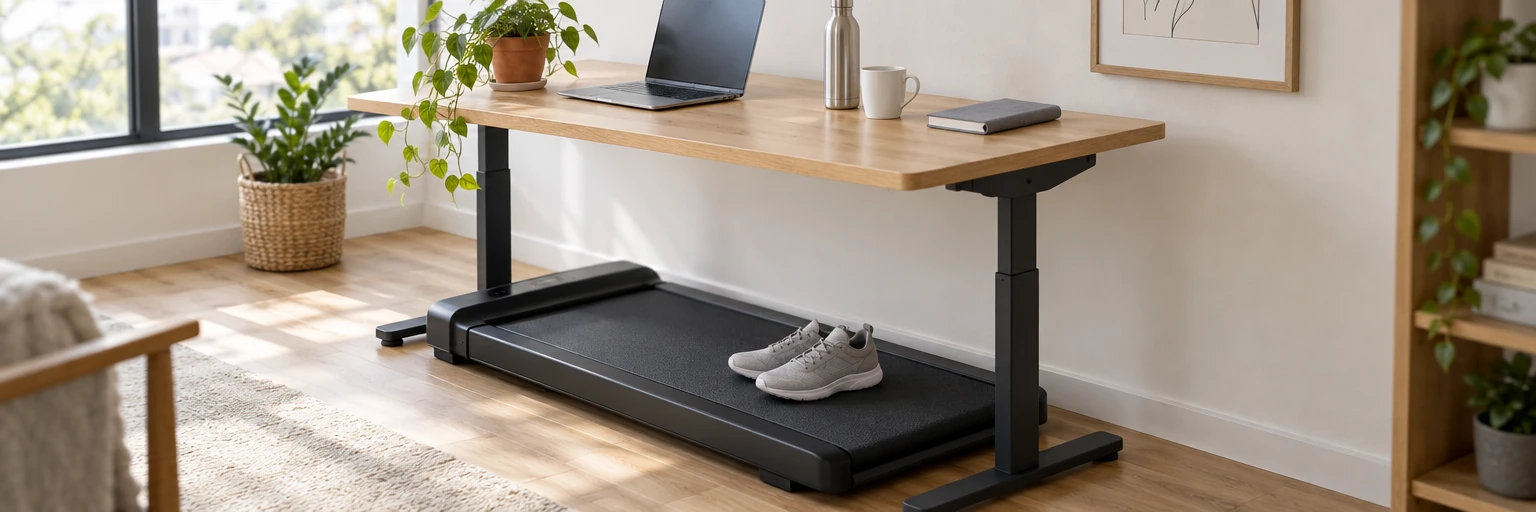
A walking pad is a slim, deck-only walking treadmill designed to sit under a standing desk. The key specs that distinguish it from a full treadmill:
- Speed range typically 0.5 to 4.0 mph, some capped at 2.5 mph (NEAT-only units); a full treadmill runs 0.5 to 12+ mph.
- No incline on most units (a few premium models offer 2 to 6 percent).
- No handrails — the desk becomes the reference surface.
- Slim deck, typically 40 to 48 inches long by 16 to 20 inches wide, foldable or roll-away.
- Deck weight limit commonly 220 to 300 lb, lower than most full home treadmills.
- Motor typically 1.0 to 2.5 HP continuous — enough for a full-body walker, not enough for running.
- Quiet motor (a specific selling point), typically 45 to 55 dB at working speeds.
The mechanism is not “portable treadmill.” It is a workstation ambulation tool. The design goal is to make walking during meetings, email, reading, and routine work as unobtrusive as sitting — same posture through the shoulders and head, same eye-line on the monitor, same keyboard and mouse ergonomics.
The mechanism, in plain English
Non-exercise activity thermogenesis (NEAT). Levine 1999 (Science) — the canonical NEAT paper — documented that between-person differences in daily activity thermogenesis of 300 to 800 kcal per day explain most of the variance in weight gain among adults consuming the same excess calories. Levine 2005 (Science) followed with a walking-workstation study that measured ~100 kcal per hour attributable to workstation ambulation at 1.0 mph vs seated work in adults with obesity, and characterized 2 to 3 hours per day as sustainable without meaningful productivity loss on the task mix most participants did. Ben-Ner 2014 (Journal of Physical Activity and Health) and Torbeyns 2014 (Sports Medicine) systematic review confirmed the effect and the productivity trade across the wider literature.
MET math at slow speeds. Ainsworth 2011 (Medicine and Science in Sports and Exercise) Compendium of Physical Activities set the per-minute energy cost for slow indoor walking:
- Code 17150 — walking, less than 2.0 mph, level surface — 2.0 MET
- Code 17151 — walking, 2.0 mph, level surface — 2.8 MET
- Code 17152 — walking, 2.5 mph, level surface — 3.0 MET (Zone 2 threshold)
At 1.5 mph, the metabolic cost sits between codes 17150 and 17151, roughly 2.3 to 2.5 MET. The formula for net kcal per hour is:
Net kcal per hour = (MET − 1) × body weight in kg
For a 155-lb (70 kg) adult at 1.5 mph (MET 2.4): (2.4 − 1) × 70 = ~98 kcal per hour net. At 2.0 mph (MET 2.8): (2.8 − 1) × 70 = ~126 kcal per hour net. The subtraction of 1 MET removes the resting-metabolic baseline so the number reflects only the ambulation cost, which is the number you want for weight-loss accounting.
Cognitive-task interference profile. Torbeyns 2014 (Sports Medicine) systematic review of ~30 studies: typing accuracy drops ~2 to 3 percent, simple math is essentially unchanged, complex-cognitive-task speed drops ~5 percent, mood improves ~5 to 8 percent, focus improves ~3 to 5 percent in most cohorts. Ohlinger 2011 (Journal of Physical Activity and Health) tracked office productivity metrics across a full workday. John 2011 (Preventive Medicine) documented treadmill-desk introductions in a live workplace. The pattern is consistent: simple tasks unaffected, complex tasks modestly slower, mood and focus modestly better.
Handrail and treadmill-artifact adjustments. Meyer 2016 (Journal of Sports Sciences) measured that holding a treadmill handrail reduces true energy expenditure by 10 to 25 percent vs matched cadence hands-free. Walking pads mostly do not have handrails — a feature, not a bug — but the desk becomes a de facto handrail if leaned on. Type with wrists floating over the keyboard, don’t lean palms on the desk. Foster 2015 (European Journal of Applied Physiology) documented that treadmill consoles and wearables overstate energy expenditure by 15 to 20 percent at slow speeds, so trust the MET-based math above, not the pad’s built-in display.
Real kcal burn — the honest per-body-weight table
Using Ainsworth 2011 MET values and body-weight in kg, per-hour net kcal:
| Body weight | 1.0 mph (~2.0 MET) | 1.5 mph (~2.4 MET) | 2.0 mph (~2.8 MET) | 2.5 mph (~3.0 MET) |
|---|---|---|---|---|
| 130 lb (59 kg) | ~60 kcal/h | ~80 kcal/h | ~105 kcal/h | ~120 kcal/h |
| 155 lb (70 kg) | ~70 kcal/h | ~100 kcal/h | ~125 kcal/h | ~140 kcal/h |
| 180 lb (82 kg) | ~80 kcal/h | ~115 kcal/h | ~145 kcal/h | ~165 kcal/h |
| 200 lb (91 kg) | ~90 kcal/h | ~125 kcal/h | ~165 kcal/h | ~180 kcal/h |
| 230 lb (105 kg) | ~105 kcal/h | ~145 kcal/h | ~190 kcal/h | ~210 kcal/h |
Worked example. A 180-lb (82 kg) adult walking 2.5 hours per day, 4 days per week at 1.5 mph: (2.4 − 1) × 82 × 2.5 = ~285 net kcal per day, or ~1,140 kcal per week of new NEAT. At the same pace over a 20-work-day month, that is roughly ~5,700 kcal — about 1.6 lb of theoretical fat-loss headroom per month if intake stays constant.
Two calibrations. First, the console on the walking pad typically overstates kcal by 15 to 20 percent — Foster 2015 documented cardio-machine console inflation broadly, and slow-speed walking is a category where the inflation is largest because the machine cannot know how much the desk is being used as a handrail. Use the MET-based numbers, not the readout. Second, the tables above are net kcal — they already subtract the resting metabolic baseline you would have burned sitting. Do not subtract again.
The 2.0 mph sweet spot
Speed is the whole conversation. Walking-pad kcal per hour is roughly linear in MET, and MET climbs modestly with speed at these ranges. The trade against pace is cognitive-task compatibility, sustainability across a workday, and stride comfort. Five speed bands:
- Below 1.0 mph. Barely above standing (~2.0 MET, ~50 to 90 kcal per hour depending on body weight). The balance-and-stride cost is disproportionate to the kcal gain, gait tends to shuffle and hips get cranky, and the walking-pad belt fatigues unevenly. Skip — just stand or sit.
- 1.0 to 1.5 mph. A comfortable “shuffle” pace for reading, email, meetings; ~60 to 120 kcal per hour depending on body weight. Sustainable 3 to 5 hours per day for many workers after a 2-week ramp. Cognitive-task performance essentially unchanged. This is the default “meeting speed.”
- 1.5 to 2.0 mph. Normal indoor walk pace; ~80 to 180 kcal per hour. Sustainable 2 to 3 hours per day. Cognitive-task performance mostly preserved on routine tasks, mild decrement (~5 percent) on complex tasks. This is the NEAT sweet spot — the highest kcal-per-hour that most work tasks tolerate without a meaningful productivity trade.
- 2.0 to 2.5 mph. Brisk pace, Zone 2 lower boundary; ~120 to 250 kcal per hour. Cognitive-task performance drops noticeably; better for meetings, phone calls, and routine tasks than for typing or reading. Sustainable ~1 to 2 hours per day for most workers.
- Above 2.5 mph. No longer NEAT — it is a session. Walking pads with a 2.5 to 4.0 mph range can be used for a short session-based workout, but at that point a full treadmill and the 12-3-30 workout protocol is a better tool for the incline and heart-rate signal.
The one-line summary: 1.5 mph for most work, 2.0 mph when the task allows, sit for deep cognitive work.
The task-vs-speed decision matrix
Six common work tasks. Match speed to task, don’t force a single pace across the day.
| Task | Recommended speed | Expected productivity impact | Sustainability |
|---|---|---|---|
| Video meetings (camera on) | 1.0 to 1.5 mph | Negligible; mic and camera stable at sub-50 dB pad | 2 to 3 hours per day |
| Audio meetings, phone calls | 1.5 to 2.0 mph | None; often better focus | 2 to 4 hours per day |
| Email, Slack, chat | 1.5 to 2.0 mph | ~2 to 3 percent typing accuracy dip | 2 to 3 hours per day |
| Reading (docs, articles) | 1.0 to 1.5 mph | None; mild comprehension boost | 2 to 4 hours per day |
| Routine coding, spreadsheet, data entry | 1.2 to 1.8 mph | Modest; watch typo rate | 1 to 2 hours per day |
| Deep writing, complex debugging, technical-cognitive work | Sit down | ~5 percent speed decrement on complex tasks | Not recommended |
The last row is the honest one. Cognitive-task interference is small on average but not zero on complex work, and the practical fix is not to give up walking — it is to sit for the 1 to 2 hours per day of deep-work that would take the productivity hit, and walk the other 2 to 3 hours.
The 4-week beginner ramp
Designed for a desk worker with no recent walking-pad exposure. Split blocks around meetings, email windows, and reading tasks — do not try to walk 2 hours continuously in Week 1.
| Week | Session structure | Speed | Total daily minutes |
|---|---|---|---|
| Week 1 | Two 30-min blocks (meetings only) | 1.0 to 1.2 mph | 60 min |
| Week 2 | Three 45-min blocks (add email + reading) | 1.2 to 1.5 mph | 135 min |
| Week 3 | Two 90-min blocks (add routine coding, spreadsheets) | 1.5 mph | 180 min |
| Week 4 | One 2-hr block + one 90-min block | 1.5 to 2.0 mph | 210 min |
After Week 4, most users stabilize at 2 to 4 total hours per day, split into 2 to 4 blocks, at 1.5 to 2.0 mph. The rule that matters most: progress duration before speed, and keep two things constant during the ramp — supportive footwear (not slippers, not barefoot) and a hydration bottle on the desk. Calves, plantar fascia, and hip flexors are the tissues that flare in Weeks 2 to 3 when the ramp is skipped; a slow build is the whole prevention protocol.
Two guardrails. First, the desk cannot become a handrail — Meyer 2016 documented the 10 to 25 percent energy-expenditure discount from handrail use, and the desk-as-handrail pattern silently drains the NEAT benefit while shifting load onto wrists and shoulders. Type with floating wrists. Second, rest days matter. Take one full rest day per week. Doing 3 hours per day 7 days per week is where the calf strain and plantar-fascia flare-ups typically appear.
Kcal vs structured exercise — the honest comparison
What does 2.5 hours per day at 1.5 mph actually equal in structured-exercise terms?
| Structured session (155 lb adult) | Approx net kcal | Cardio/strength signal |
|---|---|---|
| 30-min Zone 2 cycling | ~300 to 400 kcal | Real cardiovascular training stimulus |
| 40-min Zone 2 run | ~350 to 500 kcal | Full cardiovascular + Achilles/plantar load |
| 45-min moderate strength circuit | ~250 to 400 kcal | Hypertrophy + bone density + lean-mass protection |
| 2.5 hr at 1.5 mph walking pad | ~250 to 450 kcal | NEAT only — no cardiovascular training signal |
The kcal numbers are close. The adaptations are not. A walking pad does not replace structured cardio (VO2max, capillary density, mitochondrial adaptation) or strength (hypertrophy, bone density, lean-mass preservation in a deficit). The point is additivity: walking pads add to a structured plan, they do not replace it. The durable weekly template for a desk worker doing weight loss:
- 2 to 3 hours per work day at 1.5 to 2.0 mph on the walking pad (~1,000 to 1,500 kcal per week of new NEAT)
- 1 to 2 structured cardio sessions (Zone 2, 12-3-30, cycling, or the equivalent)
- 2 strength sessions per week to protect lean mass in a deficit — see strength training for weight loss
- A modest calorie deficit anchored on protein-forward meals — see how to count calories
- 7 to 9 hours of sleep per night (adaptive thermogenesis suppresses NEAT with sleep debt)
The productivity honest read
Yes, complex cognitive tasks slow ~5 percent at 1.5 to 2.0 mph. That is the honest number and it does show up in Torbeyns 2014 and later replications. It does not mean “a walking pad hurts productivity.” The trade is a small speed decrement on a subset of tasks — deep writing, complex debugging, high-stakes cognitive work — against a large NEAT gain (200 to 500 kcal per day) and a moderate mood plus focus lift across the workday. The practical fix is to match speed to task, not to avoid walking pads.
Three tactical rules that make the trade favorable:
- Meetings and email are free money. Cognitive interference on video meetings and email is essentially zero; walking at 1.5 to 2.0 mph during meetings costs nothing on the meeting side and buys 100 to 180 kcal per hour on the NEAT side.
- Reading is neutral to positive. Comprehension is preserved and many users report better retention while walking at 1.0 to 1.5 mph, likely a mild alertness/focus effect. If the choice is 2 hours of reading standing/sitting or 2 hours reading at 1.0 mph, the walking version buys 120 to 240 kcal for the same output.
- Sit for deep work. Do not force a walk during the 60 to 120 minutes per day that ask for peak cognitive performance. The 5 percent decrement adds up on complex tasks. The walk-pad rack is not going anywhere; sit down, do the work, and step back on when the task changes.
Walking pad vs standing desk vs under-desk elliptical
Three common workstation NEAT tools compared honestly.
| Attribute | Walking pad | Standing desk (alone) | Under-desk elliptical |
|---|---|---|---|
| Hourly kcal above sitting | ~80 to 180 kcal | ~15 to 50 kcal | ~60 to 140 kcal |
| Workday sustainability | 2 to 4 hours | 4 to 6 hours | 1 to 2 hours |
| Cognitive-task compatibility | Good on simple/routine; ~5% dip on complex | Excellent | Poor on typing; good on reading/meetings |
| Cost band | $150 to $1,200-plus | $200 to $800 | $100 to $300 |
| Deck footprint | ~40 to 48 x 16 to 20 in | Desk-only | Under-desk, minimal |
| Who it fits | Workers with 2+ hours of meetings/email/reading | Anyone; the sitting-interrupter default | Workers who want light leg movement without a walking pad |
They stack. The full-context workstation plan for a desk worker doing weight loss is: standing desk as the sit-stand alternator baseline, walking pad slotted into 2 to 4 hours of meetings/email/reading, structured cardio/strength off the clock. Under-desk ellipticals are a fine third option for readers who want light leg movement without buying a walking pad, but they cost more cognitively per hour than a walking pad does.
Contraindications and caution list
Not everyone should start a walking-pad protocol without medical clearance. Five specific carveouts:
- Acute knee, hip, ankle, or plantar fascia injury. Heal first. A walking pad at 2 hours per day is a 2-to-4x increase in per-day walking load for most desk workers, and an acute injury will not tolerate it.
- Uncontrolled hypertension (> 160/100). The steady-state light activity is generally safe once BP is managed, but hold on the protocol until a PCP conversation and BP clearance. Sustained light activity is not the same physiological load as heavy isometric strength work, but the “always-on” quality of a 2-to-3-hour walk changes the risk profile for uncontrolled cardiovascular disease.
- Post-op < 6 weeks. Surgeon clearance first, especially for abdominal, hip, knee, or spinal surgery. Most orthopedic teams clear low-impact walking earlier than running, but on their timeline.
- Pregnancy. Usually safe at 1.0 to 1.5 mph after clinician clearance in an uncomplicated pregnancy (ACOG 2020 permits moderate-intensity walking); skip any inclined variants, keep hydration high, stop if dizzy, contracting, bleeding, or short of breath disproportionate to the effort. Second- and third-trimester center-of-mass shifts make balance the specific concern — 1.0 to 1.2 mph with hand-contact on the desk (not weight-bearing) is a reasonable starting frame.
- Vertigo or balance-disorder history. Start at 1.0 mph with wall or desk contact and hold if symptoms recur. A walking pad’s belt runs steady but the visual-vestibular mismatch (moving belt, still monitor) can trigger symptoms in susceptible readers.
Also worth naming: GLP-1 users in the acute titration window (weeks 1 to 4 of a dose step) often see NEAT and spontaneous activity drop 1,500 to 3,000 steps per day from baseline. A walking pad is one of the cleanest ways to defend that step floor — structure beats spontaneity when nausea and fatigue are suppressing background activity. See preserve muscle during weight loss for the muscle-protection frame that walking pads support.
Buying guidance — six product-agnostic features
No brand endorsements. Six features to compare:
- Speed range. 0.5 to 4.0 mph is versatile — covers NEAT and short session-based work. 0.5 to 2.5 mph is NEAT-only. 0.5 to 6.0 mph is walk-and-run capability, which is a full treadmill in slim form (heavier, more expensive).
- Deck length. 40+ inches for anyone over 5’10”. 44+ inches for anyone over 6’0”. A short deck (36 to 38 inches) forces a mincing stride that fatigues hip flexors and calves inside 30 minutes.
- Motor. 1.5+ HP continuous for anyone over 200 lb. 1.0 HP continuous is acceptable for readers under 180 lb at slow speeds. Below 1.0 HP is a red flag — the motor will overheat inside a 2-hour session.
- Weight limit. Stated capacity ≥ user weight + 30 lb of margin. Walking pads are engineered lighter than full treadmills, and the deck bearings are the failure point that shows up on under-spec use.
- Deck cushioning. The single feature that separates a knee-friendly 2-hour session from a “never again” 30-minute attempt. Cushioned decks are 20 to 40 percent more expensive; the price gap is worth it. Check the deck-cushioning spec, not just the belt material.
- Noise. Sub-50 dB for video meetings. Anything over 55 dB will show up on the mic. Quiet-motor is a specific selling point on premium units — worth it if video meetings are a large share of the workday.
Price bands (2026 US pricing). Budget $150 to $300 (chain-store basic units, 2.5 mph cap, short deck, thin cushioning — fine for smaller readers doing occasional NEAT). Midrange $300 to $600 (the home-office cost/benefit sweet spot — 4 mph cap, 44+ inch deck, adequate cushioning, quiet motor). Premium $600 to $1,200-plus (extended warranty, thick cushioning, longest decks, quietest motors — worth it for daily 3+ hour users). The midrange band is where most home-office readers land.
The realistic 6-month expectation
Two to three hours per day at 1.5 to 2.0 mph adds roughly 300 to 500 kcal per day of new NEAT — enough to support ~0.5 to 1.0 lb per week of new fat-loss headroom if intake stays constant. Over six months, that is 12 to 25 lb of theoretical headroom.
The failure mode is compensatory intake. Sonneville 2013 (American Journal of Preventive Medicine) and adjacent literature documented that participants in exercise-adds-to-daily-life interventions typically compensate by eating back roughly 30 to 50 percent of the added expenditure (“I walked, I earned it”). The honest fix is not “don’t compensate” — it is to keep intake tracked and modest. See how to count calories for the tracking frame that keeps a walking-pad plan honest, and daily step count for weight loss for the wider step-count framework a walking pad plugs into.
The compounding second benefit is what shows up in blood work rather than on the scale: reduced continuous-sitting time, improved insulin sensitivity, better mood and focus during the workday, and better sleep quality on nights following high-NEAT days. Those are not scale numbers, but they are why the walking-pad literature keeps producing modest weight results and outsized non-weight health results.
What walking pads will NOT do — honest list
- Will not replace cardio training. ~2.0 to 2.8 MET is light activity; cardiovascular fitness, VO2max, capillary density, and mitochondrial adaptation require moderate-to-vigorous training. Pair with a Zone 2 cardio dose. See Zone 2 cardio for weight loss.
- Will not replace strength training. Walking sends a weak-to-absent muscle-preservation signal in a deficit. Two 30-minute strength sessions per week is the non-negotiable pairing.
- Will not out-run a poor calorie deficit. 400 kcal per day of new NEAT is real. One takeout order can add 1,500 kcal in a single meal. Intake anchors the deficit; the walking pad widens it.
- Will not fix sitting-time damage instantly. The mortality signal from sitting time (Ekelund 2016 Lancet) accrues over years; walking pads reduce the daily sitting exposure, which is the correct lever, but expect the compounding health signal to show up over months to years.
- Will not spot-reduce belly fat. No exercise targets a specific fat depot. See spot reduction myth.
When to consult PCP, PT, or an occupational health professional
- Primary care physician. Uncontrolled hypertension, unmedicated cardiac history, active pregnancy, post-op < 6 weeks, or vertigo/balance disorder — all warrant a clearance conversation before starting.
- Physical therapist. Persistent knee, hip, ankle, or plantar-fascia pain > 2 weeks; sciatica or radicular leg pain; sudden gait change; and anyone with a history of prior lower-extremity injury who wants to build to 3+ hours per day.
- Occupational health / ergonomist. If the standing-desk-plus-walking-pad setup creates wrist, shoulder, or neck complaints inside the first month, the desk height, monitor eye-line, or keyboard tray angle is the culprit — not the walking pad itself. A one-hour ergonomics consult often prevents the “I bought the pad and my shoulders hurt” pattern.
The bottom line
Under-desk walking pads are one of the highest-ROI NEAT tools available if the user is desk-bound. The math is real: 200 to 500 kcal per day of new NEAT at 1.5 to 2.0 mph across 2 to 3 work-hours, without displacing structured exercise time. The sweet spot is meetings, email, reading, and routine work at 1.5 to 2.0 mph; sit for deep cognitive work; stack the pad on top of a structured cardio and strength plan; keep intake honest.
The failure modes are documented and avoidable: skipping the 4-week ramp, using the desk as a handrail (10 to 25 percent kcal discount, per Meyer 2016), trusting the pad’s built-in kcal readout (15 to 20 percent inflated, per Foster 2015 methodology), and compensating with food (30 to 50 percent of added kcal, per Sonneville 2013 and adjacent literature). Follow the ramp, walk with a light hand on the desk, use the MET-based math, and track intake. That is the whole prescription.
For the modality-level framing, see walking for weight loss; for the session-based indoor treadmill frame, see treadmill workout for weight loss; for the specific incline-walk protocol, see 12-3-30 workout for weight loss; for the desk-worker weight-loss playbook, see weight loss and desk jobs; for the WFH-specific pattern, see weight loss and remote work; for the RTO pattern, see weight loss and return to office; for the underlying mechanism, see NEAT (non-exercise activity thermogenesis); for the step-count framework, see daily step count for weight loss; for the cardiovascular training complement, see Zone 2 cardio for weight loss; and for keeping intake honest across compensatory eating, see how to count calories.
Sources
- Levine JA, Eberhardt NL, Jensen MD. Role of nonexercise activity thermogenesis in resistance to fat gain in humans. Science (1999).
- Levine JA, Lanningham-Foster LM, McCrady SK, et al. Interindividual variation in posture allocation: possible role in human obesity. Science (2005).
- Ainsworth BE, Haskell WL, Herrmann SD, et al. 2011 Compendium of Physical Activities: A second update of codes and MET values. Medicine & Science in Sports & Exercise (2011).
- Torbeyns T, Bailey S, Bos I, Meeusen R. Active workstations to fight sedentary behaviour. Sports Medicine (2014).
- Ohlinger CM, Horn TS, Berg WP, Cox RH. The effect of active workstation use on measures of cognition, attention, and motor skill. Journal of Physical Activity and Health (2011).
- John D, Bassett D, Thompson D, Fairbrother J, Baldwin D. Effect of using a treadmill workstation on performance of simulated office work tasks. Preventive Medicine (2011).
- Ben-Ner A, Hamann DJ, Koepp G, Manohar CU, Levine J. Treadmill workstations: the effects of walking while working on physical activity and work performance. Journal of Physical Activity and Health (2014).
- Meyer C, Alenabi T, Christensen S, et al. The effect of handrail use during graded treadmill walking on energy expenditure. Journal of Sports Sciences (2016).
- Foster C, Porcari JP, Anderson J, et al. The talk test as a marker of exercise training intensity and cardio-machine energy expenditure accuracy. European Journal of Applied Physiology (2015).
- MacEwen BT, MacDonald DJ, Burr JF. A systematic review of standing and treadmill desks in the workplace. Applied Ergonomics (2015).