
2025-03-01 · lifestyle, exercise, behavior, cardio, strength training, NEAT, 150 minutes, weekly exercise plan, activity-guidelines, training-frequency, beginner-fitness
Updated 2026-07-30
Written by WeightFAQ Staff
Evidence-informed guidance from the WeightFAQ editorial team.
18 min read
Last editorial review Jul 30, 2026
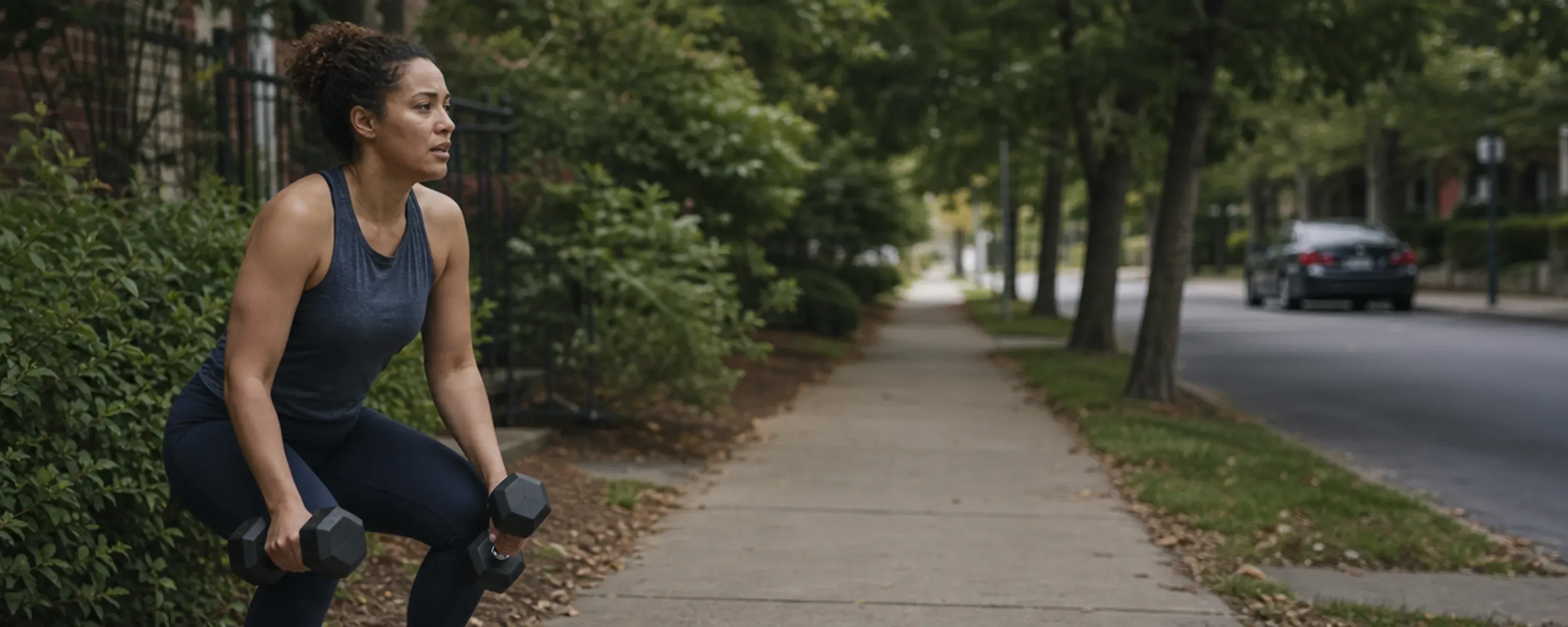
Exercise Programs for Weight Loss
Quick answer: For weight loss, aim for 150–300 minutes of moderate cardio per week plus two 30-minute strength sessions, stack 7,000–10,000 daily steps of NEAT on top, and pair the whole thing with a moderate calorie deficit from food. Exercise alone typically drives only 2–5 lb of loss over 12 weeks (Ross 2000); its bigger job is preserving lean mass (Villareal 2017), raising your daily burn (Levine 1999), and protecting long-term maintenance.
Quick stats — exercise for weight loss
- Weekly minutes for weight loss: 150–300 min moderate cardio + 2 strength sessions
- Typical calorie burn: ~200–400 kcal per moderate 45-min session for a 165-lb adult
- Realistic 12-week loss with exercise alone (no diet change): 2–5 lb
- Realistic 12-week loss with exercise + moderate deficit: 8–16 lb
- Muscle-preservation threshold: 2 × 30-min strength sessions per week
Who this is for / not for
Good fit if:
- You are medically cleared for activity and want to improve body composition and health.
- You can commit to a mix of cardio, strength, and daily movement.
- You want benefits beyond weight loss, such as energy and mobility.
Not a fit if:
- You have an acute injury or uncontrolled cardiac/respiratory condition.
- You are pushing through pain without medical clearance.
- You are relying on exercise alone without attention to nutrition.
What it is (plain-language definition)
Exercise is a powerful tool for weight loss and overall health. While diet drives most of the calorie deficit, activity helps maintain muscle, improve metabolic health, and support long-term weight maintenance. A balanced exercise plan includes both aerobic activity and strength training. The best program is one you can sustain consistently.
Evidence in this article draws on peer-reviewed clinical research, including findings from this study and this trial.
How much exercise for weight loss? (5-tier weekly matrix)
The matrix below lines up with the sibling numbers in low TDEE, [how to increase TDEE], and TDEE and calorie deficit for beginners. Use it as a lookup for the weekly movement dose that pairs with a matching food deficit — cardio minutes and strength sessions do not create the deficit on their own for most adults.
| Weekly target | Cardio minutes / wk | Strength sessions / wk | Avg daily NEAT (steps) | Realistic timeline | Notes |
|---|---|---|---|---|---|
| 0.5 lb / wk | 150 min moderate | 2 × 30 min | 7,000 | 12 weeks → ~6 lb | Gentle deficit (~250 kcal). Easiest to hold long term. |
| 1 lb / wk | 200 min moderate | 2 × 30 min | 8,000 | 12 weeks → ~12 lb | Standard beginner target. Pair with 500 kcal food deficit. |
| 1.5 lb / wk | 250 min moderate | 3 × 30 min | 9,000 | 12 weeks → ~18 lb | Only sustainable for 8–12 weeks. Watch for NEAT suppression. |
| 2 lb / wk | 300 min moderate + 1 HIIT | 3 × 40 min | 10,000 | 12 weeks → ~24 lb | Aggressive. Higher injury and burnout risk; not for beginners. |
| Maintenance | 150 min moderate | 2 × 30 min | 7,000 | Weight stable | Preserves muscle, protects the losses, resets set point. |
If your target and your minutes do not match, the target loses. A person cutting 750 kcal/day but only walking twice a week will still lose weight; a person walking 300 min/wk but eating at maintenance will not. The two levers work together — see the beginner calorie-deficit walkthrough for how to size the food side.
Benefits vs. limitations
- Benefits: Exercise alone typically produces modest weight loss—often around 2–3% of total body weight over 3–6 months—though results vary by intensity and total activity volume.
- Limitations: Overuse injuries, burnout, or compensatory hunger can slow progress.
Cardio vs. strength vs. NEAT: what each does
Not every exercise modality does the same job. The table below summarizes what the controlled trials show, so you can pick the mix that matches your goal — pure fat loss, muscle preservation, time efficiency, or long-term maintenance.
| Modality | Weekly kcal burn (typical adult) | Body-composition effect | Muscle preservation | Evidence anchor | Limitations |
|---|---|---|---|---|---|
| Cardio (moderate) | 1,200–2,400 kcal at 150–300 min/wk | Modest fat loss; small waist-circumference drop | Weak on its own | Donnelly 2009 ACSM position stand | 150 min/wk is below the threshold for meaningful loss without a diet change |
| Strength | 500–900 kcal/wk (session cost) | Small direct fat loss; large body-comp shift | Strong — protects lean mass in a deficit | Willis 2012 (STRRIDE-AT/RT) | Scale moves slowly; requires progression |
| NEAT | 700–3,500 kcal/wk | Underrated — biggest daily lever | Neutral | Levine 1999 (Science overfeeding study) | Suppressed by long deficits, short sleep, high stress |
| HIIT | 600–1,200 kcal/wk at 2–3 sessions | Equivalent fat loss to steady-state at matched work | Moderate | Wewege 2017 meta-analysis | High recovery cost; not a beginner starting point |
| Mixed (cardio + strength) | 1,500–2,800 kcal/wk | Best body-composition outcomes in trials | Strong | Villareal 2017 (NEJM, older adults) | Time cost — 4–5 sessions/wk |
The practical read is unglamorous: the mixed row is the row that wins in the trials, and the daily NEAT row is the one most people under-use. For the deeper breakdown of each modality, see walking for weight loss, running for weight loss, swimming for weight loss (the highest-leverage low-impact option for adults with arthritis, back pain, or a BMI above 35), strength training for weight loss, NEAT, HIIT for weight loss, jump rope for weight loss (the highest calorie-per-minute accessible modality at ~12 METs, delivered in a 6×6-foot floor with $20 of gear, though the 4–5× body-weight forefoot impact contraindicates it for plantar fasciitis, severe knee OA, and BMI > 35), stair climber for weight loss (roughly 9 METs on a rotating step mill — 300–450 kcal per 30-minute session, gentler on the knees than running at ~1.5–2× BW knee compression), boxing and kickboxing for weight loss for a skill-based combat-cardio option that layers HIIT physiology onto punching and footwork, martial arts for weight loss — the grappling and traditional-uniform sibling pillar covering BJJ, judo, karate, taekwondo, and muay thai at the Ainsworth 2011 MET anchors (5.5–10.3), the ~350–650 kcal NET per 60-min class range for a 175-lb adult, the injury-risk profile by discipline (Kreiswirth 2014 grappling, Bledsoe 2005 TBI transfer for full-contact striking), and the belt-and-stripe adherence hook that pulls most trainees back to the mat 2–3× per week for years, and CrossFit for weight loss — the modality-specific pillar for readers weighing a small-group box against a commercial gym or HIIT franchise, covering the 300–500 kcal per class calorie math, the community-effect adherence advantage, and the scaling rule that keeps beginner injury rates in check, pickleball for weight loss — the ~4.1-MET recreational-doubles and ~6.4-MET competitive-singles kcal-per-hour math, injury-risk read (Vitale 2020), and 3×/week template for the fastest-growing US racket sport, tennis for weight loss — the Ainsworth 2011 8.0-MET singles / 6.0-MET doubles per-hour math, Fernandez-Fernandez 2009 time-motion evidence (only ~20% of a doubles match is ball-in-play), the tennis-vs-pickleball-vs-running head-to-head, and the mandatory 2 strength days for tennis-specific injury patterns (tennis elbow, calf/Achilles, rotator cuff), rock climbing and bouldering for weight loss — the Ainsworth MET 5.8 (bouldering, session-averaged) / MET 7.0–7.5 (top-rope) per-hour math, the ~30–45 min actual on-wall time inside a 90-minute gym visit, the console-kcal-inflation warning (Foster 2015 + Bergua 2018 isometric-HR), the 4-week beginner plan, and the cross-training strength mandate for the chest/legs the sport skips, skiing and snowboarding for weight loss — the Ainsworth 4.3–7.8 MET downhill / 5.3 MET snowboard / 6.8–15.0 MET cross-country per-hour math, the Nemeth 2018 time-in-motion honest read (a 6-hour resort ski day is only 2–2.5 hours of actual moving time), and the ski-day-food defense that keeps most ski vacations from netting a +500-to-+1,500 kcal daily surplus, and golf for weight loss — the Ainsworth 4.3 MET walking-carrying / 5.3 MET walking-push-cart / 3.5 MET riding-cart per-hour math, the 800–1500 kcal-per-walking-round cost across 4–5 hours and 10,000–15,000 steps, Farahmand 2009’s ~5-year longevity signal in a 300,818-golfer Swedish cohort, and the 19th-hole honest read that determines whether the round actually produces a deficit.
How it works (or how it’s done)
Aerobic exercise such as walking, cycling, or swimming burns calories and improves cardiovascular fitness — 150 minutes per week of moderate cardio is the WHO/ACSM floor for health, and 200–300 minutes is where meaningful fat loss shows up when food is dialed in. Strength training builds and preserves muscle, which supports metabolism and body composition — 2 sessions of 30 minutes each is the minimum effective dose to protect lean mass in a calorie deficit (Villareal 2011). Flexibility and mobility work help prevent injury and improve movement quality. Combining these elements creates a well-rounded program that supports weight loss and health — and the right mix of structured sessions and added daily movement is also the most reliable way to [raise your TDEE] over time. For interval-based cardio specifically, see HIIT for weight loss — short, hard intervals are a time-efficient alternative to long steady-state sessions. To preserve muscle while in a deficit, see how much protein to eat for weight loss.
Expected outcomes (realistic results)
Exercise alone typically produces modest weight loss—often around 2–3% of total body weight over 3–6 months—though results vary by intensity and total activity volume. The biggest benefits are improved fitness and weight maintenance, and combining exercise with nutrition changes produces larger and more durable losses. Exercise works best alongside a calorie deficit; see our beginner guide on how many calories to eat for weight loss.
Special situations (5 scenarios)
Most templates assume a healthy, uninjured adult in their 30s. In practice, most readers arrive with a modifier — knee pain, a recent surgery, a medication, or older age. The five short protocols below are the ones that come up most often.
1. Chronic joint or low back pain. Low-impact volume beats high-intensity work. Substitute walking on level ground, pool workouts, and cycling for running and jump-based intervals. Two 30-minute strength sessions still fit — focus on machine-based or supported movements (leg press, seated row, chest-supported row). If back pain is the driver, the walk-first protocol in back pain and weight loss is the safest starting ramp.
2. Post-bariatric surgery. Wait for surgeon clearance (usually 4–6 weeks). Reintroduce walking first, then bodyweight resistance at wall-push-up and assisted-squat regressions for the first month regardless of pre-op fitness. Protein intake matters more than session intensity — muscle-loss risk is elevated for the first 6 months. See bariatric surgery overview for the full post-op activity ramp.
3. On a GLP-1 (semaglutide, tirzepatide, or similar). Muscle loss is the under-discussed risk on GLP-1s — as much as 25–40% of total weight lost can be lean mass without deliberate strength work. Keep 2–3 strength sessions per week non-negotiable, drop cardio volume if appetite is too suppressed to fuel it, and keep protein at 1.2 g/kg goal weight or higher. See GLP-1 weight loss overview for the medication-side context.
4. Knee osteoarthritis. Walking is protective, not damaging — the joint fluid actually improves with regular loading. Swap high-impact running for cycling or the elliptical, lift twice per week with a lower-body emphasis (seated leg extension, leg press at partial range), and prioritize the daily-steps floor over any single hard session.
5. Age 60+. Sarcopenia (age-related muscle loss) is the bigger long-term threat than a slower rate of scale progress. Front-load two full-body strength sessions per week, keep steady-state cardio moderate, and cap HIIT at one short session or skip it entirely. See weight loss for older adults for the age-specific protein and recovery targets.
What exercise does NOT do
Exercise is not a magic fat-burner, and every year it gets oversold as one. Three myths to reject before you build the plan:
- The “out-exercise a bad diet” myth. Hall 2011 in The Lancet modeled the arithmetic definitively: ~500 kcal/day of deficit = ~1 lb/week of fat loss, and for most people 80–90% of that deficit comes from food, not the gym. A hard 45-minute cardio session burns 300–500 kcal. One large restaurant meal can put back 1,000. You do not out-exercise the plate.
- The spot-reduction myth. No exercise selectively burns belly fat, thigh fat, or arm fat. Ross 2004 in Annals of Internal Medicine showed that overall fat loss follows the calorie deficit; where the fat comes off is determined by genetics and hormones, not the muscle group you trained. Crunches strengthen abs. They do not reveal them. The body-part-specific counterparts to this general claim — sit-ups do not burn belly fat, bicep curls do not burn arm fat, and squats and lunges do not burn thigh fat — each get their own pillar: how to lose belly fat, how to lose arm fat, and how to lose thigh fat.
- The “cardio for fat, weights for muscle” myth. Both matter, and the trials are unambiguous: the combined-training arms of Willis 2012 and Villareal 2017 beat either cardio-only or strength-only for body composition. If you have to pick one, strength preserves what the deficit is trying to take. For the full head-to-head breakdown — the STRRIDE-AT/RT kilogram-by-kilogram numbers, the visceral-fat data, and a four-row decision framework by time and joint constraint — see cardio vs strength training for weight loss.
Risks, side effects, or downsides
- Risks: Overuse injuries, burnout, or compensatory hunger can slow progress.
- Trade-offs: Results require time, progressive training, and recovery rather than quick fixes.
- Monitoring: Track pain, sleep, and performance; adjust volume or intensity if recovery lags.
Eligibility & contraindications
If any of the following apply, consider medical guidance before starting:
- You have an acute injury or uncontrolled cardiac/respiratory condition.
- You are pushing through pain without medical clearance.
- You are relying on exercise alone without attention to nutrition.
Cost, access, and time commitment
Exercise costs range widely. Gym memberships often run $30–$70 per month, while home equipment can be a one-time $50–$300 investment. Personal training typically costs $50–$100 per session.
Some insurers reimburse wellness programs or offer discounted gym memberships, so check for employer or plan-specific benefits. FSA/HSA funds usually do not cover general fitness expenses unless tied to a medical necessity program. Readers who want a fully no-equipment plan should start with our 8-week home workouts for weight loss bodyweight program — 4 sessions per week, no gym required. If the barrier is not equipment but anxiety about walking into a gym — the parking-lot-and-drive-home pattern, or the membership used three times — see weight loss and gym anxiety for the 4-driver audit, a 6-visit graded-exposure protocol, and the alternative-paths library that produces the same weight-loss result outside the gym.
Sample week — 1 lb / wk template
The template below is the standard beginner block from the matrix above — 200 minutes of cardio, two strength sessions, and 8,000 daily NEAT steps — sized for a 165-lb adult targeting ~1 lb of loss per week paired with a 400–500 kcal food deficit.
| Day | Session | Duration | NEAT target |
|---|---|---|---|
| Mon | Full-body strength (compound lifts) | 30 min | 8,000 steps |
| Tue | Moderate cardio (walk, cycle, swim) | 40 min | 8,000 steps |
| Wed | Rest or gentle mobility | 15 min | 8,000 steps |
| Thu | Full-body strength (compound lifts) | 30 min | 8,000 steps |
| Fri | Moderate cardio (walk, cycle, swim) | 40 min | 8,000 steps |
| Sat | Longer walk or easy hike | 60 min | 10,000 steps |
| Sun | Rest or active recovery | — | 6,000 steps |
Skip a session when sick, injured, or short on sleep — a missed workout is nothing; a training injury sets the program back weeks. If a week goes off the rails entirely, do not compensate the following week — just resume the template.
How to decide (decision checklist)
- Start with feasibility. If consistency is the barrier, choose low-impact walking or home routines first.
- Add resistance training. If body composition or metabolic health is a priority, include strength training 2–3 times weekly.
- Pair with nutrition. If weight loss is the main goal, combine exercise with a calorie deficit. Anchoring the day with protein-rich breakfast ideas supports recovery on training days and keeps hunger in check between sessions.
- Scale with recovery. Choose the plan you can recover from and repeat week after week.
Practical next steps
This week
- Schedule three activity blocks: two strength sessions and one longer walk or cardio session.
- Start with low-impact options (walking, cycling, swimming) if joints hurt.
- Pick a simple progression (add 5–10 minutes or a bit more weight weekly).
- Add 3,000 daily steps of non-exercise activity (NEAT) on top of the scheduled blocks — see [how to increase TDEE] for why the quiet daily burn usually adds more weekly calories than one hard gym day.
What to track
- Weekly minutes of movement and strength sessions completed.
- Perceived exertion and recovery (soreness, sleep).
- Waist measurements and energy levels.
How to know it’s working
- You can do more work with less fatigue over 4–6 weeks.
- Strength or endurance improves while weight trends down.
- Exercise feels sustainable rather than punishing.
If exercise and diet are dialed in but results have stalled, see how to break a weight loss plateau.
Frequently asked questions
How much exercise do I need to lose weight? Guidelines recommend at least 150 minutes of moderate activity per week, plus strength training two days a week. For meaningful weight loss, 200–300 minutes per week paired with a food deficit is a more realistic target.
Is cardio better than strength training? Both are important. Cardio burns calories, while strength training preserves muscle and improves body composition. A mix of both yields the best results — Villareal 2017 in NEJM showed the combined arm produced the best outcomes in dieting older adults.
Can I lose weight without exercise? Yes, weight loss can occur through diet alone, but exercise improves health and makes weight maintenance easier. It also protects lean mass during weight loss. For a realistic diet-only plan and what changes when you skip training, see our guide on how to lose weight without exercise.
What if I have joint pain? Low-impact activities like swimming, cycling, or walking on soft surfaces can reduce joint stress. A physical therapist can help tailor a safe plan. For lumbar-specific programming — including which low-impact options are safest during a flare — see back pain and weight loss.
What if steady cardio just doesn’t stick for me? Modality choice matters more than most people give it credit for — the best cardio plan is the one you’ll actually complete for 12+ weeks. Group formats like dance fitness for weight loss show 3–4× the long-term adherence of solo treadmill work in the exercise-psychology literature, and hit the same 150–300 min/wk moderate-cardio target. If the treadmill has already failed you twice, try a different modality before adding more discipline.
How do I stay motivated? Set small, measurable goals and track progress. Choose activities you enjoy, and consider group classes or workout partners for accountability.
Should I exercise every day? Daily movement is beneficial, but rest days are important for recovery. Aim for a mix of active and lighter days.
What is the best time of day to exercise? The best time is when you can be consistent. Some people prefer mornings, while others have more energy later in the day. For a deeper look at the morning-vs-evening evidence and where fasted cardio actually fits, see our guide to the best time of day to exercise for weight loss.
Do I need a gym membership? No. Many effective workouts can be done at home with minimal equipment. Walking, bodyweight exercises, and resistance bands are great options — see resistance band training for weight loss for a 12-week 3×30-minute band-first program that costs under $75 in equipment.
How do I avoid injury? Warm up, progress gradually, and focus on proper form. Rest and recovery are part of a sustainable program.
Can exercise help with emotional eating? Yes. Exercise reduces stress, improves mood, and can provide a healthy outlet, which may reduce emotional eating triggers.
How this compares to other options
- Compared with diet-only approaches, exercise adds cardiovascular and strength benefits even if weight loss is slower.
- Compared with behavioral therapy, exercise focuses on movement habits rather than cognitive strategies.
- Compared with apps and trackers, exercise is the habit while apps are the accountability tools.
Extra questions to consider
How do I know if this option fits my lifestyle? Look at your daily schedule, food preferences, travel routines, and stress levels. The best approach is one you can follow most days without constant friction. If an option feels overly restrictive or hard to sustain, discuss alternatives with your care team.
What should I track to know it is working? Track weight trends, measurements, and how you feel in daily life. Some people also monitor lab values, appetite, sleep quality, or exercise capacity. Choosing a few meaningful metrics helps you see progress even when the scale moves slowly.
Myths vs facts
- Myth: Exercise alone always leads to major weight loss. Fact: Nutrition intake largely determines weight change; exercise supports health and maintenance.
- Myth: Only cardio matters. Fact: Strength training preserves muscle and helps improve metabolism and body composition.
- Myth: If you are not sweating, it does not count. Fact: Consistent moderate activity still improves energy balance and health markers.
Experience-based scenarios
- You have joint pain and need low-impact movement. Walking, cycling, or water workouts can improve fitness without flaring pain, even if weight loss is gradual. For programming specific to knee osteoarthritis, pair low-impact aerobic work with lower-body strength 2 to 3 times per week.
- You expect exercise alone to drive major weight loss. Activity is essential for health and maintenance, but most people still need nutrition changes for bigger results.
How this article was researched
We reviewed peer-reviewed trials, systematic reviews, and clinical guidance on this topic, prioritizing high-quality human studies such as this publication and related evidence to summarize expected outcomes, safety considerations, and practical guidance.
Sources
- Donnelly JE, Blair SN, Jakicic JM, Manore MM, Rankin JW, Smith BK. ACSM position stand: appropriate physical activity intervention strategies for weight loss and prevention of weight regain for adults. Medicine and Science in Sports and Exercise (2009).
- Willis LH, Slentz CA, Bateman LA, Shields AT, Piner LW, Bales CW, Houmard JA, Kraus WE. Effects of aerobic and/or resistance training on body mass and fat mass in overweight or obese adults (STRRIDE-AT/RT). Journal of Applied Physiology (2012).
- Wewege M, van den Berg R, Ward RE, Keech A. The effects of high-intensity interval training vs. moderate-intensity continuous training on body composition in overweight and obese adults: a systematic review and meta-analysis. Obesity Reviews (2017).
- Villareal DT, Aguirre L, Gurney AB, Waters DL, Sinacore DR, Colombo E, Armamento-Villareal R, Qualls C. Aerobic or resistance exercise, or both, in dieting obese older adults. New England Journal of Medicine (2017).
- Levine JA, Eberhardt NL, Jensen MD. Role of nonexercise activity thermogenesis in resistance to fat gain in humans. Science (1999).
- Hall KD, Sacks G, Chandramohan D, Chow CC, Wang YC, Gortmaker SL, Swinburn BA. Quantification of the effect of energy imbalance on bodyweight. The Lancet (2011).
- Ross R, Janssen I, Dawson J, Kungl AM, Kuk JL, Wong SL, et al. Exercise-induced reduction in obesity and insulin resistance in women: a randomized controlled trial. Annals of Internal Medicine (2004).
- Ross R, et al. Reduction in obesity and related comorbid conditions after diet-induced weight loss or exercise-induced weight loss in men. Annals of Internal Medicine (2000).
- Jakicic JM, et al. Effect of exercise duration and intensity on weight loss in overweight, sedentary women: a randomized trial. JAMA (2003).