
2026-05-13 · meal plan, weight loss, nutrition, meal prep, diet plan, 1 week meal plan
Updated 2026-07-30
Written by WeightFAQ Staff
Evidence-informed guidance from the WeightFAQ editorial team.
22 min read
Last editorial review Jul 30, 2026
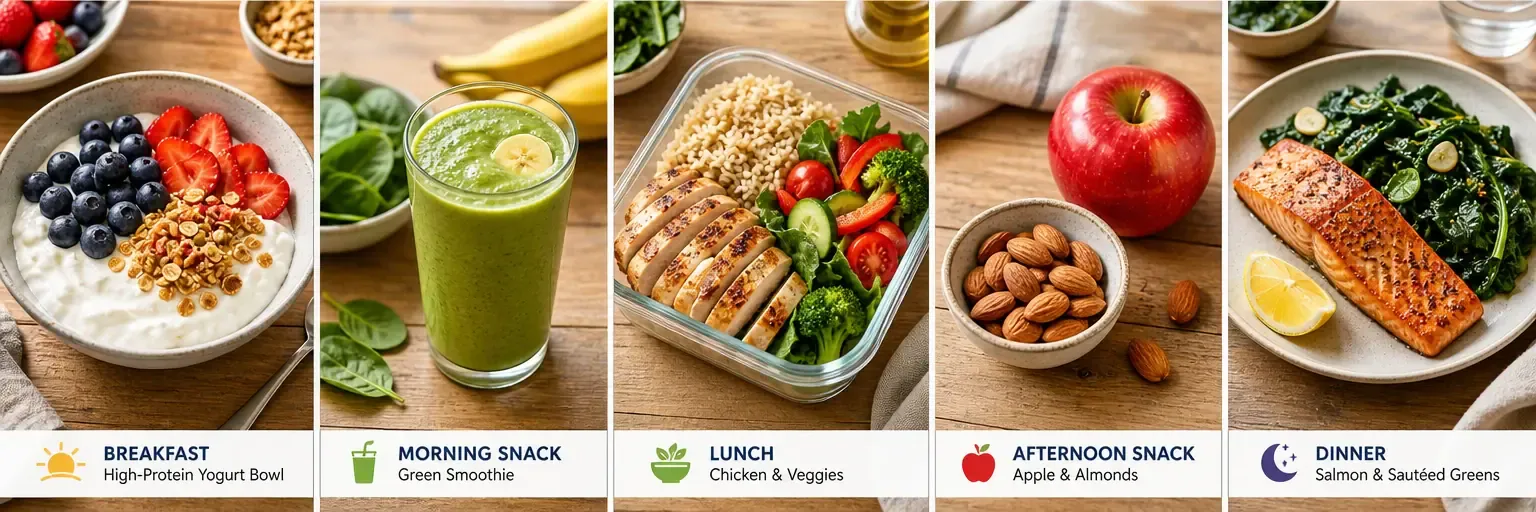
Weight Loss Meal Plan: A Simple 1-Week (7-Day) Guide
A meal plan takes the daily guesswork out of weight loss. Instead of deciding what to eat three or four times a day while hungry, you make those decisions once and follow a template. This guide gives you a complete 1-week (7-day) weight loss meal plan: a practical framework, a full sample week at roughly 1,500 to 1,600 calories per day, and the tools to adjust it to your body, budget, and preferences.
Quick answer
A complete 1-week (7-day) weight loss meal plan is a repeatable template that puts you in a calorie deficit for one week while keeping protein, fiber, and meal structure consistent.
- Daily calories: 1,400 to 2,000 for most adults (sample below targets 1,500 to 1,600).
- Protein target: 0.7 to 1.0 grams per pound of body weight.
- Meal structure: 3 meals plus 1 to 2 snacks, each anchored by a palm-sized protein.
See the day-by-day 7-day plan below for exact foods and portions, or grab the matching weight loss grocery list. Prefer meat-free? Jump to our lacto-ovo vegetarian weight loss meal plan — same calorie and per-meal split, rebuilt around Greek yogurt, cottage cheese, eggs, tofu, tempeh, and legumes.
Find the right meal plan for you
This page is the main 7-day weight loss meal plan template, but it is also the hub for the rest of the meal-plan cluster on this site. If you have a more specific need — a fixed calorie target, a vegetarian week, or a grocery list — use the table below to jump straight to the spoke that matches your intent, or browse the full meal plans hub for options grouped by calorie band, dietary pattern, and short-term reset.
| Your situation | Where to go next |
|---|---|
| If you just want the 7-day plan | 1-week diet plan for weight loss (day-by-day 7-day menu, scaled to 1,200/1,500/1,800 kcal) |
| If you have a specific pound goal | How to lose 10 pounds: a realistic plan and timeline |
| If you want a fixed calorie target | 1,500-calorie sample meal plan with grocery list |
| If you want a lower fixed target | 1,200 calorie meal plan (7-day plan + who it’s for) |
| If you want a higher fixed target (larger or more active) | 1,800-calorie meal plan (7-day plan + grocery list) |
| If you want a step-by-step builder | How to build a weight loss meal plan |
| If you eat vegetarian | Vegetarian weight loss meal plan |
| If you want Sunday meal prep | meal prep for weight loss (90-minute Sunday routine + one-session prep map) |
| If you want a grocery list | Weight loss grocery list |
| If you want high-protein breakfast ideas | High-protein breakfast ideas for weight loss |
| If you want a no-exercise plan | Can you lose weight without exercise? A realistic diet-only plan |
| If you have a question about apple cider vinegar | Apple cider vinegar for weight loss |
Choose your calorie level
If you want a fixed daily number, pick the calorie band closest to your maintenance (TDEE) minus a moderate 300 to 500 calorie deficit. Higher is not worse — the best target is the highest intake that still produces steady loss, because it is the easiest to sustain.
| Calorie level | Who it typically fits | Honest expected loss |
|---|---|---|
| 1,200 calories | Smaller, sedentary, or older adults with a genuinely low maintenance (~1,500–1,700); short-term use only | ~0.5–1 lb/week; a floor, not a goal |
| 1,500 calories | Many adult women and shorter or sedentary men with maintenance ~1,900–2,200 | ~0.5–1.5 lb/week |
| 1,800 calories | Larger or more active adults and many men with maintenance ~2,100–2,500 | ~0.5–1.5 lb/week |
Not sure which row is yours? Estimate your maintenance with the TDEE and calorie deficit guide first, then pick the band that lands 300 to 500 calories below it. The middle band is the most popular starting point — for a complete per-meal breakdown, decision matrix, and sample week at that intake, jump straight to our 1,500-calorie sample meal plan with grocery list.
If none of those fit and you want the standard sample 7-day template, keep reading below.
Key takeaways
- No single meal plan works for everyone. The best plan is one you can actually follow consistently.
- Focus on protein and fiber at every meal. They keep you full and protect muscle in a calorie deficit.
- Meal prep saves time and reduces impulse eating. Even 60 to 90 minutes on a weekend can cover most of the week.
- Adjust the template to your calorie target. The sample plan below runs roughly 1,500 to 1,600 calories per day, but your number may be higher or lower.
- A meal plan is a starting framework, not a rigid prescription. Swap foods, shift portions, and make it yours.
- Prefer to make a meal plan yourself instead of using this template? Our 6-step DIY framework for building your own weight loss meal plan walks through the calorie, protein, and rotation math from scratch.
How to build a weight loss meal plan (step by step)
To build a weight loss meal plan, work through five short steps:
- Estimate your TDEE and subtract a 300 to 500 calorie deficit to set your daily calorie target.
- Set a protein target of roughly 0.7 to 1.0 grams per pound of body weight, then divide it across the day.
- Plan three meals and one or two snacks that fit your calorie target, with a palm-sized protein at every meal.
- Fill the rest of each plate with vegetables, a fist-sized portion of whole grains, and a thumb of healthy fat.
- Pick a small rotation of meals you can prep on the weekend and repeat through the week.
That five-step framework is what every working meal plan has in common, regardless of style. The detailed Step 1 through Step 4 walkthrough below expands each one with calorie ranges and food examples, and our dedicated step-by-step guide to building a weight loss meal plan covers the same process with worked examples and a printable checklist.
Is there a “best” meal plan for weight loss?
There is no single best meal plan for weight loss — but the meal plans that consistently work share four traits. The meal plans that fail almost always miss at least one of them.
- Calorie deficit: every plan that works ends up landing daily intake below what the body burns, whether the style is Mediterranean, low-carb, high-protein, or mostly plant-based.
- Adequate protein: plans that protect muscle and blunt hunger hit roughly 0.7 to 1.0 grams of protein per pound of body weight, spread across the day rather than crammed into one meal — the protein intake for weight loss breakdown walks through the per-weight ranges and how to split the daily total across three to five eating occasions.
- Foods you actually like: the best plan is one you would still be willing to eat in week six, not just the first week when motivation is high.
- Repeatable and preppable: a small rotation of meals you can batch cook on a weekend reliably beats a plan that asks for five new recipes a week.
Notice what is not on that list: a specific superfood, a “metabolism-boosting” rule, or a brand-name diet. Anything marketed as the single best plan either pulls those four levers — in which case the brand is doing the work, not the marketing — or it does not produce lasting results.
If you are choosing between popular approaches, see our best diet for weight loss comparison.
Who this is for
Good fit if:
- You understand that weight loss requires a calorie deficit but struggle with what to eat day to day.
- You have read about TDEE, macros, or calorie counting and want a practical template to follow.
- You want to reduce impulse eating, takeout spending, or the mental load of daily food decisions.
- You are looking for a structured starting point you can customize over time.
Not a fit if:
- You have a diagnosed eating disorder or a history of disordered eating. Structured meal plans can reinforce rigid patterns. Work with a therapist or registered dietitian who specializes in eating disorders.
- You have severe food allergies, medical dietary restrictions, or a condition like diabetes that requires individualized clinical guidance. A clinician or registered dietitian should set your plan.
How to build a weight loss meal plan
Building a meal plan that works comes down to four steps. You do not need special foods or expensive ingredients.
Step 1: Calculate your calorie target
Your daily calorie target starts with your TDEE (total daily energy expenditure) minus a moderate deficit of 300 to 500 calories. If you have not estimated your TDEE yet, the fastest route is our interactive TDEE and calorie-deficit calculator, which gives you a maintenance number and a target in seconds; the TDEE and calorie deficit guide walks through the full calculation behind it. You can also use our calorie intake guide to see where common ranges land by body size and activity level.
Most adults lose weight eating somewhere between 1,400 and 2,000 calories per day. The sample plan below targets roughly 1,500 to 1,600 calories, which is a moderate deficit for many adults. Adjust portions up or down based on your personal number. If your calculated number comes in lower than you expected, our why your TDEE feels low explainer covers what is driving it and how to respond without slashing food further.
Step 2: Set your protein target
Protein is the most important macro in a calorie deficit. It preserves muscle, keeps you full, and has a higher thermic effect than carbs or fat. Aim for roughly 0.7 to 1.0 grams of protein per pound of body weight, spread across your meals. Our protein intake guide covers specific gram ranges and the best food sources.
As a practical rule, include a palm-sized portion of protein at every meal and a protein-rich snack at least once a day. If you would rather size meals by feel than by counting calories, our guide to portion control covers the full hand and plate methods.
Step 3: Fill with vegetables, whole grains, and healthy fats
After protein, build each meal around:
- Vegetables. Half your plate at lunch and dinner. They add volume, fiber, and micronutrients for very few calories. Frozen vegetables are just as nutritious as fresh and often cheaper. Leaning on low-calorie, high-volume foods like these is one of the most reliable ways to feel full while staying in a deficit.
- Whole grains and starchy carbs. Brown rice, oats, quinoa, sweet potatoes, whole wheat bread. A fist-sized portion at most meals provides energy without overshooting your calorie budget.
- Healthy fats. Olive oil, avocado, nuts, seeds. A thumb-sized portion per meal is enough. Fats are calorie-dense, so measuring matters more here than with vegetables.
Step 4: Plan 3 meals and 1 to 2 snacks
Spreading your calories across 3 meals and 1 to 2 snacks prevents the extreme hunger that leads to overeating. A rough split for a 1,500 calorie target:
- Breakfast: 350 to 400 calories
- Lunch: 400 to 450 calories
- Dinner: 450 to 500 calories
- Snack(s): 150 to 250 calories total
These are guidelines, not rules. Some people prefer larger lunches and smaller dinners, or two snacks instead of one. The total for the day is what matters. If you are weighing 3 meals vs a 5 or 6 meal plan, see meal frequency for weight loss — the head-to-head trials find no metabolic difference at matched calories, so the right choice is whichever pattern you can repeat.
Sample 1-week (7-day) meal plan
This complete one-week template targets roughly 1,500 to 1,600 calories per day with adequate protein at every meal. It uses common, affordable, widely available foods. This is a starting framework, not a medical prescription. Adjust portions up or down based on your individual calorie target. For an honest read on what a single week of dieting can actually deliver — plus a clean scaling table down to 1,200 kcal or up to 1,800 — our 1-week diet plan covers that side of the picture.
At a glance: the 1-week (7-day) plan
| Day | Breakfast | Lunch | Dinner | Approx daily calories |
|---|---|---|---|---|
| 1 | Scrambled eggs + toast | Grilled chicken salad | Baked salmon + brown rice | ~1,480 |
| 2 | Oatmeal + peanut butter | Turkey wrap | Chicken stir-fry | ~1,450 |
| 3 | Protein smoothie | Black bean bowl | Turkey marinara + zoodles | ~1,480 |
| 4 | Eggs + black bean tortilla | Tuna salad sandwich | Pork tenderloin + sweet potato | ~1,480 |
| 5 | Overnight oats | Leftover pork salad | Italian chicken + pasta | ~1,470 |
| 6 | Veggie omelet | Chicken soup + roll | Shrimp + brown rice | ~1,480 |
| 7 | PB English muffin | Chicken quinoa salad | Turkey burger + Brussels sprouts | ~1,480 |
Day 1
- Breakfast (roughly 370 cal): 2 scrambled eggs with 1/2 cup spinach and 1 slice whole wheat toast. 1 small banana.
- Lunch (roughly 430 cal): Grilled chicken breast (4 oz) over mixed greens with 1/2 cup cherry tomatoes, 1/4 avocado, and 1 tbsp olive oil vinaigrette. 1 small whole wheat roll.
- Dinner (roughly 480 cal): 5 oz baked salmon with 1 cup roasted broccoli and 3/4 cup brown rice.
- Snack (roughly 200 cal): 3/4 cup plain Greek yogurt with 1/4 cup blueberries.
Day 2
- Breakfast (roughly 360 cal): 1 cup oatmeal (dry measure 1/2 cup) cooked with water, topped with 1 tbsp peanut butter and 1/2 sliced banana.
- Lunch (roughly 420 cal): Turkey and vegetable wrap: 3 oz deli turkey, lettuce, tomato, mustard in a whole wheat tortilla. 1 medium apple on the side.
- Dinner (roughly 490 cal): 5 oz chicken thigh (skinless) stir-fried with 1.5 cups mixed vegetables (bell peppers, snap peas, carrots) and 3/4 cup brown rice. 1 tsp sesame oil.
- Snack (roughly 180 cal): 1 string cheese and 15 almonds.
Day 3
- Breakfast (roughly 380 cal): Smoothie with 1 scoop protein powder, 1 cup unsweetened almond milk, 1/2 banana, 1/2 cup frozen strawberries, and 1 tbsp ground flaxseed.
- Lunch (roughly 440 cal): Black bean bowl: 3/4 cup black beans, 1/2 cup brown rice, 1/4 cup salsa, 2 tbsp plain Greek yogurt, and 1/4 avocado over lettuce.
- Dinner (roughly 470 cal): 5 oz lean ground turkey cooked with 1/2 cup marinara sauce, served over 1 cup zucchini noodles with a side of 1 slice whole wheat garlic bread.
- Snack (roughly 190 cal): 2 tbsp hummus with 1 cup baby carrots and 1/2 cup cucumber slices.
Day 4
- Breakfast (roughly 370 cal): 2 eggs scrambled with 1/4 cup black beans, 2 tbsp salsa, and 1 small whole wheat tortilla.
- Lunch (roughly 430 cal): Tuna salad (3 oz canned tuna in water, 1 tbsp light mayo, diced celery) on 2 slices whole wheat bread with lettuce. 1 small pear.
- Dinner (roughly 480 cal): 5 oz pork tenderloin with 1 cup roasted sweet potato cubes and 1.5 cups steamed green beans. 1 tsp olive oil.
- Snack (roughly 200 cal): 3/4 cup cottage cheese with 1/4 cup pineapple chunks.
Day 5
- Breakfast (roughly 360 cal): Overnight oats: 1/2 cup rolled oats, 1/2 cup plain Greek yogurt, 1/2 cup unsweetened almond milk, 1/4 cup mixed berries. Refrigerate overnight.
- Lunch (roughly 440 cal): Leftover pork tenderloin (4 oz) sliced over mixed greens with 1/2 cup roasted sweet potato, 1/4 cup chickpeas, and 1 tbsp balsamic vinaigrette.
- Dinner (roughly 490 cal): 5 oz chicken breast baked with Italian seasoning, served with 1 cup roasted cauliflower and 3/4 cup whole wheat pasta tossed in 1/2 cup marinara.
- Snack (roughly 180 cal): 1 medium apple with 1 tbsp almond butter.
Day 6
- Breakfast (roughly 380 cal): 2 egg omelet with 1/4 cup mushrooms, 1/4 cup bell peppers, and 1 oz feta cheese. 1 slice whole wheat toast.
- Lunch (roughly 420 cal): Chicken and vegetable soup (homemade or low-sodium canned, roughly 1.5 cups) with 3 oz shredded chicken. 1 small whole wheat roll.
- Dinner (roughly 480 cal): 5 oz shrimp sautéed with 1.5 cups mixed vegetables (zucchini, tomatoes, onions) and 3/4 cup brown rice. 1 tsp olive oil.
- Snack (roughly 200 cal): 3/4 cup plain Greek yogurt with 1 tbsp honey and 1 tbsp chopped walnuts.
Day 7
- Breakfast (roughly 370 cal): Whole wheat English muffin with 2 tbsp peanut butter and 1/2 sliced banana.
- Lunch (roughly 430 cal): Large salad with 4 oz grilled chicken, 1/2 cup quinoa, 1/4 cup diced cucumber, 1/4 cup cherry tomatoes, and 1 tbsp olive oil and lemon dressing.
- Dinner (roughly 490 cal): Homemade turkey burger (5 oz lean ground turkey patty) on a whole wheat bun with lettuce, tomato, and mustard. Side of 1 cup roasted Brussels sprouts with 1 tsp olive oil.
- Snack (roughly 190 cal): 1 hard-boiled egg and 1 medium orange.
A note on portions: If your calorie target is higher than 1,500 to 1,600, increase protein portions by 1 to 2 oz, add an extra snack, or increase grain portions by a quarter cup. If your target is lower, reduce grain portions slightly or drop the second snack. The structure stays the same.
Meal prep tips
You do not need to spend an entire Sunday in the kitchen. A focused 60 to 90 minute session can cover most of your week. For a minute-by-minute routine and a one-session map of which prep covers which meals, see our guide to 7-day meal prep to lose weight.
Batch cook proteins. Grill or bake 2 to 3 pounds of chicken breast, cook a pound of ground turkey, and hard-boil 6 to 8 eggs. Cooked protein keeps for 4 days in the refrigerator.
Prep vegetables in advance. Wash and chop bell peppers, carrots, broccoli, and zucchini. Roast a sheet pan of mixed vegetables. Prepped vegetables remove the biggest friction point from weeknight cooking.
Use containers. Portion meals into individual containers so grabbing lunch is as fast as grabbing takeout. Glass containers with lids work well and are microwave safe.
Pick 2 to 3 breakfasts and rotate. You do not need 7 different breakfasts. Overnight oats, scrambled eggs, and a smoothie cover most preferences and can be prepped or made in under 5 minutes. For a longer list of options that hit 25 to 40 grams of protein, see our high-protein breakfast ideas for weight loss; for smoothie recipes calibrated to a 300 to 450 kcal breakfast with 25 to 35 g of protein, see our weight-loss smoothies guide.
Write the shopping list before you shop. A meal plan only works if the ingredients are in the house. Our weight loss grocery list gives you a printable, store-section template with the proteins, vegetables, pantry staples, budget swaps, and an alternate 7-day meal plan built entirely from the list — a clean rotation against the sample week above.
Cook once, eat twice. Double your dinner recipe and use leftovers for the next day’s lunch. The sample plan above uses this strategy on Day 5 with leftover pork tenderloin.
Freeze extras. Soups, cooked grains, and marinated proteins freeze well. Having a few frozen backup meals prevents the “nothing to eat, might as well order pizza” problem.
How to adjust the plan to your needs
The sample plan is a template. Here is how to make it work for your situation.
Higher calorie targets (1,800 to 2,200 calories). Add 1 to 2 oz of protein at lunch and dinner. Include a second snack. Increase grain portions by a quarter to half cup. Add a tablespoon of healthy fat (olive oil, nut butter, avocado) at one meal. The meal structure stays the same.
Lower calorie targets (1,200 to 1,400 calories). Reduce grain portions to half a cup or less. Drop to one snack. Use calorie-free cooking spray instead of oil where possible. Do not go below 1,200 calories without medical supervision. For more guidance on structured low-calorie approaches, see our calorie-restricted diets guide. If you specifically want a 1,500 calorie target with a different sample week and grocery list, see the 1,500-calorie sample meal plan.
Vegetarian or vegan modifications. Replace animal proteins with beans, lentils, tofu, tempeh, edamame, or protein powder. A cup of cooked lentils provides roughly 18 grams of protein and 230 calories. Combine legumes with whole grains throughout the day for complete amino acid coverage. If you want the version of this week already rebuilt around eggs, dairy, tofu, tempeh, and legumes at 1,500 to 1,600 calories, swap straight into our 7-day vegetarian meal plan — it keeps the same structure but solves the plant-protein math for you. For the strategic plant-based playbook — protein math, B12 and omega-3 supplements, and the three vegan-plateau patterns — see our plant-based weight loss guide.
Food allergies and intolerances. Swap individual foods without changing the meal structure. Nut allergy: replace peanut butter and almonds with sunflower seed butter and pumpkin seeds. Gluten intolerance: use rice, quinoa, corn tortillas, and gluten-free oats. Dairy free: use unsweetened soy or oat milk and skip the cheese and yogurt (or use fortified dairy-free alternatives).
Budget constraints. Buy frozen vegetables, canned beans, and store-brand proteins. Eggs, canned tuna, chicken thighs, and dried lentils are among the cheapest protein sources per gram. Skip pre-cut, pre-washed, and single-serving packaged items. Cook in bulk and portion at home.
Common meal planning mistakes
Over-complicating meals. A weight loss meal plan does not require restaurant-quality recipes. Simple combinations of a protein, a vegetable, and a starch work. The more complex each meal, the less likely you are to follow through.
Being too restrictive. Plans that eliminate entire food groups or rely on foods you do not enjoy fail quickly. Include foods you actually like, even if they are not “perfect.” A sustainable 80 percent effort beats a perfect plan you abandon after a week.
Skipping meals. Skipping breakfast or lunch to “save” calories often leads to overeating at dinner or late-night snacking. Spreading calories across the day keeps hunger manageable and energy steady.
Not accounting for snacks. Unplanned snacking is where many calorie budgets fall apart. Plan your snacks the same way you plan your meals. Keeping a short list of high-protein snacks under 250 calories on hand makes those choices automatic instead of impulsive. If you graze on a few handfuls of nuts and a couple of bites of leftovers, those calories add up fast.
Giving up after one bad day. Missing a day, eating off plan, or going over your calorie target is not failure. One day does not undo a week of consistency. Return to the plan at your next meal and keep going.
Frequently asked questions
What is a good meal plan for weight loss? A good weight loss meal plan keeps you in a moderate calorie deficit of 300 to 500 calories below TDEE, hits 0.7 to 1.0 grams of protein per pound of body weight, and uses foods you genuinely enjoy. In practice that looks like three meals and one or two snacks built around lean protein, vegetables, whole grains like rice or oats, and healthy fats such as olive oil or avocado. The sample week below is one example built on those rules.
Can I create my own meal plan to lose weight? Yes. To create your own plan, set a daily calorie target below your TDEE, pick a protein source for each meal, and rotate a small set of vegetables, whole grains, and healthy fats. Most people who write their own plan succeed by keeping recipes simple and repeating the same breakfast and lunch most days. Use the protein intake guide to set a protein target before you start writing meals.
How do I meal plan for weight loss as a beginner? Start by writing a calorie target and a protein target for the day, then pick three meals and one snack that hit those numbers. Choose three breakfasts, three lunches, and four dinners you actually like and rotate them through the week. Block 60 to 90 minutes once a week to cook proteins and chop vegetables in advance, then track intake for the first two weeks so you can see whether your portions actually match the target.
How many calories should my meal plan have? Your calorie target depends on your TDEE minus a moderate deficit of 300 to 500 calories. Most adults lose weight between 1,400 and 2,000 calories per day. The sample plan above targets 1,500 to 1,600, but your number could be higher or lower depending on your size and activity level. Use our TDEE guide to find your starting point.
Can I eat the same thing every day? Yes, if you want to. Many people find that repeating a few meals simplifies tracking and reduces decision fatigue. As long as you are getting adequate protein, fiber, and micronutrient variety across the week, eating the same breakfast and lunch most days is fine. Rotate your dinners and vary your vegetable and fruit choices over the week for broader nutrient coverage.
Should I count macros or just calories? For most people starting out, tracking total calories and protein is enough. Protein is the macro that matters most in a deficit because it preserves muscle and keeps you full. Once you have calories and protein dialed in, the split between carbs and fat is mostly personal preference. If you prefer low-carb meals, eat more fat. If you prefer rice and bread, eat less fat. Total calories and protein are the two numbers to anchor on.
What if I eat out while following a meal plan? Eating out does not have to derail your plan. Choose a protein-centered dish, ask for vegetables instead of fries, and skip the bread basket. Estimate portions rather than obsessing over exact calories. If you eat a larger restaurant meal, scale back slightly at the next meal. One restaurant meal per week has minimal impact on weekly results. The goal is a calorie deficit across the week, not perfection at every meal.
Is meal prepping necessary for weight loss? No. You can lose weight without meal prepping. But research shows that people who plan meals in advance tend to have better diet quality, more food variety, and healthier body weight. Prepping removes the daily decision of “what should I eat?” which is often when people default to fast food or high-calorie convenience options. Even light prep, like chopping vegetables or cooking a batch of protein, makes a meaningful difference.
What does a typical weight loss meal plan look like? A typical weight loss meal plan covers three meals and one or two snacks built around a palm-sized protein, half a plate of vegetables, a fist-sized portion of whole grains, and a thumb of healthy fat. The sample 1,500 to 1,600 calorie week above shows what that looks like across seven days, with breakfasts around 360 to 380 calories, lunches near 430, and dinners near 480.
What is the best meal plan for losing weight in a month? The best meal plan for losing weight in a month is one you can actually follow for the full four weeks. The 1,500 to 1,600 calorie sample above is a reasonable starting point for most adults, paired with 0.7 to 1.0 grams of protein per pound of body weight. Expect a fat loss of roughly 0.5 to 1 percent of body weight per week rather than dramatic single-month drops. Wondering how long will this take for your own numbers? Estimate it with the weight loss timeline calculator.
Practical next steps
This week:
- Calculate your calorie target using the steps in how to build a meal plan above, or use our calorie intake guide.
- If you want a step-by-step process for building your own plan from scratch instead of using this template, follow our 6-step guide to building a weight loss meal plan.
- Choose 3 breakfasts, 3 lunches, and 4 dinners from the sample plan (or your own recipes) and write a grocery list.
- Set aside 60 to 90 minutes to batch cook proteins and prep vegetables for the week.
What to track:
- Daily calories (total) and protein (grams). An app like MyFitnessPal or Cronometer helps for the first 2 to 4 weeks.
- Weekly average body weight. Weigh yourself at the same time each day and calculate a 7-day average. Look for a downward trend, not day-to-day fluctuations. For the full Monday-morning routine — daily weigh-in conditions, tape measurements, and progress photos — see how to track weight loss progress.
- How you feel. Manageable hunger, stable energy, and no extreme cravings are signs the plan is sustainable.
How to know it is working:
- Your 7-day average weight trends downward over 2 to 3 weeks.
- You are losing roughly 0.5 to 1 percent of body weight per week.
- You feel energized enough for daily activities and exercise.
- You are following the plan at least 80 percent of the time without dreading meals.
- If progress stalls for 3 or more weeks despite consistent tracking, revisit your calorie target and work through our weight loss plateau checklist before cutting calories further. Our best diet for weight loss guide can also help you evaluate whether a different approach might fit your preferences better.
Sources
- Ducrot P et al. Meal planning is associated with food variety, diet quality and body weight status in a large sample of French adults. International Journal of Behavioral Nutrition and Physical Activity (2017).
- Monsivais P et al. Time Spent on Home Food Preparation and Indicators of Healthy Eating. American Journal of Preventive Medicine (2014).
- Leung AW et al. Dietary self-monitoring in weight loss outcomes: systematic review and meta-analysis. Journal of the Academy of Nutrition and Dietetics (2020).