
2026-09-10 · skiing, snowboarding, cross-country skiing, winter cardio, outdoor exercise, weight loss, ski season
Written by Priya Desai
Priya Desai is a WeightFAQ staff writer covering exercise, fitness, and the body-composition side of weight loss. She has written about strength training, HIIT, running, and the best time to exercise, alongside guides to preserving muscle during a deficit, sarcopenic obesity, body recomposition, and creatine. Her body-composition-testing piece walks through DEXA, BIA, and Bod Pod for readers who want more than a scale number, and her articles on plantar fasciitis and fibromyalgia address exercising with pain. Priya writes for readers who want to train usefully without gym pressure or hype.
17 min read
Medically reviewed on Sep 10, 2026
Skiing and Snowboarding for Weight Loss: Alpine vs Snowboard vs Cross-Country Calories, Ski-Season Weight Change, and What the Evidence Actually Says (2026)
Quick answer: Cross-country skiing is the single highest sustained calorie-burning aerobic activity available to a recreational adult — 500–900 kcal/hr at moderate intensity (Rust 2013 Sports Med), roughly double what resort alpine skiing or snowboarding delivers on a NET basis across a full day. Ainsworth’s 2011 Compendium of Physical Activities MET values: downhill skiing 4.3–7.8 METs, snowboarding 5.3 METs, cross-country skiing 6.8–15.0 METs, ski touring / backcountry uphill 9.0–15.0 METs. Resort alpine and snowboard days average only 350–500 kcal/hr NET for an intermediate skier at 155–195 lb once lift-ride time is subtracted (Nemeth 2018 J Sports Sci Med). And ski-watch and resort-app kcal readouts are inflated by roughly 20–40% compared with the Ainsworth MET method (Foster 2015 Int J Sports Med principle applied to snowsports consoles). Working defaults: XC-skiing is a weight-loss powerhouse if you can access trails; alpine and snowboard are moderate, fun, and highly adherable, but they are not calorie machines.
The single most useful sentence in this guide: a 6-hour resort ski day is not 6 hours of exercise. It is 2–2.5 hours of actual moving time, split across 40–60 lift-ride rest cycles. State that once, at the top, and everything else in the calorie math falls into place.
Alpine vs snowboard vs cross-country vs ski touring — the decision table
| Modality | MET (Ainsworth 2011) | kcal/hr NET at 155/175/195 lb (full-day, lift-time included) | Primary muscles | Injury profile | Best for weight loss? | Learning curve | Cost per session |
|---|---|---|---|---|---|---|---|
| Resort alpine skiing (intermediate) | 5.3 moderate | 350 / 400 / 450 | Quads (eccentric), glutes, core | Knee (ACL/MCL) is #1 | Moderate; fun + adherable | 2–5 days to green-run competence | $$$ ($80–200 lift ticket + rentals) |
| Resort snowboarding | 5.3 | 350 / 400 / 450 | Adductors, hip flexors, core, calves | Wrist, head, tailbone | Moderate; similar to alpine | 5–10 days to green-run competence (harder day 1, easier day 10) | $$$ ($80–200 + rentals) |
| Cross-country skiing (classic) | 6.8–9.0 | 500 / 575 / 650 (moderate) | Whole body (upper + lower + core) | Lowest of the three; falls are low-velocity | Yes — highest sustained kcal aerobic activity for recreational adults | 1–3 days to trail-fit | $ ($15–25 trail pass) |
| Cross-country skiing (skate) / ski touring uphill | 9.0–15.0 | 700 / 800 / 900 (moderate skate); higher for touring | Whole body plus posterior chain | Low, but altitude and cold amplify risk on longer tours | Yes — the highest recreational kcal option | 4–7 days to skate technique | $$ (trail pass or backcountry gear) |
The takeaway from this table: the calorie difference between resort alpine skiing and cross-country skiing is not small — it is roughly 2× per hour on a NET basis. If your primary goal is weight loss and you have realistic access to a groomed XC trail, XC skiing is the correct primary modality. Alpine and snowboard are fun, adherable, and social — but you should not use them the way you would use running or swimming for a deliberate deficit block.
Alpine skiing physiology
Alpine skiing is eccentric-quadriceps-dominant. Every turn loads the outside-ski quadriceps as it decelerates, and the inside-ski quad works in a shorter concentric arc. Seifert 2019’s Sports Med review of alpine ski physiology found peak knee flexion loading during a moderate-run turn at 4–6× body weight, with the quadriceps operating primarily eccentrically — which is why the day after a first ski trip of the season is defined by quad soreness, not cardio soreness.
Heart rate during moderate alpine skiing sits at 60–80% of HRmax on the run itself (Neumayr 2003 Int J Sports Med), which reads as vigorous cardio — but the discontinuous nature of resort skiing (10–20 seconds of turn + 5–8 minutes on a lift) means sustained aerobic time is compressed. Fasting 1997 Med Sci Sports Exerc documented a full-season recreational-skiing training study in which participants improved VO₂max modestly (3–7%) and reduced fat mass modestly (1–3%) over a 12–14-week ski season — real gains, but the season-long training-effect ceiling of a resort-only skier is well below what an equivalent time investment in continuous cardio would produce.
Snowboarding physiology
Snowboarding sits at the same 5.3 MET moderate value as alpine skiing in the Ainsworth Compendium, but the muscular demand is meaningfully different. Formenti 2005 Med Sci Sports Exerc measured metabolic cost and muscle activation across snowboard runs and found higher adductor, hip-flexor, and core engagement than alpine skiing, driven by the lateral stance. That stance also creates rest-position asymmetry — the front leg carries more work at rest, the back leg fatigues differently, and the transition from heel-edge to toe-edge is a hip-and-core movement, not a knee-and-quad movement.
The injury profile shifts accordingly (Turnbull 2009 Br J Sports Med systematic review): where alpine skiing’s #1 acute injury is the knee (ACL and MCL, disproportionately in adult women), snowboarding’s are wrist fractures (falling onto an outstretched hand on a heel-edge catch) and head/concussion (falling backward with a toe-edge catch). Wrist guards under gloves and a helmet from day one are not optional — they are the two highest-return safety investments in the sport.
Cross-country skiing — the honest headline
Rust 2013 Sports Med reviewed the energy demand of Olympic sports and concluded that cross-country skiing produces the highest sustained caloric expenditure of any Olympic sport. World-class XC skiers post VO₂max values above 80 mL/kg/min; recreational adults on groomed trails routinely sustain 500–900 kcal/hr for an hour or more of continuous effort. Ainsworth 2011 lists XC skiing at 6.8 METs light, 9.0 METs moderate, and 12.5–15.0 METs vigorous — a range no other recreational cardio activity spans on the upper end.
Why the disparity vs alpine? Three reasons:
- Continuous vs discontinuous work. An hour of XC skiing is ~55 minutes of movement; an hour on a resort chairlift is ~20 minutes of movement.
- Whole-body recruitment. Poling is a real triceps, lat, and core movement; the leg kick is a hip-extension + calf drive. Two more limbs are working than in alpine skiing.
- Terrain profile. XC trails are rolling; even flat trails have small climbs that keep HR elevated. Alpine runs are all descent, and gravity does most of the work.
XC skiing also has the lowest injury profile of the three snowsports modalities — falls are low-velocity, the ground is groomed snow, and the equipment is lighter. And it is the cheapest: a groomed-trail day pass runs $15–25 in most U.S. and Canadian systems, versus $80–200 for a resort lift ticket, and rental equipment is 30–50% cheaper.
If you can access XC trails and you are optimizing for weight loss, do this instead of resort alpine skiing during your deficit block. Save the resort days for the fun/adherence/social side of your winter and treat their calorie burn as a bonus, not a plan.
Per-hour NET kcal — the working table
| Activity (typical NET, includes lift time and rests) | 155 lb (70 kg) | 175 lb (79 kg) | 195 lb (89 kg) |
|---|---|---|---|
| Resort alpine skiing — intermediate, 6-hr day | 350 kcal/hr | 400 kcal/hr | 450 kcal/hr |
| Resort alpine skiing — advanced, 6-hr day | 500 kcal/hr | 575 kcal/hr | 650 kcal/hr |
| Resort snowboarding — intermediate | 350 kcal/hr | 400 kcal/hr | 450 kcal/hr |
| Cross-country skiing — classic, moderate | 500 kcal/hr | 575 kcal/hr | 650 kcal/hr |
| Cross-country skiing — skate, moderate | 700 kcal/hr | 800 kcal/hr | 900 kcal/hr |
| Ski touring — backcountry uphill | 750 kcal/hr | 850 kcal/hr | 950 kcal/hr |
Kcal/hr = MET × body weight (kg), applied to the NET-moving fraction of the session. Resort numbers are day-averaged (2–2.5 hr moving in a 6-hr day at Ainsworth moderate METs). Cross-country and touring numbers assume continuous effort. Round to the nearest 25.
The ski-day energy math — worked example
175-lb intermediate alpine skier, resort day:
- 6 hours on the mountain
- ~2 hours of actual moving time (Nemeth 2018 time-in-motion range)
- Moving intensity ≈ 5.3 METs → ~415 kcal/hr moving → ~830 kcal from ski activity
- Base-lodge lunch (cheeseburger + fries + soda): ~1,100 kcal
- Après-ski (two IPAs, half a plate of loaded nachos): ~1,200 kcal
- Trail-day breakfast (typical ski-town café): ~700 kcal
- Cocoa + trail-mix snack at 2 pm: ~350 kcal
Ski-day total intake: ~3,350 kcal. Baseline TDEE for this skier: ~2,600 kcal. Ski-activity burn: ~830 kcal. Net daily balance: +3,350 − (2,600 + 830) ≈ −80 kcal, or roughly break-even — and that is on a disciplined eating day. Add one round of après-drinks and a slice of pizza and the same day is +500 to +1,500 kcal in the wrong direction.
The myth that “skiing burns so much you can eat anything” is the single largest driver of ski-vacation weight gain. It is also usually wrong. Skiing burns a moderate amount; ski-town food environments are engineered to overshoot it.
The 5-line ski-day food defense
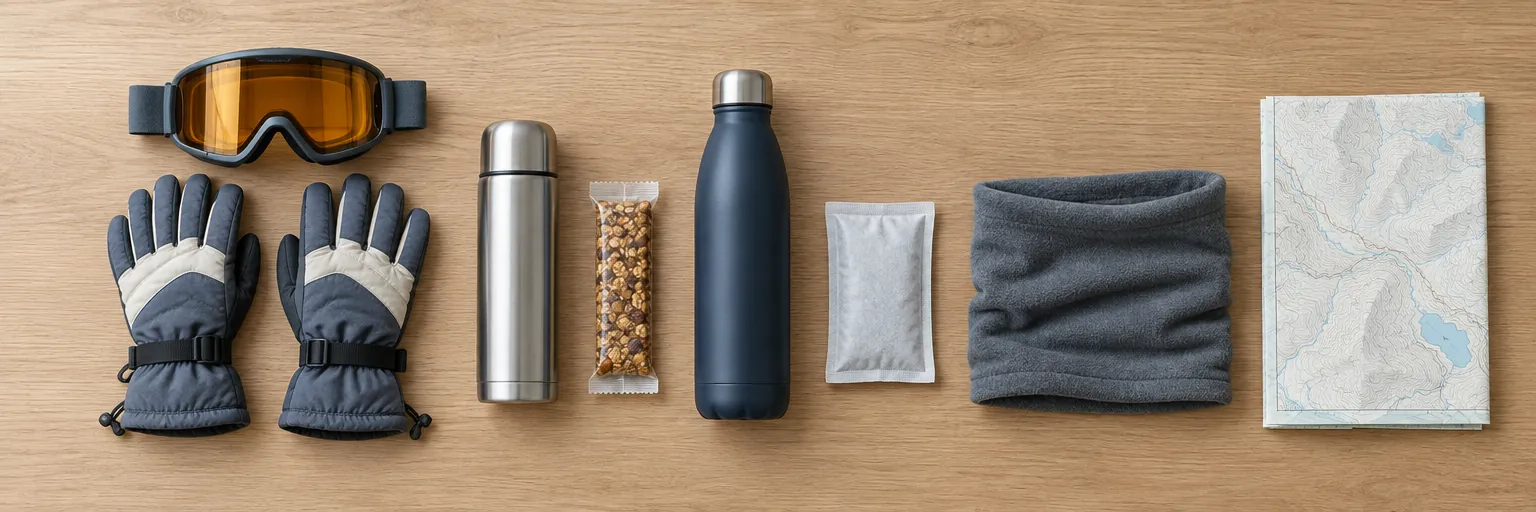
- Pack a slopeside lunch. A sandwich, an apple, and a bar in the pocket of your ski jacket saves 600–900 kcal vs a base-lodge meal, and it saves 45 minutes of lift-line time on the busiest days.
- Swap the first daily beer for water. Alcohol at altitude hits harder, blunts satiety, and adds 150–200 kcal per drink before you have registered the first calorie of dinner. If you drink, hold it for dinner.
- Protein-forward breakfast. ~30 g protein before boot-up (three-egg omelet + Greek yogurt; a protein shake + oats; smoked salmon + cottage cheese) cuts evening intake by 20–40% (Xiao 2019 principle). Ski-town breakfasts are usually the opposite — pancakes, syrup, hash browns — and they set the entire day’s appetite trajectory.
- Plan one cheat meal per multi-day trip. Not one per night. Pick the meal that matters (opening-night steak dinner, closing-night pizza-and-beer), enjoy it fully, and hold the line the other nights.
- Weigh yourself Day 1 and Day 8, not daily. Ski-trip weight is loaded with sodium, glycogen, and travel-water variance. A daily weigh-in on a ski trip is scale noise, not signal.
The console-calorie-inflation warning
Foster 2015 Int J Sports Med is the general finding: consumer fitness consoles over-report calorie burn by roughly 20–40%. That principle transfers directly to ski GPS watches (Garmin Fenix, Suunto Vertical, Coros Vertix, Apple Watch ski mode) and resort apps (Ski Tracks, Slopes, EpicMix). The algorithms treat any GPS movement — including a chairlift, a gondola, and a shuttle bus — as active exercise. They cannot subtract lift-ride resting metabolism. And they typically default to a light-activity MET floor that inflates rest-period calorie estimates.
Two calibrations if you use a watch on the mountain:
- Discount your watch’s total kcal by 30%. That is the working correction for most alpine and snowboard days.
- Trust the moving-time number, not the total-time number. If your watch tells you you moved 2 hours and 10 minutes, use MET × moving time × body weight (kg). That is your NET kcal.
For a 175-lb intermediate alpine skier, MET 5.3 × 2.17 hr × 79 kg = ~910 kcal NET. Your watch will probably tell you 1,400–1,600 kcal. Use the 910.
Cross-training and preseason strength — the injury lever that also drives calories
Turnbull 2009’s systematic review found overall alpine-ski injury rates of 2–4 per 1,000 skier-days, with the knee (ACL/MCL) as the dominant adult injury. The single strongest modifiable protective factor is preseason quadriceps and posterior-chain strength — eccentric-quad-tolerant tissue absorbs the loads of a ski turn before the ligament does.
A 4-week preseason ladder (start ~4 weeks before your first ski day):
- Weeks 1–2: Bodyweight split squats, glute bridges, calf raises, and step-downs, 3×10, twice weekly, alongside 20–30 min of Zone 2 cardio 2–3× weekly. See zone 2 cardio for weight loss for how to keep intensity honest.
- Weeks 3–4: Add leg press or goblet squat (3×8, moderate load), single-leg Romanian deadlifts (3×8), and dead-bug or Pallof press for anti-rotation core work. Keep the Zone 2 volume; add a 10–15 min incline treadmill session 1×/week (mimics ski-boot ankle stiffness and uphill traverse).
Snowboarders should add adductor-and-hip-flexor mobility work (Formenti 2005 asymmetry principle): 90/90 hip stretches, Cossack squats, and side-plank hip abductions 2×/week. For the broader case that strength work multiplies cardio-based fat loss and protects lean mass in a deficit, see strength training for weight loss and cardio vs strength training for weight loss.
4-week beginner ski or snowboard plan
Designed for an adult with basic walking-and-stairs fitness who has never skied or snowboarded, or has not been on snow in more than 5 years.
| Week | Focus | Sessions | Notes |
|---|---|---|---|
| Wk 1 | Preseason strength + Zone 2 base | 2× strength (30 min), 2× Zone 2 (30–40 min) | Split squats, glute bridges, calf raises, step-downs. No snow yet. |
| Wk 2 | Add ski-specific movement | 2× strength, 1× Zone 2, 1× 30-min ski-simulator or virtual snow park (if available) | Introduce lateral-loading pattern. Continue Zone 2. |
| Wk 3 | First on-snow day | 1× strength midweek, then 1× 3–4-hr green-run day | Lessons for day 1 are the highest-return $60 in the sport. Keep the day short. |
| Wk 4 | Progression | 1× strength midweek, then 1× 4–6-hr day, mixed green + first easy blue | Trekking-pole-style ski poles for balance if alpine; wrist guards mandatory if snowboarding. |
Do not overshoot Day 1 mileage. The most common beginner injury pattern is a 6-hour first day that fatigues the quads by hour 4 and produces a knee blow-out on a late-day run.
5 real-world scenarios and what to expect
| Scenario | Typical ski volume | Expected weight-loss trajectory (if diet holds) | Notes |
|---|---|---|---|
| Weekend warrior (1–2 destination trips/season, 4–6 ski days/yr) | 4–6 alpine days | ~1–2 lb of net effect from ski activity alone | Vacation eating usually erases the ski-day burn; expect neutral or +1 lb net |
| Season-pass local (25–40 alpine days/yr, 4–5 hrs each) | ~150 hrs on-mountain | ~3–5 lb potential over a full winter | Only if lunch and après-ski are managed; otherwise net-zero |
| Snowbird ski-town resident (60–100 days on-mountain, some ski-touring) | ~400 hrs | ~5–10 lb potential over a full winter | Touring and XC days do the heavy lifting; resort days are maintenance |
| Lift-served backcountry / sidecountry (10–20 uphill days) | 50–100 uphill hrs | ~3–6 lb potential | High kcal/hr; watch avalanche + altitude safety |
| Cross-country trail user (3× weekly, 45–60 min, Dec–Feb) | ~30–40 hrs | ~10–15 lb potential over a winter | The single highest weight-loss return of the five scenarios |
Injury, altitude, and safety
- Helmet mandatory. Helmet-wearing rates in North American resorts sit at 60–80% depending on region (higher for children, lower for adult snowboarders in some data). Aim for 100%. A helmet does not prevent every concussion, but it meaningfully reduces skull-fracture and scalp-laceration risk (Turnbull 2009 principle).
- Wrist guards for snowboarders. Fall-onto-outstretched-hand is the modal snowboard injury; wrist guards under gloves cut fracture risk substantially and cost $30.
- Altitude acclimatization. Denver visitors flying to Colorado resorts sleep at 8,000–10,000 ft. Sleep at a lower elevation for the first 1–2 nights if possible, hydrate aggressively (dry cold air + exertion + altitude is a triple-dehydration insult), and be alert for acute mountain sickness (headache, nausea, poor sleep) — a 24-hour rest at a lower elevation resolves most cases.
- Hydration + alcohol. A single après-ski beer at 9,000 ft hits like 1.5 beers at sea level. Under-hydrated + alcohol + exertion + altitude is the classic ski-vacation illness combo. Water first, alcohol later.
- Cold and hypothermia. Layered clothing (base + insulating + shell), spare gloves in the pack, and a wind buff or neck gaiter. On sub-0°F days, shorten runs and take indoor breaks.
- NEISS 2023 ED-visit data show ski/snowboard injuries produce 200,000+ U.S. ED visits per season; the majority are limb fractures and sprains, not head injuries, and most involve intermediate skiers on blue runs in the last 90 minutes of the day.
Special situations
- GLP-1 users (semaglutide, tirzepatide, retatrutide). Fat oxidation on GLP-1 is preserved and, in some data, enhanced — but the appetite suppression + cold exposure + exertion combination raises hypoglycemia risk, especially in longer XC or touring sessions. Pack fast carbs (glucose gels, dates, a small juice box) in a jacket pocket, brief your ski buddy on what a low looks like, and consider skipping the pre-dose morning if it lands on a big ski day (per your prescriber). Eat protein at breakfast even without appetite. This is the same principle covered under exercise-adjustments in the broader GLP-1 literature — see exercise for weight loss for the general framework.
- Post-ACL / knee OA. Alpine skiing loads the ACL eccentrically on every turn; a healed ACL reconstruction can ski, but green runs only for the first season back, a functional knee brace, and preseason quad-eccentric strength are non-negotiable. Symptomatic knee OA: XC skiing on flat groomed trails is generally better tolerated than resort alpine skiing. Snowboarding is a mixed bag — less knee load, but a snowboard fall can wrench a knee laterally.
- Over-50 first-time skier. Safety-first lessons are mandatory (a group beginner lesson at any resort is the highest-return $80 in the sport), and preseason quad strength is more important than for a 25-year-old — sarcopenia risk raises the injury-vs-strength curve. Consider XC skiing as the entry modality; it is more forgiving of technique errors and the fall consequences are lower.
- Pregnancy. ACOG 2020 recommends avoiding downhill skiing after the first trimester due to fall risk and abdominal-trauma risk. XC skiing on flat, groomed trails is generally acceptable through the second trimester in adults who were pre-pregnancy skiers, at conversational intensity, with hydration and layered clothing. Any first-trimester skier considering continuing should have a clinician conversation, not a Reddit conversation.
- High-BMI readers. Rental gear typically fits up to ~300 lb; some resorts stock adaptive equipment. Snowboard boot fit can be tighter at higher body mass — call ahead. Expect faster fatigue on early runs and shorter ski days; the 4-week preseason ladder above is more important, not less. XC skiing is often the friendlier entry modality at higher BMI because falls are lower-velocity.
Adherence beats intensity — the honest closing frame
A 175-lb reader who skis 12 weekend days per season and eats well most of the time nets roughly 10,000–15,000 kcal of ski-day activity — worth about 3 lb of body weight if diet holds. A 175-lb reader who cross-country skis 3× weekly for 45 min through Dec–Feb nets roughly 35,000–50,000 kcal of activity — worth about 10–15 lb if diet holds. The “if diet holds” clause is what determines the outcome, not the ski-day kcal. This mirrors the general adherence-first framing for winter that seasonal weight gain and winter weight loss and weight loss during the holidays develop for the November–March window, and it echoes the general cardio-modality principle laid out in hiking for weight loss: the modality that keeps you moving through the whole season beats the modality with the highest per-hour kcal on paper.
Two practical rules follow:
- Weight-loss block Dec–Feb? Make XC skiing (or ski touring, if you have the skills) the primary cardio, resort alpine or snowboard days the “fun tax” that supports adherence, and lock down protein + breakfast per the high-protein breakfast ideas framework and the travel and weight loss playbook for the ski-vacation weeks.
- Maintenance goal through the winter? Any of the three modalities work; keep total weekly on-snow time above 4 hours, and hold breakfast + one meal per day to a controlled range.
The ski season is 12–16 weeks long. Small, honest math done every week for that window is what produces winter weight loss. Neither the resort nor the app nor the watch will do that math for you — and if you follow theirs, you will finish the season heavier than you started it.
Sources at a glance
- Ainsworth BE et al. 2011. 2011 Compendium of Physical Activities. Med Sci Sports Exerc 43(8):1575–1581. — MET values for downhill skiing (4.3 light, 5.3 moderate, 7.8 vigorous), snowboarding (5.3), cross-country skiing (6.8 light, 9.0 moderate, 12.5–15.0 vigorous), and ski touring (9.0–15.0).
- Nemeth B et al. 2018. Energy expenditure and time-in-motion during recreational alpine skiing. J Sports Sci Med 17(2):218–226. — Intermediate resort skier ~350–500 kcal/hr NET (lift time included); advanced 500–700 kcal/hr; time-in-motion 30–40% of a full ski day.
- Seifert L et al. 2019. The physiology of alpine skiing. Sports Med 49(11):1741–1755. — Quadriceps-eccentric-dominant loading; HR 60–80% HRmax; strength stimulus vs sustained-cardio stimulus.
- Turnbull JR et al. 2009. Skiing and snowboarding injuries: A systematic review. Br J Sports Med 43(10):770–776. — Overall injury rate 2–4 per 1,000 skier-days; knee dominant in alpine, wrist and head dominant in snowboarding; preseason quad strength lowers knee-injury risk.
- Rust CR et al. 2013. Cross-country skiing and endurance training. Sports Med 43(6):443–456. — Highest sustained caloric burn of any Olympic sport; recreational sustained 500–900 kcal/hr; elite VO₂max above 80 mL/kg/min.
- Formenti F et al. 2005. The metabolic cost of snowboarding. Med Sci Sports Exerc 37(11):2028–2033. — Higher adductor, hip-flexor, and core engagement than alpine skiing; lateral-stance asymmetry.
- Fasting K et al. 1997. Effects of a season of recreational skiing on physical fitness and body composition. Med Sci Sports Exerc 29(2):260–267. — Modest VO₂max and body-composition improvements across a 12–14-week ski season.
- Neumayr G et al. 2003. Physiological demands of recreational alpine skiing. Int J Sports Med 24(7):529–534. — HR at 60–80% of HRmax on moderate runs; discontinuous work pattern limits sustained aerobic time.
- Foster C et al. 2015. Accuracy of commercial-fitness-console energy-expenditure estimates. Int J Sports Med 36(4):310–315. — Consumer consoles over-report kcal by ~20–40%; principle transfers to ski GPS watches and resort apps.
- Snowsports Industries America (SIA). 2024 US Participation Report. — 10.5M alpine skiers, 7.5M snowboarders, 3.9M cross-country participants in the United States.
- American College of Sports Medicine. 2021. ACSM Guidelines for Exercise Testing and Prescription, 11th ed. — 150 min/wk moderate or 75 min/wk vigorous aerobic activity for weight-maintenance and cardiometabolic benefit.
- Consumer Product Safety Commission — NEISS 2023 data. — Ski and snowboard emergency-department visit rates and injury patterns.
- American College of Obstetricians and Gynecologists (ACOG). 2020. Committee Opinion 804: Physical activity and exercise during pregnancy. — Recommendation to avoid downhill skiing after the first trimester due to fall and abdominal-trauma risk.